1982 CHEVROLET CAMARO fuel
[x] Cancel search: fuelPage 695 of 875
GM – CAMARO 1982-1992 – Repair Guide (Checked by WxMax) 695
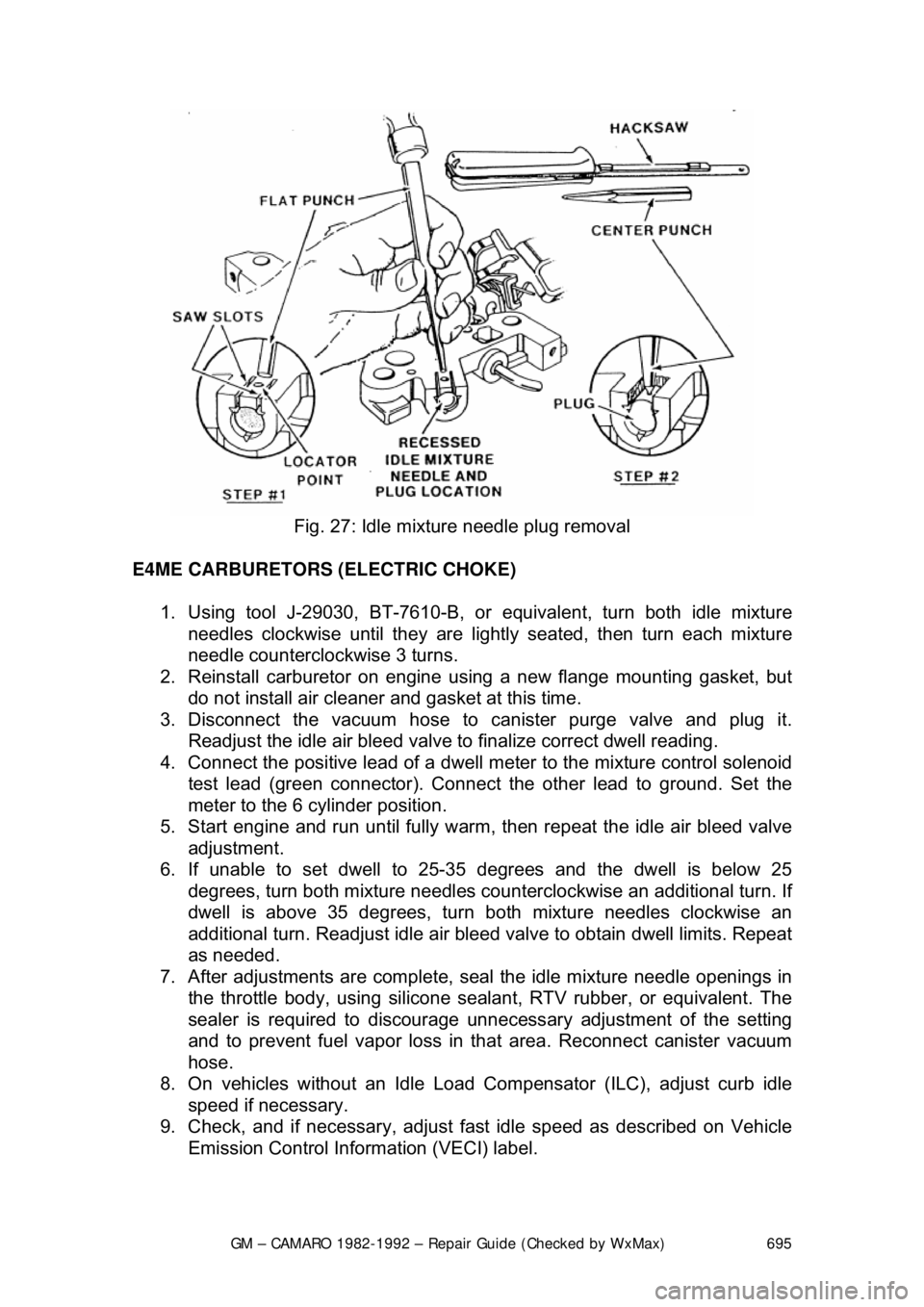
Fig. 27: Idle mixture needle plug removal
E4ME CARBURETORS (ELECTRIC CHOKE) 1. Using tool J-29030, BT-7610-B, or equivalent, turn both idle mixture
needles clockwise until they are lightly seated, then turn each mixture
needle counterclockwise 3 turns.
2. Reinstall carburetor on engine using a new flange mounting gasket, but
do not install air cleaner and gasket at this time.
3. Disconnect the vacuum hose to canister purge valve and plug it.
Readjust the idle air bleed valve to finalize correct dwell reading.
4. Connect the positive lead of a dwell me ter to the mixture control solenoid
test lead (green connector). Connect the other lead to ground. Set the
meter to the 6 cylinder position.
5. Start engine and run unt il fully warm, then repeat the idle air bleed valve
adjustment.
6. If unable to set dwell to 25-35 degrees and the dwell is below 25
degrees, turn both mixture needles counter clockwise an additional turn. If
dwell is above 35 degrees, turn both mixture needles clockwise an
additional turn. Readjust idle air bleed valve to obtain dwell limits. Repeat
as needed.
7. After adjustments are complete, seal the idle mixture needle openings in
the throttle body, using silicone sealant, RTV rubber, or equivalent. The
sealer is required to discourage unnecessary adjus tment of the setting
and to prevent fuel vapor loss in that area. Reconnect canister vacuum
hose.
8. On vehicles without an Idle Load Co mpensator (ILC), adjust curb idle
speed if necessary.
9. Check, and if necessary, adjust fa st idle speed as described on Vehicle
Emission Control Information (VECI) label.
Page 696 of 875

GM – CAMARO 1982-1992 – Repair Guide (Checked by WxMax) 696
Fig. 28: Lean mixture and idle mixture screw adjustment
E4MC CARBURETOR (HOT AIR CHOKE) 1. Using tool J-29030-B, BT-7610-B, or equivalent, turn each idle mixture
needle clockwise until lightly seated, then turn each mixture needle
counterclockwise 3 turns.
2. Reinstall carburetor on engine, using a new flange mounting gasket, but
do not install air cleaner or gasket at this time.
3. Disconnect vacuum hose to c anister purge valve and plug it.
4. Connect the positive lead of a dwell me ter to the mixture control solenoid
test lead (green connector). Connect the other lead to ground. Set the
meter to the 6 cylinder position.
5. Start engine and allow it to reac h normal operating temperature.
6. While idling in D ( N for manual transmission), adjust both mixture
needles equally, in
1/8 turn increments, until dwell reading varies within
the 25-35 degree range, attempting to be as close to 30 degrees as
possible.
7. If reading is too low, turn mixtur e needles counterclockwise. If reading is
too high, turn mixture needl es clockwise. Allow time for dwell reading to
stabilize after each adjustment.
After adjustments are complete, seal t he idle mixture needle openings in the
throttle body, using silicone sealant, RTV rubber, or equivalent. The sealer is
required to discourage unnece ssary readjustment of the setting and prevent fuel
vapor loss in that area.
8. On vehicles without a carburetor -mounted Idle Load Compensator (ILC) ,
adjust curb idle speed if necessary.
Page 697 of 875
GM – CAMARO 1982-1992 – Repair Guide (Checked by WxMax) 697
9. Check, and if necessary, adjust fast
idle speed, as described on the
Vehicle Emission Control Information (VECI) label.
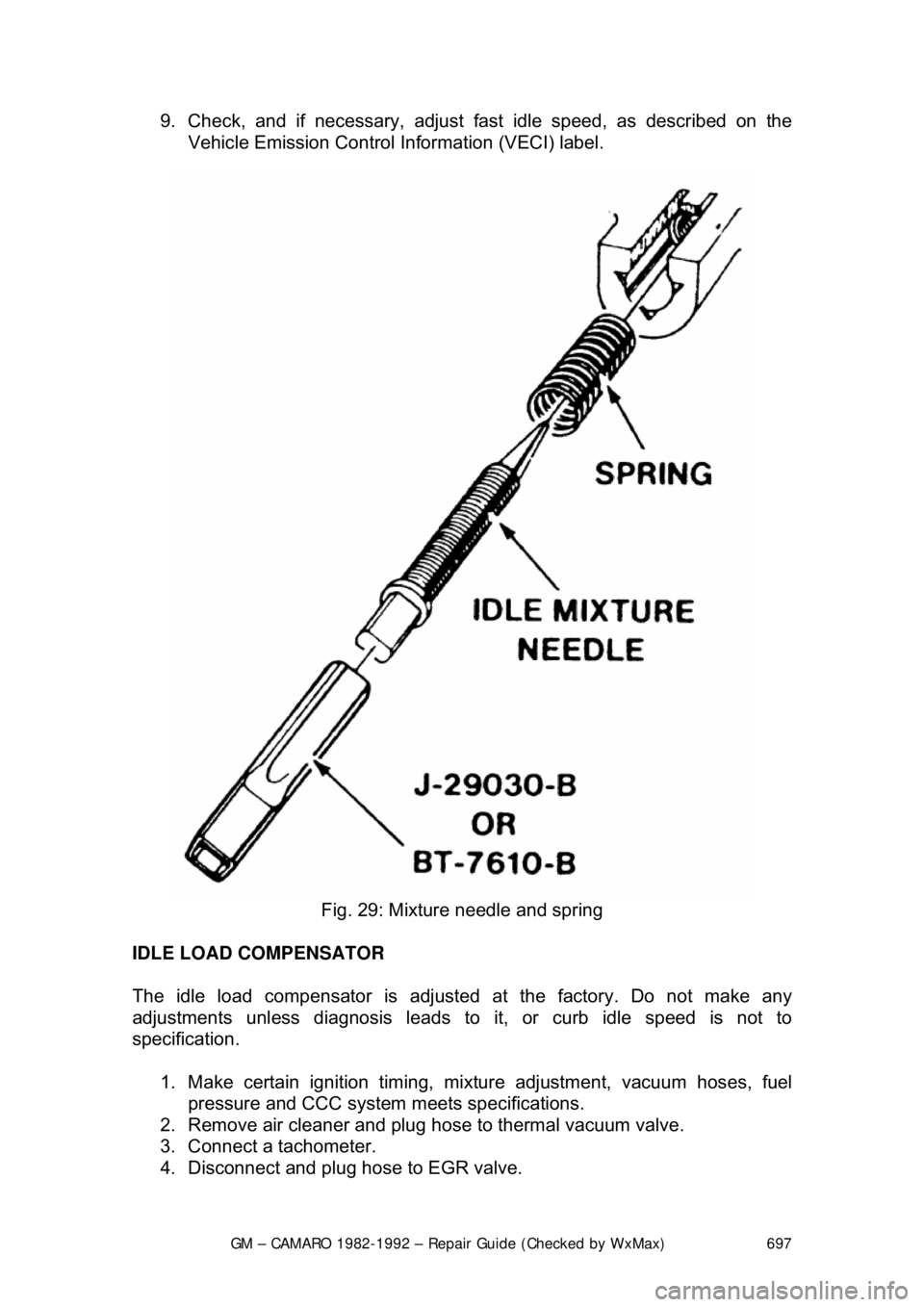
Fig. 29: Mixture needle and spring
IDLE LOAD COMPENSATOR
The idle load compensator is adjusted at the factory. Do not make any
adjustments unless diagnosis leads to i t, or curb idle speed is not to
specification.
1. Make certain ignition timing, mi xture adjustment, vacuum hoses, fuel
pressure and CCC system meets specifications.
2. Remove air cleaner and plug hose to thermal vacuum valve.
3. Connect a tachometer.
4. Disconnect and plug hose to EGR valve.
Page 701 of 875

GM – CAMARO 1982-1992 – Repair Guide (Checked by WxMax) 701
Fig. 32: Throttle position sensor adjusting screw location on E4ME/E4MC
carburetors
REMOVAL & INSTALLATION
Always replace all internal gaskets that are removed. Flooding, stumble on
acceleration and other performance comp laints are in many instances, caused
by presence of dirt, water, or other foreign matter in carburetor. To aid in
diagnosis, carburetor should be carefully removed from engine without draining
fuel from bowl. Contents of fuel bowl may then be examined for contamination
as carburetor is disassembl ed. Check the fuel filter.
ROCHESTER E2SE 1. Remove air cleaner and gasket.
2. Disconnect fuel pipe and vacuum lines.
3. Disconnect electrical connectors.
4. Disconnect accelerator linkage.
5. If equipped with automatic transmi ssion, disconnect downshift cable.
6. If equipped with cruise c ontrol, disconnect linkage.
7. Remove carburetor attaching bolts.
8. Remove carburetor and EF E heater/insulator (if used).
9. Inspect EFE heater/insulator for damage. Be certain throttle body and
EFE heater/insulator surfaces are clean.
To install: 10. Install EFE heater/insulator.
11. Install carburetor and tighten nuts alternately to the correct torque.
12. Connect downshift cable, as required.
13. Attach the cruise cont rol cable, as required.
14. Connect accelerator linkage.
15. Connect electrical connections.
Page 702 of 875

GM – CAMARO 1982-1992 – Repair Guide (Checked by WxMax) 702
16. Connect fuel pipe sand vacuum hoses.
17. Check base (slow) and fast idle.
18. Install the air cleaner.
Fig. 33: Remove the air cleaner for access to the carburetor
Fig. 34: Use a back-up wrench when disconnecting fuel lines
Page 707 of 875

GM – CAMARO 1982-1992 – Repair Guide (Checked by WxMax) 707
Fig. 43: The adjustment specifications on the emission control information label
must always be followed
ROCHESTER E4ME AND E4MC 1. Disconnect the battery and remove the air cleaner.
2. Disconnect the accelerator linkage.
3. Disconnect the transmission detent cable.
4. If equipped, remove the cr uise control cable.
5. Tag and detach all of the necessa ry vacuum lines and electrical
connections.
6. Disconnect the fuel line at the carburetor inlet.
7. Remove the attaching bolts and remove the carburetor.
To install: 8. Position the carburetor onto the manifold and install the attaching bolts.
9. Connect the fuel line at the carburetor inlet.
10. Attach all of the vacuum lines and electrical connections, as tagged
during removal.
11. If equipped, install the cruise control.
12. Connect the transmission detent cable.
13. Connect the accelerator linkage.
14. Install the air cleaner and connect the battery.
OVERHAUL
Carburetor overhaul kits are reco mmended for each overhaul. These kits
contain all gaskets and new parts to re place those which deteriorate most
Page 708 of 875

GM – CAMARO 1982-1992 – Repair Guide (Checked by WxMax) 708
rapidly. Failure to replace all parts s
upplied with the kit (especially gaskets) can
result in poor performance later.
Some carburetor manufacturers supply overhaul kits for three basic types:
minor repair; major repair; and gasket kits. Certain parts may be expected in
most kits based on the desired degree of overhaul.
MINOR REPAIR KITS
• All gaskets
• Float needle valve
• All diaphragms
• Spring for the pump diaphragm
MAJOR REPAIR KITS
• All jets and gaskets
• All diaphragms
• Float needle valve
• Pump ball valve
• Float
• Complete intermediate rod
• Intermediate pump lever
• Some cover hold-down screws and washers
GASKET KITS
• All gaskets
Efficient carburetion depends greatly on careful cleaning and inspection during
overhaul, since dirt, gum, water, or varnis h in or on the carburetor parts are
often responsible for poor performance.
Overhaul your carburetor in a clean, dust-free area. Carefully disassemble the
carburetor, referring often to the explod ed views and directions packaged with
the rebuilding kit. Keep all similar and look-alike parts separated during
disassembly and cleaning to avoid accidental interchange during assembly\
.
Make a note of all jet sizes.
When the carburetor is disassembled, wash all parts (except diaphragms,
electric components, pump pl unger, and any other plastic, leather, fiber, or
rubber parts) in clean carbur etor solvent. Do not leave parts in the solvent any
longer than is necessary to sufficiently loosen the deposits. Excessive cleaning
may remove the special finish from the float bowl and choke valve bodies,
leaving these parts unfit for service. Rinse all parts in clean solvent and blow
them dry with compressed air or allow them to air dry. Wipe clean all cork,
plastic, leather, and fiber parts with a clean, lint-free cloth.
Blow out all passages and jets with comp ressed air and be sure that there are
no restrictions or blockages. Never use wi re or similar tools to clean jets, fuel
Page 709 of 875

GM – CAMARO 1982-1992 – Repair Guide (Checked by WxMax) 709
passages, or air bleeds. Clean all jets and va
lves separately to avoid accidental
interchange.
Check all parts for wear or damage. If we ar or damage is found, replace the
defective parts. Especially check the following:
1. Check the float needle and seat for wear.
2. Check the float hinge pin for wear and the float(s) for dents or distortion.
Replace the float if fuel has leaked into it.
3. Check the throttle and choke sha ft bores for wear or an out-of-round
condition. Damage or wear to the thro ttle arm, shaft, or shaft bore will
often require replacement of the throttle body. These parts require a
close tolerance of fit; wear may allow air leakage, which could affect
starting and idling.
Throttle shafts and bushings are not included in overhaul kits. They can be
purchased separately or repaired by a qualified carburetor overhaul shop.
4. Inspect the idle mixt ure adjusting needles for bu rrs or grooves. Any such
condition requires replacement of t he needle, since you will not be able
to obtain a satisfactory idle.
5. Test the accelerator pump check va lves. They should pass air one way
but not the other. Test for proper s eating by blowing and sucking on the
valve. Replace the valve check ball and spring as necessary. If the valve
is satisfactory, wash the valve part s again to remove breath moisture.
6. Check the bowl cover for war ped surfaces with a straightedge.
7. Closely inspect the accelerato r pump plunger for wear and damage,
replacing as necessary.
8. After the carburetor is assembled, check the choke valve for freedom of
operation.
9. Check, repair or replace parts, if the following problems are encountered:
FLOODING
• Inspect the float valve and seat for dirt, deep wear grooves, scores and
improper sealing
• Inspect the float valve pull clip for proper installation; be careful no\
t to
bend the pull clip
• Inspect the float, the float arms and the hinge pin for distortion, binds,
and burrs. Check the density of the mate rial in the float; if heavier than
normal, replace the float
• Clean or replace the fuel inlet f ilter and check the valve assembly
HESITATION
• Inspect the pump plunger for cracks, scores or cup excessive wear. A
used pump cup will shrink w hen dry. If dried out, soak in fuel for 8 hours
before testing
• Inspect the pump duration and return springs for weakness or distortion \