1982 CHEVROLET CAMARO fuel
[x] Cancel search: fuelPage 628 of 875

GM – CAMARO 1982-1992 – Repair Guide (Checked by WxMax) 628
SPARK PLUG HEAT RANGE
Spark plug heat range is
the ability of the plug to dissipate heat. The longer the
insulator (or the farther it extends in to the engine), the hotter the plug will
operate; the shorter the insulator (the cl oser the electrode is to the block's
cooling passages) the cooler it will operate. A plug that absorbs little heat and
remains too cool will quickly accumulate deposits of oil and carbon since it is
not hot enough to burn them off. This leads to plug fouling and consequently to
misfiring. A plug that absorbs too much heat will have no deposits but, due to
the excessive heat, the electrodes will burn away quickly and might possibly
lead to preignition or other ignition probl ems. Preignition takes place when plug
tips get so hot that they gl ow sufficiently to ignite the air/fuel mixture before the
actual spark occurs. This early igniti on will usually cause a pinging during low
speeds and heavy loads.
Fig. 3: Spark plug heat range
The general rule of thumb for choosing the correct heat range when picking a
spark plug is: if most of your driving is long distanc e, high speed travel, use a
colder plug; if most of your driving is stop and go, use a hotter plug. Original
equipment plugs are general ly a good compromise between the 2 styles and
most people never have the need to change their plugs from the factory-
recommended heat range.
REMOVAL & INSTALLATION
A set of spark plugs usually requi res replacement after about 20,000-30,000
miles (32,000-48,000 km), depending on y our style of driving. In normal
operation plug gap increases about 0.001 in. (0.025mm) for every 2500 miles
(4000 km). As the gap increases, the plug' s voltage requirement also increases.
It requires a greater voltage to jump t he wider gap and about two to three times
Page 629 of 875

GM – CAMARO 1982-1992 – Repair Guide (Checked by WxMax) 629
as much voltage to fire the plug at hi
gh speeds than at idle. The improved
air/fuel ratio control of modern fuel injection combin ed with the higher voltage
output of modern ignition systems will often allow an engine to run significantly
longer on a set of standard spark plugs, but keep in mind that efficiency will
drop as the gap widens (along wit h fuel economy and power).
When you're removing spark plugs, work on one at a time. Don't start by
removing the plug wires all at once, because, unless you number them, they
may become mixed up. Take a minute before you begin and number the wires
with tape.
1. Disconnect the negative battery cabl e, and if the vehicle has been run
recently, allow the engine to thoroughly cool.
2. Carefully twist the spark plug wire boot to loosen it, then pull upward and
remove the boot from the plug. Be su re to pull on the boot and not on the
wire, otherwise the connector locat ed inside the boot may become
separated.
3. Using compressed air, blow any water or debris from the spark plug well
to assure that no harmful contam inants are allowed to enter the
combustion chamber when the spark plug is removed. If compressed air
is not available, use a rag or a brush to clean the area.
Remove the spark plugs when the engine is cold, if possible, to prevent damage
to the threads. If removal of the plugs is difficult, apply a few drops of
penetrating oil or silicone spray to t he area around the base of the plug, and
allow it a few minutes to work.
4. Using a spark plug socket that is equipped with a rubber insert to
properly hold the plug, turn the spar k plug counterclockwise to loosen
and remove the spark pl ug from the bore.
WARNING - Be sure not to use a flexible extension on the socket. Use of a
flexible extension may allow a shear fo rce to be applied to the plug. A shear
force could break the plug off in the cylinder head, leading to costly a\
nd
frustrating repairs.
To install:
5. Inspect the spark plug boot for t ears or damage. If a damaged boot is
found, the spark plug wire must be replaced.
6. Using a wire feeler gauge, check and adjust the spark plug gap. When
using a gauge, the proper size shoul d pass between the electrodes with
a slight drag. The next larger size should not be able to pass while the\
next smaller size should pass freely.
7. Carefully thread the plug into the bor e by hand. If resistance is felt before
the plug is almost completely th readed, back the plug out and begin
threading again. In small, hard to r each areas, an old spark plug wire and
boot could be used as a th reading tool. The boot will hold the plug while
you twist the end of the wire and t he wire is supple enough to twist
before it would allow t he plug to crossthread.
Page 638 of 875

GM – CAMARO 1982-1992 – Repair Guide (Checked by WxMax) 638
ELECTRONIC IGNITION SYSTEM
GENERAL INFORMATION
The High Energy Ignition (HEI) system
controls the fuel combustion by
providing a spark to ignite the compress ed air/fuel mixture at the correct time.
To provide improved engine performance, fuel economy, and control of exhaust
emissions, the engine contro l module (ECM) controls distributor spark advance
(timing) with an ignition control system.
The distributor may have an internal, or ex ternal ignition coil. To be certain of
the type coil used for your vehicle, vis ually inspect the ignition system. If the
ignition coil is inside the distributor c ap, it connects through a resistance brush
to the rotor. If your vehicle is equipped with an external ignition coil, it connects
to the rotor through a high tension wire.
Fig. 1: Distributor with exterior ignition coil - 1987 vehicle shown
The distributor contains the ignition c ontrol module, and the magnetic triggering
device. The magnetic pickup assembly contains a permanent magnet, a pole
piece with internal "teeth", and a pickup co il (not to be confused with the ignition
coil).
All spark timing changes are done electr onically by the engine control module
(ECM) which monitors information from various engine sensors. The ECM
computes the desired spark timing and t hen signals the distributor ignition
module to change the timing accordingly. No vacuum or mechanical advance
systems are used.
Page 640 of 875

GM – CAMARO 1982-1992 – Repair Guide (Checked by WxMax) 640
The tachometer terminal should never
be allowed to touch ground, as damage
to the computer control module and/or ignition coil assembly can result.
CONNECTORS
When disengaging connectors, do not use a screw driver or other tool to release
the locking tab, as this mi ght break the connector.
SYSTEM TESTERS
Instruments designed specific ally for testing HEI or C
3I systems are available
from several tool manufactur ers. Some of these will even test the module itself.
However, the tests given in the followin g section will require only an ohmmeter
and a voltmeter.
TESTING
The symptoms of a defective component within the HEI or C
3I system are
exactly the same as those you woul d encounter in a conventional system.
Some of these symptoms are:
• Hard or no starting
• Rough Idle
• Poor fuel economy
• Engine misses under load or while accelerating
PRELIMINARY CHECKS
If you suspect a problem in your igniti on system, there are certain preliminary
checks which you should carry out befor e you begin to check the electronic
portions of the system. First, it is extrem ely important to make sure the vehicle
battery is in a good state of charge. A defective or poorly charged battery will
cause the various components of the ignition system to read incorrectly when
they are being tested. Second, make su re all wiring connections are clean and
tight, not only at the battery, but also at the distributor cap (if so equipped),
ignition coil, camshaft and/or crankshaft sensors (if so equipped) and at the
control module.
Since the only difference between these ignition systems lies before the spark
plug wiring, it is important to check the secondary ig nition circuit first. If the
secondary circuit checks out properly (ther e is spark), then the engine condition
is probably not the fault of the ignition system. To check the secondary ignition
system, perform a simple spark test. Remove one of the plug wires and insert
some sort of extension in the plug socket. An old spark plug with the ground
electrode removed makes a good extension. Hold the wire and extension using
an insulated tool (NOT BY HAND) about
1/4 in. (6mm) away from the block and
crank the engine. If a normal spark occurs, then the problem is most likely not in
the ignition system. Check for fuel system problems, or fouled spark plugs.
Page 654 of 875

GM – CAMARO 1982-1992 – Repair Guide (Checked by WxMax) 654
spark plug must fire 5° before each pist
on reaches TDC. This only holds true,
however, when the engine is at idle speed.
As the engine speed increases, the pist ons go faster. The spark plugs have to
ignite the fuel even sooner if it is to be completely ignited when the piston
reaches TDC.
If the ignition is set too far advanced (B TDC), the ignition and expansion of the
fuel in the cylinder will occu r too soon and try to force the piston down while it is
still traveling up. This causes engine ping. If the ignition spark is set too far
retarded, after TDC (ATDC), the pi ston will have already passed TDC and
started on its way down when the fuel is igni ted. This will cause the piston to be
forced down for only a portion of its trav el, resulting in poor engine performance
and lack of power.
When timing the engine, the Number 1 pl ug wire should be used to trigger the
timing light. On engines where timing is adjustable, the notch for the No. 1
cylinder is usually scribed across all th ree edges of the double sheaf pulley.
Another notch located 180° away from t he No. 1 cylinder notch is scribed only
across the center section of the pulley to make it distinguishable from the No. 1
cylinder notch.
There are two basic types of timing light s available. The first type of light
operates from the car's battery. Two al ligator clips connect to the battery
terminals, while a third wire connects to the spark plug with an adapter or to the
spark plug wire with an inductive pickup. This type of light is more expensive,
but the xenon bulb provides a nice bright flash which can even be seen in
sunlight. The second type replaces the battery source with 110-volt house
current. Some timing lights have other func tions built into them, such as dwell
meters, tachometers, or re mote starting switches. These are convenient, in that
they reduce the tangle of wires under t he hood, but may duplicate the functions
of tools you already have.
Because this car uses electronic ignition, you should use a timing light with an
inductive pickup. This pickup simply cl amps around the Number 1 spark plug
wire (in this case, the coil wire), elimin ating the adapter. It is not susceptible to
crossfiring or false triggering, which ma y occur with a conventional light due to
the greater voltages produc ed by these systems.
ADJUSTMENT
When adjusting the timing, refer to the instructions on the emission control
sticker inside the engine compartment. If th e instructions on the label disagree
with the procedure listed below, follo w the instructions on the label.
1982-87 VEHICLES 1. Locate the timing marks on the cran kshaft pulley and the front of the
engine.
Page 655 of 875

GM – CAMARO 1982-1992 – Repair Guide (Checked by WxMax) 655
2. Clean off the marks and coat them wit
h white paint or chalk, if necessary,
so that they may be seen.
3. Run the engine until it reaches no rmal operating temperature, then shut
off the engine.
4. With the ignition OFF, connect a ta chometer to the distributor, and a
timing light with an inductive pickup lead to the No. 1 spark plug wire.
WARNING - Never pierce a secondary ignition wire in order to connect a timing
light. A pierced wire may lead to engine misfiring and driveability problems.
5. To properly set the ignition timing , the EST must be placed in the bypass
mode. a. On the 2.5L engine, refer to t he emission control label for the
procedure.
If the label is missing or unreadable, c ontact your Chevrolet dealer for a
replacement.
b. On 2.8L and 5.0L ca rbureted engines, disconnect the 4-wire EST
connector at the distributor. (Fault code 42 may be set in ECM memory,
and must be cleared once the procedur e is completed). Proceed to Step
7.
c. On 2.8L, 5.0L and 5.7L fuel inje cted engines, with the engine RUNNING
and all accessories off, use a jumper wire to connect diagnostic terminal
B and ground terminal A of the 12-terminal Assembly Line Diagnostic
Link (ALDL) usually located under t he left side of the instrument panel.
DO NOT disconnect the 4-wir e EST connector at the distributor. Aim the
timing light at the timing mark; the li ne on the balancer or pulley will line
up with the timing mark. Increase engine speed and check for timing
advance. If the timing still advances with engine speed, perform Step 6. If
timing does not advance with engi ne speed, proceed to Step 7.
If timing advances with engine speed, it will be necessary to disconnect the
single-wire Set Timing connector. (Faul t code 42 may be set in ECM memory,
and must be cleared once the procedure is completed).
6. Remove the jumper wire from t he ALDL, and shut off the ignition.
Disconnect the Set Timing connector, usually located under the plastic
cover above the heater unit, in the engi ne compartment. (The wire in this
connector is normally Tan/Black.)
7. With the engine running and all accessories off, aim the light at the timing
mark. The line on the balancer or pulle y will line up with the timing mark.
If a change in timing is necessary, loosen the hold-down clamp bolt at
the base of the distributor . While observing the timing mark, rotate the
distributor slightly unt il the line indicates the correct timing. Use the
timing specification on the emi ssion control label in the engine
compartment. If this label is missi ng or damaged, refer to the Tune-Up
Specifications chart in this Section.
Page 659 of 875

GM – CAMARO 1982-1992 – Repair Guide (Checked by WxMax) 659
VALVE LASH
All models utilize a hydraulic valve lifter system to obtain zero lash. No periodic
adjustment is necessary. An initial adjustm
ent is required anytime that the lifters
are removed or the valve tr ain is disturbed. This procedure is covered in Engine
& Engine Overhaul .
IDLE SPEED AND MIXTURE ADJUSTMENTS
Mixture adjustments are factory set and sealed; no adjustment attempt should
be made, except by an aut horized GM dealer or reputable shop equipped with
the necessary equipment.
IDLE SPEED
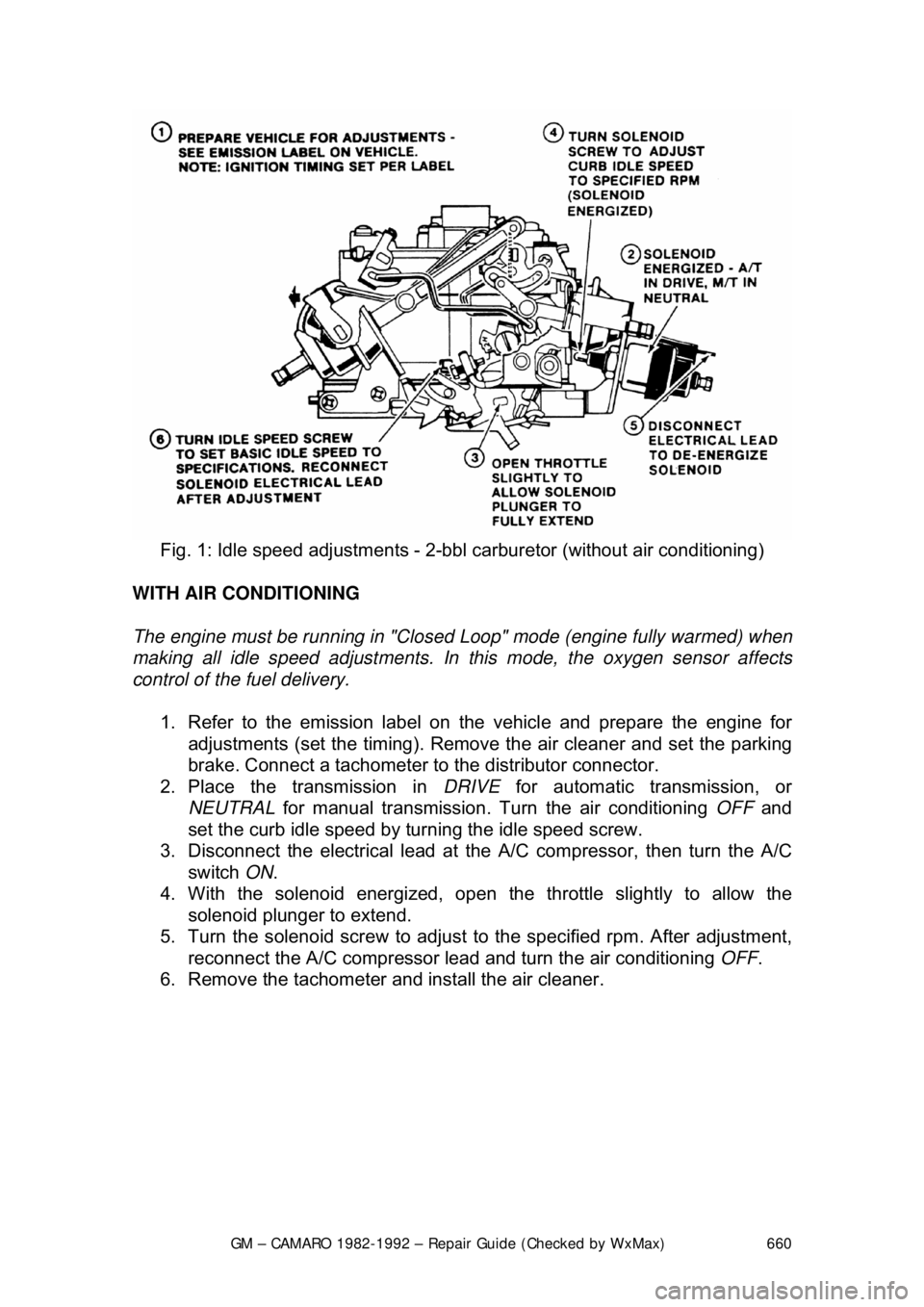
2-BBL CARBURETOR
WITHOUT AIR CONDITIONING
The engine must be running in "Closed Loop" mode (engine fully warmed) when
making all idle speed adjustments. In this mode, the oxygen sensor affects
control of the fuel delivery.
1. Refer to the emission label on the vehicle and prepare the engine for
adjustments (set the timing). Remove the air cleaner and set the parking
brake. Connect a tachometer to the distributor connector.
2. Place the transmission in DRIVE for automatic transmission, or
NEUTRAL for manual transmission; make sure that the solenoid is
energized.
3. Open the throttle slightly to allow the solenoid plunger to extend. Adjust
the curb idle speed to the specified rpm by turning the solenoid screw.
4. De-energize the solenoid by disconnecting the electrical lead.
5. Set the basic idle speed rpm by turning the idle speed screw. After
adjustment, reconnect the solenoid electrical lead.
6. Remove the tachometer and install the air cleaner.
Page 660 of 875
GM – CAMARO 1982-1992 – Repair Guide (Checked by WxMax) 660
Fig. 1: Idle speed adjustm ents - 2-bbl carburetor (without air conditioning)
WITH AIR CONDITIONING
The engine must be running in "Closed Loop" mode (engine fully warmed) when
making all idle speed adjustments. In this mode, the oxygen sensor affects
control of the fuel delivery.
1. Refer to the emission label on the vehicle and prepare the engine for
adjustments (set the timing). Remove the air cleaner and set the parking
brake. Connect a tachometer to the distributor connector.
2. Place the transmission in DRIVE for automatic transmission, or
NEUTRAL for manual transmission. Tu rn the air conditioning OFF and
set the curb idle speed by turning the idle speed screw.
3. Disconnect the electrical lead at the A/C compressor, then turn the A/C
switch ON.
4. With the solenoid e nergized, open the throttle slightly to allow the
solenoid plunger to extend.
5. Turn the solenoid screw to adjust to the specified rpm. After adjustment,
reconnect the A/C compressor lead and turn the air conditioning OFF.
6. Remove the tachometer and install the air cleaner.