Page 596 of 875

GM – CAMARO 1982-1992 – Repair Guide (Checked by WxMax) 596
recommended to have a qualified technici
an perform any further testing, if
needed.
FIELD SERVICE MODE
On fuel injected models, if the ALDL terminal B is grounded to terminal A with
the engine running, the system enters the Field Service Mode. In this mode, the
MIL will indicate whether the system is operating in open loop or closed loop.
If working in open loop, t he MIL will flash rapidly 2
1/2 times per second. In
closed loop, the flash rate slows to once per second. Additionally, if the system
is running lean in closed loop, the lamp will be off most of the cycle. A rich
condition in closed loop will cause the lamp to remain lit for most of the one
second cycle.
When operating in the Field Service M ode, additional codes cannot be stored
by the ECM. The closed loop timer is bypassed in this mode.
CLEARING CODES
Stored fault codes may be erased from me mory at any time by removing power
from the ECM for at least 30 seconds. It may be necessary to clear stored
codes during diagnosis to check for any re currence during a test drive, but the
stored should be written dow n when retrieved. The codes may still be required
for subsequent troubleshooting. Whenever a repair is complete, the stored
codes must be erased and the vehicle te st driven to confirm correct operation
and repair.
The ignition switch must be OFF any ti me power is disconnected or restored to
the ECM. Severe damage may result if this precaution is not observed.
Depending on the electric di stribution of the particular vehicle, power to the
ECM may be disconnected by removing the ECM fuse in the fusebox or
disconnecting the inline EC M power lead at the positive battery terminal.
Disconnecting the negative battery cable to clear codes will achieve the desired
result, but this will also clear other me mory data in the vehicle such as radio
presets or seat memory.
Page 601 of 875
GM – CAMARO 1982-1992 – Repair Guide (Checked by WxMax) 601
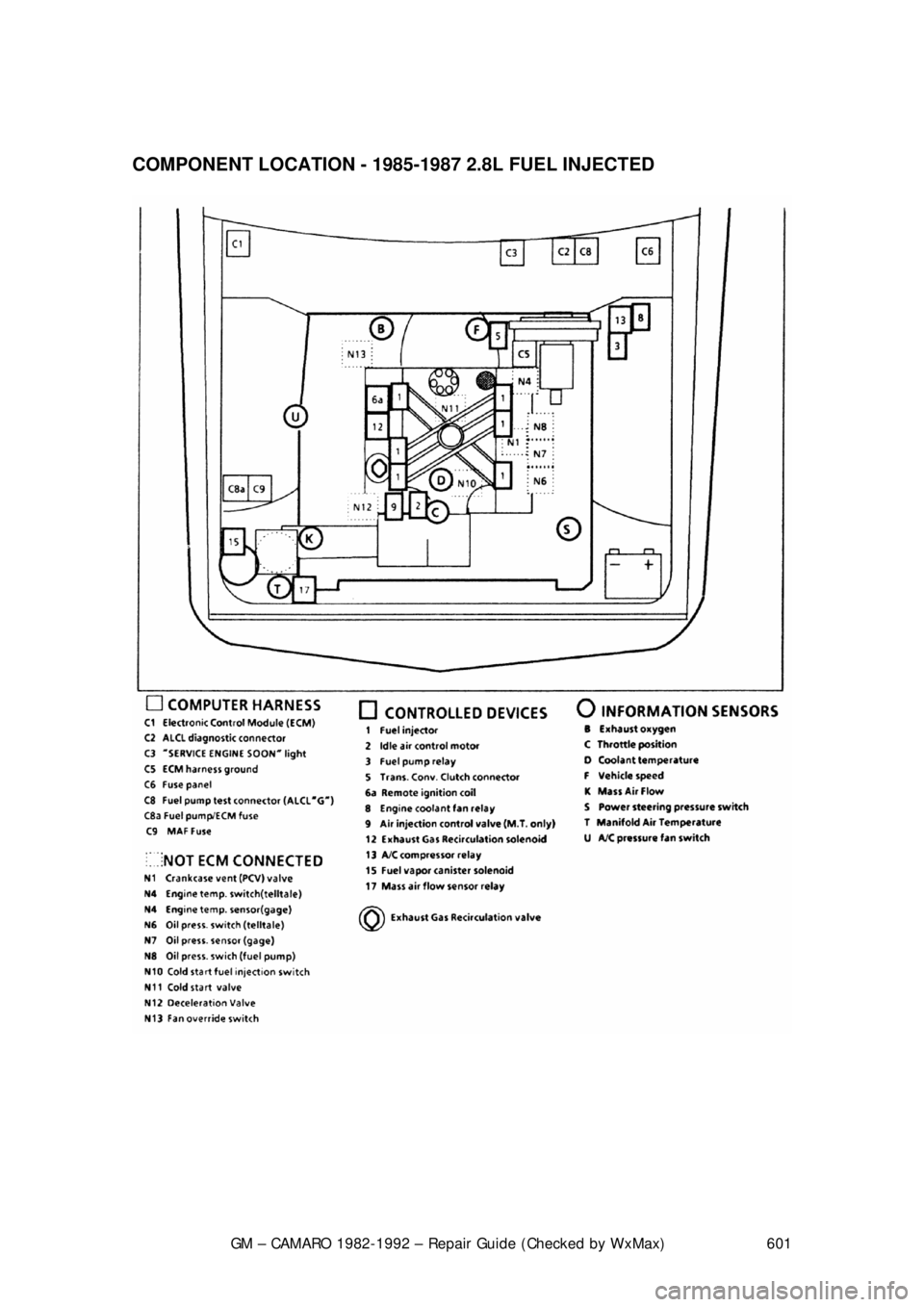
COMPONENT LOCATION - 1985-1987 2.8L FUEL INJECTED
Page 602 of 875
GM – CAMARO 1982-1992 – Repair Guide (Checked by WxMax) 602
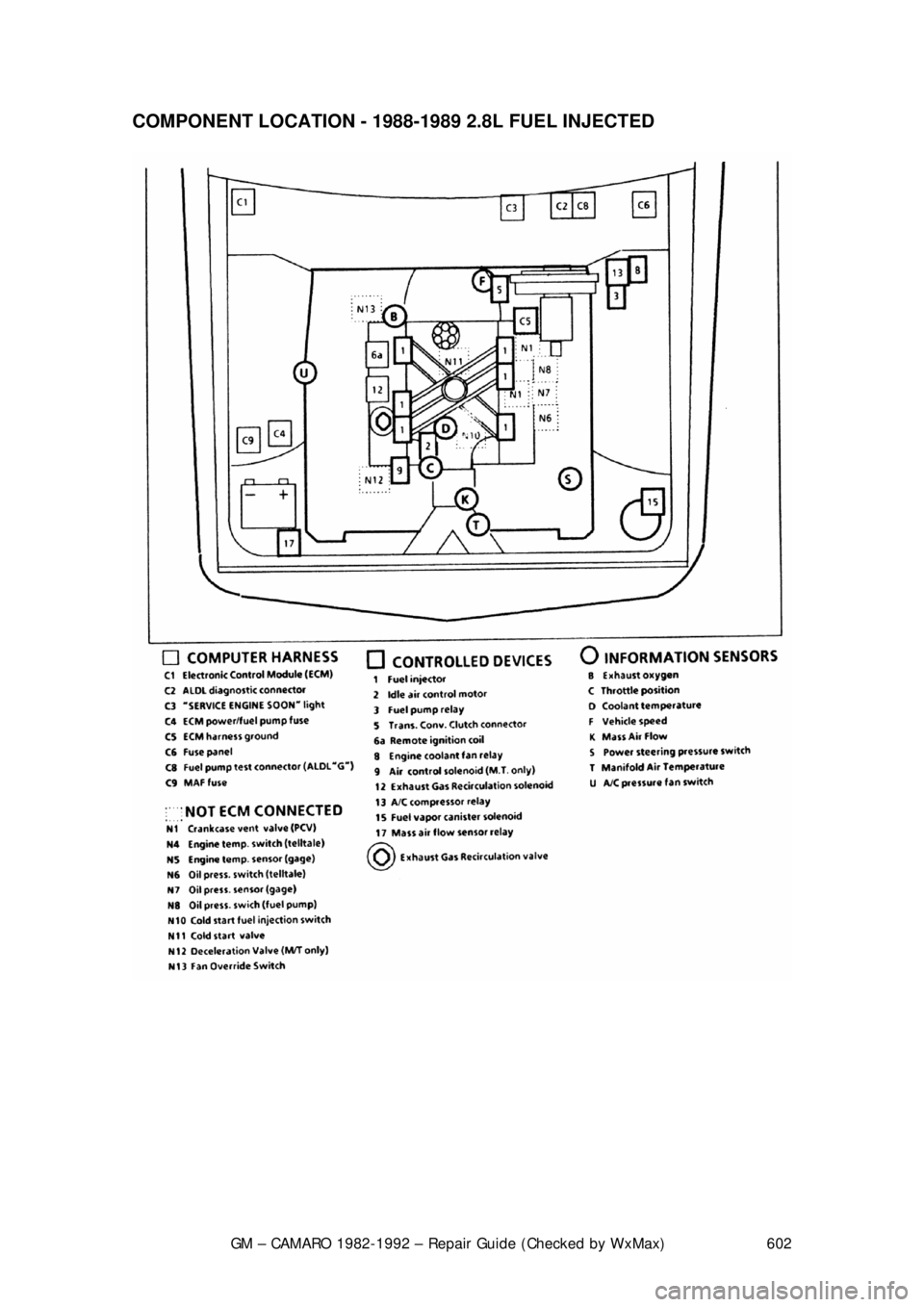
COMPONENT LOCATION - 1988-1989 2.8L FUEL INJECTED
Page 612 of 875
GM – CAMARO 1982-1992 – Repair Guide (Checked by WxMax) 612
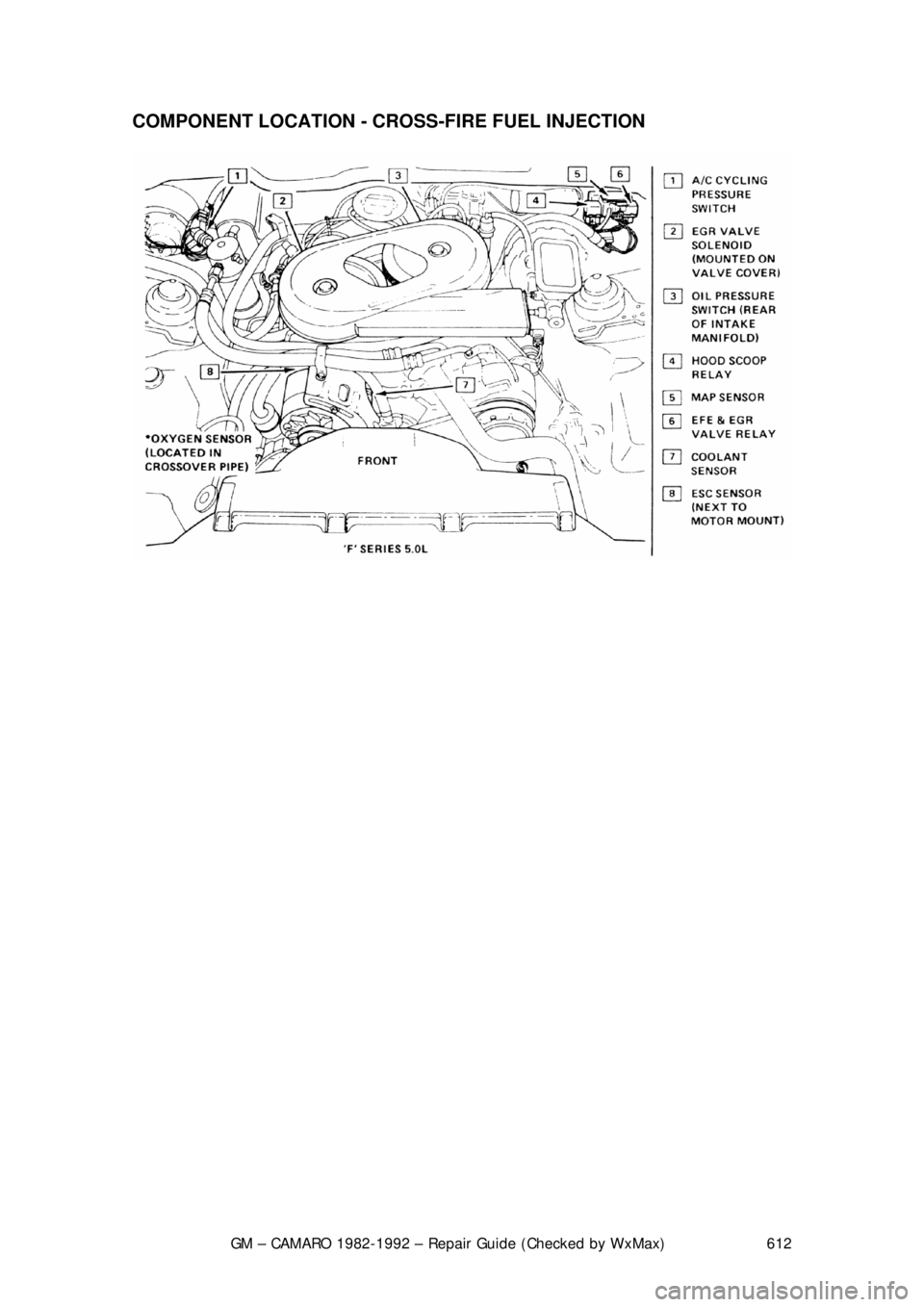
COMPONENT LOCATION - CROSS-FIRE FUEL INJECTION
Page 616 of 875
GM – CAMARO 1982-1992 – Repair Guide (Checked by WxMax) 616
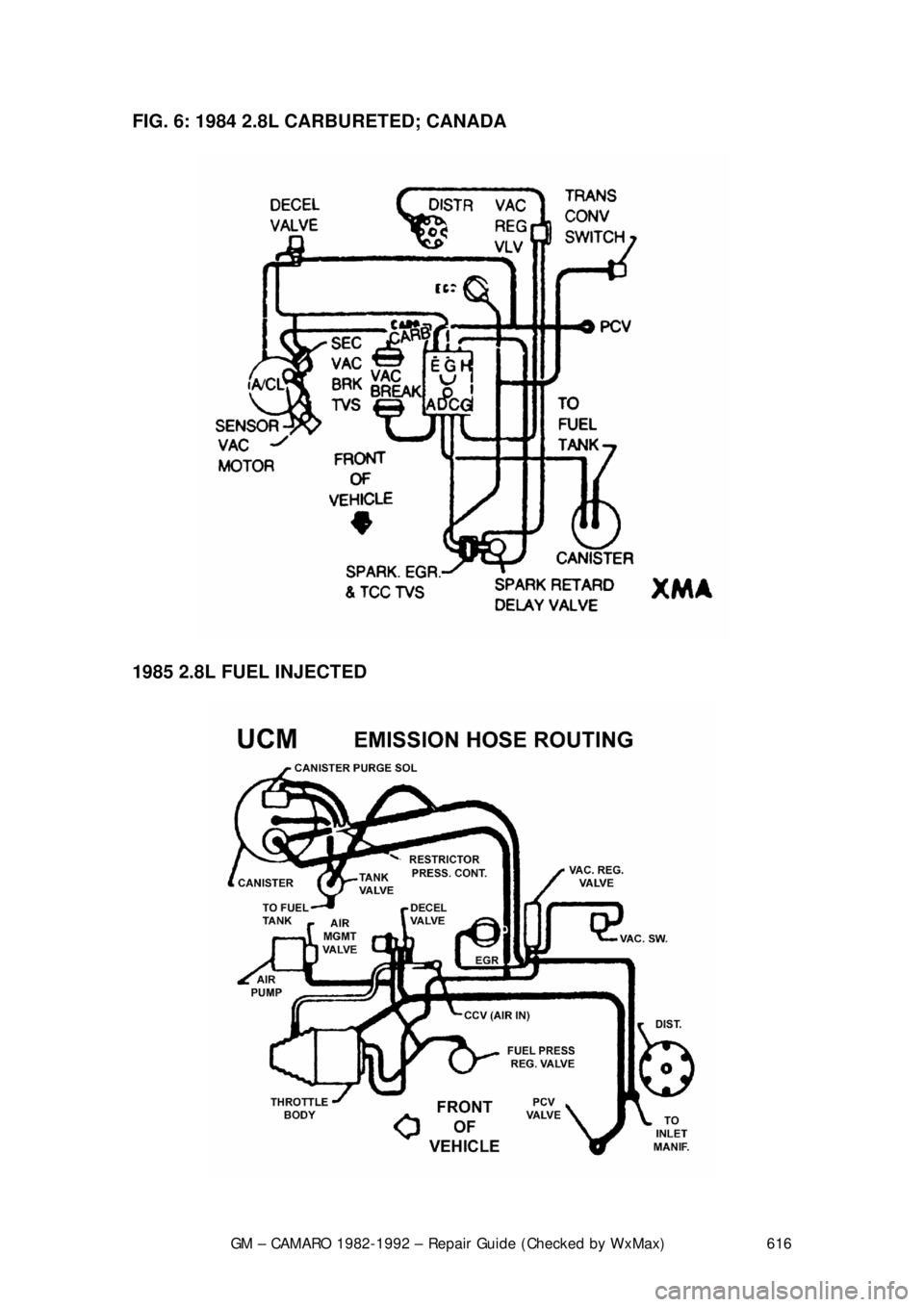
FIG. 6: 1984 2.8L CARBURETED; CANADA
1985 2.8L FUEL INJECTED
Page 617 of 875
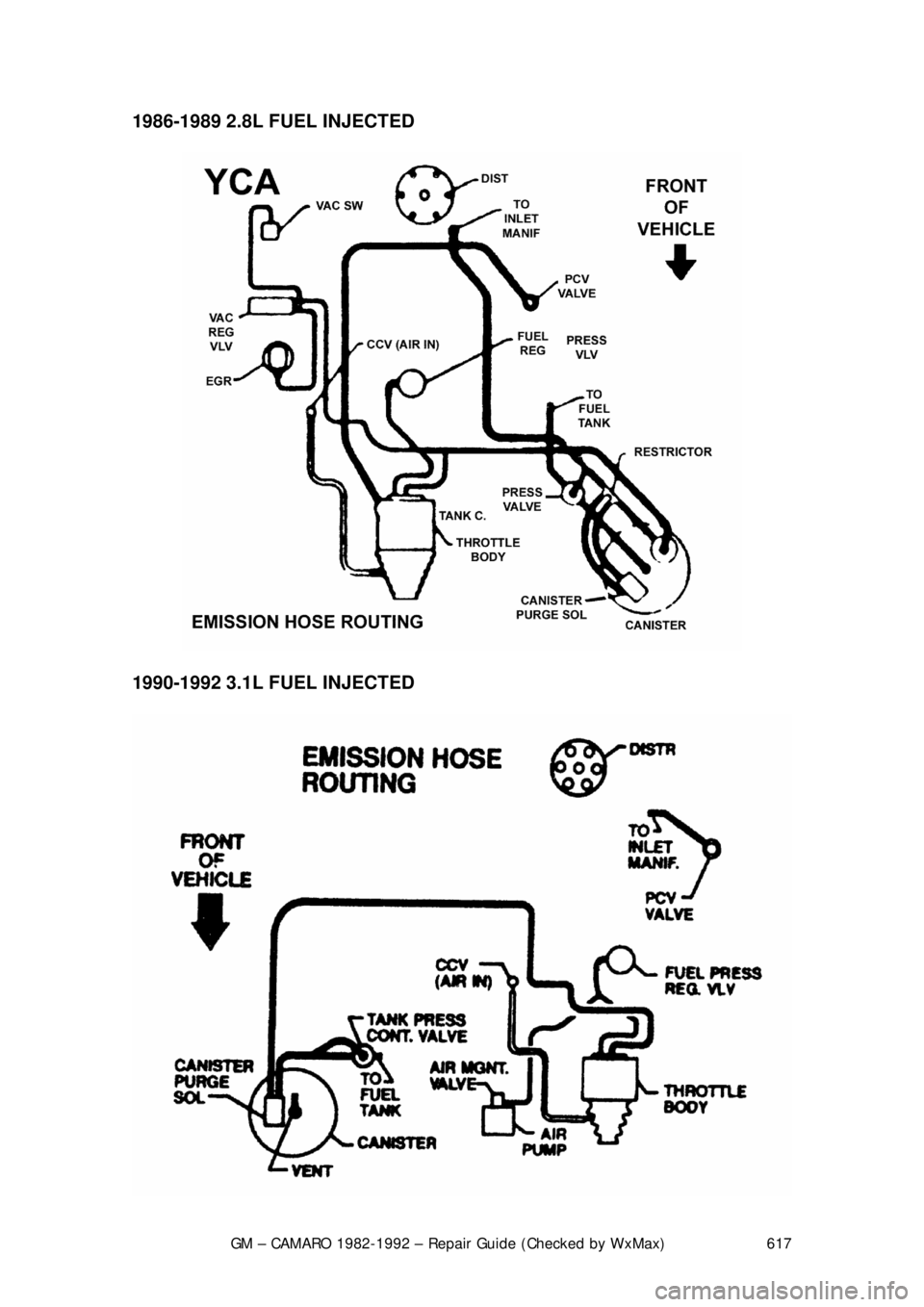
GM – CAMARO 1982-1992 – Repair Guide (Checked by WxMax) 617
1986-1989 2.8L FUEL INJECTED
1990-1992 3.1L FUEL INJECTED
Page 622 of 875
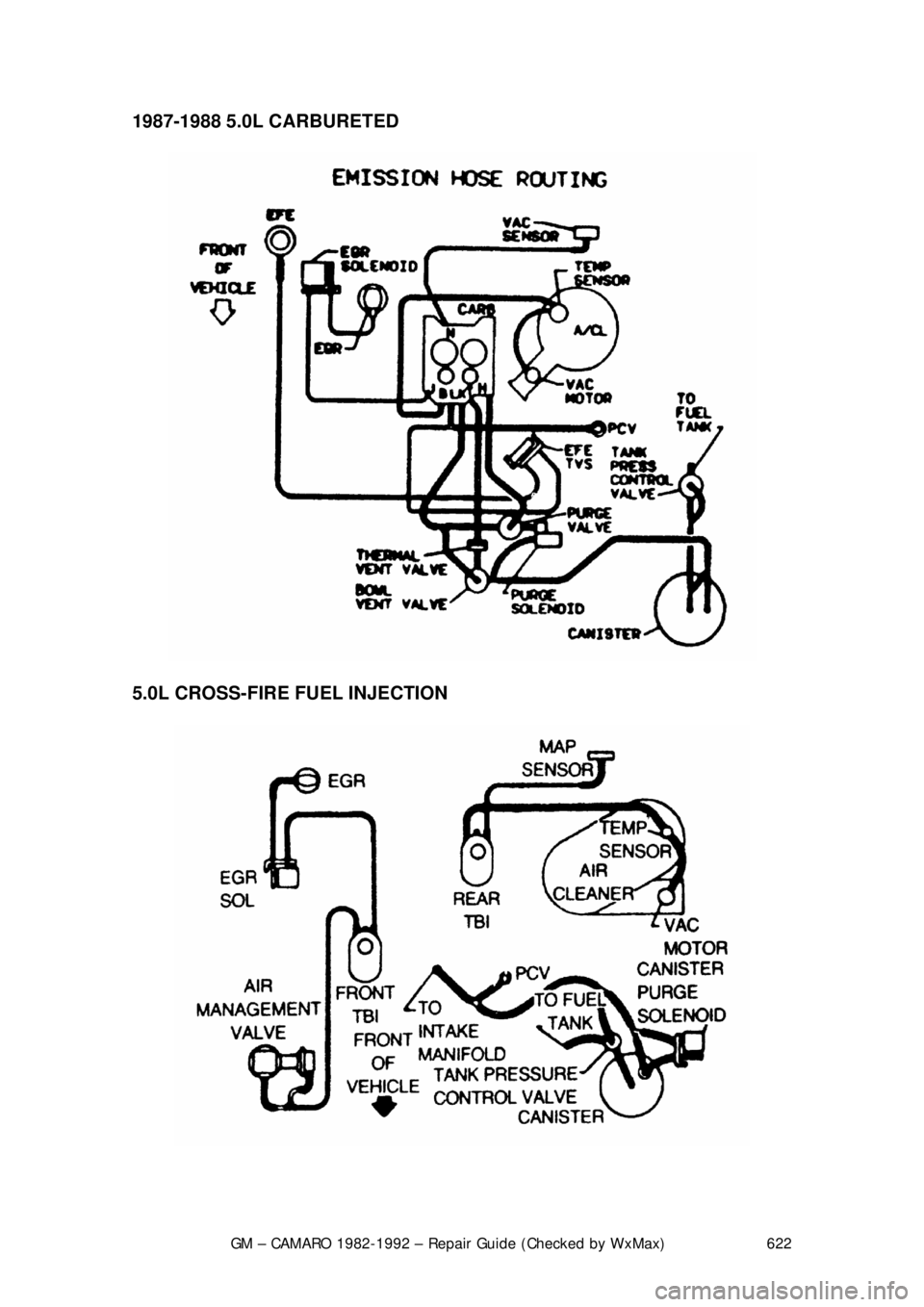
GM – CAMARO 1982-1992 – Repair Guide (Checked by WxMax) 622
1987-1988 5.0L CARBURETED
5.0L CROSS-FIRE FUEL INJECTION
Page 626 of 875

GM – CAMARO 1982-1992 – Repair Guide (Checked by WxMax) 626
ENGINE PERFORMANCE AND TUNE-UP
TUNE-UP PROCEDURES
In order to extract the full measure of performance and economy from your
engine it is essential that it is properly tuned at regul ar intervals. A regular tune-
up will keep your Camaro's engine running smoothly and will prevent the
annoying breakdowns and poor perform ance associated with an untuned
engine.
A complete tune-up should be performed every 30,000 miles (48,000 km). This
interval should be halved if the car is operated under severe conditions such as
trailer towing, prolonged idling, start-and- stop driving, or if starting or running
problems are noticed. It is assumed that the routine maintenance described in
General Information & Maintenance has been kept up, as this will have a
decided effect on the result s of a tune-up. All of the applicable steps of a tune-
up should be followed in order, as the result is a cumulative one.
If the specifications on the underhoo d tune-up sticker in the engine
compartment of your car disagree with th e "Tune-Up Specifications" chart in this
Section, the figures on the sticker must be used. The sticker often reflects
changes made during t he production run.
SPARK PLUGS
A typical spark plug consists of a metal shell surrounding a ceramic insulator. A
metal electrode extends downward through the center of the insulator and
protrudes a small distance. Located at the end of the plug and attached to the
side of the outer metal shell is the side el ectrode. The side electrode bends in at
a 90 angle so that its tip is just pas t and parallel to the tip of the center
electrode. The distance between these two electrodes (measured in
thousandths of an inch or hundredths of a millimeter) is called the spark plug
gap.
The spark plug does not pr oduce a spark, but instead provides a gap across
which the current can arc. The coil produces anywhere from 20,000 to 50,000
volts (depending on the type and application) which travels through the wires to
the spark plugs. The current passes along the center electrode and jumps the
gap to the side electrode, and in doing so, ignites the air/fuel mixture in the
combustion chamber.