Page 335 of 513
Air
intake
system
in
trouble
Overheating
Overcooling
Others
NOISY
ENGINE
Car
knocking
Car
knock
when
coasting
ENGINE
Diny
ur
clogged
fuel
strainer
Fuel
pump
will
not
work
properly
Clogged
carburetor
jets
Clogged
air
cleaner
Air
inhaling
from
manifold
gasket
or
carbu
retor
gasket
Insufficient
coolant
Loosened
fan
belt
Worn
or
defective
fan
belt
Defective
thermostat
Defective
water
pump
Clogged
or
leaky
radiator
Defective
radiator
filler
cap
Air
mixing
into
cooling
system
Improper
grade
engine
oil
Incorrect
ignition
timing
Defective
carburetor
lean
mixture
Defective
thermostat
Low
octane
fuel
Improper
tire
pressure
Dragging
brake
Slipping
clutch
Overloading
to
engine
Carbon
knocking
Timing
knocking
Fuel
knocking
Preignition
misusing
of
spark
plug
Incorrect
throttle
opener
adjustment
Trouble
in
PCV
valve
ET
30
Replace
Repair
or
replace
Disassemble
and
clean
Replace
element
Replace
gasket
Replenish
Adjust
Replace
Replace
Replace
Flush
repair
or
replace
Replace
Retighten
each
part
of
cooling
system
Replace
with
proper
grade
oil
Adjust
Overhaul
carburetor
Replace
Replace
with
specified
octane
fuel
Adjust
to
the
specified
pressure
Adjust
Adjust
Use
right
gear
in
driving
Disassemble
cylinder
head
and
remove
carbon
Adjust
ignition
timing
Use
specified
octane
fuel
Use
specified
spark
plug
Adjust
throttle
opener
Replace
PCV
valve
Page 387 of 513
COOLING
SYSTEM
COOLING
SYSTEM
CONTENTS
DESCRIPTION
WATER
PUMP
Removal
THERMOSTAT
Removal
Inspection
CO
1
CO
2
CO
2
CO
2
CO
2
CO
2
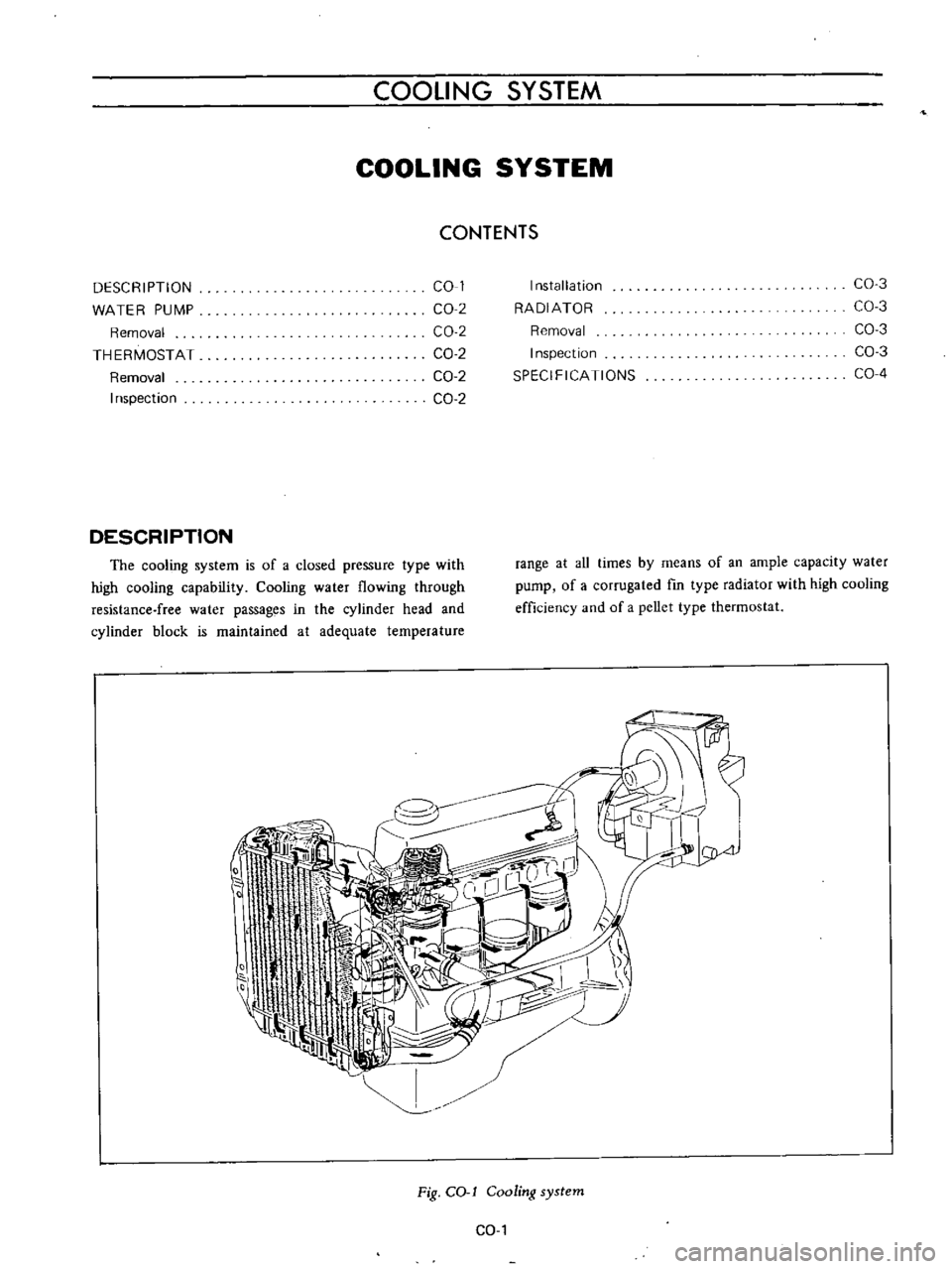
DESCRIPTION
The
cooling
system
is
of
a
closed
pressure
type
with
high
cooling
capability
Cooling
water
flowing
through
resistance
free
water
passages
in
the
cylinder
head
and
cylinder
block
is
maintained
at
adequate
temperature
Installation
RADIATOR
Removal
Inspection
SPECIFICATIONS
CO
3
CO
3
CO
3
CO
3
CO
4
range
at
aU
times
by
means
of
an
ample
capacity
water
pump
of
a
corrugated
fm
type
radiator
with
high
cooling
efficiency
and
of
a
pellet
type
thermostat
I
I
I
0
Jrl
oA
Fig
COol
Cooling
system
CO
I
Page 388 of 513
ENGINE
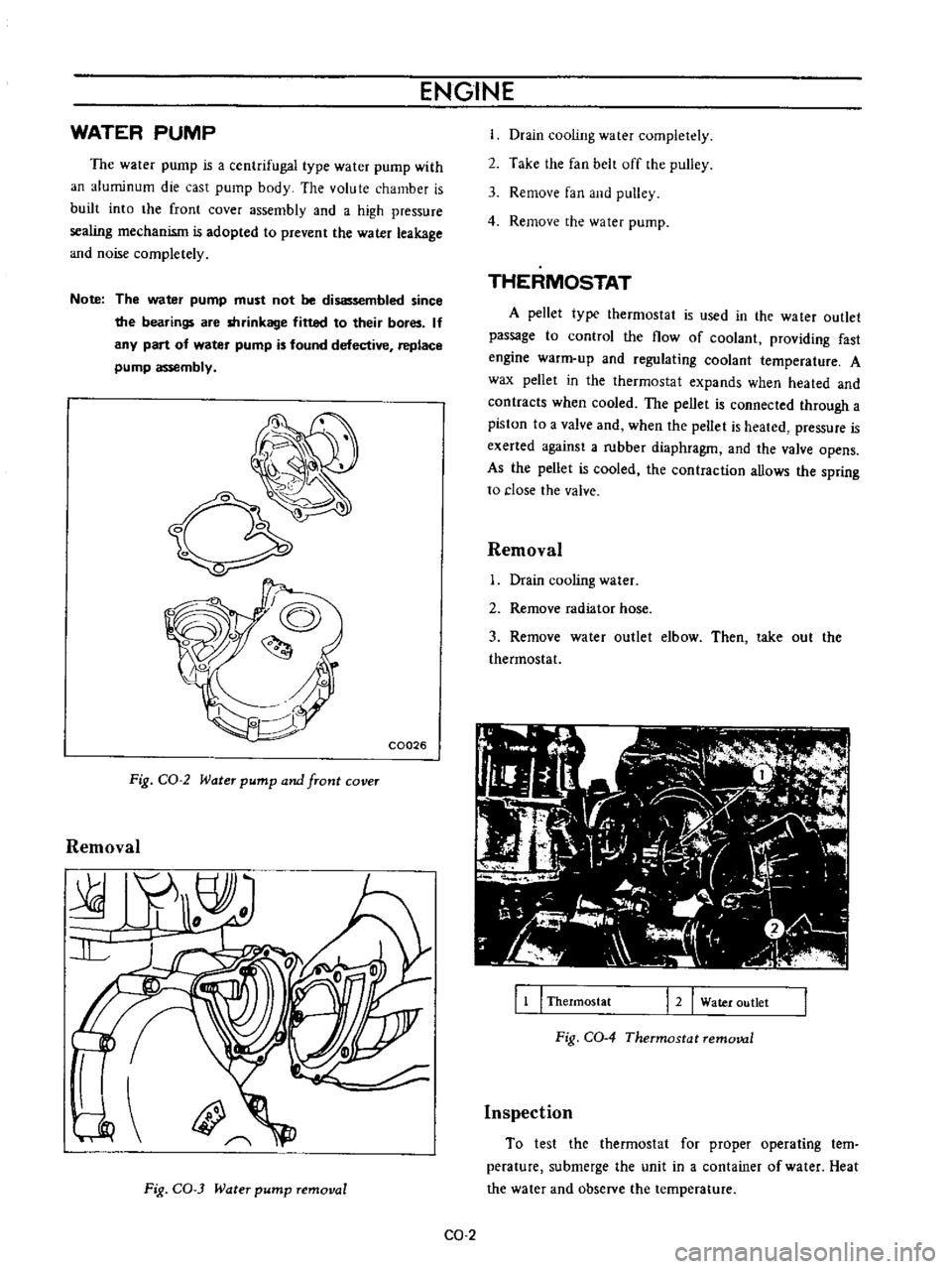
WATER
PUMP
The
water
pump
is
a
centrifugal
type
water
pump
with
an
aluminum
die
cast
pump
body
The
volute
chamber
is
built
into
the
front
cover
assembly
and
a
high
pressure
sealing
mechanism
is
adopted
to
prevent
the
water
leakage
and
noise
completely
Note
The
water
pump
must
not
be
disassembled
since
the
bearings
are
shrinkage
fitted
to
their
bores
If
any
part
of
water
pump
is
found
defective
replace
pump
assembly
o
C0026
Fig
CO
2
Water
pump
and
front
cover
Removal
Fig
CO
3
Water
pump
removal
Drain
cooling
water
completely
2
Take
the
fan
belt
off
the
pulley
3
Remove
fan
and
pulley
4
Remove
the
water
pump
THERMOSTAT
A
pellet
type
thermostat
is
used
in
the
wa
ter
outlet
passage
to
control
the
flow
of
coolant
providing
fast
engine
warm
up
and
regulating
coolant
temperature
A
wax
pellet
in
the
thermostat
expands
when
heated
and
contracts
when
cooled
The
pellet
is
connected
through
a
piston
to
a
valve
and
when
the
peUet
is
heated
pressure
is
exerted
against
a
rubber
diaphragm
and
the
valve
opens
As
the
pellet
is
cooled
the
contraction
allows
the
spring
to
close
the
valve
Removal
Drain
cooling
water
2
Remove
radiator
hose
3
Remove
water
outlet
elbow
Then
take
out
the
thermostat
11
I
Thermostat
12
Water
outlet
Fig
CO
4
Thermostat
removal
Inspection
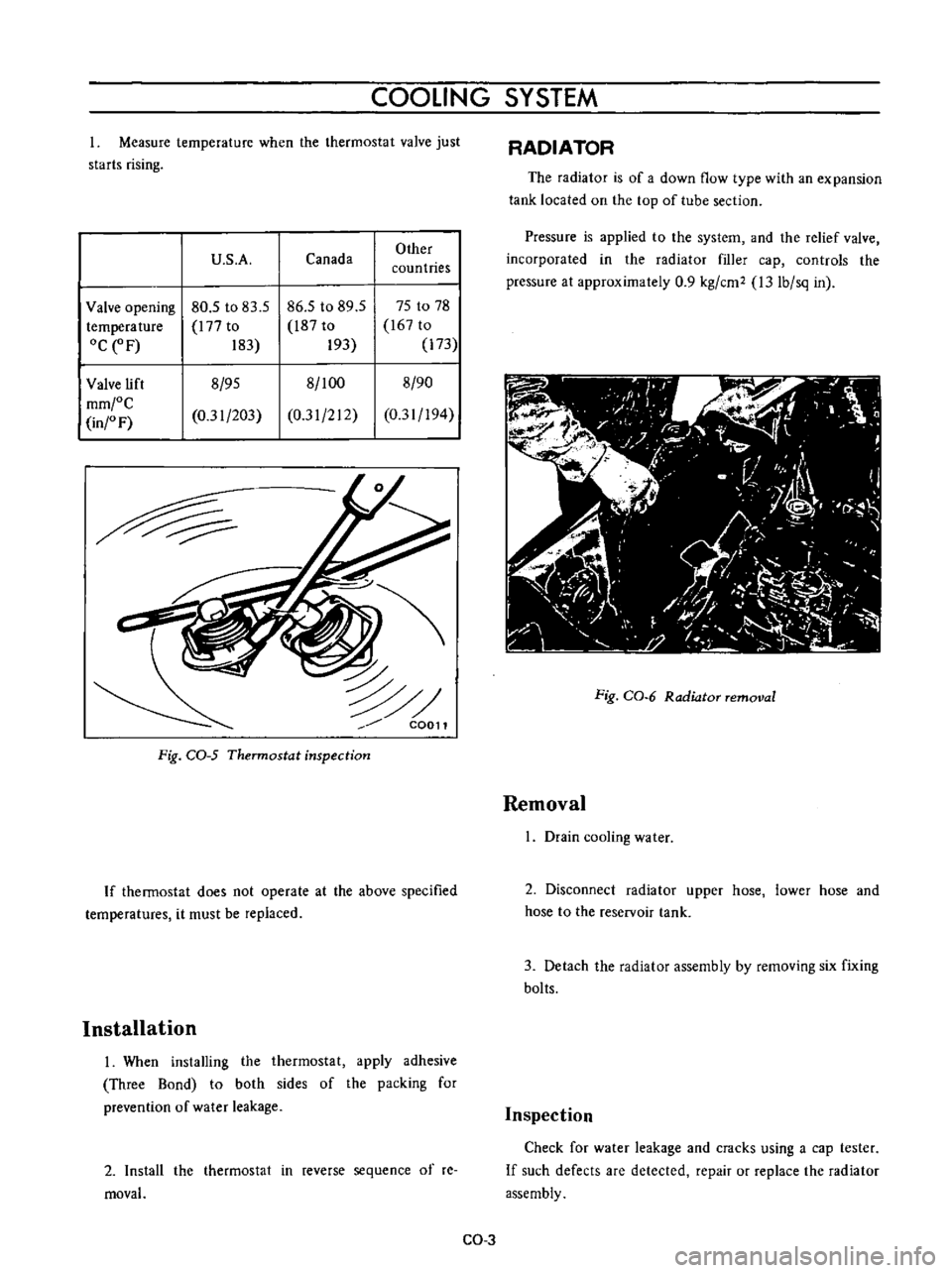
To
test
the
thermostat
for
proper
operating
tern
perature
submerge
the
unit
in
a
container
of
water
Heat
the
water
and
observe
the
temperature
CO
2
Page 389 of 513
COOLING
SYSTEM
Measure
temperature
when
the
thermostat
valve
just
starts
rising
U
S
A
Canada
Other
countries
Valve
opening
80
5
to
83
5
86
5
to
89
5
75
to
78
temperature
l77
to
l87
to
167
to
OCeF
183
193
173
Valve
lift
8
95
8
100
8
90
mm
C
0
31
203
0
31
212
0
31
194
in
F
C0011
Fig
CQ
5
Thermostat
inspection
If
thermostat
does
not
operate
at
the
above
specified
temperatures
it
must
be
replaced
Installation
I
When
installing
the
thermostat
apply
adhesive
Three
Bond
to
both
sides
of
the
packing
for
prevention
of
water
leakage
2
Install
the
thermostat
in
reverse
sequence
of
re
moval
RADIATOR
The
radiator
is
of
a
down
flow
type
with
an
expansion
tank
located
on
the
top
of
tube
section
Pressure
is
applied
to
the
system
and
the
relief
valve
incorporated
in
the
radiator
filler
cap
controls
the
pressure
at
approximately
0
9
kg
cm2
l3
Ib
sq
in
Fig
CO
6
Radiator
removal
Removal
I
Drain
cooling
water
2
Disconnect
radiator
upper
hose
lower
hose
and
hose
to
the
reservoir
tank
3
Detach
the
radiator
assembly
by
removing
six
fixing
bolts
Inspection
Check
for
water
leakage
and
cracks
using
a
cap
tester
If
such
defects
are
detected
repair
or
replace
the
radiator
assembly
CO
3
Page 390 of 513
ENGINE
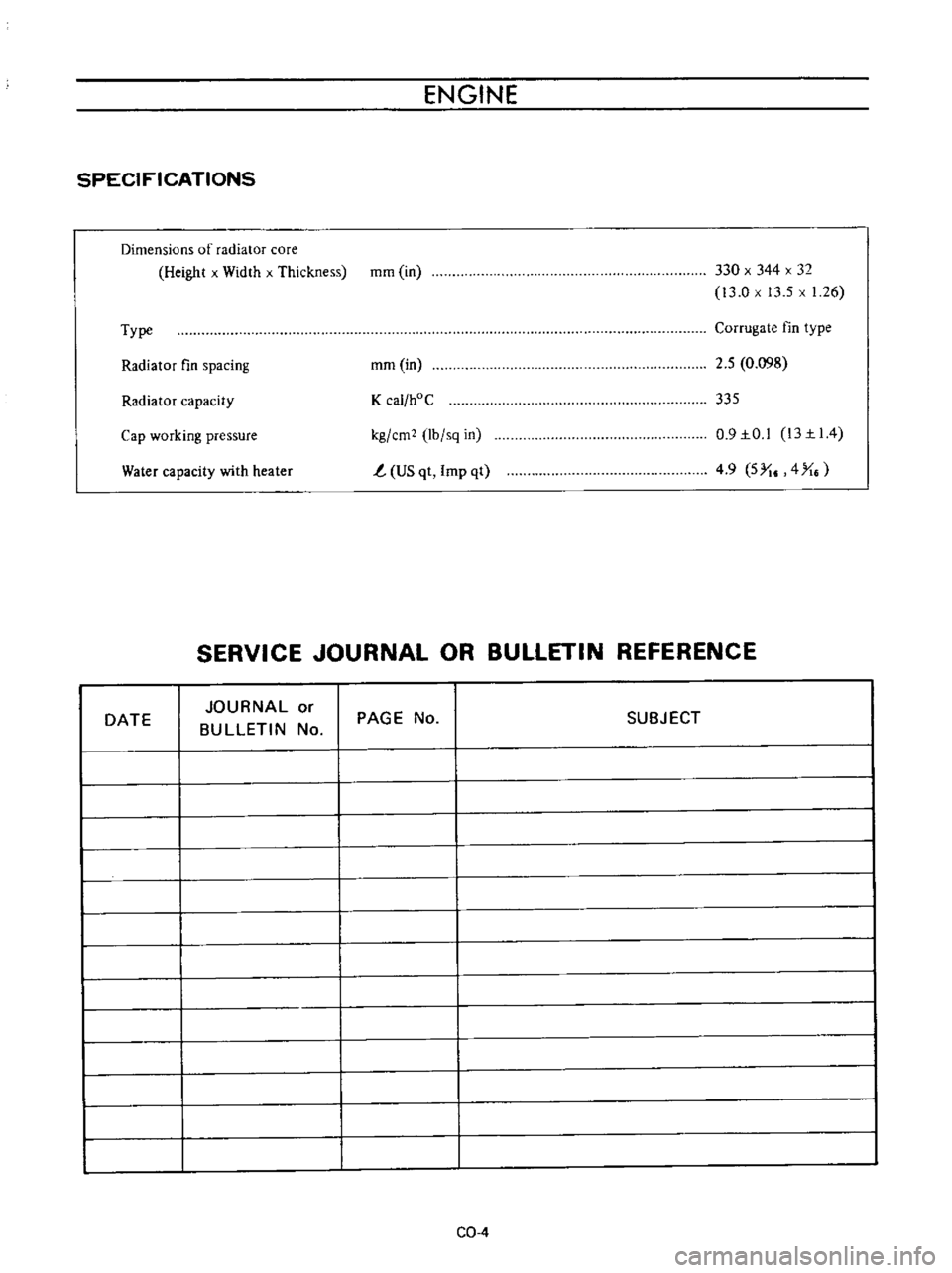
SPECIFICATIONS
Dimensions
of
radiator
core
Height
x
Width
x
Thickness
mm
in
330
x
344
x
32
13
0
x
13
5
x
1
26
Type
Corrugate
fin
type
Radiator
fin
spacing
mm
in
2
5
0
098
Radiator
capacity
K
cal
hoC
335
Water
capacity
with
heater
kg
em
lb
sq
in
t
US
qt
Imp
qt
0
9IO
l
13II4
4
9
5
I
4
X
Cap
working
pressure
SERVICE
JOURNAL
OR
BULLETIN
REFERENCE
DATE
JOURNAL
or
BULLETIN
No
PAGE
No
SUBJECT
CQ
4
Page 467 of 513

CHASSIS
ENGINE
REMOVAL
AND
INSTALLATION
CONTENTS
PR
ECAUTIONS
REMOVAL
ERA
ERA
PRECAUTIONS
Be
sure
to
use
fender
cover
so
that
the
body
is
not
damaged
2
When
lifting
the
engine
or
when
jacking
up
the
engine
pay
attention
for
safety
and
carry
out
operation
correctly
so
that
the
parts
are
not
damaged
REMOVAL
I
Removing
hood
Open
the
hood
remove
four
installation
bolts
and
remove
the
hood
2
Disconnect
the
battery
cable
from
the
terminal
3
Removing
radiator
Drain
water
from
the
radiator
disconnect
two
radiator
hoses
remove
four
radiator
installation
bolts
and
remove
the
radiator
Fig
ER
8
Removin
radiator
4
Removing
cables
and
hoses
Disconnect
the
following
cables
hoses
and
wires
High
voltage
cable
between
ignition
coil
and
distribu
INSTAllATION
ER
6
tor
Cable
to
the
thermal
transmitter
Cable
to
the
oil
pressure
switch
Cable
to
the
primary
side
of
the
distributor
Cable
to
the
starting
motor
Fuel
hose
Cable
to
the
alternator
Heater
hose
for
model
with
heater
only
Wires
for
accelerator
and
choke
The
operation
will
be
carried
out
more
easily
by
removing
the
air
cleaner
Fig
ER
9
Right
side
of
engine
compartment
Fig
ER
10
Left
side
of
engine
compartment
ERA