1969 FORD MUSTANG service
[x] Cancel search: servicePage 205 of 413
04-02-08
Rear Axle — Removable Carrier Type
04-02-08
REMOVAL AND INSTALLATION
CARRIER ASSEMBLY
REMOVAL
1.
Raise the vehicle on a hoist and
remove the two rear wheels and tires.
2.
Remove the two brake drums (3
Tinnerman nuts at each drum) from
the axle shaft flange studs. If diffi-
culty is experienced in removing the
drums, remove the brake adjuster
knockout slug or rubber plug (if so
equipped) and back off the brake
shoes.
3.
Working through the hole pro-
vided in each axle shaft flange, re-
move the nuts that secure the rear
wheel bearing retainer plate. Pull each
axle shaft assembly out of the axle
housing using axle shaft remover,
Tool 4235-C. (Fig. 4). Care must be
exercised to prevent damage to the
production-type synthetic oil seal, if so
equipped. Any roughing or cutting of
the seal element during removal or in-
stallation can result in early seal fail-
ure.
Install a nut on one of the brake
backing plate attaching bolts to hold
the plate to the axle housing after the
shaft has been removed. Whenever a
rear axle shaft is replaced, the wheel
bearing oil seals must be replaced.
Remove the seals with tool 1175AB.
4.
Make scribe marks on the drive
shaft end yoke and the axle U-joint
flange to insure proper position at as-
sembly. Disconnect the drive shaft at
the rear axle U-joint. Hold the cups
on the spider with tape. Mark the
cups so that they will be in their orig-
inal position relative to the flange
when they are assembled. Remove the
drive shaft from the transmission ex-
tension housing. Install an oil seal re-
placer tool in the housing to prevent
transmission leakage. Refer to the
transmission group for the appropriate
tool.
5.
Clean area around carrier to
housing surfaced with a wire brush and
wipe clean, to prevent dirt entry into
the housing. Place a drain pan under
the carrier and housing, remove the
carrier attaching nuts, and drain the
axle.
Remove the carrier assembly
from the axle housing.
INSTALLATION
Synthetic production-type wheel
bearing seals must not be cleaned,
soaked or washed in cleaning solvent.
1.
Clean the axle housing and
shafts using kerosene and swabs. To
avoid contamination of the grease in
the sealed ball bearings, do not allow
any quantity of solvent directly on the
wheel bearings. Clean the mating sur-
faces of the axle housing and carrier.
2.
Position the differential carrier
on the studs in the axle housing using
a new gasket between carrier and
housing. Install the carrier-to-housing
attaching nuts, and torque them to
specifications.
3.
Remove the oil seal replacer tool
from the transmission extension hous-
ing. Position the drive shaft so that
the front U-joint slip yoke splines to
the transmission output shaft.
4.
Connect the drive shaft to the
axle U-joint flange, aligning the scribe
marks made on the drive shaft end
yoke and the axle U-joint flange dur-
ing the removal procedure. Install the
U-bolts and nuts and torque to speci-
fications.
5.
If the synthetic, production-type
wheel bearing seals were replaced with
service-type leather seals, soak the
new rear wheel bearing oil seals in
SAE 10 oil for 1/2 hour before instal-
lation. Wipe a small amount of an oil
resistant sealer on the outer edge of
each seal before it is installed. Do not
put any of the sealer on the sealing
lip.
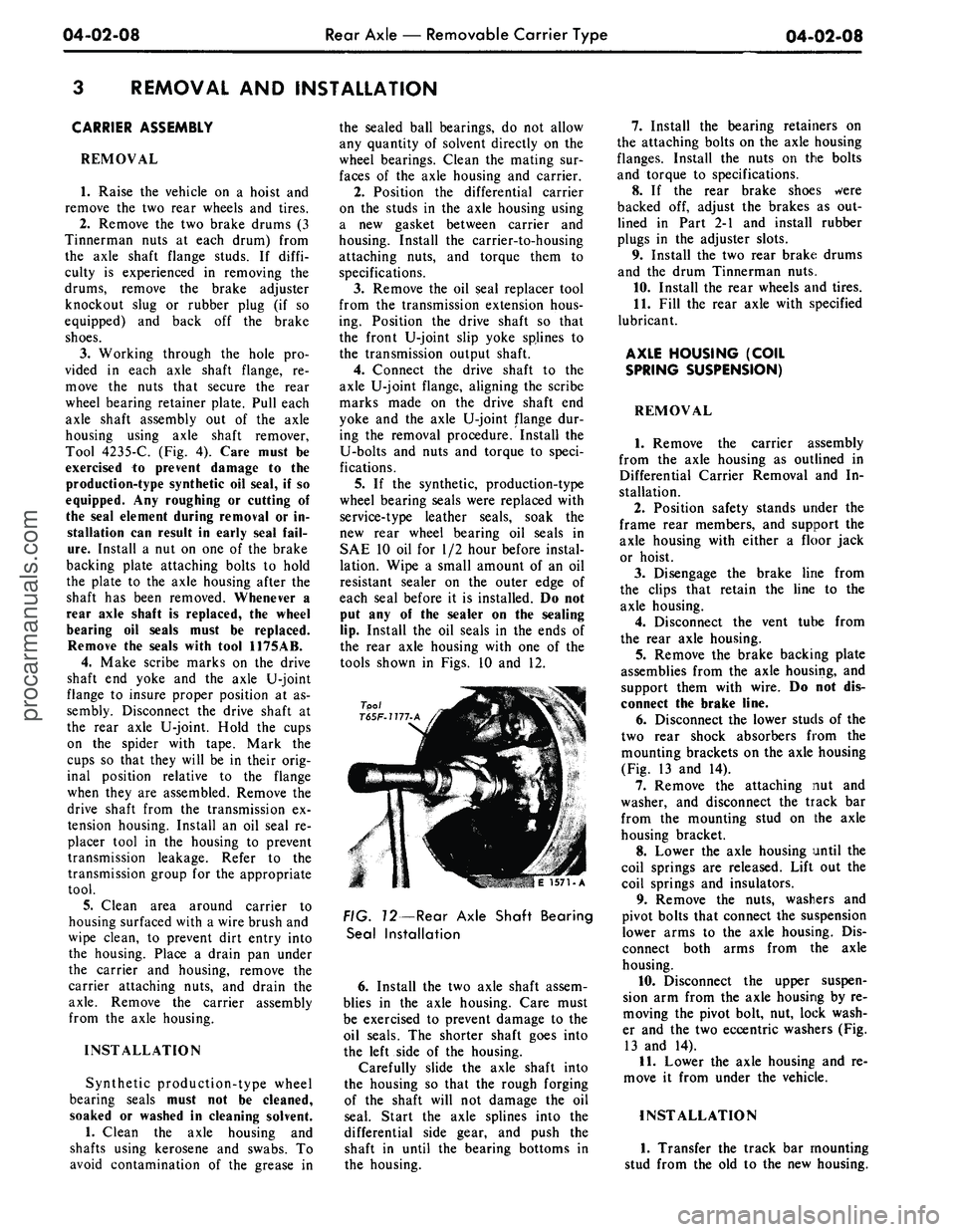
Install the oil seals in the ends of
the rear axle housing with one of the
tools shown in Figs. 10 and 12.
Tool
T65F-1177.A
E 1571-A
FIG. 12—Rear Axle Shaft Bearing
Seal Installation
6. Install the two axle shaft assem-
blies in the axle housing. Care must
be exercised to prevent damage to the
oil seals. The shorter shaft goes into
the left side of the housing.
Carefully slide the axle shaft into
the housing so that the rough forging
of the shaft will not damage the oil
seal. Start the axle splines into the
differential side gear, and push the
shaft in until the bearing bottoms in
the housing.
7.
Install the bearing retainers on
the attaching bolts on the axle housing
flanges. Install the nuts on the bolts
and torque to specifications.
8. If the rear brake shoes were
backed off, adjust the brakes as out-
lined in Part 2-1 and install rubber
plugs in the adjuster slots.
9. Install the two rear brake drums
and the drum Tinnerman nuts.
10.
Install the rear wheels and tires.
11.
Fill the rear axle with specified
lubricant.
AXLE HOUSING (COIL
SPRING SUSPENSION)
REMOVAL
1.
Remove the carrier assembly
from the axle housing as outlined in
Differential Carrier Removal and In-
stallation.
2.
Position safety stands under the
frame rear members, and support the
axle housing with either a floor jack
or hoist.
3.
Disengage the brake line from
the clips that retain the line to the
axle housing.
4.
Disconnect the vent tube from
the rear axle housing.
5.
Remove the brake backing plate
assemblies from the axle housing, and
support them with wire. Do not dis-
connect the brake line.
6. Disconnect the lower studs of the
two rear shock absorbers from the
mounting brackets on the axle housing
(Fig. 13 and 14).
7.
Remove the attaching nut and
washer, and disconnect the track bar
from the mounting stud on the axle
housing bracket.
8. Lower the axle housing until the
coil springs are released. Lift out the
coil springs and insulators.
9. Remove the nuts, washers and
pivot bolts that connect the suspension
lower arms to the axle housing. Dis-
connect both arms from the axle
housing.
10.
Disconnect the upper suspen-
sion arm from the axle housing by re-
moving the pivot bolt, nut, lock wash-
er and the two eccentric washers (Fig.
13 and 14).
11.
Lower the axle housing and re-
move it from under the vehicle.
INSTALLATION
1.
Transfer the track bar mounting
stud from the old to the new housing.procarmanuals.com
Page 215 of 413

04-02-18
Rear Axle — Removable Carrier Type
04-02-18
E 1195-C
FIG. 41—Removing
or
Installing
Pinion
and
Retainer Assembly
10.
Hold
the
flange with
the
tool
shown
in Fig. 22
(Ford)
or Fig. 23
(Mercury),
and
torque
the
pinion shaft
nut
to 175
ft-lbs.
Do not
exceed
175
ft-Ibs
at
this time.
11.
Check
the
pinion bearing
pre-
load
as
shown
in Fig. 42.
Correct
pre-load will
be
obtained when
the
torque required
to
rotate
the
pinion
in
the retainer
is as
specified
in
Part
4-3.
If
the
torque required
to
rotate
the pin-
ion
is
less than specified, tighten
the
pinion shaft
nut a
little
at a
time until
Inch-Pound
Torque Wrench
E1899A
FIG. 42—Checking Pinion Bearing
Preload
the proper preload
is
established.
Do
not overtighten
the nut. If
excessive
preload
is
obtained
as a
result
of
over-
tightening, replace
the
collapsible
bearing spacer.
Do
not
back
off the
pinion shaft
nut
to establish pinion bearing preload.
If
the torque
on the
pinion shaft
nut is
less than
175
ft-lbs after bearing
pre-
load
is
established,
a new
collapsible
spacer must
be
used.
SOLID PINION BEARING
SPACER INSTALLATION
The spacer
is
serviced
in 20
sizes
listed
in
Part
4-5. The
manner
of sel-
ecting
the
size spacer required
for ob-
taining correct preload
is
included
in
the following assembly procedure.
1.
Install
the
drive pinion rear bear-
ing cone
and
roller assembly
on the
pinion shaft
as
shown
in
Figs.
38 or
39.
2.
Select
a new
solid spacer
of a
larger size (0.485 inch thick),
and
slide
it over
the
pinion shaft against
the
rear bearing.
The pinion bearing preload
can be
accurately measured only when
the
pinion shaft
nut is
torqued
to 180-
220 ft-lbs.
If a
spacer smaller than
re-
quired
was
used,
the
specified
180-
220 ft-lbs torque would damage
the
bearings.
For
this reason,
the
largest
spacer should
be
tried first. Then,
if
the bearings
are too
loose,
the
size
of
the spacer
can be
decreased until
the
correct preload
is
obtained.
3.
Position
the
bearing retainer
and
cup assembly
on the
pinion shaft
and
install
the
front bearing cone
and rol-
ler. Press
the
front bearing cone
and
roller assembly into position,
as
shown
in Fig. 38.
4.
Mount
the
retainer
in a
holding
fixture
as
shown
in Fig. 23, and
place
the slinger over
the
pinion shaft
and
against
the
front bearing.
5.
Install
the
U-joint flange with
the tool shown
in Fig. 46.
6. Hold
the
flange with
the
tool
shown
in Fig. 23 or 24, and
install
the
old pinion shaft
nut.
Using
a
ft-lb
tor-
que wrench, torque
the nut to
180-220
ft-lbs.
While tightening
the nut,
rotate
the bearing retainer
to
determine
the
existance
of any
bearing preload
which will
be
indicated
by a
slight
drag
in the
rotation
of the
retainer.
DETERMINING SPACER
SIZE FROM
PRELOAD READING
1.
If
bearing drag indicates
a pre-
load condition exists, apply
an
in-lb
torque wrench
to the
pinion
nut as
shown
in Fig. 42 and
read
the
torque
required
to
turn
the
shaft. Effort
should
be
12-1/2
to
32-1/2 in-lbs.
2.
If
preload
is the
correct valve,
proceed with assembly procedure
given
in
Final Assembly
of
Pinion
and
Retainer, which follows.
2.
If
preload exists,
but is
below
specification, select
the
correct spacer
from
Fig. 43 and
install, completing
assembly
as
shown
in
Final Assembly
of Pinion
and
Retainer.
DETERMINING SPACER
SIZE FROM
END
PLAY READING
1.
If no
perceptible preload
is
felt
when rotating
the
pinion shaft, install
a dial indicator
as
shown
in Fig. 44,
so that
the
indicator point
is
resting
on
the end of the
pinion gear shaft
(companion flange
end).
2.
Use
both hands
to
squeeze
the
pinion shaft
and the
bearing retainer
together
(Fig. 45).
Record
the
endplay
reading shown
on the
dial indicator.
3.
Disassemble
the
pinion shaft
and
retainer
and
install
the
correct spacer
as shown
in Fig. 43.
4.
Proceed with assembly
of the pin-
ion shaft
and
retainer
as
directed
in
Final Assembly
of
Pinion
and
Retain-
er.
FINAL ASSEMBLY
OF
PINION
AND
RETAINER
1.
Install
the
drive pinion rear bear-
ing cone
and
roller assembly
on the
AS
END
PLAY
READS
(10/1000 inch)
USE THIS
SPACER
0
0.481
1
0.480
2
0.479
3
0.478
4
0.476
If there
is no end
play
and
preload
on the
bearings
IF PRELOAD READS
(in-lbs.)
USE THIS SPACER
2-11
0.482
12-20
0.483
5
0.476
6
0.474
7
0.474
8
0.472
9
0.472
10
0.470
11
0.470
12
0.468
13
0.468
14
0.466
15
0.465
exists:
21-30
0.484
31-45
0.485
FIG. 43— Solid Spacer Selectionprocarmanuals.com
Page 222 of 413

04-03-02
Rear Axles — Integral Carrier Type
04-03-02
RING GEAR
4209
DRIVE PINION
BEARINGS
4630
4621
FLANGE-4676
E1905A
FIG. 7—Typical Rear Axle Assembly
IN-VEHICLE ADJUSTMENT
AND
REPAIR
REAR AXLE SHAFT, WHEEL
BEARING
AND OIL
SEAL
REPLACEMENT
Synthetic wheel bearing seals
are
used
for
production purposes only.
>Tool-T60K-4234-A
or 4235-D
Tool-T50T-W0-A
or 8-/66
* El904A
FIG. 2—Removing Axle Shaft
E 1731-A
FIG. 3—Removing Rear Wheel
Bearing Retainer Ring
Removal
and
insertion
of
rear axle
shafts must
be
performed with
cau-
tion.
The
entire length
of the
shaft
(in-
cluding spline)
up to the
seal journal
must pass through
the
seal without
contact.
Any
roughing
or
cutting
of
the seal element during axle removal
or installation will result
in
early seal
failure. Leather seals only will
be
used
as service replacements
for
synthetic
wheel bearing seals.
The rear axle shafts, wheel bear-
ings,
and oil
seal
can be
replaced
without removing
the
differential
as-
sembly from
the
axle housing.
Re-
moval
of the
wheel bearings from
the
axle shafts make them unfit
for fur-
ther
use.
E1421-B
FIG. 4—Removing and Installing Rear Wheel Bearing—
Montego—Cougarprocarmanuals.com
Page 227 of 413
04-03-07
Rear Axles — Integral Carrier Type
04-03-07
junction and install vent hose to vent
tube.
7.
Raise the axle housing and con-
nect the shock absorbers.
8. Connect the rear end of the drive
shaft to the axle U-joint flange, align-
ing the scribe marks made on the
drive shaft end yoke and the axle U-
joint flange (Fig. 14).
9. Fill the axle with the proper
grade and amount of lubricant.
10.
Road test the vehicle.
MAJOR REPAIR OPERATIONS
DISASSEMBLY
All service operations on the differ-
ential case assembly and the drive pin-
ion assembly can be performed with
the housing in the vehicle.
REMOVAL OF
DIFFERENTIAL
CASE AND DRIVE PINION
1.
Raise the vehicle and support it
on the underbody, so that the rear
axle drops down as far as the springs
and shock absorbers permit.
2.
Remove the cover from the car-
rier casting rear face, and drain the
lubricant.
3.
Perform the Inspection Before
Disassembly of Carrier in Part 4-1,
Section 3.
4.
Remove both rear wheels.
5.
Remove the brake drums.
6. Working through the hole pro-
vided in the axle shaft flange, remove
the nuts that attach the wheel bearing
retainers to the axle housing.
7.
Pull the axle shafts with the tool
shown in Fig. 2. Care must be exer-
cised to prevent damage to the oil
seals.
Install a nut on one of the brake
backing plate attaching bolts to hold
the plate to the axle housing after the
shaft has been removed. Remove both
seals with the tool shown in Fig. 8.
8. Make scribe marks on the drive
shaft end yoke and the axle U-joint
flange to insure proper position of the
drive shaft at assembly (Fig. 14). Dis-
connect the drive shaft from the axle
U-joint flange. Be careful to avoid
dropping the loose universal joint
bearing cups. Hold the cups on the
spider with tape. Mark the cups so
that they will be in their original posi-
tion in relation to the flange when
they are assembled. Remove the drive
shaft from the transmission extension
housing. Install an oil seal replacer
tool in the transmission extension
housing to prevent transmission leak-
age.
Refer to the transmission group
for the appropriate tool.
9. Remove the differential bearing
adjusting nut locks (Fig. 15).
10.
Mark one differential bearing
cap and the case (Fig. 16) to help po-
sition the parts properly during as-
sembly.
11.
Remove the differential bearing
cap bolts and bearing caps. Hold the
differential case assembly in the hous-
ing after the caps are removed.
12.
Remove the differential case
and bearing cups (Fig. 17).
13.
Hold the drive pinion flange
and remove the pinion nut (Fig. 9).
14.
Remove the pinion flange (Fig.
10).
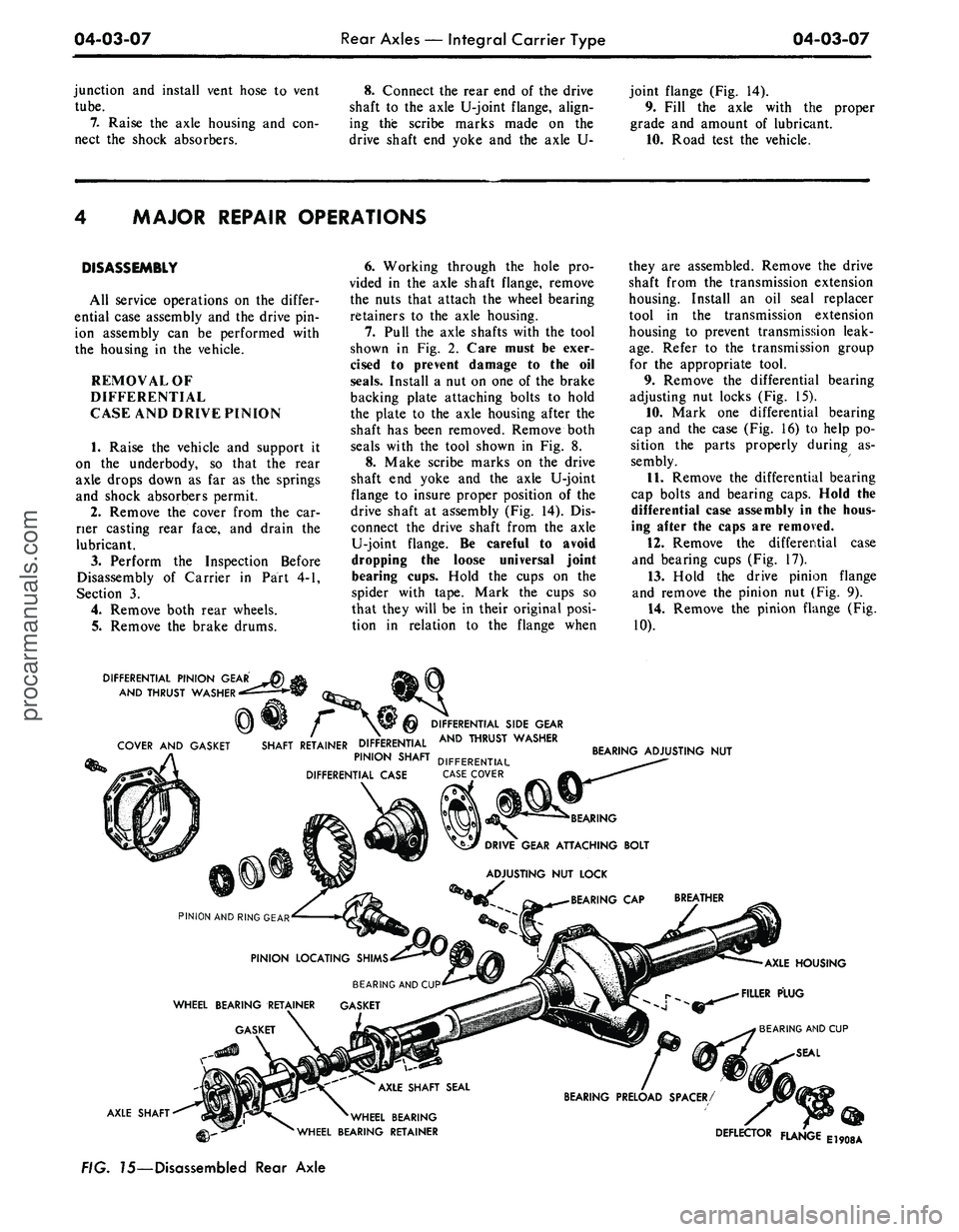
DIFFERENTIAL PINION GEAR
AND THRUST WASHER
COVER AND GASKET
DIFFERENTIAL SIDE GEAR
AND THRUST WASHER
SHAFT RETAINER DIFFERENTIAL
PINION SHAFT DIFFERENT|AL
DIFFERENTIAL CASE CASE COVER
BEARING ADJUSTING NUT
PINION AND RING GEAR
AXLE SHAFT
BEARING
DRIVE GEAR ATTACHING BOLT
ADJUSTING NUT LOCK
BEARING CAP
PINION LOCATING SHIMS
BEARING AND CUP
WHEEL BEARING RETAINER
GASKET
BEARING AND CUP
SEAL
AXLE SHAFT SEAL
BEARING PRELOAD SPACER/
AXLE HOUSING
FILLER PLUG
'WHEEL BEARING
WHEEL BEARING RETAINER
DEFLECTOR FLANGE
E1908A
FIG. 75—Disassembled Rear Axleprocarmanuals.com
Page 233 of 413
04-04-02
Rear Axle
—
Ford Light-Duty (WER)
04-04-02
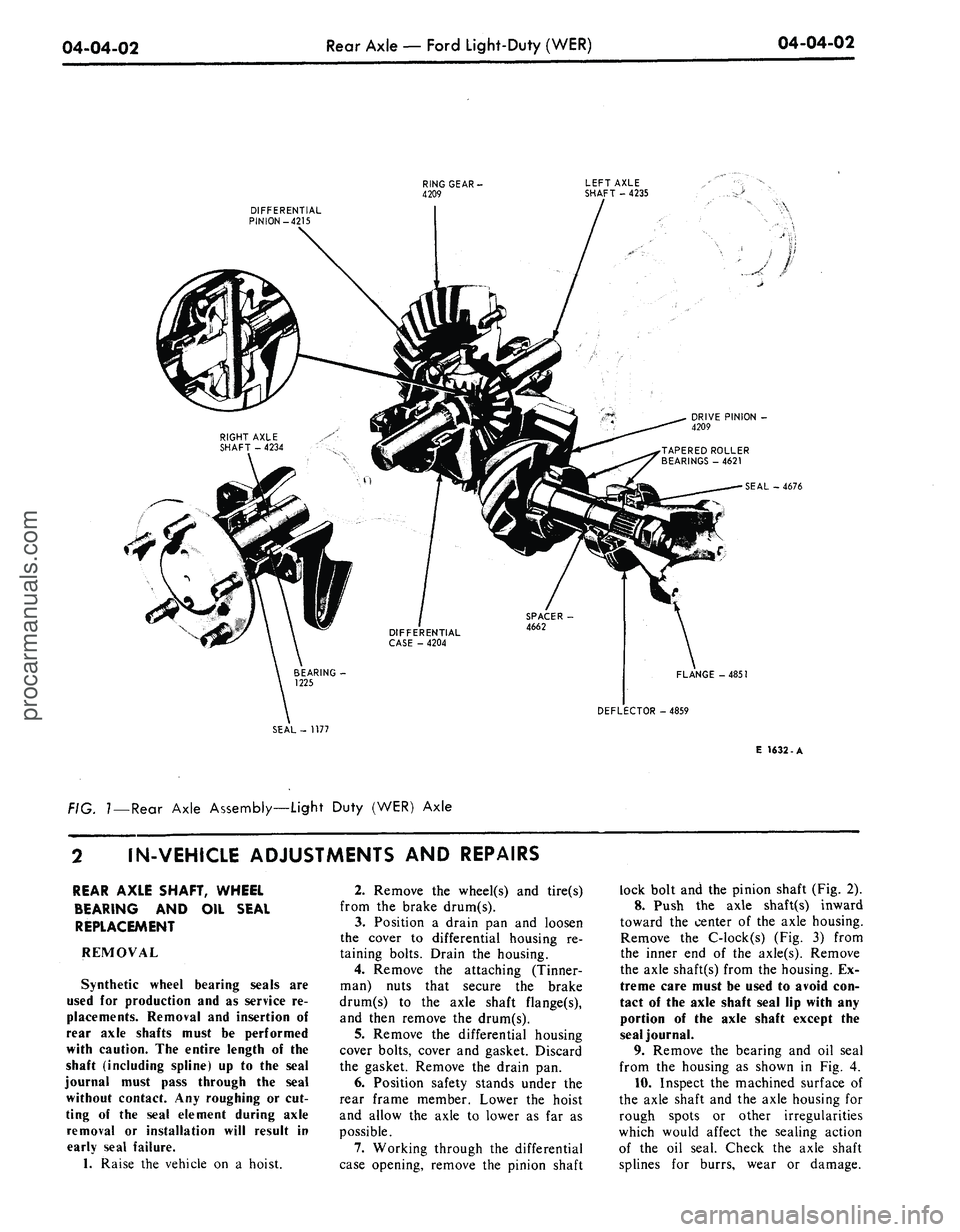
DIFFERENTIAL
PINION-4215
RING GEAR
-
4209
LEFT AXLE
SHAFT
-
4235
1
DRIVE PINION
-
4209
SEAL
-
4676
FLANGE-4851
DEFLECTOR -4859
SEAL-
1177
f\G.
7
—Rear Axle Assembly—Light Duty
(WER)
Axle
E 1632-A
IN-VEHICLE ADJUSTMENTS AND REPAIRS
REAR AXLE SHAFT, WHEEL
BEARING
AND OIL
SEAL
REPLACEMENT
REMOVAL
Synthetic wheel bearing seals
are
used
for
production
and as
service
re-
placements. Removal
and
insertion
of
rear axle shafts must
be
performed
with caution.
The
entire length
of the
shaft (including spline)
up to the
seal
journal must pass through
the
seal
without contact.
Any
roughing
or cut-
ting
of the
seal element during axle
removal
or
installation will result
in
early seal failure.
1.
Raise
the
vehicle
on a
hoist.
2.
Remove
the
wheel(s)
and
tire(s)
from
the
brake drum(s).
3.
Position
a
drain
pan and
loosen
the cover
to
differential housing
re-
taining bolts. Drain
the
housing.
4.
Remove
the
attaching (Tinner-
man) nuts that secure
the
brake
drum(s)
to the
axle shaft flange(s),
and then remove
the
drum(s).
5.
Remove
the
differential housing
cover bolts, cover
and
gasket. Discard
the gasket. Remove
the
drain
pan.
6. Position safety stands under
the
rear frame member. Lower
the
hoist
and allow
the
axle
to
lower
as far as
possible.
7.
Working through
the
differential
case opening, remove
the
pinion shaft
lock bolt
and the
pinion shaft
(Fig. 2).
8. Push
the
axle shaft(s) inward
toward
the
center
of the
axle housing.
Remove
the
C-lock(s)
(Fig. 3)
from
the inner
end of the
axle(s). Remove
the axle shaft(s) from
the
housing.
Ex-
treme care must
be
used
to
avoid
con-
tact
of the
axle shaft seal
lip
with
any
portion
of the
axle shaft except
the
seal journal.
9. Remove
the
bearing
and oil
seal
from
the
housing
as
shown
in Fig. 4.
10.
Inspect
the
machined surface
of
the axle shaft
and the
axle housing
for
rough spots
or
other irregularities
which would affect
the
sealing action
of
the oil
seal. Check
the
axle shaft
splines
for
burrs, wear
or
damage.procarmanuals.com
Page 238 of 413
04-04-07
Rear Axle — Ford Light-Duty (WER)
04-04-07
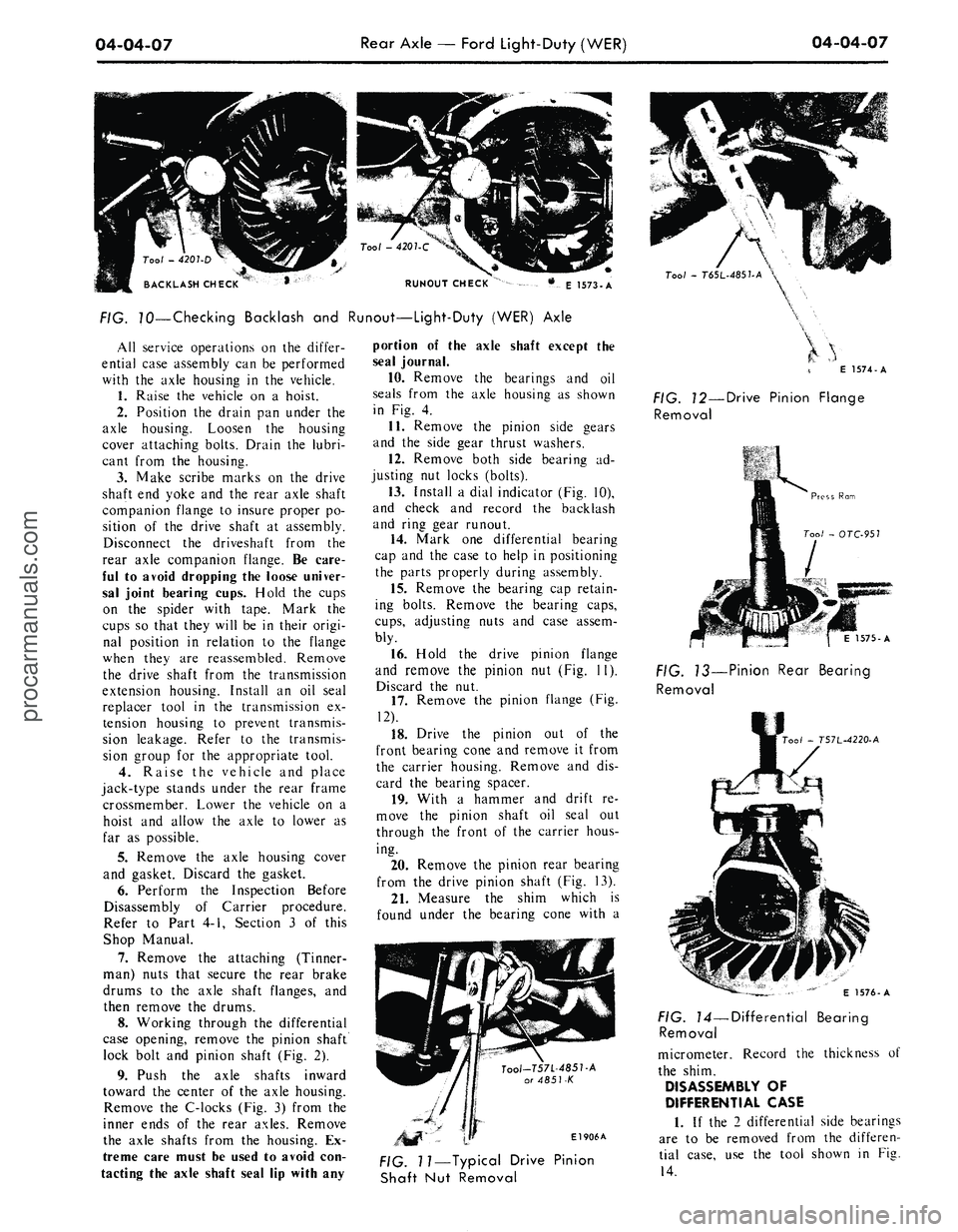
RUNOUT CHECK
E 1573-A
FIG. 70—Checking Backlash and Runout—Light-Duty (WER) Axle
All service operations on the differ-
ential case assembly can be performed
with the axle housing in the vehicle.
1.
Raise the vehicle on a hoist.
2.
Position the drain pan under the
axle housing. Loosen the housing
cover attaching bolts. Drain the lubri-
cant from the housing.
3.
Make scribe marks on the drive
shaft end yoke and the rear axle shaft
companion flange to insure proper po-
sition of the drive shaft at assembly.
Disconnect the driveshaft from the
rear axle companion flange. Be care-
ful to avoid dropping the loose univer-
sal joint bearing cups. Hold the cups
on the spider with tape. Mark the
cups so that they will be in their origi-
nal position in relation to the flange
when they are reassembled. Remove
the drive shaft from the transmission
extension housing. Install an oil seal
replacer tool in the transmission ex-
tension housing to prevent transmis-
sion leakage. Refer to the transmis-
sion group for the appropriate tool.
4.
Raise the vehicle and place
jack-type stands under the rear frame
crossmember. Lower the vehicle on a
hoist and allow the axle to lower as
far as possible.
5.
Remove the axle housing cover
and gasket. Discard the gasket.
6. Perform the Inspection Before
Disassembly of Carrier procedure.
Refer to Part 4-1, Section 3 of this
Shop Manual.
7.
Remove the attaching (Tinner-
man) nuts that secure the rear brake
drums to the axle shaft flanges, and
then remove the drums.
8. Working through the differential
case opening, remove the pinion shaft
lock bolt and pinion shaft (Fig. 2).
9. Push the axle shafts inward
toward the center of the axle housing.
Remove the C-locks (Fig. 3) from the
inner ends of the rear axles. Remove
the axle shafts from the housing. Ex-
treme care must be used to avoid con-
tacting the axle shaft seal lip with any
portion of the axle shaft except the
seal journal.
10.
Remove the bearings and oil
seals from the axle housing as shown
in Fig. 4.
11.
Remove the pinion side gears
and the side gear thrust washers.
12.
Remove both side bearing ad-
justing nut locks (bolts).
13.
Install a dial indicator (Fig. 10),
and check and record the backlash
and ring gear runout.
14.
Mark one differential bearing
cap and the case to help in positioning
the parts properly during assembly.
15.
Remove the bearing cap retain-
ing bolts. Remove the bearing caps,
cups,
adjusting nuts and case assem-
bly.
16.
Hold the drive pinion flange
and remove the pinion nut (Fig. 11).
Discard the nut.
17.
Remove the pinion flange (Fig.
12).
18.
Drive the pinion out of the
front bearing cone and remove it from
the carrier housing. Remove and dis-
card the bearing spacer.
19.
With a hammer and drift re-
move the pinion shaft oil seal out
through the front of the carrier hous-
ing.
20.
Remove the pinion rear bearing
from the drive pinion shaft (Fig. 13).
21.
Measure the shim which is
found under the bearing cone with a
Tool-T57L-485T-A
or 4851-K
El 906A
Tool
-
T6SL-485UA
\
E 1574-A
FIG. 12—Drive Pinion Flange
Removal
1575-A
FIG. 13—Pinion Rear Bearing
Removal
00/
- T57L-4220-A
FIG. 11—Typical Drive Pinion
Shaft Nut Removal
E 1576-A
FIG. 14—Differential Bearing
Removal
micrometer. Record the thickness of
the shim.
DISASSEMBLY OF
DIFFERENTIAL CASE
1.
If the 2 differential side bearings
are to be removed from the differen-
tial case, use the tool shown in Fig.
14.procarmanuals.com
Page 244 of 413

04-05-03
Specifications
04-05-03
SHIM PACK THICKNESS CHART TRACTION-LOK DIFFERENTIAL
Feeler
Gauge
Reading
0.001
0.002
0.003
0.004
0.005
0.006
0.007
0.008
0.009
0.010
0.011
0.012
0.013
0.014
0.015
0.016
0.017
0.018
0.019
0.020
0.021
0.022
0.023
0.024
0.025
0.026
0.027
Remove Shim(s)
From
Nominal
None
0.005
0.010
0.015
0.020
0.025
Total Req'd
Shim Pack
Thickness®
0.050
0.045
0.040
0.035
0.030
0.025
Feeler
Gauge
Reading
0.028
0.029
0.030
0.031
0.032
0.033
0.034
0.035
0.036
0.037
0.038
0.039
0.040
0.041
0.042
0.043
0.044
0.045
0.046
0.047
0.048
0.049
0.050
Remove Shim(s)
From
Nominal
0.030
0.035
0.040
0.045
0.050
Total Req'd
Shim Pack
Thickness ®
0.020
0.015
0.010
0.005
0.000
©Service Shims are available in 0.010" and 0.005" Thicknesses.
ADJUSTMENT TORQUE SPECIFICATION -(BY AXLE RING GEAR DIAMETERS
Description
Minimum torque required to tighten
pinion flange nut to obtain
correct pinion bearing preload
7 1/4" & 8 1/2"
8", 8 3/4" & 9"
9 3/8"
Pinion Bearing Preload-
collapsible spacer)®
Original Bearings 7 1/4"
8", 8 1/2", 8 3/4", 9"
New Bearings 7 1/4"
8", 8 1/2", 8 3/4", 9"
Pinion Bearing Preload-
(Solid Spacer) 9 3/8" Only
Torque
Lbs.
In.
6-12
8-14
17-32
22-32
15-35
. Lbs. Ft.
140®
175®
180-220
Description
Lockers Only • Minimum rotating
Torque required to turn axle
shaft and side gear with one
wheel on ground:
Limited Slip 7 1/4"
All other R. G. Sizes
Traction-Lok-All
Lockers only-Rotating Torques
required during bench check
after assembly:
Original Clutch Plates-
Limited Slip 71/4",
All other R. G. Sizes
Traction-Lok-(All)
New Clutch Plates-
Limited Slip 7 1/4"
All other R. G. Sizes
Traction-Lok-All
Torque
Lbs.
In.
Lbs.
Ft.
50
75
40
50 Min.
75 Min.
40 Min.
100-125
155-195
100-250G
©If pinion bearing preload exceeds specification before this torque is obtained, install a new spacer.
©With Oil Seal.
©Rotating torque may fluctuate up to 40 Lbs. Ft.procarmanuals.com
Page 248 of 413

05-01-01
05-01-01
Clutch
GROUP
5
PART
5-1
PAGE
Drive Shaft 05-01-01
PART
5-2
General Clutch Service 05-02-01
PART
5-3
Clutch
PART
5-4
Specifications
PAGE
05-03-01
05-04-01
PART
5-1
Drive Shaft
COMPONENT INDEX
DESCRIPTION
DRIVE SHAFT ANGLE CHECK
DRIVE SHAFT BALANCE CHECK
DRIVE SHAFT BALANCING
(Single Universal Joint)
DRIVE SHAFT DISASSEMBLY
AND
OVERHAUL
Single Universal Joint — Ford Design
Double Cardan Joint — Dana Design
Double Cardan Joint — Saginaw Design
DRIVE SHAFT REMOVAL
AND
INSTALLATION
DRIVE SHAFT RUNOUT CHECK
MODEL APPLICATION
All
Models
01-01
01-01
01-01
01-02
01-01
Ford
01-04
01-04
N/A
N/A
Mercury
01-04
01-04
N/A
N/A
Meteor
01-04
01-04
N/A
N/A
Cougar
01-04
01-04
N/A
N/A
Fairlane
01-04
01-04
N/A
N/A
Falcon
01-04
01-04
N/A
N/A
Montego
01-04
01-04
N/A
N/A
Mustang
01-04
01-04
N/A
N/A
Lincoln-
Continental
N/A
N/A
01-04
N/A
Thunderbird
N/A
N/A
N/A
01-05
Continental-
Mark
III
N/A
N/A
N/A
01-05
A page number indicates that the item
is for the
vehicle listed
at the
head
of
the column.
N/A indicates that
the
item
is not
applicable
to the
vehicle listed.
DRIVE SHAFT TESTS
DRIVE LINE BALANCE CHECK
If detailed parts
of the
drive shaft
are replaced
and
shaft vibration
is en-
countered after installation, disconnect
the shaft
at the
slip yoke. Rotate
the
slip yoke
180
degrees; then, reconnect
the shaft
to the
slip yoke.
If the
vibra-
tion persists, disconnect
the
shaft
at
the rear axle companion flange.
Ro-
tate
the
companion flange
180
degrees
and reconnect
the
shaft
to the
flange.
DRIVE LINE ANGLE CHECK
Vibration
or
"shudder" which
is no-
ticeable either
on
fast acceleration
or
when coasting, using
the
engine
for a
brake,
may be
caused
by the
rear axle
housing being loose
on the
rear
springs
or by
improper pinion angle.
Refer
to
Group
3,
Part
2 for
pinion
angle checking procedures.
If the
rear
axle U-bolts (Fairlane, Montego,
Mustang, Cougar, Falcon models
only)
are
loose, torque
the
nuts
to
specification.
DRIVE SHAFT RUNOUT CHECK
Using
a
dial indicator, check
the
runout
at
each
end and in the
middle
of
the
driveshaft.
The
rear check
should
be
made
on the
small tube
sec-
tion
of the
shaft between
the
balance
weights
and the
yoke welds. Drive-
shaft runout should
not
exceed 0.035
inch
at any one
point.
DESCRIPTION
The drive shaft
is the
means
of
transferring power from
the
engine,
through
the
transmission,
to the dif-
ferential
in the
rear axle,
and
then
to
the rear wheels.
The
drive shaft incor-
porates
two
universal joints
and a
slip
yoke
(Fig. 1) or two
double cardan
universal joints,
one at
each
end of the
shaft (Figs.
2 and 3).
Each double
procarmanuals.com