1969 FORD MUSTANG lock
[x] Cancel search: lockPage 6 of 413

01-01-02
Vehicle Identification
01-01-02
VEHICLE WARRANTY NUMBER
The vehicle warranty number is the first line of numbers and
letters appearing on the Warranty Plates (Fig. 1). The Warranty
Plate is riveted to the left front door lock face panel. The first
number indicates the model year. The letter following the model
year number indicates the manufacturing assembly plant. The next
two numbers designate the Body Serial Code followed by a letter
expressing the Engine Code. The group of six digits remaining on
the first line indicate the Consecutive Unit Number.
VEHICLE DATA
The vehicle data appears on the second or lower line on the
Warranty Plate. The first two numbers and a letter identify the
Body Style. A letter or a number appears next indicating the
Exterior Paint Color followed by a number-letter combination
designating the Interior Trim. To the right of this code appears the
Date Code indicating the date the car was manufactured. A two-
digit number next designates the district in which the car was
ordered and may appear in conjunction with a Domestic Special
Order or Foreign Special Order number when applicable. The final
two spaces indicate the Rear Axle Ratio (numbers for regular axles,
letters for locking-types) and the Transmission type (numbers for
manual,
letters for automatic).
OFFICIAL VEHICLE IDENTIFICATION NUMBER
The official Vehicle Identification Number (VIN) for title and
registration purposes is stamped on an aluminum tab that is riveted
to the instrument panel close to the windshield on the driver's side
of the car and is visible from outside (Fig. 2).
MODEL YEAR CODE
The number 9 designates 1969.
ASSEMBLY PLANT CODES
COUGAR
Code
Letter
Code
Letter
A
B
C
D
E
F
G
H
J
K
Atlanta
L
Oakville (Canada)
N
Ontario Truck
P
Dallas
R
.,
Mahwah
S
Dearborn
T
Chicago
U
Lorain
W
Los Angeles
X
Kansas City
Y
Z
Michigan Truck
Norfolk
Twin Cities
San Jose
.
(Pilot). ...Allen Park
Metuchen
Louisville
Wayne
St. Thomas
Wixom
St. Louis
BODY SERIAL AND STYLE CODES
The two-digit numeral which follows the assembly plant code
identifies the body series. This two-digit number is used in con-
junction with the Body Style Code, in the Vehicle Data, which
consists of a two-digit number with a letter suffix. The following
chart lists the Body Serial Codes, Body Style Codes and the model.
LINCOLN CONTINENTAL
Body Body
Serial Style
Code Code Body Type
82
53A
4-Door Sedan
80
65A
2-Door
Hardtop
CONTINENTAL MARK
III
Body Body
Serial Style
Code Code Body Type
89
65A
2-Door
Hardtop
Body
Serial
Code
91
92
93
94
91
Body
Style
Code
65A
76A
65B
76B
65C
® Bench Seat
MERCURY
Body
Serial
Code
44
46
48
45
40
41
42
54
56
58
63
66
68
65
63
66
68
60
61
72
72
74
74
76
76
Body
Style
Code
54A
65A
57A
76A
53M
65M
57M
54C
65B
57B
53F
65F
57 F
76F
53C
65C
57C
63G
63H
71B
71C
71F
71G
71E
71A
©Bench Seat
Body
Type
2-Door
Hardtop©
Convertible©
2-Door
Hardtop©
Convertible®
2-Door
Hardtop®
Model
Standard
XR-7 Luxury
Standard
©Split Bench ©Bucket Seats
Body Type
4-Door Sedan©
2-Door
Hardtop-Formal®
4-Door Hardtop®
Convertible®
CANADA ONLY
4-Door Hardtop Sedan®
2-Door
Hardtop-Formal®
4-Door Hardtop®
4-Door Sedan®
2-Door
Hardtop-Formal®
4-Door Hardtop®
4-Door Hardtop Sedan®©
2-Door
Hardtop-Formal®©
4-Door Hardtop®®
Convertible®®
4-Door Hardtop Sedan©
2-Door
Hardtop-Formal©
4-Door Hardtop©
Model
Monterey
Marquis
Monterey-Custom
Marquis
Brougham (Option)
2-Door
Hardtop (Tunnel Roof)®© Marauder
2-Door
Hardtop (Tunnel Roof)®®©
4-Door 2 Seat®
4-Door 3 Seat (Side Facing)®
4-Door
2
Seat®
4-Door 3 Seat (Side Facing)®
4-Door 2 Seat®©
4-Door 3 Seat (Side Facing)®©
Monterey Wagoi
Monterey-Custom Wagon
Marquis Colony Park
©Split Bench ©Bucket Seats
METEOR (CANADA)
Body
Serial
Code
20
21
23
Body
Style
Code
54A
54B
65B
Body Type
4-Door Sedan®
4-Door Sedan®
2-Door
Hardtop-Formal®
Model
Rideau
Rideau 500
30
54C
4-Door Sedan®
35
65C
2-Door
Hardtop-Formal®
35
65E
2-Door
Hardtop-Formal{5-33)®®
33
57C
4-Door Hardtop®
34
76C
Convertible®
34
76E
Convertible (S-33)®®
Montcalm
24
65F
2-Door
Hardtop-Formal®©
27
57F
4-Door Hardtop®®
LeMoyne
28
71B
Rideau 500-6 Passenger®
29
71C
Rideau 500-Dual Face Rear®
38
71E
Mo ntcalm-6 Passenger®
39
71A
Montcalm-Dual Face Rear®
Station Wagons.
©Bench Seat ©Splite Bench ©Bucket Seatsprocarmanuals.com
Page 12 of 413

02-01-01
02-01-01
GROUP
2
PART
2-1
PAGE
General Brake Service 02-01-01
PART
2-2
Brake System 02-02-01
PART
2-3
Specifications
PAGE
02-03-01
Part
2-1
General Brake Service
COMPONENT INDEX
ANTI SKID CONTROL SYSTEM
Tests
BRAKE BOOSTER
Adjustments
Cleaning
and
Inspection
Tests
BRAKE PEDAL
Free Height Test
Total Travel Test
DISC BRAKES
Cleaning
and
Inspection
Service Precautions
DRUM BRAKES
Cleaning
and
Inspection
HYDRAULIC SYSTEM BLEEDING
PARKING BRAKE CONTROL
Vacuum Release Test
PARKING BRAKE LINKAGE
Adjustment
PRESSURE DIFFERENTIAL VALVE
Adjustment (Centralize)
MODEL APPLICATION
All
Models
01-04
01-07
01-02
01-01
01-01
01-07
01-07
01-08
01-05
01-07
Ford
N/A
01-03
01-03
Mercury
N/A
01-03
01-03
Meteor
N/A
01-03
01-03
Cougar
N/A
N/A
01-03
Fairlane
N/A
N/A
01-03
F
alcon
N/A
N/A
01-03
Montego
N/A
N/A
01-03
Mustang
N/A
N/A
01-03
Lincoln-
Continental
N/A
01-03
01-04
Thunderbird
01-03
01-03
01-04
Continental-
Mark III
01-03
01-03
01-04
A page number indicates that the item
is for the
vehicle listed
at
the head
of the
column.
N/A indicates that the item
is not
applicable
to
the vehicle listed.
1 BRAKE SYSTEM TESTS
Always check
the
fluid level
in the
master cylinder before performing
the
test procedures.
If the
fluid level
is not
within
1/4
inch
of the top of the mas-
ter cylinder reservoirs,
add
Ford
Brake Fluid
—
Extra Heavy Duty —
Part Number C6AZ-19542-A
(ESA-
M6C25-A)
or
equivalent
for all
brake
applications.
The
extra heavy duty
brake fluid
is
colored blue
for
identifi-
cation purposes.
Do not mix low tem-
perature brake fluids with
the
speci-
fied brake fluid.
Should
one of the
wheel brakes
be
locked
and the
vehicle must
be
moved,
open
the
bleeder screw long enough
to
let
out a few
drops
of
brake fluid.
This bleeding operation will release
the brakes
but
will
not
correct
the
cause
of
trouble.
BRAKE PEDAL FREE
HEIGHT
AND
TRAVEL
MEASUREMENTS
With
the
engine running
for
full
power brake operation, measure
the
brake pedal free height,
and
check
the
brake pedal travel with
the use of the
Brake Pedal Pressure Gauge, Tool
WRE-5OO-5O
as
follows:
BRAKE PEDAL FREE HEIGHT
MEASUREMENT
1.
Insert
a
slender, sharp pointed
prod through
the
carpet
and
sound
deadener
to the
dash panel metal
and
measure
the
distance
to the
brake
pedal
(Fig. 1).
2.
If the
position
of the
pedal
is not
within specification, check
the
brake
pedal linkage
for
missing, worn,
or
damaged bushings,
or
loose attaching
bolts
and
replace them,
if
required.
3.
If the
pedal free height
is
still
out
of
specification, check
the
brake
pedal booster
or
master cylinder
to be
sure
the
correct parts
are
installed.
Replace
the
worn
or
damaged parts
as
necessary.
BRAKE PEDAL TRAVEL
MEASUREMENT
1.
Install
a
Brake Pedal Effort
Gauge
on the
brake pedal
pad
(Fig. 2).
2.
Hook
a
steel measuring tape
to
the brake pedal
as
shown
in Fig. 1.
Measure
and
record
the
distance from
the brake pedal free height position
to
the reference point, which
is at the six
procarmanuals.com
Page 13 of 413

02-01-02
Brakes
02*01-02
STEERING
WHEEL RIW
TOEBOARD
OR
DASH
METAL
CHECKING
POINTS
STEERING
COLUMN-
STEEL
MEASURING TAPE
VEHICLE
FORD,
MERCURY AND METEOR
FORD,
MERCURY AND METEOR
FORD,
MERCURY AND METEOR
FORD,
MERCURY AND METEOR
FAIRLANE,
MONTEGO AND FALCON
FAIRLANE,
MONTEGO AND FALCON
MUSTANG
AND COUGAR
MUSTANG
AND COUGAR
THUNDERBIRD
CONTINENTAL
MARK III
LINCOLN
CONTINENTAL
TYPE
NON-POWER
DRUM
POWER
DRUM & DISC
NON-POWER
DISC
POLICE
POWER DISC
NON-POWER
DRUM
POWER
DISC
NON-POWER
DRUM
POWER
DISC
POWER
DISC
POWER
DISC
POWER
DISC
PEDAL
FREE
HEIGHT-A
8.09-7.17
6.18-5.99
8.65-7.82
7.58-6.72
8.13-6.91
7.25-5.71
7.49-6.43
6.25-5.56
PEDAL
FREE
HEIGHT-B"
5.96-5.04
5.96-5.04
6.50-5.50
PEDAL
TRAVEL-C
3.10
3.27
2.18
3.27
2.90
2.35
2.58
1.75
3.00
3.00
2.25
NOTE:AgB
DIMENSION TO BE MEASURED TO SHEET METAL
C
DIMENSION TO BE MEASURED PARALLEL TO THE VERTICAL CENTERLINE OF THE
STEERING
COLUMN WITH A 50 POUND LOAD APPLIED TO THE CENTERLINE OF THE
BRAKE
PEDAL PAD. (CHECKS ON POWER BRAKE VEHICLES MADE WITH ENGINE RUNNING
H1630-A
FIG. 1 — Brake Pedal Height and Travel Measurements
Tool-WRE-l
HI525-A
FIG.
2—Brake Pedal Effort Gauge Installed
o'clock position on the steering wheel
rim.
3.
With the steel tape still hooked
to the brake pedal depress the brake
pedal by pressing downward on the
brake pedal effort gauge. Apply a 50
pound load to the center of the pedal
by observing the pressure gauge, and
measure the distance from the brake
pedal to the fixed reference point on
the steering wheel rim parallel to the
centerline of the steering column.
4.
The difference between the brake
pedal free height and the depressed
pedal measurement under a 50 pound
load should be within the specified
maximum pedal travel service specifi-
cation B in Fig. I.
5.
If the pedal travel is more than
the specified maximum shown in Fig.
1,
dimension C, make several sharp
reverse stops (equivalent to 50 pounds
pedal pressure) with a forward stop
before each. Move the vehicle in rev-
erse and forward for a distance of ap-
proximately ten feet; then, apply the
brakes sharply and hold the brake
pedal down until the vehicle is com-
pletely stopped. This will actuate the
brake self-adjusters. If these stops do
not bring the brake pedal travel within
specification, make several additional
forward and reverse stops as outlined
above.
6. If the second series of stops do
not bring the brake pedal travel within
specification, remove the brake drums
and check the brake adjusters to make
sure they are functioning. Check the
brake linings for wear or damage. Re-
pair or replace all worn or damaged
parts and non-functioning adjusters.
Adjust the brake lining outside diame-
ter to the approximate inside diameter
of the brake drum with Rotunda Tool
HRE-8650 (Fig. 12, Part 2-2).
7.
If all the brake adjusters, brake
drums and linings are functional and
the brake travel is not within specifi-
cations, check the pedal linkage for
missing or worn bushings, or loose at-
tachments. Bleed the brakes and cen-
tralize the differential valve.
POWER BRAKE
FUNCTIONAL TEST
1.
Check the hydraulic brake sys-
tem for leaks or insufficient fluid.
2.
With the transmission in neutral,
stop the engine and apply the parking
brake. Depress the brake pedal several
times to exhaust all vacuum in the
system.
3.
With the engine shut off and all
vacuum in the system exhausted, dep-
ress the pedal, and hold it in the ap-
plied position. Start the engine If theprocarmanuals.com
Page 14 of 413

02-01-03
Brakes
02-01-03
vacuum system is operating, the pedal
will tend to fall away under foot pres-
sure and less pressure will be required
to hold the pedal in the applied posi-
tion. If no action is felt, the vacuum
booster system is not functioning.
If the brake pedal movement feels
spongy, bleed the hydraulic system to
remove air from the system. Refer to
Hydraulic System Bleeding, Part 1,
Section 2.
VACUUM TESTS—VACUUM
RELEASE PARKING BRAKES
Visually check the operation of the
brake linkage as the brake pedal is
depressed. Then, check the operation
of the brake linkage when the manual
release lever is activiated. These
checks should indicate whether the
manual parking brake control linkage
is operating properly or requires re-
pair or adjustment due to inability of
the parking brake to hold against
moderate vehicle movement. Perform
tests of the parking brake system and
controls after making certain the link-
age and manual controls operate
properly.
When testing a parking brake vacu-
um release system, a minimum of 10
inches of vacuum (Hg.) should be
available at all points where vacuum is
applied. This can be checked with a
Rotunda Fuel Pump Tester Gauge
(ARE345) and two Distributor Tester
hose adapters (Marked Q) connected
together with a coupling. This allows
the Fuel Pump Tester Gauge hose to
be adapted to any other vacuum hose
or rubber connector in the vacuum
systems.
Failure to maintain 10 inches of
vacuum (Hg.) during vacuum system
tests could be caused by a loose hose
connection, resulting in a vacuum
leak. When checking for vacuum be-
tween two points, trace the hose along
the entire routing to be sure it is not
crossed with another hose and con-
nected to the wrong connection.
All of the vacuum parking brake
control checks are to be performed
with the engine running at idle speed.
Leaks in the parking brake hoses or
a disconnected or improperly con-
nected hose can usually be found by
listening for a hissing sound along the
hose routings. Under no circumstances
should air pressure be applied to the
vacuum system as the actuator dia-
phragm in the parking brake vacuum
motor may be damaged.
1.
Start the engine and run it at
idle speed. With the transmission shift
control in neutral, depress the parking
brake pedal to apply the parking
brake. Move the transmission shift
control to D range and observe the
parking brake pedal to see that the
pedal moves upward and the parking
brake releases. If the parking brake
releases, the parking brake vacuum
control is working properly.
2.
If the parking brake does not re-
lease, test for vacuum at the steering
column neutral switch port in the
junction block, vacuum lines and the
parking brake release vacuum motor.
Use the Rotunda Vacuum and Fuel
Pump Tester 345. This can be accom-
plished by removing the hose from
each component and attaching it to
the vacuum gauge. Connect two dis-
tributor tester vacuum hose adapters
together with a coupling as a connec-
tor to attach the gauge. A minimum
of ten inches of vacuum is required to
actuate the parking brake vacuum
motor. Do not remove any of the vac-
uum hoses from the junction block
unless the junction block is being re-
placed, as the plastic nipples are thin
and very brittle and damage may re-
sult. If a minimum reading is not
present when checking each of the
aforementioned components, they
must be replaced.
ROAD TEST
A road test should be conducted
only when the operator is sure the
brakes will stop the vehicle.
If the road test reveals one or more
problem conditions, correct all mal-
functions of the vacuum system, brake
booster and hydraulic system prior to
removing brake drums, brake calipers,
brake shoes and linings or backing
plates.
ANTI-SKID CONTROL
SYSTEM TESTS
No adjustments or repairs are to be
performed on the skid control system.
Damaged or worn parts are to be re-
placed.
Refer to Ford Car and Truck Diag-
nosis Manual for Testing procedures.
COMMON ADJUSTMENTS AND REPAIRS
PARKING BRAKE LINKAGE
ADJUSTMENT
FORD, MERCURY, METEOR,
FAIRLANE, MONTEGO,
FALCON, MUSTANG
AND COUGAR
Check the parking brake cables
when the brakes are fully released. If1
the cables are loose, adjust them as
follows:
1.
Fully release the parking brake
pedal by pulling the release lever.
2.
Depress the parking brake pedal
until it is engaged in the first notch of
the control. On a vacuum release
brake, the first notch will be approxi-
mately two inches of pedal travel.
3.
Raise the vehicle. With the
transmission in neutral, turn the ad-
justing nut forward against the equal-
izer (Figs. 3 and 4) until there is 100
L.H. REAR WHEEL CABLE -2A809> 2A791 (2 REQUIRED)
EQUALIZER-TO-ACTUATOR CABLE-2A815
R.H. REAR WHEEL CABLE-2A635
ADJUSTING NUT-2A812
H 1537-C
FIG. 3—Parking Brake Adjustment—Ford, Mercury, Meteor,
Thunderbird and Continental Mark IIIprocarmanuals.com
Page 15 of 413

02-01-04
Brakes
02-01-04
ft-lb breakaway torque.
The
breaka-
way torque
is the
torque required
to
turn
the
rear wheels
the
direction
of
forward rotation with
a
torque wrench
and tool shown
in Fig. 5. The
torque
measurement must
be
made relative
to
the center line
of the
wheel.
4.
Release
the
parking brake,
and
check
to
make sure that
the
brake
shoes return
to the
fully released posi-
tion.
5.
Depress
the
parking brake pedal
to
the
third notch. Under normal
con-
ditions, this will hold
the
vehicle satis-
factorily.
6. Release
the
parking brake again,
and check
as in
step
4.
7.
If the
rear brakes
do not
fully
release, check
the
cables
for
kinks
or
binds.
Free
the
cables
as
required.
8. Lower
the
vehicle. Remove
the
torque wrench
and
tool. Install
the
wheel attaching nuts
and
torque them
to specification. Install
the
wheel
cover.
RETAINER-*^ REAR WHEEL
(CABLE ASSEMBLY
EQUALIZER
NUT
PARKING
BRAKE CABLE
AND CONDUIT
ASSEMBLY-2853
SPRING-2A651
SPRING SEAT-2A616
JAM NUT
H1631-A
FIG. 4—Parking Brake Linkage
Adjustment—Fairlane, Montego,
Falcon,
Mustang
and
Cougar
THUNDERBIRD,
CONTINENTAL MARK
III,
AND LINCOLN
CONTINENTAL
Check
the
parking brake cables
when
the
brakes
are
fully released.
If
the cables
are
loose, adjust them
as
follows:
1.
Fully release
the
parking brake
pedal
by
pushing down
the
manual
re-
lease lever.
2.
Depress
the
parking brake pedal
1
1/4
inch from
its
normal released
position.
3.
Raise
the
vehicle with
the
trans-
mission
in
neutral.
4.
Loosen
the
lock
nut and
turn
the
adjusting
nut
forward against
the
equalizer (Figs.
3 and 6)
until there
is
100 ft-lbs breakaway torque.
The
breakaway torque
is the
torque
re-
quired
to
turn
the
rear wheels
the di-
rection
of
forward rotation with
a tor-
que wrench
and
tool shown
in Fig. 5.
The torque measurement must
be
made relative
to the
centerline
of the
wheel. Tighten
the
lock
nut.
5.
Release
the
parking brake,
and
check
to
make sure that
the
brake
shoes return
to the
fully released posi-
tion.
6. Depress
the
parking brake pedal
until
it is
fully engaged.
7.
Release
the
parking brake again,
and check
as in
step
5.
8. Depress
the
pedal
1/2
inch.
The
brakes should
not
drag.
9.
If the
rear brakes
do not
fully
release, check
the
cables
for
kinks
or
binds.
Free
the
cables
as
required.
10.
Lower
the
vehicle. Remove
the
torque wrench
and
tool. Install
the
wheel attaching nuts
and
torque them
to specification. Install
the
wheel
cover.
Tool-T59L
4204-A,
T65K
4204-A,
T66L-4204-A,
OR
Tool-4421UA
E1897-A
POWER BRAKE MASTER
CYLINDER PUSH
ROD
ADJUSTMENT
The push
rod is
provided with
an
adjustment screw
to
maintain
the cor-
rect relationship between
the
booster
control valve plunger
and the
master
cylinder.
If the
plunger
is too
long
it
will prevent
the
master cylinder piston
from completely releasing hydraulic
pressure
and can
cause
the
brakes
to
drag.
If the
plunger
is too
short
it
will
result
in
excess pedal travel
and an
undesirable clunk
in the
booster area.
The adjustment screw
is set to the
correct height
at the
time
of
original
assembly
of the
power unit. Under
normal service
the
adjustment screw
does
not
require
any
further attention
providing
the
original push
rod
assem-
bly remains
in the
original unit.
If
a
check
of the
push
rod
adjust-
ment
is
necessary,
the
push
rod
length
may
be
verified with
a
push
rod
length
gauge
and
measured with
the
engine
running
to
apply vacuum
to the
boost-
er (Fig.
7).
The push
rod
length verification
and
adjustment
of
Midland-Ross power
brake booster assemblies must
be
done according
to the
following proce-
dure:
REAR WHEEL ADJUSTING NUT
CABLES
EQUALIZER
SPRING
CABLE ASSEMBLY H1632-A
FIG. 6—Parking Brake Linkage
Adjustment—Lincoln Continental
FIG. 5—Checking Parking Brake Breakaway Torque
#16
U.J
\
0.980"
0.995"
FIG. 7—Push
Dimensions
>.S. GAUGE SHEET
i
1
STEEL
H1087-E
Rod Gaugeprocarmanuals.com
Page 28 of 413
02-02-09
Brake System
02-02-09
REMOVAL AND INSTALLATION
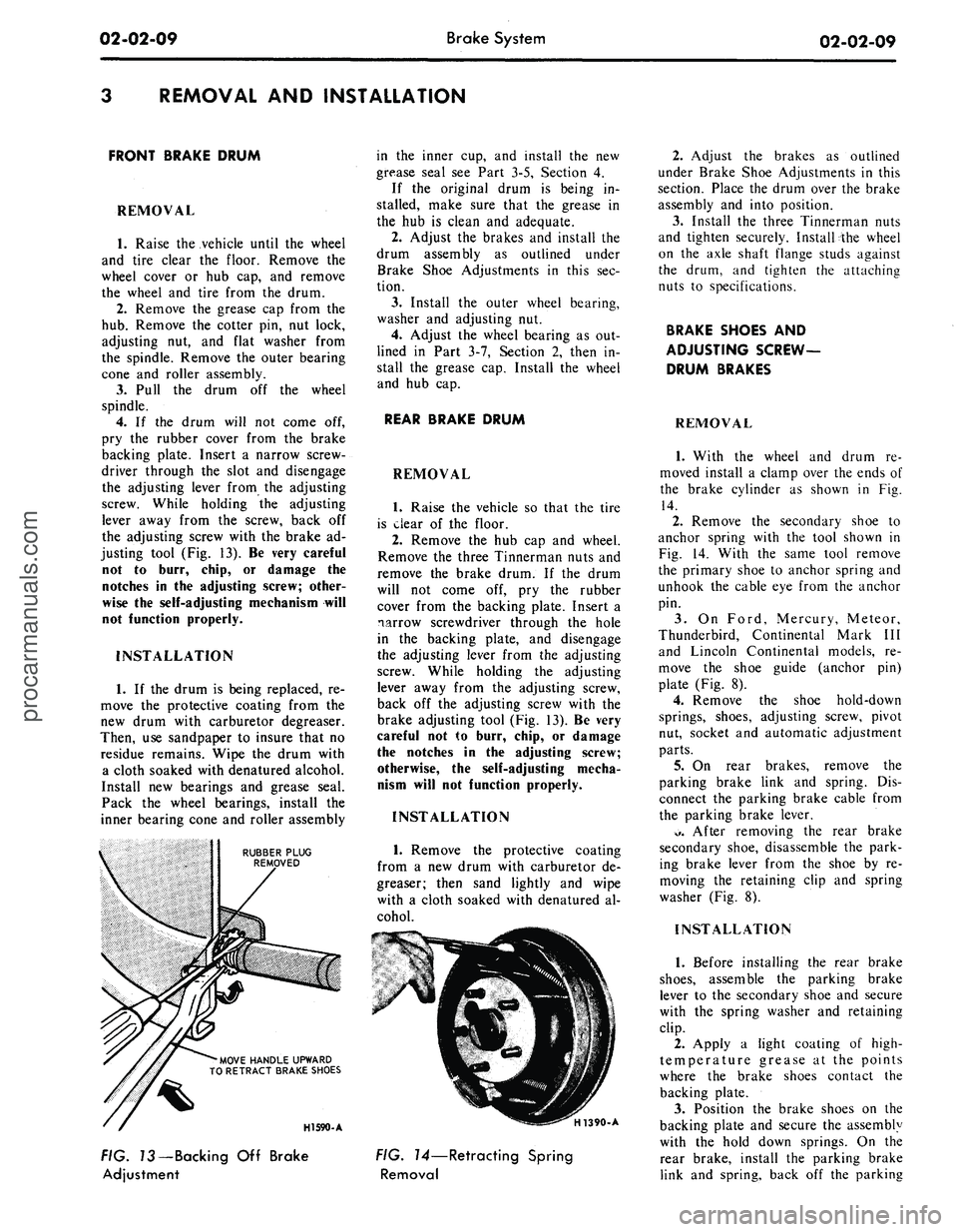
FRONT BRAKE DRUM
REMOVAL
1.
Raise the vehicle until the wheel
and tire clear the floor. Remove the
wheel cover or hub cap, and remove
the wheel and tire from the drum.
2.
Remove the grease cap from the
hub.
Remove the cotter pin, nut lock,
adjusting nut, and flat washer from
the spindle. Remove the outer bearing
cone and roller assembly.
3.
Pull the drum off the wheel
spindle.
4.
If the drum will not come off,
pry the rubber cover from the brake
backing plate. Insert a narrow screw-
driver through the slot and disengage
the adjusting lever from the adjusting
screw. While holding the adjusting
lever away from the screw, back off
the adjusting screw with the brake ad-
justing tool (Fig. 13). Be very careful
not to burr, chip, or damage the
notches in the adjusting screw; other-
wise the self-adjusting mechanism will
not function properly.
INSTALLATION
1.
If the drum is being replaced, re-
move the protective coating from the
new drum with carburetor degreaser.
Then, use sandpaper to insure that no
residue remains. Wipe the drum with
a cloth soaked with denatured alcohol.
Install new bearings and grease seal.
Pack the wheel bearings, install the
inner bearing cone and roller assembly
RUBBER PLUG
REMOVED
'MOVE HANDLE UPWARD
TO RETRACT BRAKE SHOES
in the inner cup, and install the new
grease seal see Part 3-5, Section 4.
If the original drum is being in-
stalled, make sure that the grease in
the hub is clean and adequate.
2.
Adjust the brakes and install the
drum assembly as outlined under
Brake Shoe Adjustments in this sec-
tion.
3.
Install the outer wheel bearing,
washer and adjusting nut.
4.
Adjust the wheel bearing as out-
lined in Part 3-7, Section 2, then in-
stall the grease cap. Install the wheel
and hub cap.
REAR BRAKE DRUM
REMOVAL
1.
Raise the vehicle so that the tire
is clear of the floor.
2.
Remove the hub cap and wheel.
Remove the three Tinnerman nuts and
remove the brake drum. If the drum
will not come off, pry the rubber
cover from the backing plate. Insert a
narrow screwdriver through the hole
in the backing plate, and disengage
the adjusting lever from the adjusting
screw. While holding the adjusting
lever away from the adjusting screw,
back off the adjusting screw with the
brake adjusting tool (Fig. 13). Be very
careful not to burr, chip, or damage
the notches in the adjusting screw;
otherwise, the self-adjusting mecha-
nism will not function properly.
INSTALLATION
1.
Remove the protective coating
from a new drum with carburetor de-
greaser; then sand lightly and wipe
with a cloth soaked with denatured al-
cohol.
HI 590-A
H1390-A
FIG. 73—Backing Off Brake
Adjustment
FIG. 14—Retracting Spring
Removal
2.
Adjust the brakes as outlined
under Brake Shoe Adjustments in this
section. Place the drum over the brake
assembly and into position.
3.
Install the three Tinnerman nuts
and tighten securely. Install the wheel
on the axle shaft flange studs against
the drum, and tighten the attaching
nuts to specifications.
BRAKE SHOES AND
ADJUSTING SCREW-
DRUM BRAKES
REMOVAL
1.
With the wheel and drum re-
moved install a clamp over the ends of
the brake cylinder as shown in Fig.
14.
2.
Remove the secondary shoe to
anchor spring with the tool shown in
Fig. 14. With the same tool remove
the primary shoe to anchor spring and
unhook the cable eye from the anchor
pin.
3.
On Ford, Mercury, Meteor,
Thunderbird, Continental Mark III
and Lincoln Continental models, re-
move the shoe guide (anchor pin)
plate (Fig. 8).
4.
Remove the shoe hold-down
springs, shoes, adjusting screw, pivot
nut, socket and automatic adjustment
parts.
5.
On rear brakes, remove the
parking brake link and spring. Dis-
connect the parking brake cable from
the parking brake lever.
*>.
After removing the rear brake
secondary shoe, disassemble the park-
ing brake lever from the shoe by re-
moving the retaining clip and spring
washer (Fig. 8).
INSTALLATION
1.
Before installing the rear brake
shoes,
assemble the parking brake
lever to the secondary shoe and secure
with the spring washer and retaining
clip.
2.
Apply a light coating of high-
temperature grease at the points
where the brake shoes contact the
backing plate.
3.
Position the brake shoes on the
backing plate and secure the assembly
with the hold down springs. On the
rear brake, install the parking brake
link and spring, back off the parkingprocarmanuals.com
Page 29 of 413

02-02-10
Brake System
02-02-10
brake adjustment then connect the
parking brake cable to the parking
brake lever (Fig. 8).
4.
Install the shoe guide (anchor
pin) plate on the anchor pin when so
equipped.
5.
Place the cable eye over the an-
chor pin with the crimped side toward
the backing plate.
6. Install the primary shoe to an-
chor spring (Fig. 15).
H1391-A
FIG. 75—Retracting Spring
Installation
7.
Install the cable guide on the
secondary shoe web with the flanged
hole fitted into the hole in the second-
ary shoe web. Thread the cable
around the cable guide groove (Fig.
8).
It
is
imperative that
the
cable
be
positioned
in
this groove
and not be-
tween
the
guide
and the
shoe
web.
8.
Install the secondary shoe to an-
chor spring with the tool shown in
Fig. 15.
Be certain that
the
cable
eye is not
cocked
or
binding
on the
anchor
pin
when installed.
All
parts should
be
flat
on
the
anchor
pin.
Remove
the
brake
cylinder clamp.
9. Apply high-temperature grease
(MIC-100-A) to the threads and the
socket end of the adjusting screw.
Turn the adjusting screw into the ad-
justing pivot nut to the limit of the
threads and then back off 1/2 turn.
Interchanging
the
brake shoe
ad-
justing screw assemblies from
one
side
of
the
vehicle
to the
other would cause
the brake shoes
to
retract rather than
expand each time
the
automatic
ad-
justing mechanism operated.
To pre-
vent installation on the wrong side of
the vehicle, the socket end of the ad-
justing screw is stamped with an R or
L (Fig. 16). The adjusting pivot nuts
can be distinguished by the number of
grooves machined around the body of
the nut. Two grooves on the nut indi-
cate a right thread; one groove indi-
cates a left thread.
10.
Place the adjusting socket on
the screw and install this assembly be-
tween the shoe ends with the adjusting
screw toothed wheel nearest the sec-
ondary shoe.
11.
Hook the cable hook into the
hole in the adjusting lever. The adjust-
ing levers are stamped with an R or L
to indicate their installation on right
or left brake assembly (Fig. 16).
12.
Position the hooked end of the
ADJUSTING LEVER
IDENTIFICATION LINES
H1143-C
FIG. 16—Adjusting Screw
and
Lever Identification
adjuster spring completely into the
large hole in the primary shoe web.
The last coil of the spring should be at
the edge of the hole. Connect the loop
end of the spring to the adjuster lever
hole.
13.
Pull the adjuster lever, cable
and automatic adjuster spring down
and toward the rear to engage the
pivot hook in the large hole in the sec-
ondary shoe web (Fig. 8).
14.
After installation, check the ac-
tion of the adjuster by pulling the sec-
tion of the cable between the cable
guide and the anchor pin toward the
secondary shoe web far enough to lift
the lever past a tooth on the adjusting
screw wheel. The lever should snap
into position behind the next tooth,
and release of the cable should cause
the adjuster spring to return the lever
to its original position. This return ac-
tion of the lever will turn the adjusting
screw.one tooth.
If pulling the cable does not pro-
duce the action described, or if the
lever action is sluggish instead of posi-
tive and sharp, check the position of
the lever on the adjusting screw
toothed wheel. With the brake in a
vertical position (anchor at the top),
the lever should contact the adjusting
wheel 3/16 inch (plus or minus 1/32
inch) above the centerline of the
screw. If the contact point is below
this centerline, the lever will not lock
on the teeth in the adjusting screw
wheel, and the screw will not be turned
as the lever is actuated by the cable.
To determine the cause of this con-
dition:
a. Check the cable end fittings. The
cable should completely fill or extend
slightly beyond the crimped section of
the fittings. If it does not meet this
specification, possible damage is indi-
cated and the cable assembly should
be replaced.
b.
Check the cable length. On
Ford, Mercury, Meteor, Thunderbird,
Continental Mark III, and Lincoln
Continental models, the cable should
measure 11 1/8 inches (plus or minus
1/64 inch) from the end of the cable
anchor to the end of the cable hook.
On Fairlane, Montego, Falcon,
Mustang, and Cougar models the
cable should measure 8 13/32 inches
on 9 inch brakes or 9 3/4 inches on
10 inch brakes from the end of the
cable anchor to the end of the cable
hook.
c. Check the cable guide for dam-
age.
The cable groove should be paral-
lel to the shoe web, and the body of
the guide should lie flat against the
web.
Replace the guide if it shows
damage.
d. Check the pivot hook on the
lever. The hook surfaces should be
square with the body of the lever for
proper pivoting. Replace the lever if
the hook shows damage.
e. See that the adjusting; screw
socket is properly seated in the notch
in the shoe web.
WHEEL CYLINDER
DRUM BRAKE
REMOVAL '
1.
Remove the wheel and the drum.
2.
Remove the brake shoe assem-
blies,
following procedures outlined in
this section.
3.
Disconnect the brake line from
the brake cylinder Figs. 17 thru 21.
On
a
vehicle with
a
vacuum brake
booster,
be
sure
the
engine
is
stopped
and there
is no
vacuum
in the
booster
system before disconnecting
the hy-
draulic lines.
To disconnect the hose at a front
cylinder, loosen the tube fitting that
connects the opposite end of the hose
to the brake tube at a bracket on the
frame. Remove the horseshoe-type re-
taining clip from the hose and brack-
et, disengage the hose from the brack-
et, then unscrew the entire hose as-
sembly from the front wheel cylinder.
At a rear cylinder, unscrew the tubeprocarmanuals.com
Page 35 of 413
02-02-16
Brake System
02-02-16
fitting that connects the tube to the
cylinder. Do not pull the metal tube
away from the cylinder. Pulling the
tube out of the cylinder connection
will bend the metal tube and make in-
stallation difficult. The tube will sepa-
rate from the cylinder when the cylin-
der is removed from the backing
plate.
4.
On all except the front wheels on
Ford, Mercury, and Meteor models,
remove the wheel cylinder attaching
bolts and lock washers and remove the
cylinder. On the front wheel of Ford,
Mercury and Meteor models, remove
the nut and washer that attaches the
cylinder to the anchor pin. Remove
the cylinder from the anchor pin.
INSTALLATION
Wipe the end(s) of the hydraulic
line to remove any foreign matter be-
fore making connections.
1.
On all models except Ford, Mer-
cury and Meteor, to install a front
wheel cylinder, position the cylinder to
the backing plate. Install the two lock
washers and attaching bolts. Torque
them to specifications.
On Ford, Mercury and Meteor
models, to install a front wheel cylin-
der, position the cylinder on the an-
chor pin against the backing plate. In-
stall the washer and cylinder attaching
nut on the anchor pin, and torque it
to specification. Lock the washer re-
tainer securely.
2.
Install a new copper gasket over
the hose fitting. Thread the hose into
the cylinder and tighten it to specified
torque.
3.
Engage the opposite end of the
hose to the bracket on the frame. In-
stall the horseshoe-type retaining clip,
and connect the brake tube to the
hose with the tube fitting nut. Tighten
the nut to specification with tool
1112-144.
4.
To install a rear wheel cylinder,
place the rear wheel cylinder into po-
sition. Enter the tubing into the cylin-
der, and start the tube fitting nut into
the threads of the cylinder.
5.
Secure the cylinder to the back-
ing plate by installing the attaching
bolts and lock washers.
6. Tighten the tube fitting nut to
specification with tool 1112-144.
7.
Install the links in the ends of
the wheel cylinder, install the shoes
and adjuster assemblies, and adjust
the shoes as outlined in this section.
8. Adjust the brakes (Part 2-2, Sec-
tion 2). Install the brake drum and
wheel. Bleed the brakes and centralize
the differential valve as outlined in
Part 2-1, Section 2.
BRAKE BACKING PLATE
DRUM BRAKE
REMOVAL
1.
Remove the wheel and brake
drum. Disconnect the brake line from
the brake cylinder.
2.
Remove the brake shoe and ad-
juster assemblies and the wheel cylin-
der as outlined in this section. On the
rear wheels, disconnect the parking
brake lever from the cable.
3.
If the rear backing plate is being
replaced, remove the axle shaft from
the applicable rear axle as outlined in
Group 4, Part 4-2— Rear Axle, Sec-
tion 2, disengage parking brake cable
retainer from backing plate. Remove
the backing plate and gasket.
If the front backing plate is being
replaced, remove the bolts and nuts
that secure the backing plate to the
front wheel spindle and remove the
plate and gasket.
INSTALLATION
If a rear backing plate is to be re-
placed, position a new rear backing
plate and gasket on the attaching
bolts in the axle housing flange. Insert
parking brake cable into backing plate
and secure retaining fingers. Install
the rear axle shaft for applicable rear
axle.
Refer to Group 4, Part 4-2 —
Rear Axle, Section 2 for the proper
installation procedure.
1.
If the front brake backing plate
is to be replaced, position a new front
backing plate and gasket to the wheel
spindle and install the attaching bolts
and nuts.
2.
Install the wheel cylinder and
connect the brake line as outlined in
this section.
3.
Install the brake shoe and ad-
juster assemblies as outlined in this
section. On a rear brake, connect the
parking brake cable to the lever.
4.
Adjust the brake shoes (Section
2),
and install the brake drums and
wheels. Bleed the brake system and
centralize the differential valve as out-
lined in Part 2-1, Section 2.
DISC BRAKE CALIPER
ASSEMBLY
ALL MODELS EXCEPT
LINCOLN CONTINENTAL
Removal
Refer to Figs. 22 and 23.
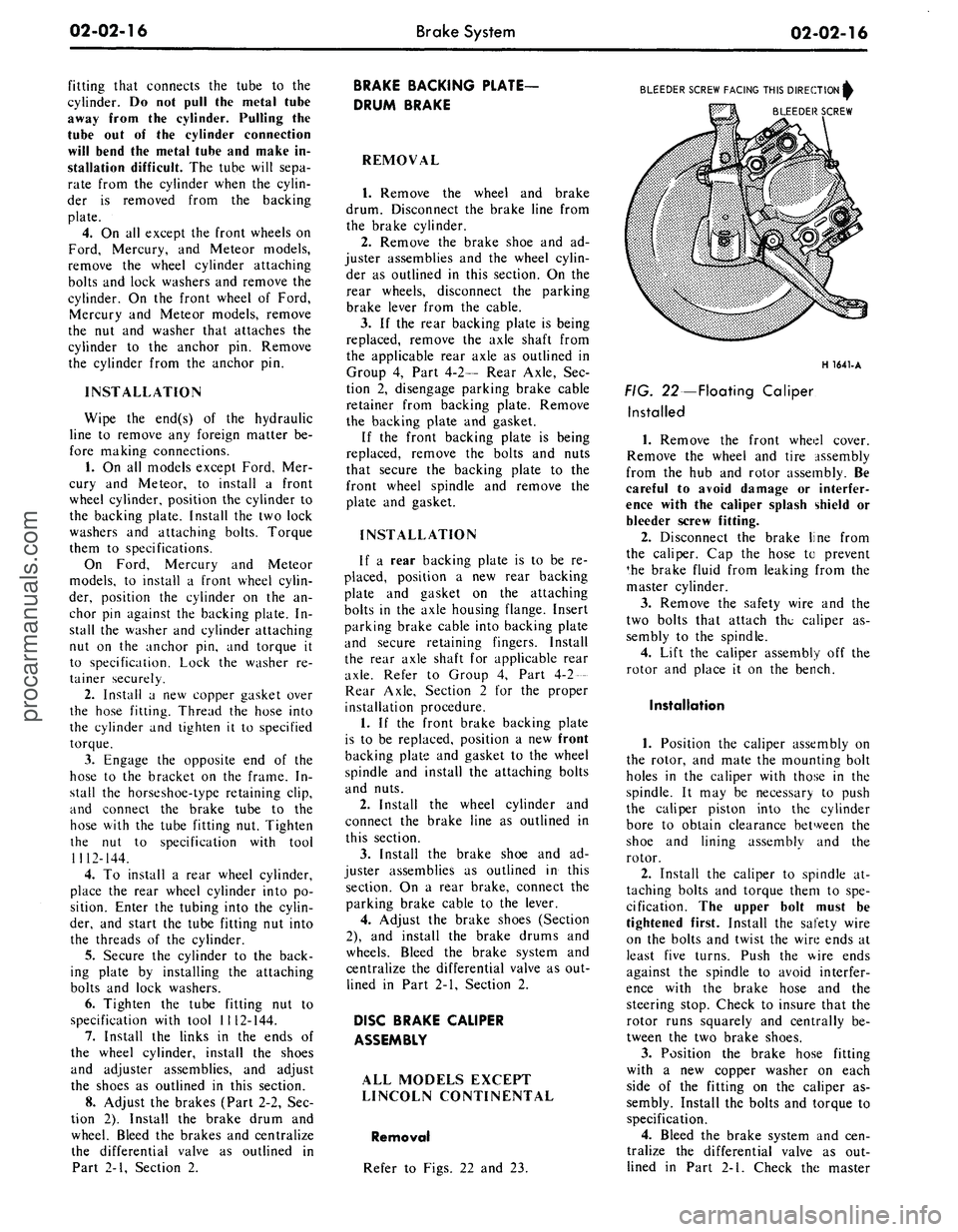
BLEEDER SCREW FACING THIS DIRECTION^
BLEEDER SCREW
H 1641-A
FIG. 22—Floating Caliper
Installed
1.
Remove the front wheel cover.
Remove the wheel and tire assembly
from the hub and rotor assembly. Be
careful to avoid damage or interfer-
ence with the caliper splash shield or
bleeder screw fitting.
2.
Disconnect the brake line from
the caliper. Cap the hose to prevent
*he brake fluid from leaking from the
master cylinder.
3.
Remove the safety wire and the
two bolts that attach the caliper as-
sembly to the spindle.
4.
Lift the caliper assembly off the
rotor and place it on the bench.
Installation
1.
Position the caliper assembly on
the rotor, and mate the mounting bolt
holes in the caliper with those in the
spindle. It may be necessary to push
the caliper piston into the cylinder
bore to obtain clearance between the
shoe and lining assembly and the
rotor.
2.
Install the caliper to spindle at-
taching bolts and torque them to spe-
cification. The upper bolt must be
tightened first. Install the safety wire
on the bolts and twist the wire ends at
least five turns. Push the wire ends
against the spindle to avoid interfer-
ence with the brake hose and the
steering stop. Check to insure that the
rotor runs squarely and centrally be-
tween the two brake shoes.
3.
Position the brake hose fitting
with a new copper washer on each
side of the fitting on the caliper as-
sembly. Install the bolts and torque to
specification.
4.
Bleed the brake system and cen-
tralize the differential valve as out-
lined in Part 2-1. Check the masterprocarmanuals.com