1969 FORD MUSTANG service
[x] Cancel search: servicePage 99 of 413

03-02-23
Suspension
03-02-23
SEDAN MODELS ONLY-
SPRING CLIPS
5705
,^-::^^^^SSSS^
^CS^.-''' .--'""-.'.'""'"* D D
A
f~
V
C
T
BRACKET
(STATION WAGON-
AND RANCHERO
ONLY) 5610
INSULATOR RETAINER
5736
INBOARD
SHACKLE
BUSHING
5791
... ».IA-
vae.
FRONT HANGER
INBOARD BUSHING
FRONT HANGER
OUTBOARD BUSHING
REAR
SHACKLE
ASSEMBLY
5776
OUTBOARD SHACKLE
BUSHING
5791
LOWER INSULATOR 5732
INSULATOR PLATES
(H.D.
STATION WAGON
AND RANCHERO) 5A584
SPRING CLIP PLATE
(STATION WAGON
AND RANCHERO
ONLY) 5798-99
SPRING HANGER
MOUNTING BOLT
HANGER
FIG. 30—Rear Spring and Shock Absorber—Typical
3.
Remove the attaching nut and
washers from the lower end of the
shock absorber.
4.
Remove the shock absorber.
5.
Remove the nut, outer washer,
and insulator that attach the shock
absorber to the mounting plate; then
remove the plate.
6. Inspect the shock absorber for
damage or leaks. If the bushing must
be replaced, the operation may be per-
formed without the use of special
tools.
Wet the rubber bushing with a
soap solution and press it into the
shock absorber eye by hand. Repla-
cethe insulators if they appear worn or
damaged.
Installation
1.
Place the inner washer and insu-
lator on the upper (stud) end of the
shock absorber (Fig. 31).
2.
Install the mounting plate, outer
insulator, washer and nut on the stud.
Torque the nut to specification.
3.
Attach the mounting plate and
shock absorber to the crossmember
with the attaching screws and washers.
Torque the screws to specifications.
4.
Connect the lower end of the
shock absorber to the mounting stud
with the washers and attaching nut.
Torque the nut to specification.
REAR SHOCK ABSORBER
LOWER MOUNTING STUD
REPLACEMENT
LINCOLN CONTINENTAL
If the shock absorber mounting stud
is damaged, replace the stud as fol-
lows:
F 1487-A
1.
Cut off the old stud as close to
the bracket as possible.
2.
Grind off the weld at both ends
of the stud and bracket face.
3.
Drive out the balance of the stud
with a brass drift. Do not enlarge the
hole in the bracket.
4.
Remove any weld remaining on
the sides of the bracket.
5.
Attach the service stud to the
axle housing bracket with a nut. Tor-
que the nut to specification.
6. Stake the nut to prevent loos-
ening.
REAR SPRING
FORD, MERCURY,
METEOR, THUNDERBIRD,
CONTINENTAL MARK III
Removal
1.
Raise the vehicle on a hoist with
the hoist under the rear axle housing.procarmanuals.com
Page 102 of 413
03-02-26
Suspension
03-02-26
T64K-578 7-B2 (Adapter)
-83 (Nut)
(Bolt)
SPRING FRONT
EYE
Tool-T64K-5781-B2 (Adapter)
BUSHING
F 1484-A
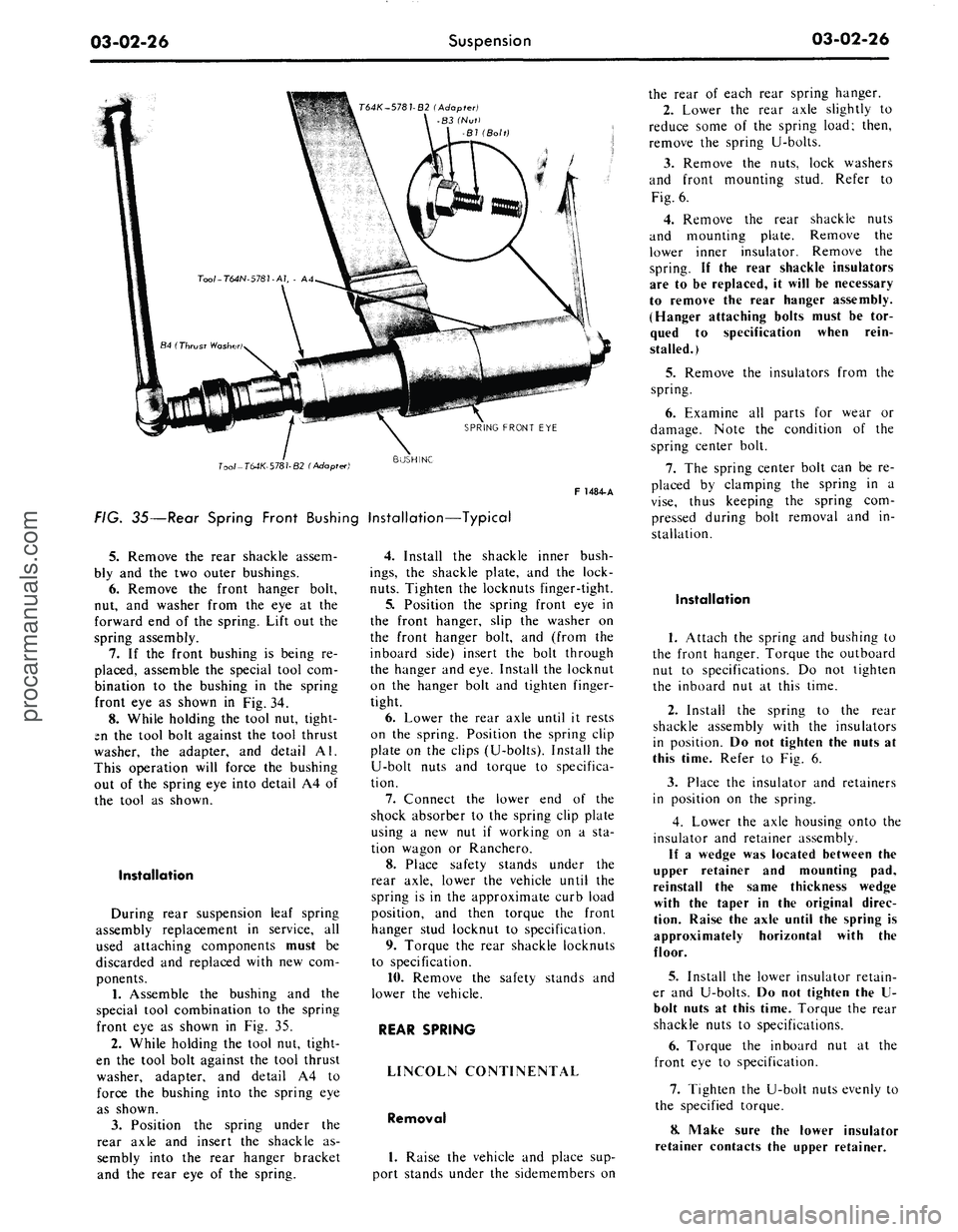
FIG. 35—Rear Spring Front Bushing Installation—Typical
5.
Remove
the
rear shackle assem-
bly
and the two
outer bushings.
6. Remove
the
front hanger bolt,
nut,
and
washer from
the eye at the
forward
end of the
spring. Lift
out the
spring assembly.
7.
If the
front bushing
is
being
re-
placed, assemble
the
special tool
com-
bination
to the
bushing
in the
spring
front
eye as
shown
in
Fig.
34.
8. While holding
the
tool
nut,
tight-
en
the
tool bolt against
the
tool thrust
washer,
the
adapter,
and
detail
Al.
This operation will force
the
bushing
out
of the
spring
eye
into detail
A4 of
the tool
as
shown.
Installation
During rear suspension leaf spring
assembly replacement
in
service,
all
used attaching components must
be
discarded
and
replaced with
new com-
ponents.
1.
Assemble
the
bushing
and the
special tool combination
to the
spring
front
eye as
shown
in Fig. 35.
2.
While holding
the
tool
nut,
tight-
en
the
tool bolt against
the
tool thrust
washer, adapter,
and
detail
A4 to
force
the
bushing into
the
spring
eye
as shown.
3.
Position
the
spring under
the
rear axle
and
insert
the
shackle
as-
sembly into
the
rear hanger bracket
and
the
rear
eye of the
spring.
4.
Install
the
shackle inner bush-
ings,
the
shackle plate,
and the
lock-
nuts.
Tighten
the
locknuts finger-tight.
5.
Position
the
spring front
eye in
the front hanger, slip
the
washer
on
the front hanger bolt,
and
(from
the
inboard side) insert
the
bolt through
the hanger
and
eye. Install
the
locknut
on
the
hanger bolt
and
tighten finger-
tight.
6. Lower
the
rear axle until
it
rests
on
the
spring. Position
the
spring clip
plate
on the
clips (U-bolts). Install
the
U-bolt nuts
and
torque
to
specifica-
tion.
7.
Connect
the
lower
end of the
shock absorber
to the
spring clip plate
using
a new nut if
working
on a sta-
tion wagon
or
Ranchero.
8. Place safety stands under
the
rear axle, lower
the
vehicle until
the
spring
is in the
approximate curb load
position,
and
then torque
the
front
hanger stud locknut
to
specification.
9. Torque
the
rear shackle locknuts
to specification.
10.
Remove
the
safety stands
and
lower
the
vehicle.
REAR SPRING
LINCOLN CONTINENTAL
Removal
1.
Raise
the
vehicle
and
place
sup-
port stands under
the
sidemembers
on
the rear
of
each rear spring hanger.
2.
Lower
the
rear axle slightly
to
reduce some
of the
spring load; then,
remove
the
spring U-bolts.
3.
Remove
the
nuts, lock washers
and front mounting stud. Refer
to
Fig.
6.
4.
Remove
the
rear shackle nuts
and mounting plate. Remove
the
lower inner insulator. Remove
the
spring.
If the
rear shackle insulators
are
to be
replaced,
it
will
be
necessary
to remove
the
rear hanger assembly.
(Hanger attaching bolts must
be tor-
qued
to
specification when rein-
stalled.)
5.
Remove
the
insulators from
the
spring.
6. Examine
all
parts
for
wear
or
damage. Note
the
condition
of the
spring center bolt.
7.
The
spring center bolt
can be re-
placed
by
clamping
the
spring
in a
vise,
thus keeping
the
spring
com-
pressed during bolt removal
and in-
stallation.
Installation
1.
Attach
the
spring
and
bushing
to
the front hanger. Torque
the
outboard
nut
to
specifications.
Do not
tighten
the inboard
nut at
this time.
2.
Install
the
spring
to the
rear
shackle assembly with
the
insulators
in position.
Do not
tighten
the
nuts
at
this time. Refer
to Fig. 6.
3.
Place
the
insulator
and
retainers
in position
on the
spring.
4.
Lower
the
axle housing onto
the
insulator
and
retainer assembly.
If
a
wedge
was
located between
the
upper retainer
and
mounting
pad,
reinstall
the
same thickness wedge
with
the
taper
in the
original direc-
tion. Raise
the
axle until
the
spring
is
approximately horizontal with
the
floor.
5.
Install
the
lower insulator retain-
er
and
U-bolts.
Do not
tighten
the U-
bolt nuts
at
this time. Torque
the
rear
shackle nuts
to
specifications.
6. Torque
the
inboard
nut at the
front
eye to
specification.
7.
Tighten
the
U-bolt nuts evenly
to
the specified torque.
8. Make sure
the
lower insulator
retainer contacts
the
upper retainer.procarmanuals.com
Page 115 of 413
03-05-02
Steering Columns
And
Linkage
03-05-02
which also will shear away during
im-
pact.
TILT STEERING COLUMNS
The steering column
is of the col-
lapsible type
to
lessen
the
possibility
of injury
to the
driver
of the
vehicle
should
he
become involved
in an
acci-
dent.
The
lower
end of the
steering
column tube
at the
bellows area will
collapse approximately
six
inches
upon
a
hard impact.
The shift tube
and the
steering shaft
are provided with plastic dowels
and
will shear
and
allow them
to
collapse
in proportion
to the
outer tube upon
impact.
Once
the
steering column
has
been
collapsed,
a
complete
new
column
must
be
installed.
The tilt column features nine driv-
ing positions (four
up and
four down
from
a
center position).
The
.column
also features
a
turn signal switch with
a lane-changer position turn indicating
position
and
emergency warning flash-
er control.
TILT-AWAY STEERING COLUMNS
The tilt-away steering column
fea-
tures nine driving positions (four
up
and four down from
a
center position)
and
a
tilt-away position that
is
auto-
matically accomplished
on
Mustang
and Cougar models when
the
ignition
key
is
turned
to the
OFF
position
and
the left door
is
opened.
On
Thunder-
bird models,
the
tilt-away occurs when
the shift lever
is
placed
in
PARK
and
the driverns door
is
opened.
The steering column
is of the col-
lapsible type
to
lessen
the
possibility
of injury
to the
driver
of the
vehicle
should
he
become involved
in an
acci-
dent.
The
lower
end of the
steering
column tube
at the
bellows area will
collapse approximately
six
inches
upon
a
hard impact.
The shift tube
and the
steering shaft
are provided with plastic dowels
and
will shear
and
allow them
to
collapse
in proportion
to the
outer tube upon
impact.
Once
the
steering column
has
been
collapsed,
a
complete
new
column
must
be
installed along with mounting
brackets which will also shear away
during impact.
IN-VEHICLE ADJUSTMENTS
AND
REPAIRS
STEERING WHEEL SPOKE
POSITION ADJUSTMENT
When
the
steering gear
is on the
high point,
the
front wheels should
be
in
the
straight-ahead position
and the
steering wheel spokes should
be in
their normal position with
the
Pitman
arm pointing directly forward.
If the
spokes
are not in
their normal posi-
tion, they
can be
adjusted without
dis-
turbing
the
toe-in adjustment (Part
3-1).
STEERING WHEEL
REPLACEMENT
1.
Disconnect
the
negative cable
from
the
battery.
2.
Working from
the
underside
of
the steering wheel spoke, remove
the
crash
pad
attaching screws. Lift
the
crash
pad
from
the
wheel.
(On
Conti-
nental Mark
III
models,
pry out the
crash
pad
insert
and
remove
the two
screws that secure
the
crash
pad. Re-
move
the
crash
pad. On
models
equipped with steering wheel mounted
speed controls, refer
to
Group
16 for
removal instructions). Remove
the
horn ring
(if so
equipped)
by
turning
it counterclockwise.
3.
Remove
the
steering wheel
nut,
and then remove
the
steering wheel
with tool T67L-3600-A
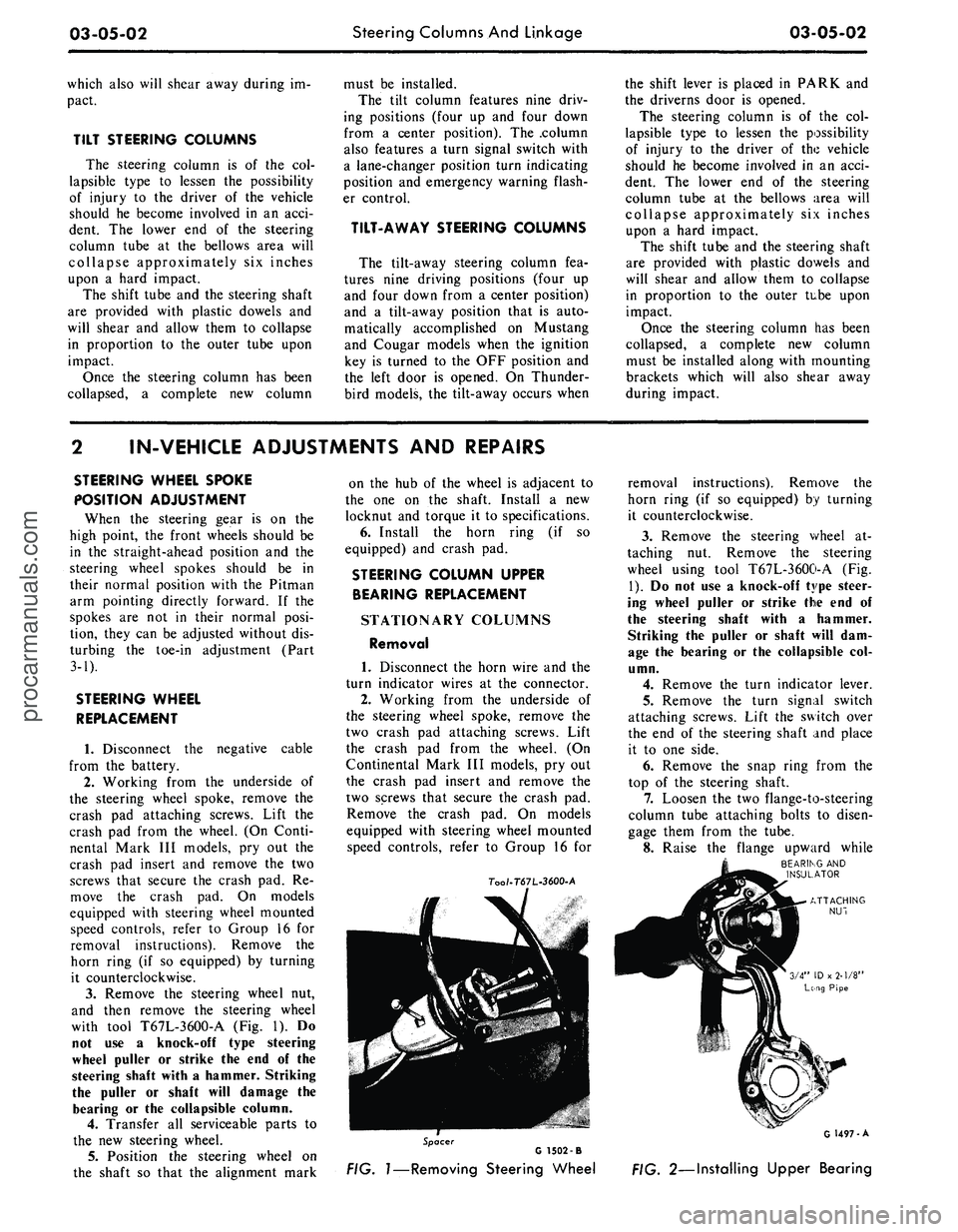
(Fig. 1). Do
not
use a
knock-off type steering
wheel puller
or
strike
the end of the
steering shaft with
a
hammer. Striking
the puller
or
shaft will damage
the
bearing
or the
collapsible column.
4.
Transfer
all
serviceable parts
to
the
new
steering wheel.
5.
Position
the
steering wheel
on
the shaft
so
that
the
alignment mark
on
the hub of the
wheel
is
adjacent
to
the
one on the
shaft. Install
a new
locknut
and
torque
it to
specifications.
6. Install
the
horn ring
(if so
equipped)
and
crash
pad.
STEERING COLUMN UPPER
BEARING REPLACEMENT
STATIONARY COLUMNS
Removal
1. Disconnect
the
horn wire
and the
turn indicator wires
at the
connector.
2.
Working from
the
underside
of
the steering wheel spoke, remove
the
two crash
pad
attaching screws. Lift
the crash
pad
from
the
wheel.
(On
Continental Mark
III
models,
pry out
the crash
pad
insert
and
remove
the
two screws that secure
the
crash
pad.
Remove
the
crash
pad. On
models
equipped with steering wheel mounted
speed controls, refer
to
Group
16 for
7oo/-T67L-3600-A
removal instructions). Remove
the
horn ring
(if so
equipped)
by
turning
it counterclockwise.
3.
Remove
the
steering wheel
at-
taching
nut.
Remove
the
steering
wheel using tool T67L-3600-A
(Fig.
1).
Do not use a
knock-off type steer-
ing wheel puller
or
strike
the end of
the steering shaft with
a
hammer.
Striking
the
puller
or
shaft will
dam-
age
the
bearing
or the
collapsible
col-
umn.
4.
Remove
the
turn indicator lever.
5.
Remove
the
turn signal switch
attaching screws. Lift
the
switch over
the
end of the
steering shaft
and
place
it
to one
side.
6. Remove
the
snap ring from
the
top
of the
steering shaft.
7.
Loosen
the two
flange-to-steering
column tube attaching bolts
to
disen-
gage them from
the
tube.
8. Raise
the
flange upward while
BEARING
AND
INSULATOR
Spacer
G 1502 -B
FIG.
1—Removing
Steering Wheel
G 1497-A
FIG. 2—Installing Upper Bearingprocarmanuals.com
Page 120 of 413

03-05-07
Steering Columns And Linkage
03-05-07
the steering column
(F in Fig. 8).
7.
Disconnect
the
transmission shift
rod
at the
shift tube.
8. Working under
the
hood, install
the aligning spacer (Fig.
9)
around
the
visible portion
of the
steering shaft
and slide
it up the
shaft into
the
steer-
ing column.
It may be
necessary
to
move
the
shaft back
and
forth
to
com-
pletely install
the
spacer.
9.
At
this point
the
steering column
assembly, being loose,
may
have
dropped toward
the
steering gear
grounding
the
steering shaft
on the
steering gear input shaft.
To
properly
establish
the
steering shaft
to
steering
gear clearance, insert
a 1/8
diameter
rod
or
drill through
the
opening
in the
upper half
of the
flex coupling.
10.
Tighten
to a
snug
fit
(approxi-
mately
2-3
ft-lb)
the
nuts retaining
the
toe plates
to the
dash panel
(B in Fig.
8).
11.
If the
aligning spacer cannot
be
rotated freely,
the
dash panel holes
must
be
filed
or
reamed
for
greater
travel
(as
mentioned
in the
second
paragraph
at the
beginning
of
this
procedure).
12.
Tighten
all
nuts
and
bolts
(noted
as C, D and E in
Fig.
8) in the
passenger compartment
to a
snug
fit
(approximately 2-3 ft-lb). Again check
aligning spacer
for
looseness. Perform
these tightening operations
in
alpha-
betical order.
13.
Tighten
the
lateral adjustment
bolt
(F in Fig. 8) to
snug
fit.
Again
check
the
aligning spacer
for
loose-
ness.
14.
Tighten
all
bolts and nuts
to the
proper torque value (listed
in Fig. 8)
in alphabetical order.
15.
Remove
the
steering shaft
al-
igning spacer.
16.
Remove
the 1/8
diameter
rod or
drill previously inserted
in the
flex
coupling.
17.
Reinstall
the
trim
at the
instru-
ment panel
to
steering column mount-
ing.
LINCOLN CONTINENTAL
If
a
condition
of
high shift
or
steer-
ing effort
is
experienced
it may be
caused
by
improper alignment
of the
energy absorbing steering column.
The
following procedures outline
the
steps
necessary
to
correctly realign either
fixed
or
tilt columns:
1.
Disconnect
the
battery.
2.
Loosen four
toe
plate attaching
nuts (Fig.
10).
3.
Loosen
one toe
plate
to
steering
column clamp bolt
and nut.
Check
alignment
of
steering shaft
to
shift
-HANDLE PORTION
2-3/4"
-*- 3/4"
BEND AROUND
STEERING SHAFT
DIMENSION
A:
STANDARD COLUMN 7/16"
TILT WHEEL COLUMN
1-1/8"
•2-3/4
FABRICATE ALIGNING SPACER OUT OF
PLASTIC SHIPPING COLLAR PROVIDED
ON SERVICE DRIVESHAFTS, OR OUT
OF
1/32"—1/16" CARDBOARD
STEERING SHAFT
ALIGNMENT SPACER-BEND AROUND
STEERING SHAFT (DIMENSION
A)
AND
SLIDE UP THE SHAFT INTO COLUMN
G1537-A
FIG. 9—Aligning Spacer Fabrication
and
Insertion
BRAKE PEDAL
SUPPORT BRACKET
PART
A-TOE PLATE
B-CLAMP
C-C0LUMN BRACKET
D-BRAKE PEDAL
SUPPORT BRACKET
TORQUE VALUE
8-12 FT. LB.
3-5 FT. LB.
10-15
FT.
LB.
8-12 FT. LB.
G1541-A
FIG. 10—Steering Column Alignment Locations
and
Torque
Specifications—Lincoln Continentalprocarmanuals.com
Page 135 of 413

03-06-01
Manual Steering
03 06-01
PART
3-6
Manual Steering
COMPONENT INDEX
STEERING GEAR
Cleaning
and
Inspection
(See Part 03-01)
Description
Disassembly
and
Overhaul
Removal
and
Installation
STEERING WORM
AND
SECTOR
Adjustment
and
Repair
MODEL APPLICATION
All
Models
Ford
06-01
06-03
06-02
06-02
Mercury
06-01
06-03
06-02
06-02
Meteor
06-01
06-03
06-02
06-02
Cougar
06-01
06-03
06-02
06-02
Fairlane
06-01
06-03
06-02
06-02
Falcon
06-01
06-03
06-02
06-02
Montego
06-01
06-03
06-02
06-02
Mustang
06-01
06-03
06-02
06-02
Lincoln-
Continental
N/A
N/A
N/A
N/A
Thunderbird
N/A
N/A
N/A
N/A
Continental-
Mark
III
N/A
N/A
N/A
N/A
A page number indicates that the item
is for
the vehicle listed
at
the head
of
the column.
N/A indicates that the item
is not
applicable
to
the vehicle listed.
DESCRIPTION
STEERING GEAR
The steering gear
(Fig.
1) is of the
worm
and
recirculating ball type.
The
sector shaft
is
straddle mounted
hav-
INPUT SHAFT
ing
a
bushing located
in the
cover
above
the
gear
and a
roller bearing
in
the housing below
the
gear.
SECTOR SHAFT ADJUSTMENT SCREW
LOCK
NUT
IDENTIFICATION
TAG
SECTOR SHAFT COVER
The worm bearing preload
is con-
trolled
by the
large adjusting
nut
which
is
threaded into
the
housing.
The sector shaft mesh load
is con-
trolled
by an
adjusting screw located
in
the
housing cover.
The steering linkage consists
of the
Pitman
arm,
steering-arm-to-idler
arm
rod, idler
arm and the
spindle
con-
necting rods
(tie
rods).
A steering gear identification
tag is
provided under
one of the
cover
at-
taching bolts
(Fig.
2).
STEERING GEAR
MODEL
SERVICE IDENTIFICATION
CODE NUMBER
FIG.
1—Manual
Steering Gear
SERIAL NUMBER
OR
DATE CODE
G 1625-A
G
1626-A
FIG. 2—Steering Gear Identification
procarmanuals.com
Page 158 of 413

03-09-06
Saginaw Design Integral Power Steering Gear
03-09-06
ADJUSTER
PLUG
DUST
SEAL
FIG. 14 —Adjuster Plug Disassembled
the plug far enough to provide clear-
ance for the dust seal and the snap
ring.
8. Lubricate a new dust seal
C1AZ-19582-A and install it with
smooth rubber surface facing outward.
9. Secure the dust seal with the
ring, making sure that the ring is
properly seated.
10.
Lubricate a new O-ring seal
with vaseline and install it on the ad-
juster plug.
11.
Assemble the thrust bearing
outer race, thrust bearing, inner race,
and the thrust bearing spacer on the
adjuster plug (Fig. 16).
OIL
RETAINING
SEAL
RING
G
1637-A
12.
Press a new bearing retainer
into the bearing bore. The radial loca-
tion of the dimples is not important.
STUB SHAFT AND
VALVE ASSEMBLY
The control valve and spool is a se-
lect fit and cannot be serviced other
BEARING
AND
RACES
1636-A
FIG. 15 —Removing or Installing
Roller Rearing from Adjuster Plug
G
1635-A
FIG.
76
—Installing Thrust
Bearing Retainer
SPOOL
SPRING
DOWEL
BEARING
RACE
G1634-A
FIG. 77—Control Valve Disassembled
than removing the spool to replace the
dampener O-ring or replace the three
teflon seals or O-rings under the teflon
seals.
1.
Remove the cap to worm O-ring
and discard it (Fig. 17).
2.
Work the rear coil of spool
spring onto the stub shaft bearing sur-
face.
Do not pry on the valve body.
Slide the spring off the shaft.
3.
Extreme care must be used when
removing the valve spool. The diame-
tral clearance between the valve body
and the spool may be as low as 0.0004
inch. The slightest cocking of the
spool may jam it in the valve body.
a. To remove the valve spool, hold
the valve assembly in both hands with
the stub shaft pointing downward.
Push lightly on the valve spool with a
small rod by inserting the rod through
the openings in the end cap (Fig. 18)
until the spool is far enough out of the
valve so that it may be grasped by the
hand. Withdraw the spool with a
steady oscillating pull to prevent jam-
ming. If slight sticking occurs, make a
gentle attempt to reverse the with-
drawal procedure. If this does not free
the spool, it has become cocked in the
valve body bore. Do not attempt to
force the spool in or out if it becomes
cocked. In this case, continue to disas-
semble the valve assembly as follows
and return to the spool as described
later. Remove the stub shaft, torsion
bar, and end cap assembly by holding
the thumbs on the valve body as
shown in Fig. 18. Tap the torsion bar
lightly against the workbench. This
will dislodge the cap from the valve
body to cap pin. The stub shaft, tor-
sion bar and end cap assembly can
now be removed from the valve body.
b.
If the valve spool has become
cocked as described in step 3 above, it
can now be freed. By visual inspection
on a flat surface it can be determined
in which direction the spool is cocked.
A few very light taps with a light soft
plastic or raw-hide mallet should align
the spool in the bore and free it. Do
not tap with anything metallic. If
spool can be rotated, it can be re-
moved.
4.
Remove O-ring dampener seal
from the spool and discard it.
5.
Carefully cut the valve rings and
the ring back-up seals, remove and
discard them, providing the rings show
evidence of excessive wear. The valve
rings are made of filled teflon and it is
very unusual that replacement is re-
quired.
6. Remove the dampener O-ring
from the valve spool and discard it.procarmanuals.com
Page 160 of 413
03-09-08
Saginaw Design Integral Power Steering Gear
03-09-08
Code
Size
6
7
8
9
10
11
Diameter
Mean
0.28117
0.28125
0.28133
0.28141
0.28149
0.28157
Size Range of Ball
(Inch)
0.28112-0.28122
0.28120-0.28130
0.28128-0.28138
0.28136-0.28146
0.28144-0.28154
0.28152-0.28162
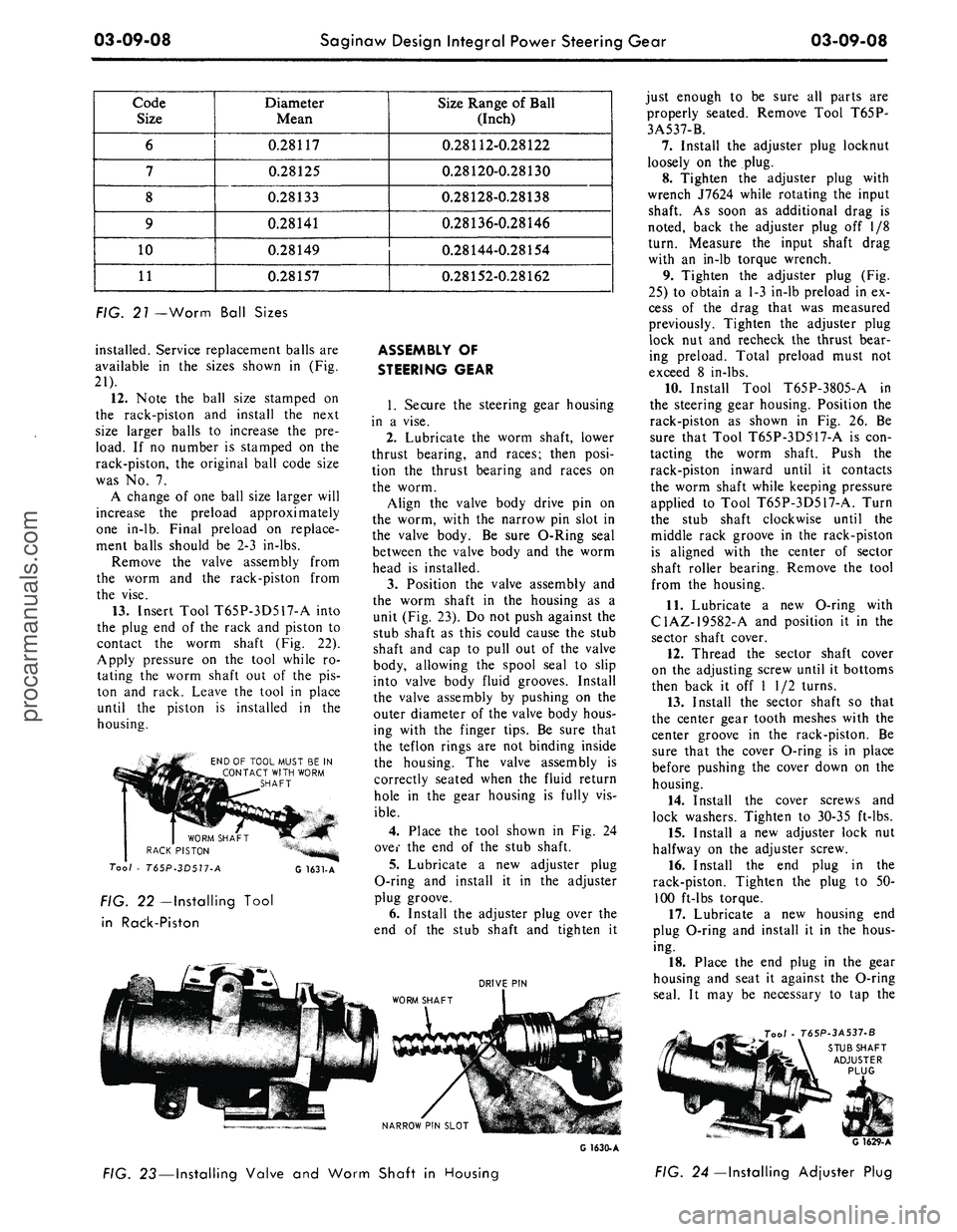
FIG. 21 —Worm Ball Sizes
installed. Service replacement balls are
available in the sizes shown in (Fig.
21).
12.
Note the ball size stamped on
the rack-piston and install the next
size larger balls to increase the pre-
load. If no number is stamped on the
rack-piston, the original ball code size
was No. 7.
A change of one ball size larger will
increase the preload approximately
one in-lb. Final preload on replace-
ment balls should be 2-3 in-lbs.
Remove the valve assembly from
the worm and the rack-piston from
the vise.
13.
Insert Tool T65P-3D517-A into
the plug end of the rack and piston to
contact the worm shaft (Fig. 22).
Apply pressure on the tool while ro-
tating the worm shaft out of the pis-
ton and rack. Leave the tool in place
until the piston is installed in the
housing.
END OF TOOL MUST BE IN
CONTACT WITH WORM
SHAFT
Tool * T65P-3D517-A
FIG. 22—Installing Tool
in Raek-Piston
G 1631-A
ASSEMBLY OF
STEERING GEAR
1.
Secure the steering gear housing
in a vise.
2.
Lubricate the worm shaft, lower
thrust bearing, and races; then posi-
tion the thrust bearing and races on
the worm.
Align the valve body drive pin on
the worm, with the narrow pin slot in
the valve body. Be sure O-Ring seal
between the valve body and the worm
head is installed.
3.
Position the valve assembly and
the worm shaft in the housing as a
unit (Fig. 23). Do not push against the
stub shaft as this could cause the stub
shaft and cap to pull out of the valve
body, allowing the spool seal to slip
into valve body fluid grooves. Install
the valve assembly by pushing on the
outer diameter of the valve body hous-
ing with the finger tips. Be sure that
the teflon rings are not binding inside
the housing. The valve assembly is
correctly seated when the fluid return
hole in the gear housing is fully vis-
ible.
4.
Place the tool shown in Fig. 24
over the end of the stub shaft.
5.
Lubricate a new adjuster plug
O-ring and install it in the adjuster
plug groove.
6. Install the adjuster plug over the
end of the stub shaft and tighten it
DRIVE PIN
just enough to be sure all parts are
properly seated. Remove Tool T65P-
3A537-B.
7.
Install the adjuster plug locknut
loosely on the plug.
8. Tighten the adjuster plug with
wrench J7624 while rotating the input
shaft. As soon as additional drag is
noted, back the adjuster plug off 1/8
turn. Measure the input shaft drag
with an in-lb torque wrench.
9. Tighten the adjuster plug (Fig.
25) to obtain a 1-3 in-lb preload in ex-
cess of the drag that was measured
previously. Tighten the adjuster plug
lock nut and recheck the thrust bear-
ing preload. Total preload must not
exceed 8 in-lbs.
10.
Install Tool T65P-3805-A in
the steering gear housing. Position the
rack-piston as shown in Fig. 26. Be
sure that Tool T65P-3D517-A is con-
tacting the worm shaft. Push the
rack-piston inward until it contacts
the worm shaft while keeping pressure
applied to Tool T65P-3D517-A. Turn
the stub shaft clockwise until the
middle rack groove in the rack-piston
is aligned with the center of sector
shaft roller bearing. Remove the tool
from the housing.
11.
Lubricate a new O-ring with
C1AZ-19582-A and position it in the
sector shaft cover.
12.
Thread the sector shaft cover
on the adjusting screw until it bottoms
then back it off 1 1/2 turns.
13.
Install the sector shaft so that
the center gear tooth meshes with the
center groove in the rack-piston. Be
sure that the cover O-ring is in place
before pushing the cover down on the
housing.
14.
Install the cover screws and
lock washers. Tighten to 30-35 ft-lbs.
15.
Install a new adjuster lock nut
halfway on the adjuster screw.
16.
Install the end plug in the
rack-piston. Tighten the plug to 50-
100 ft-lbs torque.
17.
Lubricate a new housing end
plug O-ring and install it in the hous-
ing.
18.
Place the end plug in the gear
housing and seat it against the O-ring
seal. It may be necessary to tap the
Tool
T65P-3A537-B
STUB SHAFT
ADJUSTER
PLUG
G 1630-A
FIG. 23—Installing Valve and Worm Shaft in Housing
G 1629-A
FIG. 24 —Installing Adjuster Plugprocarmanuals.com
Page 164 of 413
03-10-03
Ford-Thompson Power Steering Pump
03-10-03
EIGHT CYLINDER WITH
AIR CONDITIONER
1.
Remove the power steering fluid
from the pump reservoir by discon-
necting the fluid return hose from the
reservoir and allow the fluid to drain
in a suitable container.
2.
Disconnect the pressure hose
from the pump.
3.
Remove 3 bolts from the front of
the pump and the one nut at the rear
that attach the pump to the mounting
bracket and remove the drive belt
from the pump pulley.
4.
Loosen the upper pump bracket-
to-engine attaching bolt and remove
the bolt in the belt adjusting slot. Re-
move the pump.
5.
Position the pump to the bracket
and install the bracket-to-pump at-
taching bolts and nuts. Tighten to spe-
cifications.
6. Place the belt on the pump pul-
ley. Adjust the belt tension as outlined
in Section 2 and tighten the bolts and
nut to specification.
7.
Torque the pressure hose fitting
hex nut to specification. Then, connect
the pressure hose to the fitting and
torque the hose nut to specification.
8. Connect the return hose to the
power steering pump and tighten the
clamp.
9. Fill the pump with automatic
transmission fluid C1AZ-19582-A.
Bleed the air from the system (Part
3-1) and check for leaks and again
check the fluid level. Add fluid as re-
quired.
POWER STEERING PUMP
PULLEY REPLACEMENT
REMOVAL
1.
Drain as much of the fluid as
possible from the pump through filler
pipe.
2.
Install a 3/8-16 inch capscrew in
the end of the pump shaft to prevent
damage to the shaft end by the tool
screw.
3.
Install the pulley remover, Tool
T63L-1O3OO-B, on pulley hub, and
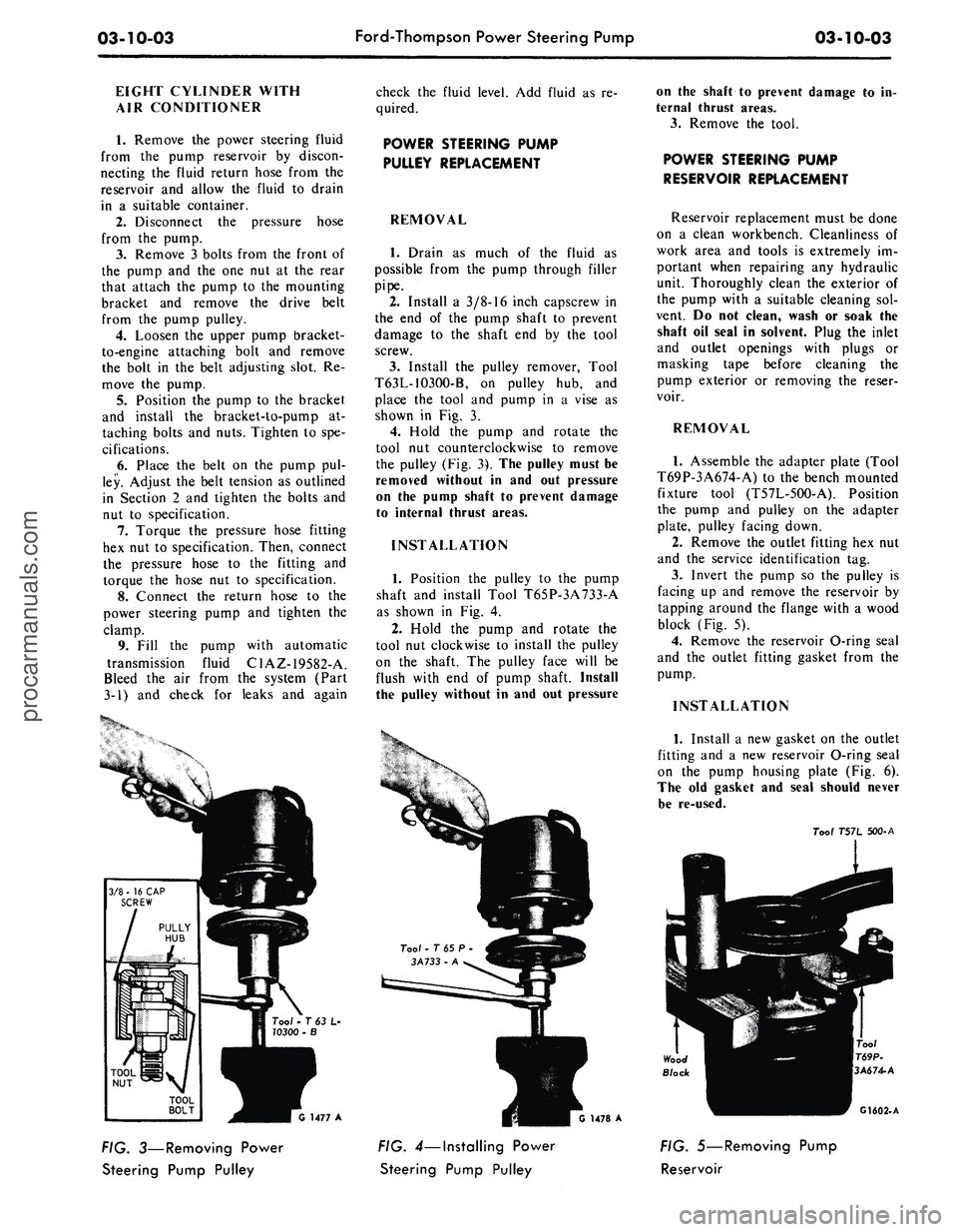
place the tool and pump in a vise as
shown in Fig. 3.
4.
Hold the pump and rotate the
tool nut counterclockwise to remove
the pulley (Fig. 3). The pulley must be
removed without in and out pressure
on the pump shaft to prevent damage
to internal thrust areas.
INSTALLATION
1.
Position the pulley to the pump
shaft and install Tool T65P-3A733-A
as shown in Fig. 4.
2.
Hold the pump and rotate the
tool nut clockwise to install the pulley
on the shaft. The pulley face will be
flush with end of pump shaft. Install
the pulley without in and out pressure
on the shaft to prevent damage to in-
ternal thrust areas.
3.
Remove the tool.
POWER STEERING PUMP
RESERVOIR REPLACEMENT
Reservoir replacement must be done
on a clean workbench. Cleanliness of
work area and tools is extremely im-
portant when repairing any hydraulic
unit. Thoroughly clean the exterior of
the pump with a suitable cleaning sol-
vent. Do not clean, wash or soak the
shaft oil seal in solvent. Plug the inlet
and outlet openings with plugs or
masking tape before cleaning the
pump exterior or removing the reser-
voir.
REMOVAL
1.
Assemble the adapter plate (Tool
T69P-3A674-A) to the bench mounted
fixture tool (T57L-5OO-A). Position
the pump and pulley on the adapter
plate, pulley facing down.
2.
Remove the outlet fitting hex nut
and the service identification tag.
3.
Invert the pump so the pulley is
facing up and remove the reservoir by
tapping around the flange with a wood
block (Fig. 5).
4.
Remove the reservoir O-ring seal
and the outlet fitting gasket from the
pump.
INSTALLATION
Tool • T 63 L-
10300 -
G 1477 A
FIG. 3—Removing Power
Steering Pump Pulley
1478 A
FIG. 4—Installing Power
Steering Pump Pulley
1.
Install a new gasket on the outlet
fitting and a new reservoir O-ring seal
on the pump housing plate (Fig. 6).
The old gasket and seal should never
be re-used.
Too/
T57L 500-A
G1602-A
FIG. 5—Removing Pump
Reservoirprocarmanuals.com