1969 FORD MUSTANG service
[x] Cancel search: servicePage 165 of 413
03-10-04
Ford-Thompson Power Steering Pump
03-10-04
OUTLET FITTING
GASKET
Wood Block
0-RING SEAL
G1345-
-500-
A
G1603- A
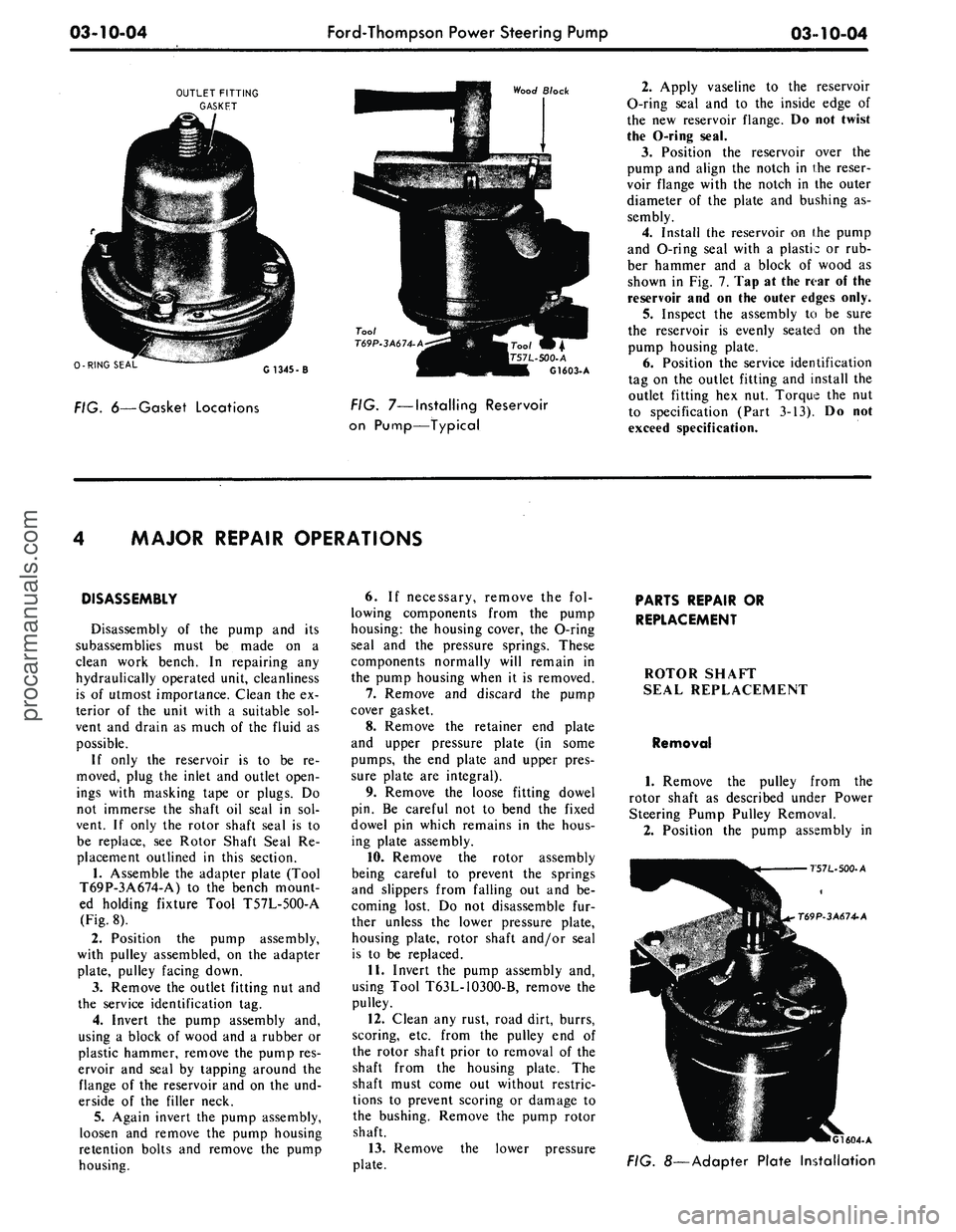
FIG. 6—Gasket Locations
FIG.
7—Installing
Reservoir
on Pump—Typical
2.
Apply vaseline to the reservoir
O-ring seal and to the inside edge of
the new reservoir flange. Do not twist
the O-ring seal.
3.
Position the reservoir over the
pump and align the notch in the reser-
voir flange with the notch in the outer
diameter of the plate and bushing as-
sembly.
4.
Install the reservoir on the pump
and O-ring seal with a plastic or rub-
ber hammer and a block of wood as
shown in Fig. 7. Tap at the rear of the
reservoir and on the outer edges only.
5.
Inspect the assembly to be sure
the reservoir is evenly seated on the
pump housing plate.
6. Position the service identification
tag on the outlet fitting and install the
outlet fitting hex nut. Torque the nut
to specification (Part 3-13). Do not
exceed specification.
MAJOR REPAIR OPERATIONS
DISASSEMBLY
Disassembly of the pump and its
subassemblies must be made on a
clean work bench. In repairing any
hydraulically operated unit, cleanliness
is of utmost importance. Clean the ex-
terior of the unit with a suitable sol-
vent and drain as much of the fluid as
possible.
If only the reservoir is to be re-
moved, plug the inlet and outlet open-
ings with masking tape or plugs. Do
not immerse the shaft oil seal in sol-
vent. If only the rotor shaft seal is to
be replace, see Rotor Shaft Seal Re-
placement outlined in this section.
1.
Assemble the adapter plate (Tool
T69P-3A674-A) to the bench mount-
ed holding fixture Tool T57L-5OO-A
(Fig. 8).
2.
Position the pump assembly,
with pulley assembled, on the adapter
plate, pulley facing down.
3.
Remove the outlet fitting nut and
the service identification tag.
4.
Invert the pump assembly and,
using a block of wood and a rubber or
plastic hammer, remove the pump res-
ervoir and seal by tapping around the
flange of the reservoir and on the und-
erside of the filler neck.
5.
Again invert the pump assembly,
loosen and remove the pump housing
retention bolts and remove the pump
housing.
6. If necessary, remove the fol-
lowing components from the pump
housing: the housing cover, the O-ring
seal and the pressure springs. These
components normally will remain in
the pump housing when it is removed.
7.
Remove and discard the pump
cover gasket.
8. Remove the retainer end plate
and upper pressure plate (in some
pumps, the end plate and upper pres-
sure plate are integral).
9. Remove the loose fitting dowel
pin. Be careful not to bend the fixed
dowel pin which remains in the hous-
ing plate assembly.
10.
Remove the rotor assembly
being careful to prevent the springs
and slippers from falling out and be-
coming lost. Do not disassemble fur-
ther unless the lower pressure plate,
housing plate, rotor shaft and/or seal
is to be replaced.
11.
Invert the pump assembly and,
using Tool T63L-1O3OO-B, remove the
pulley.
12.
Clean any rust, road dirt, burrs,
scoring, etc. from the pulley end of
the rotor shaft prior to removal of the
shaft from the housing plate. The
shaft must come out without restric-
tions to prevent scoring or damage to
the bushing. Remove the pump rotor
shaft.
13.
Remove the lower pressure
plate.
PARTS REPAIR OR
REPLACEMENT
ROTOR SHAFT
SEAL REPLACEMENT
Removal
1.
Remove the pulley from the
rotor shaft as described under Power
Steering Pump Pulley Removal.
2.
Position the pump assembly in
T57L-500-A
T69P-3A674-A
•
G1604-A
FIG. 8—Adapter Plate Installationprocarmanuals.com
Page 168 of 413
03-10-07
Ford-Thompson Power Steering Pump
03-10-07
15.
Place small amounts of vaseline
on the pump housing plate to hold the
cover gasket in place. Install the gas-
ket on the pump housing plate.
16.
Insert the pressure plate springs
into the pockets in the pump valve as-
sembly. Vaseline may be placed in the
spring pockets to hold the springs in
position (Fig. 17).
17.
Using Tool T69P-3B586-A,
plug the intake hole in the housing
(Fig. 17).
18.
Lubricate the inside of the
housing and the housing cover seal
with C1AZ-19582-A lubricant. Fabri-
cate two studs (3/8-16x1.55 ) to be
used as positioning guides. Install one
in the housing plate bolt hole closest
to the drain hole and one in the bolt
hole diametrically opposite.
19.
Align the small diameter lube
hole in the housing rim with the lube
hole in the housing plate.
20.
Install the housing, applying an
even, downward pressure. The pres-
sure plate springs must not be jarred
and moved out of position. Remove
the guide studs.
21.
Install the housing retaining
bolts finger tight.
22.
Remove Tool T69P-3B586-A.
23.
Torque the retaining bolts even-
ly to 28-32 ft-lbs until the housing
flange contacts the gasket.
24.
Install a 3/8x16 hex head
screw, finger tight, into the end of the
rotor shaft. Using a torque wrench,
check the input torque of the shaft
(Fig. 18). The torque should not ex-
ceed 15 in-lbs. If it does, loosen the
retaining bolts slightly, rotate the
rotor shaft, retorque the bolts evenly
and again check the shaft torque. The
pump must not be used if the shaft
torque exceeds 15 in-lbs.
25.
Release the pin in the bench
holding fixture and agitate the pump
assembly back and forth. If there is a
rattle, the pressure plate springs have
fallen out of their seats and must be
reinstalled.
26.
Install the reservoir O-ring on
the housing plate being careful not to
twist the O-ring. Apply vaseline to the
seal and to the ID of the reservoir
flange.
27.
Install the reservoir, aligning
the notch in the reservoir flange with
the notch in the OD of the pump
housing plate and bushing assembly.
Using only a plastic or rubber ham-
mer, tap at the rear on the outer cor-
ners of the reservoir to avoid damage.
28.
Inspect the assembly to deter-
mine if the reservoir is seated on the
housing plate.
29.
Install the service identification
tag on the outlet valve fitting.
30.
Install the outlet valve fitting
nut and torque to 43-47 ft-lbs.
31.
Invert the pump assembly.
32.
If the pulley was removed, in-
stall the correct pulley using Tool
T65P-3A733-A.procarmanuals.com
Page 181 of 413

03-13-02
Specifications
03-13-02
POWER STEERING PUMP
SERVICE
SPECIFICATIONS
Description
Pump Rotor Shaft End Play
Max. Torque Allowed
to
Rotate Rotor Shaft
Stamped Housing to Plate
Assy. Screw and Washer Assy.
Reservoir
to
Stamped Housing
Nut
Cam Ring to Pressure Plate
Screw
Housing to Cover Screw
Ford-Thompson
.017 in. Max.-.003 in. Min.
15 In-Lb.
28-32 Ft.-Lb.
43-47 Ft.-Lb.
_
-
Eaton
—
_
-
—
20 In-Lb.
15-20 Ft,-Lb.
FORD-THOMPSON POWER STEERING
PUMP
TORQUE
LIMITS (FT-LBS)
Description
Pump Rear Mounting Nut
Pressure Hose Nut
Pump Attaching Nuts
Bracket
to
Engine Attaching Nuts
6-Cyl.
302-351 CID
390,427,428,429 CID
Bracket
to
Cylinder Head
Belt Adjustment Bolt
Rear Support Bracket Attaching Nuts
Bracket
to
Engine Adapter
Engine Adapter
to
Engine
Engine Adapter
to
Pump
240 CID
170-200 CID
170-200 CID
250 CID
250 CID
Ford,
Mercury,
Meteor,
Thunderbird
14-18
20-30
25-35
1216
18-25
30-40
25-35
-
45-60
-
-
-
-
Cougar, Falcon,
Fairlane, Montego,
Mustang
20-30
20-30
30-40
7-10
18-25
30-40
25-35
25-35
-
25-35
17-25
30-40
25-35
INTEGRAL
POWER
STEERING GEAR SPECIFICATIONS
Description
Type
Ratio
Turns of Steering Wheel (Lock
to
Lock-Linkage Disconnected)
Fluid Specifications
Fluid Capacity (Included in Pump Reservoir Fill)
Phosphorescent Dye Additive (For Leak Detection)
Sector Shaft End Play -Linkage Disconnected
Sector Shaft Mesh Load. Total Over Mechanical Center
Position.
Must beCDGreater Than Worm
Bearing Preload Torque, Shown Below
Worm Bearing Preload
Clearance Between Valve Spool
&
Retaining Ring
Pressure Variation Between Right
&
Left Turn (At 250
P.S.I.)
-
Check Efforts Each Side
of
Center
Clearance Between Inner Sector Seal and Housing
Ford Design
(XR-«0)
Saginaw
Design
Recirculating Ball Torsion Bar
17:1
4
17.5:1
41/8
M-2C33-F
1.6 Pints (Approx.)
M99B103-A(4 0z. per quart)
None
14 In Lb (Max)
(Exc. Lincoln)
17
In
Lb (Max.)
(Lincoln)
2-7 la
U)
.0035-.0005"
Preferable .002"
4
In
Lb Max.
Variation
.025"
.002"
Max.
14
In
Lb (Max)
4-7 In Lb®
_
—
-
©8-9 In Lb (XR-50 Exc. Lincoln) 11-12 In Lb
for
Uncoln,
4-8 In
Lb
for
Saginaw Gear.
® 3 In Lb in Excess of Valve Assy. Drag Total Worm Bearing Preload and Seal Drag
not to
Exceed
8 In
Lb.procarmanuals.com
Page 182 of 413
03-13-03
Specifications
03-13-03
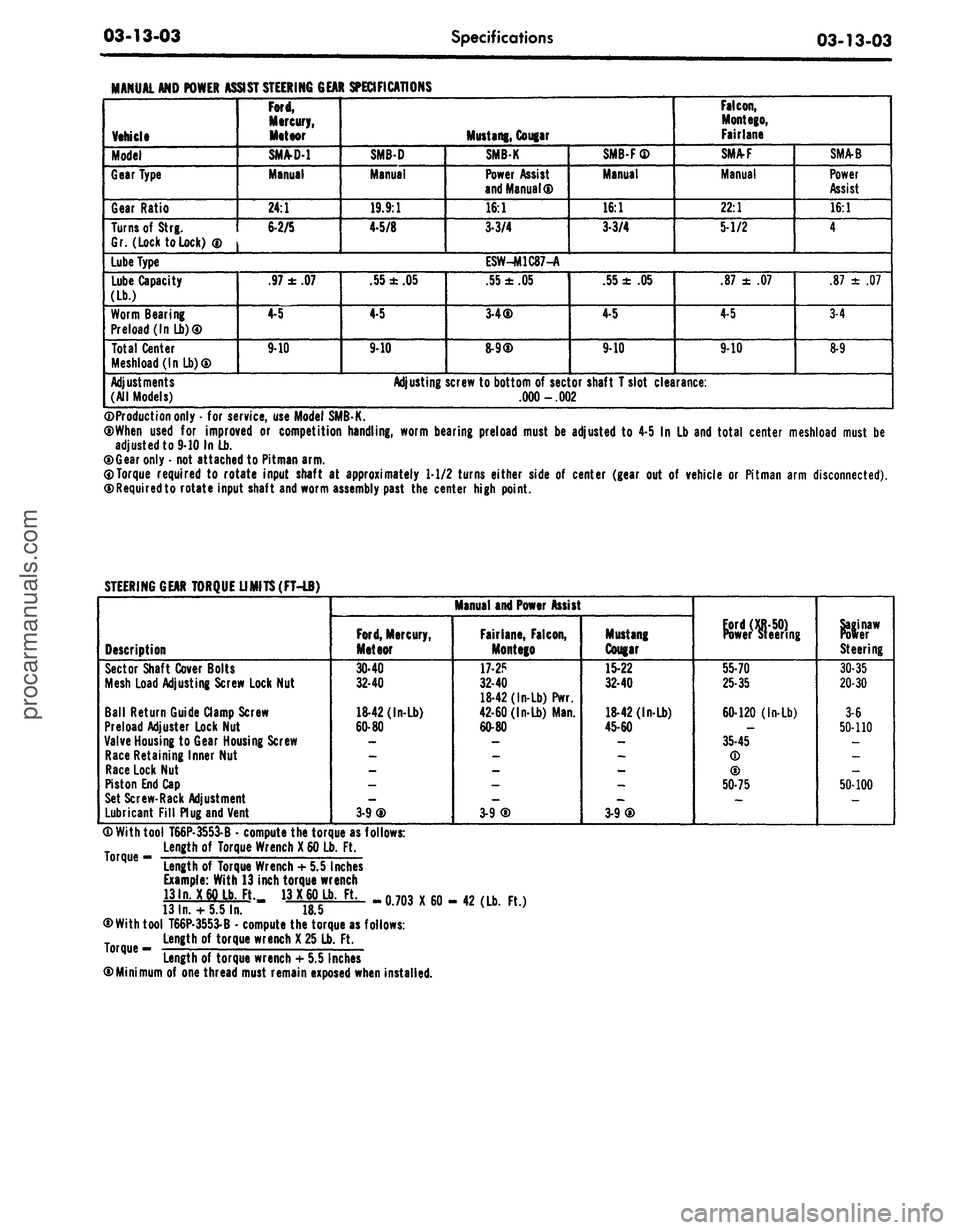
MANUAL AND POWER
Vehicle
Model
Gear Type
Gear Ratio
Turns of
Strg.
Gr. (Lock to Lock)
®
Lube Type
Lube Capacity
(Lb.)
Worm Bearing
Preload (In Lb)®
Total Center
Meshload(lnLb)®
Adjustments
(All Models)
ASSIST STEERING GEAR SPECIFICATIONS
Ford,
Mercury,
Meteor
SM/VD-1
Manual
24:1
6-2/5
.97
±
.07
4-5
9-10
SMB-D
Manual
19.9:1
4-5/8
.55
±
.05
4-5
9-10
Adjusting
Mustang, Cougar
SMBK
Power Assist
and Manual®
16:1
3-3/4
ESW-M1C87-A
.55
±
.05
3-4®
8-9®
screw to bottom
of
sector
.000 -.002
SMB-F®
Manual
16:1
3-3/4
.55
±
.05
4-5
9-10
shaft T slot clearance:
Falcon,
Mont ego,
Fairlane
SMA-F
Manual
22:1
5-1/2
.87
±
.07
4-5
9-10
SMA-B
Power
Assist
16:1
4
.87
±
.07
3-4
8-9
©Production only
-
for service, use Model SMB-K.
®When used
for
improved
or
competition handling, worm bearing preload must
be
adjusted
to
4-5
In
Lb and total center meshload must
be
adjusted to 9-10 In Lb.
®Gear only
-
not attached to Pitman arm.
0Torque required
to
rotate input shaft
at
approximately 1-1/2 turns either side
of
center (gear
out of
vehicle
or
Pitman arm disconnected).
©Requiredto rotate input shaft and worm assembly past
the
center high point.
STEERING GEAR TORQUE UMITS(FT-LB)
Description
Sector Shaft Cover Bolts
Mesh Load Adjusting Screw Lock Nut
Ball Return Guide Clamp Screw
Preload Adjuster Lock Nut
Valve Housing
to
Gear Housing Screw
Race Retaining Inner Nut
Race Lock Nut
Piston End Cap
Set Screw-Rack Adjustment
Lubricant Fill Plug and Vent
Manual and Power Assist
Ford,
Mercury,
Meteor
30-40
32-40
18-42 (In-Lb)
60-80
3-9®
Fairlane, Falcon,
Montego
17-2?
32-40
18-42 (In-Lb) Pwr.
42-60 (In-Lb) Man.
60-80
3-9®
Mustang
Cougar
15-22
32-40
18-42 (In-Lb)
45-60
3-9®
Power steering
55-70
25-35
60-120 (In-Lb)
35-45
(D
®
50-75
Steering
30-35
20-30
3-6
50-110
50-100
® With tool T66P-3553-B
•
compute the torque as follows:
Length
of
Torque Wrench
X
60 Lb.
Ft.
°rque
"
Length
of
Torque Wrench
+
5.5 Inches
Example: With 13 inch torque wrench
13ln.
X
60 Lb. Ft. 13
X
60 Lb.
Ft.
13
In.
+
5.5 In.
18.5
®With tool T66P-3553-B
•
compute the torque as follows:
Length
of
torque wrench
X
25 Lb.
Ft.
Length of torque wrench
+
5.5 Inches
©Minimum
of
one thread must remain exposed when installed.
-0.703 X60- 42 (Lb.
Ft.)procarmanuals.com
Page 187 of 413
03-13-08
Specifications
03-13-08
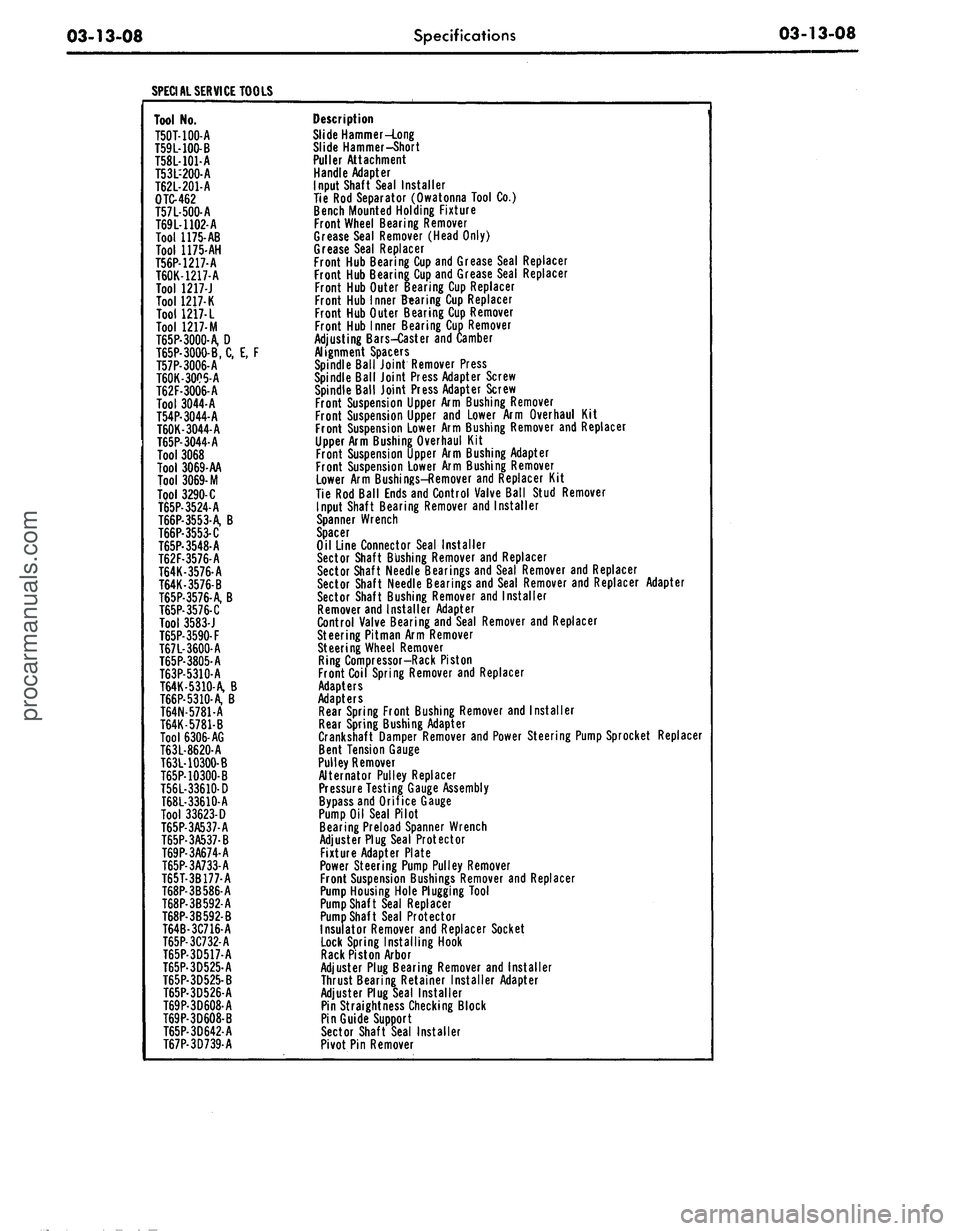
SPECIAL SERVICE TOOLS
Tool No.
T50T-100-A
T59L-100-B
T58L-101-A
T53L-200-A
T62L-201-A
OTC-462
T57L-500-A
T69L-1102-A
Tool 1175-AB
Tool 1175-AH
T56P-1217-A
T60K-1217-A
Tool 1217-J
Tool 1217-K
Tool
1217- L
Tool 1217-M
T65P-3000-A, D
T65P-3000-B, C, E, F
T57P-3006-A
T60K-3005-A
T62F-3006-A
Tool 3044-A
T54P-3044-A
T60K-3044-A
T65P-3044-A
Tool 3068
Tool 3069-AA
Tool
3069-
M
Tool 3290-C
T65P-3524-A
T66P-3553-A, B
T66P-3553-C
T65P-3548-A
T62F-3576-A
T64K-3576-A
T64K-3576-B
T65P-3576-A, B
T65P-3576-C
Tool 3583-J
T65P-3590-F
T67L-3600-A
T65P-3805-A
T63P-5310-A
T64K-5310-A, B
T66P-5310-A, B
T64N-5781-A
T64K-5781-B
Tool 6306-AG
T63L-8620-A
T63L-10300-B
T65P-10300-B
T56L-33610-D
T68L-33610-A
Tool 33623-D
T65P-3A537-A
T65P-3A537-B
T69P-3A674-A
T65P-3A733-A
T65T-3B177-A
T68P-3B586-A
T68P-3B592-A
T68P-3B592-B
T64B-3C716-A
T65P-3C732-A
T65P-3D517-A
T65P-3D525-A
T65P-3D525-B
T65P-3D526-A
T69P-3D608-A
T69P-3D608-B
T65P-3D642-A
T67P-3D739-A
Description
Slide Hammer-Long
Slide Hammer-Short
Puller Attachment
Handle Adapter
Input Shaft Seal Installer
Tie Rod Separator (Owatonna Tool Co.)
Bench Mounted Holding Fixture
Front Wheel Bearing Remover
Grease Seal Remover (Head Only)
Grease Seal Replacer
Front Hub Bearing Cup and Grease Seal Replacer
Front Hub Bearing Cup and Grease Seal Replacer
Front Hub Outer Bearing Cup Replacer
Front Hub Inner Bearing Cup Replacer
Front Hub Outer Bearing Cup Remover
Front Hub Inner Bearing Cup Remover
Adjusting Bars-Caster and Camber
Alignment Spacers
Spindle Ball Joint Remover Press
Spindle Ball Joint Press Adapter Screw
Spindle Ball Joint Press Adapter Screw
Front Suspension Upper Arm Bushing Remover
Front Suspension Upper and Lower Arm Overhaul Kit
Front Suspension Lower Arm Bushing Remover and Replacer
Upper Arm Bushing Overhaul Kit
Front Suspension Upper Arm Bushing Adapter
Front Suspension Lower Arm Bushing Remover
Lower Arm Bushings-Remover and Replacer Kit
Tie Rod Ball Ends and Control Valve Ball Stud Remover
Input Shaft Bearing Remover and Installer
Spanner Wrench
Spacer
Oil Line Connector Seal Installer
Sector Shaft Bushing Remover and Replacer
Sector Shaft Needle Bearings and Seal Remover and Replacer
Sector Shaft Needle Bearings and Seal Remover and Replacer Adapter
Sector Shaft Bushing Remover and Installer
Remover and Installer Adapter
Control Valve Bearing and Seal Remover and Replacer
Steering Pitman Arm Remover
Steering Wheel Remover
Ring Compressor-Rack Piston
Front Coil Spring Remover and Replacer
Adapters
Adapters
Rear Spring Front Bushing Remover and Installer
Rear Spring Bushing Adapter
Crankshaft Damper Remover and Power Steering Pump Sprocket Replacer
Bent Tension Gauge
Pulley Remover
Alternator Pulley Replacer
Pressure Testing Gauge Assembly
Bypass and Orifice Gauge
Pump Oil Seal Pilot
Bearing Preload Spanner Wrench
Adjuster Plug Seal Protector
Fixture Adapter Plate
Power Steering Pump Pulley Remover
Front Suspension Bushings Remover and Replacer
Pump Housing Hole Plugging Tool
Pump Shaft Seal Replacer
Pump Shaft Seal Protector
Insulator Remover and Replacer Socket
Lock Spring Installing Hook
Rack Piston Arbor
Adjuster Plug Bearing Remover and Installer
Thrust Bearing Retainer Installer Adapter
Adjuster Plug Seal Installer
Pin Straightness Checking Block
Pin Guide Support
Sector Shaft Seal Installer
Pivot Pin Removerprocarmanuals.com
Page 188 of 413
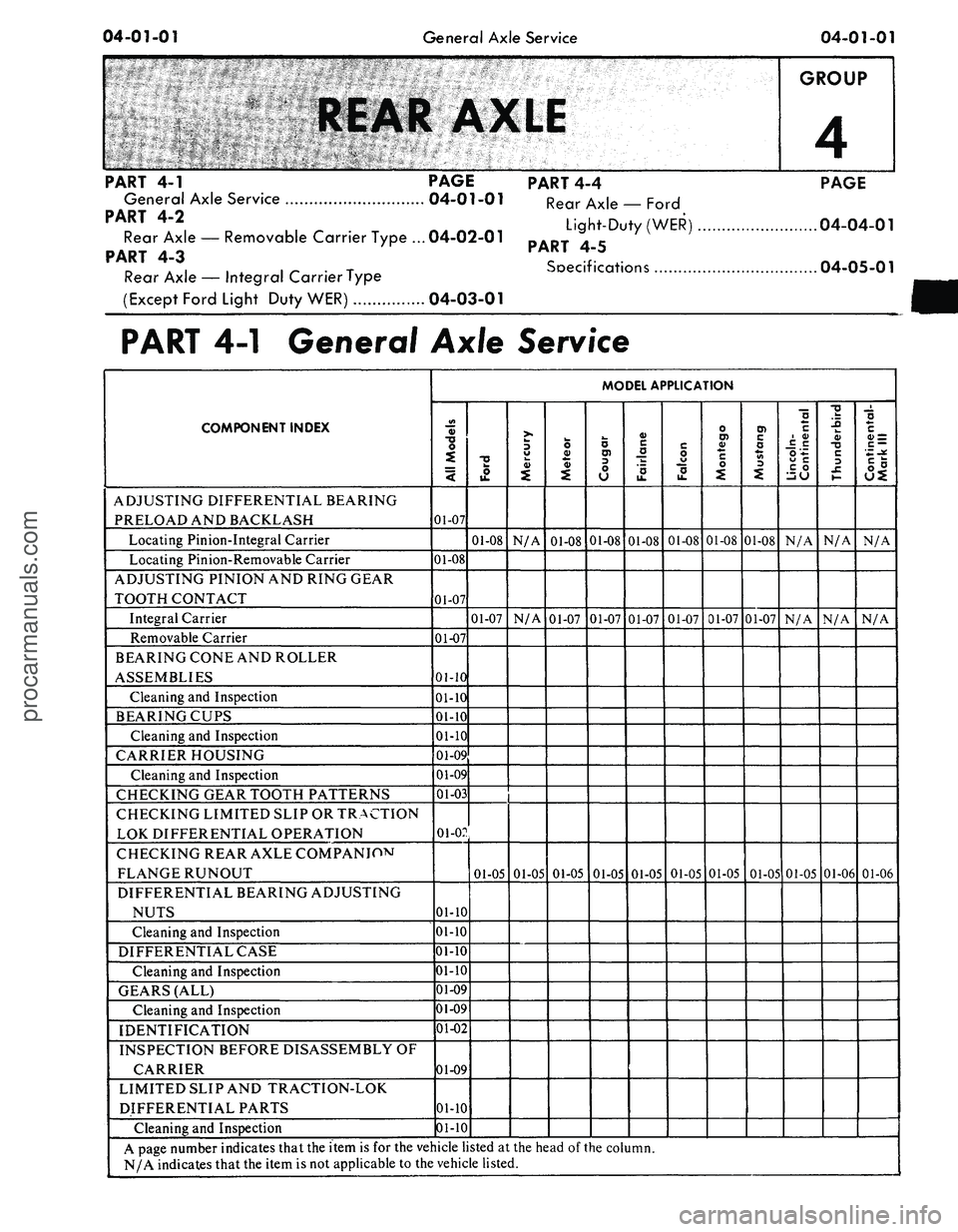
04-01-01
General Axle Service
04-01-01
GROUP
4
PART
4-1
PAGE
General Axle Service 04-01-01
PART 4-2
Rear Axle
—
Removable Carrier Type ... 04-02-01
PART
4-3
Rear Axle
—
Integral CarrierType
(Except Ford Light Duty WER) 04-03-01
PART 4-4
Rear Axle
—
Ford
Light-Duty (WER)
PART
4-5
Soecifications
PAGE
04-04-01
04-05-01
PART
4-1
General Axle Service
COMPONENT INDEX
ADJUSTING DIFFERENTIAL BEARING
PRELOAD AND BACKLASH
Locating Pinion-Integral Carrier
Locating Pinion-Removable Carrier
ADJUSTING PINION AND RING GEAR
TOOTH CONTACT
Integral Carrier
Removable Carrier
BEARING CONE AND ROLLER
ASSEMBLIES
Cleaning
and
Inspection
BEARING CUPS
Cleaning
and
Inspection
CARRIER HOUSING
Cleaning
and
Inspection
CHECKING GEAR TOOTH PATTERNS
CHECKING LIMITED SLIP
OR
TRACTION
LOK DIFFERENTIAL OPERATION
CHECKING REAR AXLE COMPANIOM
FLANGE RUNOUT
DIFFERENTIAL BEARING ADJUSTING
NUTS
Cleaning
and
Inspection
DIFFERENTIAL CASE
Cleaning
and
Inspection
GEARS (ALL)
Cleaning
and
Inspection
IDENTIFICATION
INSPECTION BEFORE DISASSEMBLY
OF
CARRIER
LIMITED SLIP AND TRACTION-LOK
DIFFERENTIAL PARTS
Cleaning
and
Inspection
MODEL APPLICATION
All
Models
01-07
01-08
01-07
01-07
01-10
01-10
01-10
01-10
01-09
01-09
01-03
01-02
01-10
01-10
01-10
01-10
01-09
01-09
01-02
01-09
01-10
01-10
Ford
01-08
01-07
01-05
Mercury
N/A
N/A
01-05
Meteor
01-08
01-07
01-05
Cougar
01-08
01-07
01-05
Fairlane
01-08
01-07
01-05
Falcon
01-08
01-07
01-05
Montego
01-08
01-07
01-05
Mustang
01-08
01-07
01-05
Lincoln-
Continental
N/A
N/A
01-05
Thunderbird
N/A
N/A
01-06
Continental-
Mark
III
N/A
N/A
01-06
A page number indicates that the item
is for
the vehicle listed
at the
head
of
the column.
N/A indicates that the item
is not
applicable
to
the vehicle listed.
procarmanuals.com
Page 189 of 413
04-01-02
General Axle Service
04-01-02
COMPONENT INDEX
MODEL APPLICATION
o
3
I
i
Ji
LUBRICANT LEVEL CHECK
01-10
PINION RETAINER
01-10
Cleaning and Inspection
01-10
SHIM AND BACKLASH CHANGES
01-03
Integral Carrier
Removable Carrier
01-04
N/A
01-04
01-04
01-04
01-04
01-04
01-04
N/A
N/A
N/A
U-JOINT FLANGE
01-10
Cleaning and Inspection
01-10
A page number indicates that the item is for the vehicle listed at the head of the column.
N/A indicates that the item is not applicable to the vehicle listed.
1
COMMON ADJUSTMENTS
AND
REPAIRS
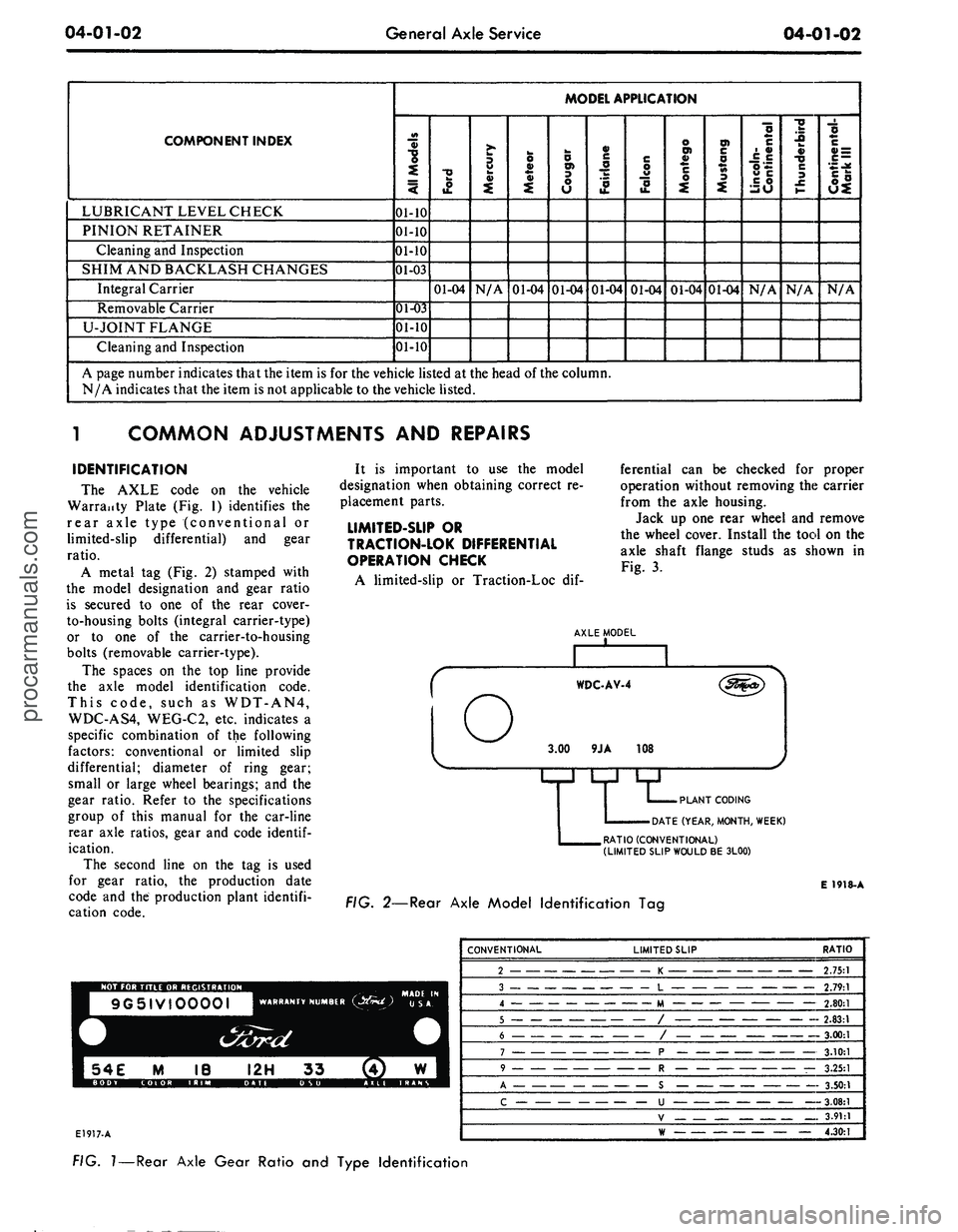
IDENTIFICATION
The AXLE code on the vehicle
Warranty Plate (Fig. 1) identifies the
rear axle type (conventional or
limited-slip differential) and gear
ratio.
A metal tag (Fig. 2) stamped with
the model designation and gear ratio
is secured to one of the rear cover-
to-housing bolts (integral carrier-type)
or to one of the carrier-to-housing
bolts (removable carrier-type).
The spaces on the top line provide
the axle model identification code.
This code, such as WDT-AN4,
WDC-AS4, WEG-C2, etc. indicates a
specific combination of the following
factors: conventional or limited slip
differential; diameter of ring gear;
small or large wheel bearings; and the
gear ratio. Refer to the specifications
group of this manual for the car-line
rear axle ratios, gear and code
identif-
ication.
The second line on the tag is used
for gear ratio, the production date
code and the production plant identifi-
cation code.
It is important to use the model
designation when obtaining correct re-
placement parts.
LIMITED-SUP
OR
TRACTION-LOK DIFFERENTIAL
OPERATION CHECK
A limited-slip or Traction-Loc dif-
ferential can be checked for proper
operation without removing the carrier
from the axle housing.
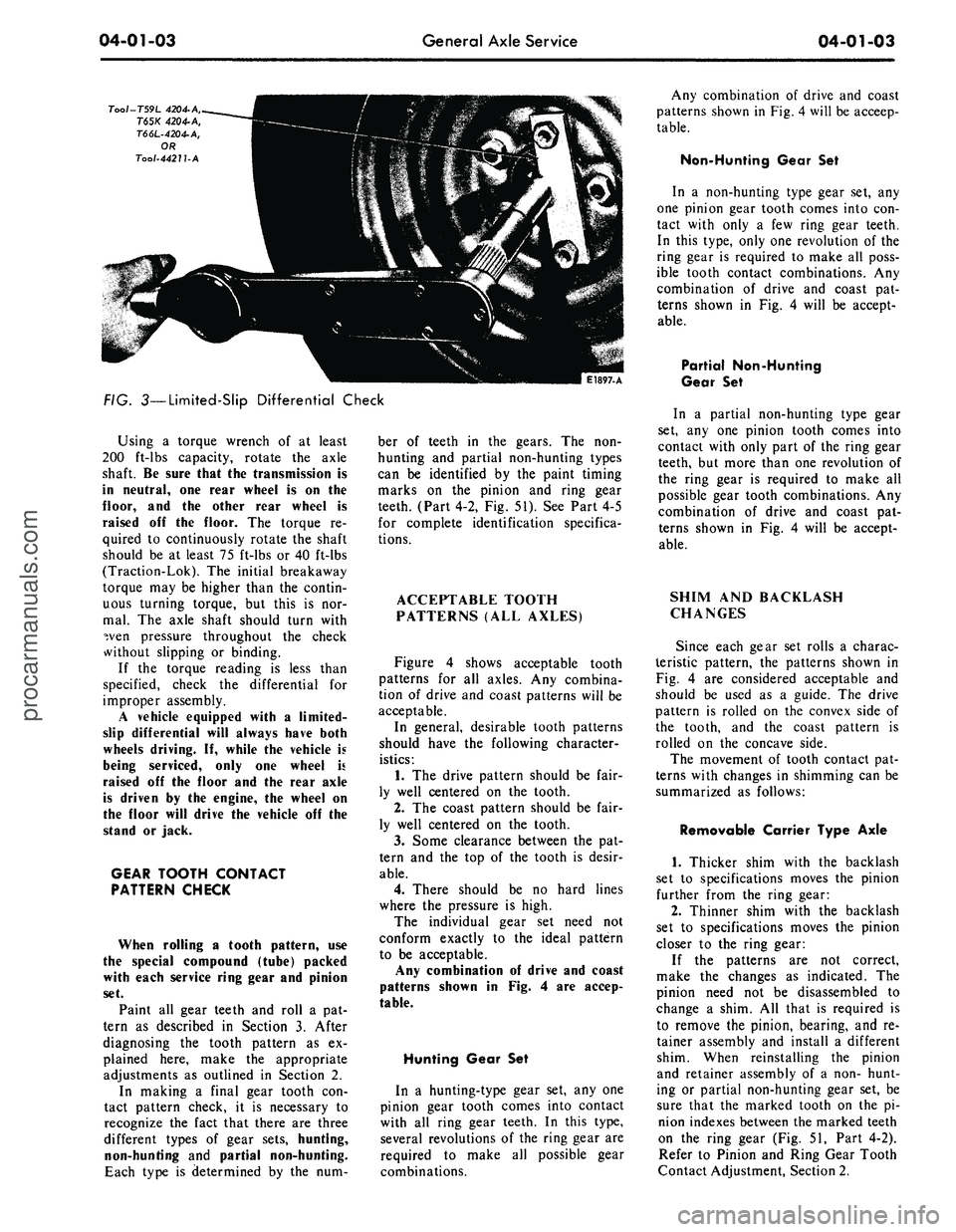
Jack up one rear wheel and remove
the wheel cover. Install the tool on the
axle shaft flange studs as shown in
Fig. 3.
AXLE MODEL
PLANT CODING
DATE (YEAR, MONTH, WEEK)
RATIO (CONVENTIONAL)
(LIMITED SLIP WOULD
BE
3L00)
E 1918-A
FIG.
2—Rear
Axle Model Identification
Tag
NOT
FOR
TITLE
OR
REGISTRATION
9G5IVI0000I
WARRANTY NUMBER
E1917-A
CONVENTIONAL
2
3
4
.
5
6
7
A
c
LIMITED SLIP
K
L
M
/
/
p
_ —
R
— —
c
—
u
V
RATIO
2.75:1
2.79:1
— 2.80:1
2.83:1
-
3.00:1
3.10:1
—
3.25:1
3.50:1
3.08:1
3.91:1
— 4.30:1
FIG.
1
— Rear Axle Gear Ratio
and
Type Identificationprocarmanuals.com
Page 190 of 413
04-01-03
General Axle Service
04-01-03
Tool-759L 4204-A,
T65K 4204-
A,
T66L-4204-A,
OR
Tool-44211-A
E1897-A
FIG. 3—Limited-Slip Differential Check
Using
a
torque wrench
of at
least
200 ft-lbs capacity, rotate
the
axle
shaft.
Be
sure that
the
transmission
is
in neutral,
one
rear wheel
is on the
floor,
and the
other rear wheel
is
raised
off the
floor.
The
torque
re-
quired
to
continuously rotate
the
shaft
should
be at
least
75
ft-lbs
or 40
ft-lbs
(Traction-Lok).
The
initial breakaway
torque
may
be
higher than
the
contin-
uous turning torque,
but
this
is nor-
mal.
The
axle shaft should turn with
^ven pressure throughout
the
check
without slipping
or
binding.
If
the
torque reading
is
less than
specified, check
the
differential
for
improper assembly.
A vehicle equipped with
a
limited-
slip differential will always have both
wheels driving.
If,
while
the
vehicle
is
being serviced, only
one
wheel
is
raised
off the
floor
and the
rear axle
is driven
by the
engine,
the
wheel
on
the floor will drive
the
vehicle
off the
stand
or
jack.
GEAR TOOTH CONTACT
PATTERN CHECK
When rolling
a
tooth pattern,
use
the special compound (tube) packed
with each service ring gear
and
pinion
set.
Paint
all
gear teeth
and
roll
a pat-
tern
as
described
in
Section
3.
After
diagnosing
the
tooth pattern
as ex-
plained here, make
the
appropriate
adjustments
as
outlined
in
Section
2.
In making
a
final gear tooth
con-
tact pattern check,
it is
necessary
to
recognize
the
fact that there
are
three
different types
of
gear sets, hunting,
non-hunting
and
partial non-hunting.
Each type
is
determined
by the num-
ber
of
teeth
in the
gears.
The non-
hunting
and
partial non-hunting types
can
be
identified
by the
paint timing
marks
on the
pinion
and
ring gear
teeth. (Part 4-2,
Fig. 51).
See
Part
4-5
for complete identification specifica-
tions.
ACCEPTABLE TOOTH
PATTERNS (ALL AXLES)
Figure
4
shows acceptable tooth
patterns
for all
axles.
Any
combina-
tion
of
drive
and
coast patterns will
be
acceptable.
In general, desirable tooth patterns
should have
the
following character-
istics:
1.
The
drive pattern should
be
fair-
ly well centered
on the
tooth.
2.
The
coast pattern should
be
fair-
ly well centered
on the
tooth.
3.
Some clearance between
the pat-
tern
and the top of the
tooth
is
desir-
able.
4.
There should
be no
hard lines
where
the
pressure
is
high.
The individual gear
set
need
not
conform exactly
to the
ideal pattern
to
be
acceptable.
Any combination
of
drive
and
coast
patterns shown
in Fig. 4 are
accep-
table.
Hunting Gear
Set
In
a
hunting-type gear
set, any one
pinion gear tooth comes into contact
with
all
ring gear teeth.
In
this type,
several revolutions
of
the
ring gear
are
required
to
make
all
possible gear
combinations.
Any combination
of
drive
and
coast
patterns shown
in
Fig.
4
will
be
acceep-
table.
Non-Hunting Gear
Set
In
a
non-hunting type gear
set, any
one pinion gear tooth comes into
con-
tact with only
a few
ring gear teeth.
In this type, only
one
revolution
of
the
ring gear
is
required
to
make
all
poss-
ible tooth contact combinations.
Any
combination
of
drive
and
coast
pat-
terns shown
in Fig. 4
will
be
accept-
able.
Partial Non-Hunting
Gear
Set
In
a
partial non-hunting type gear
set,
any one
pinion tooth comes into
contact with only part
of
the
ring gear
teeth,
but
more than
one
revolution
of
the ring gear
is
required
to
make
all
possible gear tooth combinations.
Any
combination
of
drive
and
coast
pat-
terns shown
in Fig. 4
will
be
accept-
able.
SHIM
AND
BACKLASH
CHANGES
Since each gear
set
rolls
a
charac-
teristic pattern,
the
patterns shown
in
Fig.
4 are
considered acceptable
and
should
be
used
as a
guide.
The
drive
pattern
is
rolled
on the
convex side
of
the tooth,
and the
coast pattern
is
rolled
on the
concave side.
The movement
of
tooth contact
pat-
terns with changes
in
shimming
can
be
summarized
as
follows:
Removable Carrier Type Axle
1.
Thicker shim with
the
backlash
set
to
specifications moves
the
pinion
further from
the
ring gear:
2.
Thinner shim with
the
backlash
set
to
specifications moves
the
pinion
closer
to the
ring gear:
If
the
patterns
are not
correct,
make
the
changes
as
indicated.
The
pinion need
not be
disassembled
to
change
a
shim.
All
that
is
required
is
to remove
the
pinion, bearing,
and re-
tainer assembly
and
install
a
different
shim. When reinstalling
the
pinion
and retainer assembly
of a
non-
hunt-
ing
or
partial non-hunting gear
set, be
sure that
the
marked tooth
on the pi-
nion indexes between
the
marked teeth
on
the
ring gear
(Fig.
51,
Part
4-2).
Refer
to
Pinion
and
Ring Gear Tooth
Contact Adjustment, Section
2.procarmanuals.com