1969 FORD MUSTANG gas type
[x] Cancel search: gas typePage 17 of 413
02-01-06
Brakes
02-01-06
side.
Refill the master cylinder reser-
voir after each wheel cylinder is bled
and install the master cylinder cover
and gasket. Be sure the diaphragm
type gasket is properly positioned in
the master cylinder cover. When the
bleeding operation is completed, the
fluid level should be filled to within
1/4 inch of the top of the reservoirs.
7. If the primary (front brake) sys-
tem is to be bled. Repeat steps 2
through 6 at the right front brake cal-
iper or cylinder and ending at the left
front brake caliper or cylinder.
8. On disc brake equipped models
be sure that the front brake pistons
are returned to their normal positions
and that the shoe and lining assem-
blies are properly seated by depressing
the brake pedal several times until
normal pedal travel is established.
9. Centralize the pressure differen-
tial valve. Refer to the Centralizing
the Pressure Differential Valve proce-
dures which follow.
PRESSURE BLEEDING
The Lincoln Continental hydraulic
brake system is to be bled only with
pressure bleeding equipment.
Bleed the longest lines first. The
bleeder tank should contain enough
new Ford Brake Fluid to complete the
bleeding operation. Use Ford Brake
Fluid — Extra Heavy Duty — Part
Number C6AZ-19542-A (ESA-
M6C25-A) or equivalent for all brake
applications. The brake fluid is col-
ored blue for identification purposes.
Do not mix low temperature brake
fluid with the specified brake fluid
during the bleeding operations. Never
re-use brake fluid that has been
drained from the hydraulic system.
The tank should be charged with ap-
proximately 10 to 30 pounds of air
pressure. Never exceed 50 pounds
pressure.
1.
Clean all dirt from the master
cylinder reservoir cover.
2.
Remove the master cylinder res-
ervoir cover and rubber gasket, and
fill the master cylinder reservoir with
the specified brake fluid. Install the
pressure bleeder adapter tool to the
master cylinder, and attach the bleed-
er tank hose to the fittng on the
adapter.
Master cylinder pressure bleeder
adapter tools can be obtained from
the various manufacturers of pressure
bleeding equipment. Follow the in-
structions of the manufacturer when
installing the adapter.
3.
If the master cylinder is
equipped with a bleed screw, loosen
the bleed screw and bleed the master
cylinder until the fluid is free of air
bubbles; then, tighten the bleed screw.
Do not use the secondary piston stop
screw, located on the bottom of the
master cylinder, to bleed the master
cylinder.
4.
If the rear wheel cylinders, the
secondary brake system, are to be
bled, position a 3/8 inch box wrench
(Fig. 9) on the bleeder fitting on the
right rear brake wheel cylinder. At-
tach a bleeder tube to the bleeder fit-
ting. The end of the tube should fit
snugly around the bleeder fitting.
5. Open the valve on the bleeder
tank to admit pressurized brake fluid
to the master cylinder reservoir.
6. Submerge the free end of the
tube in a container partially filled with
clean brake fluid, and loosen the
bleeder fitting.
7.
When air bubbles cease to ap-
pear in the fluid at the submerged end
of the bleeder tube, close the bleeder
fitting and remove the tube.
8. Repeat steps 3 through 7 at the
left rear wheel cylinder.
9. If the vehicle is equipped with
disc brakes, repeat steps 4 through 7,
starting at the right front disc caliper
and ending at the left front disc cali-
per.
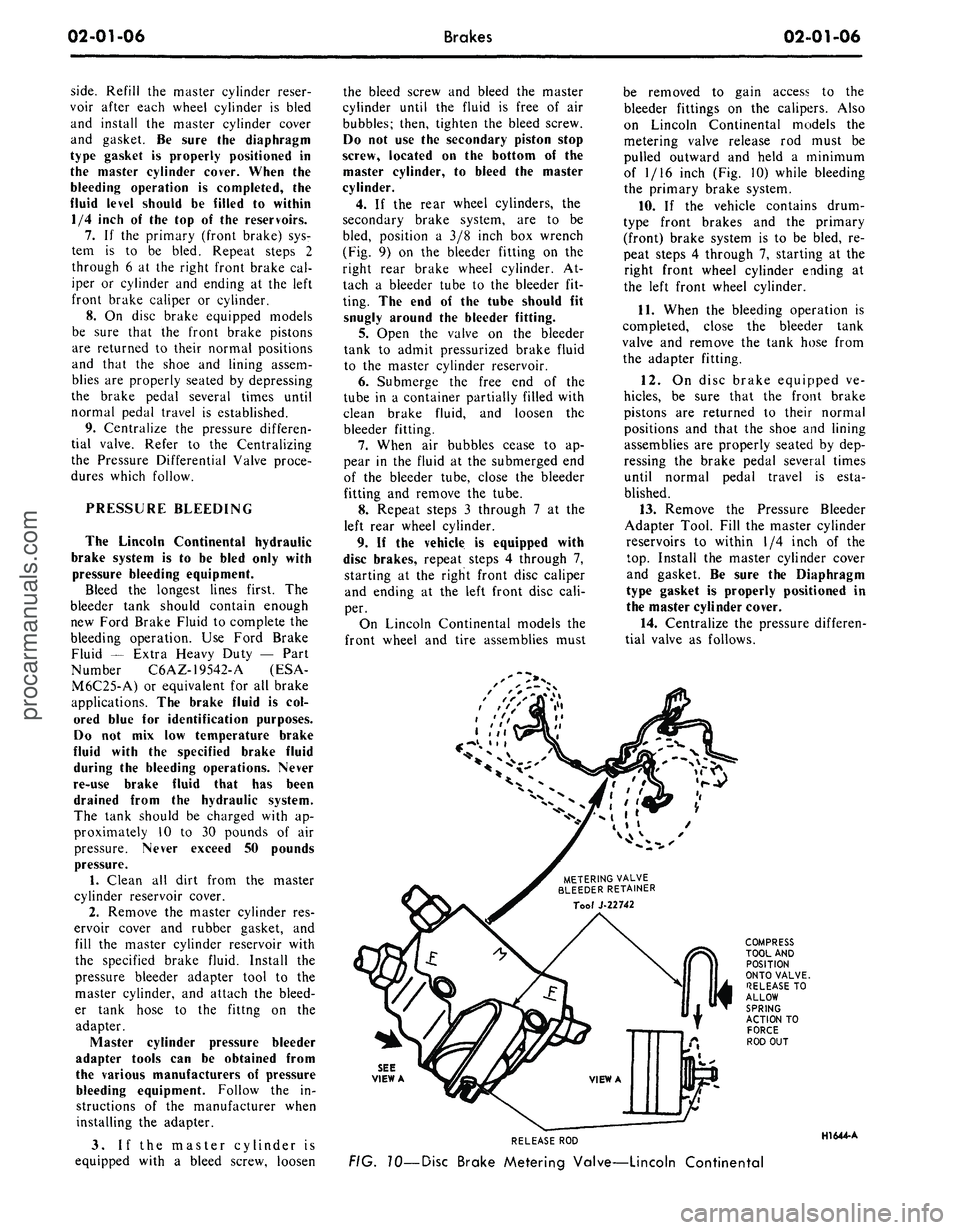
On Lincoln Continental models the
front wheel and tire assemblies must
be removed to gain access to the
bleeder fittings on the calipers. Also
on Lincoln Continental models the
metering valve release rod must be
pulled outward and held a minimum
of 1/16 inch (Fig. 10) while bleeding
the primary brake system.
10.
If the vehicle contains drum-
type front brakes and the primary
(front) brake system is to be bled, re-
peat steps 4 through 7, starting at the
right front wheel cylinder ending at
the left front wheel cylinder.
11.
When the bleeding operation is
completed, close the bleeder tank
valve and remove the tank hose from
the adapter fitting.
12.
On disc brake equipped ve-
hicles,
be sure that the front brake
pistons are returned to their normal
positions and that the shoe and lining
assemblies are properly seated by dep-
ressing the brake pedal several times
until normal pedal travel is esta-
blished.
13.
Remove the Pressure Bleeder
Adapter Tool. Fill the master cylinder
reservoirs to within 1/4 inch of the
top.
Install the master cylinder cover
and gasket. Be sure the Diaphragm
type gasket is properly positioned in
the master cylinder cover.
14.
Centralize the pressure differen-
tial valve as follows.
METERING VALVE
BLEEDER RETAINER
SEE
VIEW A
RELEASE ROD
FIG. 10—Disc Brake Metering Valve—Lincoln Continental
HI 644-Aprocarmanuals.com
Page 27 of 413

02-02-08
Brake System
02-02-08
Tool-HRE-8650
JUST SET TO DRUM
DIAMETER HERE . . .
FIND CORRECT BRAKE
SHOE DIAMETER HERE
H1416-A
FIG.
7
7—Adjusting Brake Shoes Using Tool HRE-8650
BOOT
BOOT
PISTON
. BLEEDER .
CYLINDER
SCREW RETURN SPRING PIST0N
H1385-B
FIG. 72—Brake Wheel Cylinder—Typical
DISASSEMBLY
1.
Remove the links and the rubber
boots from the ends of the brake cyl-
inder. Remove the pistons, cups, and
return spring from the cylinder bore
(Fig. 12).
2.
Remove the bleeder screw from
the cylinder.
INSPECTION
1.
Wash all parts in clean brake
fluid. Dry with compressed air.
2.
Replace scored pistons. Always
replace the rubber cups and dust
boots.
3.
Inspect the cylinder bore for
score marks or rust. If either condi-
tion is present the cylinder bore must
be honed. However, the cylinder
should not be honed more than 0.003
inch beyond its original diameter.
4.
Check the bleeder hole to be sure
that it is open.
ASSEMBLY
1.
Apply a light coating of heavy-
duty brake fluip! to all internal parts.
2.
Thread the bleeder screw into the
cylinder and tighten securely.
3.
Insert the return spring, cups,
and pistons into their respective posi-
tions in the cylinder bore (Fig. 12).
Place a boot over each end of the cyl-
inder. Bleed the brake system.
HYDRAULIC LINE REPAIR
Steel tubing is used throughout the
brake system with the exception of the
flexible hoses at the front wheels and
at the fear axle housing brake tube
connection (Figs. 17 thru 21).
Always bleed the applicable pri-
mary or secondary brake system after
primary or secondary brake system
hose or line replacement. Centralize
the pressure differential valve after
bleeding the system.
BRAKE TUBE
REPLACEMENT
If a section of the brake tubing be-
comes damaged, the entire section
should be replaced with tubing of the
same type, size, shape and length.
Copper tubing should not be used in a
hydraulic system. When bending
brake tubing to fit underbody or rear
axle contours, be careful not to kink
or crack the tube.
All brake tubing should be double
flared properly to provide good leak-
proof connections. Clean the brake
tubing by flushing with clean brake
fluid before installation.
When connecting a tube to a hose,
tube connector, or brake cylinder,
tighten the tube fitting nut to specified
torque with Milbar tool 1112-144 or
equivalent.
BRAKE HOSE
REPLACEMENT
A flexible brake hose should be re-
placed if it shows signs of softening,
cracking, or other damage.
When installing a new front brake
hose,
position the hose to avoid con-
tact with other chassis parts. Place a
new copper gasket over the hose fit-
ting and thread the hose assembly into
the front wheel cylinder. Engage the
opposite end of the hose to the brack-
et on the frame. Install the horsesho-
e-type retaining clip, and connect the
tube to the hose with the tube fitting
nut (Figs. 17 thru 21).
A rear brake hose should be in-
stalled so that it does not touch the
muffler outlet pipe or shock absorber.
Thread the hose into the rear brake
tube connector. Engage the front end
of the hose to the bracket on the
frame. Install the horseshoe-type re-
taining clip, and connect the tube to
the hose with the tube fitting nut.procarmanuals.com
Page 35 of 413
02-02-16
Brake System
02-02-16
fitting that connects the tube to the
cylinder. Do not pull the metal tube
away from the cylinder. Pulling the
tube out of the cylinder connection
will bend the metal tube and make in-
stallation difficult. The tube will sepa-
rate from the cylinder when the cylin-
der is removed from the backing
plate.
4.
On all except the front wheels on
Ford, Mercury, and Meteor models,
remove the wheel cylinder attaching
bolts and lock washers and remove the
cylinder. On the front wheel of Ford,
Mercury and Meteor models, remove
the nut and washer that attaches the
cylinder to the anchor pin. Remove
the cylinder from the anchor pin.
INSTALLATION
Wipe the end(s) of the hydraulic
line to remove any foreign matter be-
fore making connections.
1.
On all models except Ford, Mer-
cury and Meteor, to install a front
wheel cylinder, position the cylinder to
the backing plate. Install the two lock
washers and attaching bolts. Torque
them to specifications.
On Ford, Mercury and Meteor
models, to install a front wheel cylin-
der, position the cylinder on the an-
chor pin against the backing plate. In-
stall the washer and cylinder attaching
nut on the anchor pin, and torque it
to specification. Lock the washer re-
tainer securely.
2.
Install a new copper gasket over
the hose fitting. Thread the hose into
the cylinder and tighten it to specified
torque.
3.
Engage the opposite end of the
hose to the bracket on the frame. In-
stall the horseshoe-type retaining clip,
and connect the brake tube to the
hose with the tube fitting nut. Tighten
the nut to specification with tool
1112-144.
4.
To install a rear wheel cylinder,
place the rear wheel cylinder into po-
sition. Enter the tubing into the cylin-
der, and start the tube fitting nut into
the threads of the cylinder.
5.
Secure the cylinder to the back-
ing plate by installing the attaching
bolts and lock washers.
6. Tighten the tube fitting nut to
specification with tool 1112-144.
7.
Install the links in the ends of
the wheel cylinder, install the shoes
and adjuster assemblies, and adjust
the shoes as outlined in this section.
8. Adjust the brakes (Part 2-2, Sec-
tion 2). Install the brake drum and
wheel. Bleed the brakes and centralize
the differential valve as outlined in
Part 2-1, Section 2.
BRAKE BACKING PLATE
DRUM BRAKE
REMOVAL
1.
Remove the wheel and brake
drum. Disconnect the brake line from
the brake cylinder.
2.
Remove the brake shoe and ad-
juster assemblies and the wheel cylin-
der as outlined in this section. On the
rear wheels, disconnect the parking
brake lever from the cable.
3.
If the rear backing plate is being
replaced, remove the axle shaft from
the applicable rear axle as outlined in
Group 4, Part 4-2— Rear Axle, Sec-
tion 2, disengage parking brake cable
retainer from backing plate. Remove
the backing plate and gasket.
If the front backing plate is being
replaced, remove the bolts and nuts
that secure the backing plate to the
front wheel spindle and remove the
plate and gasket.
INSTALLATION
If a rear backing plate is to be re-
placed, position a new rear backing
plate and gasket on the attaching
bolts in the axle housing flange. Insert
parking brake cable into backing plate
and secure retaining fingers. Install
the rear axle shaft for applicable rear
axle.
Refer to Group 4, Part 4-2 —
Rear Axle, Section 2 for the proper
installation procedure.
1.
If the front brake backing plate
is to be replaced, position a new front
backing plate and gasket to the wheel
spindle and install the attaching bolts
and nuts.
2.
Install the wheel cylinder and
connect the brake line as outlined in
this section.
3.
Install the brake shoe and ad-
juster assemblies as outlined in this
section. On a rear brake, connect the
parking brake cable to the lever.
4.
Adjust the brake shoes (Section
2),
and install the brake drums and
wheels. Bleed the brake system and
centralize the differential valve as out-
lined in Part 2-1, Section 2.
DISC BRAKE CALIPER
ASSEMBLY
ALL MODELS EXCEPT
LINCOLN CONTINENTAL
Removal
Refer to Figs. 22 and 23.
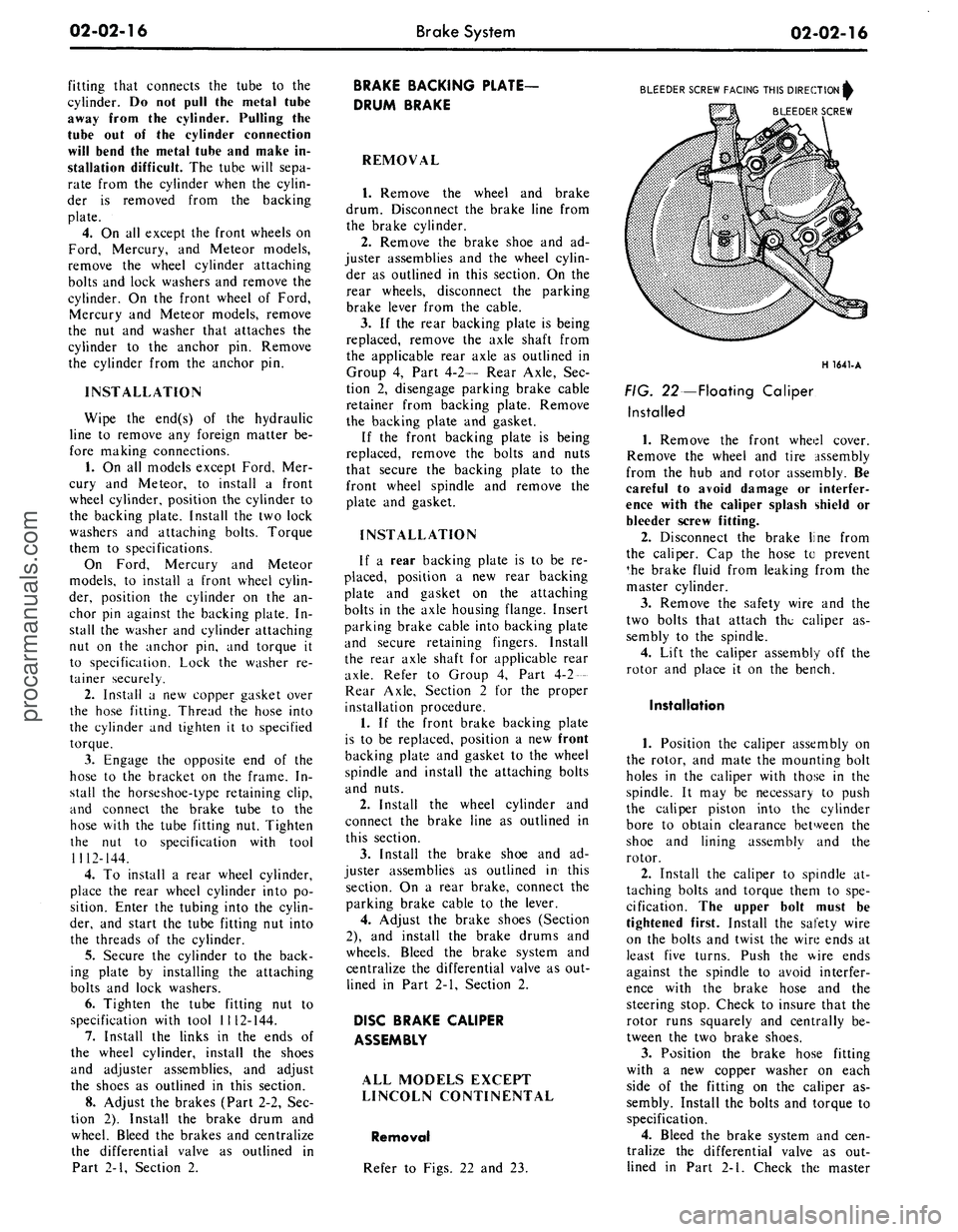
BLEEDER SCREW FACING THIS DIRECTION^
BLEEDER SCREW
H 1641-A
FIG. 22—Floating Caliper
Installed
1.
Remove the front wheel cover.
Remove the wheel and tire assembly
from the hub and rotor assembly. Be
careful to avoid damage or interfer-
ence with the caliper splash shield or
bleeder screw fitting.
2.
Disconnect the brake line from
the caliper. Cap the hose to prevent
*he brake fluid from leaking from the
master cylinder.
3.
Remove the safety wire and the
two bolts that attach the caliper as-
sembly to the spindle.
4.
Lift the caliper assembly off the
rotor and place it on the bench.
Installation
1.
Position the caliper assembly on
the rotor, and mate the mounting bolt
holes in the caliper with those in the
spindle. It may be necessary to push
the caliper piston into the cylinder
bore to obtain clearance between the
shoe and lining assembly and the
rotor.
2.
Install the caliper to spindle at-
taching bolts and torque them to spe-
cification. The upper bolt must be
tightened first. Install the safety wire
on the bolts and twist the wire ends at
least five turns. Push the wire ends
against the spindle to avoid interfer-
ence with the brake hose and the
steering stop. Check to insure that the
rotor runs squarely and centrally be-
tween the two brake shoes.
3.
Position the brake hose fitting
with a new copper washer on each
side of the fitting on the caliper as-
sembly. Install the bolts and torque to
specification.
4.
Bleed the brake system and cen-
tralize the differential valve as out-
lined in Part 2-1. Check the masterprocarmanuals.com
Page 205 of 413
04-02-08
Rear Axle — Removable Carrier Type
04-02-08
REMOVAL AND INSTALLATION
CARRIER ASSEMBLY
REMOVAL
1.
Raise the vehicle on a hoist and
remove the two rear wheels and tires.
2.
Remove the two brake drums (3
Tinnerman nuts at each drum) from
the axle shaft flange studs. If diffi-
culty is experienced in removing the
drums, remove the brake adjuster
knockout slug or rubber plug (if so
equipped) and back off the brake
shoes.
3.
Working through the hole pro-
vided in each axle shaft flange, re-
move the nuts that secure the rear
wheel bearing retainer plate. Pull each
axle shaft assembly out of the axle
housing using axle shaft remover,
Tool 4235-C. (Fig. 4). Care must be
exercised to prevent damage to the
production-type synthetic oil seal, if so
equipped. Any roughing or cutting of
the seal element during removal or in-
stallation can result in early seal fail-
ure.
Install a nut on one of the brake
backing plate attaching bolts to hold
the plate to the axle housing after the
shaft has been removed. Whenever a
rear axle shaft is replaced, the wheel
bearing oil seals must be replaced.
Remove the seals with tool 1175AB.
4.
Make scribe marks on the drive
shaft end yoke and the axle U-joint
flange to insure proper position at as-
sembly. Disconnect the drive shaft at
the rear axle U-joint. Hold the cups
on the spider with tape. Mark the
cups so that they will be in their orig-
inal position relative to the flange
when they are assembled. Remove the
drive shaft from the transmission ex-
tension housing. Install an oil seal re-
placer tool in the housing to prevent
transmission leakage. Refer to the
transmission group for the appropriate
tool.
5.
Clean area around carrier to
housing surfaced with a wire brush and
wipe clean, to prevent dirt entry into
the housing. Place a drain pan under
the carrier and housing, remove the
carrier attaching nuts, and drain the
axle.
Remove the carrier assembly
from the axle housing.
INSTALLATION
Synthetic production-type wheel
bearing seals must not be cleaned,
soaked or washed in cleaning solvent.
1.
Clean the axle housing and
shafts using kerosene and swabs. To
avoid contamination of the grease in
the sealed ball bearings, do not allow
any quantity of solvent directly on the
wheel bearings. Clean the mating sur-
faces of the axle housing and carrier.
2.
Position the differential carrier
on the studs in the axle housing using
a new gasket between carrier and
housing. Install the carrier-to-housing
attaching nuts, and torque them to
specifications.
3.
Remove the oil seal replacer tool
from the transmission extension hous-
ing. Position the drive shaft so that
the front U-joint slip yoke splines to
the transmission output shaft.
4.
Connect the drive shaft to the
axle U-joint flange, aligning the scribe
marks made on the drive shaft end
yoke and the axle U-joint flange dur-
ing the removal procedure. Install the
U-bolts and nuts and torque to speci-
fications.
5.
If the synthetic, production-type
wheel bearing seals were replaced with
service-type leather seals, soak the
new rear wheel bearing oil seals in
SAE 10 oil for 1/2 hour before instal-
lation. Wipe a small amount of an oil
resistant sealer on the outer edge of
each seal before it is installed. Do not
put any of the sealer on the sealing
lip.
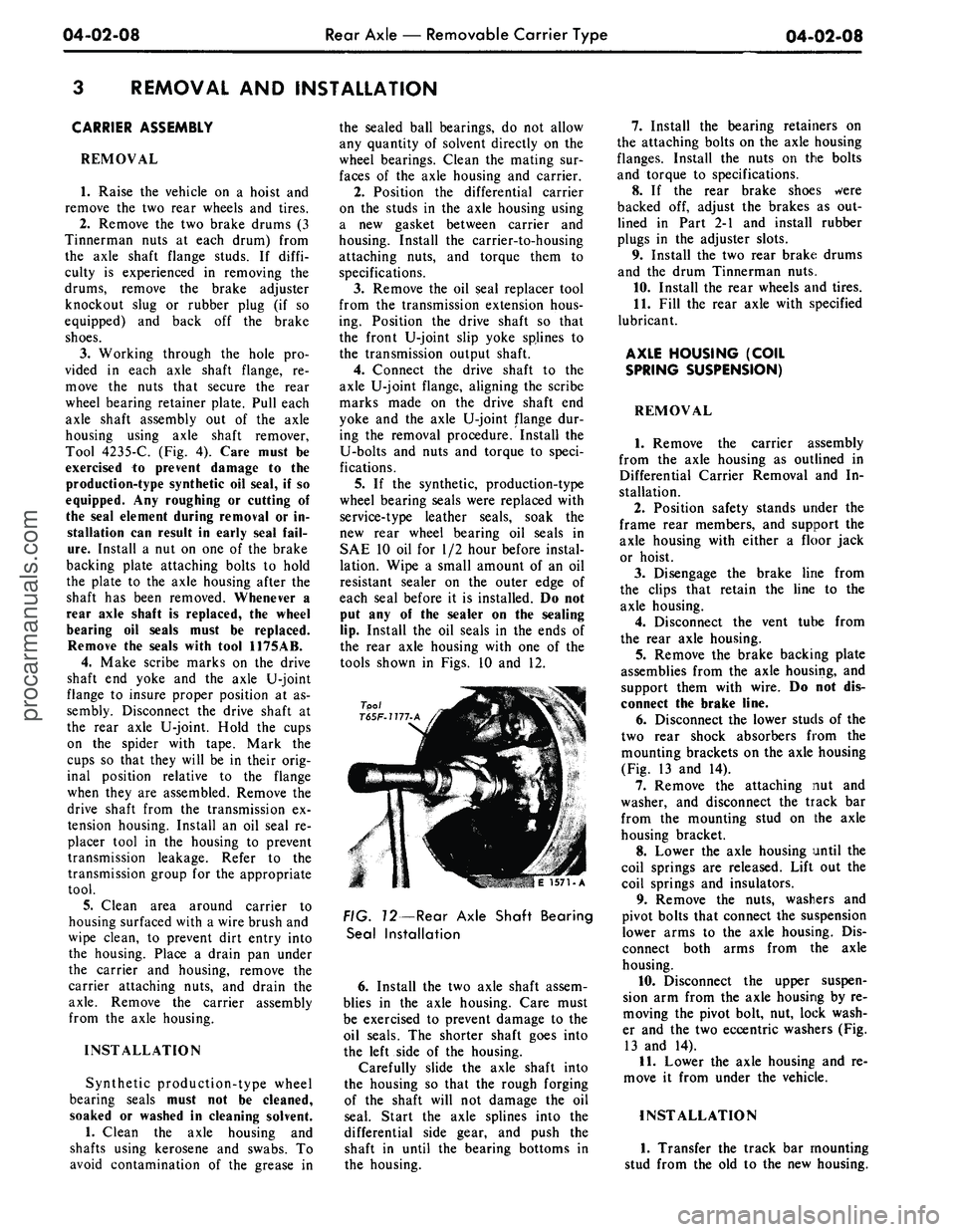
Install the oil seals in the ends of
the rear axle housing with one of the
tools shown in Figs. 10 and 12.
Tool
T65F-1177.A
E 1571-A
FIG. 12—Rear Axle Shaft Bearing
Seal Installation
6. Install the two axle shaft assem-
blies in the axle housing. Care must
be exercised to prevent damage to the
oil seals. The shorter shaft goes into
the left side of the housing.
Carefully slide the axle shaft into
the housing so that the rough forging
of the shaft will not damage the oil
seal. Start the axle splines into the
differential side gear, and push the
shaft in until the bearing bottoms in
the housing.
7.
Install the bearing retainers on
the attaching bolts on the axle housing
flanges. Install the nuts on the bolts
and torque to specifications.
8. If the rear brake shoes were
backed off, adjust the brakes as out-
lined in Part 2-1 and install rubber
plugs in the adjuster slots.
9. Install the two rear brake drums
and the drum Tinnerman nuts.
10.
Install the rear wheels and tires.
11.
Fill the rear axle with specified
lubricant.
AXLE HOUSING (COIL
SPRING SUSPENSION)
REMOVAL
1.
Remove the carrier assembly
from the axle housing as outlined in
Differential Carrier Removal and In-
stallation.
2.
Position safety stands under the
frame rear members, and support the
axle housing with either a floor jack
or hoist.
3.
Disengage the brake line from
the clips that retain the line to the
axle housing.
4.
Disconnect the vent tube from
the rear axle housing.
5.
Remove the brake backing plate
assemblies from the axle housing, and
support them with wire. Do not dis-
connect the brake line.
6. Disconnect the lower studs of the
two rear shock absorbers from the
mounting brackets on the axle housing
(Fig. 13 and 14).
7.
Remove the attaching nut and
washer, and disconnect the track bar
from the mounting stud on the axle
housing bracket.
8. Lower the axle housing until the
coil springs are released. Lift out the
coil springs and insulators.
9. Remove the nuts, washers and
pivot bolts that connect the suspension
lower arms to the axle housing. Dis-
connect both arms from the axle
housing.
10.
Disconnect the upper suspen-
sion arm from the axle housing by re-
moving the pivot bolt, nut, lock wash-
er and the two eccentric washers (Fig.
13 and 14).
11.
Lower the axle housing and re-
move it from under the vehicle.
INSTALLATION
1.
Transfer the track bar mounting
stud from the old to the new housing.procarmanuals.com
Page 208 of 413
04-02-11
Rear Axle — Removable Carrier Type
04-02-11
If the axle housing is new, install a
new vent. The hose attaching portion
must face toward the front of the ve-
hicle.
2.
If leather-type wheel bearing ser-
vice seals are to be installed, soak the
new rear wheel bearing oil seals in
SAE 10 oil for 1/2 hour before instal-
lation. Wipe a small amount of an oil
resistant sealer on the outer edge of
each seal before it is installed. Do not
put any of the sealer on the sealing
lip.
Install the oil seals in the ends of
the axle housing with one of the tools
shown in Fig. 10 and 12.
3.
Position the replacement axle
housing under the vehicle, and raise
the axle with a hoist or floor jack.
Connect the suspension lower arms to
their mounting brackets on the axle
housing with pivot bolts and nuts. Do
not tighten the bolts and nuts at this
point.
4.
Position the suspension upper
arm in its mounting bracket on the
axle housing, and install the adjusting
bolt, eccentric washers, lock washer
and nut. Leave the bolt and nut loose
at this point.
5.
Position the brake lines to the
axle housing, and secure with the re-
taining clips.
6. Install the brake backing plates
on the axle housing flanges.
7.
Connect the track bar to the
mounting stud, install the washer and
attaching nut, and torque to specifica-
tions.
8. Position the rear coil springs and
insulators in the pockets provided.
9. Connect the lower studs of the
two rear shock absorbers to the
mounting brackets on the axle hous-
ing. Install the attaching nuts, and
torque to specifications.
10.
Connect the vent tube to the
vent on the housing. If axle housing is
new, install a new vent.
11.
Clean the mating surfaces of
the axle housing and differential car-
rier. Position the carrier on the
mounting studs on the housing using a
new gasket between carrier and hous-
ing. Install the copper washers and the
carrier-to-housing attaching nuts, and
torque to specifications.
12.
Make sure that both the front
and rear pivot bolts of the upper and
the two lower arms are loose, and
then raise the axle assembly to con-
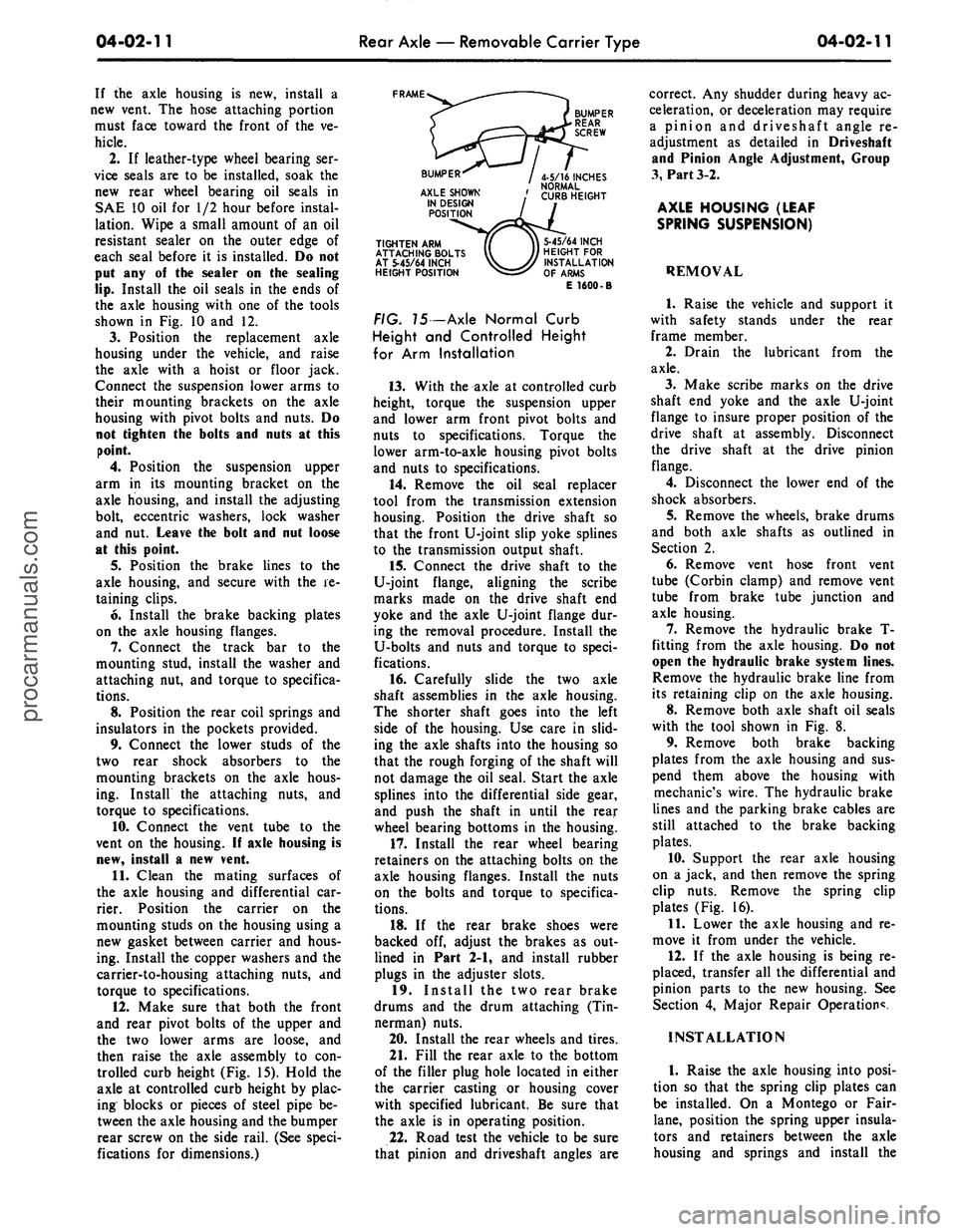
trolled curb height (Fig. 15). Hold the
axle at controlled curb height by plac-
ing blocks or pieces of steel pipe be-
tween the axle housing and the bumper
rear screw on the side rail. (See speci-
fications for dimensions.)
FRAME
TIGHTEN ARM
ATTACHING BOLTS
AT 5-45/64 INCH
HEIGHT POSITION
5-45/64 INCH
HEIGHT FOR
INSTALLATION
OF ARMS
E 1600-B
FIG. 75 -Axle Normal Curb
Height and Controlled Height
for Arm Installation
13.
With the axle at controlled curb
height, torque the suspension upper
and lower arm front pivot bolts and
nuts to specifications. Torque the
lower arm-to-axle housing pivot bolts
and nuts to specifications.
14.
Remove the oil seal replacer
tool from the transmission extension
housing. Position the drive shaft so
that the front U-joint slip yoke splines
to the transmission output shaft.
15.
Connect the drive shaft to the
U-joint flange, aligning the scribe
marks made on the drive shaft end
yoke and the axle U-joint flange dur-
ing the removal procedure. Install the
U-bolts and nuts and torque to speci-
fications.
16.
Carefully slide the two axle
shaft assemblies in the axle housing.
The shorter shaft goes into the left
side of the housing. Use care in slid-
ing the axle shafts into the housing so
that the rough forging of the shaft will
not damage the oil seal. Start the axle
splines into the differential side gear,
and push the shaft in until the rear
wheel bearing bottoms in the housing.
17.
Install the rear wheel bearing
retainers on the attaching bolts on the
axle housing flanges. Install the nuts
on the bolts and torque to specifica-
tions.
18.
If the rear brake shoes were
backed off, adjust the brakes as out-
lined in Part 2-1, and install rubber
plugs in the adjuster slots.
19.
Install the two rear brake
drums and the drum attaching (Tin-
nerman) nuts.
20.
Install the rear wheels and tires.
21.
Fill the rear axle to the bottom
of the filler plug hole located in either
the carrier casting or housing cover
with specified lubricant. Be sure that
the axle is in operating position.
22.
Road test the vehicle to be sure
that pinion and driveshaft angles are
correct. Any shudder during heavy ac-
celeration, or deceleration may require
a pinion and driveshaft angle re-
adjustment as detailed in Driveshaft
and Pinion Angle Adjustment, Group
3,
Part 3-2.
AXLE HOUSING (LEAF
SPRING SUSPENSION)
REMOVAL
1.
Raise the vehicle and support it
with safety stands under the rear
frame member.
2.
Drain the lubricant from the
axle.
3.
Make scribe marks on the drive
shaft end yoke and the axle U-joint
flange to insure proper position of the
drive shaft at assembly. Disconnect
the drive shaft at the drive pinion
flange.
4.
Disconnect the lower end of the
shock absorbers.
5.
Remove the wheels, brake drums
and both axle shafts as outlined in
Section 2.
6. Remove vent hose front vent
tube (Corbin clamp) and remove vent
tube from brake tube junction and
axle housing.
7.
Remove the hydraulic brake T-
fitting from the axle housing. Do not
open the hydraulic brake system lines.
Remove the hydraulic brake line from
its retaining clip on the axle housing.
8. Remove both axle shaft oil seals
with the tool shown in Fig. 8.
9. Remove both brake backing
plates from the axle housing and sus-
pend them above the housing with
mechanic's wire. The hydraulic brake
lines and the parking brake cables are
still attached to the brake backing
plates.
10.
Support the rear axle housing
on a jack, and then remove the spring
clip nuts. Remove the spring clip
plates (Fig. 16).
11.
Lower the axle housing and re-
move it from under the vehicle.
12.
If the axle housing is being re-
placed, transfer all the differential and
pinion parts to the new housing. See
Section 4, Major Repair Operation*.
INSTALLATION
1.
Raise the axle housing into posi-
tion so that the spring clip plates can
be installed. On a Montego or Fair-
lane,
position the spring upper insula-
tors and retainers between the axle
housing and springs and install theprocarmanuals.com
Page 226 of 413
04-03-06
Rear Axles — Integral Carrier Type
04-03-06
9. Install a new integral nut and
ivasher on the pinion shaft. (Apply a
small amount of lubricant on the
washer side of the nut.)
10.
Hold the flange with the tool
shown in Fig. 9 while the nut is being
tightened.
11.
Tighten the pinion shaft nut,
rotating the pinion occasionally to in-
sure proper bearing seating, (Fig. 6)
and take frequent preload readings
until the preload is at the original rec-
orded reading established in step 3.
12.
After original preload has been
reached, tighten the pinion nut slowly,
until an additional preload of 6 to 12
in-lbs has been added.
The preload should not exceed the
amount shown above, or bearing fail-
ure may result.
Under no circumstances should the
pinion nut be backed off to lessen pre-
load. If this is done, a new pinion
bearing spacer must be installed. (In
addition, the U-joint flange must
never be hammered on, or pneumatic-
-tools used.)
13.
Remove the oil seal replacer
tool from the transmission extension
housing. Install the front end of the
drive shaft on the transmission output
shaft.
14.
Connect the rear end of the
drive shaft to the axle U-joint flange,
aligning the scribe marks made on the
drive shaft end yoke and the axle U-
joint flange (Fig. 14).
15.
Check the lubricant level. Make
sure the axle is in running position.
Add whatever amount of specified lu-
bricant is required to reach the lower
edge of the filler plug hole, located in
the carrier casting or housing cover.
REMOVAL AND INSTALLATION
REAR AXLE HOUSING
REMOVAL
1.
Raise the vehicle and support it
with safety stands under the rear
frame member.
2.
Drain the lubricant from the
axle.
3.
Make scribe marks on the drive
shaft end yoke and the axle U-joint
flange to insure proper position of the
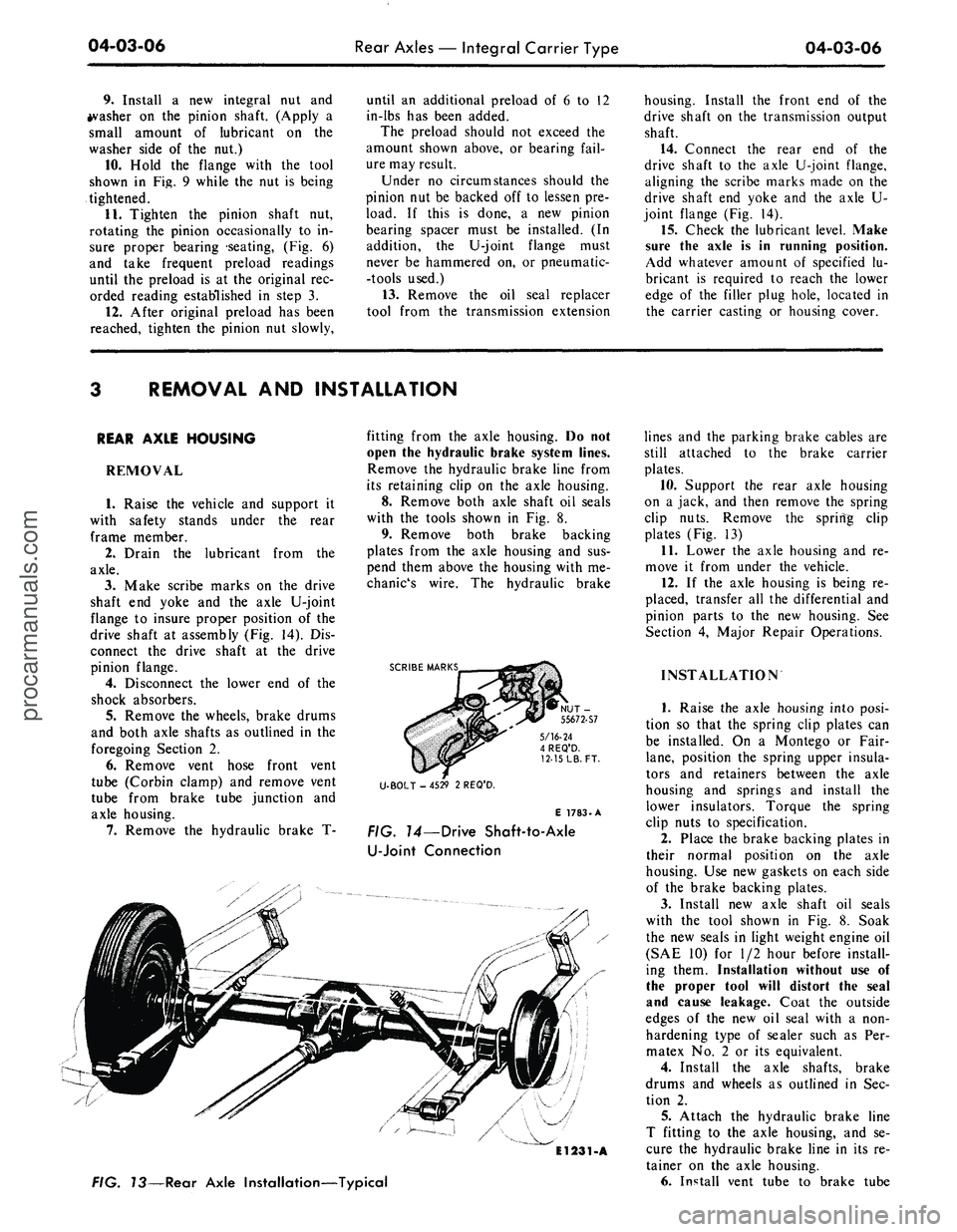
drive shaft at assembly (Fig. 14). Dis-
connect the drive shaft at the drive
pinion flange.
4.
Disconnect the lower end of the
shock absorbers.
5.
Remove the wheels, brake drums
and both axle shafts as outlined in the
foregoing Section 2.
6. Remove vent hose front vent
tube (Corbin clamp) and remove vent
tube from brake tube junction and
axle housing.
7.
Remove the hydraulic brake T-
fitting from the axle housing. Do not
open the hydraulic brake system lines.
Remove the hydraulic brake line from
its retaining clip on the axle housing.
8. Remove both axle shaft oil seals
with the tools shown in Fig. 8.
9. Remove both brake backing
plates from the axle housing and sus-
pend them above the housing with me-
chanic's wire. The hydraulic brake
SCRIBE MARKS
5/16-24
4 REQ'D.
12-15
LB.
FT.
U-BOLT - 4529 2 REQ'D.
E 1783-A
FIG. 14—Drive Shaft-to-Axle
U-Joint
Connection
El231-A
FIG. 73—Rear Axle Installation—Typical
lines and the parking brake cables are
still attached to the brake carrier
plates.
10.
Support the rear axle housing
on a jack, and then remove the spring
clip nuts. Remove the spring clip
plates (Fig. 13)
11.
Lower the axle housing and re-
move it from under the vehicle.
12.
If the axle housing is being re-
placed, transfer all the differential and
pinion parts to the new housing. See
Section 4, Major Repair Operations.
INSTALLATION
1.
Raise the axle housing into posi-
tion so that the spring clip plates can
be installed. On a Montego or Fair-
lane,
position the spring upper insula-
tors and retainers between the axle
housing and springs and install the
lower insulators. Torque the spring
clip nuts to specification.
2.
Place the brake backing plates in
their normal position on the axle
housing. Use new gaskets on each side
of the brake backing plates.
3.
Install new axle shaft oil seals
with the tool shown in Fig. 8. Soak
the new seals in light weight engine oil
(SAE 10) for 1/2 hour before install-
ing them. Installation without use of
the proper tool will distort the seal
and cause leakage. Coat the outside
edges of the new oil seal with a non-
hardening type of sealer such as Per-
matex No. 2 or its equivalent.
4.
Install the axle shafts, brake
drums and wheels as outlined in Sec-
tion 2.
5.
Attach the hydraulic brake line
T fitting to the axle housing, and se-
cure the hydraulic brake line in its re-
tainer on the axle housing.
6. Install vent tube to brake tubeprocarmanuals.com
Page 227 of 413
04-03-07
Rear Axles — Integral Carrier Type
04-03-07
junction and install vent hose to vent
tube.
7.
Raise the axle housing and con-
nect the shock absorbers.
8. Connect the rear end of the drive
shaft to the axle U-joint flange, align-
ing the scribe marks made on the
drive shaft end yoke and the axle U-
joint flange (Fig. 14).
9. Fill the axle with the proper
grade and amount of lubricant.
10.
Road test the vehicle.
MAJOR REPAIR OPERATIONS
DISASSEMBLY
All service operations on the differ-
ential case assembly and the drive pin-
ion assembly can be performed with
the housing in the vehicle.
REMOVAL OF
DIFFERENTIAL
CASE AND DRIVE PINION
1.
Raise the vehicle and support it
on the underbody, so that the rear
axle drops down as far as the springs
and shock absorbers permit.
2.
Remove the cover from the car-
rier casting rear face, and drain the
lubricant.
3.
Perform the Inspection Before
Disassembly of Carrier in Part 4-1,
Section 3.
4.
Remove both rear wheels.
5.
Remove the brake drums.
6. Working through the hole pro-
vided in the axle shaft flange, remove
the nuts that attach the wheel bearing
retainers to the axle housing.
7.
Pull the axle shafts with the tool
shown in Fig. 2. Care must be exer-
cised to prevent damage to the oil
seals.
Install a nut on one of the brake
backing plate attaching bolts to hold
the plate to the axle housing after the
shaft has been removed. Remove both
seals with the tool shown in Fig. 8.
8. Make scribe marks on the drive
shaft end yoke and the axle U-joint
flange to insure proper position of the
drive shaft at assembly (Fig. 14). Dis-
connect the drive shaft from the axle
U-joint flange. Be careful to avoid
dropping the loose universal joint
bearing cups. Hold the cups on the
spider with tape. Mark the cups so
that they will be in their original posi-
tion in relation to the flange when
they are assembled. Remove the drive
shaft from the transmission extension
housing. Install an oil seal replacer
tool in the transmission extension
housing to prevent transmission leak-
age.
Refer to the transmission group
for the appropriate tool.
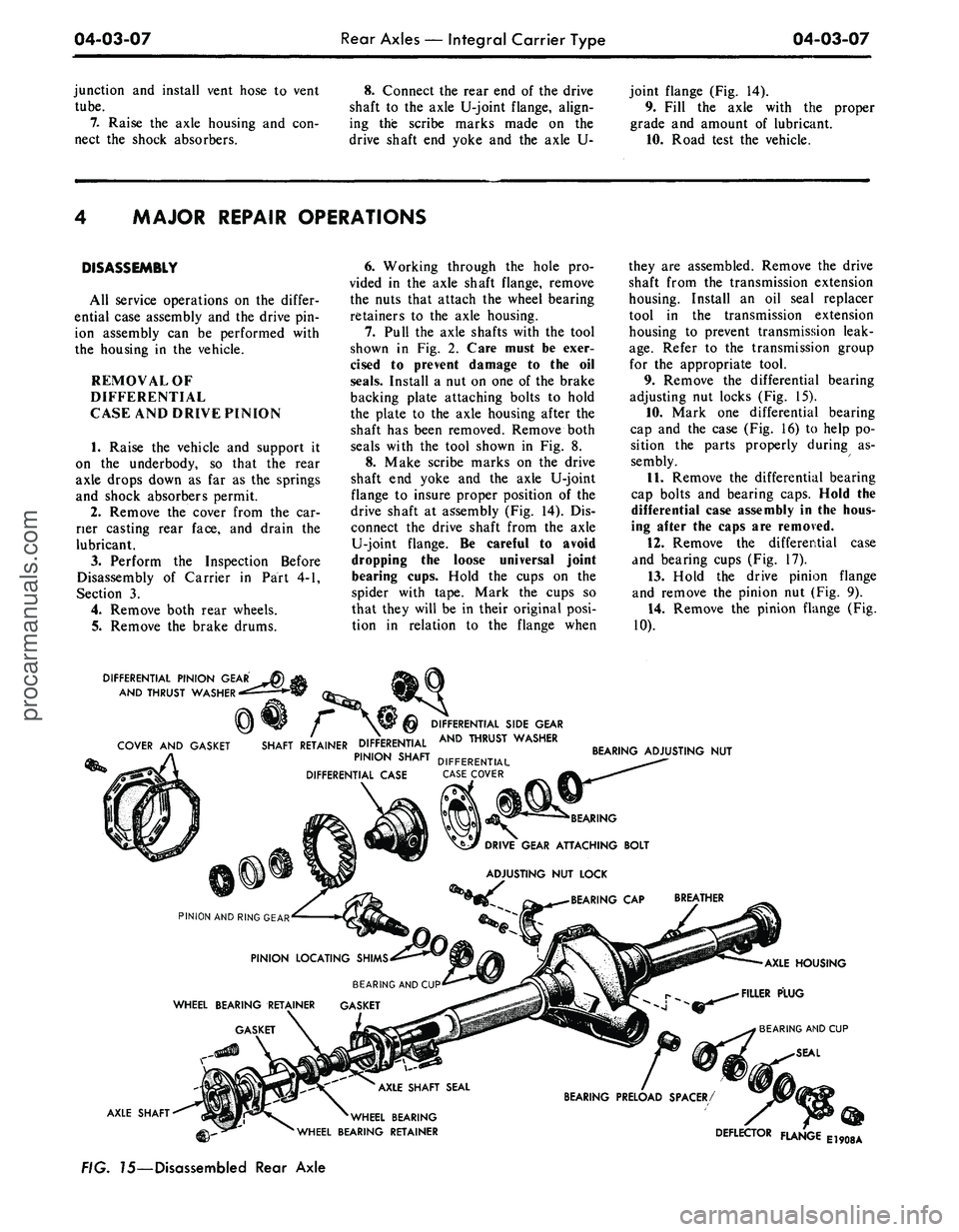
9. Remove the differential bearing
adjusting nut locks (Fig. 15).
10.
Mark one differential bearing
cap and the case (Fig. 16) to help po-
sition the parts properly during as-
sembly.
11.
Remove the differential bearing
cap bolts and bearing caps. Hold the
differential case assembly in the hous-
ing after the caps are removed.
12.
Remove the differential case
and bearing cups (Fig. 17).
13.
Hold the drive pinion flange
and remove the pinion nut (Fig. 9).
14.
Remove the pinion flange (Fig.
10).
DIFFERENTIAL PINION GEAR
AND THRUST WASHER
COVER AND GASKET
DIFFERENTIAL SIDE GEAR
AND THRUST WASHER
SHAFT RETAINER DIFFERENTIAL
PINION SHAFT DIFFERENT|AL
DIFFERENTIAL CASE CASE COVER
BEARING ADJUSTING NUT
PINION AND RING GEAR
AXLE SHAFT
BEARING
DRIVE GEAR ATTACHING BOLT
ADJUSTING NUT LOCK
BEARING CAP
PINION LOCATING SHIMS
BEARING AND CUP
WHEEL BEARING RETAINER
GASKET
BEARING AND CUP
SEAL
AXLE SHAFT SEAL
BEARING PRELOAD SPACER/
AXLE HOUSING
FILLER PLUG
'WHEEL BEARING
WHEEL BEARING RETAINER
DEFLECTOR FLANGE
E1908A
FIG. 75—Disassembled Rear Axleprocarmanuals.com
Page 238 of 413
04-04-07
Rear Axle — Ford Light-Duty (WER)
04-04-07
RUNOUT CHECK
E 1573-A
FIG. 70—Checking Backlash and Runout—Light-Duty (WER) Axle
All service operations on the differ-
ential case assembly can be performed
with the axle housing in the vehicle.
1.
Raise the vehicle on a hoist.
2.
Position the drain pan under the
axle housing. Loosen the housing
cover attaching bolts. Drain the lubri-
cant from the housing.
3.
Make scribe marks on the drive
shaft end yoke and the rear axle shaft
companion flange to insure proper po-
sition of the drive shaft at assembly.
Disconnect the driveshaft from the
rear axle companion flange. Be care-
ful to avoid dropping the loose univer-
sal joint bearing cups. Hold the cups
on the spider with tape. Mark the
cups so that they will be in their origi-
nal position in relation to the flange
when they are reassembled. Remove
the drive shaft from the transmission
extension housing. Install an oil seal
replacer tool in the transmission ex-
tension housing to prevent transmis-
sion leakage. Refer to the transmis-
sion group for the appropriate tool.
4.
Raise the vehicle and place
jack-type stands under the rear frame
crossmember. Lower the vehicle on a
hoist and allow the axle to lower as
far as possible.
5.
Remove the axle housing cover
and gasket. Discard the gasket.
6. Perform the Inspection Before
Disassembly of Carrier procedure.
Refer to Part 4-1, Section 3 of this
Shop Manual.
7.
Remove the attaching (Tinner-
man) nuts that secure the rear brake
drums to the axle shaft flanges, and
then remove the drums.
8. Working through the differential
case opening, remove the pinion shaft
lock bolt and pinion shaft (Fig. 2).
9. Push the axle shafts inward
toward the center of the axle housing.
Remove the C-locks (Fig. 3) from the
inner ends of the rear axles. Remove
the axle shafts from the housing. Ex-
treme care must be used to avoid con-
tacting the axle shaft seal lip with any
portion of the axle shaft except the
seal journal.
10.
Remove the bearings and oil
seals from the axle housing as shown
in Fig. 4.
11.
Remove the pinion side gears
and the side gear thrust washers.
12.
Remove both side bearing ad-
justing nut locks (bolts).
13.
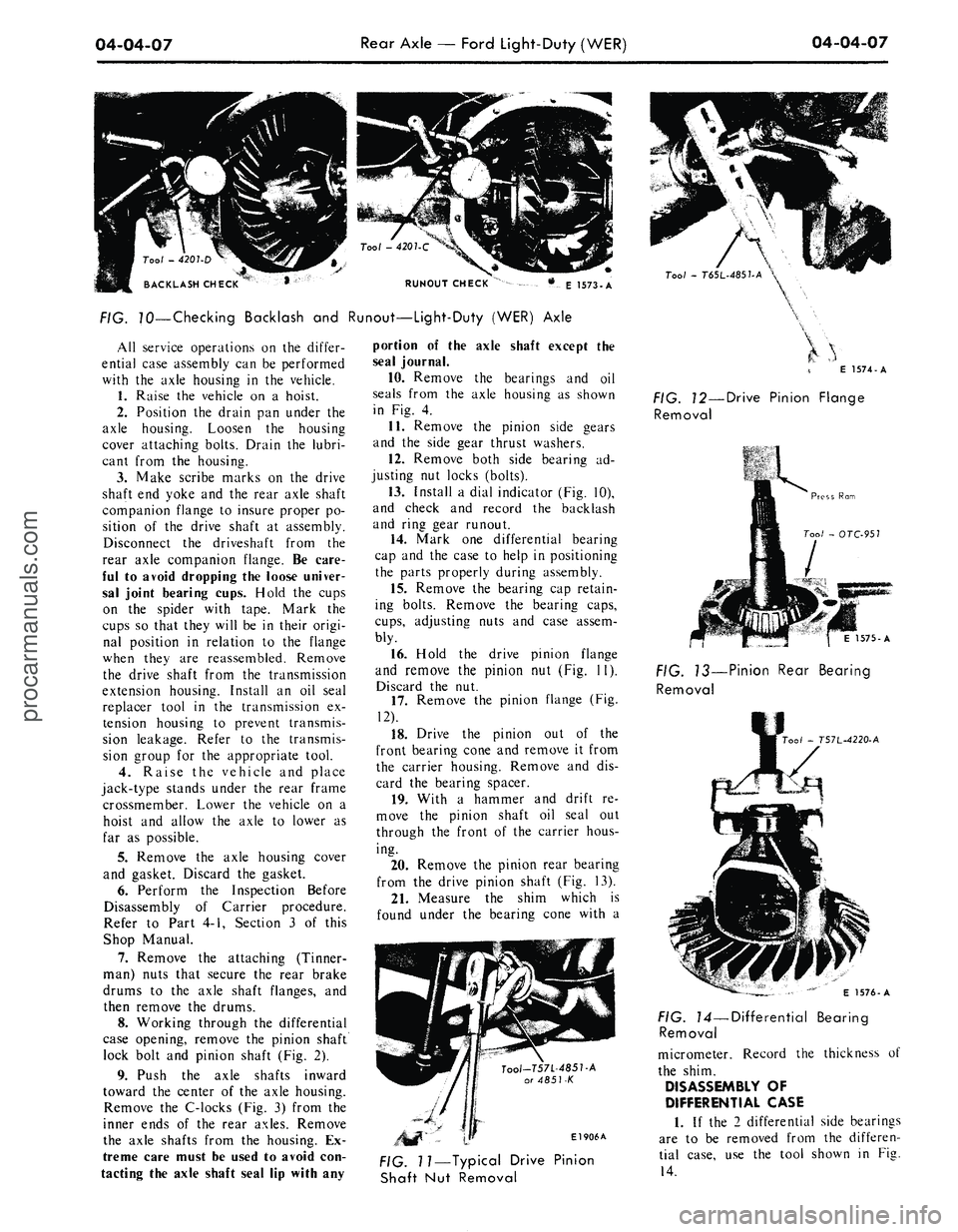
Install a dial indicator (Fig. 10),
and check and record the backlash
and ring gear runout.
14.
Mark one differential bearing
cap and the case to help in positioning
the parts properly during assembly.
15.
Remove the bearing cap retain-
ing bolts. Remove the bearing caps,
cups,
adjusting nuts and case assem-
bly.
16.
Hold the drive pinion flange
and remove the pinion nut (Fig. 11).
Discard the nut.
17.
Remove the pinion flange (Fig.
12).
18.
Drive the pinion out of the
front bearing cone and remove it from
the carrier housing. Remove and dis-
card the bearing spacer.
19.
With a hammer and drift re-
move the pinion shaft oil seal out
through the front of the carrier hous-
ing.
20.
Remove the pinion rear bearing
from the drive pinion shaft (Fig. 13).
21.
Measure the shim which is
found under the bearing cone with a
Tool-T57L-485T-A
or 4851-K
El 906A
Tool
-
T6SL-485UA
\
E 1574-A
FIG. 12—Drive Pinion Flange
Removal
1575-A
FIG. 13—Pinion Rear Bearing
Removal
00/
- T57L-4220-A
FIG. 11—Typical Drive Pinion
Shaft Nut Removal
E 1576-A
FIG. 14—Differential Bearing
Removal
micrometer. Record the thickness of
the shim.
DISASSEMBLY OF
DIFFERENTIAL CASE
1.
If the 2 differential side bearings
are to be removed from the differen-
tial case, use the tool shown in Fig.
14.procarmanuals.com