1969 FORD MUSTANG gas type
[x] Cancel search: gas typePage 294 of 413

07-01-03
General Transmission Service
07-01-03
COMPONENT INDEX
FMX Transmission
REAR SUPPORT (FMX)
Inspection
SHIFT POINT CHECKS
STATOR ONE-WAY CLUTCH CHECK
STATOR TO IMPELLOR INTERFERENCE
CHECK
STATOR TO TURBINE INTERFERENCE
CHECK
TRANSMISSION CLEANING
TURBINE AND STATOR END PLAY
CHECK
VACUUM DIAPHRAGM ADJUSTMENT
Altitude Compensating Type
Non-Altitude Compensating Type
VACUUM UNIT CHECK
Altitude Compensating Type
Non-Altitude Compensating Type
MODEL APPLICATION
All
Models
01-06
01-12
01-12
01-12
01-11
01-12
Ford
01-17
01-16
N/A
01-08
N/A
01-05
Mercury
N/A
N/A
N/A
01-08
N/A
01-05
Meteor
01-17
01-16
N/A
01-08
N/A
01-05
Cougar
01-17
01-16
N/A
01-08
N/A
01-05
Fairlane
01-17
01-16
N/A
01-08
N/A
01-05
Falcon
N/A
N/A
N/A
01-08
N/A
01-05
Montego
01-17
01-16
N/A
01-08
N/A
01-05
Mustang
01-17
01-16
N/A
01-08
N/A
01-05
Lincoln-
Continental
N/A
N/A
01-09
N/A
01-06
N/A
Thunderbird
N/A
N/A
01-09
N/A
01-06
N/A
Continental-
Mark
III
N/A
N/A
01-09
N/A
01-06
N/A
A page number indicates that the item is for the vehicle listed at the head of the column.
N/A indicates that the item is not applicable to the vehicle listed.
Three different three-speed trans-
missions are used. The C4 Automatic,
C6 Automatic and the FMX Auto-
matic. Part 7-1 covers testing, com-
mon adjustments and repairs, and
cleaning and inspection for the three
types of transmissions. Where there
are differences in procedures or speci-
fications, the type of transmission af-
fected will be designated.
l
AUTOMATIC TRANSMISSION TESTS
When diagnosing transmission
problems, refer to the Ford Car and
Truck Diagnosis Manual for the de-
tailed information on the items that
could be causing the problem.
The following preliminary checks
should be made before proceeding
with other diagnosis checks.
TRANSMISSION FLUID LEVEL
CHECK
1.
Make sure that the vehicle is
standing level. Then firmly apply the
parking brake.
2.
Run the engine at normal idle
speed. If the transmission fluid is cold
run the engine at fast idle speed
(about 1200 rpm) until the fluid reach-
es its normal operating temperature.
When the fluid is warm, slow the en-
gine down to normal idle speed.
3.
On a vehicle equipped with a
vacuum brake release, disconnect the
release line and plug the end of the
line;
otherwise the parking brake will
not hold the transmission in any drive
position.
4.
Shift the selector lever through
all positions, and place the lever at P.
Do not turn off the engine during the
fluid level checks.
5.
Clean all dirt from the transmis-
sion fluid dipstick cap before remov-
ing the dipstick from the filler tube.
6. Pull the dipstick out of the tube,
wipe it clean, and push it all the way
back into the tube. Be sure it is prop-
erly seated.
7.
Pull the dipstick out of the tube
again, and check the fluid level. The
fluid level should be above the ADD
mark. If necessary, add enough fluid
to the transmission through the filler
tube to bring the level between the
ADD and FULL marks on the dip-
stick. Do not overfill the transmission.
Install the dipstick, making sure it is
fully seated in the tube.
8. Connect the vacuum brake re-
lease line if so equipped, and test it
for proper operation.
FLUID AERATION CHECK
A fluid level that is too high will
cause the fluid to become aerated:
Aerated fluid will cause low control
pressure, and the aerated fluid may be
forced out the vent.
Check the transmission fluid level.
Low fluid level can affect the opera-
tion of the transmission, and may in-
dicate fluid leaks that could cause
transmission damage.
TRANSMISSION FLUID
LEAKAGE CHECKS
Check the speedometer cable con-
nection at the transmission. Replace
the rubber seal if necessary.
Leakage at the oil pan gasket often
can be stopped by tightening the at-
procarmanuals.com
Page 299 of 413

07-01-08
General Transmission Service
07-01-08
3.
Install the bench testing tool on
the transmission.
4.
Remove the
1/8-inch
pipe plug
at the transmission case. Turn the
front pump in a clockwise direction at
75-100 rpm until a regular flow of
transmission fluid leaves the hole in
the transmission case. This operation
bleeds the air from the pump.
5.
Install the pressure gauge (77820
or T57L-77820-A) as shown in Fig.
13.
PRESSURE TESTS
Turn the front pump at 75-100 rpm
and note the gauge readings. The
pressure readings on the bench test
must be within the limits as outlined
in Figure 13, for the engine idle check.
If pressure gauge readings are with-
in limits in all selector lever positions,
install the vacuum diaphragm control
rod unit.
COMMON ADJUSTMENTS AND REPAIRS
TRANSMISSION FLUID DRAIN
AND REFILL
Normal maintenance and lubrica-
tion requirements do not necessitate
periodic automatic transmission fluid
changes.
If a major repair, such as a clutch
band, bearing, etc., is required in the
transmission, it will have to be re-
moved for service. At this time the
converter, transmission cooler and
cooler lines must be thoroughly
flushed to remove any dirt.
When filling a dry transmission and
converter, install five quarts of fluid.
Start the engine, shift the selector
lever as outlined below, and check and
add fluid as necessary.
Following are the procedures for
partial drain and refill due to in-
vehicle repair operation.
C4 TRANSMISSION
1.
On PEA models, disconnect the
fluid filler tube from the transmission
oil pan to drain the fluid.
On PEB and PEE models, loosen
the pan attaching bolts to drain the
fluid from the transmission.
2.
When the fluid has stopped
draining from the transmission, re-
move and thoroughly clean the pan
and the screen. Discard the pan gas-
ket.
3.
Place a new gasket on the pan,
and install the pan on the transmis-
sion.
4.
On PEA models, connect the
filler tube to the pan and tighten the
fitting securely.
5.
Add three quarts of fluid to the
transmission through the filler tube.
6. Run the engine at idle speed for
about two minutes, and then run it at
fast idle speed (about 1200 rpm) until
it reaches it's normal operating temp-
erature. Do not race the engine.
7.
Shift the selector lever through
all the positions, place it at P, and
check the fluid level. The fluid level
should be above the ADD mark. If
necessary, add enough fluid io the
transmission to bring the level be-
tween the ADD and FULL marks on
che dipstick. Do not overfill the trans-
mission.
FMX OK C6
TRANSMISSION
1.
Raise the vehicle on a hoist or
jack stands.
2.
Place a drain pan under the
transmission.
3.
Loosen the pan attaching bolts
to drain the fluid from the transmis-
sion.
4.
After the fluid has drained to the
level of the pan flange, remove the
rest of the pan bolts working from the
rear and both sides of the pan to
allow it to drop and drain slowly.
5.
When the fluid has stopped
draining from the transmission, re-
move and thoroughly clean the pan
and the screen. Discard the pan gas-
ket.
6. Place a new gasket on the pan,
and install the pan on the transmis-
sion.
7.
Add three quarts of fluid to the
transmission through the filler tube.
8. Run the engine at idle speed for
about two minutes, and then run it at
fast idle speed (about 1200 rpm) until
it reaches normal operating tempera-
ture.
Do not race the engine.
9. Shift the selector lever through
all the positions, place it at P, and
check the fluid level. The fluid level
should be above the ADD mark. If
necessary, add enough fluid to the
transmission to bring the level be-
tween the ADD and FULL marks on
the dipstick. Do not overfill the trans-
mission.
OIL COOLER TUBE
REMOVAL AND INSTALLATION
When fluid leakage is found at the
oil cooler, the cooler must be re-
placed. Cooler replacement is de-
scribed in the Cooling System Section
of Group 11.
When one or more of the fluid
cooler steel tubes must be replaced,
each replacement tube must be fabri-
cated from the same size steel tubing
as the original line.
Using the old tube as a guide, bend
the new tube as required. Add the
necessary fittings, and install the tube.
After the fittings have been tight-
ened, add fluid as needed, and check
for fluid leaks.
VACUUM DIAPHRAGM
ADJUSTMENT NON-ALTITUDE
COMPENSATING TYPE
The C4 and C6 transmissions are
equipped with an adjustable vacuum
diaphragm assembly. A similar ad-
justable diaphragm has been released
for service with the FMX transmis-
sion. However, the FMX service dia-
phragm is not interchangeable with
that used on C4 and C6 models.
The vacuum diaphragm assembly
has an adjusting screw in the vacuum
hose connecting tube (Fig. 14).
SPRING
SEAT
THIS CLEARANCE CHANGED
BY ADJUSTING SCREW
D1830-A
FIG. 14—Adjustable Vacuum Unit
The inner end of the screw bears
against a plate which in turn bears
against the vacuum diaphragm spring.
All readings slightly high or all
readings slightly low may indicate the
vacuum unit needs adjustment to cor-
rect a particular shift condition.procarmanuals.com
Page 307 of 413
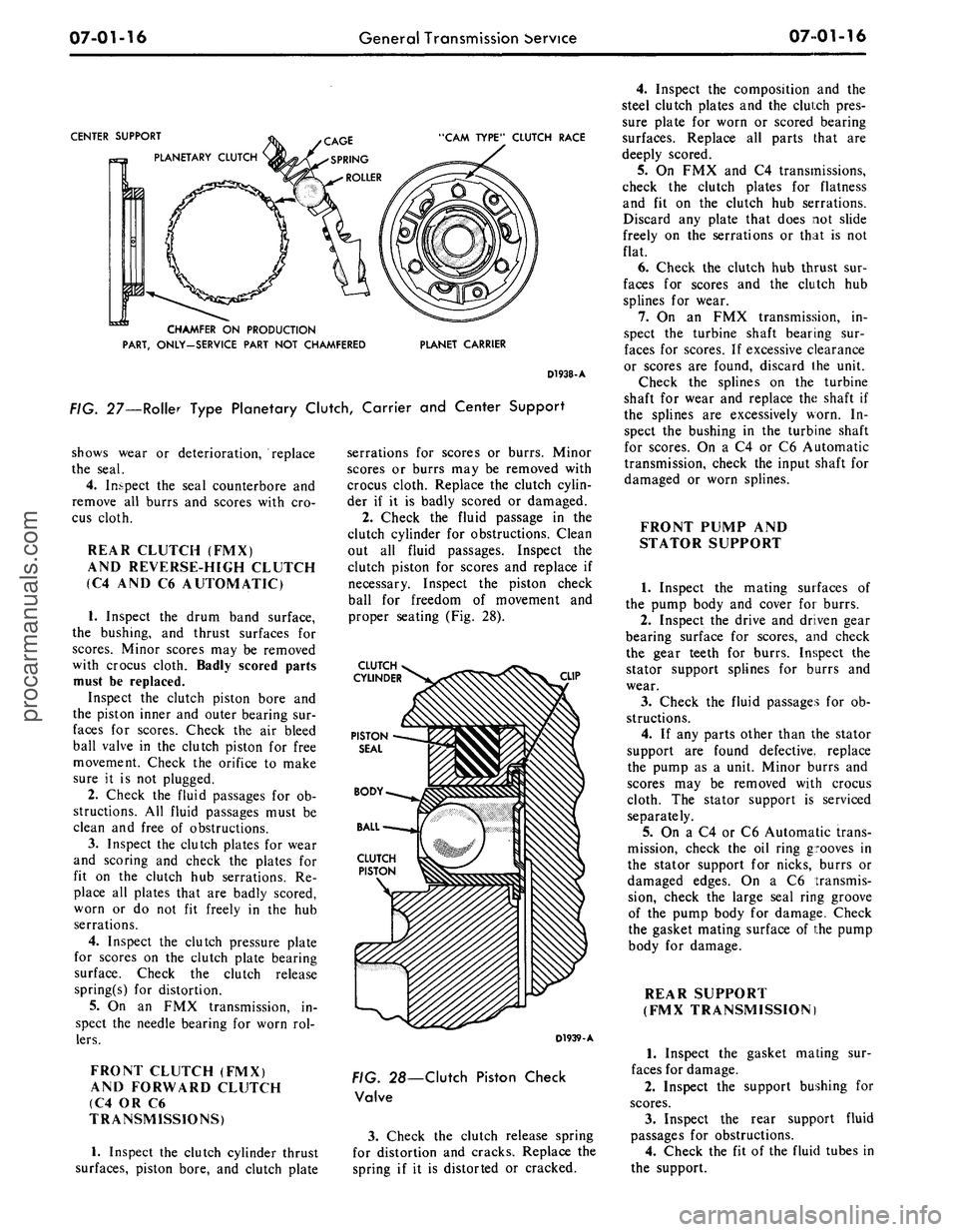
07-01-16
General Transmission bervice
07-01-16
CENTER SUPPORT
PLANETARY CLUTCH
"CAM TYPE" CLUTCH RACE
CHAMFER ON PRODUCTION
PART, ONLY-SERVICE PART NOT CHAMFERED
PLANET CARRIER
D1938-A
FIG. 27—Roller Type Planetary Clutch, Carrier and Center Support
shows wear or deterioration, replace
the seal.
4.
Inspect the seal counterbore and
remove all burrs and scores with cro-
cus cloth.
REAR CLUTCH (FMX)
AND REVERSE-HIGH CLUTCH
(C4 AND C6 AUTOMATIC)
1.
Inspect the drum band surface,
the bushing, and thrust surfaces for
scores. Minor scores may be removed
with crocus cloth. Badly scored parts
must be replaced.
Inspect the clutch piston bore and
the piston inner and outer bearing sur-
faces for scores. Check the air bleed
ball valve in the clutch piston for free
movement. Check the orifice to make
sure it is not plugged.
2.
Check the fluid passages for ob-
structions. All fluid passages must be
clean and free of obstructions.
3.
Inspect the clutch plates for wear
and scoring and check the plates for
fit on the clutch hub serrations. Re-
place all plates that are badly scored,
worn or do not fit freely in the hub
serrations.
4.
Inspect the clutch pressure plate
for scores on the clutch plate bearing
surface. Check the clutch release
spring(s) for distortion.
5.
On an FMX transmission, in-
spect the needle bearing for worn rol-
lers.
FRONT CLUTCH (FMX)
AND FORWARD CLUTCH
(C4 OR C6
TRANSMISSIONS)
1.
Inspect the clutch cylinder thrust
surfaces, piston bore, and clutch plate
serrations for scores or burrs. Minor
scores or burrs may be removed with
crocus cloth. Replace the clutch cylin-
der if it is badly scored or damaged.
2.
Check the fluid passage in the
clutch cylinder for obstructions. Clean
out all fluid passages. Inspect the
clutch piston for scores and replace if
necessary. Inspect the piston check
ball for freedom of movement and
proper seating (Fig. 28).
CLUTCH
CYLINDER
PISTON
SEAL
CLIP
D1939-A
. 28—Clutch Piston Check
Valve
3.
Check the clutch release spring
for distortion and cracks. Replace the
spring if it is distorted or cracked.
4.
Inspect the composition and the
steel clutch plates and the clutch pres-
sure plate for worn or scored bearing
surfaces. Replace all parts that are
deeply scored.
5.
On FMX and C4 transmissions,
check the clutch plates for flatness
and fit on the clutch hub serrations.
Discard any plate that does not slide
freely on the serrations or that is not
flat.
6. Check the clutch hub thrust sur-
faces for scores and the clutch hub
splines for wear.
7.
On an FMX transmission, in-
spect the turbine shaft bearing sur-
faces for scores. If excessive clearance
or scores are found, discard the unit.
Check the splines on the turbine
shaft for wear and replace the shaft if
the splines are excessively worn. In-
spect the bushing in the turbine shaft
for scores. On a C4 or C6 Automatic
transmission, check the input shaft for
damaged or worn splines.
FRONT PUMP AND
STATOR SUPPORT
1.
Inspect the mating surfaces of
the pump body and cover for burrs.
2.
Inspect the drive and driven gear
bearing surface for scores, and check
the gear teeth for burrs. Inspect the
stator support splines for burrs and
wear.
3.
Check the fluid passages for ob-
structions.
4.
If any parts other than the stator
support are found defective, replace
the pump as a unit. Minor burrs and
scores may be removed with crocus
cloth. The stator support is serviced
separately.
5.
On a C4 or C6 Automatic trans-
mission, check the oil ring grooves in
the stator support for nicks, burrs or
damaged edges. On a C6 transmis-
sion, check the large seal ring groove
of the pump body for damage. Check
the gasket mating surface of the pump
body for damage.
REAR SUPPORT
(FMX TRANSMISSION)
1.
Inspect the gasket mating sur-
faces for damage.
2.
Inspect the support bushing for
scores.
3.
Inspect the rear support fluid
passages for obstructions.
4.
Check the fit of the fluid tubes in
the support.procarmanuals.com
Page 366 of 413

07-03-26
FMX Transmission
07-03-26
MANUAL SHAFT
AND LEVER
DETENT SPRING—«^ DETENT PLUNGER
DETENT
/ LEVER
MANUAL SHAFT
NUT
INNER DOWNSHIFT LEVER
/ DOWNSHIFT
/ SHAFT
NUT
TOGGLE LIFT
ijG
LEVER SPRING
TOGGLE LEVER-
PAWL RETURN SPRING-
TOGGLE LEVER
PIN-
PLUG'
D1967-A
FIG. 52—Transmission Case Control Linkage
pawl return spring. Assemble
the tog-
gle lever
to the
link with
the
toggle
link
pin.
Position
the
pawl return
spring over
the
toggle link pin,
and se-
cure
it in
place with
the
washer
and
the small retainer clip
(Fig. 52). In-
stall
the
assembly
in the
transmission
case
by
installing
the
pawl
pin and the
toggle lever
pin.
Install
the
torsion
lever assembly. Position
the
spring
on
the torsion lever with
a
screwdriver.
Make certain that
the
short side
of
toggle does
not
extend beyond
the
largest diameter
of the
ball
or the
tog-
gle lever
pin
(Fig. 52).
Tap the
toggle
lever
in or out as
necessary
to
center
the toggle lever
on the
ball.
4.
Install
the
manual lever
and
shaft
in the
transmission case. Posi-
tion
the
detent lever
on the
shaft,
and
secure
it
with
a nut.
Tighten
the nut
to 20-30 ft-lbs torque. Rotate
the
manual lever
to the
rear
of the
case.
Position
the
detent spring
in the
case.
Press Ram
Hold
the
detent plug
on the
spring
with
a
3/16-inch socket wrench, then
depress
the
spring until
the
plug
is
flush with
the
case. Carefully rotate
the manual lever
to the
front
of the
case
to
secure
the
plug.
A
piece
of
thin walled tubing
may be
used
to
depress
the
plug
if a
small socket
wrench
is not
available.
5.
Position
the
ends
of the
parking
pawl operating
rod in the
detent lever
and toggle lift lever,
and
secure with
the
two
small retaining pins.
6. Install
a new
seal
on the
down-
shift lever shaft, then install
the
lever
and shaft
in the
case. Position
the
inner downshift lever
on the
inner
end
of
the
shaft with
the
mark
O
facing
toward
the
center
of the
case. Install
the lock washer
and nut,
then tighten
the
nut to
17-20 ft-lbs torque.
7.
Check
the
operation
of the
link-
age.
The
linkage should operate freely
without binding.
Handle
Tool -
T64L.7003-BS
REMOVAL
Tool - T64L-7003-A5
INSTALLATION
D 1745-B
FIG. 53—Replacing Transmission Case Bushing
TRANSMISSION CASE
BUSHING REPLACEMENT
1.
If the
transmission case bushing
is
to be
replaced, press
the
bushing
out
of the
case with
the
tools shown
in
Fig.
53.
2.
Install
a new
transmission case
bushing with
the
tool shown
in Fig.
53.
ASSEMBLY
OF
TRANSMISSION
Do
not use
force
to
assemble
mat-
ing parts.
If the
parts
do not
assemble
freely, examine them
for the
cause_pf
the difficulty. Always
use new
gaskets
and seals during
the
assembly opera-
tions.
CLUTCH ASSEMBLIES
1.
Install
the
front band
in the
transmission case
so
that
the
anchor
end
is
aligned with
the
anchor
in the
case.
2.
Make sure
the
thrust washer
is
in place
on the
input shaft. Lift
the
clutch assemblies
out of the
holding
block.
Do not
allow
the
clutches
to
separate.
3.
Install
the
clutch sub-assemblies
in
the
transmission case while posi-
tioning
the
servo band
on the
drum.
Hold
the
units together while install-
ing them (Fig.
25).
CENTER SUPPORT,
ONE-WAY CLUTCH,
PINION CARRIER,
AND
OUTPUT SHAFT
The production center supports
are
chamfered
at the
edge
of the
race
(Fig.
54). The
service center supports
are
not
chamfered.
The
following
as-
sembly procedures cover both types
of
center supports.
Installation—Center Support
With Chamfered Edge
1.
Install
the
center support
and the
rear band
in the
case.
2.
Install
the
primary
sun
gear rear
thrust bearing race, needle bearing,
and front thrust bearing race
if
used
in
the
planet carrier using petroleum
jelly
to
retain them
in
place.
3.
Lubricate
the
bearing surface
on
the center support,
the
rollers
of the
planetary clutch,
and the cam
race
in
the carrier with petroleum jelly
(Fig.
54).
4.
Install
the
planetary clutch
in the
carrier (Fig.
55).procarmanuals.com