1969 FORD MUSTANG service
[x] Cancel search: servicePage 271 of 413

06-02-02
Ford Design Three Speed Transmission
06-02-02
DESCRIPTION
DESCRIPTION
The RAN and RAT Model three-
speed transmission (Fig. 1) are used
on models having 170, 200, 240, 250,
302,
351 and 390 C.I.D. engines. The
specifications of this section, Part 6-4,
lists the transmission model numbers
and vehicles in which they are used.
A transmission service identification
tag is located on the right side of the
case at the front (Fig. 2). The first
line on the tag will show the transmis-
sion model and service identification
code when required. The second line
will show the transmission serial num-
ber. Additionally, a driveline compo-
nent identification tag is attached to
the upper right side of the transmis-
sion case.
This transmission is of the fully
synchronized type, with all gears ex-
cept the reverse gear and sleeve being
in constant mesh. All forward-speed
changes are accomplished with syn-
chronizer sleeves.
The forward-speed gears are
helical-cut and are in constant mesh.
Gears used in the reverse gear train
are spur-cut and are not synchronized.
C2O87-A
FIG.
1—Three-Speed
Transmission—Typical
TRANS.
MODEL
SERIAL
NO.
C 2089-A
FIG.
2—Transmission
Identification
Tag
IN-VEHICLE ADJUSTMENTS
AND
REPAIRS
GEAR SHIFT LINKAGE
ADJUSTMENT—COLUMN
MOUNTED
1. Place the gear shift lever in the
neutral position.
2.
Loosen the two gear shift rod
adjustment nuts.
3.
Check shift levers on transmis-
sion to be in neutral position.
4.
Insert a 3/16-inch diameter
alignment tool through the first and
reverse gear shift lever, the second and
third gear shift lever and both holes
in the lower casting (Fig. 3). An align-
ment tool can be made from 3/16
inch drill rod bent to an L shape.
The extensions should be 1 inch and 2
inches from the elbow. The short end
of the tool should be inserted into the
alignment holes.
5.
Tighten the two gear shift rod
adjustment nuts.
6. Remove the alignment tool from
the levers.
7.
Start the engine and shift the se-
lector lever to each position to make
sure it operates freely.
FIG.
3—Gearshift
Linkage Adjustment—Typicalprocarmanuals.com
Page 281 of 413

06-03-02
Ford Design Four-Speed Transmission
06-03-02
1 DESCRIPTION
DESCRIPTION
The Ford designed 4-speed trans-
mission
(Fig. 1) is of the
fully
syn-
chronized type with
all
gears except
the reverse sliding gear being
in con-
stant mesh.
All
forward-speed changes
are accomplished with synchronizer
sleeves.
All forward-speed gears
in the
transmission
are
helical-type, however,
the reverse sliding gear
and the
exter-
ior
of the
first-and second-speed
syn-
chronizer sleeve
are
spur-type gears.
The specifications
of
this section Part
6-4 lists
the
transmission model
num-
bers
and
vehicles
in
which they
are
used.
C 1765-B
FIG. 7—Four-Speed Transmission—Typical
A transmission service identification
tag
is
located
on the
right side
of the
case
at the
front
(Fig. 2). The
first
line
on the tag
will show
the
transmis-
sion model
and
service identification
code when required.
The
second line
will show
the
transmission serial
num-
ber. Additionally,
a
driveline compo-
nent identification
tag is
attached
to
the upper right side
of the
transmis-
sion case.
TRANS.
MODEL
O
RUG-C-2
10001
O
SERIAL NO.
C 2088-A
FIG. 2—Transmission
Identification
Tag
IN-VEHICLE ADJUSTMENTS
AND
REPAIRS
SHIFT LINKAGE ADJUSTMENT
1.
Loosen
the
three shift linkage
adjustment nuts. Install
a 1/4
inch
di-
ameter alignment tool through
the
control bracket
and
lever holes
as
shown
in Fig. 13.
An alignment tool
can be
made
from
1/4
inch diameter drill
rod
bent
to
an "L"
shape.
The
extensions
should
be 2 1/2
inch
and 3 3/4
inch
from
the
elbow. Short
end of
align-
ment
pin
should
be
inserted into
con-
trol bracket
and
linkage holes until
it
bottoms.
2.
Disconnect
the
reverse gear shift
rod from
the
shift lever.
3.
Shift
the
transmission into
re-
verse gear.
4.
Tighten
the 1-2 and 3-4
shift
rod
adjustment nuts.
5.
Connect
the
reverse gear shift
rod
to the
shift lever. Shift
the
reverse
lever
to the
neutral position
and
tight-
en
the
adjustment
nut.
6. Remove
the
alignment
pin.
7.
Check
the
gear shift lever
for a
smooth crossover.
REMOVAL
AND
INSTALLATION
REMOVAL
1.
Raise
the
vehicle
on a
hoist.
2.
Mark
the
driveshaft
so
that
it
may
be
installed
in the
same relative
position. Disconnect
the
drive shaft
from
the
rear U-joint flange. Slide
the
drive shaft
off the
transmission output
shaft
and
install
the
extension housing
seal installation tool into the extension
housing
to
prevent lubricant leakage.
See
Fig. 2,
Part
6-1.
3.
Disconnect
the
speedometer
cable from
the
extension housing.
4.
Disconnect
the
parking brakeprocarmanuals.com
Page 292 of 413

07-01-01
07-01-01
*.v:;V*>
-"^g&ly-
'y.y... -4^*:
GROUP
7
PART
7-1
PAGE
General Transmission Service
07-01-01
PART
7-2
C4 Automatic Transmission
07-02-01
PART
7-3
FMX Transmission
07-03-01
PART
7-4
C6 Automatic Transmission
....
PART
7-5
Specifications
PAGE
07-04-01
07-05-01
TRANSMISSION
CODE
TRANSMISSION
TYPE
AUTOMATIC
(C4)
U AUTOMATIC
(C6)
X AUTOMATIC
(FMX)
Z AUTOMATIC
(C6
SPECIAL)
D2040-A
FIG. 1—Typical Warranty Plate—Transmission Identification
PART
7-1
General
Transmission
Service
COMPONENT INDEX
AIR PRESSURE CHECKS
ANTI-STALL DASHPOT CLEARANCE
CHECK
(Engine Compartment)
CASE (Transmission)
Inspection
CONTROL PRESSURE CHECK
CONTROL VALVE BODY
Inspection
CONVERTER
Checking
Cleaning
DRAIN AND REFILL (Transmission)
ENGINE IDLE SPEED CHECK
EXTENSION HOUSING INSPECTION
FLUID AERATION CHECK
MODEL APPLICATION
All
Models
01-06
01-04
01-17
01-05
01-17
01-04
01-11
01-08
01-04
01-15
01-03
Ford
Mercury
Meteor
Cougar
Fairiane
Falcon
Montego
Mustang
Lincoln-
Continental
Thunderbird
Continental-
Mark
III
A page number indicates that the item
is for
the vehicle listed
at
the head
of
the column.
N/A indicates that the item
is not
applicable
to
the vehicle listed.
procarmanuals.com
Page 293 of 413

07-01-02
General Transmission Service
07-01-02
COMPONENT INDEX
FLUID LEAKAGE CHECK
FLUID LEVEL CHECK
FRONT CLUTCH (Forward) INSPECTION
C4 Transmission
C6 Transmission
FMX Transmission
FRONT PUMP AND STATOR SUPPORT
Inspection
FRONT SERVO (Intermediate) INSPECTION
C4 Transmission
C6 Transmission
FMX Transmission
GOVERNOR INSPECTION
HYDRAULIC SYSTEM BENCH TESTS
(FMX)
Pressure Tests
Testing Tool Installation
MANUAL LINKAGE CHECKS
MANUAL SHIFT LINKAGE GROMMET
COLUMN SHIFT
Removal and Installation
NEUTRAL START SWITCH-COLUMN
SHIFT
Adjustment
Removal and Installation
OIL COOLER CLEANING
OIL COOLER TUBES
Removal and Installation
ONE-WAY CLUTCH INSPECTION
OUTPUT SHAFT AND PRIMARY SUN
GEAR
Shaft (FMX)
Inspection
PINION CARRIER, ONE-WAY CLUTCH
AND CENTER SUPPORT (FMX)
Inspection
PINION CARRIERS INSPECTION
C4 Transmission
C6 Transmission
PRESSURE REGULATOR (FMX)
Inspection
REAR CLUTCH (Reverse-High) INSPECTION
C4 Transmission
C6 Transmission
FMX Transmission
REAR SERVO (Low-Reverse) INSPECTION
C4 Transmission
MODEL APPLICATION
All
Models
01-03
01-03
01-16
01-17
01-04
01-11
01-08
01-17
Ford
01-16
01-16
01-16
01-17
01-17
01-17
01-08
01-07
01-11
01-09
01-10
01-12
01-15
01-15
01-15
01-17
01-16
01-16
01-16
01-17
01-17
Mercury
N/A
01-16
N/A
N/A
01-17
N/A
N/A
N/A
01-11
01-09
01-10
N/A
N/A
N/A
01-15
N/A
N/A
01-16
N/A
N/A
N/A
Meteor
01-16
01-16
01-16
01-17
01-17
01-17
01-08
01-07
01-11
01-09
01-10
01-12
01-15
01-15
01-15
01-17
01-16
01-16
01-16
01-17
01-17
Cougar
N/A
01-16
01-16
N/A
01-17
01-17
01-08
01-07
N/A
N/A
N/A
01-12
01-15
N/A
01-15
01-17
N/A
01-16
01-16
N/A
01-17
Fairlane
01-16
01-16
01-16
01-17
01-17
01-17
01-08
01-07
01-11
01-09
01-10
01-12
01-15
01-15
01-15
01-17
01-16
01-16
01-16
01-17
01-17
Falcon
01-16
N/A
N/A
01-17
N/A
N/A
N/A
N/A
01-11
01-09
01-10
N/A
N/A
01-15
N/A
N/A
01-16
N/A
N/A
01-17
N/A
Montego
01-16
01-16
01-16
01-17
01-17
01-17
01-08
01-07
01-11
01-09
01-10
01-12
01-15
01-15
01-15
01-17
01-16
01-16
01-16
01-17
01-17
Mustang
01-16
01-16
01-16
01-17
01-17
01-17
01-08
01-07
N/A
N/A
N/A
01-12
01-15
01-15
01-15
01-17
01-16
01-16
01-16
01-17
01-17
Lincoln-
Continental
N/A
01-16
N/A
N/A
01-17
N/A
N/A
N/A
01-11
01-09
01-10
N/A
N/A
N/A
01-15
N/A
N/A
01-16
N/A
N/A
N/A
Thunderbird
N/A
01-16
N/A
N/A
01-17
N/A
N/A
N/A
01-11
01-09
01-10
N/A
N/A
N/A
01-15
N/A
N/A
01-16
N/A
N/A
N/A
Continental-
Mark
III
N/A
01-16
N/A
N/A
01-17
N/A
N/A
N/A
01-11
01-09
01-10
N/A
N/A
N/A
01-15
N/A
N/A
01-16
N/A
N/A
N/A
A page number indicates that the item is for the vehicle listed at the head of the column.
N/A indicates that the item is not applicable to the vehicle listed.
procarmanuals.com
Page 294 of 413

07-01-03
General Transmission Service
07-01-03
COMPONENT INDEX
FMX Transmission
REAR SUPPORT (FMX)
Inspection
SHIFT POINT CHECKS
STATOR ONE-WAY CLUTCH CHECK
STATOR TO IMPELLOR INTERFERENCE
CHECK
STATOR TO TURBINE INTERFERENCE
CHECK
TRANSMISSION CLEANING
TURBINE AND STATOR END PLAY
CHECK
VACUUM DIAPHRAGM ADJUSTMENT
Altitude Compensating Type
Non-Altitude Compensating Type
VACUUM UNIT CHECK
Altitude Compensating Type
Non-Altitude Compensating Type
MODEL APPLICATION
All
Models
01-06
01-12
01-12
01-12
01-11
01-12
Ford
01-17
01-16
N/A
01-08
N/A
01-05
Mercury
N/A
N/A
N/A
01-08
N/A
01-05
Meteor
01-17
01-16
N/A
01-08
N/A
01-05
Cougar
01-17
01-16
N/A
01-08
N/A
01-05
Fairlane
01-17
01-16
N/A
01-08
N/A
01-05
Falcon
N/A
N/A
N/A
01-08
N/A
01-05
Montego
01-17
01-16
N/A
01-08
N/A
01-05
Mustang
01-17
01-16
N/A
01-08
N/A
01-05
Lincoln-
Continental
N/A
N/A
01-09
N/A
01-06
N/A
Thunderbird
N/A
N/A
01-09
N/A
01-06
N/A
Continental-
Mark
III
N/A
N/A
01-09
N/A
01-06
N/A
A page number indicates that the item is for the vehicle listed at the head of the column.
N/A indicates that the item is not applicable to the vehicle listed.
Three different three-speed trans-
missions are used. The C4 Automatic,
C6 Automatic and the FMX Auto-
matic. Part 7-1 covers testing, com-
mon adjustments and repairs, and
cleaning and inspection for the three
types of transmissions. Where there
are differences in procedures or speci-
fications, the type of transmission af-
fected will be designated.
l
AUTOMATIC TRANSMISSION TESTS
When diagnosing transmission
problems, refer to the Ford Car and
Truck Diagnosis Manual for the de-
tailed information on the items that
could be causing the problem.
The following preliminary checks
should be made before proceeding
with other diagnosis checks.
TRANSMISSION FLUID LEVEL
CHECK
1.
Make sure that the vehicle is
standing level. Then firmly apply the
parking brake.
2.
Run the engine at normal idle
speed. If the transmission fluid is cold
run the engine at fast idle speed
(about 1200 rpm) until the fluid reach-
es its normal operating temperature.
When the fluid is warm, slow the en-
gine down to normal idle speed.
3.
On a vehicle equipped with a
vacuum brake release, disconnect the
release line and plug the end of the
line;
otherwise the parking brake will
not hold the transmission in any drive
position.
4.
Shift the selector lever through
all positions, and place the lever at P.
Do not turn off the engine during the
fluid level checks.
5.
Clean all dirt from the transmis-
sion fluid dipstick cap before remov-
ing the dipstick from the filler tube.
6. Pull the dipstick out of the tube,
wipe it clean, and push it all the way
back into the tube. Be sure it is prop-
erly seated.
7.
Pull the dipstick out of the tube
again, and check the fluid level. The
fluid level should be above the ADD
mark. If necessary, add enough fluid
to the transmission through the filler
tube to bring the level between the
ADD and FULL marks on the dip-
stick. Do not overfill the transmission.
Install the dipstick, making sure it is
fully seated in the tube.
8. Connect the vacuum brake re-
lease line if so equipped, and test it
for proper operation.
FLUID AERATION CHECK
A fluid level that is too high will
cause the fluid to become aerated:
Aerated fluid will cause low control
pressure, and the aerated fluid may be
forced out the vent.
Check the transmission fluid level.
Low fluid level can affect the opera-
tion of the transmission, and may in-
dicate fluid leaks that could cause
transmission damage.
TRANSMISSION FLUID
LEAKAGE CHECKS
Check the speedometer cable con-
nection at the transmission. Replace
the rubber seal if necessary.
Leakage at the oil pan gasket often
can be stopped by tightening the at-
procarmanuals.com
Page 295 of 413

07-01-04
General Transmission Service
07-01-04
taching bolts to the proper torque. If
necessary, replace the gasket.
Check the fluid filler tube connec-
tion at the transmission case or pan.
If leakage is found here, install a new
O-ring or tighten the fitting to the
specified torque.
Check the fluid lines and fittings
between the transmission and the
cooler in the radiator tank for loose-
ness,
wear, or damage. If leakage can-
not be stopped by tightening a fitting,
replace the damaged parts.
Check the engine coolant in the ra-
diator. If transmission fluid is present
in the coolant, the cooler in the radia-
tor is probably leaking.
The cooler can be further checked
for leaks by disconnecting the lines
from the cooler fittings and applying
50-75 psi air pressure to the fittings.
Remove the radiator cap to relieve the
pressure build at the exterior of the oil
cooler tank. If the cooler is leaking
and will not hold this pressure the
cooler must be replaced. Cooler re-
placement is described in the Cooling
System Section of Group 11.
If leakage is found at either the
downshift control lever shaft or the
manual lever shaft, replace either or
both seals.
Inspect the pipe plug on the left
side of the transmission case at the
front. If the plug shows leakage, tor-
que the plug to specifications. If tight-
ening does not stop the leaks, replace
the plug. On a C6 transmission, a TV
pressure plug is also provided on the
right rear side of the case.
When converter drain plugs leak,
remove drain plugs with a six-point
wrench. Coat the threads with FoMo-
Co Perfect Seal Sealing Compound or
its equivalent, and install the plugs.
Torque the drain plugs to specifica-
tion. Fluid leakage from the converter
housing may be caused by engine oil
leaking past the rear main bearing or
from oil gallery plugs, or power steer-
ing oil leakage from steering system.
Be sure to determine the exact cause
of the leak before repair procedures
are started.
Oil-soluble aniline or fluorescent dyes
premixed at the rate of 1/2 teaspoon
of dye powder to 1/2 pint of transmis-
sion fluid have proved helpful in locat-
ing the source of the fluid leakage.
Such dyes may be used to determine
whether an engine oil or transmission
fluid leak is present or if the fluid in
the oil cooler leaks into the engine
coolant system. A black light, how-
ever, must be used with the fluorescent
dye solution.
DISHED OR
FLAT WASHER
" O.D.,
a" STEEL PLATE
5/8"X \W,
DRILL TO SUIT
HEX. HEAD SCREW
3/8"-24 X Vl
HEX. NUT W—
24
WELD
TOGETHER
WING
NUT
>/2"_13
THREAD
CHAIN,
10"
LONG
RUBBER PLUG
1
Vi" DIA. X 2"
LONG Vl"
HOLE THRU
APPROXIMATELY
40 DUROMETER
FLAT WASHER
Vs" O.D.
PLUG
VALVE
STANDARD BOLT
W-13
X 4Vl"
LONG SQUARE
THREAD
END
REMOVE HEAD
AND WELD
TO
WASHER
STANDARD 1/8" FITTING-87971-S FOR
RETAPPED DRAIN PLUG THREADS-USE
1/4" OVERSIZE FITTING-87973-S
D 1067-B
WELD TOGETHER
SECURELY—MUST
NOT LEAK
FIG. 2—Converter Leak Checking Tool
CONVERTER LEAKAGE
CHECK
If there are indications that the
welds on the torque converter are
leaking, the converter will have to be
removed and the following check
made before the unit is replaced.
A leak checking tool (Fig. 2) can be
made from standard parts. The tool
can be used to check all converters.
1.
Install the plug in the converter
(Fig. 3) and expand it by tightening
the wing nut. Attach the safety chains.
2.
Install the air valve in one of the
drain plug holes.
3.
Introduce air pressure into the
converter. Check the pressure with a
tire gauge and adjust it to 20 psi.
4.
Place the converter in a tank of
water. Observe the weld areas for
bubbles. If no bubbles are observed, it
may be assumed that the welds are
not leaking.
ENGINE IDLE SPEED CHECK
Check and, if necessary, adjust the
engine idle speed, using the procedure
given in Group 10.
If the idle speed is too low, the en-
gine will run roughly. An idle speed
that is too high will cause the vehicle
to creep, have harsh engagements and
harsh closed-throttle downshifts.
ANTI-STALL DASHPOT
CLEARANCE CHECK
After the engine idle speed has been
properly adjusted, check the anti-stall
dashpot clearance. Follow the proce-
dure given in Group 10 for checking
and adjusting this clearance.
MANUAL LINKAGE CHECKS
Correct manual linkage adjustment
is necessary to position the manual
valve for proper fluid pressure direc-
tion to the different transmission com-
ponents. Improperly adjusted manual
Tire Pressure Gauge
D1921-A
FIG. 3—Converter Leak Checking
Tool Installationprocarmanuals.com
Page 296 of 413
07-01-05
General Transmission Service
07-01-05
linkage may cause crossleakage and
subsequent transmission failure. Refer
to Linkage Adjustments in Part 7-2,
7-3 or 7-4 for detailed manual linkage
adjustment procedures.
CONTROL PRESSURE
CHECK
When the vacuum diaphragm unit is
operating properly and the downshift
linkage is adjusted properly, all the
transmission shifts (automatic and
kickdown) should occur within the
road speed limits specified in Part 7-5.
If the shifts do not occur within
limits or the transmission slips during
shift point, the following procedure is
suggested to determine engine, trans-
mission, linkage, vacuum diaphragm
unit or valve body problems.
1.
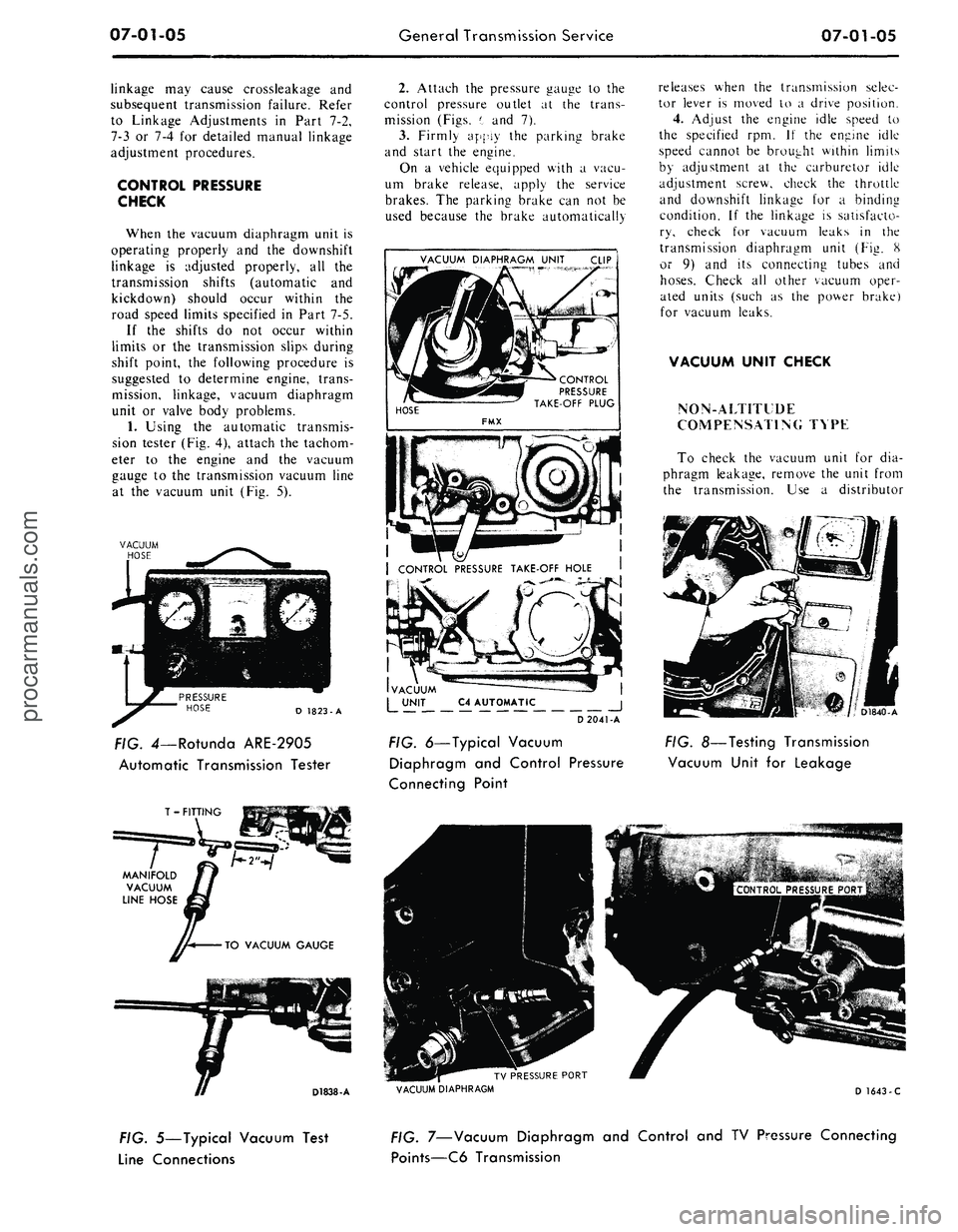
Using the automatic transmis-
sion tester (Fig. 4), attach the tachom-
eter to the engine and the vacuum
gauge to the transmission vacuum line
at the vacuum unit (Fig. 5).
D 1823-A
. 4—Rotunda ARE-2905
Automatic Transmission Tester
T - FITTING
2.
Attach the pressure gauge to the
control pressure outlet at the trans-
mission (Figs. '., and 7).
3.
Firmly apply the parking brake
and start the engine.
On a vehicle equipped with a vacu-
um brake release, apply the service
brakes. The parking brake can not be
used because the brake automatically
VACUUM DIAPHRAGM UNIT
CLIP
I
| CONTROL PRESSURE TAKE-OFF HOLE
D2041-A
FIG. 6—Typical Vacuum
Diaphragm and Control Pressure
Connecting Point
releases when the transmission selec-
tor lever is moved to a drive position.
4.
Adjust the engine idle speed lo
the specified rpm. If the engine idle
speed cannot be brought within limits
by adjustment at the carburetor idle
adjustment screw, check the throttle
and downshift linkage for a binding
condition. If the linkage is satisfacto-
ry, check for vacuum leaks in the
transmission diaphragm unit (Fig. 8
or 9) and its connecting tubes and
hoses.
Check all other vacuum oper-
ated units (such as the power brake)
for vacuum leaks.
VACUUM UNIT CHECK
NON-ALTITIDE
COMPENSATING TYPE
To check the vacuum unit for dia-
phragm leakage, remove the unit from
the transmission. Use a distributor
D1840-A
FIG. 8—Testing Transmission
Vacuum Unit for Leakage
VACUUM DIAPHRAGM
D 1643 -C
FIG. 5—Typical Vacuum Test
Line Connections
FIG.
7—Vacuum
Diaphragm and Control and TV Pressure Connecting
Points—C6 Transmissionprocarmanuals.com
Page 297 of 413

07-01-06
General Transmission Service
07-01-06
MAKE MARK HERE
BELLOWS INTACT
BELLOWS FAILED
FIG. 9—Checking Vacuum Unit Bellows
tester equipped with a vacuum pump
(Fig. 8). Set the regulator knob so
that the vacuum gauge reads 18 inches
with the end of the vacuum hose
blocked off.
Then connect the vacuum hose to
the transmission vacuum unit. If the
gauge still reads 18 inches, the vacuT
urn unit diaphragm is not leaking. As
the hose is removed from the trans-
mission vacuum unit, hold a finger
over the end of the control rod. When
the hose is removed, the internal
spring of the vacuum unit should push
the control rod outward.
ALTITUDE
COMPENSATING-TYPE
The vacuum diaphragm should be
checked for ruptured or damaged bel-
lows.
Check the diaphragm assembly
as follows:
1.
Remove the diaphragm and
throttle valve rod from the transmis-
sion.
2.
Insert a rod into the diaphragm,
making sure that the rod is buttonec
in the hole. Make a reference mark on
the rod where it enters the diaphragm
hole.
3.
Hold the assembly in such a way
that the end of the rod is resting on
the weighing surface of a scale (Fig.
9).
4.
Gradually press down on the dia-
phragm assembly until the rod is
pressed into the diaphragm body. If
the reference mark on the rod is still
visible with 12 pounds of force regis-
tered on the scale, the bellows are in-
tact. If the mark disappears before 4
pounds of force is exerted, the bellows
have failed and the diaphragm must
be replaced. If the bellows are intact,
then perform various pressure checks.
SHIFT POINT CHECKS
Check the minimum throttle up-
shifts in D. The transmission should
start in first gear, shift to second, and
then shift to third, within the shift
points specified in the specification
section.
While the transmission is in third
gear, depress the accelerator pedal
through the detent (to the floor). The
transmission should shift from third to
second or third to first, depending on
the vehicle speed.
Check the closed throttle downshift
from third to first by coasting down
from about 30 mph in third gear. The
shift should occur within the limits
specified in the specification section.
When the selector lever is at 2, the
transmission can operate only in sec-
ond gear.
With the transmission in third gear
and road speed over 30 mph, the
transmission should shift to second
gear when the selector lever is moved
from D to 2 to 1. The transmission
will downshift from second or third to
first gear when this same manual shift
is made below approximately 25 mph
with a C4 transmission, 30 mph with
D 1791.A
a C6 transmission or 35 mph with an
FMX transmission. This check will
determine if the governor pressure and
shift control valves are functioning
properly.
During the shift point check opera-
tion, if the transmission does not shift
within specifications or certain gear
ratios cannot be obtained, refer to the
Ford Car and Truck Diagnosis Manu-
al to resolve the problem.
AIR PRESSURE CHECKS
A NO DRIVE condition can exist,
even with correct transmission fluid
pressure, because of inoperative
clutches or bands. Erratic shifts could
be caused by a stuck governor valve.
The inoperative units can be located
through a series of checks by subst-
ituting air pressure for the fluid pres-
sure to determine the location of the
malfunction.
To make the air pressure checks,
drain the transmission fluid and re-
move the oil pan and the control valve
body assembly. The inoperative units
can be located by introducing air pres-
sure into the transmission case passa-
ges leading to the clutches, servos, and
governor (Figs. 10, 11 or 12).
HYDRAULIC SYSTEM BENCH
TESTS (FMX TRANSMISSION)
After the transmission has been as-
sembled and is ready for installationprocarmanuals.com