1969 FORD MUSTANG service
[x] Cancel search: servicePage 306 of 413
07-01-15
General Transmission Service
07-01-15
GOVERNOR
DRIVE BALL
POCKET
FRONT PUMP AND STATOR
SUPPORT SHAFT
D1922-A
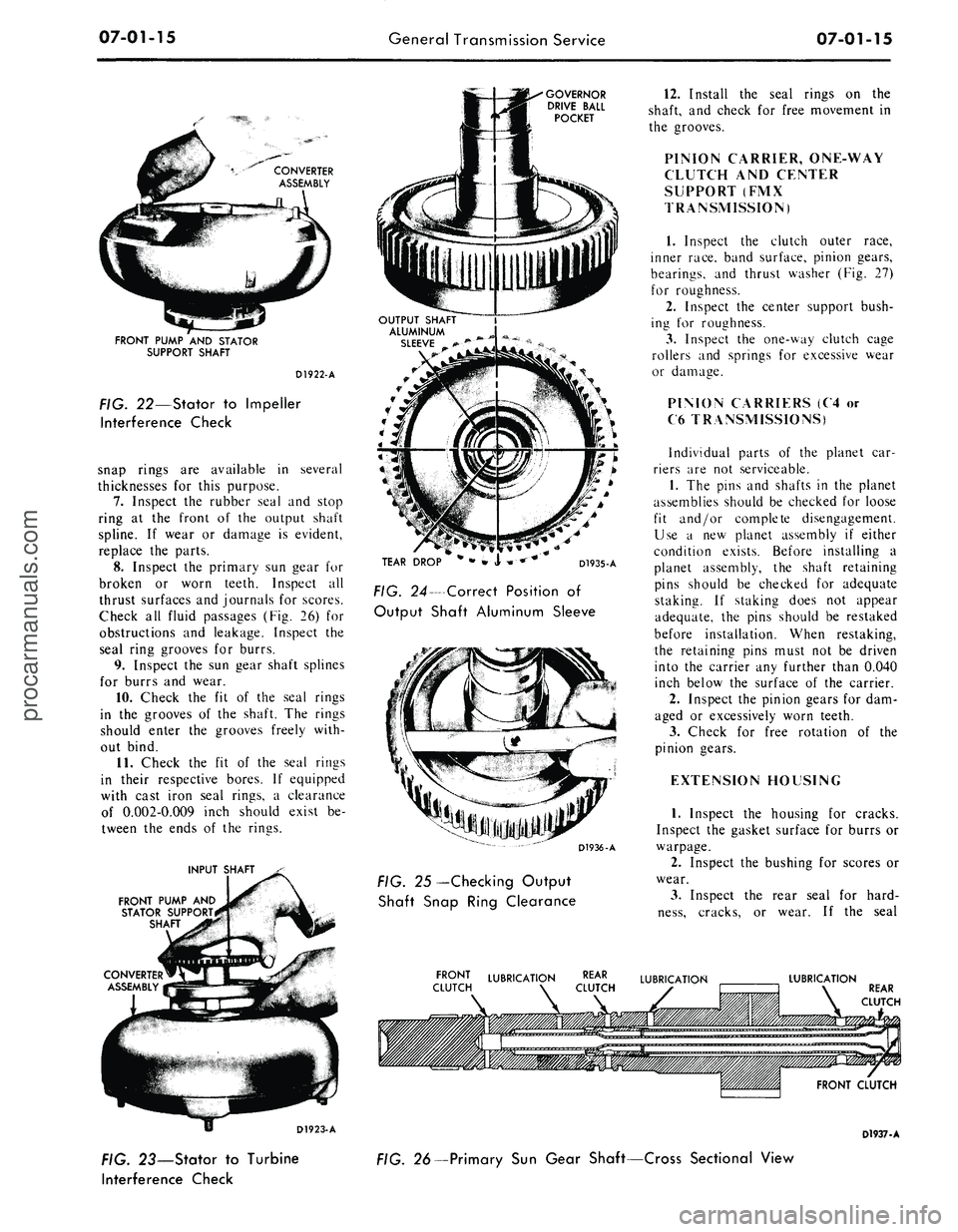
FIG. 22—Stator to Impeller
Interference Check
snap rings are available in several
thicknesses for this purpose.
7.
Inspect the rubber seal and stop
ring at the front of the output shaft
spline. If wear or damage is evident,
replace the parts.
8. Inspect the primary sun gear for
broken or worn teeth. Inspect all
thrust surfaces and journals for scores.
Check all fluid passages (Fig. 26) for
obstructions and leakage. Inspect the
seal ring grooves for burrs.
9. Inspect the sun gear shaft splines
for burrs and wear.
10.
Check the fit of the seal rings
in the grooves of the shaft. The rings
should enter the grooves freely with-
out bind.
11.
Check the fit of the seal rings
in their respective bores. If equipped
with cast iron seal rings, a clearance
of 0.002-0.009 inch should exist be-
tween the ends of the rings.
INPUT SHAFT
FRONT PUMP AND
STATOR SUPPORT
SHAFT
CONVERTER
ASSEMBLY
D1923-A
TEAR DROP
D1935-A
FIG. 24—Correct Position of
Output Shaft Aluminum Sleeve
D1936-A
FIG. 25—Checking Output
Shaft Snap Ring Clearance
12.
Install the seal rings on the
shaft, and check for free movement in
the grooves.
PINION CARRIER, ONE-WAY
CLUTCH AND CENTER
SUPPORT (FMX
TRANSMISSION)
1.
Inspect the clutch outer race,
inner race, band surface, pinion gears,
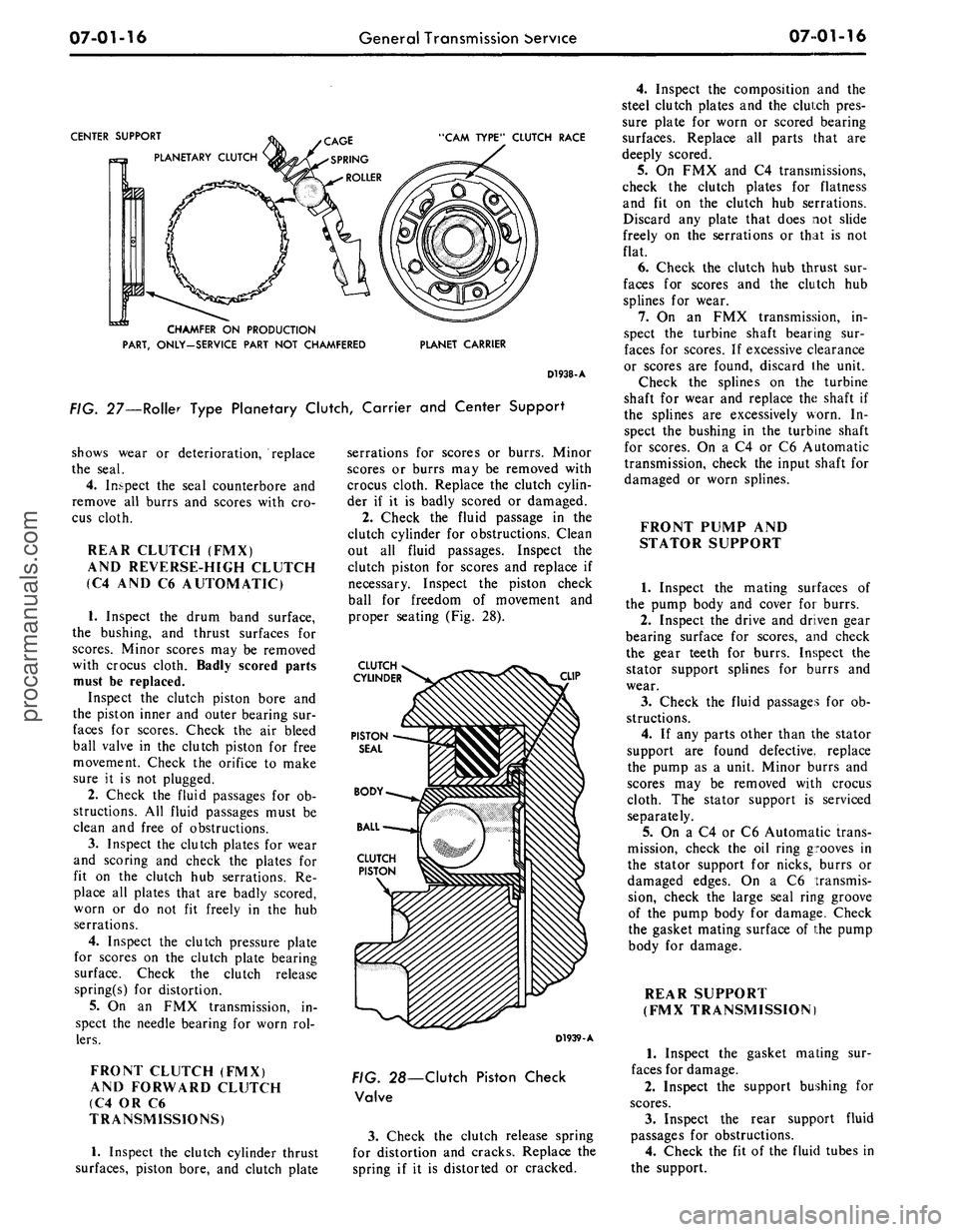
bearings, and thrust washer (Fig. 27)
for roughness.
2.
Inspect the center support bush-
ing for roughness.
3.
Inspect the one-way clutch cage
rollers and springs for excessive wear
or damage.
PINION CARRIERS (C4 or
C6 TRANSMISSIONS)
Individual parts of the planet car-
riers are not serviceable.
1.
The pins and shafts in the planet
assemblies should be checked for loose
fit and/or complete disengagement.
Use a new planet assembly if either
condition exists. Before installing a
planet assembly, the shaft retaining
pins should be checked for adequate
staking. If staking does not appear
adequate, the pins should be restaked
before installation. When restaking,
the retaining pins must not be driven
into the carrier any further than 0.040
inch below the surface of the carrier.
2.
Inspect the pinion gears for dam-
aged or excessively worn teeth.
3.
Check for free rotation of the
pinion gears.
EXTENSION HOUSING
1.
Inspect the housing for cracks.
Inspect the gasket surface for burrs or
warpage.
2.
Inspect the bushing for scores or
wear.
3.
Inspect the rear seal for hard-
ness,
cracks, or wear. If the seal
FRONT LUBRICATION REAR LUBRICATION
CLUTCH \ CLUTCH
LUBRICATION
FRONT CLUTCH
D1937-A
FIG. 23—Stator to Turbine
Interference Check
FIG. 26—Primary Sun Gear Shaft—Cross Sectional Viewprocarmanuals.com
Page 307 of 413
07-01-16
General Transmission bervice
07-01-16
CENTER SUPPORT
PLANETARY CLUTCH
"CAM TYPE" CLUTCH RACE
CHAMFER ON PRODUCTION
PART, ONLY-SERVICE PART NOT CHAMFERED
PLANET CARRIER
D1938-A
FIG. 27—Roller Type Planetary Clutch, Carrier and Center Support
shows wear or deterioration, replace
the seal.
4.
Inspect the seal counterbore and
remove all burrs and scores with cro-
cus cloth.
REAR CLUTCH (FMX)
AND REVERSE-HIGH CLUTCH
(C4 AND C6 AUTOMATIC)
1.
Inspect the drum band surface,
the bushing, and thrust surfaces for
scores. Minor scores may be removed
with crocus cloth. Badly scored parts
must be replaced.
Inspect the clutch piston bore and
the piston inner and outer bearing sur-
faces for scores. Check the air bleed
ball valve in the clutch piston for free
movement. Check the orifice to make
sure it is not plugged.
2.
Check the fluid passages for ob-
structions. All fluid passages must be
clean and free of obstructions.
3.
Inspect the clutch plates for wear
and scoring and check the plates for
fit on the clutch hub serrations. Re-
place all plates that are badly scored,
worn or do not fit freely in the hub
serrations.
4.
Inspect the clutch pressure plate
for scores on the clutch plate bearing
surface. Check the clutch release
spring(s) for distortion.
5.
On an FMX transmission, in-
spect the needle bearing for worn rol-
lers.
FRONT CLUTCH (FMX)
AND FORWARD CLUTCH
(C4 OR C6
TRANSMISSIONS)
1.
Inspect the clutch cylinder thrust
surfaces, piston bore, and clutch plate
serrations for scores or burrs. Minor
scores or burrs may be removed with
crocus cloth. Replace the clutch cylin-
der if it is badly scored or damaged.
2.
Check the fluid passage in the
clutch cylinder for obstructions. Clean
out all fluid passages. Inspect the
clutch piston for scores and replace if
necessary. Inspect the piston check
ball for freedom of movement and
proper seating (Fig. 28).
CLUTCH
CYLINDER
PISTON
SEAL
CLIP
D1939-A
. 28—Clutch Piston Check
Valve
3.
Check the clutch release spring
for distortion and cracks. Replace the
spring if it is distorted or cracked.
4.
Inspect the composition and the
steel clutch plates and the clutch pres-
sure plate for worn or scored bearing
surfaces. Replace all parts that are
deeply scored.
5.
On FMX and C4 transmissions,
check the clutch plates for flatness
and fit on the clutch hub serrations.
Discard any plate that does not slide
freely on the serrations or that is not
flat.
6. Check the clutch hub thrust sur-
faces for scores and the clutch hub
splines for wear.
7.
On an FMX transmission, in-
spect the turbine shaft bearing sur-
faces for scores. If excessive clearance
or scores are found, discard the unit.
Check the splines on the turbine
shaft for wear and replace the shaft if
the splines are excessively worn. In-
spect the bushing in the turbine shaft
for scores. On a C4 or C6 Automatic
transmission, check the input shaft for
damaged or worn splines.
FRONT PUMP AND
STATOR SUPPORT
1.
Inspect the mating surfaces of
the pump body and cover for burrs.
2.
Inspect the drive and driven gear
bearing surface for scores, and check
the gear teeth for burrs. Inspect the
stator support splines for burrs and
wear.
3.
Check the fluid passages for ob-
structions.
4.
If any parts other than the stator
support are found defective, replace
the pump as a unit. Minor burrs and
scores may be removed with crocus
cloth. The stator support is serviced
separately.
5.
On a C4 or C6 Automatic trans-
mission, check the oil ring grooves in
the stator support for nicks, burrs or
damaged edges. On a C6 transmis-
sion, check the large seal ring groove
of the pump body for damage. Check
the gasket mating surface of the pump
body for damage.
REAR SUPPORT
(FMX TRANSMISSION)
1.
Inspect the gasket mating sur-
faces for damage.
2.
Inspect the support bushing for
scores.
3.
Inspect the rear support fluid
passages for obstructions.
4.
Check the fit of the fluid tubes in
the support.procarmanuals.com
Page 308 of 413
07-01-17
General Transmission Service
07-01-17
PRESSURE REGULATOR
(FMX TRANSMISSION)
1.
Inspect the regulator body and
cover mating surface for burrs.
2.
Check all fluid passages for ob-
structions.
3.
Inspect the control pressure and
converter pressure valves and bores for
burrs and scores. Remove all burrs
carefully with crocus cloth.
4.
Check free movement of the
valves in their bores. The valves
should fall freely into the bores when
both the valve and bore are dry.
5.
Inspect the valve springs and
spacers for distortion.
CONTROL VALVE BODY
1.
Clean all parts thoroughly in
clean solvent, and then blow them dry
with moisture-free compressed air.
2.
Inspect all valve and plug bores
for scores. Check all fluid passages for
obstructions. Inspect the check valve
for free movement. Inspect all mating
surfaces for burrs or distortion. In-
spect all plugs and valves for burrs
and scores. Crocus cloth can be used
to polish valves and plugs if care is
taken to avoid rounding the sharp
edges of the valves and plugs.
3.
Inspect all springs for distortion.
Check all valves and plugs for free
movement in their respective bores.
Valves and plugs, when dry, must fall
from their own weight in their respec-
tive bores.
4.
Roll the manual valve on a flat
surface to check it for a bent condi-
tion.
GOVERNOR
1.
Inspect the governor valves and
bores for scores. Minor scores may be
removed from the valves with crocus
cloth. Replace the governor if the
valves or body is deeply scored.
2.
Check for free movement of the
valves in the bores. The valves should
slide freely of their own weight in the
bores when dry. Inspect fluid passages
in the valve body and counterweight
for obstructions. All fluid passages
must be clean.
3.
Inspect the mating surfaces of
the governor body and governor dis-
tributor (C4 or C6 Automatic) for
burrs and distortion. Mating surfaces
must be smooth and flat.
4.
Check the mating surface of the
governor valve and the counterweight
on a FMX transmission for burrs or
scratches.
5.
When cleaning the governor as-
sembly (C4 Automatic), the oil screen
should be removed from the collector
body and thoroughly blown out with
compressed air.
FRONT SERVO (FMX)
AND INTERMEDIATE
SERVO (C4 AND C6
AUTOMATIC)
1.
Inspect the servo bore for cracks
and the piston bore and the servo pis-
ton stem for scores. Check fluid pas-
sages for obstructions. Replace seals
that are damaged.
2.
On an FMX transmission, check
the actuating lever for free movement,
and inspect it for wear. If necessary to
replace the actuating lever or shaft,
remove the retaining pin and push the
shaft out of the bracket.
Inspect the adjusting screw threads
and the threads in the lever for dam-
age.
3.
Check the servo spring and servo
band strut(s) for distortion.
4.
Inspect the cover seal and gasket
cover sealing surface for defects.
REAR SERVO (FMX)
AND LOW-REVERSE SERVO
(C4 TRANSMISSION)
1.
Inspect the servo body for cracks
and the piston bore for scores.
2.
Check the fluid passages for ob-
structions.
3.
Inspect the band and the struts
for distortion. Inspect the band ends
for cracks.
4.
Inspect the servo spring for dis-
tortion.
5.
Inspect the band lining for exces-
sive wear and bonding to the metal
band.
6. On an FMX transmission, check
the servo body to case mating surface
for burrs. Check the accumulator pis-
ton and the check valve for freedom
of movement. Check the actuating
lever socket for scores.
7.
Replace seals that are damaged.
CASE
Inspect the case for cracks and
stripped threads. Inspect the gasket
surfaces and mating surfaces for
burrs.
Check the vent for obstructions,
and check all fluid passages for ob-
structions and leakage (Figs. 10, 11
and 12).
Inspect the case bushing for scores.
Check all parking linkage parts for
wear or damage.
ONE-WAY CLUTCH
1.
Inspect the outer and inner races
for scores or damaged surface area
where the rollers contact the races. If
the outer race on the C6 transmission
is damaged, the low-reverse clutch hub
must be replaced.
2.
Inspect the rollers and springs
for excessive wear or damage.
3.
Inspect the spring and roller case
for bent or damaged spring retainers.procarmanuals.com
Page 310 of 413

J7-02-02
C4 Automatic Transmission
07-02-02
COMPONENT INDEX
Disassembly and Overhaul
REVERSE RING GEAR AND HUB
Disassembly and Overhaul
SELECTOR LEVER-CONSOLE SHIFT
Removal and Installation
THROTTLE LINKAGE
All
Models
02-22
02-26
02-08
COMPONENT INDEX
Adjustments
TRANSMISSION (Complete)
Removal and Installation
TRANSMISSION CASE BUSHING
Parts Repair or Replacement
TRANSMISSION CASE THREAD REPAIR
All
Models
02-04
02-11
02-18
02-18
DESCRIPTION
CONVERTER HOUSING,
CONVERTER
STATOR SUPPORT
FRONT PUMP CASE
INTERMEDIATE
BAND
LOW-REVERSE DRUM
-,
FORWARD CLUTCH
HUB AND RING GEAR
INPUT
SHELL
REVERSE RING GEAR
LOW REVERSE BAND
ONE-WAY
CLUTCH
GOVERNOR
DISTRIBUTOR
SLEEVE
GOVERNOR
DISTRIBUTOR
SPLINE SEAL
EXTENSION
HOUSING
SPEEDOMETER
DRIVE GEAR
GOVERNOR
REVERSE PLANET CARRIER
FRONT PLANET CARRIER
PARK TOGGLE LEVER
LOW-REVERSE SERVO PISTON
FORWARD CLUTCH
CONTROL LEVERS
FIG.
1—C4
Automatic Transmission
DESCRIPTION
Figure
1
shows
the
location
of the
converter, front pump, clutches, gear
train
and
most
of the
internal parts
used
in
the C4 transmission. The iden-
tification
tag
(Fig.
2) is
located under
the lower front intermediate servo
cover bolt.
The tag
shows
the
model
prefix
and
suffix, assembly part num-
bers,
and the
built date code.
The
service identification number indicates
changes
to
service details which affect
interchangeability when
the
transmis-
sion model
is not
changed.
For
inter-
pretation
of
this number, see the Mas-
ter Parts Catalog.
REVERSE-HIGH CLUTCH
IMPELLER CONTROL VALVE BODY
TRANSMISSION MODEL
D 1474-A
ASSEMBLY PART NO. BUILD DATE
FIG.
2—Identification
Tag
The
C4
transmission
is a
three
speed unit capable
of
providing auto-
matic upshifts
and
downshifts through
SHIFT
D1846-A
the three forward gear ratios,
and
also
capable
of
providing manual selection
of first
and
second gears.
procarmanuals.com
Page 326 of 413
07-02-18
C4 Automatic Transmission
07-02-18
OUTER MANUAL LEVER
MANUAL LEVER LINK
INNER MANUAL LEVER
PARKING PAWL LINK
TOGGLE ROD
PARKING PAWL LINK
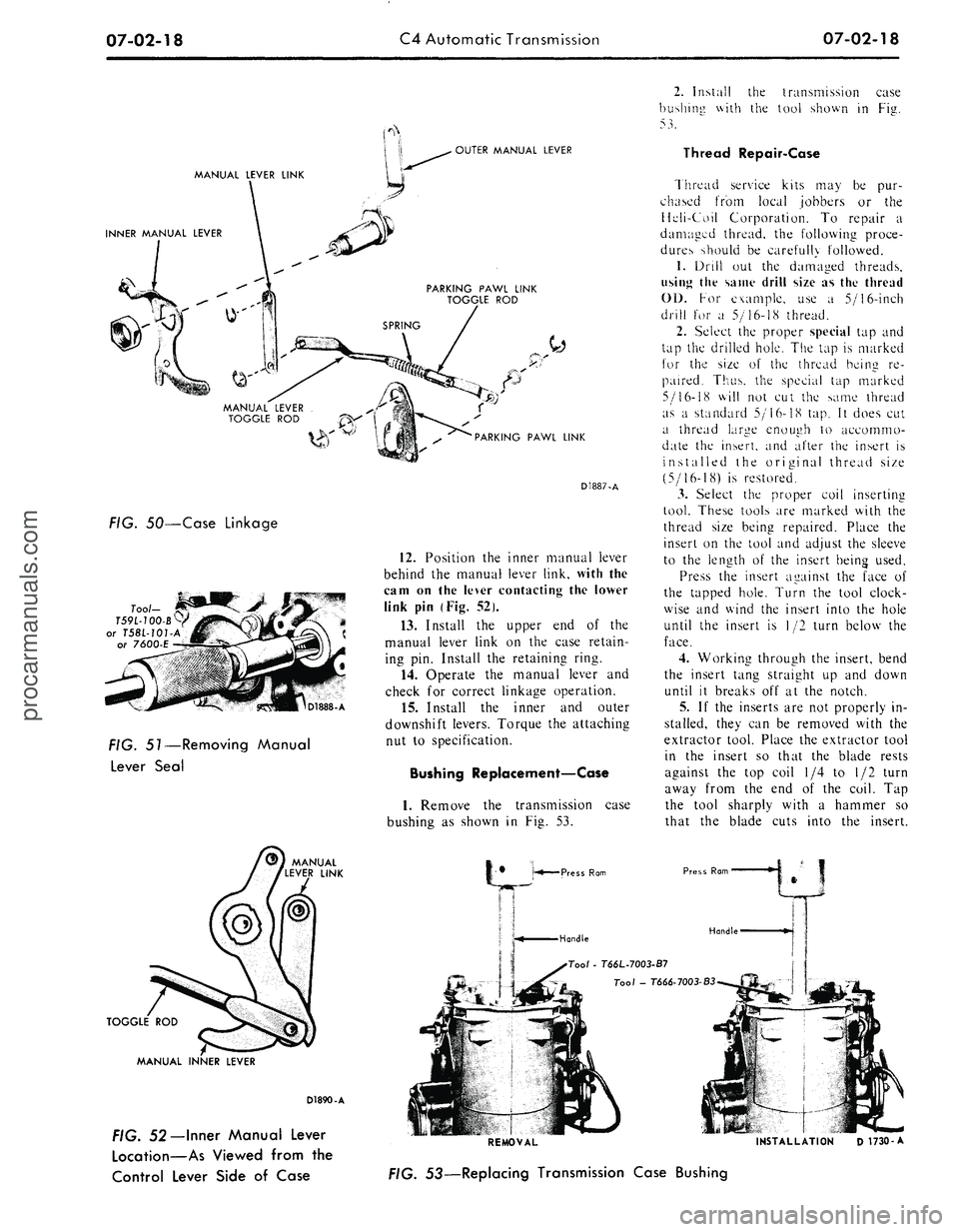
FIG. 50—Case Linkage
D1888-A
FIG. 51—Removing Manual
Lever Seal
TOGGLE ROD
D1887-A
12.
Position the inner manual lever
behind the manual lever link, with the
cam on the lever contacting the lower
link pin (Fig. 52).
13.
Install the upper end of the
manual lever link on the case retain-
ing pin. Install the retaining ring.
14.
Operate the manual lever and
check for correct linkage operation.
15.
Install the inner and outer
downshift levers. Torque the attaching
nut to specification.
Bushing Replacement—Case
1.
Remove the transmission case
bushing as shown in Fig. 53.
Press Ram
Handle
MANUAL INNER LEVER
D1890-A
FIG. 52— Inner Manual Lever
Location—As Viewed from the
Control Lever Side of Case
2.
Install the transmission case
bushing with the tool shown in Fig.
53.
Thread Repair-Case
Thread service kits may be pur-
chased from local jobbers or the
Heli-Coil Corporation. To repair a
damaged thread, the following proce-
dures should be carefully followed.
1.
Drill out the damaged threads,
using the same drill size as the thread
01).
For example, use a 5/16-inch
drill for a 5/16-18 thread.
2.
Select the proper special tap and
tap the drilled hole. The tap is marked
for the size of the thread being re-
paired. Thus, the special tap marked
5/16-18 will not cut the same thread
as a standard 5/16-18 tap. It does cut
a thread large enough to accommo-
date the insert, and after the insert is
installed the original thread size
(5/16-18) is restored.
3.
Select the proper coil inserting
tool. These tools are marked with the
thread size being repaired. Place the
insert on the tool and adjust the sleeve
to the length of the insert being used.
Press the insert against the face of
the tapped hole. Turn the tool clock-
wise and wind the insert into the hole
until the insert is 1/2 turn below the
face.
4.
Working through the insert, bend
the insert tang straight up and down
until it breaks off at the notch.
5.
If the inserts are not properly in-
stalled, they can be removed with the
extractor tool. Place the extractor tool
in the insert so that the blade rests
against the top coil 1/4 to 1/2 turn
away from the end of the coil. Tap
the tool sharply with a hammer so
that the blade cuts into the insert.
Press Rom
Handle
Too/
- T66L-7003-B7
Tool - T666-7003-B3
REMOVAL INSTALLATION D 1730-A
FIG. 53—Replacing Transmission Case Bushingprocarmanuals.com
Page 342 of 413
07-03-02
FMX Transmission
07-03-02
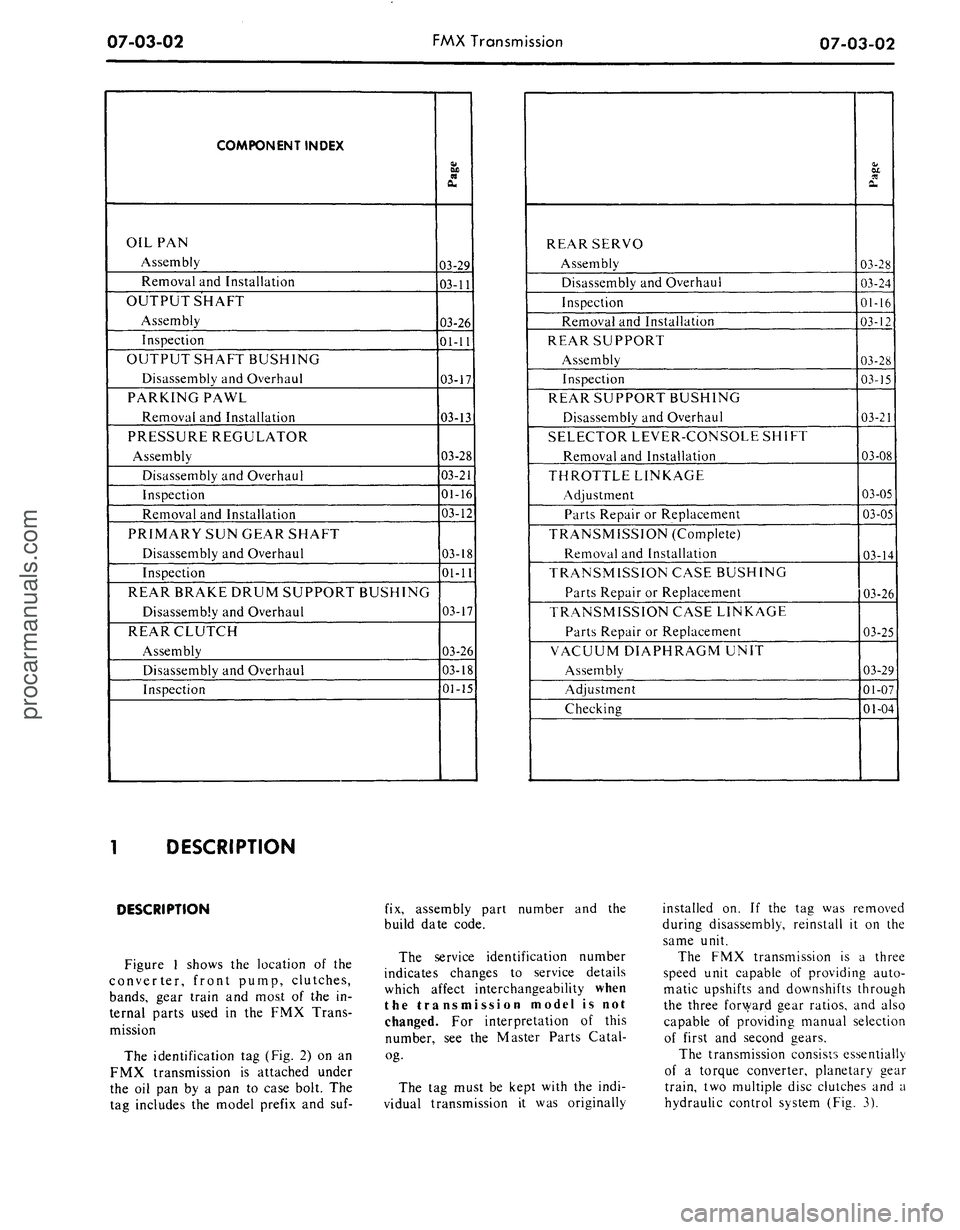
COMPONENT INDEX
OIL PAN
Assembly
Removal and Installation
OUTPUT SHAFT
Assembly
Inspection
OUTPUT SHAFT BUSHING
Disassembly and Overhaul
PARKING PAWL
Removal and Installation
PRESSURE REGULATOR
Assembly
Disassembly and Overhaul
Inspection
Removal and Installation
PRIMARY SUN GEAR SHAFT
Disassembly and Overhaul
Inspection
REAR BRAKE DRUM SUPPORT BUSHING
Disassembly and Overhaul
REAR CLUTCH
Assembly
Disassembly and Overhaul
Inspection
Page
03-29
03-11
03-26
01-11
03-17
03-13
03-28
03-21
01-16
03-12
03-18
01-11
03-17
03-26
03-18
01-15
REAR SERVO
Assembly
Disassembly and Overhaul
Inspection
Removal and Installation
REAR SUPPORT
Assembly
Inspection
REAR SUPPORT BUSHING
Disassembly and Overhaul
SELECTOR LEVER-CONSOLE SHIFT
Removal and Installation
THROTTLE LINKAGE
Adjustment
Parts Repair or Replacement
TRANSMISSION (Complete)
Removal and Installation
TRANSMISSION CASE BUSHING
Parts Repair or Replacement
TRANSMISSION CASE LINKAGE
Parts Repair or Replacement
VACUUM DIAPHRAGM UNIT
Assembly
Adjustment
Checking
Page
03-28
03-24
01-16
03-12
03-28
03-15
03-21
03-08
03-05
03-05
03-14
03-26
03-25
03-29
01-07
01-04
DESCRIPTION
DESCRIPTION
Figure 1 shows the location of the
converter, front pump, clutches,
bands,
gear train and most of the in-
ternal parts used in the FMX Trans-
mission
The identification tag (Fig. 2) on an
FMX transmission is attached under
the oil pan by a pan to case bolt. The
tag includes the model prefix and suf-
fix, assembly part number and the
build date code.
The service identification number
indicates changes to service details
which affect interchangeability when
the transmission model is not
changed. For interpretation of this
number, see the Master Parts Catal-
og-
The tag must be kept with the indi-
vidual transmission it was originally
installed on. If the tag was removed
during disassembly, reinstall it on the
same unit.
The FMX transmission is a three
speed unit capable of providing auto-
matic upshifts and downshifts through
the three forward gear ratios, and also
capable of providing manual selection
of first and second gears.
The transmission consists essentially
of a torque converter, planetary gear
train, two multiple disc clutches and a
hydraulic control system (Fig. 3).
procarmanuals.com
Page 360 of 413

07-03-20
FMX Transmission
07-03-20
Handle
Tool - T64L-7003-A6
D 1752-A
FIG. 35—Installing Input Shaft
Bushing
install the snap ring as shown in Fig.
33.
Make sure the snap ring is fully
seated in the groove. .
13.
Install the front clutch housing
on the primary sun gear shaft by ro-
tating the clutch units to mesh the
rear clutch plates with the serrations
on the clutch hub. Do not break the
seal rings.
14.
Install the clutch hub in the
clutch cylinder with the deep counter-
bor down (Fig. 36). Install the thrust
washer on the clutch hub.
15.
Install the pressure plate in the
clutch cylinder with the bearing sur-
face up (Fig. 37). Install the composi-
tion and the steel clutch plates alter-
nately, starting with a composition
plate (Fig. 38). Lubricate the plates as
they are installed.
HUB
PRESSURE PLATE
D1O45-A
FIG. 37—Installing Pressure Plate
D1961-A
FIG. 38—Installing Clutch Plates
BUSHING ^.^^ DRIVE GEAR
D 1047-B
39—Front Pump Disassembled
The final friction plate to be in-
stalled is selective. Install the thickest
plate that will be a minimum of 0.010
inch below input shaft shoulder in cyl-
inder. For all other plates, use the
thinnest available. Refer to the Speci-
fications Section for available plate
thickness.
16.
Install the turbine shaft in the
clutch cylinder, and then install the
snap ring. Make sure the snap ring is
fully seated in the groove.
17.
Install the thrust washer on the
turbine shaft.
FRONT PUMP
1.
Remove the stator support at-
taching screws and remove the stator
support. Mark the top surface of the
pump driven gear with Prussian blue
to assure correct assembly. Do not
scratch the pump gears.
2.
Remove the drive and driven
gears from the pump body.
3.
Refer to Fig. 39 for a disas-
sembled view of the front pump. In-
spect the pump body housing, gear
pockets and crescent for scores.
4.
If the pump housing bushing is
to be replaced, press the bushing from
the front housing with the tools shown
in Fig. 40.
5.
Press a new bushing into the
pump housing with the handle and
tool shown in Fig. 40.
6. If any parts other than the stator
support or bushings are found defec-
tive,
replace the pump as a unit.
Minor burrs and scores may be re-
moved with crocus cloth. The stator
support is serviced separately.
7.
Bolt the front pump to the trans-
mission case with capscrews.
D1960-A
/:/G.
36—Installing Clutch Hub
REMOVAL
INSTALLATION
D 1748-A
4Q—Replacing Front Pump Housing Bushingprocarmanuals.com
Page 366 of 413

07-03-26
FMX Transmission
07-03-26
MANUAL SHAFT
AND LEVER
DETENT SPRING—«^ DETENT PLUNGER
DETENT
/ LEVER
MANUAL SHAFT
NUT
INNER DOWNSHIFT LEVER
/ DOWNSHIFT
/ SHAFT
NUT
TOGGLE LIFT
ijG
LEVER SPRING
TOGGLE LEVER-
PAWL RETURN SPRING-
TOGGLE LEVER
PIN-
PLUG'
D1967-A
FIG. 52—Transmission Case Control Linkage
pawl return spring. Assemble
the tog-
gle lever
to the
link with
the
toggle
link
pin.
Position
the
pawl return
spring over
the
toggle link pin,
and se-
cure
it in
place with
the
washer
and
the small retainer clip
(Fig. 52). In-
stall
the
assembly
in the
transmission
case
by
installing
the
pawl
pin and the
toggle lever
pin.
Install
the
torsion
lever assembly. Position
the
spring
on
the torsion lever with
a
screwdriver.
Make certain that
the
short side
of
toggle does
not
extend beyond
the
largest diameter
of the
ball
or the
tog-
gle lever
pin
(Fig. 52).
Tap the
toggle
lever
in or out as
necessary
to
center
the toggle lever
on the
ball.
4.
Install
the
manual lever
and
shaft
in the
transmission case. Posi-
tion
the
detent lever
on the
shaft,
and
secure
it
with
a nut.
Tighten
the nut
to 20-30 ft-lbs torque. Rotate
the
manual lever
to the
rear
of the
case.
Position
the
detent spring
in the
case.
Press Ram
Hold
the
detent plug
on the
spring
with
a
3/16-inch socket wrench, then
depress
the
spring until
the
plug
is
flush with
the
case. Carefully rotate
the manual lever
to the
front
of the
case
to
secure
the
plug.
A
piece
of
thin walled tubing
may be
used
to
depress
the
plug
if a
small socket
wrench
is not
available.
5.
Position
the
ends
of the
parking
pawl operating
rod in the
detent lever
and toggle lift lever,
and
secure with
the
two
small retaining pins.
6. Install
a new
seal
on the
down-
shift lever shaft, then install
the
lever
and shaft
in the
case. Position
the
inner downshift lever
on the
inner
end
of
the
shaft with
the
mark
O
facing
toward
the
center
of the
case. Install
the lock washer
and nut,
then tighten
the
nut to
17-20 ft-lbs torque.
7.
Check
the
operation
of the
link-
age.
The
linkage should operate freely
without binding.
Handle
Tool -
T64L.7003-BS
REMOVAL
Tool - T64L-7003-A5
INSTALLATION
D 1745-B
FIG. 53—Replacing Transmission Case Bushing
TRANSMISSION CASE
BUSHING REPLACEMENT
1.
If the
transmission case bushing
is
to be
replaced, press
the
bushing
out
of the
case with
the
tools shown
in
Fig.
53.
2.
Install
a new
transmission case
bushing with
the
tool shown
in Fig.
53.
ASSEMBLY
OF
TRANSMISSION
Do
not use
force
to
assemble
mat-
ing parts.
If the
parts
do not
assemble
freely, examine them
for the
cause_pf
the difficulty. Always
use new
gaskets
and seals during
the
assembly opera-
tions.
CLUTCH ASSEMBLIES
1.
Install
the
front band
in the
transmission case
so
that
the
anchor
end
is
aligned with
the
anchor
in the
case.
2.
Make sure
the
thrust washer
is
in place
on the
input shaft. Lift
the
clutch assemblies
out of the
holding
block.
Do not
allow
the
clutches
to
separate.
3.
Install
the
clutch sub-assemblies
in
the
transmission case while posi-
tioning
the
servo band
on the
drum.
Hold
the
units together while install-
ing them (Fig.
25).
CENTER SUPPORT,
ONE-WAY CLUTCH,
PINION CARRIER,
AND
OUTPUT SHAFT
The production center supports
are
chamfered
at the
edge
of the
race
(Fig.
54). The
service center supports
are
not
chamfered.
The
following
as-
sembly procedures cover both types
of
center supports.
Installation—Center Support
With Chamfered Edge
1.
Install
the
center support
and the
rear band
in the
case.
2.
Install
the
primary
sun
gear rear
thrust bearing race, needle bearing,
and front thrust bearing race
if
used
in
the
planet carrier using petroleum
jelly
to
retain them
in
place.
3.
Lubricate
the
bearing surface
on
the center support,
the
rollers
of the
planetary clutch,
and the cam
race
in
the carrier with petroleum jelly
(Fig.
54).
4.
Install
the
planetary clutch
in the
carrier (Fig.
55).procarmanuals.com