2017 MERCEDES-BENZ G-Class Level
[x] Cancel search: LevelPage 48 of 286
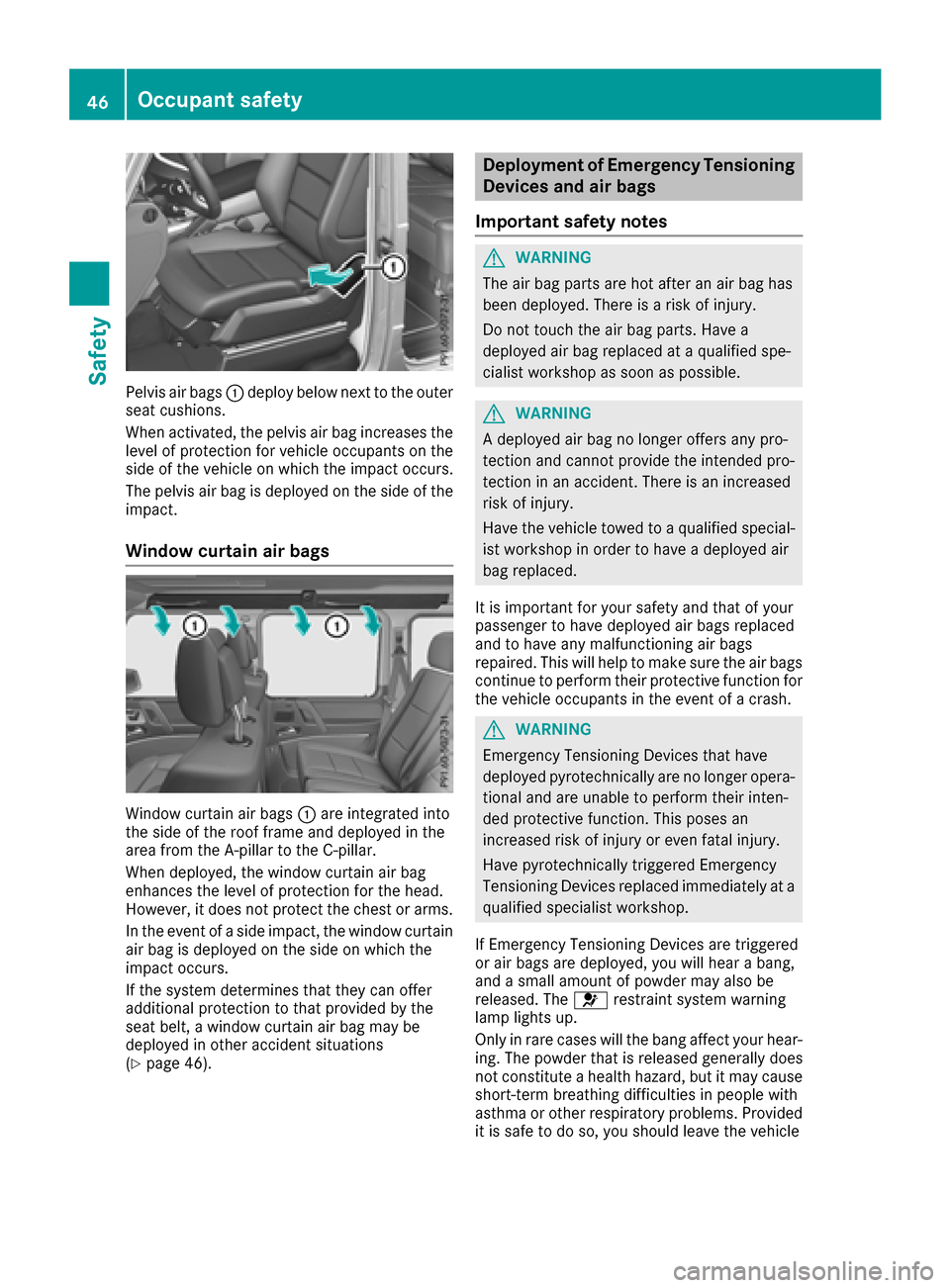
Pelvis air bags:deploy below next to the outer
seat cushions.
When activated, the pelvis air bag increases the
level of protection for vehicle occupantsont he
side of the vehicle on which the impact occurs.
The pelvis air bag is deployed on the side of the
impact.
Window curtain air bags
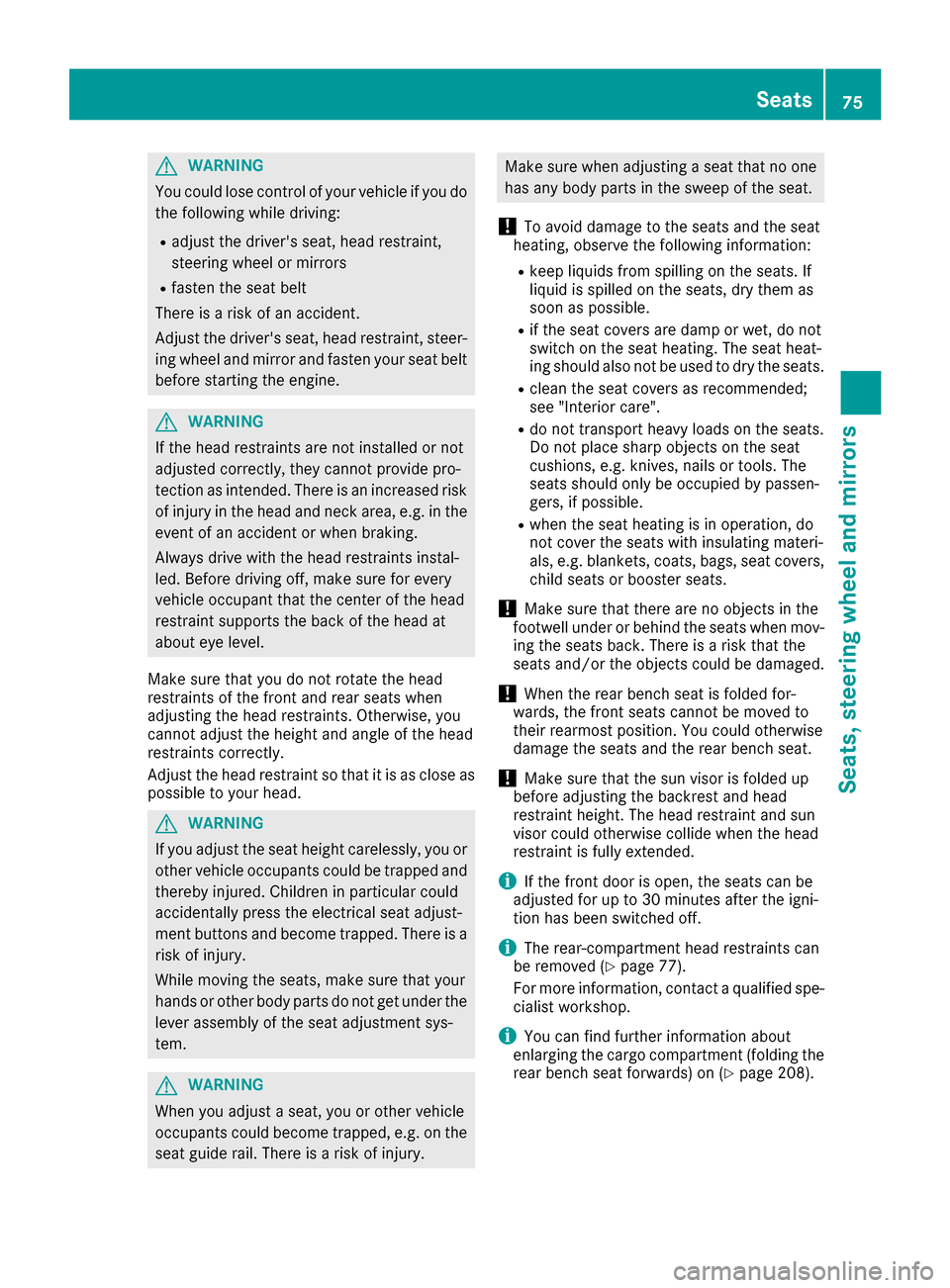
Window curtain air bags :are integrated into
the side of the roof frame and deployed in the
area from the A-pillar to the C-pillar.
When deployed, the window curtain air bag
enhances the level of protection for the head.
However, it does not protec tthe chest or arms.
In the event of aside impact, the window curtain
air bag is deployed on the side on which the
impact occurs.
If the system determines that they can offer
additional protection to that provided by the
seat belt, awindow curtain air bag may be
deployed in other accident situations
(
Ypage 46).
Deployment of Emergency Tensioning
Devicesa nd air bags
Important safety notes
GWARNING
The air bag parts are hot after an air bag has
been deployed. There is arisk of injury.
Do not touch the air bag parts. Have a
deployed air bag replaced at aqualified spe-
cialist workshop as soon as possible.
GWARNING
Ad eployed air bag no longer offers any pro-
tection and cannot provide the intended pro-
tection in an accident .There is an increased
risk of injury.
Have the vehicle towed to aqualified special-
ist workshop in order to have adeployed air
bag replaced.
It is importan tfor your safety and that of your
passenger to have deployed air bags replaced
and to have any malfunctioning air bags
repaired. This will help to make sure the air bags
continue to perform their protective function for
the vehicle occupantsint he event ofacrash.
GWARNING
Emergency TensioningD evices that have
deployed pyrotechnically are no longer opera-
tional and are unable to perform their inten-
ded protective function. This poses an
increased risk of injury or even fatal injury.
Have pyrotechnically triggered Emergency
TensioningD evices replaced immediately at a
qualified specialist workshop.
If Emergency TensioningD evices are triggered
or air bags are deployed, you will hear abang,
and asmall amount of powder may also be
released. The 6restraint system warning
lamp lights up.
Only in rare cases will the bang affect your hear-
ing. The powder that is released generally does
not constitut eahealth hazard, but it may cause
short-term breathing difficulties in people with
asthma or other respiratory problems. Provided
it is safe to do so, you should leave the vehicle
46Occupant safety
Safety
Page 77 of 286
GWARNING
You coul dlose control of you rvehicleify ou do
the following while driving:
Radjust the driver's seat, headr estraint,
steering wheelorm irrors
Rfasten the seat belt
There is arisk of an accident.
Adjust the driver's seat, headr estraint, steer-
ing wheela nd mirror and fasten you rseat belt
before starting the engine.
GWARNING
If the headr estraints are not installed or not
adjusted correctly, they cannot providep ro-
tection as intended. There is an increased risk
of injury in the heada nd neck area,e.g. in the
event of an accident or when braking.
Always drive with the headr estraints instal-
led.B efore driving off, make sure for every
vehicleo ccupant that the center of the head
restraint supports the back of the heada t
about eye level.
Make sure that you do not rotate the head
restraints of the front and rear seats when
adjusting the headr estraints. Otherwise, you
cannot adjust the height and angle of the head
restraints correctly.
Adjust the headr estraint so that it is as close as
possible to you rhead.
GWARNING
If you adjust the seat height carelessly, you or
other vehicleo ccupants couldbetrappe dand
thereby injured .Childreninp articular could
accidentally press the electricals eat adjust-
ment buttons and become trapped. There is a
risk of injury.
Whilem oving the seats, make sure that your
hands or other body parts do not get under the
levera ssembly of the seat adjustment sys-
tem.
GWARNING
When you adjust aseat, you or other vehicle
occupants coul dbecome trapped, e.g. on the
seat guide rail .There is arisk of injury.
Make sure when adjusting aseat that no one
has any body parts in the sweepoft he seat.
!To avoiddamage to the seats and the seat
heating, observe the following information:
Rkeep liquid sfrom spilling on the seats. If
liquid is spilled on the seats, dry them as
soon as possible.
Rif the seat covers are damp or wet, do not
switch on the seat heating. The seat heat-
ing should als onot be used to dry the seats.
Rcleant he seat covers as recommended;
see "Interio rcare".
Rdo not transport heav yloads on the seats.
Do not place sharp objects on the seat
cushions, e.g. knives, nail sortools. The
seats should only be occupied by passen-
gers, if possible.
Rwhen the seat heating is in operation, do
not cover the seats with insulating materi-
als ,e.g. blankets, coats, bags, seat covers,
child seats or booster seats.
!Make sure that there are no objects in the
footwellu nder or behind the seats when mov-
ing the seats back. There is arisk that the
seats and/or the objects coul dbedamaged.
!When the rear bench seat is foldedf or-
wards, the front seats cannot be moved to
their rearmost position. You coul dotherwise
damage the seats and the rear bench seat.
!Make sure that the sun visor is foldedu p
before adjusting the backrest and head
restraint height. The head restraint and sun
visor coul dotherwise collide when the head
restraint is full yextended.
iIf the front door is open, the seats can be
adjusted for up to 30 minutes after the igni-
tion has been switched off.
iThe rear-compartment head restraints can
be removed (Ypage7 7).
For more information, contact aqualified spe-
cialist workshop.
iYou can find further information about
enlarging the cargo compartment (folding the
rear bench seat forwards) on (
Ypage2 08).
Seats75
Seats, steering wheel and mirrors
Z
Page 78 of 286
Adjusting theseats electri cally
!
Mak esuret hatthe cup holder on th ecenter
console is folded down before you mov ethe
front-passenger seat forwards.
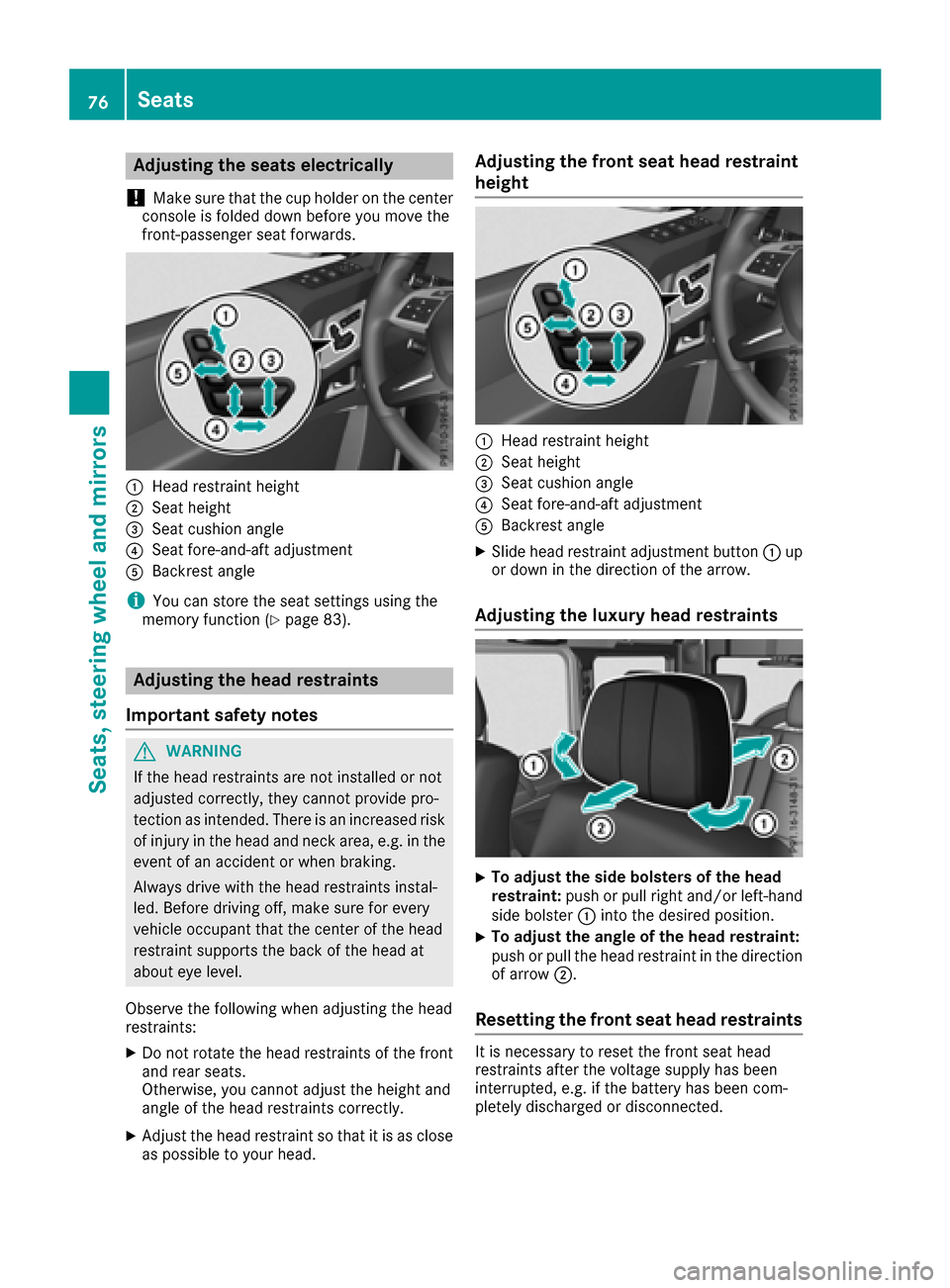
:Hea drestrain theight
;Seat height
=Seat cushion angle
?Seat fore-and-af tadjustmen t
ABackrest angle
iYou can store th eseat setting susingthe
memory function (Ypage 83).
Adjusting th eheadr estraints
Import ant safety notes
GWARNIN G
If th ehead restraints are no tinstalled or no t
adjusted correctly, they canno tprovid epro-
tection as intended. There is an increased ris k
of injury in th ehead and neck area, e.g. in th e
event of an acciden torwhen braking .
Always drive wit hthe head restraints instal -
led. Befor edrivin goff,m akes uref or every
vehicl eoccupant that th ecenter of thehead
restrain tsupport sthe bac koft hehead at
about eye level.
Observ ethe followin gwhen adjusting th ehead
restraints :
XDo notrotate th ehead restraints of th efront
and rear seats.
Otherwise ,you canno tadjust th eheight and
angle of th ehead restraints correctly.
XAdjus tthe head restrain tsothatiti sasc lose
as possibl etoyour head .
Adjusting th efront seath eadr estraint
height
:Hea drestrain theight
;Seat height
=Seat cushion angle
?Seat fore-and-af tadjustmen t
ABackrest angle
XSlide head restrain tadjustmen tbutto n: up
or down in th edirection of th earrow.
Adjusting th eluxur yheadr estraints
XTo adjust th esideb olsters of th ehead
restraint: push or pull right and/o rleft-han d
side bolste r: intot he desired position .
XTo adjust theangle of th eheadr estraint:
push or pull th ehead restrain tinthedirection
of arrow ;.
Resetting th efront seath eadr estraints
It is necessar ytor eset th efront seat head
restraints after th evoltag esupply has been
interrupted, e.g. if th ebattery has been com-
pletely discharged or disconnected.
76Seats
Seats ,steering wheel and mirrors
Page 79 of 286
XMake sure that the cup holder on the center
console is folded down (Ypage 210).
XMove the seat as far forward as possible andthe head restraint in as far as possible.
Rear seat head restraints
Important safety notes
GWARNING
If the head restraintsa re not installed or not
adjusted correctly, they cannot provide pro-
tection as intended. There is an increased risk
of injury in the head and neck area, e.g. in the event of an accident or when braking.
Always drive with the head restraintsi nstal-
led. Before driving off, make sure for every
vehicle occupant that the center of the head
restraint supports the back of the head at
about eye level.
Observe the following when adjusting the head
restraints:
XDo not rotate the head restraintsoft he front
and rear seats.
Otherwise, you cannot adjust the height and
angle of the head restraintsc orrectly.
XAdjust the head restraint so that it is as close
as possible to your head.
Adjusting the rear seat head restraint
height
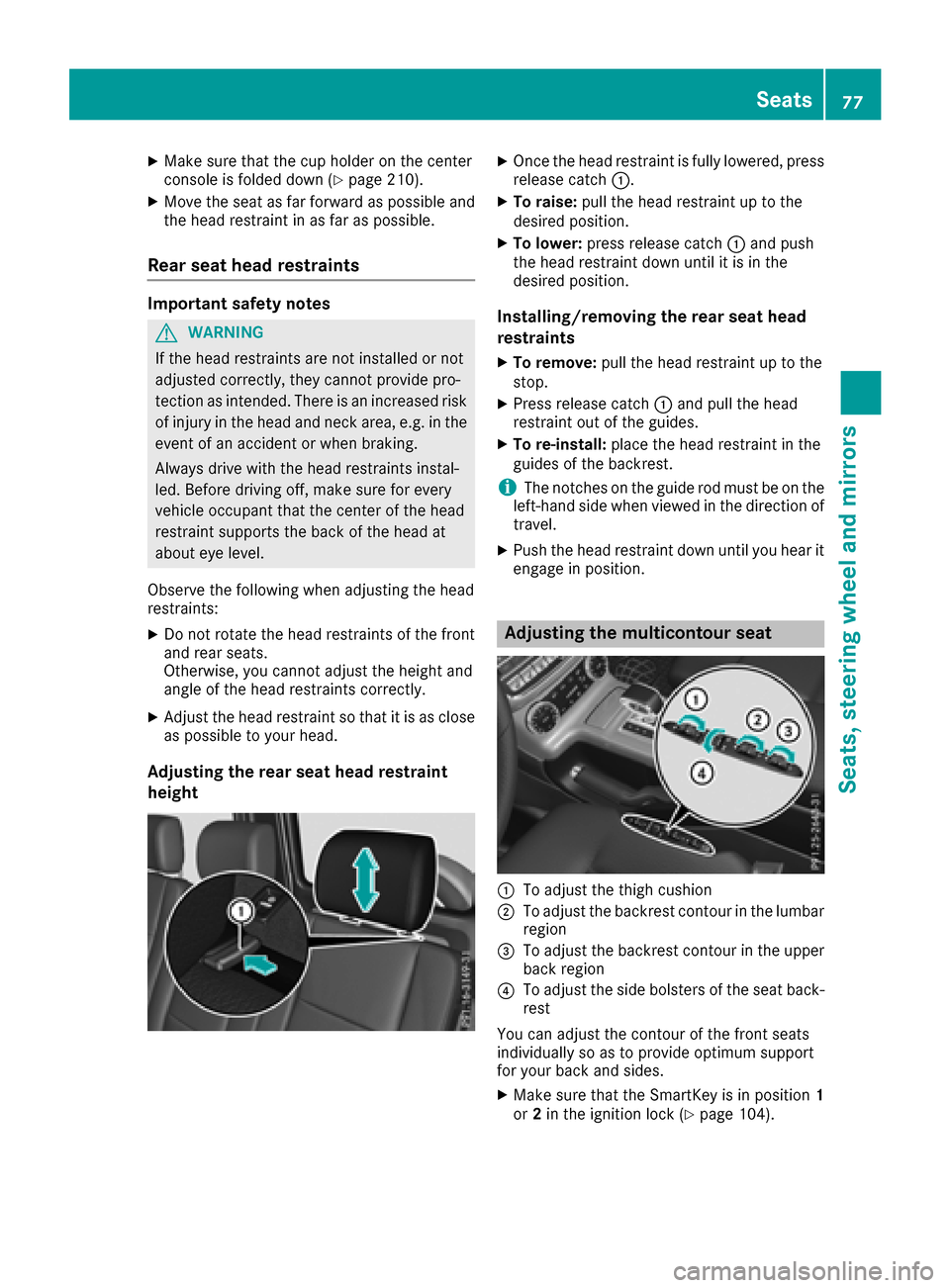
XOnce the head restraint is fully lowered, press
release catch:.
XTo raise:pull the head restraint up to the
desired position.
XTo lower: press release catch :and push
the head restraint down until it is in the
desired position.
Installing/removing the rear seat head
restraints
XTo remove: pull the head restraint up to the
stop.
XPress release catch :and pull the head
restraint out of the guides.
XTo re-install: place the head restraint in the
guides of the backrest.
iThe notches on the guide rod must be on the
left-hand side when viewed in the direction of
travel.
XPush the head restraint down until you hear it
engage in position.
Adjusting the multicontour seat
:To adjust the thigh cushion
;To adjust the backrest contour in the lumbar
region
=To adjust the backrest contour in the upper
back region
?To adjust the side bolsters of the seat back-
rest
You can adjust the contour of the front seats
individually so as to provide optimum support
for your back and sides.
XMake sure that the SmartKey is in position 1
or 2in the ignition lock (Ypage 104).
Seats77
Seats, steering wheela nd mirrors
Z
Page 80 of 286
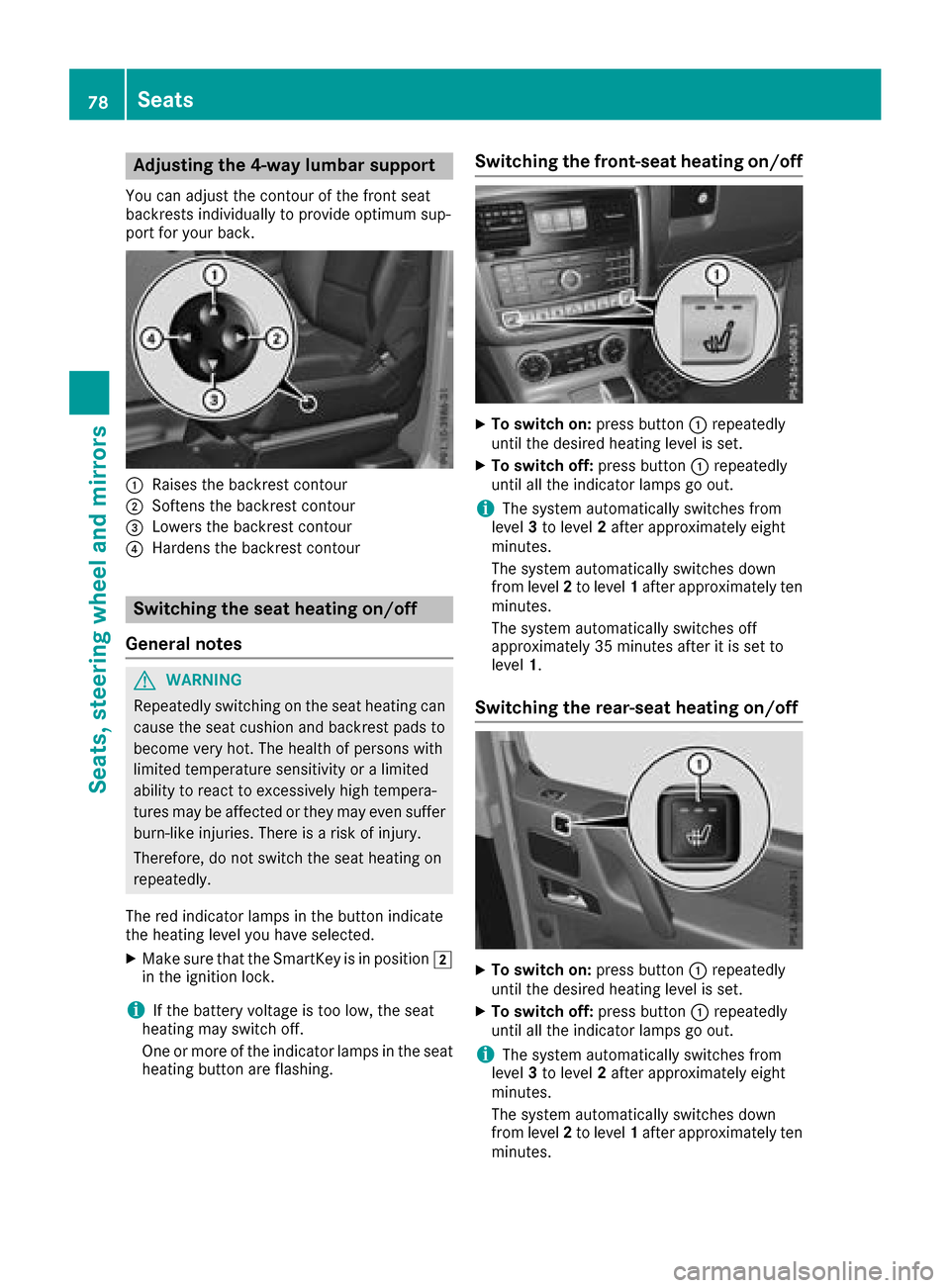
Adjusting the4-wa ylumbar support
You can adjust th econtou rofthefron tseat
backrest sindividually to provid eoptimum sup-
por tfor your back.
:Raises th ebackrest contour
;Soften sthe backrest contour
=Lowers th ebackrest contour
?Harden sthe backrest contour
Switchin gthe seath eating on/off
Gene raln otes
GWARNIN G
Repeatedly switching on th eseat heating can
caus ethe seat cushion and backrest pads to
become ver yhot.T he healt hofpersonswith
limite dtem perature sensitivit yoralimited
abilit ytor eac ttoe xcessivelyhigh tempera-
tures may be affecte dortheym ay eve nsuffer
burn-like injuries. There is ariskofi njury.
Therefore ,donotswitch th eseat heating on
repeatedly.
The red indicator lamp sinthebutto nindicat e
th eh eating level you hav eselected.
XMak esuret ha tthe SmartKey is in position 2
in th eignition lock.
iIf th ebattery voltag eistoolow, th eseat
heating may switch off .
On eorm oreoft heindicator lamp sintheseat
heating butto nare flashing.
Switchin gthe front-seat heating on/off
XTo switch on: press button: repeatedly
until th edesired heating level is set .
XTo switch off:press butto n: repeatedly
until all th eindicator lamp sgoout.
iThe system automatically switches from
level 3to level 2after approximately eigh t
minutes.
The system automatically switches down
from level 2to level 1after approximately te n
minutes.
The system automatically switches off
approximately 35 minute safter it is set to
level 1.
Switchin gthe rea r-seath eating on/off
XTo switch on: press button: repeatedly
until th edesired heating level is set .
XTo switch off:press butto n: repeatedly
until all th eindicator lamp sgoout.
iThe system automatically switches from
level 3to level 2after approximately eigh t
minutes.
The system automatically switches down
from level 2to level 1after approximately te n
minutes.
78Seats
Seats ,steering wheel and mirrors
Page 81 of 286
The system automatically switches off
approximately 35 minutes after it is set to
level1.
Switching the seat ventilation on/off
Switching on/off
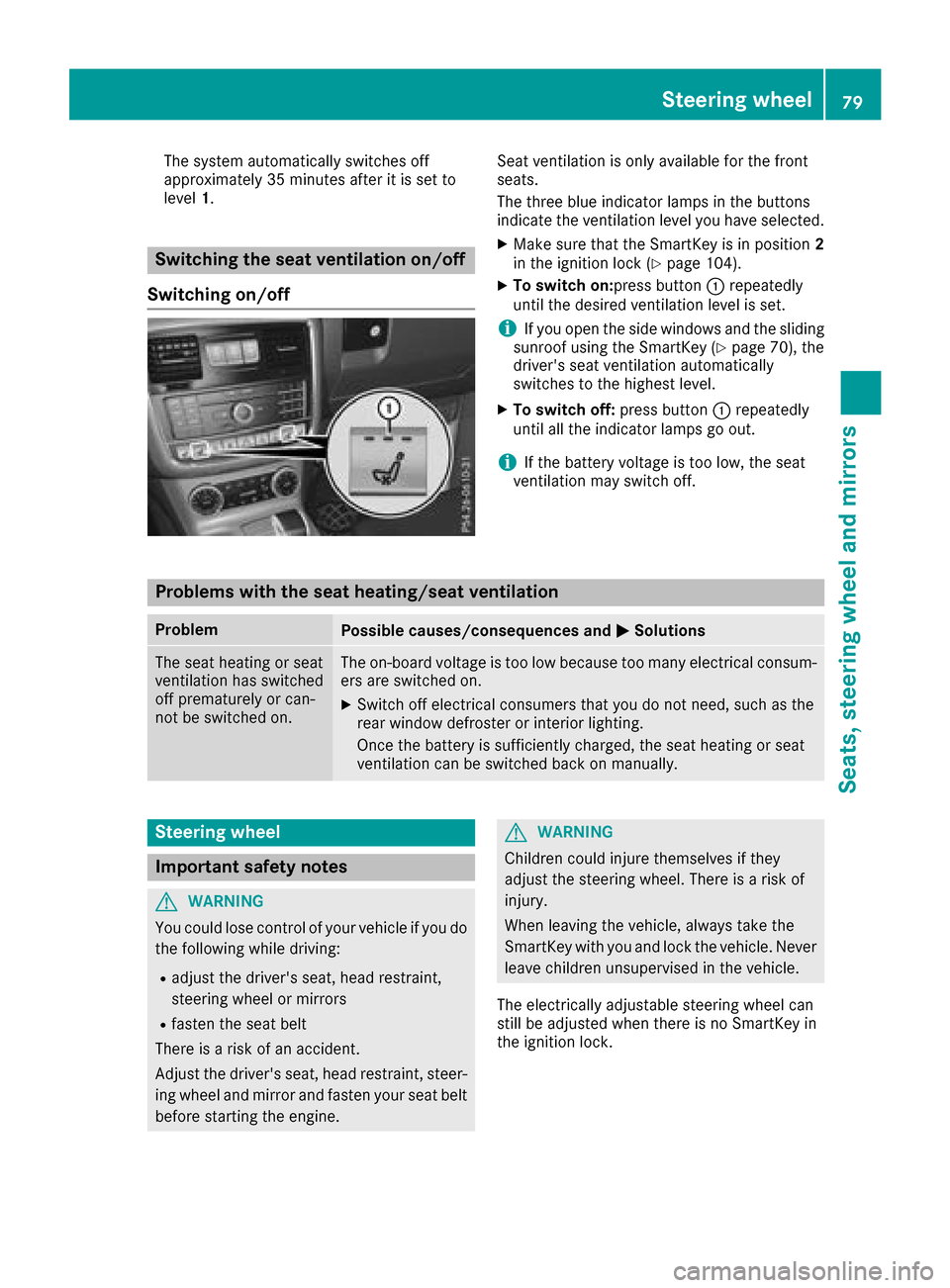
Seat ventilation is only availablef or the front
seats.
The three blue indicator lamps in the buttons
indicate the ventilation level you have selected.
XMake sure that the SmartKey is in position 2
in the ignition lock (Ypage 104).
XTo switch on:press button :repeatedly
until the desired ventilation level is set.
iIf you open the side windows and the sliding
sunroof using the SmartKey (Ypage 70), the
driver's seat ventilation automatically
switches to the highest level.
XTo switch off: press button:repeatedly
until all the indicator lamps go out.
iIf the battery voltage is too low, the seat
ventilation may switch off.
Problems with the seat heating/seat ventilation
ProblemPossible causes/consequences and MSolutions
The seat heating or seat
ventilation has switched
off prematurely or can-
not be switched on.The on-board voltage is too low because too many electrical consum-
ers are switched on.
XSwitch off electrical consumersthat you do not need, such as the
rear window defroster or interior lighting.
Once the battery is sufficiently charged, the seat heating or seat
ventilation can be switched back on manually.
Steering wheel
Important safety notes
GWARNING
You could lose control of your vehicle if you do the following while driving:
Radjust the driver's seat, head restraint,
steerin gwheel or mirrors
Rfasten the seat belt
There is arisk of an accident.
Adjust the driver's seat, head restraint, steer-
ing wheel and mirror and fasten your seat belt before starting the engine.
GWARNING
Children could injure themselves if they
adjust the steerin gwheel. There is arisk of
injury.
When leaving the vehicle, alwayst ake the
SmartKey with you and lock the vehicle. Never
leave children unsupervised in the vehicle.
The electrically adjustable steerin gwheel can
still be adjusted when there is no SmartKey in
the ignition lock.
Steering wheel79
Seats, steering wheel and mirrors
Z
Page 100 of 286
ProblemPossible causes/consequences andMSolutions
The indicator lamp in the
¿orÁ button
flashes three times or
remains off. The "Cool-
ing with air dehumidifi-
cation" function cannot
be switched on.Cooling with air dehumidification has been deactivated due to amal-
function.
XVisit aqualified specialist workshop.
Setting climate control to automatic
General notes
In automatic mode, the set temperature is main-
tained at aconstant level. The system automat-
ically regulates the temperature of the dis-
pensed air, the airflow and the air distribution.
Automatic mode works best when cooling with
air dehumidification is also activated. If neces-
sary, cooling with air dehumidification can be
deactivated.
Automatic control
XTurn the SmartKey to position 2in the igni-
tion lock (Ypage 104).
XSet the desired temperature.
XTo activate: press theÃbutton.
The indicator lamp in the Ãbutton lights
up. Automatic air distribution and airflow are
activated.
XTo deactivate: press the_button.
or
XPress the IorK button.
The indicator lamp in the Ãbutton goes
out.
XTo switch to manualm ode:press the_
button.
Setting the temperature
Differentt emperatures can be set for the driv-
er's and front-passenger sides.
XTurn the SmartKey to position 2in the igni-
tion lock (Ypage 104).
XAdjust control :orB (Ypage 95) to the
desired temperature.
Only change the temperature settingins mall
increments. Start at 72 ‡(22 †).
Setting the air distribution
Air distribution settings
P Directsa ir through the center and side air
vents
O Directsa ir through the footwell air vents
S Directsa ir through the center, side and
footwell vents
¯ Directsa ir through the defroster vents
b Canada only: directs the airflow through
the defroster, center and side air vents.
a Directsa ir through the defroster and
footwell vents
_ Canada only: directs the airflow through
the defroster, center and footwell air
vents.
Setting
XTurn the SmartKey to position 2in the igni-
tion lock (Ypage 104).
XPress the _button repeatedly until the
desired symbol appears in the display.
Setting the airflow
XTurn the SmartKey to position 2in the igni-
tion lock (Ypage 104).
XTo increase: press theKbutton.
XTo reduce: press theIbutton.
iThe airflow from the rear-compartment
ventsa nd the center ventsist he same.
98Operating the climate control system
Climatecontrol
Page 103 of 286
Switching air-recirculation mode
on/off
General notes
If you switch on air-recirculation mode, the win-
dows can fog up more quickly, in particular at
low temperatures. Only use air-recirculation
mode briefly to prevent the windows from fog-
ging up.
Activating/deactivating
XTurn the SmartKey to position 2in the igni-
tion lock (Ypage 104).
XTo activate: press thedbutton.
The indicator lamp in the dbutton lights
up.
iAir-recirculation mode is automatically acti-
vated at high levels of pollution or at high out-
side temperatures. When air-recirculation
mode is activated automatically, the indicator
lamp in the dbutton is not lit.
Outside air is added after about 30 minutes.
XTo deactivate: press thedbutton.
The indicator lamp in the dbutton goes
out.
iAir-recirculation mode switches off auto-
matically:
Rafter approximately five minutes at outside
temperatures below approximately 41 ‡
Rafter approximately five minutes if cooling
with air dehumidification is deactivated
Rafter approximately 30 minutes at outside
temperatures above approximately 41 ‡
(5 †)
Switching the residual heat on or off
General notes
The residual heat function is only available on
vehicles for Canada.
It is possible to make use of the residual heat of
the engine to continue heating the stationary
vehicle for up to 30 minutes after the engine has
been switched off. The heating time depends on the set interior temperature.
Activating/deactivating
XTurn the SmartKey to position gin the igni-
tion lock (Ypage 104) or remove it.
XTo activate: press theÁbutton.
The indicator lamp in the Ábutton lights
up.
iThe blower will run at alow speed regardless
of the airflow setting.
iIf you activate the residual heat function at
high temperatures, only the ventilation will be
activated.
XTo deactivate: press theÁbutton.
The indicator lamp in the Ábutton goes
out.
Residual heat is deactivated automatically:
Rafter approximately 30 minutes
Rwhen the ignition is switched on
Rif the battery voltage drops
Rif the coolant temperature is too low
Air vents
Important safety notes
GWARNING
Very hot or very cold air can flow from the air
vents. This could result in burns or frostbitei n
the immediate vicinity of the air vents. There
is ar isk of injury.
Make sure that all vehicle occupants always
maintain asufficient distance to the air out-
lets. If necessary, redirect the airflow to
another area of the vehicle interior.
In order to ensure the direct flow of fresh air
through the air ventsi nto the vehicle interior,
please observe the following notes:
Rkeep the air inlet between the windshield and
the hood free of blockages, such as ice, snow or leaves.
Rnever cover the air ventsora ir intake grilles in
the vehicle interior.
iFor virtually draft-free ventilation, adjust the
sliders of the air ventstot he center position.
iIf the automatic climate control constantly
differs from the set temperature or if unde-
Air vents101
Climatec ontrol
Z