2017 MERCEDES-BENZ G-Class Level
[x] Cancel search: LevelPage 230 of 286
If theEngine Oil Level Not Measurablewith Running Enginemessage appears:
XSwitch off the engine.
XIf the engine is at normal operating tem-
perature: waitabou tfive minutes before car-
rying out the measurement.
XIf the engine is not at normal operating
temperature: e.g. if the engine was only star-
ted briefly, wai tapproximately 30 minutes
before carrying out the measurement.
If you wish to cancel the measurement, press
the 9 or: button on the multifunction
steering wheel.
Adding engine oil
!Use only engine oils and oil filters that are
approved for vehiclesw ithaservice system. A
list of the engine oils and oil filters that have
been tested and approved in accordance with
Mercedes-Benz Specifications for Service
Products is available at any authorized
Mercedes-Benz Center.
The following cause engine failure or damage
to the exhaust system:
RUse of engine oils and oil filters that have
not been expressly approved for the service
system
RReplacement of engine oil and oil filter after
the replacement interval specifiedbyt he
service system has expired
RUse of engine oil additives
!Do not add too much oil. If the oil level is
above the "max" mark on the dipstick, too
much oil has been added. This can leadt o
damage to the engine or the catalytic con-
verter. Have excess oil siphoned off.
HEnvironmental note
When adding oil, take care not to spilla ny. If
oil enters the soil or waterways ,itisharmful to
the environment.
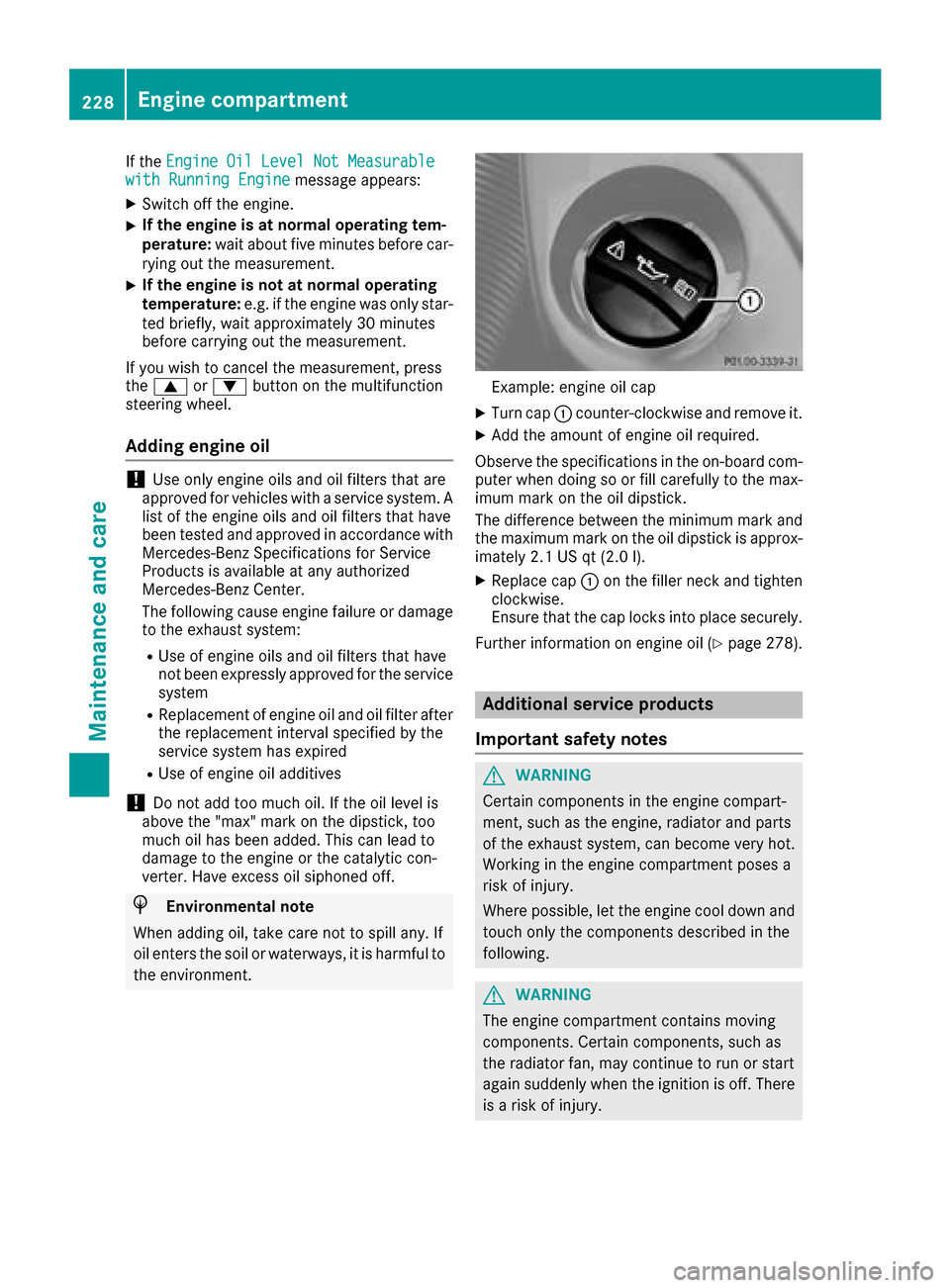
Example: engine oil cap
XTurn cap :counter-clockwise and remove it.
XAdd the amount of engine oil required.
Observe the specifications in the on-board com-
puter when doing so or fill carefully to the max-
imum mark on the oil dipstick.
The difference betweent he minimum mark and
the maximum mark on the oil dipstick is approx-
imatel y2.1 US qt (2.0 l).
XReplace cap :on the fille rneck and tighten
clockwise.
Ensur ethat the cap locks into place securely.
Further information on engine oil(
Ypage 278).
Additional servic eproducts
Important safety notes
GWARNING
Certai ncomponents in the engine compart-
ment, such as the engine, radiator and parts
of the exhaus tsystem, can become very hot.
Working in the engine compartment poses a
ris kofi njury.
Where possible ,let the engine cool dow nand
touch only the components described in the
following.
GWARNING
The engine compartment contains moving
components .Certai nc omponents ,suc ha s
the radiator fan, may continu etorun or start
agai nsudde nlyw hent he ignition is off. There
is ar iskofi njury.
228Engine compartment
Maintenancea nd care
Page 231 of 286
If you need to do any work inside the engine
compartment:
Rswitch off the ignition
Rnever reach into the area where there is a
risk of danger from moving components,
such as the fan rotation area
Rremove jewelry and watches
Rkeep items of clothing and hair, for exam-
ple, awayfrom moving parts
GWARNING
The cooling system is pressurized, particularly
when the motor is warm. If you open the cap,
you could be scaldedifh ot coolant spraysout.
There is arisk of injury.
Let the engine cool down before you open the
cap. Wear gloves and eye protection. Slowly
open the cap to relieve pressure.
GWARNING
Opening the hood when the engine is over-
heated or when there is afire in the engine
compartment could expose you to hot gases
or other service products. There is arisk of
injury.
Let an overheated engine cool down before
opening the hood. If there is afire in the
engine compartment, keep the hood closed
and contact the fire department.
Checking coolant level
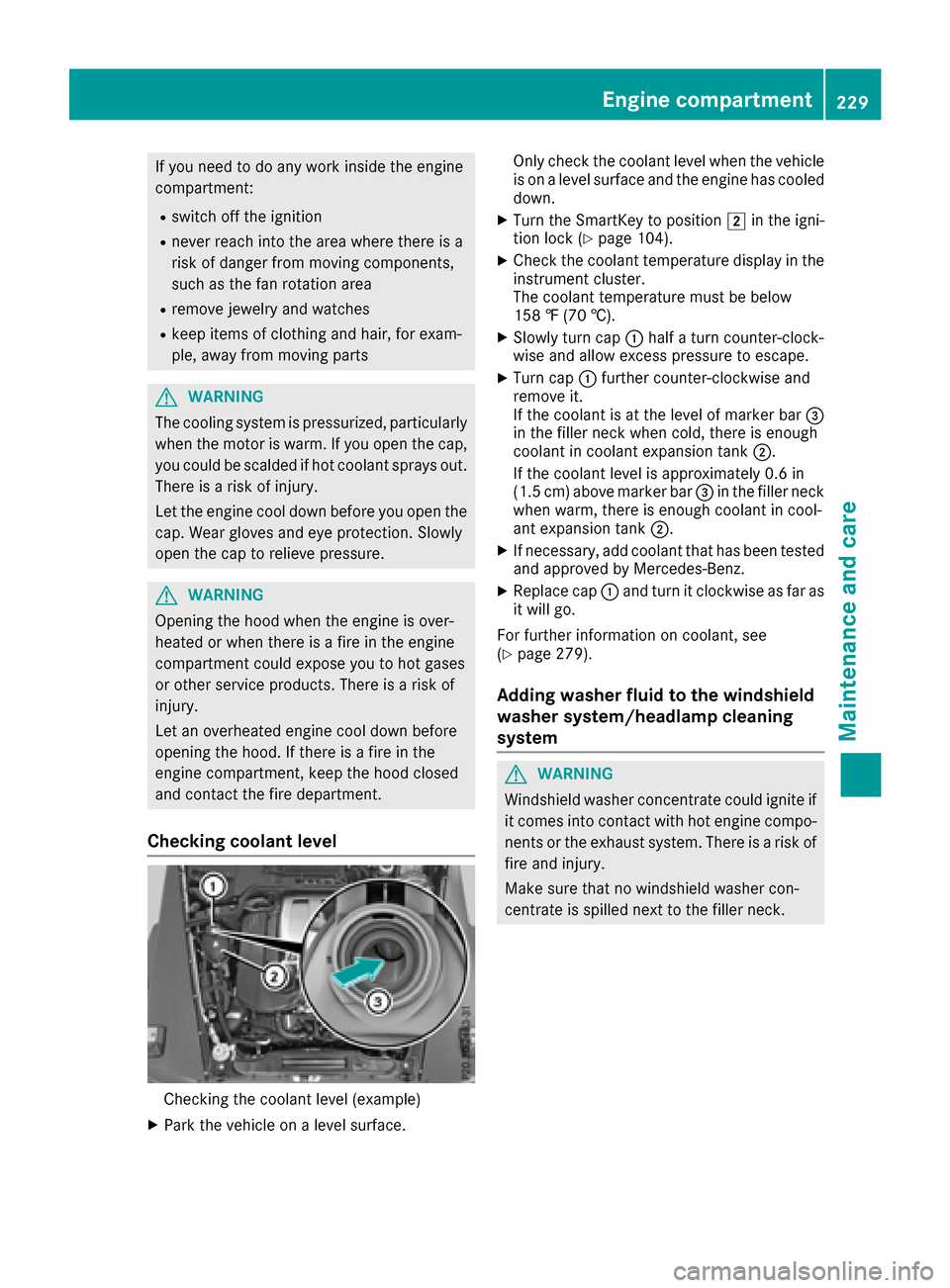
Checking the coolant level (example)
XPark the vehicle on alevel surface. Only check the coolant level when the vehicle
is on alevel surface and the engine has cooled
down.
XTurn the SmartKey to position 2in the igni-
tion lock (Ypage 104).
XCheck the coolant temperature display in the
instrument cluster.
The coolant temperature must be below
158 ‡(70 †).
XSlowlyt urn cap :half aturn counter-clock-
wise and allow excess pressure to escape.
XTurn cap :further counter-clockwise and
remove it.
If the coolant is at the level of marker bar =
in the fillern eck when cold, there is enough
coolant in coolant expansion tank ;.
If the coolant level is approximately 0.6 in
(1.5 cm) above marker bar =in the fillern eck
when warm, there is enough coolant in cool-
ant expansion tank ;.
XIf necessary,add coolant that has been tested
and approved by Mercedes-Benz.
XReplace cap :and turn it clockwise as far as
it willg o.
For further information on coolant, see
(
Ypage 279).
Adding washe rfluid to the windshield
washe rsystem/headlamp cleaning
system
GWARNING
Windshield washer concentrate could ignite if it comes into contact with hot engine compo-
nents or the exhaust system. There is arisk of
fire and injury.
Make sure that no windshield washer con-
centrate is spilled next to the fillern eck.
Engine compartment229
Maintenanceand care
Z
Page 232 of 286
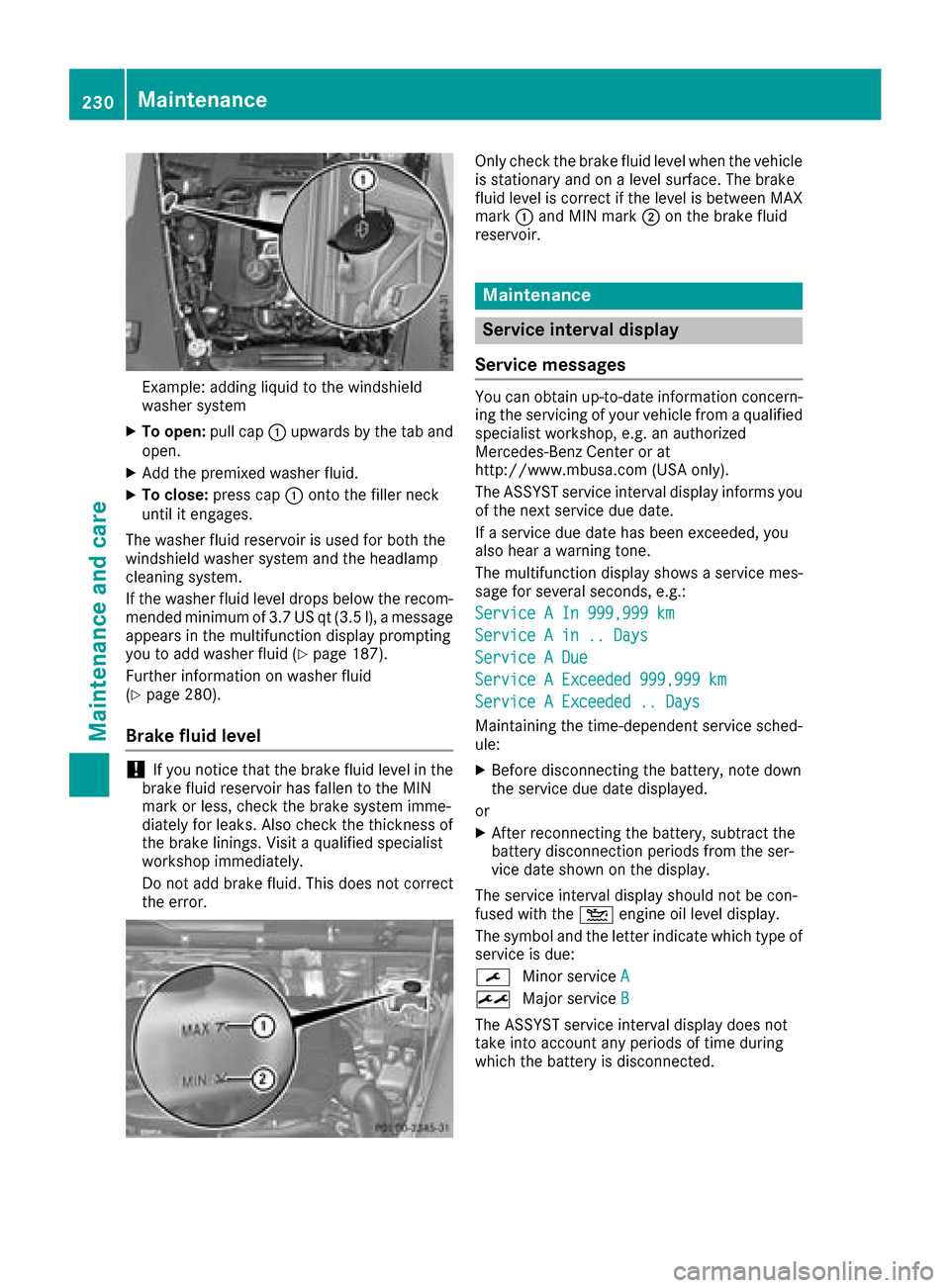
Example: adding liquid to the windshield
washersystem
XTo open: pull cap:upwards by the tab and
open.
XAdd the premixed washe rfluid.
XTo close: press cap :onto the fille rneck
unti lite ngages.
The washe rfluid reservoi risusedf or both the
windshiel dwashers ystem and the headlamp
cleaning system.
If the washe rfluid level drops belo wthe recom-
mended minimu mof3.7 US qt (3.5 l) ,amessage
appear sinthe multifunctio ndisplay prompting
yo utoa ddwashe rfluid (
Ypage 187).
Furtheri nformatio nonwasherf luid
(
Ypage 280).
Brake fluid level
!If yo unotice thatt he brake fluid level in the
brake fluid reservoi rhas fallen to the MIN
mark or less, check the brake system imme-
diately for leaks .Alsoc heck the thicknes sof
the brake linings. Visitaq ualified specialist
workshop immediately.
Do not ad dbrake fluid .Thisd oesn ot correct
the error.
Onlyc heck the brake fluid level when the vehicle
is stationar yand on alevel surface. The brake
fluid level is correct if the level is between MAX
mark :and MIN mark ;on the brake fluid
reservoir.
Maintenance
Service interval display
Service messages
Yo uc an obtai nup-to-date informatio nconcern-
ing the servicing of your vehicl efromaq ualified
specialis tworkshop ,e.g.ana uthorized
Mercedes-Benz Center or at
http://www.mbusa.com (USA only).
The ASSYST servic eintervald isplayinforms you
of the next servic eduedate.
If as ervic eduedate hasb eene xceeded ,you
also hear awarning tone.
The multifunctio ndisplay shows aservic emes-
sage for severa lseconds, e.g.:
ServiceAIn9 99,999km
ServiceAin..D ays
ServiceADue
ServiceAExceeded 999,999k m
ServiceAExceeded .. Days
Maintaining the time-dependent servic esched-
ule:
XBefore disconnecting the battery ,note down
the servic eduedate displayed.
or
XAfter reconnecting the battery ,sub tract the
battery disconnection periods fromt he ser-
vic ed ates hown on the display.
The servic eintervald isplayshouldnot be con-
fused with the 4engine oi llev el display.
The symbo land the letter indicate which typ eof
servic eisdue:
¯ Minor service A
±
Major service B
The ASSYST servic eintervald isplaydoes not
take into account any periods of time during
which the battery is disconnected.
230Maintenance
Maintenance and care
Page 242 of 286
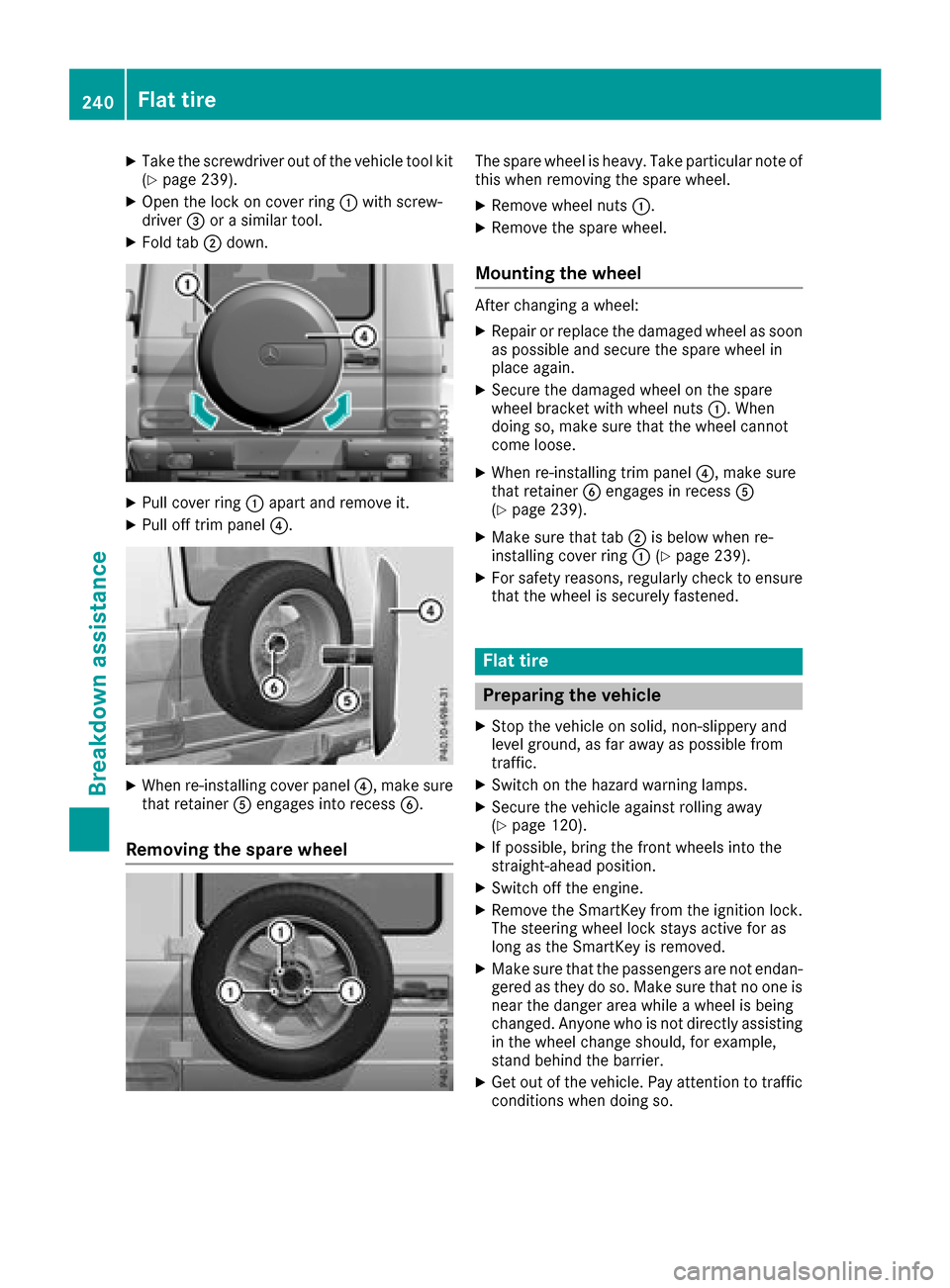
XTake the screwdriver out of the vehicle tool kit(Ypage 239).
XOpen the lock on cover ring :with screw-
driver =oras imilar tool.
XFold tab ;down.
XPull cover ring :apart and remove it.
XPull off trim panel ?.
XWhen re-installing cover panel ?,make sure
that retainer Aengages into recess B.
Removing the sparew heel
The spare wheel is heavy. Take particular noteo f
this when removing the spare wheel.
XRemove wheel nuts :.
XRemove the spare wheel.
Mounting the wheel
After changingawheel:
XRepair or replace the damaged wheel as soon
as possible and secure the spare wheel in
place again.
XSecure the damaged wheel on the spare
wheel bracket with wheel nuts :.When
doing so, make sure that the wheel cannot
come loose.
XWhen re-installing trim panel ?,make sure
that retainer Bengages in recess A
(
Ypage 239).
XMake sure that tab ;is below when re-
installing cover ring :(Ypage 239).
XFor safety reasons, regularly check to ensure
that the wheel is securely fastened.
Flat tire
Preparing the vehicle
XStop the vehicle on solid, non-slippery and
level ground, as far away as possible from
traffic.
XSwitch on the hazard warning lamps.
XSecure the vehicle against rolling away
(Ypage 120).
XIf possible, bring the front wheels into the
straight-ahead position.
XSwitch off the engine.
XRemove the SmartKey from the ignition lock.
The steerin gwheel lock stays active for as
long as the SmartKey is removed.
XMake sure that the passengers are not endan-
gered as they do so. Make sure that no one is
near the danger area while awheel is being
changed. Anyon ewho is not directly assisting
in the wheel change should, for example,
stand behind the barrier.
XGet out of the vehicle. Pay attention to traffic
conditions when doing so.
240Flat tire
Breakdown assistance
Page 260 of 286
Your vehicle has also been equipped with a
TPMS malfunction indicator to indicate if the
systemisn ot operating properly. The TPMS
malfunction indicator is combined with the
low tir epressure telltale. When the system
detects amalfunction, the warnin glamp will
flash for approximately aminut eand then
remain continuously illuminated. This
sequence will be repeated every tim ethe vehi-
cle is started as long as the malfunction
exists.
When the malfunction indicator is illuminated,
the syste mmay not be able to detec torsignal
low tir epressure as intended .TPMS malfunc-
tion smay occur for avarietyofr easons,
including the mountin gofincompatible
replacementora lternatetires or wheels on
the vehicle that prevent the TPMS from func-
tioning properly. Always chec kthe TPMS mal-
function telltale afte rreplacing one or more
tires or wheels on your vehicle to ensur ethat
the replacementora lternatetires and wheels
allow the TPMS to continue to function prop-
erly.
It is the driver's responsibility to set the tire
pressure to that recommended for cold tires
which is suitable for the operating situation
(
Ypage 254). Notet hat the correcttirep ressure
for the current operating situation must firstb e
taught-in to the tir epressure monitor .Ifasub-
stantial loss of pressure occurs, the warning
threshold for the warnin gmessageisa ligned to
the taught-in reference values. Restar tthe tire
pressure monitor afte radjusting the pressure of
the cold tires (
Ypage 259). The current pres-
sures are saved as new reference values. As a
result,aw arningmessagew ill appear if the tire
pressure drops significan tly.
The t
ir ep ressure monitor does not warn you of
an incorrectly set tir epressure. Observe the
notes on the recommended tir epressure
(
Ypage 254).
The tir epressure monitor is not able to warn you
of as udden loss of pressure, e.g. if the tir eis
penetrate dbyaforeign object .Inthe eventofa
sudden loss of pressure, bringt he vehicle to a
halt by braking carefully. Avoid abrupt steering
movements.
The tir epressure monitor has ayellow h
warnin glamp on the instrumentc luster for indi-cating
apressure loss or malfunction. The way
that the warnin glamp flashes or lightsupi ndi-
cates whether atirep ressure is too low or
whether the tir epressure monitor is malfunc-
tioning:
Rif the h warnin glamp is lit continuously,
the tir epressure in one or more tires is sig-
nificantly too low. The tir epressure monitor is
not malfunctioning.
Rif the h warnin glamp flashes for around a
minut eand the nremainsl it constantly, the
tir ep ressure monitor is malfunctioning.
In addition to the hwarnin glamp, amessage
appears in the multifunction display. Observe
the information on display messages
(
Ypage 183).
It may tak euptoten minutes for amalfunction
of the tir epressure monitor to be indicated. The
malfunction is indicated firstbyt heh tire
pressure warnin glamp flashingf or approx-
imately one minut eand the nremaining lit. If the
malfunction has been rectified, the htire
pressure warnin glamp goes out afte rdrivingf or
af ew minutes.
The tir epressure values indicated by the on-
board computer may differf rom those meas-
ured at agas st
ation with apressure gauge. The
tir ep ressures shown by the on-board computer
refertot hose measured at sea level. At high
altitudes, the tir epressure values indicated by a
pressure gauge are higher than those shown by
the on-board computer .Inthis case, do not
reduce the tir epressures.
The operation of the tir epressure monitor can
be affected by interference from radio transmit-
tin ge quipment( e.g. radio headphones, two-way
radios) that may be being operated in or near the
vehicle.
Checking th etirep ressuree lectroni-
cally
XMake sure that the SmartKey is in position 2
in the ignition lock.
XPress the =or; button on the steering
wheel to selectt heServ.menu.
XPress the 9or: button to select
Tire Pressure.
XPress the abutton.
The multifunction display shows the current
tir ep ressure of each wheel.
If the vehicle has been parked for over
20 minutes, the Tire pressure will be
258Tirep ressure
Wheels and tires
Page 266 of 286
in combination, can cause excessiveheat
build-up and possible tir efailure.
The temperature grades are A(the highest), B,
and C, representin gthe tire's resistance to the
generatio nofheat and its ability to dissipate
heat when tested under controlled conditions
on aspecified indoo rlaboratory tes twheel. Sus-
tained high temperature can cause the material
of the tir etodegeneratea nd reducetirel ife, and
excessivet emperature can lead to sudden tire
failure. The grade Ccorresponds to alevel of
performance which all passenger car tires must
meet under the Federal Motor Vehicle Safety
Standard No. 109.G radesBandArepresent
higher levels of performance on the laboratory
tes twheel than the minimum requiredbyl aw.
Tirelabeling
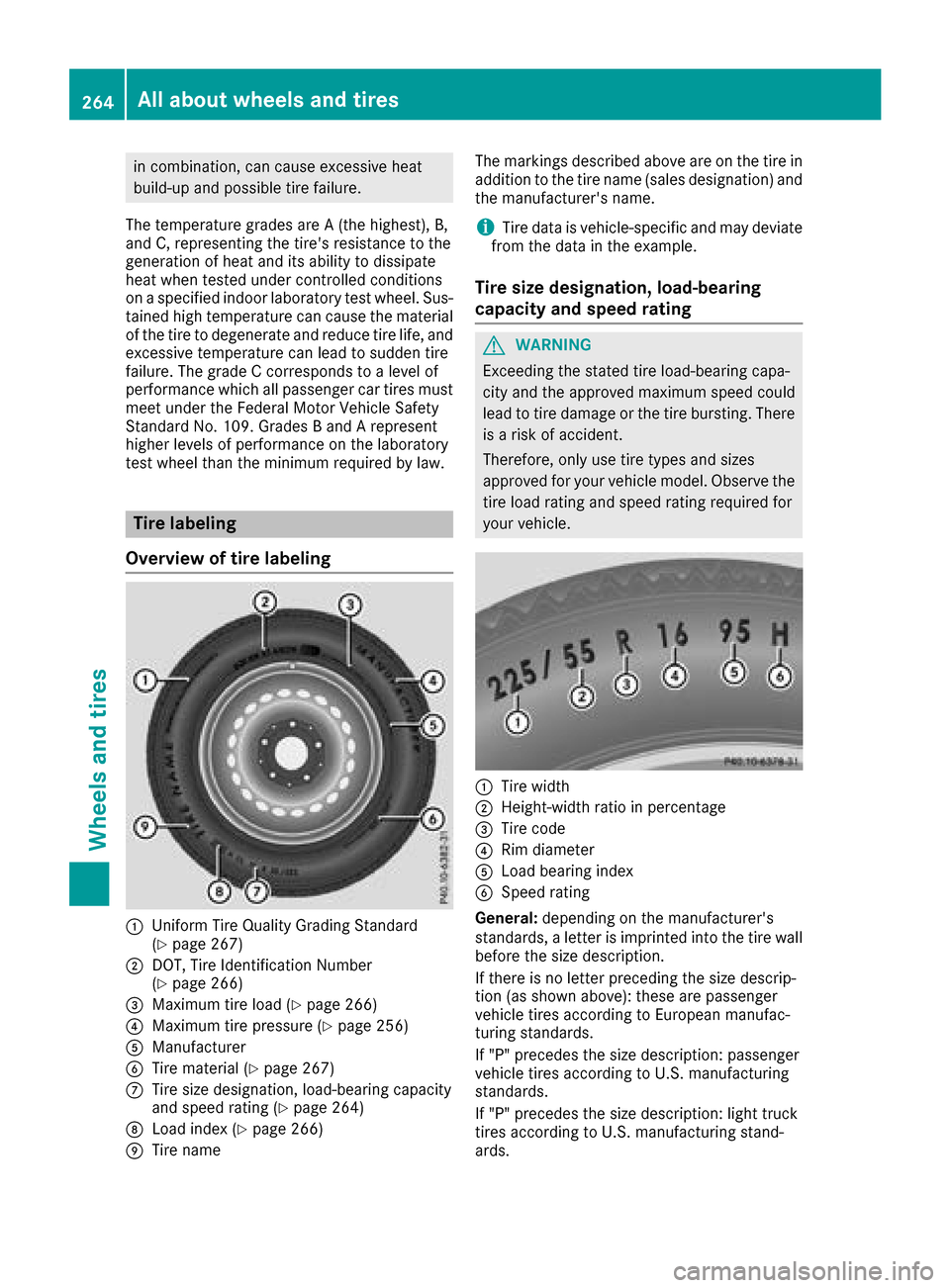
Overview of tir elabeling
:Uniform Tire Quality Grading Standard
(Ypage 267)
;DOT ,Tire Identification Number
(Ypage 266)
=Maximum tir eload (Ypage 266)
?Maximum tir epressure (Ypage 256)
AManufacturer
BTire material (Ypage 267)
CTire size designation ,load-bearing capacity
and speed ratin g(Ypage 264)
DLoad index (Ypage 266)
ETire name The markings described above are on the tir
ein
addition to the tir ename (sales designation )and
the manufacturer'sn ame.
iTire data is vehicle-specific and may deviate
fromt he data in the example.
Tires ize designation, load-bearing
capacity and speed rating
GWARNING
Exceedin gthe stated tir eload-bearing capa-
cit ya nd the approved maximum speed could
lead to tir edamage or the tir ebursting. There
is ar isk of accident.
Therefore, only use tir etypes and sizes
approved for your vehicle model. Observe the
tir el oad ratin gand speed ratin grequiredf or
your vehicle.
:Tire width
;Height-width ratio in percentage
=Tire code
?Rim diameter
ALoad bearingi ndex
BSpeed rating
General: depending on the manufacturer's
standards, aletter is imprinted int othe tir ewall
beforet he size description.
If there is no letter preceding the size descrip-
tion (as shown above): these are passenger
vehicle tires accordingtoE uropean manufac-
turin gstandards.
If "P" precedes the size description: passenger
vehicle tires accordingtoU .S.m anufacturing
standards.
If "P" precedes the size description: light truck
tires accordingtoU .S.m anufacturing stand-
ards.
264All about wheels and tires
Wheels and tires
Page 271 of 286
PSI (pounds per squareinch)
Astandard unit of measure for tire pressure.
Aspect ratio
Relationship between tire height and tire width
in percent.
Tire pressure
This is pressure inside the tire applying an out-
ward force to each square inch of the tire's sur-
face. The tire pressure is specified in pounds per
square inch (psi), in kilopascals (kPa) or in bar.
The tire pressure should only be corrected when
the tires are cold.
Cold tire pressure
The tires are cold:
Rif the vehicle has been parked with the tires
out of direct sunlight for at least three hours
and
Rif the vehicle has not been driven further than
1m ile (1.6 km)
Tread
The part of the tire that comes into contact with
the road.
Bead
The tire bead ensures that the tire sits securely
on the wheel. There are several steel wires in the
bead to prevent the tire from coming loose from
the wheel rim.
Sidewall
The part of the tire between the tread and the
bead.
Weight of optional extras
The combined weight of those optional extras
that weigh more than the replaced standard
parts and more than 2.3 kg (5 lbs). These
optional extras, such as high-performance
brakes, level control, aroof rack or ahigh-per-
formanceb attery, are not included in the curb
weight and the weight of the accessories.
TIN (Tire Identification Number)
This is aunique identifier which can be used by
at ire manufacturer to identify tires, for example
for aproduct recall, and thus identify the pur-
chasers. The TIN is made up of the manufactur-
er's identity code, tire size, tire type code and
the manufacturing date.
Load bearing index
The load bearing index (also load index) is acode
that contains the maximum load bearing capa-
city of atire.
Traction
Traction is the result of friction between the tires
and the road surface.
TWR (Tongue Weight Rating)
The TWR specifies the maximum permissible
weight that the ball coupling of the trailer tow
hitch can support.
Treadwear indicators
Narrow bars (tread wear bars) that are distrib-
uted over the tire tread. If the tire tread is level
with the bars, the wear limit of áin (1.6 mm)
has been reached.
Occupant distribution
The distribution of occupants in avehicle at their
designated seating positions.
Total load limit
Nominal load and luggage load plus 68 kg
(150 lbs) multiplied by the number of seats in
the vehicle.
Changing awheel
Flat tire
You can find information on what to do in the
event of aflat tire in the "Breakdown assistance"
section (
Ypage 240).
Rotating the wheels
GWARNING
Interchanging the front and rear wheels may
severely impair the driving characteristics if
the wheels or tires have different dimensions. The wheel brakes or suspension components
may also be damaged. There is arisk of acci-
dent.
Rotate front and rear wheels only if the wheels and tires are of the same dimensions.
Changing awheel269
Wheels and tires
Z
Page 272 of 286
!On vehicles equipped withatire pressure
monitor, electronic componentsa re located
in the wheel.
Tire-mounting tools should not be used near
the valve. This could damage the electronic
components.
Only have tires changed at aqualified spe-
cialist workshop.
Alwayso bserve the instructionsa nd safety
notes under "Installing awheel" (
Ypage 270).
The wear patterns on the front and rear tires
differ, depending on the operating conditions.
Rotate the wheels before aclear wear pattern
has formed on the tires. Front tires typically
wear more on the shoulders and the rear tires in the center.
On vehicles that have the same size front and
rear wheels, you can rotate the wheels accord-
ing to the intervals in the tire manufacturer's
warranty book in your vehicle documents. If no
warranty book is available, the tires should be
rotated every 3,000 to 6,000 miles (5,000 to
10,000 km). Depending on tire wear, this may
be required earlier. Do not change the direction
of wheel rotation.
Cleant he contact surfaces of the wheel and the
brake disc thoroughly every time awheel is rota-
ted. Check the tire pressure and reactivate the
tire pressure monitor if necessary (
Ypage 259).
Direction of rotation
Tires with aspecified direction of rotation have
additional benefits, e.g. if there is arisk of hydro-
planing. You will only gain these benefits if the
correct direction of rotation is observed.
An arrow on the sidewall of the tire indicates its
correct direction of rotation.
You may mount the spare wheel against the
direction of rotation. Adhere to the time restric-
tion on use as well as the speed limitation speci-
fied on the spare wheel.
Storing wheels
Store tires that are not being used in acool, dry
and preferably dark place. Protect the tires from
oil, grease, gasoline and diesel.
Mounting awheel
Preparing the vehicle
GWARNING
When you remove the spare wheel from the
spare wheel bracket, the vehicle’s weight dis-
tribution changes. If the vehicle is already
raised, the jack could tip over. There is arisk
of injury.
Remove the spare wheel from the spare wheel
bracket before lifting the vehicle.
XStop the vehicle on solid, non-slippery and
level ground.
XApply the parking brake.
XBring the front wheels into the straight-ahead
position.
XShift the automatic transmission to position
P.
XSwitch off the engine.
XRemove the vehicle tools and jack from the
vehicle (Ypage 120).
XRemove the spare wheel from the spare wheel
bracket (Ypage 239).
XSafeguard the vehicle against rolling away.
Securing the vehicletop revent it from
rolling away
XPlace chocks or other suitablei tems under
the front and rear of the wheel that is diago-
nally opposite the wheel you wish to change.
Raising the vehicle
GWARNING
If you do not position the jack correctly at the
appropriate jacking point of the vehicle, the
jack could tip over with the vehicle raised.
There is arisk of injury.
Only position the jack at the appropriate jack-
ing point of the vehicle. The base of the jack
must be positioned vertically, directly under
the jacking point of the vehicle.
!Only position the jack at the appropriate
jacking point of the vehicle. Otherwise, you
could damage the vehicle.
270Changing awheel
Wheels and tires