2014 SUBARU TRIBECA check engine
[x] Cancel search: check enginePage 334 of 426

Maintenance schedule....................................... 11-3
Maintenance precautions................................... 11-3Before checking or servicing in the enginecompartment.................................................... 11-4When you do checking or servicing in the enginecompartment while the engine is running.......... 11-4
Engine hood....................................................... 11-4
Engine compartment overview.......................... 11-6
Engine oil............................................................ 11-7Checking the oil level......................................... 11-7Changing the oil and oil filter.............................. 11-8Recommendedgrade and viscosity.................... 11-9Synthetic oil....................................................... 11-9
Cooling system................................................ 11-10Hose and connections...................................... 11-10Engine coolant................................................. 11-11
Air cleaner element.......................................... 11-12Replacing the air cleaner element..................... 11-12
Spark plugs...................................................... 11-13Recommended spark plugs.............................. 11-13
Drive belts........................................................ 11-13
Automatic transmission fluid.......................... 11-14Checking the fluid level.................................... 11-14Recommended fluid......................................... 11-15
Front differential gear oil................................. 11-15Checking the oil level....................................... 11-15Recommended grade and viscosity.................. 11-16
Rear differential gear oil.................................. 11-16Recommended grade and viscosity.................. 11-16
Power steering fluid........................................ 11-16Checking the fluid level.................................... 11-16Recommended fluid......................................... 11-17
Brake fluid........................................................ 11-17Checking the fluid level.................................... 11-17Recommended brake fluid............................... 11-18
Brakebooster.................................................. 11-18
Brake pedal...................................................... 11-19Checking the brake pedal free play.................. 11-19Checking the brake pedal reserve distance....... 11-19
Replacement of brake pad and lining............ 11-19Breaking-in of new brake pads and linings....... 11-20
Parking brake stroke....................................... 11-20
Tires and wheels.............................................. 11-21Types of tires................................................... 11-21Tire pressure monitoring system (TPMS).......... 11-21Tire inspection................................................. 11-22Tire pressuresand wear.................................. 11-23Wheel balance................................................. 11-25Wear indicators............................................... 11-25Tire rotation direction mark.............................. 11-25Tire rotation..................................................... 11-26Tire replacement.............................................. 11-26Wheel replacement.......................................... 11-27
Aluminum wheels............................................ 11-27
Windshield washer fluid.................................. 11-28
Replacement of wiper blades......................... 11-29Windshield wiper blade assembly..................... 11-30Windshield wiper blade rubber ......................... 11-30Rear window wiper blade assembly.................. 11-31
Maintenance and service
11
Page 337 of 426
11-4Maintenance and service
guard against getting oil or fluidsin your eyes. If something doesget in your eyes, thoroughlywash them out with clean water.
.Do not tamper with the wiring ofthe SRS airbag system or seat-belt pretensioner system, or at-tempt to take its connectorsapart, as that may activate thesystem or it can render it inop-erative. NEVER use a circuittester for these wiring. If yourSRS airbag or seatbelt preten-sioner needs service, consultyour nearest SUBARU dealer.
&Before checking or servicing
in the engine compartment
WARNING
.Always stop the engine and setthe parking brake firmly to pre-vent the vehicle from moving.
.Always let the engine cool down.Engine parts become very hotwhen the engine is running andremain hot for some time afterthe engine is stopped.
.Do not spill engine oil, enginecoolant, brake fluid or any other
fluid on hot engine components.This may cause a fire.
.Always remove the key from theignition switch. When the ignitionswitch is in the“ON”position,the cooling fan may operatesuddenly even when the engineis stopped.
&When you do checking or
servicing in the engine com-
partment while the engine is
running
WARNING
A running engine can be dangerous.Keep your fingers, hands, clothing,hair and tools away from the coolingfan, belts and any other movingengine parts. Removing rings,watches and ties is advisable.
Engine hood
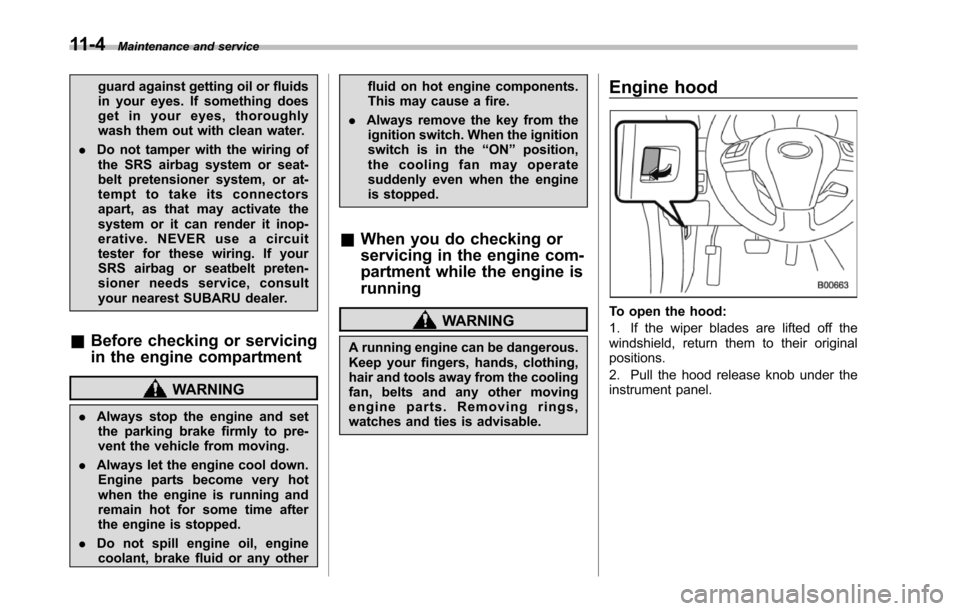
To open the hood:
1. If the wiper blades are lifted off thewindshield, return them to their originalpositions.
2. Pull the hood release knob under theinstrument panel.
Page 340 of 426
Engine oil
NOTE
.The engine oil consumption rate isnot stabilized, and therefore cannot bedetermined until the vehicle has tra-veled at least several thousand miles(kilometers). Even after break-in, whenthe vehicle is used under severe driv-ing conditions such as those men-tioned in the“Warranty and Mainte-nance Booklet”,engineoiliscon-sumed or deteriorated more quicklythan under normal driving conditions.If you drive your vehicle under thesesevere conditions, you should checkthe oil level at least at every secondfuel fill-up time, and change the oilmore frequently. Please refer to the“Warranty and Maintenance Booklet”for more details..If the oil consumption rate seemsabnormally high after the break-inperiod, for example more than 1 quartper 1,200 miles or 1 liter per 2,000kilometers, we recommend that youcontact your SUBARU dealer.
&Checking the oil level
Check the engine oil level at each fuelstop.
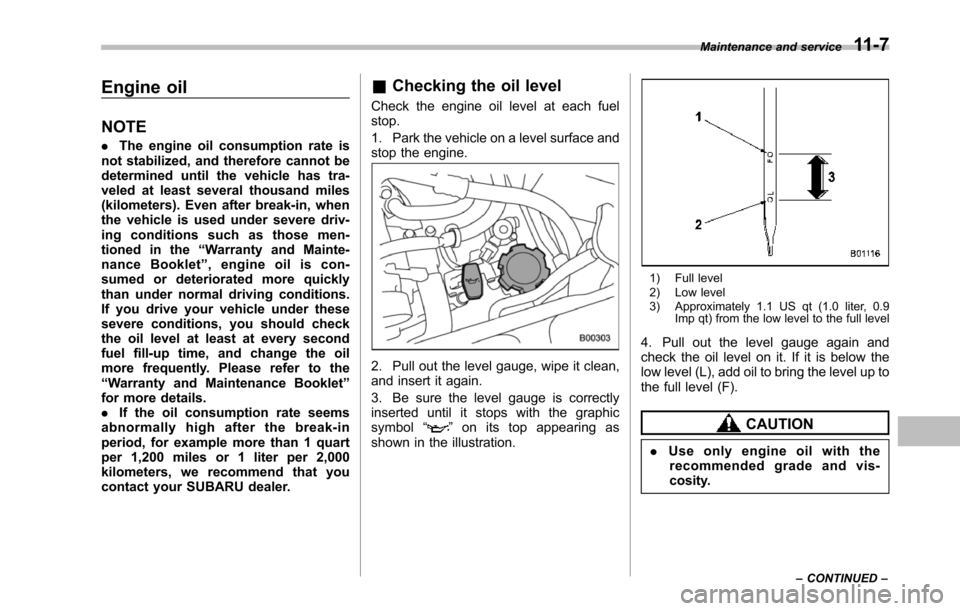
1. Park the vehicle on a level surface andstop the engine.
2. Pull out the level gauge, wipe it clean,and insert it again.
3. Be sure the level gauge is correctlyinserted until it stops with the graphicsymbol“”on its top appearing asshown in the illustration.
1) Full level2) Low level3) Approximately 1.1 US qt (1.0 liter, 0.9Imp qt) from the low level to the full level
4. Pull out the level gauge again andcheck the oil level on it. If it is below thelow level (L), add oil to bring the level up tothe fulllevel (F).
CAUTION
.Use only engine oil with therecommended grade and vis-cosity.
Maintenance and service11-7
–CONTINUED–
Page 341 of 426
11-8Maintenance and service
.Be careful not to spill engine oilwhen adding it. If oil touches theexhaust pipe, it may cause a badsmell, smoke, and/or a fire. Ifengine oil gets on the exhaustpipe, be sure to wipe it off.
If you check the oil level just after stoppingthe engine, wait a few minutes for the oil todrain back into the oil pan before checkingthe level.
To prevent overfilling the engine oil, do notadd any additional oil above the full levelwhen the engine is cold.
&Changing the oil and oil filter
CAUTION
.If you change your own oil, besure to drain all the oil from thefilter before disposal.
.Do not dispose of used engine oilby placing it in the trash, or bypouring it onto the ground, intosewers, or into any body of water.Check with your local govern-ment office for the proper dis-posal options available to you.
Change the oil and oil filter according tothe maintenance schedule in the“War-
ranty and Maintenance Booklet”.
The engine oil and oil filter must bechanged more frequently than listed inthe maintenance schedule when drivingon dusty roads, when short trips arefrequently made, or when driving inextremely cold weather.
1. Warm up the engine by letting theengine idle for approximately 10 minutesto ease draining the engine oil.
2. Park the vehicle on a level surface andstop the engine.
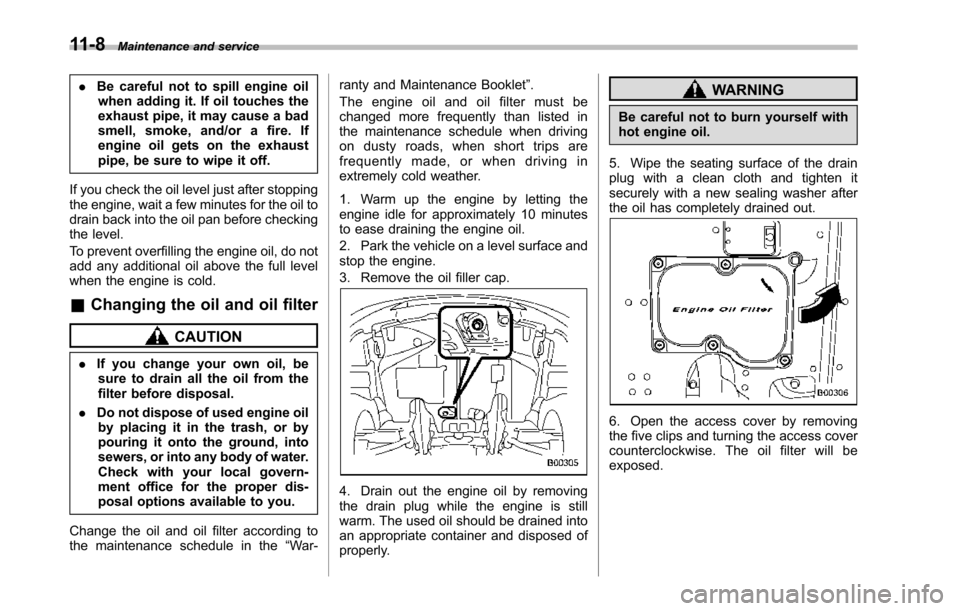
3. Remove the oil filler cap.
4. Drain out the engine oil by removingthe drain plug while the engine is stillwarm. The used oil should be drained intoan appropriate container and disposed ofproperly.
WARNING
Be careful not to burn yourself withhot engine oil.
5. Wipe the seating surface of the drainplug with a clean cloth and tighten itsecurely with a new sealing washer afterthe oil has completely drained out.
6. Open the access cover by removingthe five clips and turning the access covercounterclockwise. The oil filter will beexposed.
Page 342 of 426
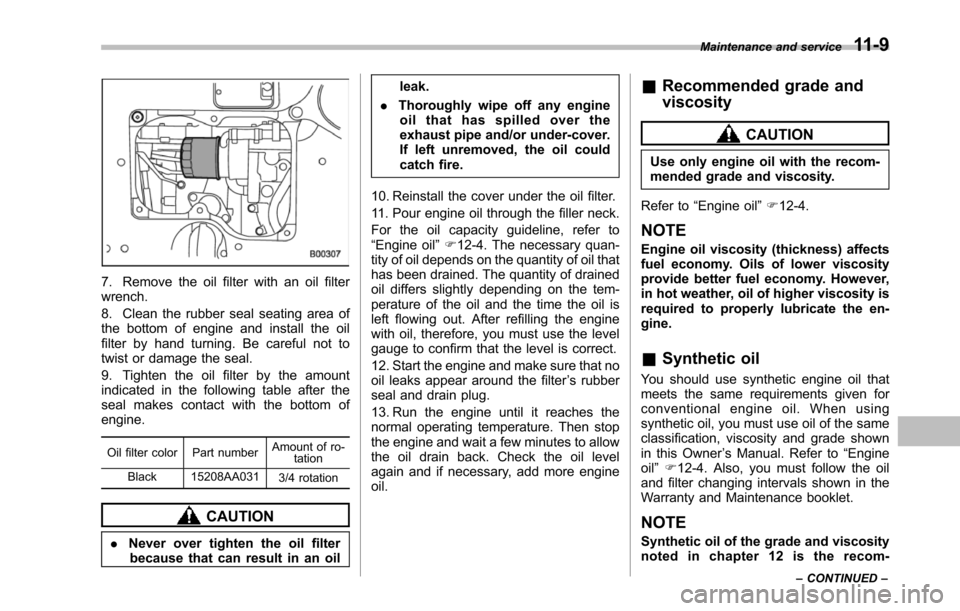
7. Remove the oil filter with an oil filterwrench.
8. Clean the rubber seal seating area ofthe bottom of engine and install the oilfilterby hand turning. Be careful not totwist or damage the seal.
9. Tighten the oil filter by the amountindicatedin the following table after theseal makes contact with the bottom ofengine.
Oil filter color Part numberAmount of ro-tation
Black 15208AA0313/4 rotation
CAUTION
.Never over tighten the oil filterbecause that can result in an oil
leak.
.Thoroughly wipe off any engineoil that has spilled over theexhaust pipe and/or under-cover.If left unremoved, the oil couldcatch fire.
10. Reinstall thecover under the oil filter.
11. Pour engine oil through the filler neck.
For the oil capacity guideline, refer to“Engine oil”F12-4. The necessary quan-tity of oil depends on the quantity of oil thathas been drained. The quantity of drainedoil differs slightly depending on the tem-perature of the oil and the time the oil isleft flowing out. After refilling the enginewith oil, therefore, you must use the levelgauge to confirm that the level is correct.
12.Start the engine and make sure that nooil leaks appear around the filter’s rubberseal and drain plug.
13. Run the engine until it reaches thenormal operating temperature. Then stopthe engine and wait a few minutes to allowthe oil drain back. Check the oil levelagain and if necessary, add more engineoil.
&Recommended grade and
viscosity
CAUTION
Use only engine oil with the recom-mended grade and viscosity.
Refer to“Engine oil”F12-4.
NOTE
Engine oil viscosity (thickness) affectsfuel economy. Oils of lower viscosityprovide better fuel economy. However,in hot weather, oil of higher viscosity isrequired to properly lubricate the en-gine.
&Synthetic oil
You should use synthetic engine oil thatmeets the samerequirements given forconventional engine oil. When usingsynthetic oil, you must use oil of the sameclassification,viscosity and grade shownin this Owner’s Manual. Refer to“Engineoil”F12-4. Also, you must follow the oiland filter changing intervals shown in theWarranty and Maintenance booklet.
NOTE
Synthetic oil of the grade and viscositynoted in chapter 12 is the recom-
Maintenance and service11-9
–CONTINUED–
Page 343 of 426
11-10Maintenance and service
mended engine oil for optimum engineperformance. Conventional oil may beused if synthetic oil is unavailable.
Cooling system
WARNING
Never attempt to remove the radia-tor cap until the engine has beenshut off and has cooled downcompletely. Since the coolant isunder pressure, you may sufferserious burns from a spray of boil-ing hot coolant when the cap isremoved.
CAUTION
.Vehicles are filled at the factorywith SUBARU Super Coolant thatdoes not require the first changefor 11 years/137,500 miles (11years/220,000 km). This coolantshould not be mixed with anyother brand or type of coolantduring this period. Mixing with adifferent coolant will reduce thelife of the coolant. Should it benecessary to top off the coolantfor any reason, use onlySUBARU Super Coolant.
If the SUBARU Super Coolant isdiluted with another brand ortype, the maintenance interval is
shortened to that of the mixingcoolant.
.Do not splash the engine coolantover painted parts. The alcoholcontained in the engine coolantmay damage the paint surface.
&Hose and connections
Your vehicle employs an electric coolingfan which is thermostatically controlled tooperate when the engine coolant reachesa specific temperature.
If the radiator cooling fan does not operateeven when the engine coolant tempera-ture gauge exceeds the normal operatingrange, the cooling fan circuit may bedefective.Check the fuse and replace itif necessary. If the fuse is not blown, havethe cooling system checked by yourSUBARU dealer.
If frequent addition of coolant is neces-sary, there may be a leak in the enginecooling system. It is recommended thatthe cooling system and connections bechecked for leaks, damage, or looseness.
Page 344 of 426
&Engine coolant
!Checking the coolant level
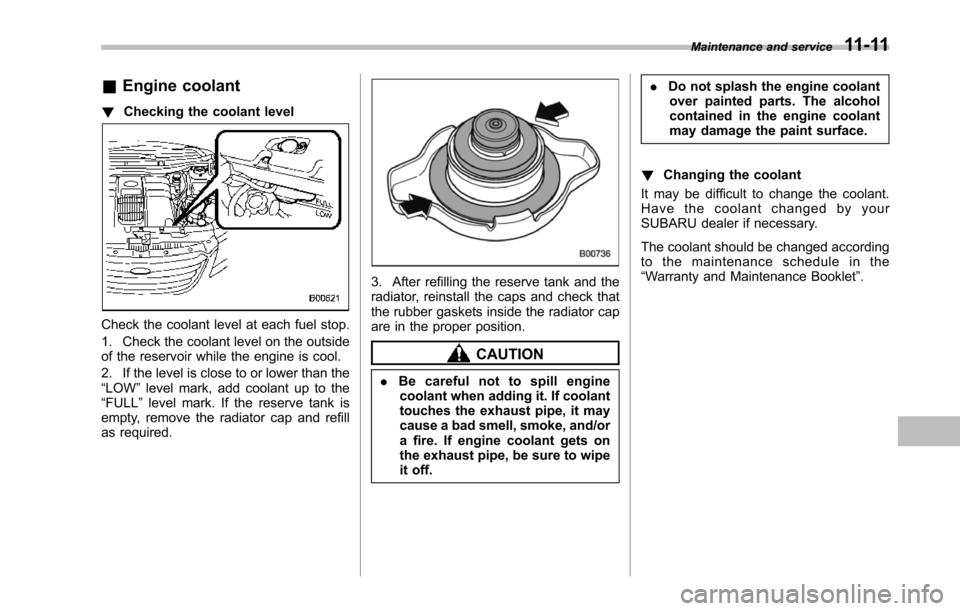
Check the coolant level at each fuel stop.
1. Check the coolant level on the outsideof the reservoir while the engine is cool.
2. If the level is close to or lower than the“LOW”level mark, add coolant up to the“FULL”level mark. If the reserve tank isempty, remove the radiator cap and refillas required.
3. After refilling the reserve tank and theradiator, reinstall the caps and check thatthe rubber gaskets inside the radiator capare in the proper position.
CAUTION
.Be careful not to spill enginecoolant when adding it. If coolanttouches the exhaust pipe, it maycause a bad smell, smoke, and/ora fire. If engine coolant gets onthe exhaust pipe, be sure to wipeit off.
.Do not splash the engine coolantover painted parts. The alcoholcontained in the engine coolantmay damage the paint surface.
!Changing the coolant
It may be difficult to change the coolant.Have the coolant changed by yourSUBARU dealer if necessary.
The coolant should be changed accordingto the maintenance schedule in the“Warranty and Maintenance Booklet”.
Maintenance and service11-11
Page 346 of 426

6. To install the air cleaner case cover,insert the three projections on the aircleaner case cover into the slits on theair cleaner case.
7. Install in the reverse order of removal.
Spark plugs
It may be difficult to replace the sparkplugs. It is recommended that you havethe spark plugs replaced by yourSUBARU dealer.
The spark plugs should be replacedaccording to the maintenance schedulein the“Warranty and Maintenance Book-let”.
&Recommended spark plugs
Refer to“Electrical system”F12-7.
Drive belts
The alternator, power steering pump, andair conditioner compressor depend ondrive belts. Satisfactory performance re-quires that belt tension be correct.
It is unnecessary to check belt tensionperiodically because your engine isequipped with an automatic belt tensionadjuster. However, replacement of the beltshould be done according to the main-tenance schedule in the“Warranty andMaintenance Booklet”.ConsultyourSUBARU dealer for replacement.
If a belt is loose, cracked, or worn, contactyour SUBARU dealer.
Maintenance and service11-13