2014 SUBARU TRIBECA check engine
[x] Cancel search: check enginePage 347 of 426
11-14Maintenance and service
Automatic transmission fluid
&Checking the fluid level
The automatic transmission fluid expandslargely as its temperature rises; the fluidlevel differs according to fluid temperature.Therefore, there are two different scalesfor checking the level of hot fluid and coldfluid on the level gauge.
Though the fluid level can be checkedwithout warming up the fluid on the“COLD”range, we recommend checkingthe fluid level when the fluid is at operatingtemperature.
!Checking the fluid level when thefluid is hot
Check the fluid level monthly.
1. Drive the vehicle several miles to raisethe temperature of the transmission fluidup to normal operating temperature; 158to 1768F (70 to 808C) is normal.
2. Park the vehicle on a level surface andset the parking brake.
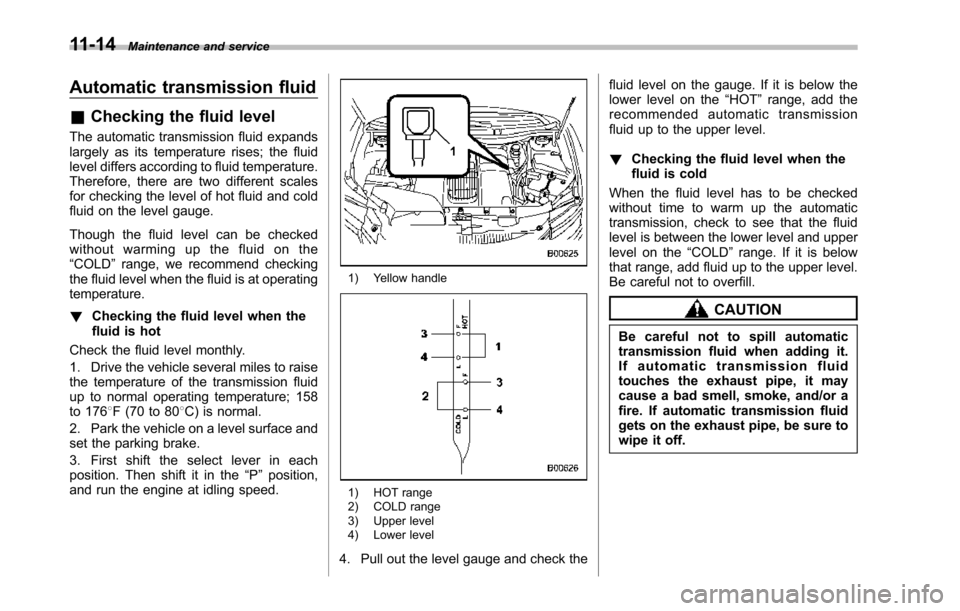
3. First shift the select lever in eachposition. Then shift it in the“P”position,and run the engine at idling speed.
1) Yellow handle
1) HOT range2) COLD range3) Upper level4) Lower level
4. Pull out the level gauge and check the
fluid level on the gauge. If it is below thelower level on the“HOT”range, add therecommended automatic transmissionfluid up to the upper level.
!Checking the fluid level when thefluid is cold
When the fluid level has to be checkedwithout time to warm up the automatictransmission,check to see that the fluidlevel is between the lower level and upperlevel on the“COLD”range. If it is belowthat range, add fluid up to the upper level.Be careful not to overfill.
CAUTION
Be careful not to spill automatictransmission fluid when adding it.If automatic transmission fluidtouches the exhaust pipe, it maycause a bad smell, smoke, and/or afire. If automatic transmission fluidgets on the exhaust pipe, be sure towipe it off.
Page 348 of 426
&Recommended fluid
Refer to“Fluids”F12-7.
NOTE
Using any non-specified type of auto-matic transmission fluid could result indamage inside the transmission. Whenreplacingthe automatic transmissionfluid, be sure to use the specified type.
Front differential gear oil
&Checking the oil level
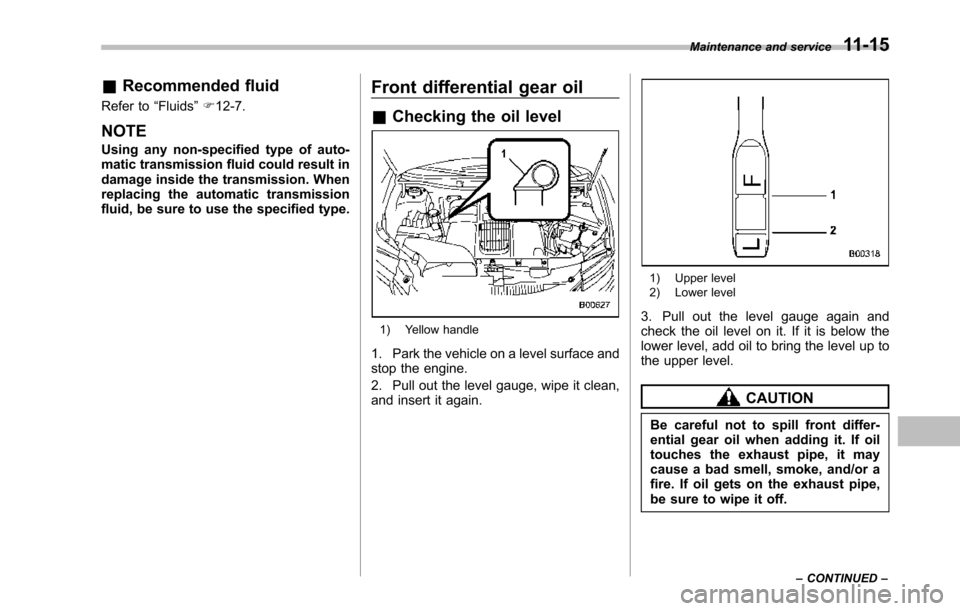
1) Yellow handle
1. Park the vehicle on a level surface andstop the engine.
2. Pull out the level gauge, wipe it clean,and insert it again.
1) Upper level2) Lower level
3. Pull out the level gauge again andcheck theoil level on it. If it is below thelower level, add oil to bring the level up tothe upper level.
CAUTION
Be careful not to spill front differ-ential gear oil when adding it. If oiltouches the exhaust pipe, it maycause a bad smell, smoke, and/or afire. If oil gets on the exhaust pipe,be sure to wipe it off.
Maintenance and service11-15
–CONTINUED–
Page 350 of 426
power steering fluid touches theexhaust pipe, it may cause a badsmell, smoke, and/or a fire. Ifpower steering fluid gets on theexhaust pipe, be sure to wipe itoff.
The power steering fluid expands greatlyas its temperature rises; the fluid leveldiffers according to fluid temperature.Therefore, the reservoir tank has twodifferent checking ranges for hot and coldfluids.
Check the power steering fluid levelmonthly.
1. Park the vehicle on a level surface,and stop the engine.
2. Check the fluid level of the reservoirtank.
When the fluid is hot after the vehicle hasbeen run: Check that the oil level isbetween“HOT MIN”and“HOT MAX”onthe surface of the reservoir tank.
When the fluid is cool before the vehicle isrun: Check that the oil level is between“COLD MIN”and“COLD MAX”on thesurface of the reservoir tank.
3. If the fluid level is lower than theapplicable“MIN”line, add the recom-mended fluid as necessary to bring thelevel between the“MIN”and“MAX”line.
If the fluid level is extreme low, it mayindicate possible leakage. Consult yourSUBARU dealer for inspection.
&Recommended fluid
Refer to“Fluids”F12-7.
Brake fluid
&Checking the fluid level
WARNING
.Never let brake fluid contact youreyes because brake fluid can beharmful to your eyes. If brakefluid gets in your eyes, immedi-ately flush them thoroughly withclean water. For safety, whenperforming this work, wearingeye protection is advisable.
.Brake fluid absorbs moisturefrom the air. Any absorbed moist-ure can cause a dangerous lossof braking performance.
.If the vehicle requires frequentrefilling, there may be a leak. Ifyou suspecta problem, have thevehicle checked at your SUBARUdealer.
CAUTION
.When adding brake fluid, be care-ful not to allow any dirt into thereservoir.
.Never splash the brake fluid overpainted surfaces or rubber parts.
Maintenance and service11-17
–CONTINUED–
Page 351 of 426
11-18Maintenance and service
Alcohol contained in the brakefluid may damage them.
.Be careful not to spill brake fluidwhen adding it. If brake fluidtouches the exhaust pipe, it maycause a bad smell, smoke, and/ora fire. If brake fluid gets on theexhaust pipe, be sure to wipe itoff.
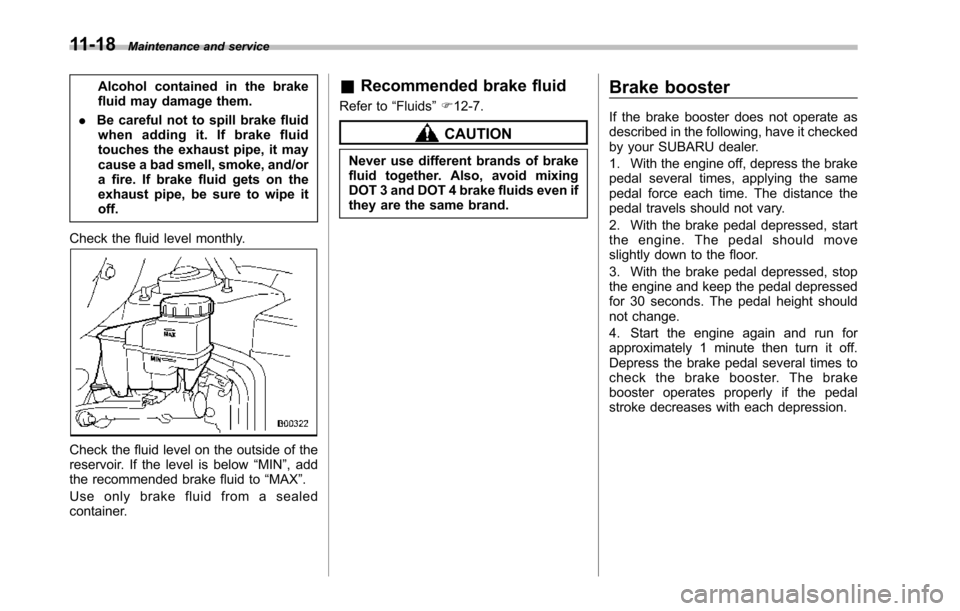
Check the fluid level monthly.
Check thefluid level on the outside of thereservoir. If the level is below“MIN”, addthe recommended brake fluid to“MAX”.
Use only brake fluid from a sealedcontainer.
&Recommended brake fluid
Refer to“Fluids”F12-7.
CAUTION
Never use different brands of brakefluid together. Also, avoid mixingDOT 3 and DOT 4 brake fluids even ifthey are the same brand.
Brake booster
If the brake booster does not operate asdescribed in the following, have it checkedby your SUBARU dealer.
1. With the engine off, depress the brakepedal several times, applying the samepedal force each time. The distance thepedal travels should not vary.
2. With the brake pedal depressed, startthe engine. The pedal should moveslightly down to the floor.
3. With the brake pedal depressed, stopthe engine and keep the pedal depressedfor 30 seconds. The pedal height shouldnot change.
4. Start the engine again and run forapproximately 1 minute then turn it off.Depress the brake pedal several times tocheck the brake booster. The brakebooster operates properly if the pedalstroke decreases with each depression.
Page 352 of 426
Brake pedal
Check the brake pedal free play andreserve distance according to the main-tenance schedule in the“Warranty andMaintenance Booklet”.
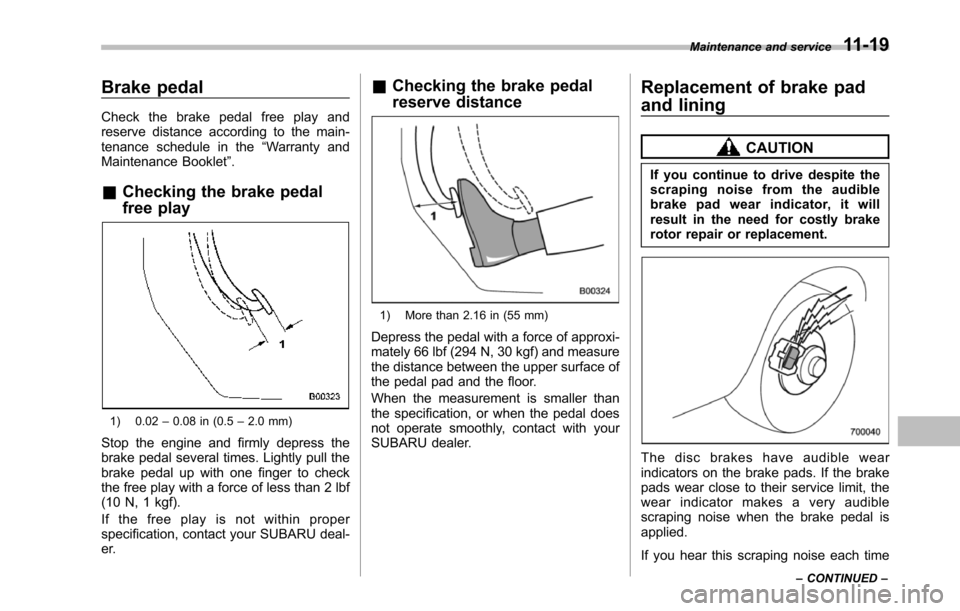
&Checking the brake pedal
free play
1) 0.02–0.08 in (0.5–2.0 mm)
Stop the engine and firmly depress thebrake pedal several times. Lightly pull thebrake pedal up with one finger to checkthe free play with a force of less than 2 lbf(10 N, 1 kgf).
If the free play is not within properspecification, contact your SUBARU deal-er.
&Checking the brake pedal
reserve distance
1) More than 2.16 in (55 mm)
Depress the pedal with a force of approxi-mately 66 lbf (294 N, 30 kgf) and measurethe distance between the upper surface ofthe pedal pad and the floor.
When the measurement is smaller thanthe specification, or when the pedal doesnot operate smoothly, contact with yourSUBARU dealer.
Replacement of brake pad
and lining
CAUTION
If you continue to drive despite thescraping noise from the audiblebrake pad wear indicator, it willresult in the need for costly brakerotor repair or replacement.
The disc brakes have audible wearindicators on the brake pads. If the brakepads wear close to their service limit, thewear indicator makes a very audiblescraping noise when the brake pedal isapplied.
If you hear this scraping noise each time
Maintenance and service11-19
–CONTINUED–
Page 361 of 426
11-28Maintenance and service
Windshield washer fluid
CAUTION
Never use engine coolant as washerfluid because it could cause paintdamage.
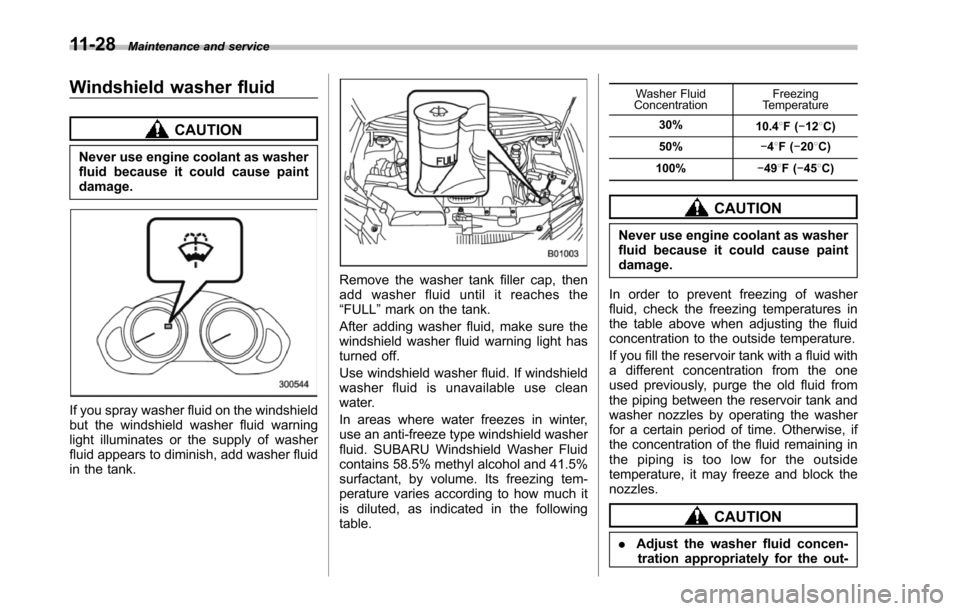
If you spray washer fluid on the windshieldbut thewindshield washer fluid warninglight illuminates or the supply of washerfluid appears to diminish, add washer fluidin the tank.
Remove the washer tank filler cap, thenadd washer fluid until it reaches the“FULL”mark on the tank.
After adding washer fluid, make sure thewindshieldwasher fluid warning light hasturned off.
Use windshield washer fluid. If windshieldwasher fluid is unavailable use cleanwater.
In areas where water freezes in winter,use an anti-freeze type windshield washerfluid. SUBARU Windshield Washer Fluidcontains 58.5% methyl alcohol and 41.5%surfactant, by volume. Its freezing tem-perature varies according to how much itis diluted, as indicated in the followingtable.
Washer FluidConcentrationFreezingTemperature
30%10.48F(!128C)
50%!48F(!208C)
100%!498F(!458C)
CAUTION
Never use engine coolant as washerfluid because it could cause paintdamage.
In order to prevent freezing of washerfluid, check the freezing temperatures inthe table above when adjusting the fluidconcentration to the outside temperature.
If you fill the reservoir tank with a fluid witha different concentration from the oneused previously, purge the old fluid fromthe piping between the reservoir tank andwasher nozzles by operating the washerfor a certain period of time. Otherwise, ifthe concentration of the fluid remaining inthe piping is too low for the outsidetemperature, it may freeze and block thenozzles.
CAUTION
.Adjust the washer fluid concen-tration appropriately for the out-
Page 381 of 426
12-4Specifications
&Engine oil
For the checking, adding and replacing procedure or other details, refer to“Engine oil”F11-7.
NOTE
The procedure for changing the engine oil and oil filter should be performed by a properly-trained expert. It is recommendedthat you have this service performed by your SUBARU dealer.
!Approved engine oil
Always use the SUBARU approved engine oil. For further details, please contact your SUBARU dealer.If the approved engine oil is unavailable, use the alternative engine oil described on the next page.
!Alternative engine oil
If the SUBARU approved oil is unavailable, the following alternative oil can be used.
NOTE
.Each quantity indicated is only a guideline. The necessary quantity for replacement may differ slightly depending on thetemperature and other factors..In choosing an oil, you want the proper quality and viscosity, as well as one that will enhance fuel economy. Oils of lowerviscosity provide better fuel economy. However, in hot weather, oil of higher viscosity is required to properly lubricate theengine. The following table lists the recommended viscosities and applicable temperatures..When adding oil, different brands may be used togetheras long as they are the same API classification and SAE viscosityas those recommended by SUBARU.
Page 412 of 426
Braking..................................................................... 7-19Tips . . . . . . . . . . . . . . . . . . . . . . . . . . . . . . . . . . . . . . . . . . . . . . . . . . . . . . . . . . . . . . . . . . . . . . 7-19Breaking-in of new brake pads and linings................... 11-20BulbChart.................................................................. 12-12Replacing............................................................. 11-36
CCargo areaCover................................................................... 6-14Light....................................................................... 6-3Tie-down hooks..................................................... 6-16Catalytic converter....................................................... 8-3CenterConsole.................................................................. 6-6Ventilators............................................................... 4-4ChangingCoolant................................................................ 11-11Flat tire................................................................... 9-6Oil andoil filter...................................................... 11-8Charge warning light.................................................. 3-13CHECKENGINE warning light/Malfunction indicatorlight....................................................................... 3-12CheckingBrake pedal free play............................................ 11-19Brake pedal reserve distance................................. 11-19Coolant level........................................................ 11-11Fluid level (automatic transmission fluid).................. 11-14Fluid level (brake fluid).......................................... 11-17Fluidlevel (power steering fluid).............................. 11-16Fluid level (washer fluid)........................................ 11-28
Oil level (engine oil)................................................ 11-7Oil level (front differential gear oil).......................... 11-15Child restraint systems................................................ 1-29Installation of a booster seat.................................... 1-36Installation with A/ELR seatbelt ................................ 1-32Lower and tether anchorages................................... 1-37Top tether anchorages............................................ 1-40Child safety................................................................... 5Locks.................................................................... 2-21ChimeKey........................................................................ 3-4Light..................................................................... 3-27Seatbelt................................................................. 3-10CleaningAluminum wheels................................................... 10-3Interior.................................................................. 10-5Ventilation grille...................................................... 4-10Climate control systemAutomatic............................................................... 4-5Clock................................................................ 3-22, 3-24Coat hook.................................................................. 6-12Compass........................................................... 3-38, 3-41Console..................................................................... 6-6Coolant........................................................... 11-11, 12-7Cooling system........................................................ 11-10Corrosionprotection.................................................... 10-4Cruise control............................................................ 7-29Indicator light......................................................... 3-22Set indicator light.................................................... 3-22Cup holder................................................................. 6-8Front passenger’s.................................................... 6-8
Index14-3