2014 SUBARU TRIBECA oil type
[x] Cancel search: oil typePage 116 of 426
&Sounding a panic alarm
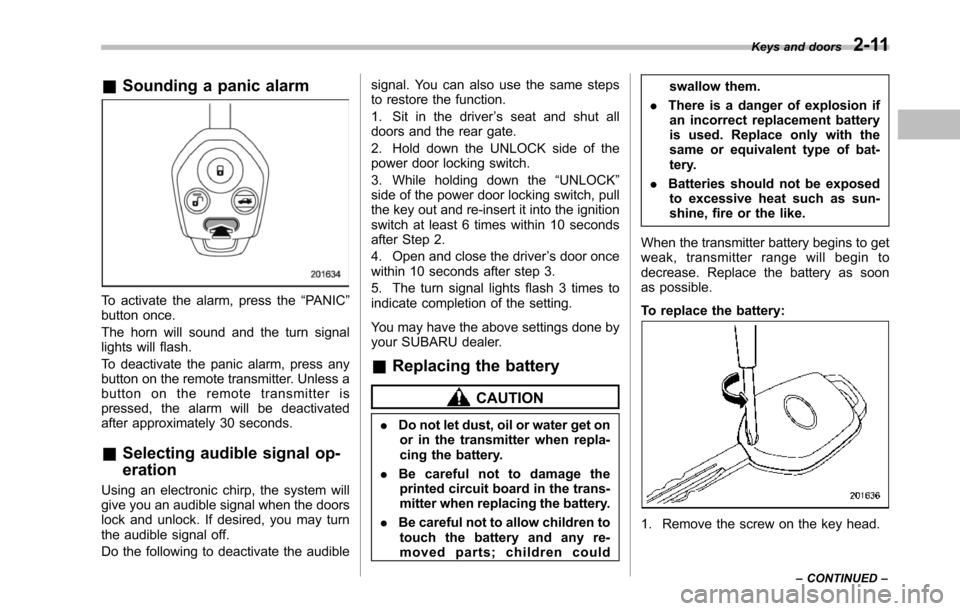
To activate the alarm, press the“PANIC”button once.
The horn will sound and the turn signallights will flash.
To deactivate the panic alarm, press anybuttonon the remote transmitter. Unless abutton on the remote transmitter ispressed, the alarm will be deactivatedafter approximately 30 seconds.
&Selecting audible signal op-
eration
Using an electronic chirp, the system willgive you an audible signal when the doorslock and unlock. If desired, you may turnthe audible signal off.
Do the following to deactivate the audible
signal. You can also use the same stepsto restore the function.
1. Sit in the driver’s seat and shut alldoors and the rear gate.
2. Hold down the UNLOCK side of thepower door locking switch.
3. While holding down the“UNLOCK”sideof the power door locking switch, pullthe key out and re-insert it into the ignitionswitch at least 6 times within 10 secondsafter Step 2.
4. Open and close the driver’s door oncewithin 10 seconds after step 3.
5. The turn signal lights flash 3 times toindicate completion of the setting.
You may have the above settings done byyour SUBARU dealer.
&Replacing the battery
CAUTION
.Do not let dust, oil or water get onor in the transmitter when repla-cing the battery.
.Be careful not to damage theprinted circuit board in the trans-mitter when replacing the battery.
.Be careful not to allow children totouch the battery and any re-moved parts; children could
swallow them.
.There is a danger of explosion ifan incorrect replacement batteryis used. Replace only with thesame or equivalent type of bat-tery.
.Batteries should not be exposedto excessive heat such as sun-shine, fire or the like.
When the transmitter battery begins to getweak, transmitter range will begin todecrease. Replace the battery as soonas possible.
To replace the battery:
1. Remove the screw on the key head.
Keys and doors2-11
–CONTINUED–
Page 249 of 426
7-2Starting and operating
Fuel
CAUTION
Use of a fuel which is low in qualityor use of an inappropriate fueladditive may cause engine damage.
&Fuel requirements
The engine is designed to operate usingunleaded gasolinewith an octane ratingof87 AKI (90 RON) or higher.
!Fuel octane rating
This octane rating is the average of theResearch Octane and Motor Octanenumbers andis commonly referred to asthe Anti Knock Index (AKI).
Using a gasoline with a lower octanerating can causepersistent and heavyknocking, which can damage the engine.Do not be concerned if your vehiclesometimes knocks lightly when you driveup a hill or when you accelerate. Contactyour SUBARU dealer if you use a fuel withthe specified octane rating and yourvehicle knocks heavily or persistently.
!Unleaded gasoline
The neck of the fuel filler pipe is designedto accept only an unleaded gasoline filler
nozzle. Under no circumstances shouldleaded gasoline be used because it willdamage the emission control system andmay impair driveability and fuel economy.
!California fuel
If your vehicle was certified to CaliforniaEmission Standards as indicated on theunderhood tune-up label, it is designed tooptimize engine and emission controlsystem performance with gasoline thatmeets the clean burning low-sulfur Cali-fornia gasoline specifications. If you live inany other state than California, yourvehicle will operate on gasoline meetingFederal specifications. Gasoline sold out-side California is permitted to have highersulfur levels, which may affect the perfor-mance of your vehicle’s catalytic converterand may produce a sulfur exhaust odor orsmell. SUBARU recommends that you trya different brand of unleaded gasolinehaving lower sulfur to determine if theproblem is fuel related before returningyour vehicle to an authorized dealer forservice. The CHECK ENGINE warninglight/Malfunction indicator light may alsoilluminate. If this occurs, return to yourauthorized SUBARU dealer for diagnosis.If it is determined that the condition iscausedby the type of fuel used, repairsmay not be covered by your warranty.
!MMT
Some gasoline contains an octane-en-hancing additive called MMT (Methylcy-clopentadienyl Manganese Tricarbonyl). Ifyou use such fuels, your emission controlsystem performance may deteriorate andthe CHECK ENGINE warning light/Mal-function indicator light may illuminate. Ifthis happens, return to your authorizedSUBARU dealer for service. If it isdetermined that the condition is causedby the type of fuel used, repairs may notbe covered by your warranty.
!Gasoline for cleaner air
CAUTION
Do not let fuel spill on the exteriorsurfaces of the vehicle. Fuels con-taining alcohol may cause paintdamage, which is not covered underthe SUBARU Limited Warranty.
Yo u r u s e o f g a s o l i n e w i t h d e t e r g e n tadditives will help prevent deposits fromforming in your engine and fuel system.This helps keepyour engine in tune andyour emission control system workingproperly, and is a way of doing your partfor cleaner air. If you continuously use ahigh quality fuel with the proper detergentand other additives, you should never
Page 258 of 426
sing the brake pedal repeatedly will togglethe feature ON or OFF each time.
7. To exit the remote transmitter andfeature programming mode, turn the igni-tion switch to the“LOCK”position, removethe key from the ignition switch and testoperation of the remote transmitter(s) andhorn confirmation feature.
&System maintenance
!Changing the batteries
CAUTION
.Do not let dust, oil or water get onor in the remote engine starttransmitter when replacing thebattery.
.Be careful not to damage theprinted circuit board in the re-mote engine start transmitterwhen replacing the battery.
.Be careful not to allow children totouch the battery and any re-moved parts; children couldswallowthem.
.There is a danger of explosion ifan incorrect replacement batteryis used. Replace only with thesame or equivalent type of bat-tery.
.Batteries should not be exposedto excessive heat such as sun-shine, fire or the like.
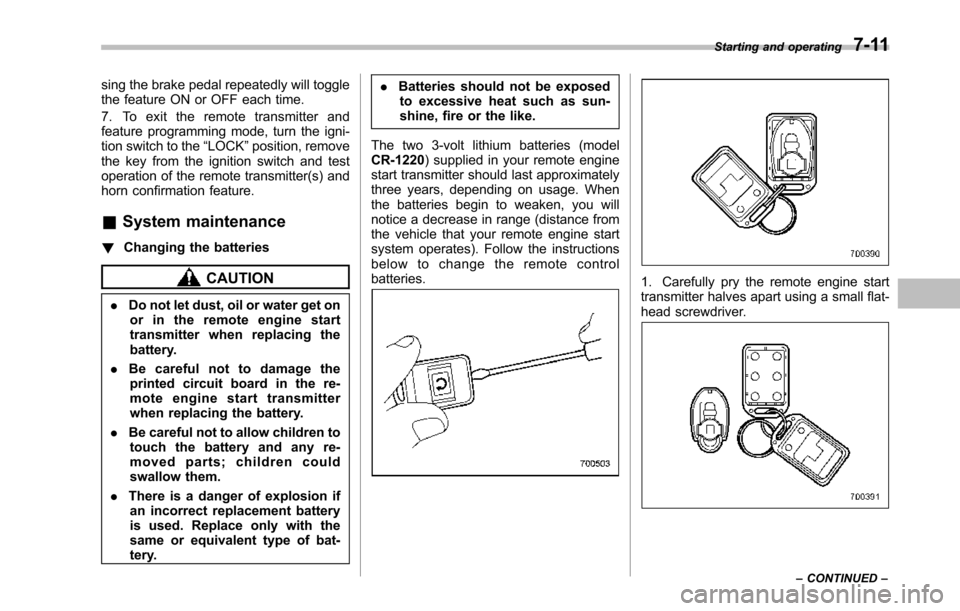
The two 3-volt lithium batteries (modelCR-1220) supplied in your remote enginestart transmitter should last approximatelythree years, depending on usage. Whenthebatteries begin to weaken, you willnotice a decrease in range (distance fromthe vehicle that your remote engine startsystem operates). Follow the instructionsbelow to change the remote controlbatteries.1. Carefully pry the remote engine starttransmitter halves apart using a small flat-head screwdriver.
Starting and operating7-11
–CONTINUED–
Page 316 of 426
WARNING
Do not use oil or grease on thewheel studs or nuts when the sparetire is installed. This could cause thenuts to become loose and lead to anaccident.
15. Turn the jack handle counterclockwiseto lower the vehicle.
CAUTION
There are 2 types of wheel nutwrenches that apply to differentlengths.
For models with silver-colored alu-minumwheels, the 10.8-inch (275mm) wheel nut wrench is equippedas a maintenance tool. And formodels with optional chrome-fin-ished wheels, the 13.2-inch (335mm) wheel nut wrench is equippedas well. Confirm the equipped wheelnut wrench type when you replace atire. If the wheel nut wrench is thedifferent type, it cannot be tightenedto the specified torque.
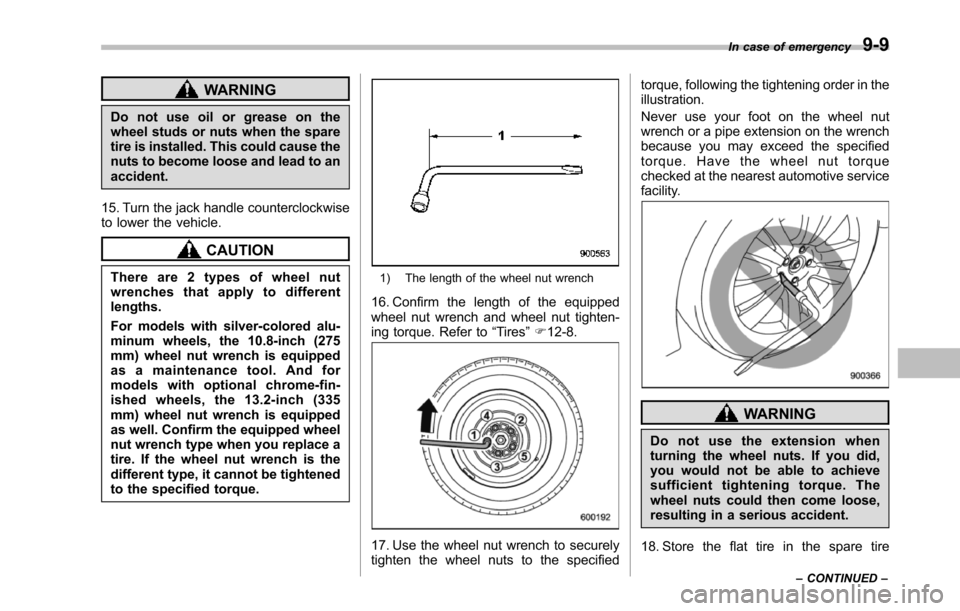
1) The length of the wheel nut wrench
16. Confirm the length of the equippedwheel nut wrench and wheel nut tighten-ing torque. Refer to“Tires”F12-8.
17. Use the wheel nut wrench to securelytighten thewheel nuts to the specified
torque, following the tightening order in theillustration.
Never use your foot on the wheel nutwrench or a pipe extension on the wrenchbecause you may exceed the specifiedtorque. Have the wheel nut torquechecked at the nearest automotive servicefacility.
WARNING
Do not use the extension whenturning the wheel nuts. If you did,you would not be able to achievesufficient tightening torque. Thewheel nuts could then come loose,resulting in a serious accident.
18. Store the flat tire in the spare tire
In case of emergency9-9
–CONTINUED–
Page 334 of 426

Maintenance schedule....................................... 11-3
Maintenance precautions................................... 11-3Before checking or servicing in the enginecompartment.................................................... 11-4When you do checking or servicing in the enginecompartment while the engine is running.......... 11-4
Engine hood....................................................... 11-4
Engine compartment overview.......................... 11-6
Engine oil............................................................ 11-7Checking the oil level......................................... 11-7Changing the oil and oil filter.............................. 11-8Recommendedgrade and viscosity.................... 11-9Synthetic oil....................................................... 11-9
Cooling system................................................ 11-10Hose and connections...................................... 11-10Engine coolant................................................. 11-11
Air cleaner element.......................................... 11-12Replacing the air cleaner element..................... 11-12
Spark plugs...................................................... 11-13Recommended spark plugs.............................. 11-13
Drive belts........................................................ 11-13
Automatic transmission fluid.......................... 11-14Checking the fluid level.................................... 11-14Recommended fluid......................................... 11-15
Front differential gear oil................................. 11-15Checking the oil level....................................... 11-15Recommended grade and viscosity.................. 11-16
Rear differential gear oil.................................. 11-16Recommended grade and viscosity.................. 11-16
Power steering fluid........................................ 11-16Checking the fluid level.................................... 11-16Recommended fluid......................................... 11-17
Brake fluid........................................................ 11-17Checking the fluid level.................................... 11-17Recommended brake fluid............................... 11-18
Brakebooster.................................................. 11-18
Brake pedal...................................................... 11-19Checking the brake pedal free play.................. 11-19Checking the brake pedal reserve distance....... 11-19
Replacement of brake pad and lining............ 11-19Breaking-in of new brake pads and linings....... 11-20
Parking brake stroke....................................... 11-20
Tires and wheels.............................................. 11-21Types of tires................................................... 11-21Tire pressure monitoring system (TPMS).......... 11-21Tire inspection................................................. 11-22Tire pressuresand wear.................................. 11-23Wheel balance................................................. 11-25Wear indicators............................................... 11-25Tire rotation direction mark.............................. 11-25Tire rotation..................................................... 11-26Tire replacement.............................................. 11-26Wheel replacement.......................................... 11-27
Aluminum wheels............................................ 11-27
Windshield washer fluid.................................. 11-28
Replacement of wiper blades......................... 11-29Windshield wiper blade assembly..................... 11-30Windshield wiper blade rubber ......................... 11-30Rear window wiper blade assembly.................. 11-31
Maintenance and service
11
Page 343 of 426
11-10Maintenance and service
mended engine oil for optimum engineperformance. Conventional oil may beused if synthetic oil is unavailable.
Cooling system
WARNING
Never attempt to remove the radia-tor cap until the engine has beenshut off and has cooled downcompletely. Since the coolant isunder pressure, you may sufferserious burns from a spray of boil-ing hot coolant when the cap isremoved.
CAUTION
.Vehicles are filled at the factorywith SUBARU Super Coolant thatdoes not require the first changefor 11 years/137,500 miles (11years/220,000 km). This coolantshould not be mixed with anyother brand or type of coolantduring this period. Mixing with adifferent coolant will reduce thelife of the coolant. Should it benecessary to top off the coolantfor any reason, use onlySUBARU Super Coolant.
If the SUBARU Super Coolant isdiluted with another brand ortype, the maintenance interval is
shortened to that of the mixingcoolant.
.Do not splash the engine coolantover painted parts. The alcoholcontained in the engine coolantmay damage the paint surface.
&Hose and connections
Your vehicle employs an electric coolingfan which is thermostatically controlled tooperate when the engine coolant reachesa specific temperature.
If the radiator cooling fan does not operateeven when the engine coolant tempera-ture gauge exceeds the normal operatingrange, the cooling fan circuit may bedefective.Check the fuse and replace itif necessary. If the fuse is not blown, havethe cooling system checked by yourSUBARU dealer.
If frequent addition of coolant is neces-sary, there may be a leak in the enginecooling system. It is recommended thatthe cooling system and connections bechecked for leaks, damage, or looseness.
Page 348 of 426
&Recommended fluid
Refer to“Fluids”F12-7.
NOTE
Using any non-specified type of auto-matic transmission fluid could result indamage inside the transmission. Whenreplacingthe automatic transmissionfluid, be sure to use the specified type.
Front differential gear oil
&Checking the oil level
1) Yellow handle
1. Park the vehicle on a level surface andstop the engine.
2. Pull out the level gauge, wipe it clean,and insert it again.
1) Upper level2) Lower level
3. Pull out the level gauge again andcheck theoil level on it. If it is below thelower level, add oil to bring the level up tothe upper level.
CAUTION
Be careful not to spill front differ-ential gear oil when adding it. If oiltouches the exhaust pipe, it maycause a bad smell, smoke, and/or afire. If oil gets on the exhaust pipe,be sure to wipe it off.
Maintenance and service11-15
–CONTINUED–
Page 360 of 426
WARNING
.When replacing a tire, you mustuse a tire that is of the same size,circumference, speed symboland load index as the originaltires listed on the tire placard.Using tires of other sizes, cir-cumferences or constructionsmay result in severe mechanicaldamage to the drive train of yourvehicle and may affect ride,handling, braking, speedometer/odometer calibration, and clear-ance betweenthe body and tires.It also may be dangerous andlead to loss of vehicle control.
.You must install four tires that areof the same size, circumference,construction, manufacturer,brand(tread pattern), degree ofwear, speed symbol and loadindex. Mixing tires of differenttypes, sizes or degrees of wearcan result in damage to thevehicle’spowertrain.Useofdifferent types or sizes of tirescan also dangerously reducecontrollability and braking per-formance and can lead to anaccident.
.Use only radial tires. Do not use
radial tires together with beltedbias tires and/or bias-ply tires.Doing so can dangerously re-duce controllability, resulting inan accident.
&Wheel replacement
When replacing wheels due, for example,to damage, make sure the replacementwheels match the specifications of thewheels that are fitted as standard equip-ment. Replacement wheels are availablefrom SUBARUdealers.
WARNING
Use only those wheels that arespecified for your vehicle. Wheelsnot meeting specifications couldinterfere with brake caliper opera-tion and may cause the tires to rubagainst the wheel well housing dur-ing turns. The resulting loss ofvehicle control could lead to anaccident.
Aluminum wheels
.Aluminum wheels can be scratchedand damaged easily. Handle them care-fully to maintain their appearance, perfor-mance, and safety.
.When any of the wheels are removedand replaced for tire rotation or to changea flat tire, always check the tightness ofthe wheel nuts after driving approximately600 miles (1,000 km). If any nut is loose,tighten it to the specified torque.–For the wheel nut tightening torque,refer to“Tires”F12-8.–For the wheel nut tightening proce-dure, refer to“Changing a flat tire”F9-6..Never apply oil to the threaded parts,wheel nuts, or tapered surface of thewheel.
.Never let the wheel rub against sharpprotrusions or curbs.
.When wheel nuts, balance weights, orthe center cap is replaced, be sure toreplace them with genuine SUBARU partsdesigned for the specific wheel.
Maintenance and service11-27