2014 MERCEDES-BENZ B-CLASS SPORTS brake
[x] Cancel search: brakePage 21 of 360
Loading
.......................................... 323
Locking (in an emergency) ...............81
Locking (SmartKey) .......................... 74
Lowering ........................................ 339
Maintenance .................................... 22
Parking for along period ................ 155
Pulling away ................................... 138
Raising ........................................... 337
Reporting problems .........................25
Securing from rolling away ............337
Towing away .................................. 305
Tow-starting ................................... 305
Transporting .................................. 307
Unlocking (in an emergency) ...........81
Unlocking (SmartKey) ......................74
Vehicle data ................................... 353
Vehicle data ....................................... 353
Vehicle dimensions ...........................353
Vehicle emergency locking ................81
Vehicle identification number see VIN
Vehicle identification plate ..............346
Vehicle tool kit .................................. 294
Video (DVD) ........................................ 197
VIN ...................................................... 346W
Warning and indicator lamps ABS ................................................ 239
Brakes ........................................... 239
Check Engine ................................. 245
Coolant .......................................... 245
Distance warning ........................... 247
DISTRONI CPLUS ........................... 247
ESP ®
.............................................. 241
ESP ®
OFF ....................................... 242
Fuel tank ........................................ 245
Overview .......................................... 32
PASSENGER AIR BAG OFF
indicator lamp .................................. 47
Reserve fuel ................................... 245
Seat bel t........................................ 237
SRS ................................................ 244
Tire pressure monitor ....................248
Warranty ............................................ 346
Washer fluid Display message ............................ 236Whee
lboltt ightening torque ...........339
Whee lchock ...................................... 337
Wheels Changing awheel .......................... 336
Checking ........................................ 313
Cleaning ......................................... 287
Cleaning (warning) .........................336
Emergency spare wheel .................342
Important safety notes ..................312
Interchanging/changing ................336
Mounting anew wheel ................... 339
Mounting awheel .......................... 337
Removing awheel .......................... 339
Storing ........................................... 336
Tightening torqu e........................... 339
Whee lsize/tir esize ....................... 340
Windo wcurtain air bag
Display message ............................ 217
Operation ........................................ .47
Windows
see Side windows
Windshield
Defrosting ...................................... 130
Windshiel dwasher system
Adding washer fluid .......................284
Notes ............................................. 352
Windshiel dwipers
Display message ............................ 236
Problem (malfunction) ...................120
Rea rwindow wiper ........................ 118
Replacing the wiper blades ............118
Switching on/off ........................... 117
Winte rdriving
Slippery roa dsurface s................... 160
Snow chains .................................. 315
Winte roperation
General notes ................................ 314
Winte rtires
M+S tires ....................................... 314
Wiper blades
Cleaning ......................................... 288
Important safety notes ..................118
Replacing (rea rwindow) ................ 119
Replacing (windshield )................... 118
Wooden trim (cleaning instructions) 290
Workshops see Qualified specialist workshop Index
19
Page 23 of 360
Protection of the environment
General notes
H
Environmental note
Daimler's declared policy is one of
comprehensive environmental protection.
The objectives are for the natural resources
that form the basis of our existence on this
planet to be used sparingly and in amanner
that takes the requirements of both nature
and humanity into account.
You too can help to protect the environment
by operating your vehicle in an
environmentally responsible manner.
Fuel consumption and the rate of engine,
transmission, brake and tire wear are affected
by these factors:
R operating condition sofyour vehicle
R your personal driving style
You can influence both factors. You should
bear the following in mind:
Operating conditions:
R avoid short trips as these increase fuel
consumption.
R always make sure that the tire pressures
are correct.
R do not carry any unnecessary weight.
R remove roof racks once you no longer need
them.
R ar egularly serviced vehicle will contribute
to environmental protection. You should
therefore adhere to the service intervals.
R always have service work carried out at a
qualified specialist workshop.
Personal driving style:
R do not depress the accelerator pedal when
startingt he engine.
R do not warm up the engine when the vehicle
is stationary.
R drive carefully and maintain asafe distance
from the vehicle in front.
R avoid frequent, sudden acceleration and
braking. R
change gear in good time and use each gear
only up to 001Bof its maximum engine speed.
R switch off the engine in stationary traffic.
R keep an eye on the vehicle's fuel
consumption. Environmental concerns and
recommendations
Wherever the operating instructions require
you to dispose of materials, first try to
regenerate or re-use them. Observe the
relevant environmental rules and regulations
when disposing of materials. In this way you
will help to protect the environment. Genuine Mercedes-Benz parts
H
Environmental note
Daimler AG also suppliesr econditioned major
assemblies and parts which are of the same
quality as new parts. They are covered by the
same Limited Warranty entitlements as new
parts.
! Air bags and Emergency Tensioning
Devices, as well as control units and
sensors for these restraint systems, may be
installed in the following areas of your
vehicle:
R doors
R door pillars
R door sills
R seats
R cockpit
R instrumen tcluster
R center console
Do not install accessories such as audio
systems in these areas. Do not carry out
repairs or welding. You could impair the
operating efficienc yofthe restraint
systems. Introduction
21 Z
Page 24 of 360
Have aftermarke
taccessories installed at
aq uali fied specialist workshop.
You could jeopardize the operating safety of
your vehicle if yo uuseparts, tire sand wheels
as well as accessorie srelevant to safety
which have not bee napproved by Mercedes.
This could lead to malfunction sinsafety-
relevant systems, e.g. the brake system .Use
only genuine Mercedes-Benz parts or parts of
equalq uality. Only use tires, wheels and
accessories that have been specifically
approved for your vehicle.
Genuine Mercedes-Benz parts are subject to
strict quality control. Every part has been
specifically developed,m anufactured or
selected for and adapted to Mercedes-Benz
vehicles. Only genuine Mercedes-Benz parts
should therefore be used.
More than 300,000 different genuine
Mercedes-Benz parts are available for
Mercedes-Benz models.
All authorized Mercedes-Benz Centers
maintain asupplyofg enuine Mercedes-Benz
parts for necessary service and repair work.
In addition, strategically located parts
delivery centers provide quick and reliable
parts service.
Alwayss pecify the vehicle identification
number (VIN) (Y page 346) when ordering
genuine Mercedes-Benz parts. Operator's Manual
Vehicle equipment
This Operator's Manual describes all models
and all standard and optional equipment of
your vehicle available at the time of going to
print. Country-specific differences are
possible.B ear in mind that your vehicle may
not feature all function sdescribed here. This
also applies to safety-relevant systems and
functions. The equipment in your vehicle may
therefore differ from that shown in the
descriptions and illustrations. The original purchase agreement lists all
systems installed in your vehicle.
Should you have any questions concerning
equipment and operation
,please consult an
authorized Mercedes-BenzC enter.
The Operator's Manual and Maintenance
Booklet are important documents and should
be kept in the vehicle. Service and vehicle operation
Service and literature
Your vehicle is covered under the term softhe
warranties printed in the Service and
Warrant yInformation booklet .Your
authorized Mercedes-Benz Center will
exchange or repair any defective parts
originally installed in the vehicle in
accordance with the term softhe following
warranties:
R New Vehicle Limited Warranty
R Emission Systems Warranty
R Emission Performance Warranty
R California, Connecticut, Maine,
Massachusetts, New York, Pennsylvania,
Rhode Island and Vermont Emission
Control Systems Warranty
R Statew arranty enforcement laws (lemon
laws) Maintenance
The Service and Warranty Booklet describes
all the necessary maintenancew ork which
should be done at regular intervals.
Always have the Service and Warranty
Booklet with you when you bring the vehicle
to an authorized Mercedes-Ben zCenter. The
servic eadvisor will recor devery servic efor
you in the Service and Warrant yBooklet. 22
Introduction
Page 26 of 360
G
WARNING
If you switch off the ignitio nwhile driving,
safety-relevant functions are only available
with limitations, or not at all. This could affect,
for example, the power steering and the brake
boosting effect.Y ou will require considerably
more effort to steer and brake. There is arisk
of an accident.
Do not switch off the ignition while driving. G
WARNING
Modifications to electronic components, their
software as well as wiring can impair their
function and/or the function of other
networked components. In particular,
systems relevant to safety could also be
affected. As aresult, these may no longer
function as intended and/or jeopardize the
operating safety of the vehicle. There is an
increased risk of an accident and injury.
Never tamper with the wiring as well as
electronic components or their software. You
should have all work to electrical and
electronic equipment carried out at aqualified
specialist workshop.
! There is arisk of damage to the vehicle if:
R the vehicle becomes stuck,e .g. onahigh
cur boranu npavedroad
R yo ud rive too fas tover an obstacle, e.g.
ac urb or ahole in the road
R ah eavy object strikes the undercarriage
or parts of the chassis
In situations like this, the body ,the
undercarriage, chassi sparts, wheels or
tires coul dbedamaged without the
damage being visible .Components
damaged in this way can unexpectedly fail
or, in the case of an accident ,nolonger
withstand the strain they are designed to.
If the underbody paneling is damaged,
combustible materials such as leaves,
grass or twigs can gather between the
underbody and the underbody paneling. If
these materials come in contact with hot parts of the exhaust system for an
extended period, they can catchf
ire.
In such cases, have the vehicle checked
and repaired immediately at aqualified
specialist workshop. If on continuing your
journey you notice that driving safety is
impaired, pull over and stop the vehicle
immediately, paying attention to road and
traffic conditions. In such cases, visit a
qualified specialist workshop. Declarations of conformity
Vehicle components which receive
and/or transmit radio waves USA:
"The wireless devices of this vehicle
comply with Part 15 of the FCC Rules.
Operation is subject to the following two
conditions: 1) These devices may not cause
harmful interference, and 2) These devices
must accept any interferenc ereceived,
including interferenc ethat may cause
undesired operation. Changes or
modifications not expressly approved by the
party responsible for compliance could void
the user’s authority to operate the
equipment."
Canada: "The wireless devices of this vehicle
comply with Industr yCanada license-exempt
RSS standard(s). Operation is subject to the
following two conditions: (1) These devices
may not cause interference, and (2) These
devices must accept any interference,
including interferenc ethat may cause
undesired operation of the device." Diagnostics connection
The diagnostics connection is only intended
for the connection of diagnostic equipment at
aq ualified specialist workshop. G
WARNING
If you connect equipment to the diagnostics
connection in the vehicle, it may affect the
operation of the vehicle systems. As aresult, 24
Introduction
Page 28 of 360
The following text is published as required of
manufacturers under Title 49, Code of U.S.
Federal Regulations, Part 575 pursuant to the
"National Traffic and Motor Vehicle Safety Act
of 1966".
If you believe that your vehicle has adefect
which could cause acrash or could cause
injury or death, you should immediately
inform the National Highway Traffic Safety
Administration (NHTSA )inadditionto
notifying Mercedes-Benz USA, LLC.
If NHTS Areceive ssimilar complaints ,itmay
open an investigation, and if it find sthata
safety defect exists in agroup of vehicles, it
may order arecall and remedy campaign.
However, NHTSA cannot become involved in
individualp roblems between you, your
dealer, or Mercedes-Benz USA, LLC.
To contact NHTSA,y ou may call the Vehicle
Safety Hotline toll-free at
1-888-327-4236(TTY: 1-800-424-9153) ;go
to http://www.safercar.gov;orw rite to:
Administrator,N HTSA,400 SeventhS treet,
SW., Washington, DC 20590.
You can also obtain other information about
motor vehicle safety from
http://www.safercar.gov Limited Warranty
! Follow the instructions in this manual
aboutt he proper operation of your vehicle
as well as about possible vehicle damage.
Damage to your vehicle that arises from
culpablec ontraventionsa gainst these
instructions is not covered either by the
Mercedes-Ben zLimited Warranty or by the
New or Used-Vehicle Warranty. Data stored in th
evehicle Information about electronic data
acquisition in th
evehicle
(Includin gnotice pursuan ttoCalifornia Code
§9 951) Please notet
hat your vehicle is equipped with
devices that can record vehicle systems data.
If your vehicle is equipped with mbrace
(Canada: TELE AID), data is transmitted in the
event of an accident.
This information helps, for example, to test
vehicle systems after an accident and to
continually improve vehicle safety.
Daimler AG can access these data and submit
them:
R for safety research or vehicle diagnosis
purposes
R with the consen tofthe vehicle owner
R on the instruction of prosecuting
authorities
R for use in arbitration of disputes that
involve Daimler AG, its subsidiaries or its
sales and service organizations
R as otherwise required or permitted by law
Please check your mbrace (Canada:T ELE
AID) purchase agreement to fin doutmore
abou tdata that can be recorded and
transmitte dbythiss ystem.
This vehicle is equippe dwithane vent data
recorder (EDR). The main purpose of an EDR
is to record dat athatw ill assis tin
understandin ghow avehicle’s systems
performed in certain crash or near crash-like
situations, suc hasduringair bag deployment
or when hitting aroad obstacle .The EDR is
designed to record data related to vehicle
dynamics and safety systems for ashort
period of time, typically 30 seconds or less.
The EDR in this vehicle is designed to record
such data as:
R how various systems in your vehicle are
operating
R whether or not the driver and passenger
seat belts are fastened
R how far (if at all) the driver is depressing the
accelerator and/or brake pedal and
R how fast the vehicle is traveling
This data can help provide abetter
understanding of the circumstances in which
crashes and injuries occur .NOTE :EDR data 26
Introduction
Page 32 of 360
Dashboard
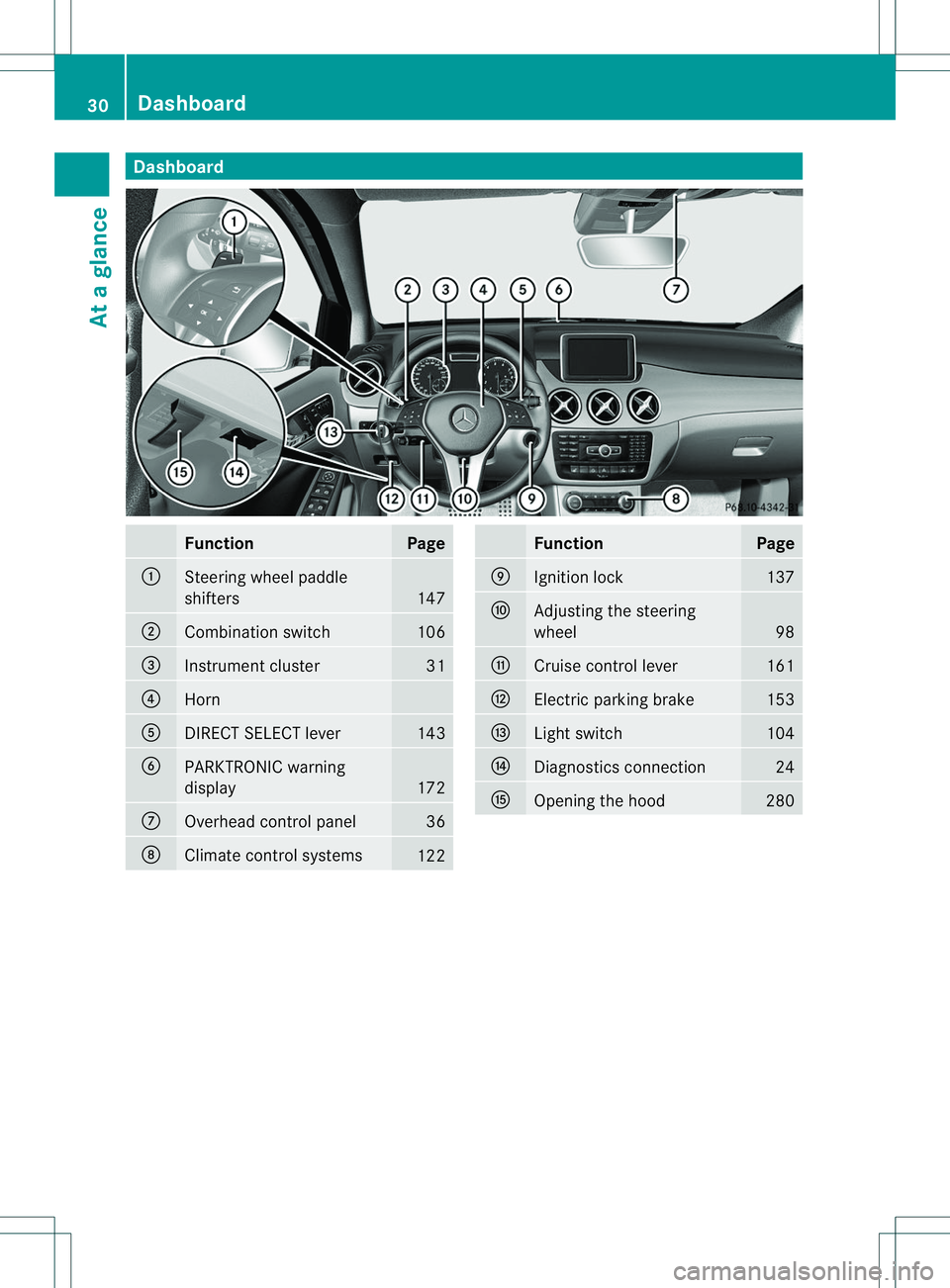
Function Page
001A
Steerin
gwhee lpaddle
shifters 147
0010
Combination switch 106
0023
Instrumen
tcluster 31
0021
Horn
001E
DIREC
TSELEC Tlever 143
0024
PARKTRONIC warning
display
172
0007
Overhead contro
lpanel 36
0008
Climat
econtrol systems 122 Function Page
0009
Ignition lock 137
0016
Adjustin
gthe steering
wheel 98
001D
Cruis
econtrol lever 161
0004
Electric parking brake 153
000B
Light switch 104
001C
Diagnostic
sconnection 24
000E
Opening th
ehood 28030
Dashboa
rdAtag lance
Page 34 of 360
Warning and indicator lamps
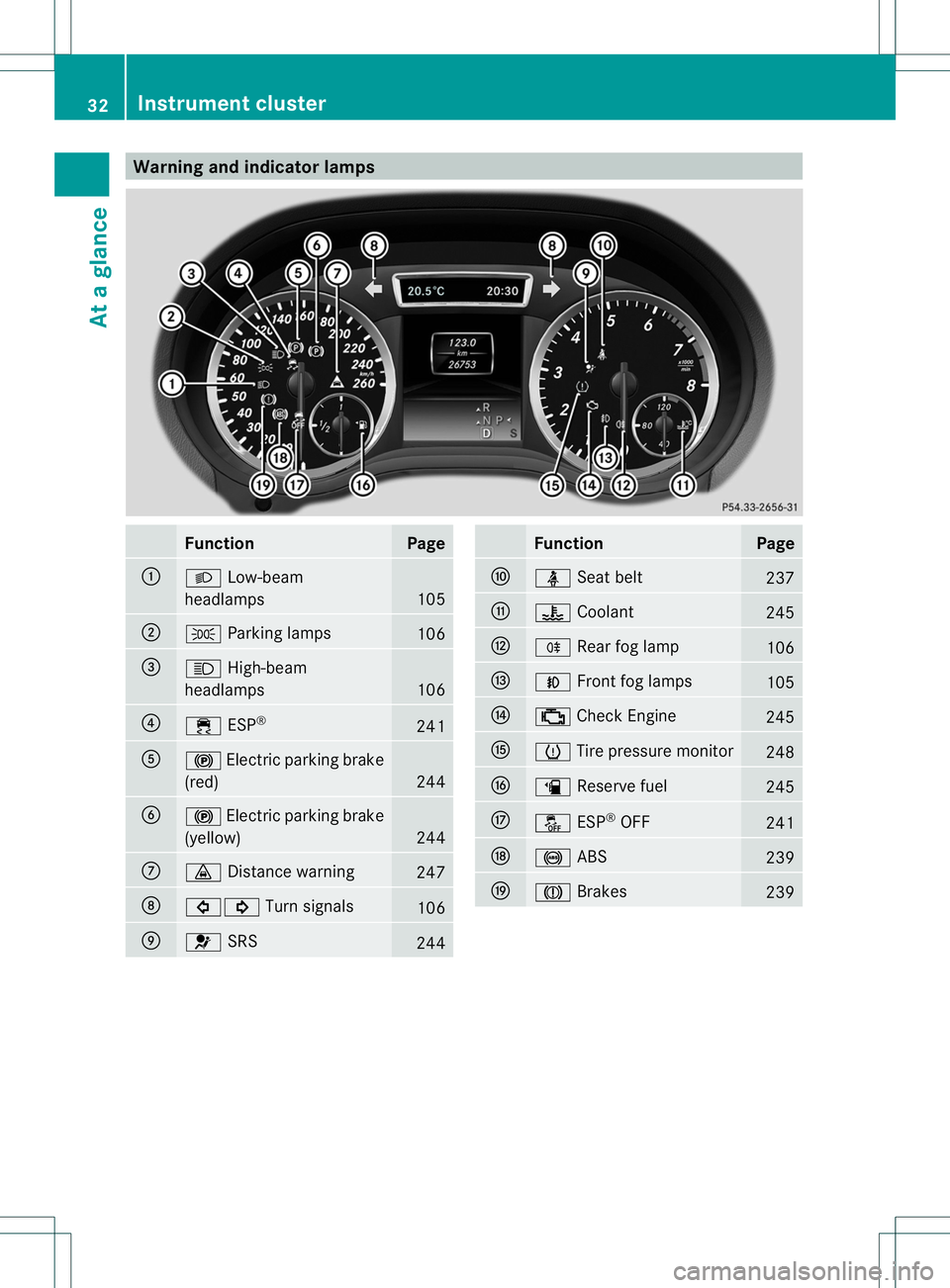
Function Page
001A
0005
Low-beam
headlamps 105
0010
000F
Parking lamps 106
0023
0011
High-beam
headlamps 106
0021
000A
ESP® 241
001E
000A
Electric parking brake
(red) 244
0024
000A
Electric parking brake
(yellow) 244
0007
0008
Distance warning 247
0008
00020001
Turn signals 106
0009
0021
SRS 244 Function Page
0016
0016
Seat belt 237
001D
0010
Coolant 245
0004
0006
Rearfog lamp 106
000B
0019
Frontf og lamps 105
001C
000A
Check Engine 245
000E
0005
Tire pressure monitor 248
0013
0007
Reserve fuel 245
0017
0004
ESP®
OFF 241
0022
001C
ABS 239
0020
0001
Brakes 23932
Instrument clusterAt
ag lance
Page 47 of 360
function for the vehicle occupants in the
event of acrash.
i After an airb ag has been deployed, have
th ev ehicle towed to th eneares tqualified
specialist workshop, eve nifyour vehicle is
ready to drive.
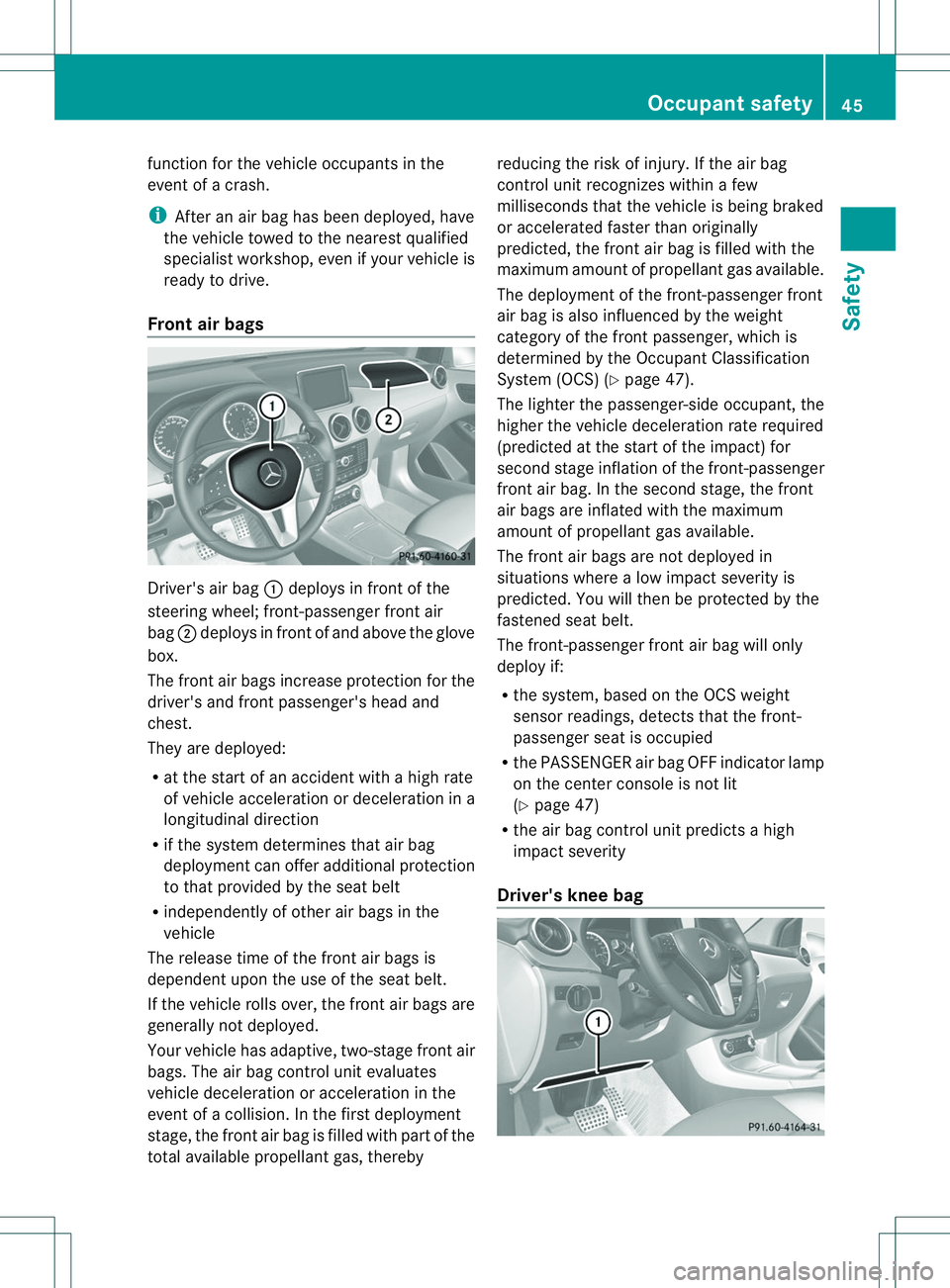
Front air bags Driver'
sair bag 001Adeploys in front of the
steerin gwheel; front-passenger front air
bag 0010deploys in front of and above the glove
box.
The front air bags increase protection for the
driver's and front passenger's head and
chest.
They are deployed:
R at the start of an accident with ahigh rate
of vehicle acceleration or deceleration in a
longitudinal direction
R if the system determines that air bag
deployment can offer additional protection
to that provided by the seat belt
R independently of other air bags in the
vehicle
The release time of the front air bags is
dependent upon the use of the seat belt.
If the vehicle rolls over, the front air bags are
generally not deployed.
Your vehicle has adaptive, two-stage front air
bags. The air bag control unit evaluates
vehicle deceleration or acceleration in the
event of acollision. In the first deployment
stage, the front air bag is filled with part of the
total available propellant gas, thereby reducing the risk of injury. If the air bag
control unit recognizes within
afew
milliseconds that the vehicle is being braked
or accelerated faster than originally
predicted, the front air bag is filled with the
maximum amount of propellant gas available.
The deployment of the front-passenger front
air bag is also influenced by the weight
category of the front passenger, which is
determined by the Occupant Classification
System (OCS) (Y page 47).
The lighter the passenger-side occupant ,the
higher the vehicle deceleration rate required
(predicted at the start of the impact) for
second stage inflation of the front-passenger
front air bag. In the second stage, the front
air bags are inflated with the maximum
amount of propellant gas available.
The front air bags are not deployed in
situations where alow impact severity is
predicted. You will then be protected by the
fastened seat belt.
The front-passenger front air bag will only
deploy if:
R the system, based on the OCS weight
sensor readings, detect sthat the front-
passenger seat is occupied
R the PASSENGER air bag OFF indicator lamp
on the center console is not lit
(Y page 47)
R the air bag control unit predicts ahigh
impact severity
Driver's knee bag Occupant safety
45Safety Z