Page 698 of 3039

center and an amber warning indicator will illuminate.
Refer to: Information and Message Center (413-08 Information and Message Center, Description and Operation).
As the wheel speed sensors are active devices, a return signal is available when the road wheels are not rotating. This enables
the ABS module to check the condition of the speed sensors while the vehicle is stationary.
Steering Angle Sensor
The steering angle sensor measures the steering wheel angle and the rate of change of the steering wheel angle. These
measurements are received by the ABS module and broadcast on the high speed CAN bus for use by other systems.
The steering angle sensor is mounted on the steering column upper shroud mounting bracket, immediately behind the
multifunction switches, and is secured by 2 screws. A fly lead connects the sensor to the passenger compartment wiring
harness via a 4 pin multiplug.
The sensor is housed in a 'U' shaped plastic casing and contains two offset LED (light emitting diode)s facing two detectors.
An encoder ring is mounted on the inner steering column shaft and intersects the LEDs and detectors. The encoder ring contains 60 slots which break and restore the light beams between the LEDs and the detectors as the steering wheel is
Page 699 of 3039

beams change state. The LEDs and detectors are mounted in such a way that only one beam will change state, either to broken or restored, at any one time.
The center (straight ahead) position of the steering wheel has to be learned by the ABS module every time the ignition is switched ON. The steering angle sensor is unable to determine the center position so inputs from the yaw rate and lateral
acceleration sensor and wheel speed signals are also used by the ABS module to help it perform this process. If extreme weather conditions are present, for example ice causing extreme wheel spin or understeer/oversteer, the ABS module may not be able to determine the center position of the steering wheel. In this situation 'DSC NOT AVAILABLE' will be displayed in the
instrument cluster message center and the amber warning indicator will illuminate.
Refer to: Information and Message Center (413-08 Information and Message Center, Description and Operation).
'DSC NOT AVAILABLE' will also be displayed if the ABS module detects a steering angle sensor fault. The amber warning indicator will illuminate until the fault is rectified.
Yaw Rate and Lateral Acceleration Sensor
The yaw rate and lateral acceleration sensor is mounted on the rear parcel shelf. The sensor is secured by two screws and
connects to the vehicle wiring via a four pin multiplug.
When the ignition is ON, the sensor receives a power feed from the CJB. The ground path for the sensor is located behind the left hand rear seat back. The sensor measures the yaw rate and lateral acceleration of the vehicle, providing values to the ABS module via a dedicated, private high speed CAN bus connection. The ABS module broadcasts these values on the high speed CAN bus for use by other systems.
If a sensor fault is detected by the ABS module, 'DSC NOT AVAILABLE' will be displayed in the instrument cluster message center and the amber warning indicator will illuminate.
Refer to: Information and Message Center (413-08 Information and Message Center, Description and Operation).
Page 700 of 3039
Stoplamp Switch
The stoplamp switch is mounted on the brake pedal box and is connected to the vehicle harness via a four pin multiplug.
When the brake pedal is pressed, the switch contacts close. This allows a hard wired signal feed to be sent to the ECM. A stoplamp switch status message is then sent from the ECM to the ABS module on the high speed CAN bus. The ABS module is then able to control braking force accordingly in conjunction with the HCU.
NOTE: The stoplamp switch also forms part of the speed control system.
For additional information, refer to:
Speed Control (310-03 Speed Control - 2.7L V6 - TdV6, Description and Operation),
Speed Control (310-03 Speed Control - 3.0L NA V6 - AJ27, Description and Operation),
Speed Control (310-03 Speed Control - 4.2L NA V8 - AJV8/4.2L SC V8 - AJV8, Description and Operation). www.JagDocs.com
Page 701 of 3039

Item Description 1 ABS warning indicator (USA only) 2 ABS warning indicator (Canada and Mexico only) 3 ABS warning indicator (all except USA, Canada and Mexico) 4 DSC warning indicator 5 Brake warning indicator (USA only) 6 Brake warning indicator (all except USA) The instrument cluster and message center contains warning indicators and warning messages to display the operating status
of the anti-lock control - stability assist functions. The warning indicators and messages provide a visual notification of either
a system warning or information indication to the driver. There are three warning indicators on the instrument cluster, which
vary dependant on market, and several types of message relating to the anti-lock control - stability assist functions. The DSC
OFF message is accompanied by an audible warning.
The following anti-lock control - stability assist warning indicators are installed in the instrument cluster:
An amber ABS warning indicator. A red brake warning indicator.
An amber DSC warning indicator.
Refer to: Instrument Cluster (413-01 Instrument Cluster, Description and Operation) / Information and Message Center (413-08
Information and Message Center, Description and Operation). Instrument Cluster Warning Indicators
Page 702 of 3039

ABS Module
Item Description 1 LH front brake 2 RH rear brake 3 LH rear brake 4 RH front brake 5 Primary inlet 6 Secondary inlet The ABS module is located in the passenger side, rear engine bay and incorporates the HCU. The module is mounted on the rear face of the HCU, which it uses to control all braking and stability functions by modulating hydraulic pressure to the individual wheel brakes.
Two types of ABS modules are available; one for vehicles with standard Speed Control, one for vehicles fitted with Adaptive Speed Control.
If an ABS modulator fault is detected, 'ABS FAULT' will be displayed in the instrument cluster message center and the amber warning indicator will illuminate.
Refer to: Information and Message Center (413-08 Information and Message Center, Description and Operation).
CAUTION: The ABS module and the HCU comprise a single unit and must not be separated.
Hydraulic Control Unit
The HCU is a four channel unit, secured to a mounting bracket located in the passenger side, rear engine bay. The HCU modulates the supply of hydraulic pressure to the brakes under the control of the ABS module. Refer to: Hydraulic Brake Actuation (206-06 Hydraulic Brake Actuation, Description and Operation).
Page 703 of 3039

Published: 09-Jul-2014
Anti-Lock Control - Stability Assist - Anti-Lock Control - Stability Assist
Diagnosis and Testing
Principle of Operation
For a detailed description of the Anti-Lock Control - Stability Assist system, refer to the relevant Description and Operation
sections in the workshop manual. REFER to: (206-09 Anti-Lock Control - Stability Assist)
Anti-Lock Control - Stability Assist (Description and Operation), Anti-Lock Control - Stability Assist (Description and Operation), Anti-Lock Control - Stability Assist (Description and Operation).
Inspection and Verification
CAUTION: Diagnosis by substitution from a donor vehicle is NOT acceptable. Substitution of control modules does not
guarantee confirmation of a fault, and may also cause additional faults in the vehicle being tested and/or the donor vehicle.
1. Verify the customer concern.
2. Confirm if the Anti-Lock Brake System (ABS) warning light was illuminated, or still is.
NOTE: An intermittent fault may allow the warning light to go off. This does not necessarily mean the fault is not
present. Some warnings will appear to clear when the ignition is cycled. This is often because the warning has flagged as a
result of one of the vehicle's on-board diagnostic routines having run to detect the fault. If the same routine is not run when
the ignition status is set to ON, the warning will not re-flag until the routine does run.
3. Visually inspect for obvious signs of damage and system integrity.
Visual Inspection
Mechanical Electrical
Brake fluid level
Vacuum system
Wheel speed sensor installation
Wheel speed sensor air gap
Magnetic pulse wheel(s) (damaged/contaminated)
Steering angle sensor
Yaw rate sensor and accelerometer cluster installation
Incorrect wheel or tire size
Warning light operation
Fuses
Wheel speed sensors
Connectors/Pins
Harnesses
Steering wheel rotation sensor
Yaw rate sensor and accelerometer cluster
Booster pressure sensor
Hydraulic Control Unit (HCU)
4. If an obvious cause for an observed or reported concern is found, correct the cause (if possible) before proceeding to
the next step.
5. If the cause is not visually evident check for Diagnostic Trouble Codes (DTCs) and refer to the DTC Index.
DTC Index
For a list of Diagnostic Trouble Codes (DTCs) that could be logged on this vehicle, please refer to Section 100-00.
REFER to: Diagnostic Trouble Code (DTC) Index - DTC: Anti-Lock Braking System (ABS) (100-00 General Information, Description and Operation).
Page 704 of 3039
Published: 11-May-2011
Anti-Lock Control - Stability Assist - Anti-Lock Brake System (ABS) Module
Removal and Installation
Removal
1. NOTE: The anti-lock braking system (ABS) module mounted to the
hydraulic control unit (HCU) cannot be serviced separately. If the ABS
module requires replacement, the unit must be replaced as a complete
assembly.
Remove the HCU.
For additional information, refer to: Hydraulic Control Unit (HCU)
(206-09, Removal and Installation).
Installation
1. Install the HCU.
For additional information, refer to: Hydraulic Control Unit (HCU)
(206-09, Removal and Installation).
www.JagDocs.com
Page 710 of 3039
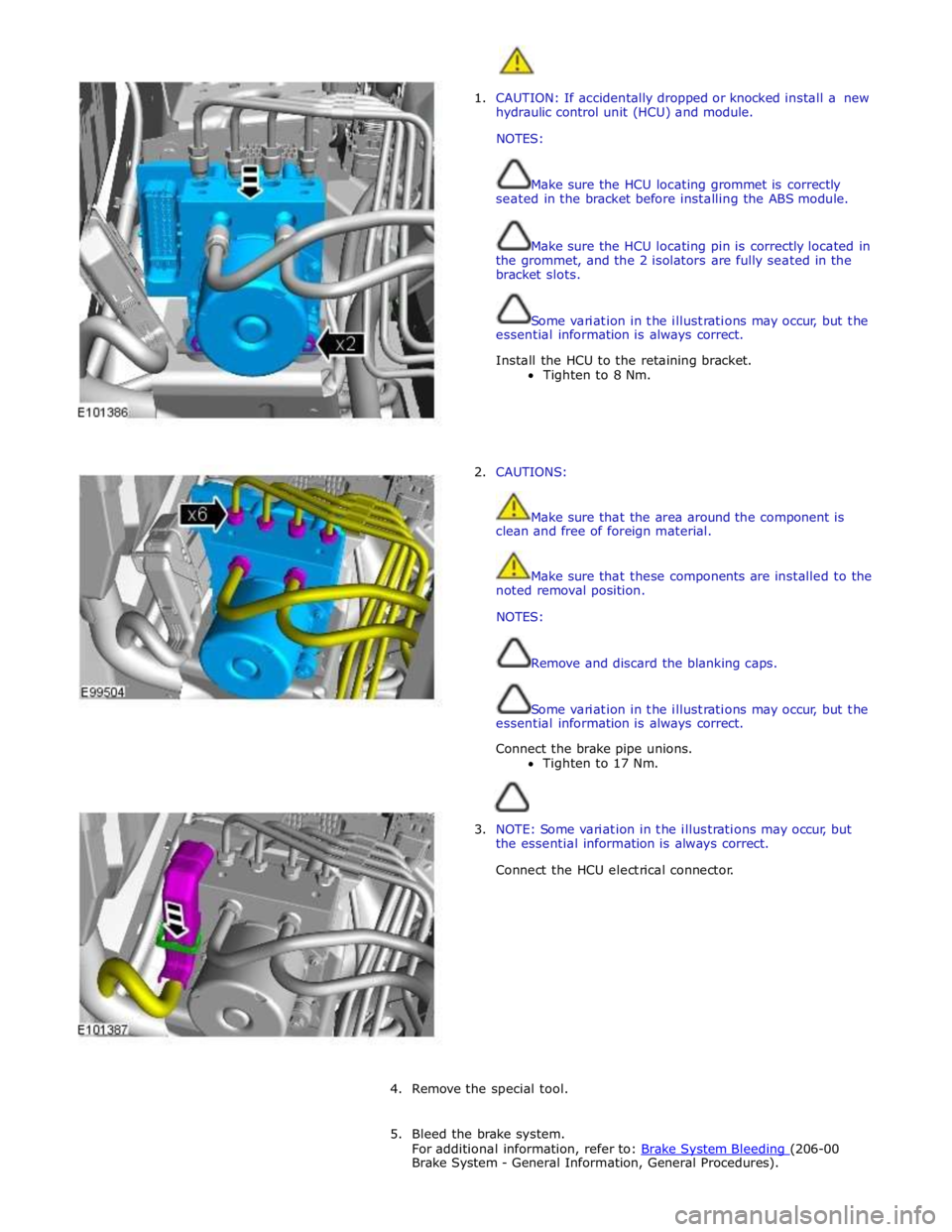
1. CAUTION: If accidentally dropped or knocked install a new
hydraulic control unit (HCU) and module.
NOTES:
Make sure the HCU locating grommet is correctly
seated in the bracket before installing the ABS module.
Make sure the HCU locating pin is correctly located in
the grommet, and the 2 isolators are fully seated in the
bracket slots.
Some variation in the illustrations may occur, but the
essential information is always correct.
Install the HCU to the retaining bracket.
Tighten to 8 Nm.
2. CAUTIONS:
Make sure that the area around the component is
clean and free of foreign material.
Make sure that these components are installed to the
noted removal position.
NOTES:
Remove and discard the blanking caps.
Some variation in the illustrations may occur, but the
essential information is always correct.
Connect the brake pipe unions.
Tighten to 17 Nm.
3. NOTE: Some variation in the illustrations may occur, but
the essential information is always correct.
Connect the HCU electrical connector.
4. Remove the special tool.
5. Bleed the brake system.
For additional information, refer to: Brake System Bleeding (206-00 Brake System - General Information, General Procedures).

