Page 266 of 2453
EI-24
Front Bumper
EXTERIOR/INTERIOR TRIM
2. REPAIR INSTRUCTIONS FOR COLORED PP BUMPER
NOTE:
All PP bumpers are provided with a grained surface, and if the surface is damaged, it cannot normally be re-
stored to its former condition. Damages limited to the shallow scratches that cause only a change in the luster
of the base material or coating, can be almost fully restored. Before repairing a damaged area, explain this
point to the customer and obtain an understanding about the matter. Repair methods are outlined below,
based on a classification of the extent of damage.
1) Minor damage causing only a change in the luster of the bumper due to a light touch
Almost restorable.
2) Deep damage caused by scratching with fences etc.
A dent cannot be repaired but a whitened or swelled part can be removed.
Process
No.Process name Job contents
1Cleaning Clean the area to be repaired using water.
2Sanding Grind the repairing area with #500 sand paper in a “feathering” motion.
3Finish
Resin section Coated section
Repeatedly apply wax to the affected area
using soft cloth (such as flannel). Recom-
mended wax: NITTO KASEI Soft 99 TIRE
WA X B L ACK , o r e qu iva le n t.
Perfor m either the same process as for the
resin section or process No. 18 and subse-
quent in the 3) section, depending on the
degree and nature of damage.Po li sh t he waxed ar e a w i t h c le a n c lo t h a f te r 5
— 10 minutes.
Process
No.Process name Job contents
1Cleaning Clean the damaged area with water.
2Removal of dam-
aged areaCut off protruding area, if any, due to collision, using a putty knife.
3Sanding Sand the affected area with #100 — #500 sand paper.
4Finish
Resin section Coated section
Same as step 3 in the “1)” section.Perfor m step 12 and subsequent operations in
the “3)” section.
Page 269 of 2453
EI-27
Front Bumper
EXTERIOR/INTERIOR TRIM
18Cleaning/degreas-
ingSame as Process No. 12.
19 Top coat (I)
Non-colored Metallic paint
Use a “block” coating method.
•Recommended paint:
Suncryl (SC)
No. 307 Flex Hardener
SC Reducer (thinner)
•Mixture ratio:
Suncryl (SC) vs. No. 307 Flex Hardener = 3 : 1
•Viscosity: 11 — 13 sec./20°C (68°F)
• Coating film thickness: 40 — 50 µ
•Spraying pressure: 245 — 343 kPa
(2.5 — 3.5 kg/cm2, 36 — 50 psi)
Use a “block” coating method.
•Recommended paint:
Suncryl (SC)
No. 307 Flex Hardener
SC Reducer (thinner)
•Mixture ratio:
Suncryl (SC) vs. No. 307 Flex Hardener = 3 : 1
•Viscosity: 11 — 13 sec./20°C (68°F)
•Coating film thickness: 20 — 30 µ
•Spraying pressure: 245 — 343 kPa
(2.5 — 3.5 kg/cm2, 36 — 50 psi)
20 Leave unattended Not required.
Leave unattended at 20°C (68°F) for at least
10 minutes until the topcoat area is half-dry.
NOTE:
Be careful to keep dust or dirt from coming in
contact with the affected area.
21 Top coat (II) Not required.
Apply a clear coat three times at an interval of
3 to 5 minutes.
•Recommended paint:
SC710 Overlay Clear
No. 307 Flex Hardener
SC Reducer (thinner)
•Mixture ratio:
Suncryl (SC) vs. No. 307 Flex Hardener = 3 : 1
•Viscosity: 10 — 13 sec./20°C (68°F)
•Coating film thickness: 20 — 30 µ
•Spraying pressure: 245 — 343 kPa
(2.5 — 3.5 kg/cm2, 36 — 50 psi)
22 Drying
Allow the coated surface to dry for two hours at 20°C (68°F) or 30 minutes at 60°C (140°F)].
NOTE:Do not allow the temperature to exceed 80°C (176°F) since this will deform the PP substrate.
23 Inspection Carefully check the condition of the repaired area.
24Removal of mask-
ingRemove the masking tape applied in Process No. 11 and 13.
25 Parts installation Install parts on the bumper in reverse order of removal.
26 Bumper installation Install the bumper.
Process
No.Process name Job contents
Page 325 of 2453
GW-30
Wiper Deicer System
GLASS/WINDOWS/MIRRORS
21.Wiper Deicer System
A: WIRING DIAGRAM
B: INSPECTION
Refer to “Rear Window Defogger” for inspection.
NOTE:
Wiper deicer system can be customized on the Subaru Select Monitor.
*: When one of the following conditions occurs, continuous operation is suspended and turned off after 15 min.
•Ambient temperature at 5°C (41°F) or more continues for 10 sec.
•Malfunction occurs on ambient sensor.
•Vehicle speed below 15 km/h (9 MPH) continues 15 min.
•Malfunction occurs in CAN communication.
C: REPAIR
Refer to “Rear Window Defogger” for repair.
Symptom Repair order
Wiper deicer does not operate.
1. Fuse (F/B No. 4, 9)
2. Wiper deicer relay
3. Wiper deicer switch
4. Wiring harness
5. Body integrated unit
System name Initial setting Customize setting
Wiper deicer timer OFF after 15 min. Continuous operation*
Page 328 of 2453

AC-2
General Description
HVAC SYSTEM (HEATER, VENTILATOR AND A/C)
1. General Description
A: SPECIFICATION
1. HEATER SYSTEM
2. A/C SYSTEM
•Single A/C model (front only)
Item Specification Condition
Heating capacity5.2 kW (4,471 kcal/h, 17,743
BTU/h) or more
•Mode selector switch: HEAT
•Temperature control switch: FULL HOT
•Temperature difference between hot water and inlet
air: 65°C (149°F)
•Hot water flow rate: 360 2 (95.1 US gal, 79.2 Imp
gal)/h
Air flow rate340 m3 (11,301 cu ft)/hHeat mode (FRESH), FULL HOT at 12.5 V
Max air flow rate550 m3 (16,245 cu ft)/h
•Temperature control switch: FULL COLD
•Blower fan speed:
6th position
•Mode selector lever: RECIRC
Heater core size
(height × length × width)
264 × 110 × 27 mm
(10.4 × 4.33 × 1.06 in)—
Blower Motor
Ty p e B r u s h m o t o r 2 2 0 W o r l e s s 1 2 V
Fa n t y pe an d si ze
(diameter × width)
Sirocco fan type
165 ×75 mm (6.51 × 2.95 in)—
Item Specification
Ty p e o f a i r c o n d i t i o n e r R e h e a t a i r - m i x t y p e
Cooling capacity6.2 kW
(5,331 kcal/h, 21,154 BTU/h)
RefrigerantHFC-134a (CH2FCF3)
[0.87±0.03 kg (1.92±0.07 lb)]
Compressor
Ty p eInclined plate (SWASH PLATE), fixed capacity
(10SR17), Temperature fuse
Exhaust 177 cc (10.80 cu in)/rev
Max. permissible speed 6,000 rpm
Magnet clutch
Ty p e D r y, s i n g l e - d i s c t y p e
Powe r c on su mp t i on 35 W
Ty p e o f b e l t V- b e l t 6 P K
Pulley dia. (effective dia.) 115 mm (4.53 in)
Pulley ratio 1.16
Condenser
Ty p e C o r r u g a t e d f i n ( S u b c o o l t y p e )
Core face area0.29 m2 (3.122 sq ft)
Core thickness 16 mm (0.63 in)
Radiation area7.65 m2 (82.35 sq ft)
Receiver drier Effective inner capacity190 cm3 (11.6 cu in)
Expansion valve Type Box time (external pressure equalizing type)
Evaporator
Ty p e S i n g l e t a n k
Dimensions (W × H × T)293.1 × 211 × 38 mm
(11.54 × 8.31 × 1.50 in)
Blower fan
Fan t yp e S i r oc co fa n
Outer diameter× width 165 ×75 mm (6.50 × 2.95 in)
Powe r c on su mp t i on 2 60 W
Page 337 of 2453
AC-11
General Description
HVAC SYSTEM (HEATER, VENTILATOR AND A/C)
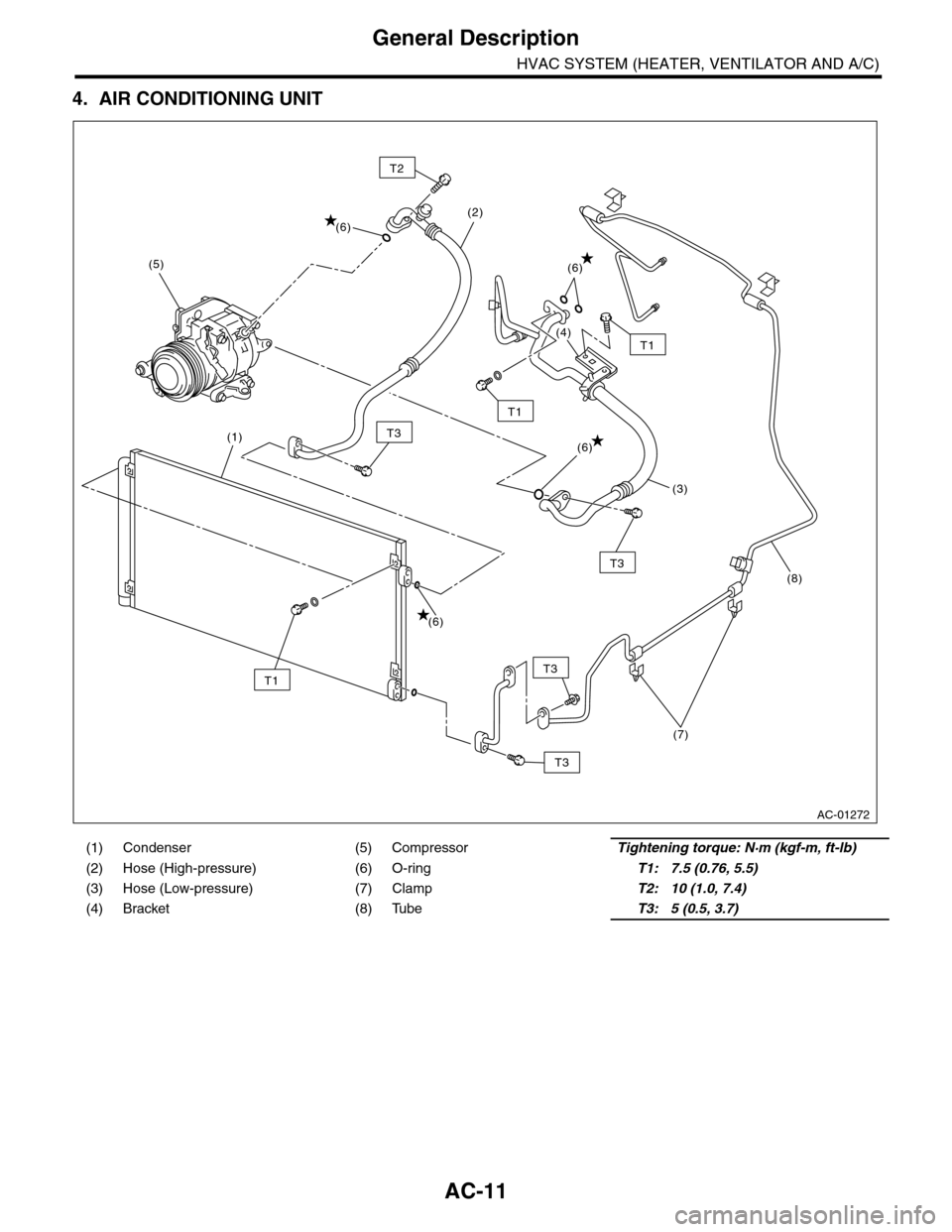
4. AIR CONDITIONING UNIT
(1) Condenser (5) CompressorTightening torque: N·m (kgf-m, ft-lb)
(2) Hose (High-pressure) (6) O-ringT1: 7.5 (0.76, 5.5)
(3) Hose (Low-pressure) (7) ClampT2: 10 (1.0, 7.4)
(4) Bracket (8) TubeT3: 5 (0.5, 3.7)
AC-01272
(4)
T2
(7)
(8)
(5)
(6)(2)
T3
T1T3
(6)
(6)(1)
T1
(6)
(3)
T1
T3
T3
Page 342 of 2453
AC-16
General Description
HVAC SYSTEM (HEATER, VENTILATOR AND A/C)
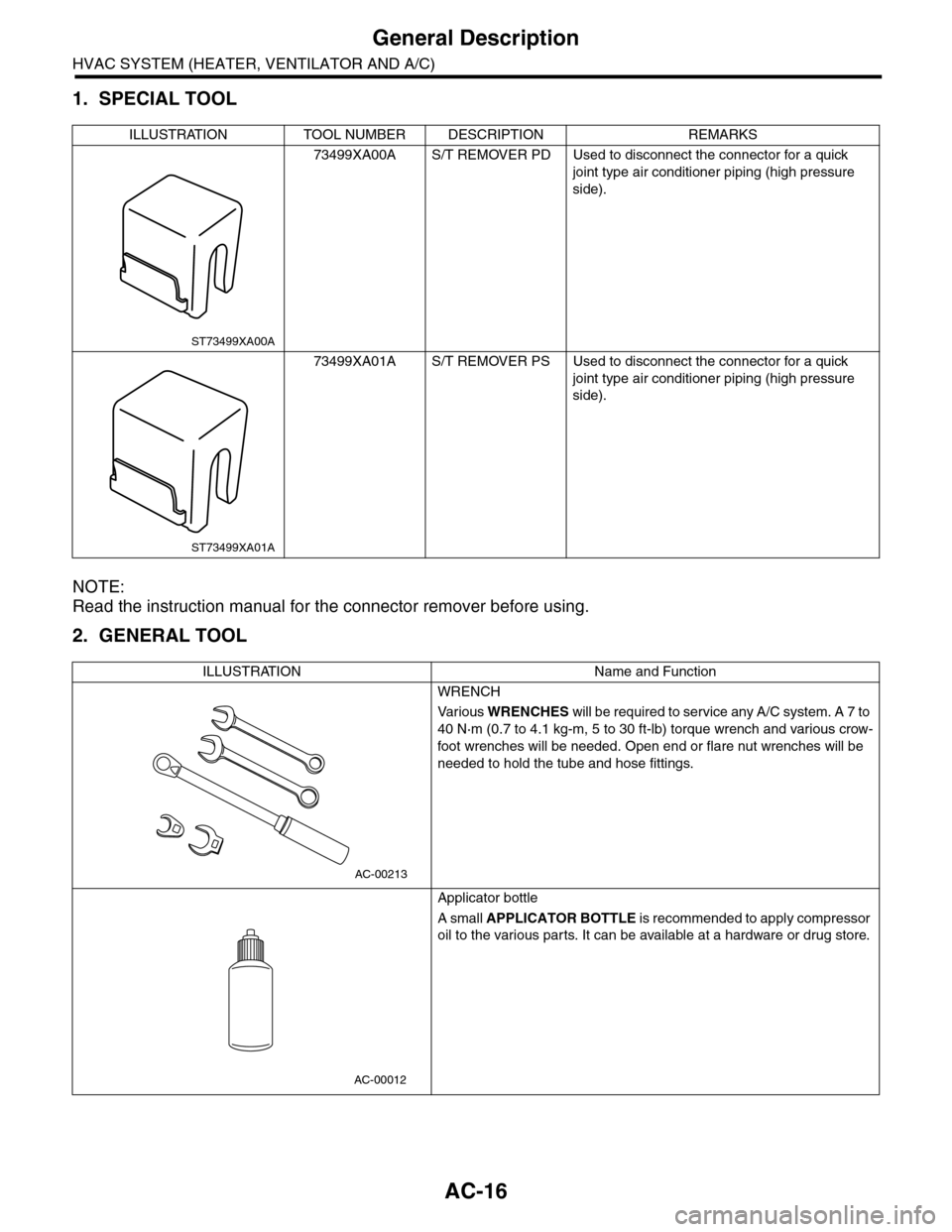
1. SPECIAL TOOL
NOTE:
Read the instruction manual for the connector remover before using.
2. GENERAL TOOL
ILLUSTRATION TOOL NUMBER DESCRIPTION REMARKS
73499XA00A S/T REMOVER PD Used to disconnect the connector for a quick
joint type air conditioner piping (high pressure
side).
73499XA01A S/T REMOVER PS Used to disconnect the connector for a quick
joint type air conditioner piping (high pressure
side).
ILLUSTRATION Name and Function
WRENCH
Va r i o u s WRENCHES will be required to service any A/C system. A 7 to
40 N·m (0.7 to 4.1 kg-m, 5 to 30 ft-lb) torque wrench and various crow-
foot wrenches will be needed. Open end or flare nut wrenches will be
needed to hold the tube and hose fittings.
Applicator bottle
A small APPLICATOR BOTTLE i s r e c om me nd e d to a p pl y co mp r e ss or
oil to the various parts. It can be available at a hardware or drug store.
ST73499XA00A
ST73499XA01A
AC-00213
AC-00012
Page 345 of 2453

AC-19
Refrigerant Pressure with Manifold Gauge Set
HVAC SYSTEM (HEATER, VENTILATOR AND A/C)
2. Refrigerant Pressure with Manifold Gauge Set
A: PROCEDURE
1) Place the vehicle in the shade and windless condition.
2) Connect the manifold gauge set.
3) Open all windows and close all doors.
4) Increase the engine to 1,500 rpm.
5) Turn on the A/C switch.
6) Turn the temperature control switch to MAX COOL.
7) Put in RECIRC position.
8) Turn the blower control switch to HI.
9) Read the gauge.
Standard:
Low pressure: 127 — 196 kPa (1.3 — 2.0 kg/cm2, 18 — 28 psi)
High pressure: 1,471 — 1,667 kPa (15 — 17 kg/cm2, 213 — 242 psi)
Ambient temperature: 30 — 35°C (86—95°F)
B: INSPECTION
Symptom Probable cause Repair order
High-pressure side is unusually high.
•Defective condenser fan motor
•Clogged condenser fin
•Too much refrigerant
•Air inside the system
•Defective receiver dryer
•Replace the fan motor.
•Clean the condenser fin.
•Discharge refrigerant.
•Replace the receiver dryer.
•After evacuating again, charge an
appropriate amount of refrigerant.
High-pressure side is unusually low.
•Defective compressor
•Not enough refrigerant
•Clogged expansion valve
•Expansion valve frozen temporarily by
moisture.
•Replace the compressor.
•Check for leaks.
•Replace the expansion valve.
•Fully evacuate the expansion valve.
Low-pressure side is unusually high.
•Defective compressor
•Defective expansion valve
•Too much refrigerant
•Replace the compressor.
•Replace the expansion valve.
•Discharge refrigerant.
Low-pressure side is unusually low.
•Not enough refrigerant
•Clogged expansion valve
•Expansion valve frozen temporarily by
moisture.
•Saturated receiver dryer
•Check for leaks.
•Replace the expansion valve.
•Replace the receiver dryer.
Page 351 of 2453
AC-25
Compressor Oil
HVAC SYSTEM (HEATER, VENTILATOR AND A/C)
6. Compressor Oil
A: PROCEDURE
NOTE:
Before making repairs, perform the oil return oper-
ation to return the compressor oil in circulation with
the refrigerant to the compressor.
1) Increase the engine to 1,500 rpm.
2) Turn on the A/C switch.
3) Turn the temperature control switch to MAX
COOL.
4) Put in RECIRC position.
5) Turn the blower control switch to HI. (For models
with rear coolers, also turn the rear cooler fan
switch to HI)
6) Leave in this condition for 10 minutes.
B: REPLACEMENT
NOTE:
•If a component has been replaced, add an ap-
propriate amount of compressor oil (same as the
amount of remaining oil in removed component).
•When replacing the compressor, the new com-
pressor will already have the specified amount of
oil in it. Install the new compressor after removing
the same amount of oil that is remaining in the com-
pressor removed.