2009 SUBARU TRIBECA air condition
[x] Cancel search: air conditionPage 1684 of 2453
GD(H6DO)-72
Diagnostic Trouble Code (DTC) Detecting Criteria
GENERAL DESCRIPTION
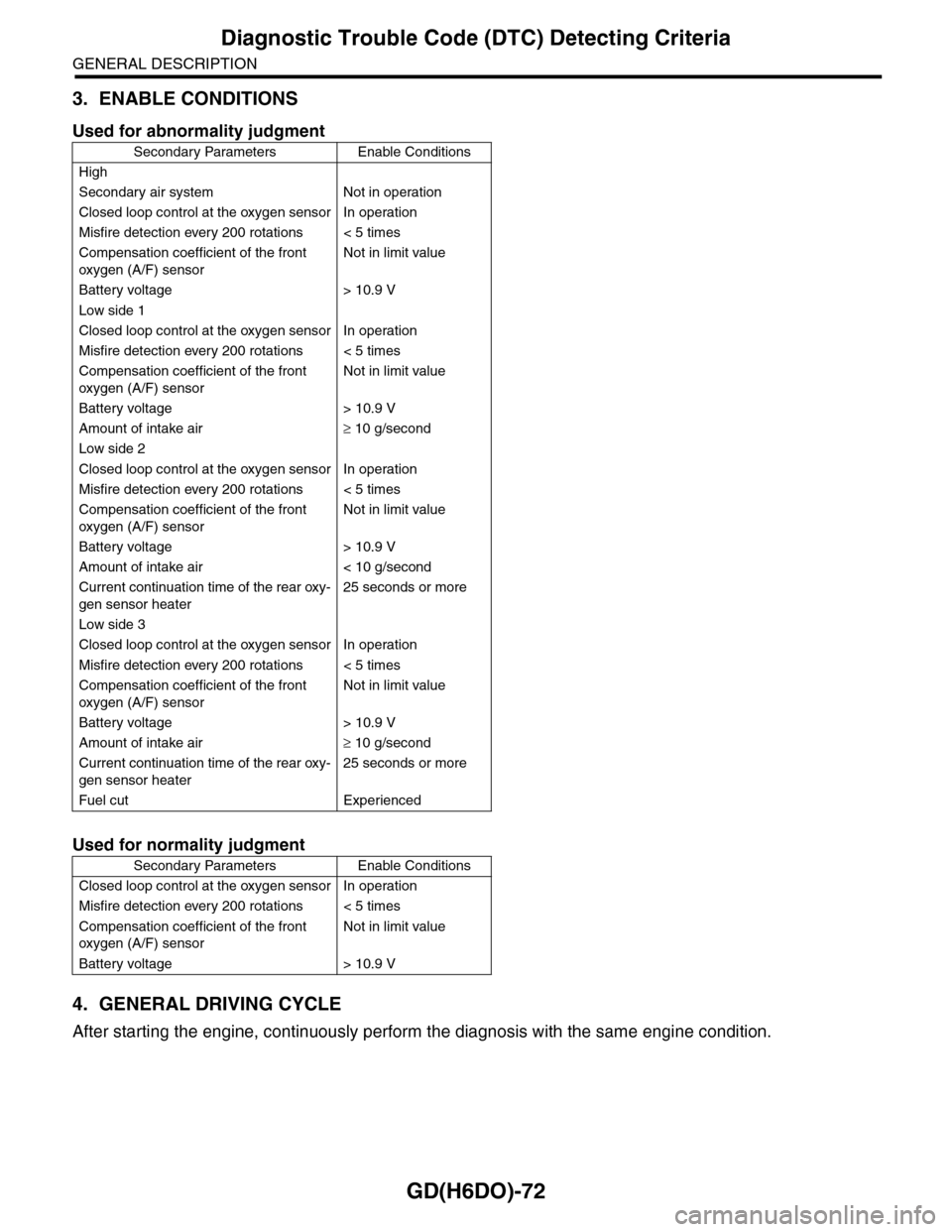
3. ENABLE CONDITIONS
4. GENERAL DRIVING CYCLE
After starting the engine, continuously perform the diagnosis with the same engine condition.
Used for abnormality judgment
Secondary Parameters Enable Conditions
High
Secondary air system Not in operation
Closed loop control at the oxygen sensor In operation
Misfire detection every 200 rotations < 5 times
Compensation coefficient of the front
oxygen (A/F) sensor
Not in limit value
Battery voltage > 10.9 V
Low side 1
Closed loop control at the oxygen sensor In operation
Misfire detection every 200 rotations < 5 times
Compensation coefficient of the front
oxygen (A/F) sensor
Not in limit value
Battery voltage > 10.9 V
Amount of intake air≥ 10 g/second
Low side 2
Closed loop control at the oxygen sensor In operation
Misfire detection every 200 rotations < 5 times
Compensation coefficient of the front
oxygen (A/F) sensor
Not in limit value
Battery voltage > 10.9 V
Amount of intake air < 10 g/second
Current continuation time of the rear oxy-
gen sensor heater
25 seconds or more
Low side 3
Closed loop control at the oxygen sensor In operation
Misfire detection every 200 rotations < 5 times
Compensation coefficient of the front
oxygen (A/F) sensor
Not in limit value
Battery voltage > 10.9 V
Amount of intake air≥ 10 g/second
Current continuation time of the rear oxy-
gen sensor heater
25 seconds or more
Fuel cut Experienced
Used for normality judgment
Secondary Parameters Enable Conditions
Closed loop control at the oxygen sensor In operation
Misfire detection every 200 rotations < 5 times
Compensation coefficient of the front
oxygen (A/F) sensor
Not in limit value
Battery voltage > 10.9 V
Page 1687 of 2453
GD(H6DO)-75
Diagnostic Trouble Code (DTC) Detecting Criteria
GENERAL DESCRIPTION
AQ:DTC P0139 O2 SENSOR CIRCUIT SLOW RESPONSE (BANK 1 SENSOR 2)
1. OUTLINE OF DIAGNOSIS
Detect the slow response of the oxygen sensor.
Judge as NG if either the rich to lean response diagnosis or lean to rich response diagnosis is NG, and Judge
as OK if both are OK.
[Rich → Lean diagnosis response]
1. Measure the response time for oxygen sensor output changes when the A/F ratio changes to rich to lean.
If the measured response time is larger than the threshold value, it is NG. If it is smaller, it is OK.
2. Judge as NG when the oxygen sensor voltage is large (rich) when recovering from a deceleration fuel cut.
[Lean → Rich diagnosis response]
1. Measure the response time for oxygen sensor output changes when the A/F ratio changes to lean to rich.
If the measured response time is larger than the threshold value, it is NG.
2. Judge as NG when the oxygen sensor voltage remains small when recovering from a deceleration fuel cut.
Diagnostic method
Measure the response time of the output change of the oxygen sensor when the A/F ratio changes to rich to
lean. And Judge as NG when the measured response time is larger than the threshold value.
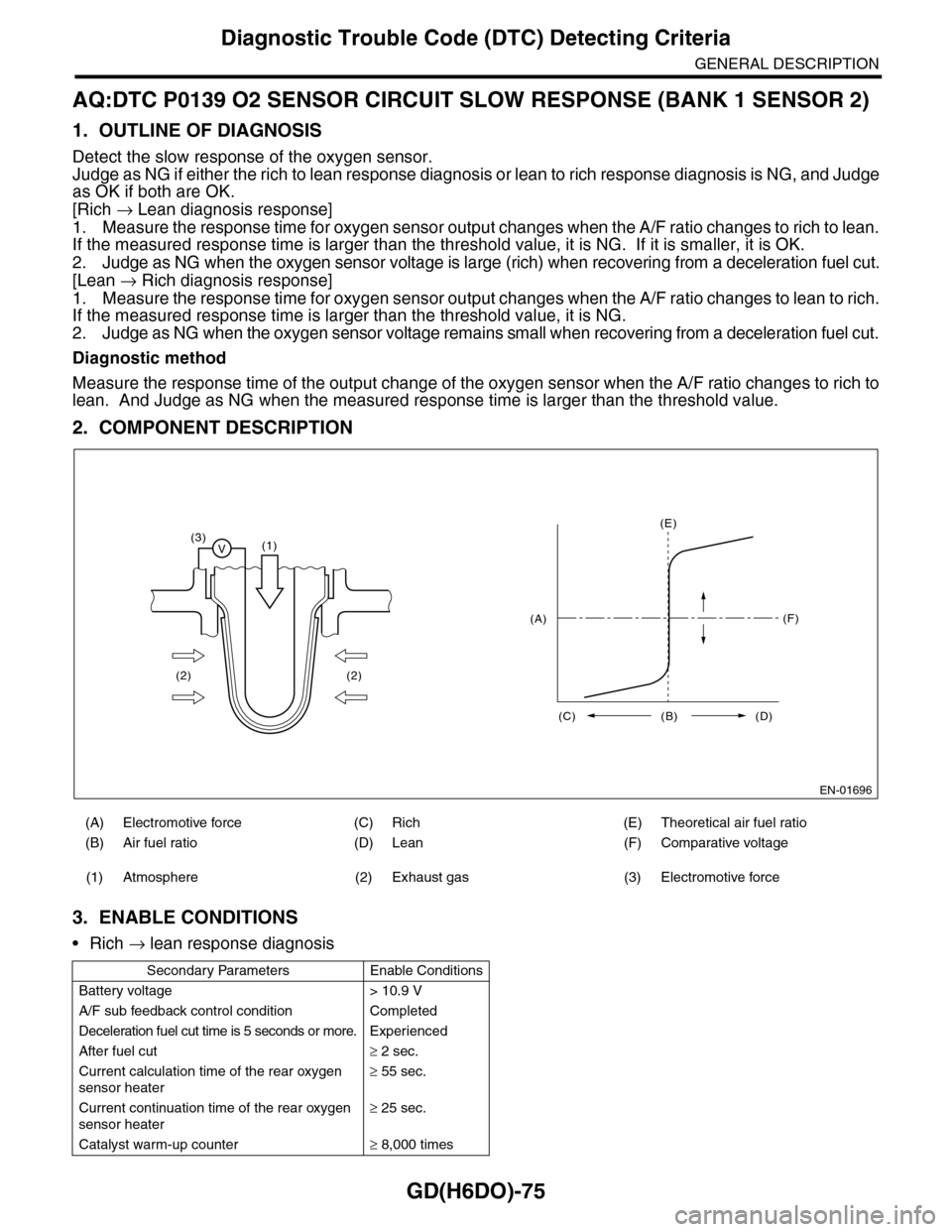
2. COMPONENT DESCRIPTION
3. ENABLE CONDITIONS
•Rich → lean response diagnosis
(A) Electromotive force (C) Rich (E) Theoretical air fuel ratio
(B) Air fuel ratio (D) Lean (F) Comparative voltage
(1) Atmosphere (2) Exhaust gas (3) Electromotive force
Secondary Parameters Enable Conditions
Battery voltage > 10.9 V
A/F sub feedback control condition Completed
Deceleration fuel cut time is 5 seconds or more. Experienced
After fuel cut≥ 2 sec.
Current calculation time of the rear oxygen
sensor heater
≥ 55 sec.
Current continuation time of the rear oxygen
sensor heater
≥ 25 sec.
Catalyst warm-up counter≥ 8,000 times
EN-01696
(3)V(1)
(2) (2)
(E)
(F)
(C) (B) (D)
(A)
Page 1692 of 2453
GD(H6DO)-80
Diagnostic Trouble Code (DTC) Detecting Criteria
GENERAL DESCRIPTION
AR:DTC P0140 O2 SENSOR CIRCUIT NO ACTIVITY DETECTED (BANK 1 SEN-
SOR 2)
1. OUTLINE OF DIAGNOSIS
Detect the rear oxygen sensor open or short circuit. Judge as NG when the rear oxygen sensor voltage can
be determined to be abnormal considering conditions such as intake air amount, engine coolant tempera-
ture, main feedback control and deceleration fuel cut.
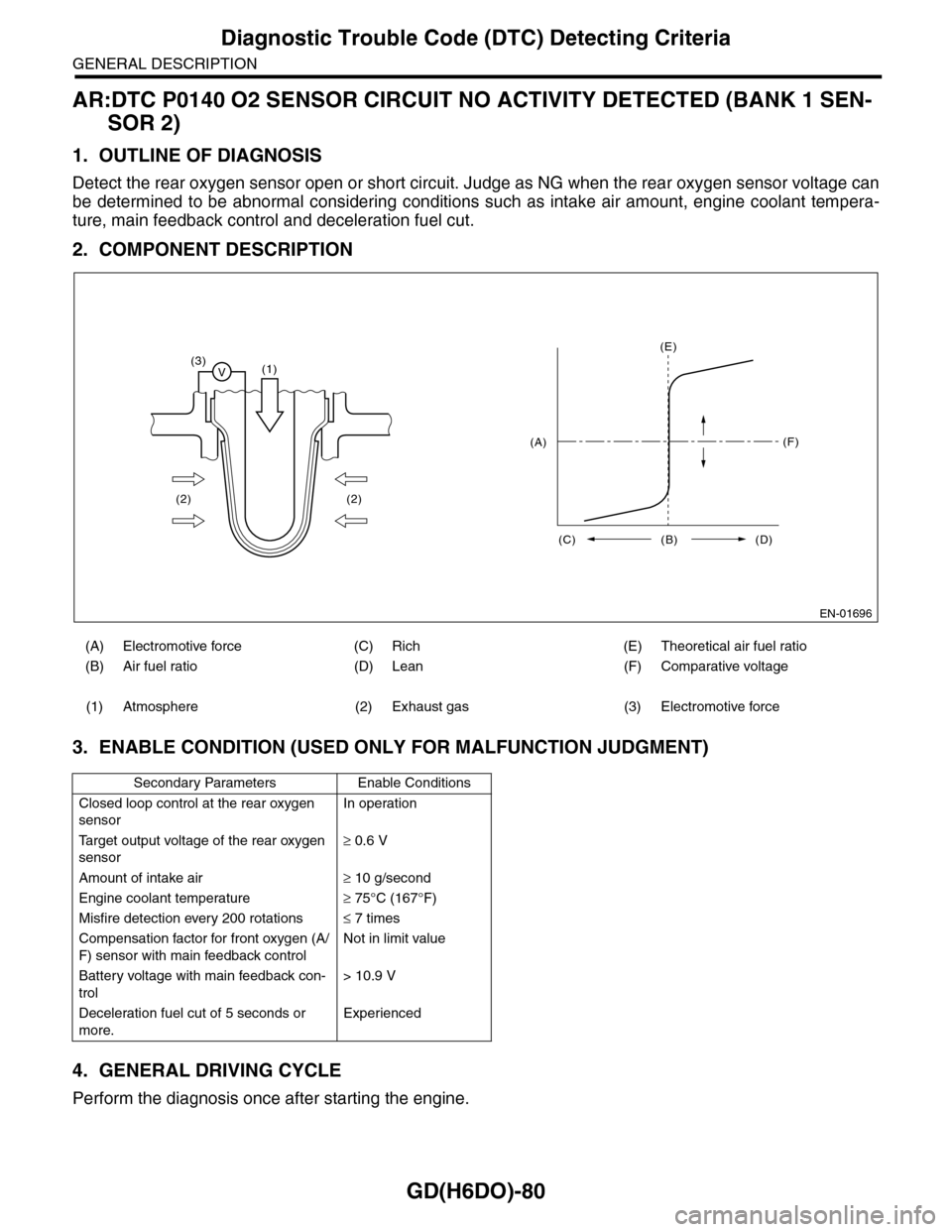
2. COMPONENT DESCRIPTION
3. ENABLE CONDITION (USED ONLY FOR MALFUNCTION JUDGMENT)
4. GENERAL DRIVING CYCLE
Perform the diagnosis once after starting the engine.
(A) Electromotive force (C) Rich (E) Theoretical air fuel ratio
(B) Air fuel ratio (D) Lean (F) Comparative voltage
(1) Atmosphere (2) Exhaust gas (3) Electromotive force
Secondary Parameters Enable Conditions
Closed loop control at the rear oxygen
sensor
In operation
Ta r g e t o u t p u t v o l t a g e o f t h e r e a r o x y g e n
sensor
≥ 0.6 V
Amount of intake air≥ 10 g/second
Engine coolant temperature≥ 75°C (167°F)
Misfire detection every 200 rotations≤ 7 times
Compensation factor for front oxygen (A/
F) sensor with main feedback control
Not in limit value
Battery voltage with main feedback con-
trol
> 10.9 V
Deceleration fuel cut of 5 seconds or
more.
Experienced
EN-01696
(3)V(1)
(2) (2)
(E)
(F)
(C) (B) (D)
(A)
Page 1695 of 2453
GD(H6DO)-83
Diagnostic Trouble Code (DTC) Detecting Criteria
GENERAL DESCRIPTION
BA:DTC P0171 SYSTEM TOO LEAN (BANK 1)
1. OUTLINE OF DIAGNOSIS
Detect fuel system malfunction by the amount of main feedback control.
Diagnostic method
Fuel system is diagnosed by comparing the target air fuel ratio calculated by ECM with the actual air fuel ra-
tio measured by sensor.
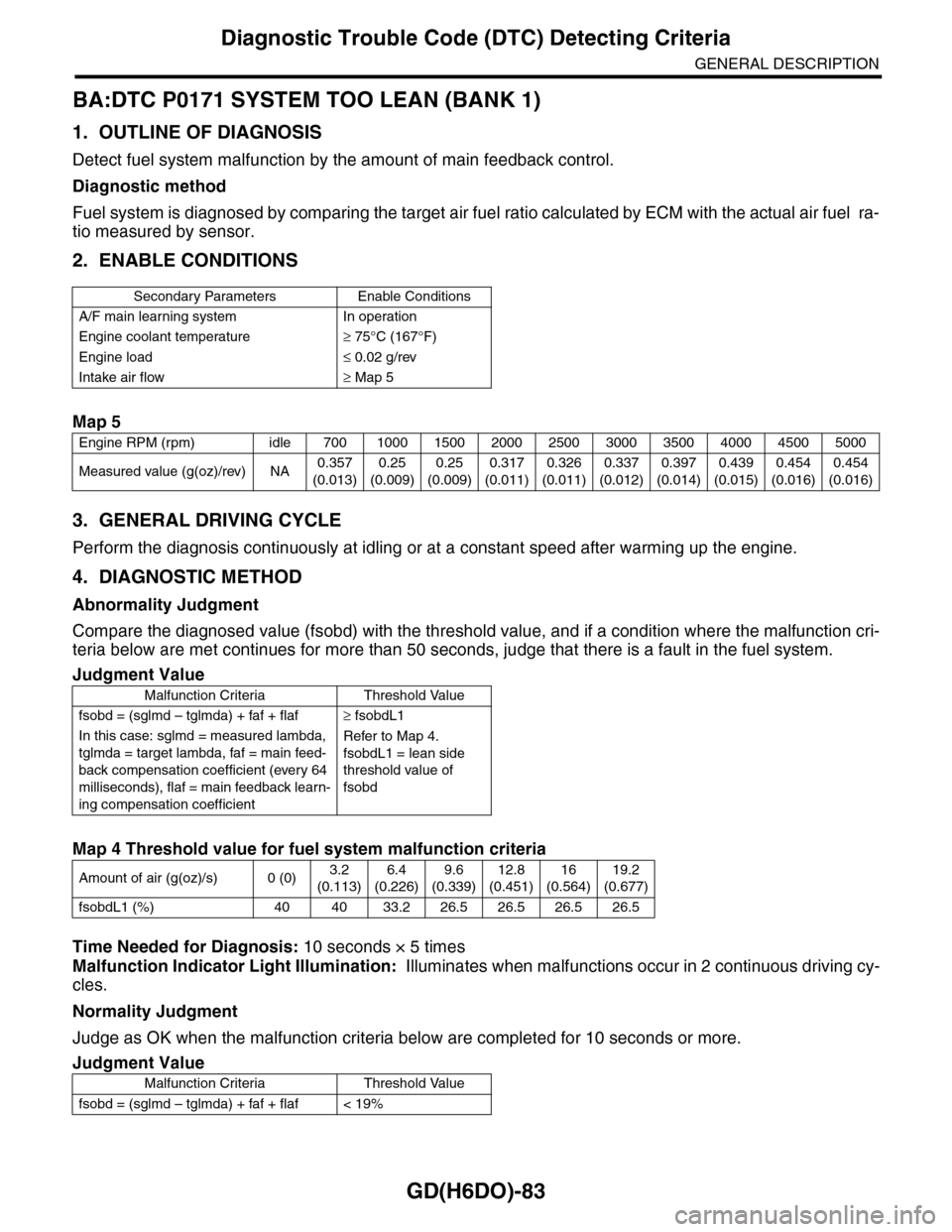
2. ENABLE CONDITIONS
3. GENERAL DRIVING CYCLE
Perform the diagnosis continuously at idling or at a constant speed after warming up the engine.
4. DIAGNOSTIC METHOD
Abnormality Judgment
Compare the diagnosed value (fsobd) with the threshold value, and if a condition where the malfunction cri-
teria below are met continues for more than 50 seconds, judge that there is a fault in the fuel system.
Time Needed for Diagnosis: 10 seconds × 5 times
Malfunction Indicator Light Illumination: Illuminates when malfunctions occur in 2 continuous driving cy-
cles.
Normality Judgment
Judge as OK when the malfunction criteria below are completed for 10 seconds or more.
Secondary Parameters Enable Conditions
A/F main learning system In operation
Engine coolant temperature≥ 75°C (167°F)
Engine load≤ 0.02 g/rev
Intake air flow≥ Map 5
Map 5
Engine RPM (rpm) idle 700 1000 1500 2000 2500 3000 3500 4000 4500 5000
Measured value (g(oz)/rev) NA0.357
(0.013)
0.25
(0.009)
0.25
(0.009)
0.317
(0.011)
0.326
(0.011)
0.337
(0.012)
0.397
(0.014)
0.439
(0.015)
0.454
(0.016)
0.454
(0.016)
Judgment Value
Malfunction Criteria Threshold Value
fsobd = (sglmd – tglmda) + faf + flaf≥ fsobdL1
In this case: sglmd = measured lambda,
tglmda = target lambda, faf = main feed-
back compensation coefficient (every 64
milliseconds), flaf = main feedback learn-
ing compensation coefficient
Refer to Map 4.
fsobdL1 = lean side
threshold value of
fsobd
Map 4 Threshold value for fuel system malfunction criteria
Amount of air (g(oz)/s) 0 (0)3.2
(0.113)
6.4
(0.226)
9.6
(0.339)
12.8
(0.451)
16
(0.564)
19.2
(0.677)
fsobdL1 (%) 40 40 33.2 26.5 26.5 26.5 26.5
Judgment Value
Malfunction Criteria Threshold Value
fsobd = (sglmd – tglmda) + faf + flaf < 19%
Page 1697 of 2453
GD(H6DO)-85
Diagnostic Trouble Code (DTC) Detecting Criteria
GENERAL DESCRIPTION
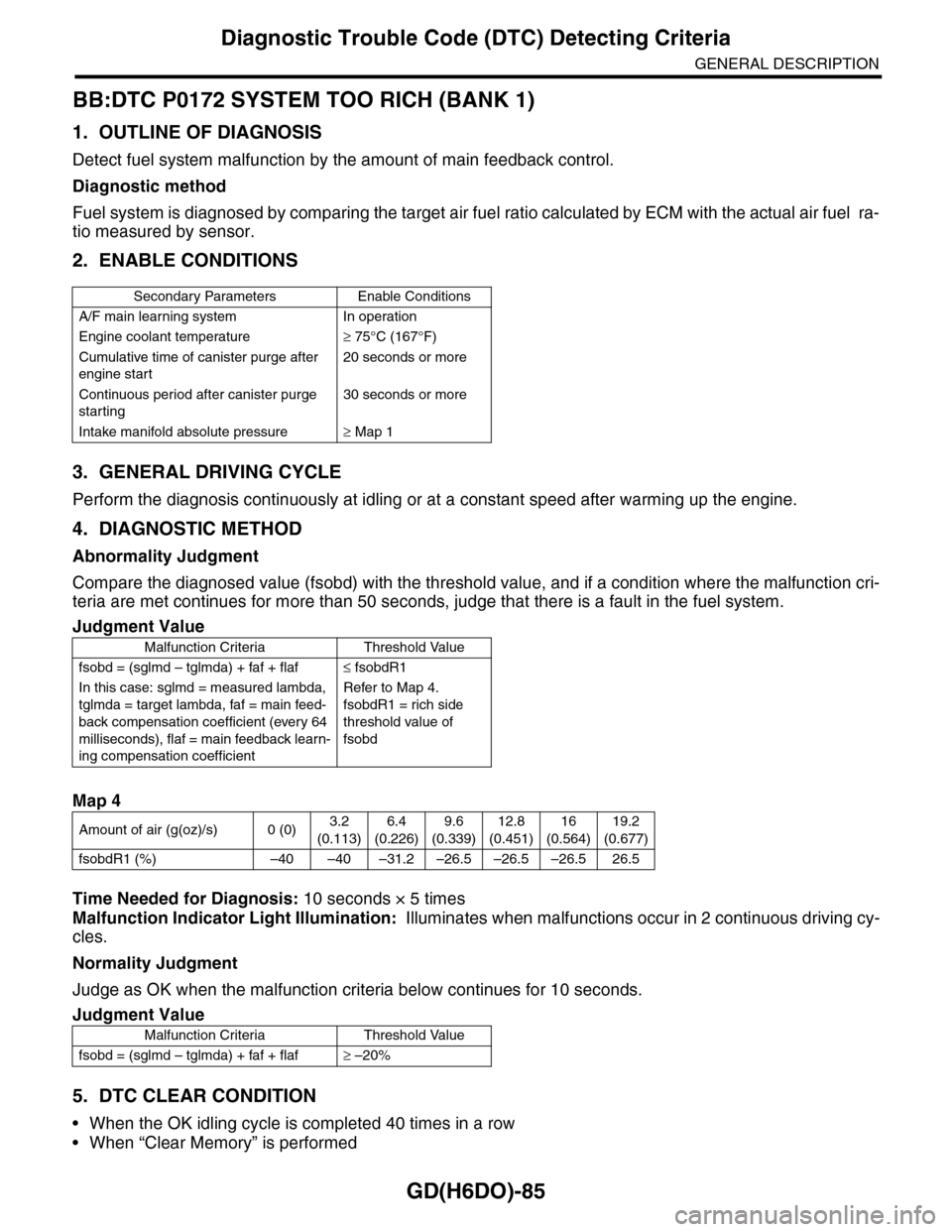
BB:DTC P0172 SYSTEM TOO RICH (BANK 1)
1. OUTLINE OF DIAGNOSIS
Detect fuel system malfunction by the amount of main feedback control.
Diagnostic method
Fuel system is diagnosed by comparing the target air fuel ratio calculated by ECM with the actual air fuel ra-
tio measured by sensor.
2. ENABLE CONDITIONS
3. GENERAL DRIVING CYCLE
Perform the diagnosis continuously at idling or at a constant speed after warming up the engine.
4. DIAGNOSTIC METHOD
Abnormality Judgment
Compare the diagnosed value (fsobd) with the threshold value, and if a condition where the malfunction cri-
teria are met continues for more than 50 seconds, judge that there is a fault in the fuel system.
Time Needed for Diagnosis: 10 seconds × 5 times
Malfunction Indicator Light Illumination: Illuminates when malfunctions occur in 2 continuous driving cy-
cles.
Normality Judgment
Judge as OK when the malfunction criteria below continues for 10 seconds.
5. DTC CLEAR CONDITION
•When the OK idling cycle is completed 40 times in a row
•When “Clear Memory” is performed
Secondary Parameters Enable Conditions
A/F main learning system In operation
Engine coolant temperature≥ 75°C (167°F)
Cumulative time of canister purge after
engine start
20 seconds or more
Continuous period after canister purge
starting
30 seconds or more
Intake manifold absolute pressure≥ Map 1
Judgment Value
Malfunction Criteria Threshold Value
fsobd = (sglmd – tglmda) + faf + flaf≤ fsobdR1
In this case: sglmd = measured lambda,
tglmda = target lambda, faf = main feed-
back compensation coefficient (every 64
milliseconds), flaf = main feedback learn-
ing compensation coefficient
Refer to Map 4.
fsobdR1 = rich side
threshold value of
fsobd
Map 4
Amount of air (g(oz)/s) 0 (0)3.2
(0.113)
6.4
(0.226)
9.6
(0.339)
12.8
(0.451)
16
(0.564)
19.2
(0.677)
fsobdR1 (%) –40 –40 –31.2 –26.5 –26.5 –26.5 26.5
Judgment Value
Malfunction Criteria Threshold Value
fsobd = (sglmd – tglmda) + faf + flaf≥ –20%
Page 1700 of 2453
GD(H6DO)-88
Diagnostic Trouble Code (DTC) Detecting Criteria
GENERAL DESCRIPTION
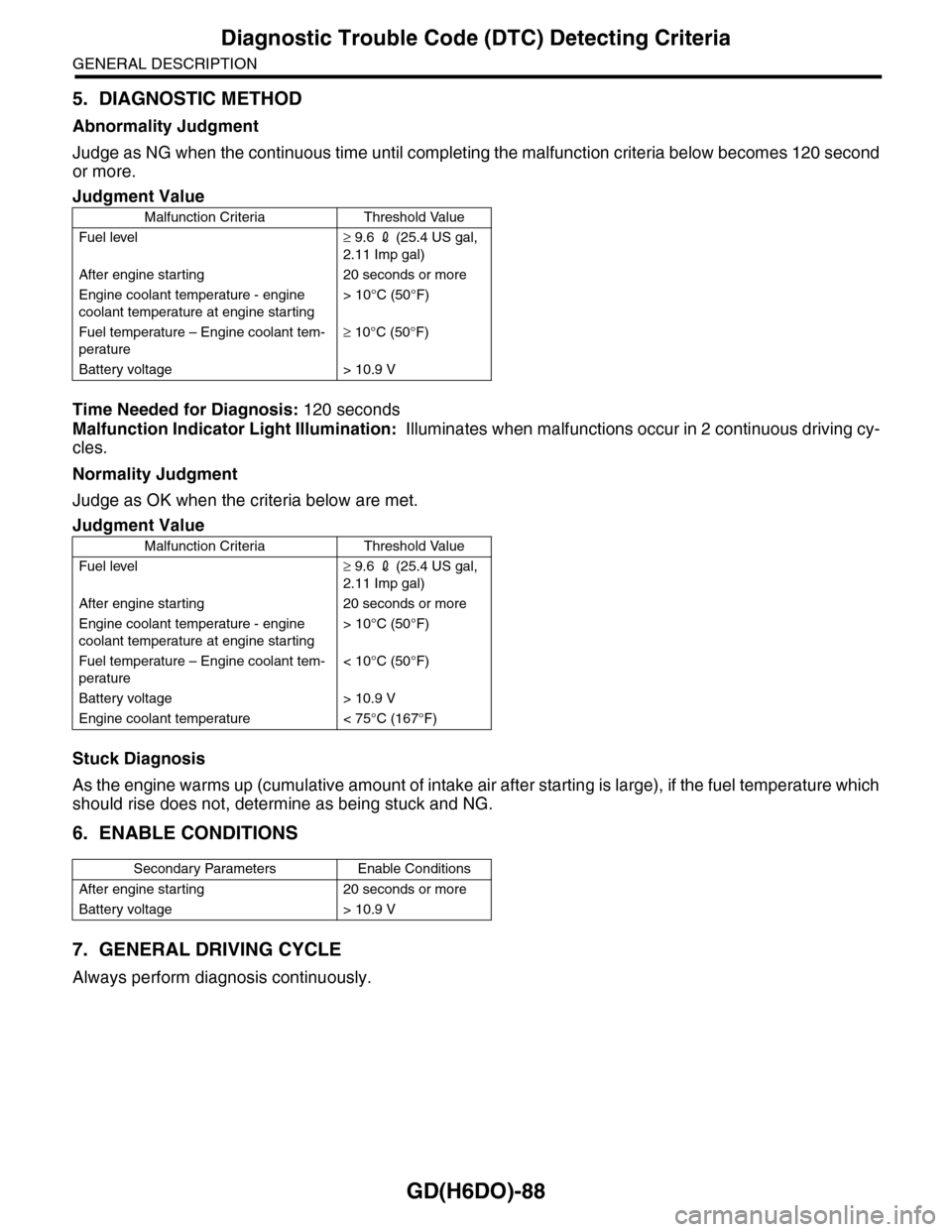
5. DIAGNOSTIC METHOD
Abnormality Judgment
Judge as NG when the continuous time until completing the malfunction criteria below becomes 120 second
or more.
Time Needed for Diagnosis: 120 seconds
Malfunction Indicator Light Illumination: Illuminates when malfunctions occur in 2 continuous driving cy-
cles.
Normality Judgment
Judge as OK when the criteria below are met.
Stuck Diagnosis
As the engine warms up (cumulative amount of intake air after starting is large), if the fuel temperature which
should rise does not, determine as being stuck and NG.
6. ENABLE CONDITIONS
7. GENERAL DRIVING CYCLE
Always perform diagnosis continuously.
Judgment Value
Malfunction Criteria Threshold Value
Fuel level≥ 9.6 2 (25.4 US gal,
2.11 Imp gal)
After engine starting 20 seconds or more
Engine coolant temperature - engine
coolant temperature at engine starting
> 10°C (50°F)
Fuel temperature – Engine coolant tem-
perature
≥ 10°C (50°F)
Battery voltage > 10.9 V
Judgment Value
Malfunction Criteria Threshold Value
Fuel level≥ 9.6 2 (25.4 US gal,
2.11 Imp gal)
After engine starting 20 seconds or more
Engine coolant temperature - engine
coolant temperature at engine starting
> 10°C (50°F)
Fuel temperature – Engine coolant tem-
perature
< 10°C (50°F)
Battery voltage > 10.9 V
Engine coolant temperature < 75°C (167°F)
Secondary Parameters Enable Conditions
After engine starting 20 seconds or more
Battery voltage > 10.9 V
Page 1701 of 2453
GD(H6DO)-89
Diagnostic Trouble Code (DTC) Detecting Criteria
GENERAL DESCRIPTION
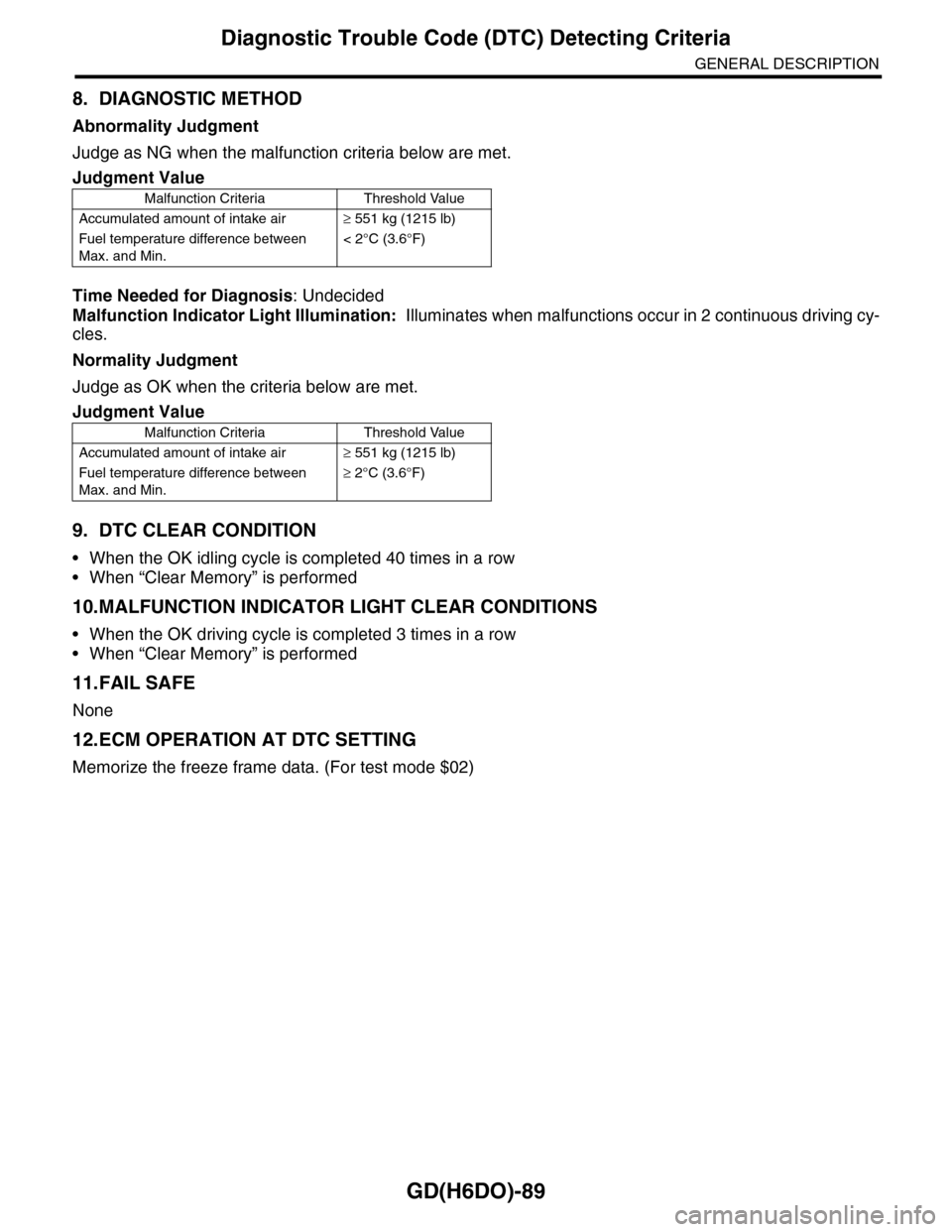
8. DIAGNOSTIC METHOD
Abnormality Judgment
Judge as NG when the malfunction criteria below are met.
Time Needed for Diagnosis: Undecided
Malfunction Indicator Light Illumination: Illuminates when malfunctions occur in 2 continuous driving cy-
cles.
Normality Judgment
Judge as OK when the criteria below are met.
9. DTC CLEAR CONDITION
•When the OK idling cycle is completed 40 times in a row
•When “Clear Memory” is performed
10.MALFUNCTION INDICATOR LIGHT CLEAR CONDITIONS
•When the OK driving cycle is completed 3 times in a row
•When “Clear Memory” is performed
11.FAIL SAFE
None
12.ECM OPERATION AT DTC SETTING
Memorize the freeze frame data. (For test mode $02)
Judgment Value
Malfunction Criteria Threshold Value
Accumulated amount of intake air≥ 551 kg (1215 lb)
Fuel temperature difference between
Max. and Min.
< 2°C (3.6°F)
Judgment Value
Malfunction Criteria Threshold Value
Accumulated amount of intake air≥ 551 kg (1215 lb)
Fuel temperature difference between
Max. and Min.
≥ 2°C (3.6°F)
Page 1720 of 2453
GD(H6DO)-108
Diagnostic Trouble Code (DTC) Detecting Criteria
GENERAL DESCRIPTION
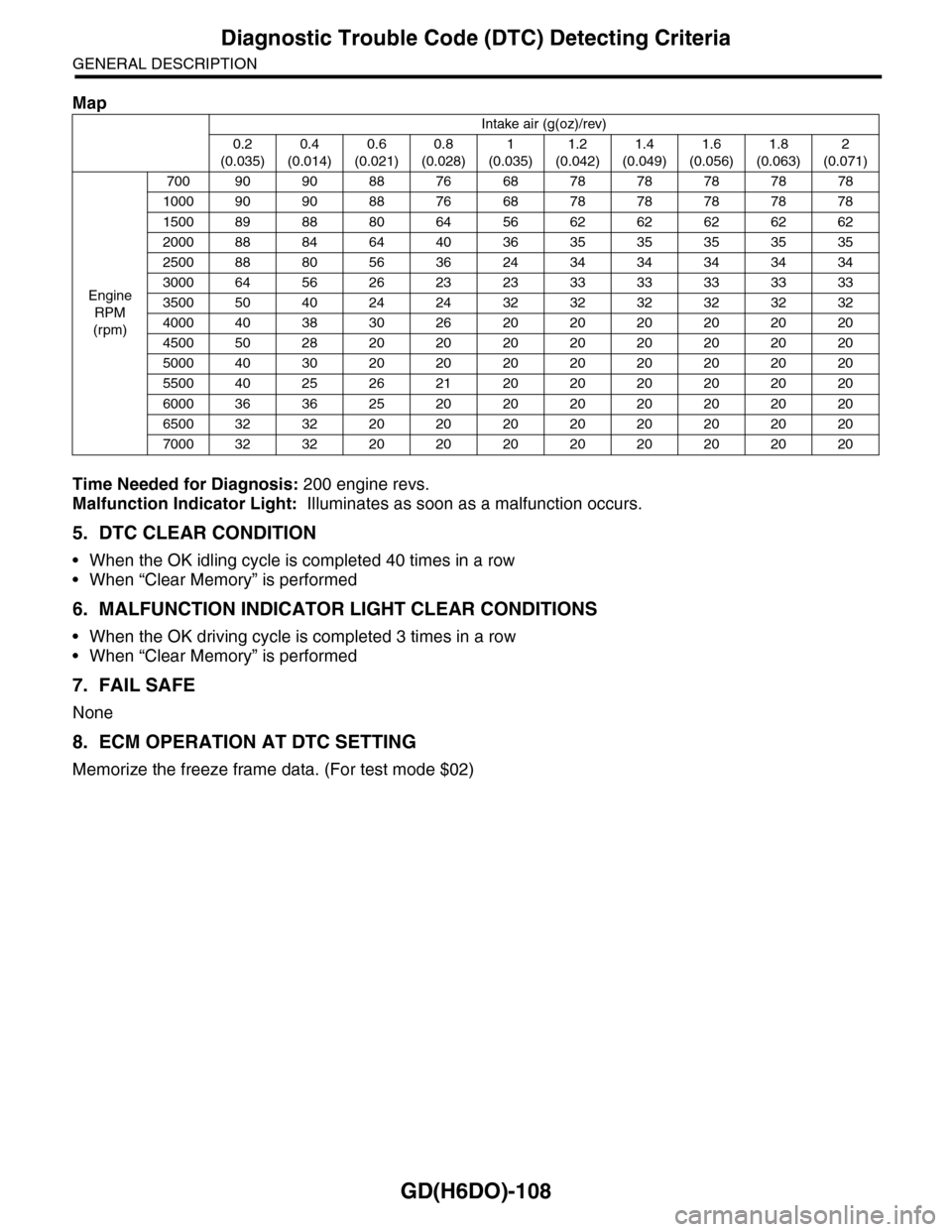
Time Needed for Diagnosis: 200 engine revs.
Malfunction Indicator Light: Illuminates as soon as a malfunction occurs.
5. DTC CLEAR CONDITION
•When the OK idling cycle is completed 40 times in a row
•When “Clear Memory” is performed
6. MALFUNCTION INDICATOR LIGHT CLEAR CONDITIONS
•When the OK driving cycle is completed 3 times in a row
•When “Clear Memory” is performed
7. FAIL SAFE
None
8. ECM OPERATION AT DTC SETTING
Memorize the freeze frame data. (For test mode $02)
Map
Intake air (g(oz)/rev)
0.2
(0.035)
0.4
(0.014)
0.6
(0.021)
0.8
(0.028)
1
(0.035)
1.2
(0.042)
1.4
(0.049)
1.6
(0.056)
1.8
(0.063)
2
(0.071)
Engine
RPM
(rpm)
700 90 90 88 76 68 78 78 78 78 78
1000 90 90 88 76 68 78 78 78 78 78
1500 89 88 80 64 56 62 62 62 62 62
2000 88 84 64 40 36 35 35 35 35 35
2500 88 80 56 36 24 34 34 34 34 34
3000 64 56 26 23 23 33 33 33 33 33
3500 50 40 24 24 32 32 32 32 32 32
4000 40 38 30 26 20 20 20 20 20 20
4500 50 28 20 20 20 20 20 20 20 20
5000 40 30 20 20 20 20 20 20 20 20
5500 40 25 26 21 20 20 20 20 20 20
6000 36 36 25 20 20 20 20 20 20 20
6500 32 32 20 20 20 20 20 20 20 20
7000 32 32 20 20 20 20 20 20 20 20