Page 241 of 2453
EB-22
Rear Gate
EXTERIOR BODY PANELS
8. Rear Gate
A: REMOVAL
1. REAR GATE PANEL
1) Remove the weather strip clip, and remove the
rear gate panel weather strip.
NOTE:
If the weather strip clip is removed with excessive
force, the weather strip may be damaged. Be sure
to use clip remover to remove.
2) Remove the rear gate trim.
MOVAL, Rear Gate Trim.>
3) Remove the rear gate garnish.
REMOVAL, Rear Gate Garnish.>
4) Remove the rear wiper arm.
REMOVAL, Rear Wiper Arm.>
5) Remove the rear wiper motor.
REMOVAL, Rear Wiper Motor.>
6) Remove the rear gate latch assembly.
SL-43, REMOVAL, Rear Gate Latch Assembly.>
7) Detach the roof spoiler.
AL, Roof Spoiler.>
8) Remove the roof trim, and disconnect connector
from the rear gate harness connector.
50, REMOVAL, Roof Trim.>
9) Disconnect the ground cable from battery.
10) Remove harness clip of each connector from
the rear gate panel.
11) Remove the rubber duct (A) connection, and
pull out the harness and washer hose from the rear
gate.
12) Before removing the rear gate damper stay,
prevent the rear gate from closing using prop or the
like.
CAUTION:
If the prop comes off, operators may get injured
and vehicle may get damaged. Make sure to
support the rear gate with secure material to
prevent injury or damage.
13) Remove the mounting bolt of rear gate damper
stay.
EB-00280
EB-00141
(A)
EB-00020
EB-00281
EB-00282
Page 242 of 2453
EB-23
Rear Gate
EXTERIOR BODY PANELS
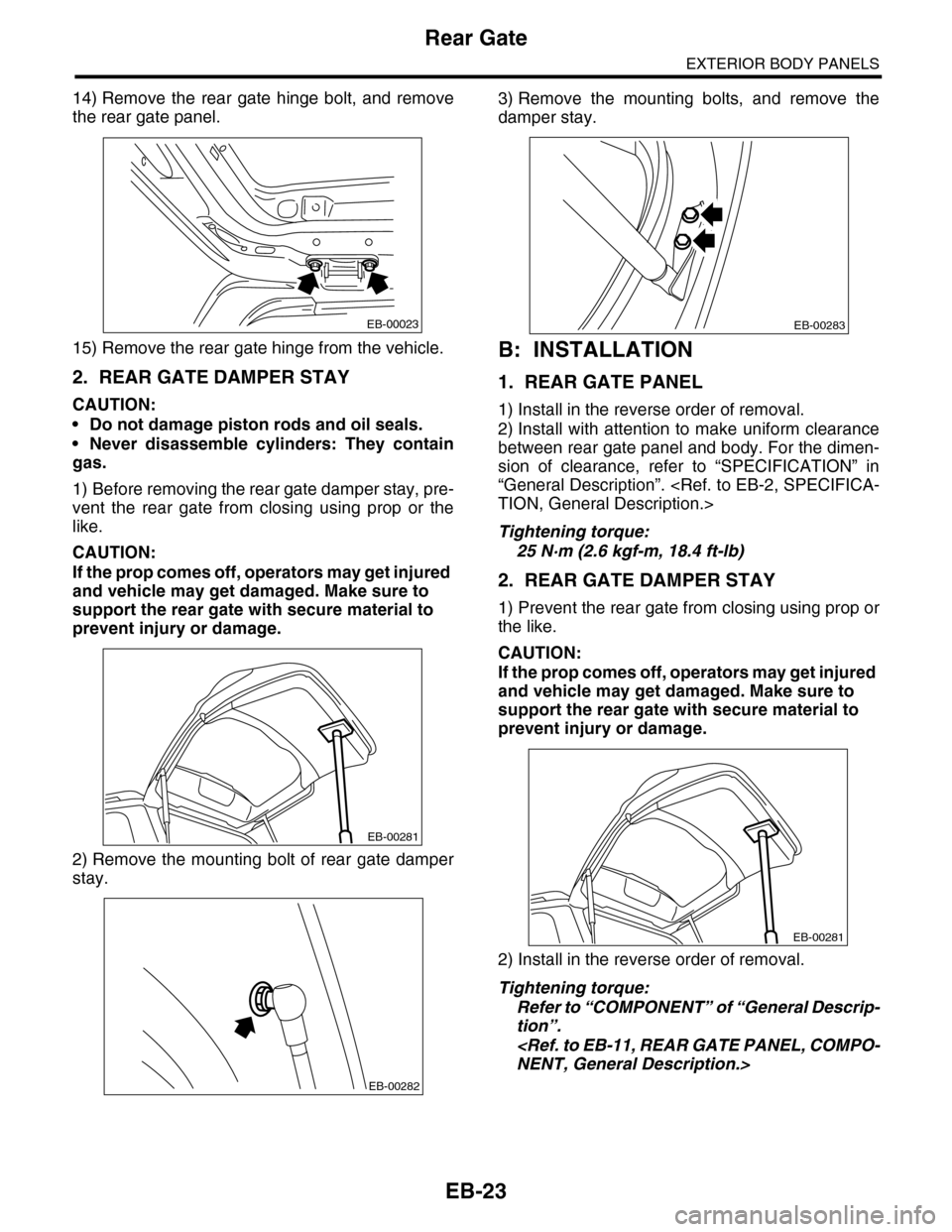
14) Remove the rear gate hinge bolt, and remove
the rear gate panel.
15) Remove the rear gate hinge from the vehicle.
2. REAR GATE DAMPER STAY
CAUTION:
•Do not damage piston rods and oil seals.
•Never disassemble cylinders: They contain
gas.
1) Before removing the rear gate damper stay, pre-
vent the rear gate from closing using prop or the
like.
CAUTION:
If the prop comes off, operators may get injured
and vehicle may get damaged. Make sure to
support the rear gate with secure material to
prevent injury or damage.
2) Remove the mounting bolt of rear gate damper
stay.
3) Remove the mounting bolts, and remove the
damper stay.
B: INSTALLATION
1. REAR GATE PANEL
1) Install in the reverse order of removal.
2) Install with attention to make uniform clearance
between rear gate panel and body. For the dimen-
sion of clearance, refer to “SPECIFICATION” in
“General Description”.
TION, General Description.>
Tightening torque:
25 N·m (2.6 kgf-m, 18.4 ft-lb)
2. REAR GATE DAMPER STAY
1) Prevent the rear gate from closing using prop or
the like.
CAUTION:
If the prop comes off, operators may get injured
and vehicle may get damaged. Make sure to
support the rear gate with secure material to
prevent injury or damage.
2) Install in the reverse order of removal.
Tightening torque:
Refer to “COMPONENT” of “General Descrip-
tion”.
NENT, General Description.>
EB-00023
EB-00281
EB-00282
EB-00283
EB-00281
Page 243 of 2453
EB-24
Rear Gate
EXTERIOR BODY PANELS
C: DISPOSAL
1. REAR GATE DAMPER STAY
CAUTION:
Gas is colorless, odorless, and harmless. How-
ever, gas pressure may spray cutting powder or
oil. Be sure to wear dust-resistant goggles.
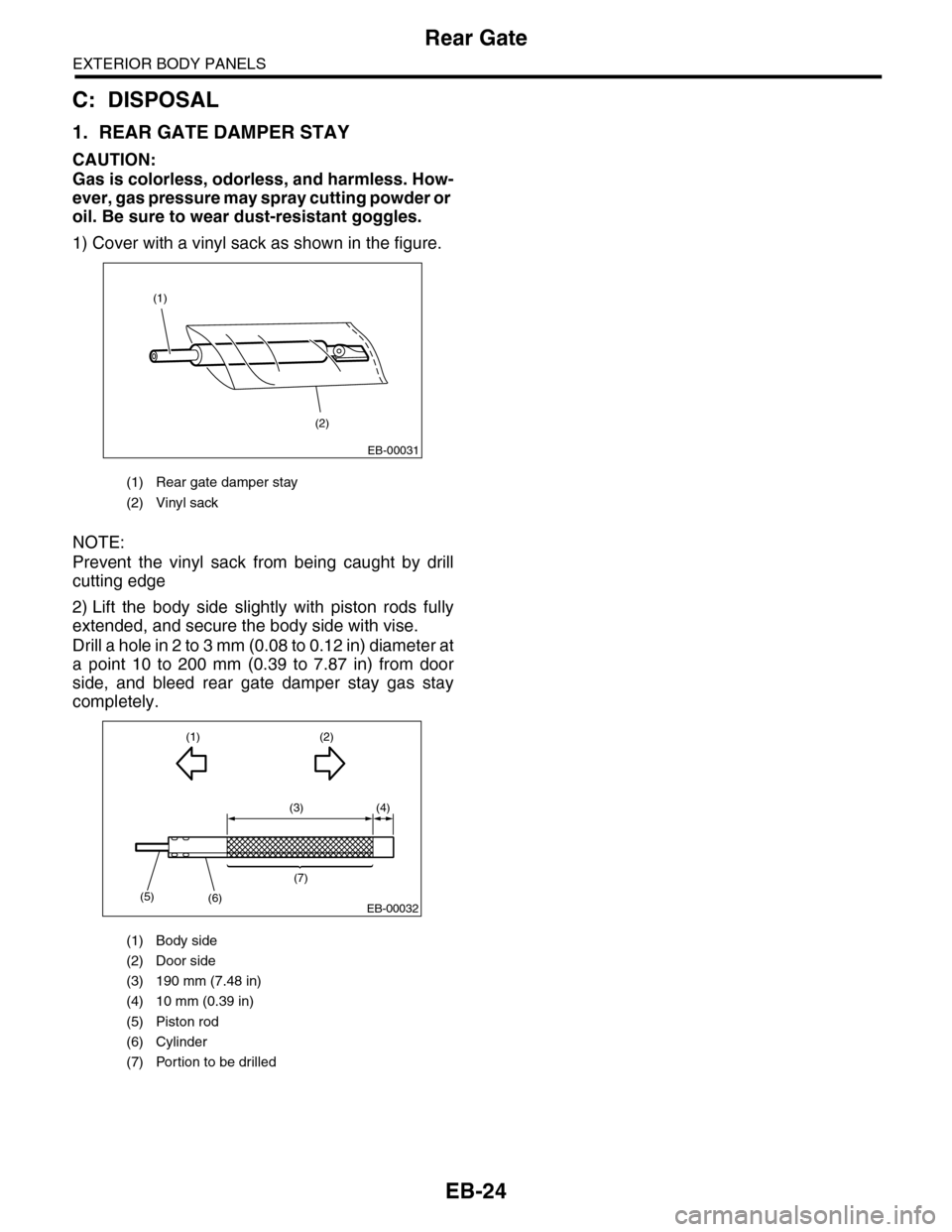
1) Cover with a vinyl sack as shown in the figure.
NOTE:
Prevent the vinyl sack from being caught by drill
cutting edge
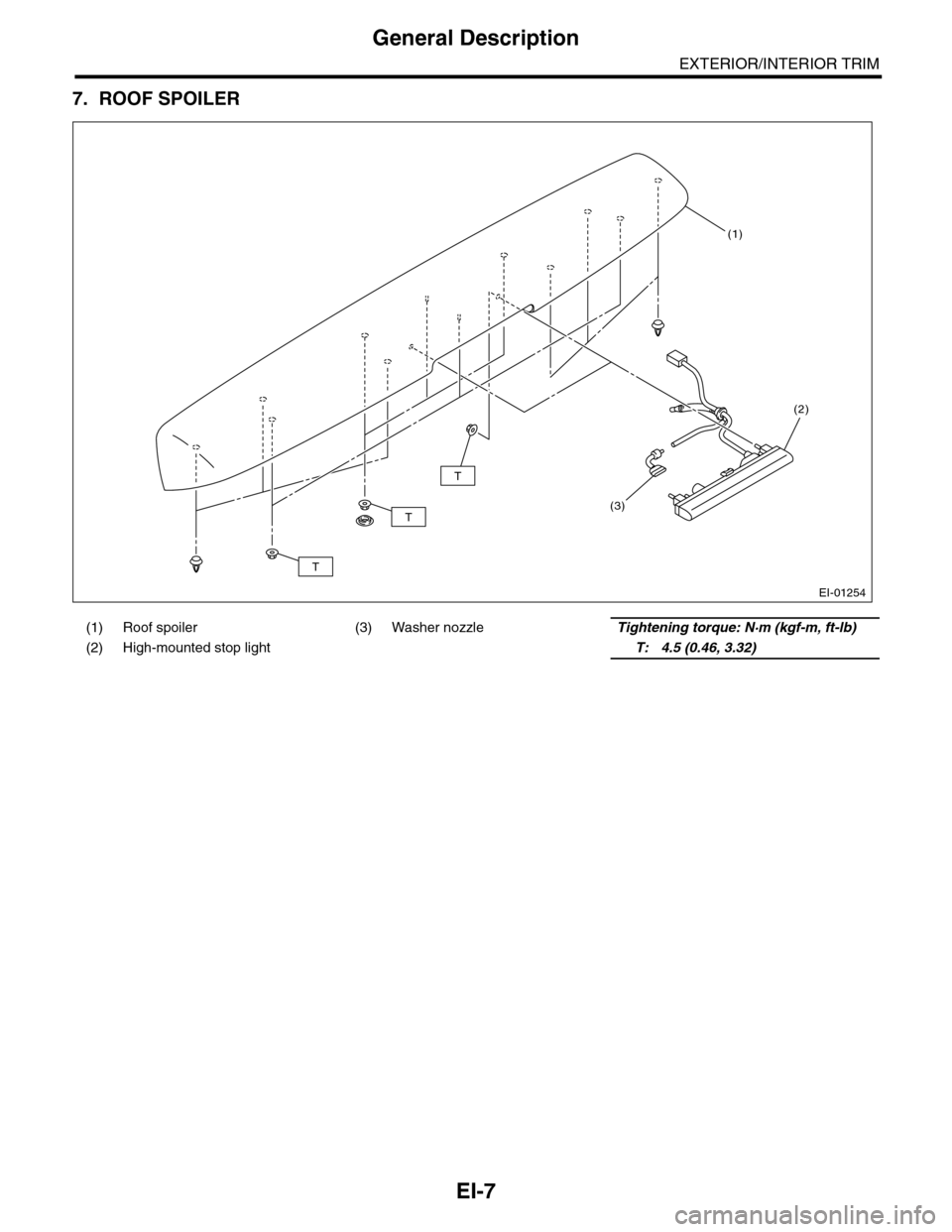
2) Lift the body side slightly with piston rods fully
extended, and secure the body side with vise.
Drill a hole in 2 to 3 mm (0.08 to 0.12 in) diameter at
a point 10 to 200 mm (0.39 to 7.87 in) from door
side, and bleed rear gate damper stay gas stay
completely.
(1) Rear gate damper stay
(2) Vinyl sack
(1) Body side
(2) Door side
(3) 190 mm (7.48 in)
(4) 10 mm (0.39 in)
(5) Piston rod
(6) Cylinder
(7) Portion to be drilled
(1)
(2)
EB-00031
(3) (4)
(1)
(5)(6)
(7)
(2)
EB-00032
Page 249 of 2453
EI-7
General Description
EXTERIOR/INTERIOR TRIM
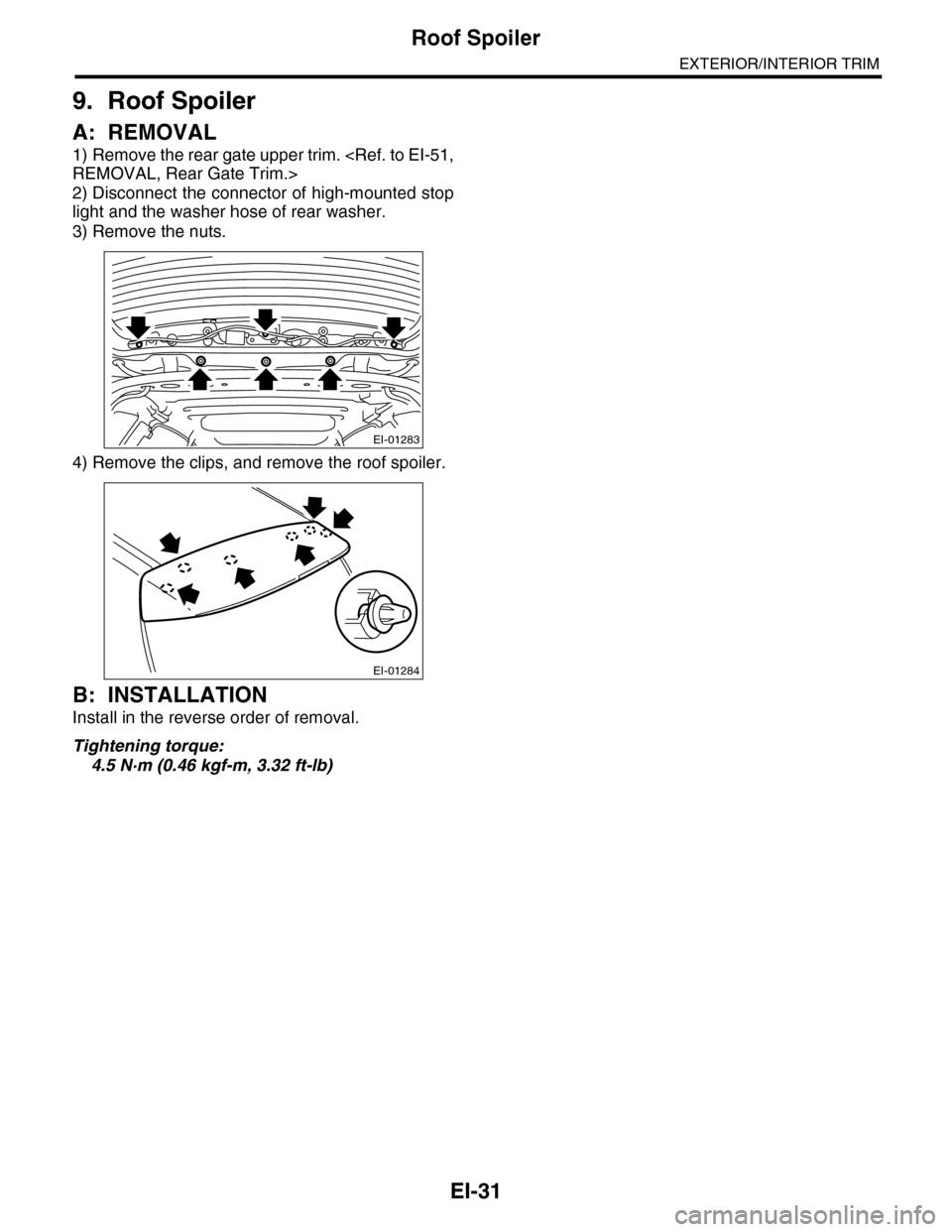
7. ROOF SPOILER
(1) Roof spoiler (3) Washer nozzleTightening torque: N·m (kgf-m, ft-lb)
(2) High-mounted stop light T: 4.5 (0.46, 3.32)
EI-01254
T
T
T
(2)
(3)
(1)
Page 265 of 2453

EI-23
Front Bumper
EXTERIOR/INTERIOR TRIM
C: REPAIR
1. COATING METHOD FOR PP BUMPER
Process
No.Process name Job contents
1Bumper installation
Place the bumper on a paint worktable as
required. Use the paint worktable conforming
to inner shape of bumper if possible.
(1) Bumper
(2) Set bumper section
2MaskingMask specified part (black base) with masking tape. Use masking tape for PP (example,
Nichiban No. 533, etc. ).
3Degreasing/cleaningClean all parts to be painted with white gasoline, normal alcohol, etc. to remove dirt, oil, fat, etc.
4Primer paint Apply primer to all parts to be painted, using spray gun. Use primer (clear).
5Drying
Dry at normal temperature [10 — 15 min. at 20°C (68°F)].
In half-dried condition, PP primer paint is dissolved by solvent, e.g. thinner, etc.
Therefore, if dust or dirt must be removed, use ordinary alcohol etc.
6Top coat paint (I)
Non-colored Metallic paint
Use section (block) paint for top coat.
•Paint to be used (for each color):
Solid paint
Hardener PB
Thinner T-301
•Mixture ratio:
Main agent vs. hardener = 4:1
• Viscosity: 10 — 13 sec./20°C (68°F)
•Film thickness: 35 — 45 µ
•Spraying pressure: 245 — 343 kPa
(2.5 — 3.5 kg/cm2, 36 — 50 psi)
Use section (block) paint for top coat.
•Paint to be used (for each color):
Metallic paint
Hardener PB
Thinner T-306
•Mixture ratio:
Main agent vs. hardener = 10:1
•Viscosity: 10 — 13 sec./20°C (68°F)
•Film thickness: 15 — 20 µ
•Spraying pressure: 245 — 343 kPa
(2.5 — 3.5 kg/cm2, 36 — 50 psi)
7Drying Not required.
Dry at normal temperature [at least 10 min. at
20°C (68°F)].
In half-dried condition, avoid dust, dirt.
8Top coat paint (II)Not required.
Apply a clear coat to parts with top coat paint
(I), three times at 5 — 7 minutes intervals.
•Paint to be used:
Metallic paint
Hardener PB
Thinner T-301
•Mixture ratio:
Clear coat vs. hardener = 6:1
•Viscosity: 14 — 16 sec./20°C (68°F)
•Film thickness: 25 — 30 µ
•Spraying pressure: 245 — 343 kPa
(2.5 — 3.5 kg/cm2, 36 — 50 psi)
9Drying
60°C (140°F), 60 min. or 80°C (176°F), 30 min.
If higher than 80°C (176°F), PP may become be deformed. Keep maximum temperature below
80°C (176°F).
10 Inspection Check paint.
11 Removal of masking Remove the masking tape applied in procedure 2.
EI-00234(2)
(1)
Page 267 of 2453

EI-25
Front Bumper
EXTERIOR/INTERIOR TRIM
3) Deep damage such as a break or hole that requires filling
Much of the peripheral grained surface must be sacrificed for repair. The degree of restoration is not really
worth the expense. (The surface, however, will become almost flush with adjacent areas. )
Recommended repair kit: PP Part Repair Kit (NRM)
Process
No.Process name Job contents
1Bumper removalRemove the bumper as required.
2Removal of partsRemove the parts built into bumper as required.
3Bumper placement
Place the bumper on a paint worktable as
required.
It is recommended to use the paint worktable
conforming to internal shape of bumper.
(1) Bumper
(2) Set bumper section
4Surface prepara-
tion
Remove dust, oil, etc. from areas to be repaired and surrounding areas, using a suitable solvent
(NRM No. 900 Precleno, white gasoline, or alcohol, etc.).
5Cutting
If the damage is a crack or a hole, cut a guide
slit of 20 to 30 mm (0.79 to 1.18 in) in length
along the crack or hole up to the bumper base
surface. Next, use a knife or grinder to carve a
V- s h a p e d g r o o ve i n t h e a r e a f o r r e p a i r.
(1) Paint surface
(2) PP base surface
(3) 20 — 30 mm (0.79 — 1.18 in)
(4) 3 mm (0.12 in)
6Sanding (I) Grind beveled surface with sand paper (#40 — #60) to smooth finish.
7Cleaning Clean the sanded surface with the same solvent as used in Procedure 4.
8Temporary welding
Grind the side just opposite the beveled area with sand paper (#40 — #60) and clean using a
solvent.
Te m p o r a r i l y s p o t - w e l d t h e s i d e , u s i n g P P w e l d i n g r o d a n d h e a t e r g u n .
(1) Welded point (Use heater gun and PP welding rod)
(2) PP base surface
(3) Beveled section
NOTE:•Do not melt welding rod until it flows out. This results in reduced strength.
•Leave the welded spot unattended until it cools completely.
EI-00234(2)
(1)
EI-00235
(4)(2)
(1)(3)
EI-00236
(1)
(2)
(3)
Page 273 of 2453
EI-31
Roof Spoiler
EXTERIOR/INTERIOR TRIM
9. Roof Spoiler
A: REMOVAL
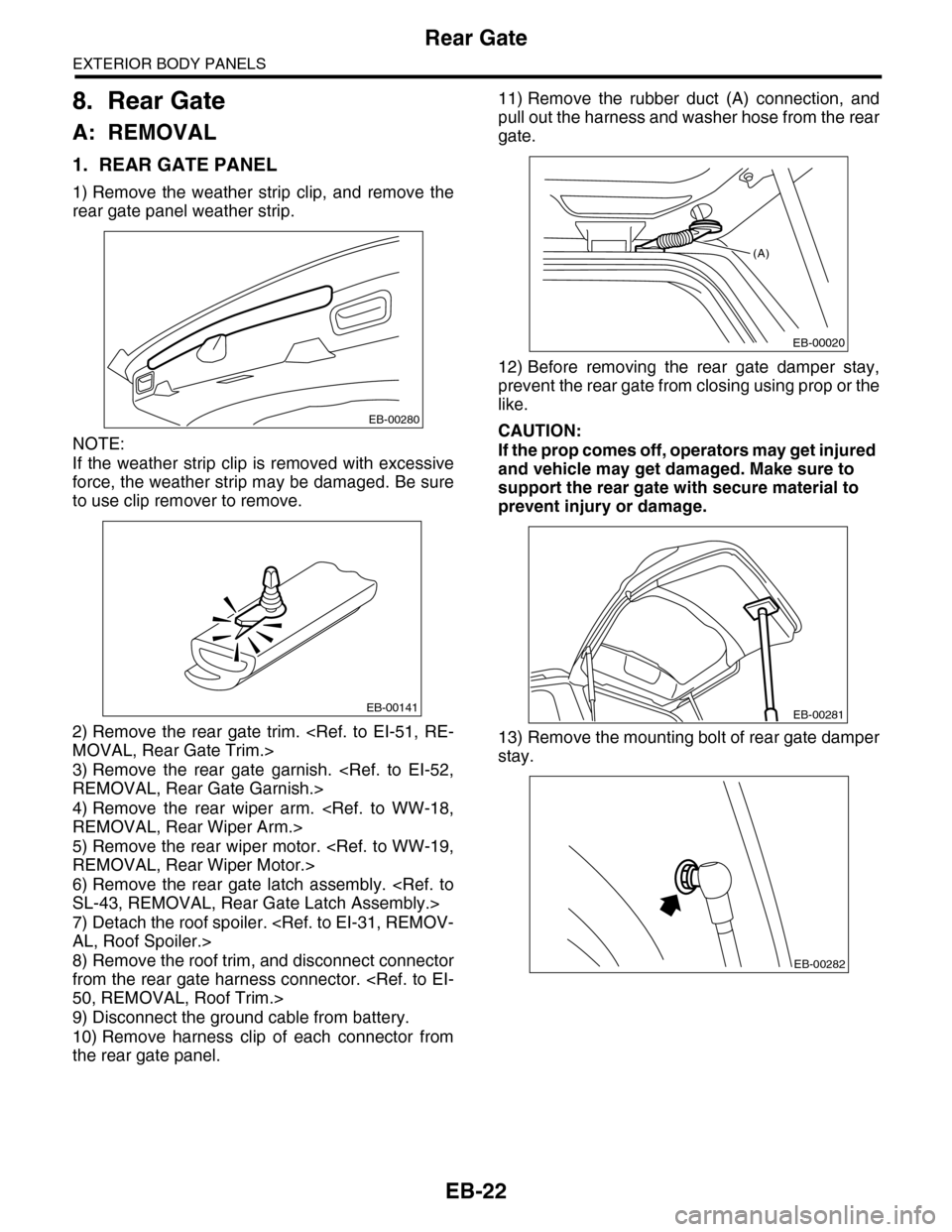
1) Remove the rear gate upper trim.
REMOVAL, Rear Gate Trim.>
2) Disconnect the connector of high-mounted stop
light and the washer hose of rear washer.
3) Remove the nuts.
4) Remove the clips, and remove the roof spoiler.
B: INSTALLATION
Install in the reverse order of removal.
Tightening torque:
4.5 N·m (0.46 kgf-m, 3.32 ft-lb)
EI-01283
EI-01284
Page 274 of 2453

EI-32
Side Garnish
EXTERIOR/INTERIOR TRIM
10.Side Garnish
A: REMOVAL
1) Remove the clip on the bottom side of the vehi-
cle body, and the clip that is attached with the front
and rear mudguards.
2) Remove the double sided tape and the clip on
the vehicle side, and remove the side sill spoiler.
(1) Insert a thin piece of string (A) of 0.8 mm
(0.031 in) (fishing line, etc.) between the vehicle
body and the door garnish.
(2) Cut the double sided tape, and remove the
clip using a clip remover.
NOTE:
•To optimize the effect of solvent, slide the thread
along body without removing the double-sided tape
on the surface of body and spoiler.
•If it is difficult to remove the double-sided tape,
warm it up to approx. 40°C (104°F).
•If the double-sided tape remains thick on the sur-
face due to interfacial peeling, apply solvent after
slicing off the double-sided tape using a cutter.
(1) Front fender garnish (3) Rear door garnish (5) Rear quarter garnish
(2) Front door garnish (4) Side sill garnish (6) Garnish end cover
EI-01256
(1)
(2)
(3)
(6)
(4)
(5)
EI-00153
(A)
(A) Panel
(B) Door garnish
(C) Double-sided tape
EI-00478
(A) (B) (C)