2007 MITSUBISHI LANCER EVOLUTION Leak
[x] Cancel search: LeakPage 417 of 1449

ENGINE -On-vehicle ServiceENGINE -On-vehicle ServiceENGINE -On-vehicle Service11A-11
10. Turn the ignition switch to the “LOCK” (OFF) position
and then remove the MUT-II.
COMPRESSION PRESSURE CHECK
1. Before inspection, check that the engine oil, starter and
battery are normal. In addition, set the vehicle to the
pre-inspection condition.
2. Remove the ignition coils and spark plug cables.
3. Remove all of the spark plugs.
4. Disconnect the crank angle sensor connector.
NOTE
Doing this will prevent the engine-ECU from carrying out
ignition and fuel injection.
5. Cover the spark plug hole with a shop towel etc., and
after the engine has been cranked, check that no foreign
material is adhering to the shop towel.
Caution
(1) Keep away from the spark plug hole when
cranking.
(2) If compression is measured with water, oil, fuel,
etc., that has come from cracks inside the cylinder,
these materials will become heated and will gush
out from the spark plug hole, which is dangerous.
6. Set compression gauge to one of the spark plug holes.
7. Crank the engine with the throttle valve fully open and
measure the compression pressure.
Standard value (at engine speed of 250 r/min):
1,128 kPa
Limit (at engine speed of 250 r/min):
Min. 951 kPa
8. Measure the compression pressure for all the cylinders,
and check that the pressure differences of the cylinders are
below the limit.
Limit: Max. 98 kPa
9. If there is a cylinder with compression or a compression
difference that is outside the limit, pour a small amount
of engine oil through the spark plug hole, and repeat
the operations in steps 7 and 8.
(1) If the compression increases after oil is added, the
cause of the malfunction is a worn or damaged piston
ring and/or cylinder inner surface.
(2) If the compression does not rise after oil is added,
the cause is a burnt or defective valve seat, or pressure
is leaking from the gasket.
10. Connect the crank angle sensor connector.
11. Install the spark plugs.
Crank angle sensor
connector
Page 434 of 1449

ENGINE -Cylinder Head Gasket11A-28
CYLINDER HEAD GASKET
REMOVAL AND INSTALLATION
Caution
If the vehicle is equipped with the Brembo disc brake, during maintenance, take care not to contact
the parts or tools to the caliper because the paint of caliper will be scratched.
Pre-removal and Post-installation Operation
DFuel Outflow Preventive Operation (Refer to GROUP 13A - On-vehicle Service.)
DFuel Leak Check
DStrut Tower Bar Removal and Installation (Refer to GROUP 42.)
DUnder Cover Removal and Installation (Refer to GROUP 51 - Front Bumper.)
DDrive Belt Tension Check (Refer to P.11A-7.)
DAccelerator Cable Adjustment (Refer to GROUP 17 - On-vehicle Service.)
DDrainage and Refilling Engine Oil (Refer to GROUP 12 - On-vehicle Service.)
DDrainage and Refilling of Engine Coolant (Refer to GROUP 14 - On-vehicle Service.)
DAir Cleaner Assembly Removal and Installation (Refer to GROUP 15.)
DAir Hose E, Air Pipe C, Air hose D Removal and Installation (Refer to GROUP 15 - Intercooler.)
DBattery Removal and Installation
DCenter Cover Removal and Installation (Refer to P.11A-17.)
DAccelerator Cable Removal and Installation (Refer to GROUP 17.)
DRadiator Removal and Installation (Refer to GROUP 14.)
DSecondary Air Control Valve Bracket Removal and Installation (Refer to GROUP 15 - Secondary Air Supply System.)
DCrossmember Bar Removal and Installation (Refer to GROUP32 - Engine Roll Stopper, Centermember.)
DFront Exhaust Pipe Removal and Installation (Refer to GROUP 15.)
DStarter Removal and Installation (Refer to GROUP 16.)
DTiming Belt Removal and Installation (Refer to P.11A-34.)
Page 448 of 1449
ENGINE -Timing belt and timing belt B11A-42
INSPECTION
AUTO-TENSIONER CHECK
1. Check the sealant for oil leakage and replace if necessary.
2. Check the rod end for wear or damage and replace if
necessary.
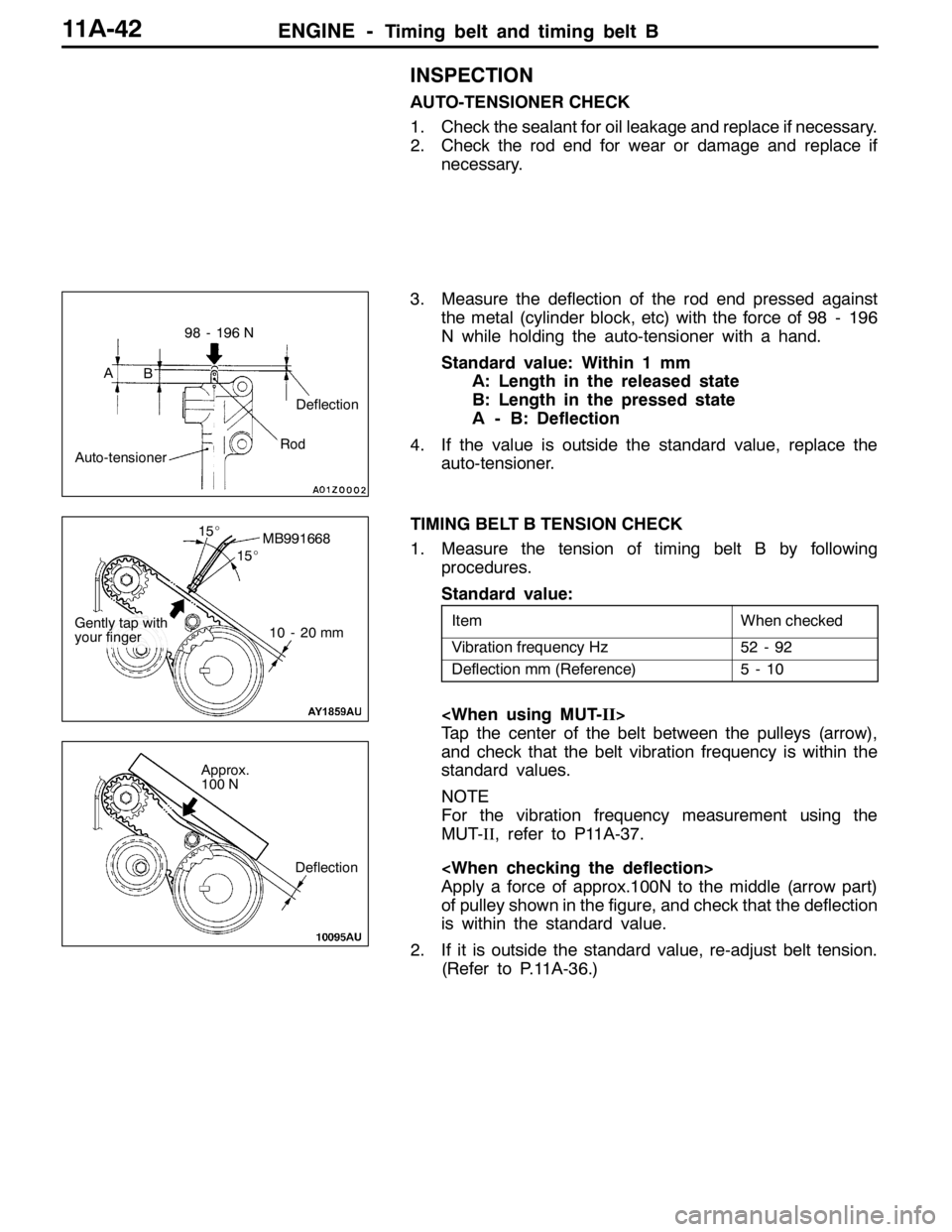
3. Measure the deflection of the rod end pressed against
the metal (cylinder block, etc) with the force of 98 - 196
N while holding the auto-tensioner with a hand.
Standard value: Within 1 mm
A: Length in the released state
B: Length in the pressed state
A - B: Deflection
4. If the value is outside the standard value, replace the
auto-tensioner.
TIMING BELT B TENSION CHECK
1. Measure the tension of timing belt B by following
procedures.
Standard value:
ItemWhen checked
Vibration frequency Hz52 - 92
Deflection mm (Reference)5-10
Tap the center of the belt between the pulleys (arrow),
and check that the belt vibration frequency is within the
standard values.
NOTE
For the vibration frequency measurement using the
MUT-II, refer to P11A-37.
Apply a force of approx.100N to the middle (arrow part)
of pulley shown in the figure, and check that the deflection
is within the standard value.
2. If it is outside the standard value, re-adjust belt tension.
(Refer to P.11A-36.)
AB
Auto-tensioner
98 - 196 N
Deflection
Rod
MB991668
10 - 20 mm
15_
15_
Gently tap with
your finger
Deflection
Approx.
100 N
Page 449 of 1449

ENGINE -Engine Assembly11A-43
ENGINE ASSEMBLY
REMOVAL AND INSTALLATION
Caution
1. If the vehicle is equipped with the Brembo disc brake, during maintenance, take care not to
contact the parts or tools to the caliper because the paint of caliper will be scratched.
2. Tightening sections indicated in the mark (*) should be finally tightened with engine weight
applied on the body after lightly tightening.
Pre-removal and Post-installation Operation
DFuel Outflow Preventive Operation (Refer to GROUP 13A - On-vehicle Service.)
DFuel Leak Check
DRemoval and Installation of Hood (Refer to GROUP 42.)
DRemoval and Installation of Strut Tower Bar (Refer to GROUP 42.)
DRemoval and Installation of Under Cover (Refer to GROUP 51 - Front Bumper.)
DRemoval and Installation of Side Cover.
DDrive Belt Tension Check (Refer to P.11A - 7.)
DAccelerator Cable Adjustment (Refer to GROUP 17 - On-vehicle Service.)
DDrainage and Refilling Engine Oil(Refer to GROUP 12 - On-vehicle Service.)
DDrainage and Refilling of Engine Coolant (Refer to GROUP 14 - On-vehicle Service.)
DAir Cleaner Removal and Installation (Refer to GROUP 15)
DRemoval and Installation of Air Pipe C, Air Pipe B and Air Hose A (Refer to GROUP 15 - Intercooler.)
DBattery and Battery Tray Removal and Installation
DRemoval and Installation of Center Cover (Refer to P.11A - 17.)
DRemoval and Installation of Accelerator Cable (Refer to GROUP 17.)
DRemoval and Installation of Radiator (Refer to GROUP 14.)
DRemoval and Installation of Crossmember Bar (Refer to GROUP 32 - Engine Roll Stopper, Centermember.)
DRemoval and Installation of Front Exhaust Pipe (Refer to GROUP 15.)
DRemoval and Installation of Air Outlet Fitting (Refer to GROUP 15 - Exhaust manifold.)
Page 462 of 1449

ENGINE OVERHAUL -Specifications11B-8
SEALANTS
ItemSpecified sealantQuantity
Engine support bracket bolt3MTMAAD Part No. 8672 or equivalentAs required
Semi-circular packing3MTMAAD Part No. 8672 or equivalentAs required
Rocker cover3MTMAAD Part No. 8672 or equivalentAs required
Water outlet fittingMitsubishi Genuine Part No. MD970389 or
equivalentAs required
Engine coolant temperature gauge unit3MTMAAD Part No. 8672 or equivalentAs required
Engine coolant temperature sensor3MTMAAD Part No. 8672 or equivalentAs required
Cylinder head (camshaft bearing cap mounting
section)3MTMAAD Part No. 8672 or equivalentAs required
Cam position sensor supportMitsubishi Genuine Part No. MD970389 or
equivalentAs required
Oil pressure switch3MTMAAD Part No. 8672 or equivalentAs required
Oil panMitsubishi Genuine Part No. MD970389 or
equivalentAs required
Oil seal caseMitsubishi Genuine Part No. MD970389 or
equivalentAs required
FORM-IN-PLACE-GASKET
FIPG is used for several members of this engine. With this gasket, caution is required to the application
amount, application procedure and state of the application surface so that the performance is sufficiently
attained.
If sufficient gasket is not applied, leaks could occur, and if too much is applied, the gasket could protrude
and plug or restrict the oil and water flow passage. Thus, to prevent leaks from the joined sections,
it is absolutely necessary to evenly apply the correct amount.
The FIPG used for the engine parts reacts with moisture in the air and hardens so use it for the normal
metal flange parts.
DISASSEMBLY
The parts assembled with FIPG can be easily disassembled without special means. However, in some
cases, the sealant on the seams must be broken by lightly tapping with a wood hammer or similar tool.
A smooth and thin gasket scraper can be lightly tapped into the seams but in this case, take care not
to damage the seams.
The special tool oil pan remover (MD998727) is set for this purpose.
WASHING THE GASKET SURFACE
Completely remove all matters adhered on the gasket surfaces with a gasket scraper or wire brush.
Confirm that the FIPG application surface is smooth. There must be no grease or foreign matter on
the gasket surface.
Always remove the old FIPG that has entered the mounting holes and screw holes.
APPLICATION PROCEDURES
Apply an even coat of FIPG within the predetermined radius. Completely cover the areas around the
mounting holes. The FIPG can be wiped off if it has not hardened. Install at the set position while the
FIPG is still wet (within 15 minutes). When installing, maker sure that the FIPG does not get on areas
other than the required areas. After installing, do not subject the application areas to oil or water or
start the engine until the FIPG has sufficiently hardened (approx. one hour). The FIPG application procedures
differ according to the member, so follow the procedures given in this manual and apply the FIPG.
Page 478 of 1449

ENGINE OVERHAUL -Timing Belt11B-24
INSPECTION
1. TIMING BELT
Inspect each section of the belt in detail, and if any of
the following type of damage is found, replace the belt
with a new part.
(1) Hardening of backface rubber.
The backface is glossy, marks are not made even
when a fingernail is run cross it, and there is no
elasticity.
(2) Cracking of backface rubber.
(3) Cracking of canvas.
(4) Cracking at root.
(5) Cracking on side of belt.
(6) Abnormal wear on side of belt.
NOTE
The state is normal if the cutting surface is neat as
if cut with a sharp knife.
(7) Abnormal wear of teeth.
First stages: Canvas is worn (canvas fibres are raised,
rubber is removed and whitish, and canvas seams
are unclear).
Latter stages: Canvas is worn off, and rubber is
exposed (face width is narrow).
(8) Teeth are missing.
2. AUTO TENSIONER
(1) Check for oil leaks. If any leaks are found, replace.
(2) Check whether the rod end is worn or damaged,
and replace if necessary.
(3) Measure the rod protrusion length. If not at the
standard value, replace the auto tensioner.
Standard value: 12 mm
Crack
Crack
Peeling of canvas
Cracking
on side
Cracking at root
Edges are rounded
Abnormal wear
(The core wires are frayed.)
Rubber exposed due to
worn canvas
Teeth are missing
12 mm
Page 497 of 1449
ENGINE OVERHAUL -Cylinder Head and Valve11B-43
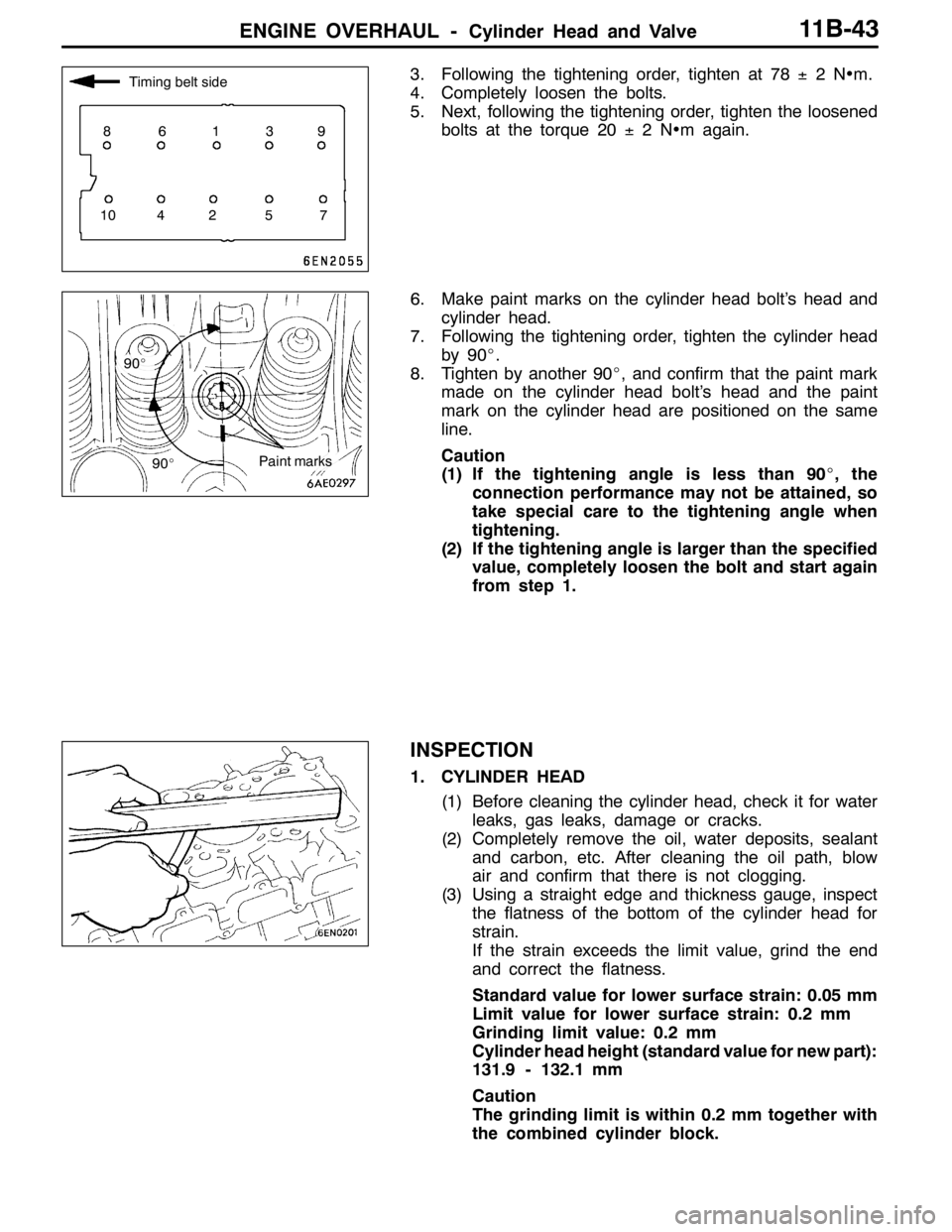
3. Following the tightening order, tighten at 78±2N•m.
4. Completely loosen the bolts.
5. Next, following the tightening order, tighten the loosened
bolts at the torque 20±2N•m again.
6. Make paint marks on the cylinder head bolt’s head and
cylinder head.
7. Following the tightening order, tighten the cylinder head
by 90_.
8. Tighten by another 90_, and confirm that the paint mark
made on the cylinder head bolt’s head and the paint
mark on the cylinder head are positioned on the same
line.
Caution
(1) If the tightening angle is less than 90_, the
connection performance may not be attained, so
take special care to the tightening angle when
tightening.
(2) If the tightening angle is larger than the specified
value, completely loosen the bolt and start again
from step 1.
INSPECTION
1. CYLINDER HEAD
(1) Before cleaning the cylinder head, check it for water
leaks, gas leaks, damage or cracks.
(2) Completely remove the oil, water deposits, sealant
and carbon, etc. After cleaning the oil path, blow
air and confirm that there is not clogging.
(3) Using a straight edge and thickness gauge, inspect
the flatness of the bottom of the cylinder head for
strain.
If the strain exceeds the limit value, grind the end
and correct the flatness.
Standard value for lower surface strain: 0.05 mm
Limit value for lower surface strain: 0.2 mm
Grinding limit value: 0.2 mm
Cylinder head height (standard value for new part):
131.9 - 132.1 mm
Caution
The grinding limit is within 0.2 mm together with
the combined cylinder block.
Timing belt side
86139
10 4 2 5 7
90_
90_
Paint marks
Page 508 of 1449

ENGINE OVERHAUL -Oil Pump and Oil Pan11B-54
"MADRAIN PLUG GASKET INSTALLATION
Replace the gasket with a new part, and install at the direction
shown in the illustration.
Caution
Incorrect installation direction will lead to oil leaks.
"NAOIL FILTER INSTALLATION
1. Clean the installation surface on the cylinder block side.
2. Apply engine oil on the O-ring for the oil filter.
3. Screw in the oil filter, and tighten approx. 3/4 of a rotation
(approx. 14±2N•m) from where the O-ring contacts
the installation surface.
INSPECTION
1. COUNTER BALANCE SHAFT
(1) Make sure that the oil hole is not clogged.
(2) Check the journal (bearing section) for seizure or
damage, and check the state of contact with the
bearings. If any faults are found, replace the counter
balance shaft, bearing or oil pump case assembly.
2. OIL COOLER BYPASS VALVE
(1) The valve must move smoothly.
(2) The L dimension must be at the standard value at
a constant temperature, constant humidity state.
Standard value: 34.5 mm
(3) The protruded dimensions must be at the standard
value after submerging into 100_C oil.
Standard value: 40 mm
Drain plug
Oil pan
Oil pan side Gasket
Bracket side
L
Valve