Page 710 of 1449
INTAKE AND EXHAUST -On-vehicle Service15-4
4. When the indicated supercharging is more than standard
value, supercharging control may be faulty, therefore
check the followings.
DMalfunction of the waste gate actuator
DMalfunction of waste gate valve
DDisconnection or cracks of the waste gate actuator
rubber hose
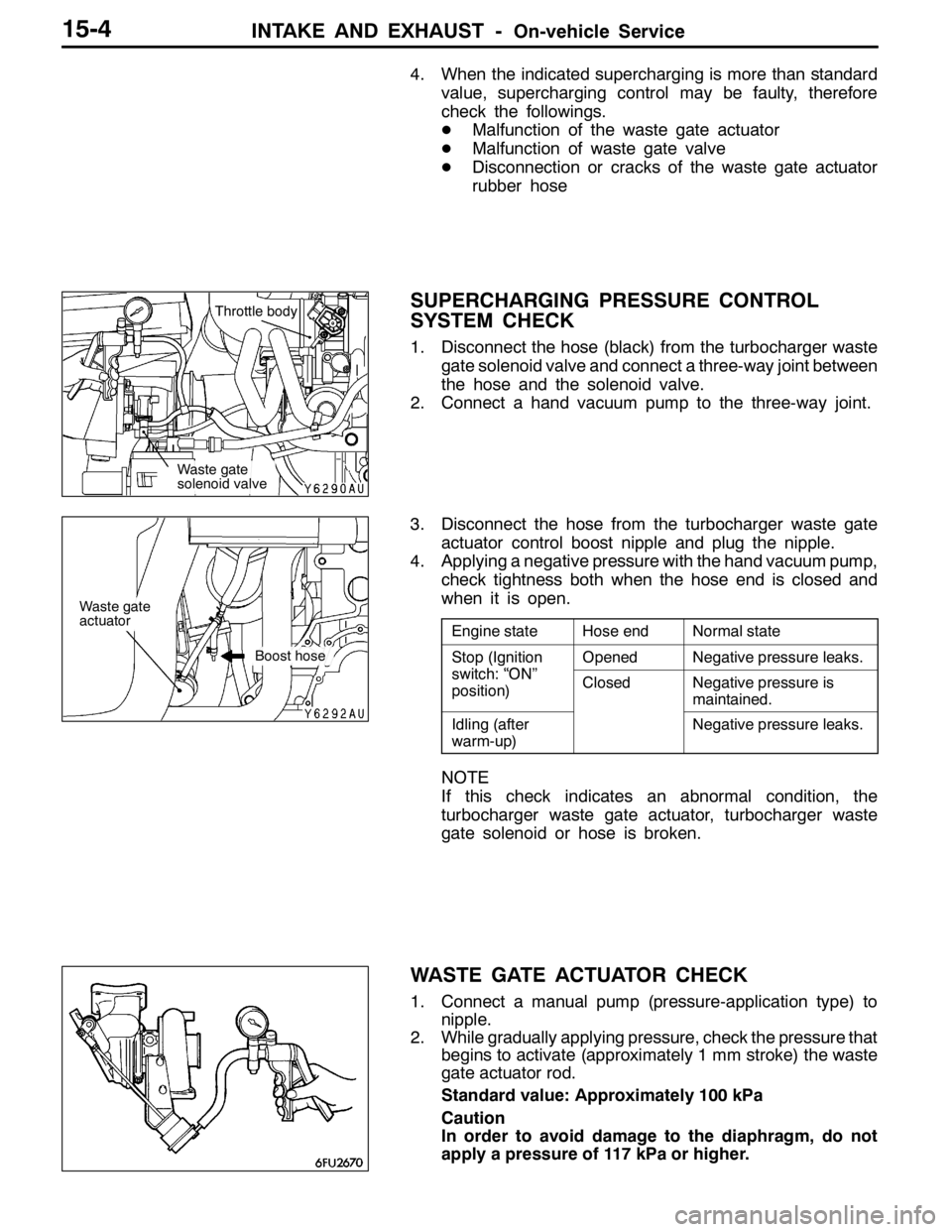
SUPERCHARGING PRESSURE CONTROL
SYSTEM CHECK
1. Disconnect the hose (black) from the turbocharger waste
gate solenoid valve and connect a three-way joint between
the hose and the solenoid valve.
2. Connect a hand vacuum pump to the three-way joint.
3. Disconnect the hose from the turbocharger waste gate
actuator control boost nipple and plug the nipple.
4. Applying a negative pressure with the hand vacuum pump,
check tightness both when the hose end is closed and
when it is open.
Engine stateHose endNormal state
Stop (Ignition
it h“ON”
OpenedNegative pressure leaks.p(g
switch: “ON”
position)ClosedNegative pressure is
maintained.
Idling (after
warm-up)Negative pressure leaks.
NOTE
If this check indicates an abnormal condition, the
turbocharger waste gate actuator, turbocharger waste
gate solenoid or hose is broken.
WASTE GATE ACTUATOR CHECK
1. Connect a manual pump (pressure-application type) to
nipple.
2. While gradually applying pressure, check the pressure that
begins to activate (approximately 1 mm stroke) the waste
gate actuator rod.
Standard value: Approximately 100 kPa
Caution
In order to avoid damage to the diaphragm, do not
apply a pressure of 117 kPa or higher.
Waste gate
solenoid valveThrottle body
Waste gate
actuator
Boost hose
Page 711 of 1449

INTAKE AND EXHAUST -On-vehicle Service15-5
3. If there is a significant deviation from the standard value,
check the actuator or the waste gate valve: replace
actuator or turbocharger assembly if necessary.
WASTE GATE SOLENOID VALVE CHECK
OPERATION CHECK
1. Connect a hand vacuum pump to the solenoid valve nipple
A.
2. Using a jumper wire, connect between the solenoid valve
terminal and battery terminal.
3. Connecting and disconnecting the jumper wire at the
battery negative terminal to apply a negative pressure,
check tightness.
Jumper wireB nipple
conditionNormal condition
ConnectedOpenedNegative pressure leaks.
ClosedNegative pressure is held.
DisconnectedOpenedNegative pressure is held.
COIL RESISTANCE CHECK
Measure the resistance between solenoid valve terminals.
Standard value: 29 – 35Ω(at 20_C)
AIR BYPASS VALVE CHECK
1. Remove the air bypass valve.
2. Connect the hand vacuum pump to the nipple of the
air bypass valve.
3. Apply a negative pressure of approximately 49 kPa, and
check that air tightness is maintained.
4. Also check operation of the valve.
Standard value:
Negative pressureValve operation
Approximately 53 kPaIt starts opening
Battery B A
Page 712 of 1449

INTAKE AND EXHAUST -On-vehicle Service15-6
INTAKE MANIFOLD PRESSURE CHECK
Refer to GROUP 11A – On-vehicle Service.
SECONDARY AIR CONTROL SYSTEM CHECK
1. Start the engine and carry out idling.
2. Confirm that the secondary air valve lifts up when the
engine-ECU connector No. 53 terminal is short-circuited
with the earth using a jumper wire.
The engine-ECU connector must be connected at this
time.
SECONDARY AIR CONTROL SOLENOID
VALVE CHECK
OPERATION CHECK
1. Disconnect the vacuum hose (white-striped, yellow-
striped) from the solenoid valve.
2. Separate the harness connector.
3. Connect the hand vacuum pump to the solenoid valve’s
A nipple.
4. Connect the solenoid valve terminal and battery terminal
with a jumper wire.
5. Disconnect the jumper wire between the battery’s ( - )
terminals, apply a negative pressure, and inspect the
tightness.
Jumper wireState of B
nippleNormal state
ConnectedOpenedNegative pressure leaks.
ClosedNegative pressure is
maintained.
DisconnectedClosedNegative pressure leaks.
Vacuum tank
Secondary
air control
solenoid
valve
Battery A B
Page 713 of 1449

INTAKE AND EXHAUST -On-vehicle Service15-7
COIL RESISTANCE CHECK
Measure the resistance between the solenoid valve terminals.
Standard value: 29 – 35Ω(at 20_C)
SECONDARY AIR VALVE CHECK
1. Disconnect the secondary air valve.
2. Connect the hand vacuum pump to the secondary air
valve’s nipple.
3. Apply a negative pressure of 67 kPa, and confirm that
the negative pressure is maintained.
4. Blow in air from the (A) side and (B) side of the secondary
air valve, and inspect the ventilation.
Negative pressureAir blow-in
directionAir ventilation
0 kPa
(State without
negative pressure)(A)→(B)Not ventilated
40 kPa or more(A)→(B)Ventilated
(B)→(A)Not ventilated
VACUUM TANK CHECK
1. Connect the hand vacuum pump to the vacuum tank’s
A nipple. Apply a negative pressure of 67 kPa, and confirm
that the negative pressure is maintained.
2. Connect the hand vacuum pump to the vacuum tank’s
B nipple.
3. Plug the A nipple with a finger, and apply a negative
pressure of 67 kPa. Confirm that the negative pressure
leaks immediately when the finger is released.
BA
A
B
Page 727 of 1449
INTAKE AND EXHAUST -Exhaust Manifold15-21
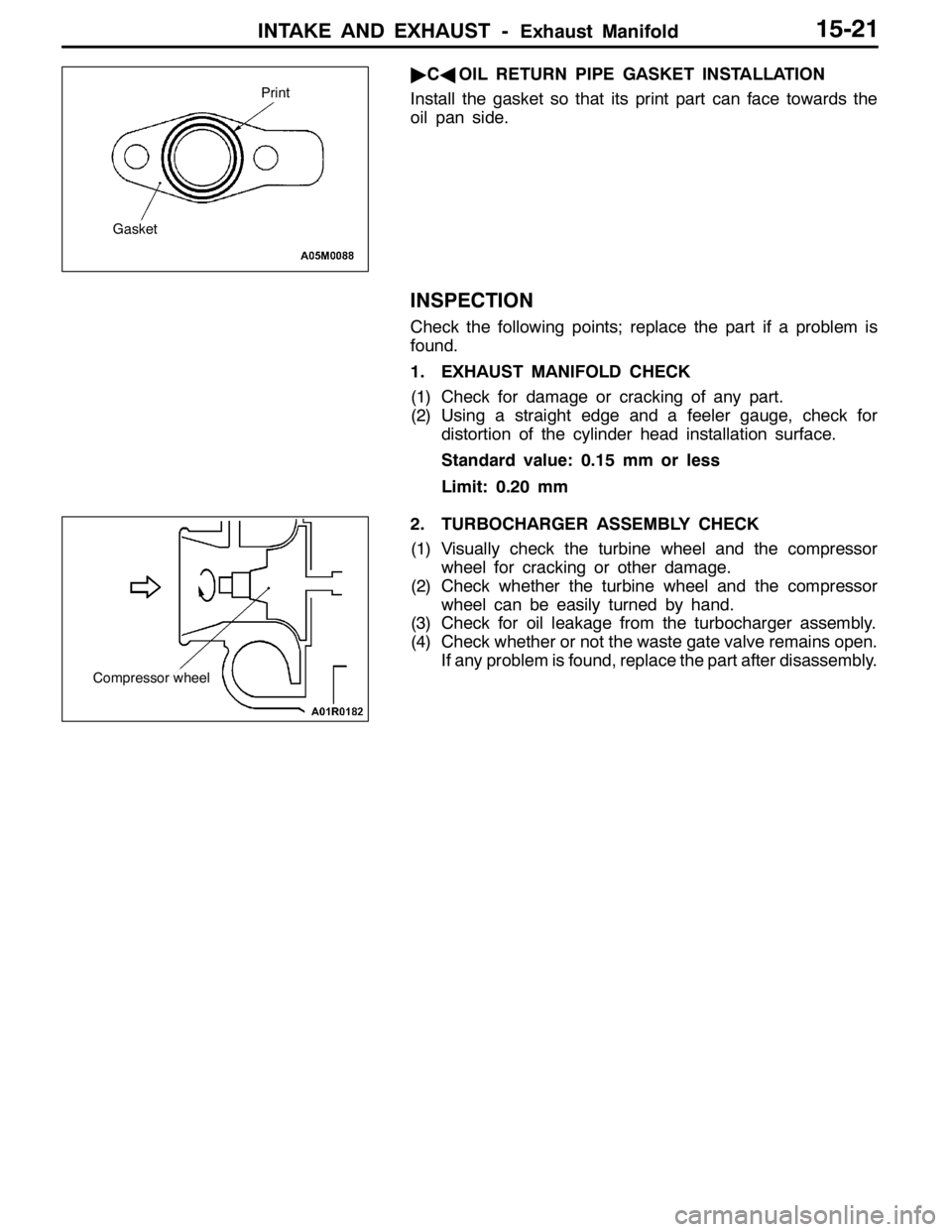
"CAOIL RETURN PIPE GASKET INSTALLATION
Install the gasket so that its print part can face towards the
oil pan side.
INSPECTION
Check the following points; replace the part if a problem is
found.
1. EXHAUST MANIFOLD CHECK
(1) Check for damage or cracking of any part.
(2) Using a straight edge and a feeler gauge, check for
distortion of the cylinder head installation surface.
Standard value: 0.15 mm or less
Limit: 0.20 mm
2. TURBOCHARGER ASSEMBLY CHECK
(1) Visually check the turbine wheel and the compressor
wheel for cracking or other damage.
(2) Check whether the turbine wheel and the compressor
wheel can be easily turned by hand.
(3) Check for oil leakage from the turbocharger assembly.
(4) Check whether or not the waste gate valve remains open.
If any problem is found, replace the part after disassembly.
Gasket
Print
Compressor wheel
Page 729 of 1449
INTAKE AND EXHAUST -Turbocharger15-23
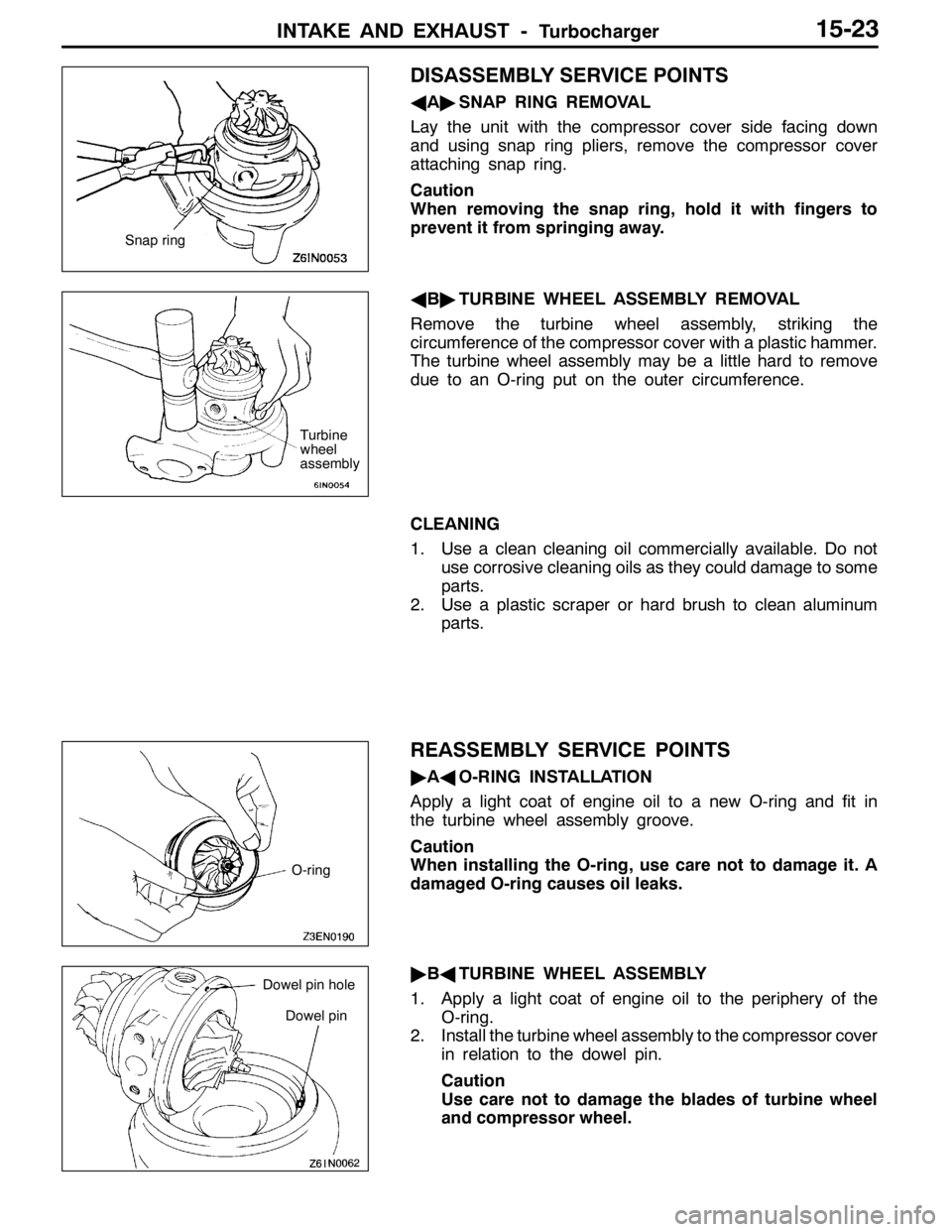
DISASSEMBLY SERVICE POINTS
AA"SNAP RING REMOVAL
Lay the unit with the compressor cover side facing down
and using snap ring pliers, remove the compressor cover
attaching snap ring.
Caution
When removing the snap ring, hold it with fingers to
prevent it from springing away.
AB"TURBINE WHEEL ASSEMBLY REMOVAL
Remove the turbine wheel assembly, striking the
circumference of the compressor cover with a plastic hammer.
The turbine wheel assembly may be a little hard to remove
due to an O-ring put on the outer circumference.
CLEANING
1. Use a clean cleaning oil commercially available. Do not
use corrosive cleaning oils as they could damage to some
parts.
2. Use a plastic scraper or hard brush to clean aluminum
parts.
REASSEMBLY SERVICE POINTS
"AAO-RING INSTALLATION
Apply a light coat of engine oil to a new O-ring and fit in
the turbine wheel assembly groove.
Caution
When installing the O-ring, use care not to damage it. A
damaged O-ring causes oil leaks.
"BATURBINE WHEEL ASSEMBLY
1. Apply a light coat of engine oil to the periphery of the
O-ring.
2. Install the turbine wheel assembly to the compressor cover
in relation to the dowel pin.
Caution
Use care not to damage the blades of turbine wheel
and compressor wheel.
Snap ring
Turbine
wheel
assembly
O-ring
Dowel pin
Dowel pin hole
Page 764 of 1449

ENGINE ELECTRICAL -Ignition System16-32
WAVEFORM OBSERVATION POINTS
Point A: The height, length and slope of the spark line show the following trends (Refer to abnormal
waveform examples, 1, 2, 3 and 4).
Spark linePlug gapCondition of
electrodeCompression
forceConcentration of
air mixtureIgnition timingSpark plug
cable
LengthLongSmallNormalLowRichAdvancedLeak
ShortLargeLarge wearHighLeanRetardedHigh
resistance
HeightHighLargeLarge wearHighLeanRetardedHigh
resistance
LowSmallNormalLowRichAdvancedLeak
SlopeLargePlug is fouled----
Point B: Number of vibration in reduction vibration section (Refer to abnormal waveform example 5)
Number of vibrationsCoil and condenser
Three or moreNormal
Except aboveAbnormal
Point C: Number of vibrations at beginning of dwell section (Refer to abnormal waveform example 5)
Number of vibrationsCoil
5 - 6 or higherNormal
Except aboveAbnormal
Point D: Ignition voltage height (distribution per each cylinder) shows the following trends.
Ignition
voltagePlug gapCondition of
electrodeCompression
forceConcentration of
air mixtureIgnition timingSpark plug cable
HighLargeLarge wearHighLeanRetardedHigh resistance
LowSmallNormalLowRichAdvancedLeak
Page 781 of 1449
ENGINE AND EMISSION CONTROL -Emission Control System17-11
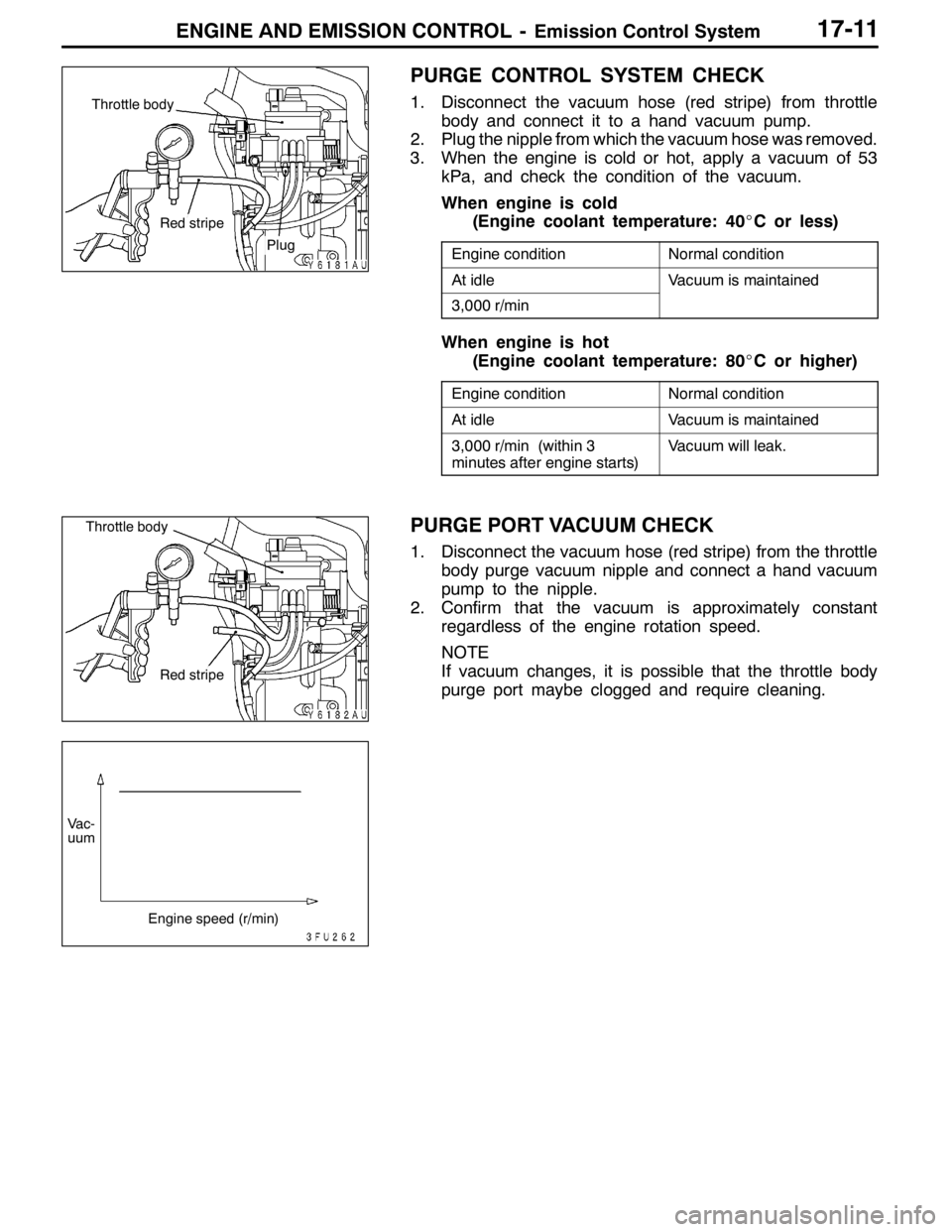
PURGE CONTROL SYSTEM CHECK
1. Disconnect the vacuum hose (red stripe) from throttle
body and connect it to a hand vacuum pump.
2. Plug the nipple from which the vacuum hose was removed.
3. When the engine is cold or hot, apply a vacuum of 53
kPa, and check the condition of the vacuum.
When engine is cold
(Engine coolant temperature: 40_C or less)
Engine conditionNormal condition
At idleVacuum is maintained
3,000 r/min
When engine is hot
(Engine coolant temperature: 80_C or higher)
Engine conditionNormal condition
At idleVacuum is maintained
3,000 r/min (within 3
minutes after engine starts)Vacuum will leak.
PURGE PORT VACUUM CHECK
1. Disconnect the vacuum hose (red stripe) from the throttle
body purge vacuum nipple and connect a hand vacuum
pump to the nipple.
2. Confirm that the vacuum is approximately constant
regardless of the engine rotation speed.
NOTE
If vacuum changes, it is possible that the throttle body
purge port maybe clogged and require cleaning.
Red stripe
Plug
Throttle body
Red stripe
Throttle body
Vac-
uum
Engine speed (r/min)