2007 MITSUBISHI LANCER EVOLUTION Leak
[x] Cancel search: LeakPage 782 of 1449

ENGINE AND EMISSION CONTROL -Emission Control System17-12
PURGE CONTROL SOLENOID VALVE CHECK
NOTE
When disconnecting the vacuum hose, always make a mark
so that it can be reconnected at original position.
1. Disconnect the vacuum hose from the solenoid valve.
2. Disconnect the harness connector.
3. Connect a hand vacuum pump to nipple (A) of the solenoid
valve (refer to the illustration at left).
4. Check airtightness by applying a vacuum with voltage
applied directly from the battery to the purge control
solenoid valve and without applying voltage.
Battery voltageNormal condition
AppliedVacuum leaks
Not appliedVacuum maintained
5. Measure the resistance between the terminals of the
solenoid valve.
Standard value: 30 - 34Ω(at 20_C)
CHECK VALVE CHECK
Connect a hand vacuum pump to the check valve, apply
vacuum and check the airtightness.
Connected nipple colourNormal condition
BlackVacuum leaks
BrownVacuum is maintained
Battery A
Page 786 of 1449

ENGINE AND EMISSION CONTROL -Emission Control System17-16
EGR CONTROL SOLENOID VALVE CHECK
NOTE
When disconnecting the vacuum hose, always make a mark
so that it can be reconnected at original position.
1. Disconnect the vacuum hose (yellow stripe, green stripe,
white stripe) from the solenoid valve.
2. Disconnect the harness connector.
3. Connect a hand vacuum pump to the nipple to which
the green-striped vacuum hose was connected.
4. Check airtightness by applying a vacuum with voltage
applied directly from the battery to the EGR control
solenoid valve and without applying voltage.
Battery voltageB nipple conditionNormal condition
Not appliedOpenVacuum maintained
AppliedOpenVacuum leaks
ClosedVacuum maintained
5. Measure the resistance between the terminals of the
solenoid valve.
Standard value: 29 - 35Ω(at 20_C)
Battery
A B
C
Page 838 of 1449
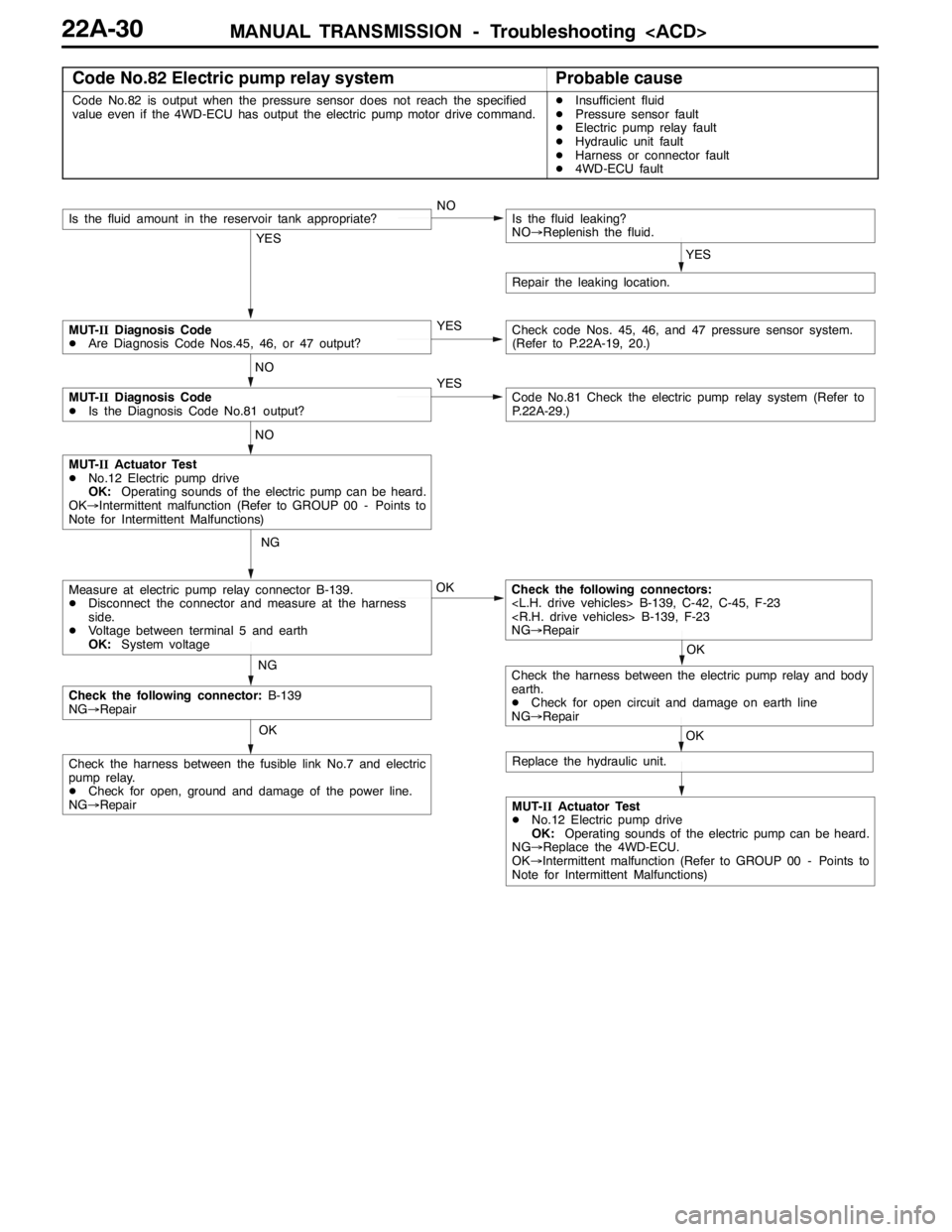
MANUAL TRANSMISSION - Troubleshooting
Code No.82 Electric pump relay systemProbable cause
Code No.82 is output when the pressure sensor does not reach the specified
value even if the 4WD-ECU has output the electric pump motor drive command.DInsufficient fluid
DPressure sensor fault
DElectric pump relay fault
DHydraulic unit fault
DHarness or connector fault
D4WD-ECU fault
OK
OK
NG
NG
MUT-IIActuator Test
DNo.12 Electric pump drive
OK:Operating sounds of the electric pump can be heard.
OK→Intermittent malfunction (Refer to GROUP 00 - Points to
Note for Intermittent Malfunctions)
Check the following connectors:
NG→Repair
OK
Check the following connector:B-139
NG→Repair
Check the harness between the fusible link No.7 and electric
pump relay.
DCheck for open, ground and damage of the power line.
NG→Repair
Measure at electric pump relay connector B-139.
DDisconnect the connector and measure at the harness
side.
DVoltage between terminal 5 and earth
OK:System voltage
MUT-IIActuator Test
DNo.12 Electric pump drive
OK:Operating sounds of the electric pump can be heard.
NG→Replace the 4WD-ECU.
OK→Intermittent malfunction (Refer to GROUP 00 - Points to
Note for Intermittent Malfunctions)
YES
NOIs the fluid amount in the reservoir tank appropriate?
YES
Is the fluid leaking?
NO→Replenish the fluid.
Repair the leaking location.
YES
NO
MUT-IIDiagnosis Code
DAre Diagnosis Code Nos.45, 46, or 47 output?Check code Nos. 45, 46, and 47 pressure sensor system.
(Refer to P.22A-19, 20.)
YESCode No.81 Check the electric pump relay system (Refer to
P.22A-29.)
NO
MUT-IIDiagnosis Code
DIs the Diagnosis Code No.81 output?
OK
Check the harness between the electric pump relay and body
earth.
DCheck for open circuit and damage on earth line
NG→Repair
Replace the hydraulic unit.
Page 842 of 1449
MANUAL TRANSMISSION - Troubleshooting
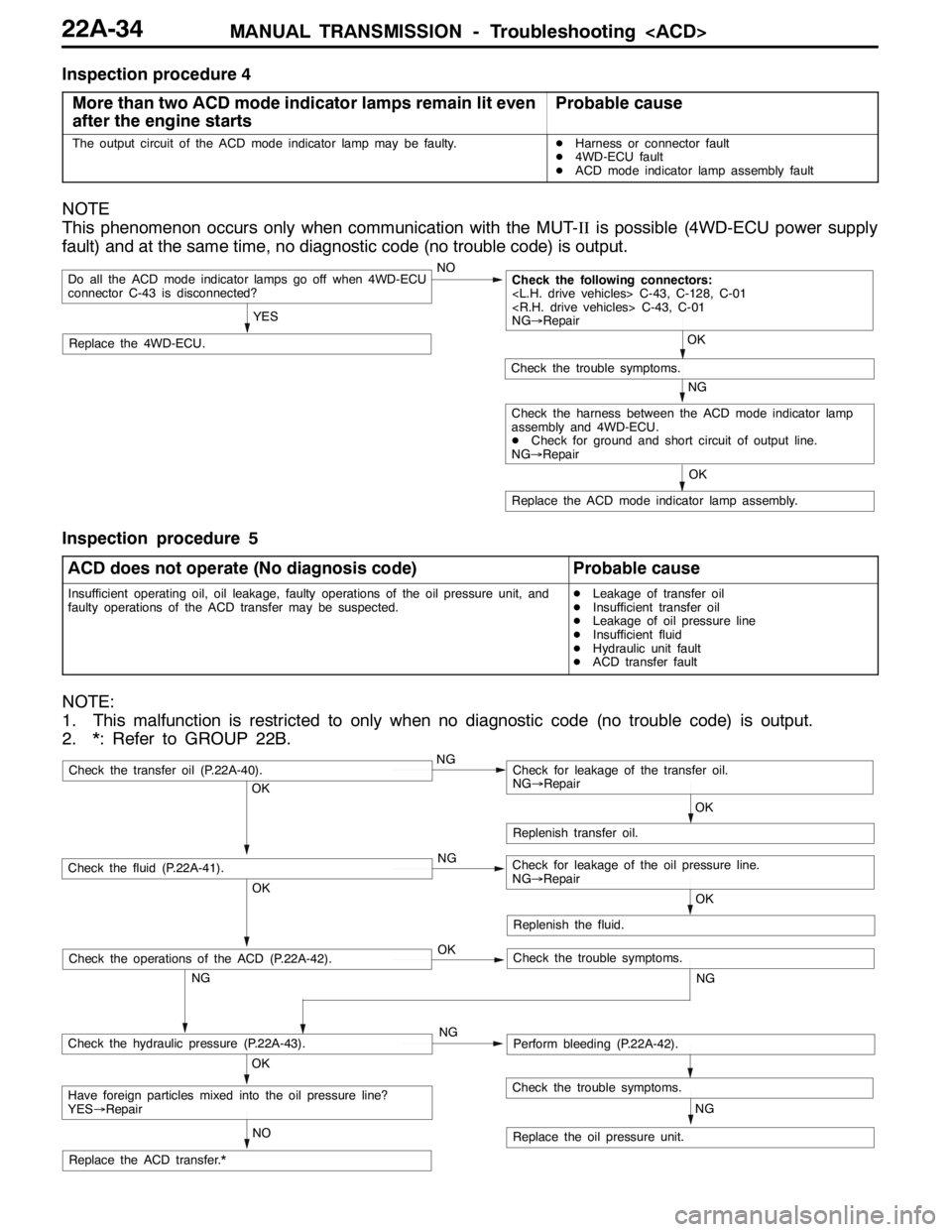
Inspection procedure 4
More than two ACD mode indicator lamps remain lit even
after the engine starts
Probable cause
The output circuit of the ACD mode indicator lamp may be faulty.DHarness or connector fault
D4WD-ECU fault
DACD mode indicator lamp assembly fault
NOTE
This phenomenon occurs only when communication with the MUT-IIis possible (4WD-ECU power supply
fault) and at the same time, no diagnostic code (no trouble code) is output.
NO
Replace the 4WD-ECU.
Do all the ACD mode indicator lamps go off when 4WD-ECU
connector C-43 is disconnected?
YES
Replace the ACD mode indicator lamp assembly.OK
NG
Check the trouble symptoms.
Check the following connectors:
NG→Repair
OK
Check the harness between the ACD mode indicator lamp
assembly and 4WD-ECU.
DCheck for ground and short circuit of output line.
NG→Repair
Inspection procedure 5
ACD does not operate (No diagnosis code)
Probable cause
Insufficient operating oil, oil leakage, faulty operations of the oil pressure unit, and
faulty operations of the ACD transfer may be suspected.DLeakage of transfer oil
DInsufficient transfer oil
DLeakage of oil pressure line
DInsufficient fluid
DHydraulic unit fault
DACD transfer fault
NOTE:
1. This malfunction is restricted to only when no diagnostic code (no trouble code) is output.
2. *: Refer to GROUP 22B.
OK
NG OKNG OKNG
NG
NO
NG
OK
Replenish transfer oil.
Replace the oil pressure unit.
Have foreign particles mixed into the oil pressure line?
YES→Repair
Check the hydraulic pressure (P.22A-43).Perform bleeding (P.22A-42).
Check the fluid (P.22A-41).Check for leakage of the oil pressure line.
NG→Repair
Check the transfer oil (P.22A-40).Check for leakage of the transfer oil.
NG→Repair
Check the trouble symptoms.
Replace the ACD transfer.*OK
Replenish the fluid.
OK
NG
Check the operations of the ACD (P.22A-42).Check the trouble symptoms.
Page 845 of 1449

MANUAL TRANSMISSION - Troubleshooting
ACTUATOR TEST JUDGEMENT VALUE
Item
no.Check itemTest descriptionNormal state
01Bleeding
according to the steering angle, and operate
the Proportional valve for five minutes.Make sure no air leaks from the bleeder
screw on the transfer.
02Bleeding
according to the steering angle, and operate
the directional valve for five minutes.Make sure no air leaks from the bleeder
screw on the torque transfer differential.
03Check the oil vol-
umeOperate the directional valve to the left and
right for 20 seconds.Check that the oil volume of the reservoir
tank is appropriate.
04Electric pump
driveOperate the electric pump for 5 seconds.Operation sounds of the electric pump
can be heard.
05Check the opera-
tions of the ACDOperate the Proportional valve
supply the maximum oil pressure to the multi
plate clutch.9Generate the tight corner braking
phenomenon.
06Check clutch op-
erations
maximum oil pressure to the left clutch.When the wheels are lifted, speed
difference will occur between the rear
left and right wheels.
07Check clutch op-
erations
maximum oil pressure to the right clutch.When the wheels are lifted, speed
difference will occur between the rear
left and right wheels.
08Control OFFTurn OFF the electric pump relay, and turn
OFF the control of the ACD and AYC.In actual driving, there is difference
between control ON and OFF.
(1) The actuator test can be executed only when all the following conditions are satisfied.
DAll wheel speed sensor inputs below 20 km/h
DNo system malfunction detected
DSteering angle is within±30 degrees from the neutral position
(2) When the actuator test corresponds to one of the following conditions, forced driving will be cleared.
DWhen any one of the wheel speed sensor input is detected to be above 20 km/h (excluding
Item No.08 “Control OFF”.)
DWhen system malfunction is detected (excluding diagnostic code No.82, 84, and 85)
DWhen the forced drive time is exceeded
DWhen the MUT-IIis removed
DWhen the Clear key of the MUT-IIis operated
Page 873 of 1449

MANUAL TRANSMISSION OVERHAUL -Sealants22B-7
SEALANTS
TRANSMISSION
ItemsSpecified sealants
Clutch housing and transmission case contact surfaceMITSUBISHI genuine sealant Part
No MD997740orequivalent
Control housing and transmission case contact surface
No.MD997740or equivalent
Under cover and transmission case contact surface
Air breather3M SUPER WEATHERSTRIP No.8001 or
equivalent
Center differential drive gear bolt3M STUD Locking No.4170 or equivalent
FORM-IN-PLACE GASKET (FIPG)
FIPG is used for several members of this transmission. With this gasket, caution is required to the application
amount, application procedure and state of the application surface so that the performance is sufficiently
attained.
If sufficient gasket is not applied, leaks could occur, and if too much is applied, the gasket could protrude
and plug or restrict the oil flow passage. Thus, to prevent leaks from the joined sections, it is absolutely
necessary to evenly apply the correct amount.
DISASSEMBLY
The parts assembled with FIPG can be easily disassembled without special means. However, in some
cases, the sealant on the contact surfaces must be broken by lightly tapping with a wood hammer or
similar tool.
Washing the gasket surface
Completely remove all matters adhered on the contact surfaces with a gasket scraper. Confirm that the
FIPG application surface is smooth. There must be no grease or foreign matter on the contact surfaces.
Always remove the old FIPG that has entered the mounting holes and screw holes.
APPLICATION PROCEDURES
Apply an even coat of FIPG within the predetermined radius (1.5±0.3 mm). Completely cover the areas
around the mounting holds. The FIPG can be wiped off if it has not hardened. Install at the set position
while the FIPG is still wet (within 10 minutes). When installing, make sure that the FIPG does not get
on areas other than the required areas. After installing, do not subject the application areas to oil or
water or start operation until the FIPG has sufficiently hardened (approx. one hour).
The FIPG application procedures differ according to the member, so follow the procedures given in this
manual and apply the FIPG.
Page 960 of 1449
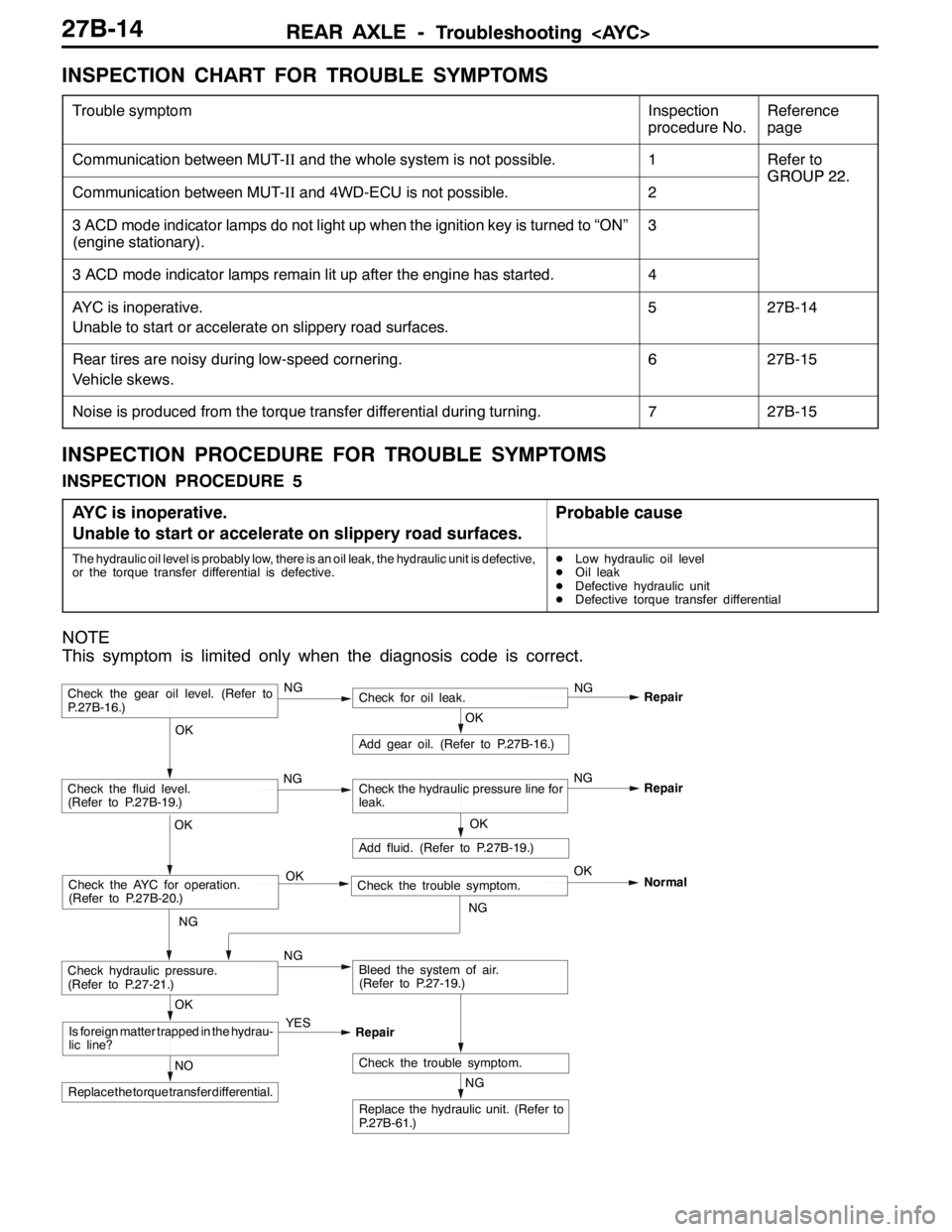
REAR AXLE -Troubleshooting
INSPECTION CHART FOR TROUBLE SYMPTOMS
Trouble symptomInspection
procedure No.Reference
page
Communication between MUT-IIand the whole system is not possible.1Refer to
GROUP22
Communication between MUT-IIand 4WD-ECU is not possible.2
GROUP22.
3 ACD mode indicator lamps do not light up when the ignition key is turned to “ON”
(engine stationary).3
3 ACD mode indicator lamps remain lit up after the engine has started.4
AYC is inoperative.
Unable to start or accelerate on slippery road surfaces.527B-14
Rear tires are noisy during low-speed cornering.
Vehicle skews.627B-15
Noise is produced from the torque transfer differential during turning.727B-15
INSPECTION PROCEDURE FOR TROUBLE SYMPTOMS
INSPECTION PROCEDURE 5
AYC is inoperative.
Unable to start or accelerate on slippery road surfaces.
Probable cause
The hydraulic oil level is probably low, there is an oil leak, the hydraulic unit is defective,
or the torque transfer differential is defective.DLow hydraulic oil level
DOil leak
DDefective hydraulic unit
DDefective torque transfer differential
NOTE
This symptom is limited only when the diagnosis code is correct.
NG
Replace the hydraulic unit. (Refer to
P.27B-61.)
NG
Add fluid. (Refer to P.27B-19.)
OKRepair
Check the trouble symptom.NO
Replace the torque transfer differential.
OK
Is foreign matter trapped in the hydrau-
lic line?YES
Repair
OK
Check the fluid level.
(Refer to P.27B-19.)Check the hydraulic pressure line for
leak.
OK
Add gear oil. (Refer to P.27B-16.)
OK
Check hydraulic pressure.
(Refer to P.27-21.)NGBleed the system of air.
(Refer to P.27-19.)
Check the gear oil level. (Refer to
P.27B-16.)NGCheck for oil leak.NG
Repair
Check the AYC for operation.
(Refer to P.27B-20.)Check the trouble symptom. OKOK
NGNormal
NGNG
Page 961 of 1449
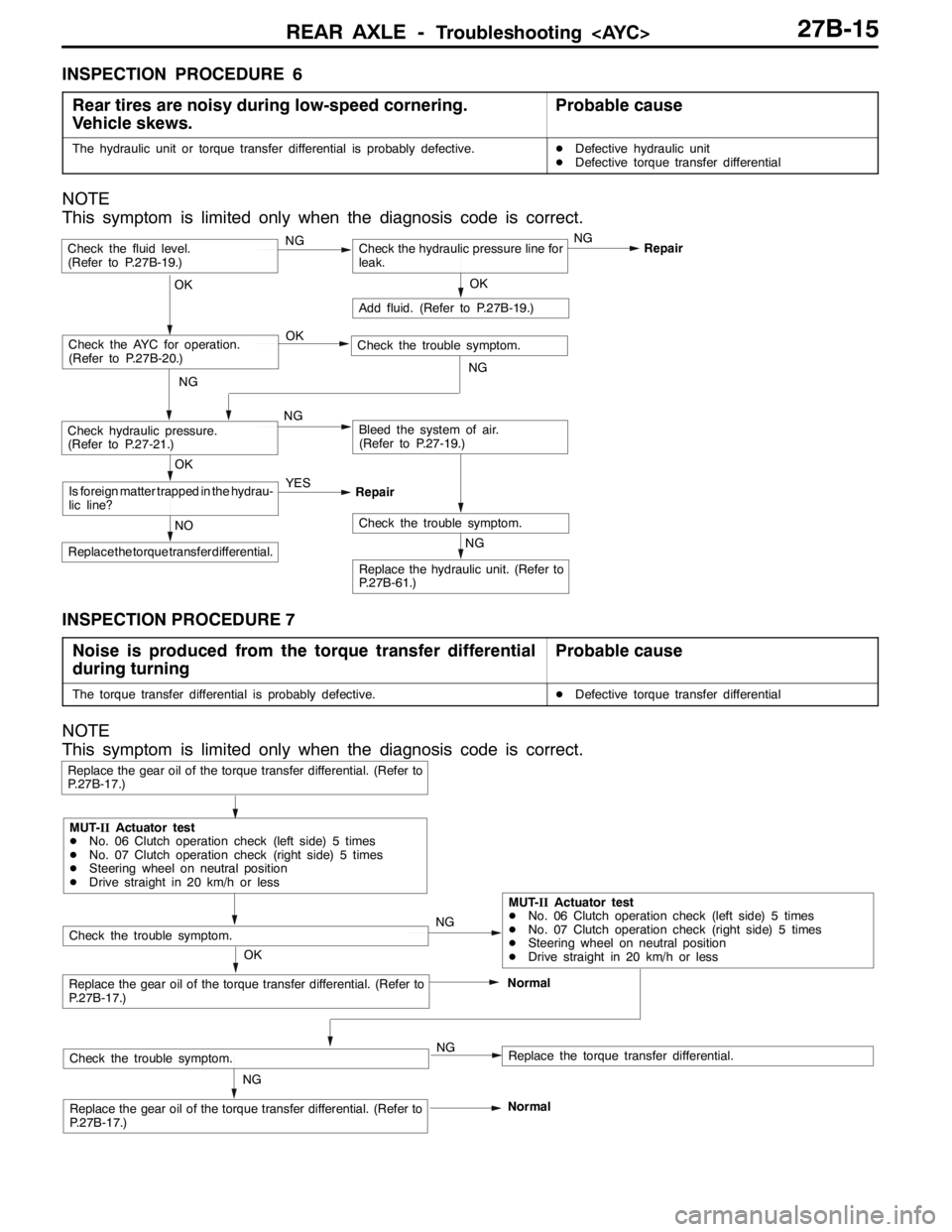
REAR AXLE -Troubleshooting
INSPECTION PROCEDURE 6
Rear tires are noisy during low-speed cornering.
Vehicle skews.
Probable cause
The hydraulic unit or torque transfer differential is probably defective.DDefective hydraulic unit
DDefective torque transfer differential
NOTE
This symptom is limited only when the diagnosis code is correct.
NG
Replace the hydraulic unit. (Refer to
P.27B-61.)
NG
Add fluid. (Refer to P.27B-19.)
OKRepair
Check the trouble symptom.NO
Replace the torque transfer differential.
OK
Is foreign matter trapped in the hydrau-
lic line?YES
Repair
Check the fluid level.
(Refer to P.27B-19.)Check the hydraulic pressure line for
leak.
OK
Check hydraulic pressure.
(Refer to P.27-21.)NGBleed the system of air.
(Refer to P.27-19.)
Check the AYC for operation.
(Refer to P.27B-20.)Check the trouble symptom. OK
NG
NGNG
INSPECTION PROCEDURE 7
Noise is produced from the torque transfer differential
during turning
Probable cause
The torque transfer differential is probably defective.DDefective torque transfer differential
NOTE
This symptom is limited only when the diagnosis code is correct.
NG
Replace the gear oil of the torque transfer differential. (Refer to
P.27B-17.)
Replace the gear oil of the torque transfer differential. (Refer to
P.27B-17.)Normal
Replace the gear oil of the torque transfer differential. (Refer to
P.27B-17.)
Replace the torque transfer differential.
Check the trouble symptom.
OKNG
NG
MUT-IIActuator test
DNo. 06 Clutch operation check (left side) 5 times
DNo. 07 Clutch operation check (right side) 5 times
DSteering wheel on neutral position
DDrive straight in 20 km/h or less
MUT-IIActuator test
DNo. 06 Clutch operation check (left side) 5 times
DNo. 07 Clutch operation check (right side) 5 times
DSteering wheel on neutral position
DDrive straight in 20 km/h or less
Check the trouble symptom.
Normal