2007 MITSUBISHI LANCER EVOLUTION brake
[x] Cancel search: brakePage 802 of 1449

CLUTCH OVERHAUL -General Description/Specifications/Service Specifications/
Tightening Torque/Lubricants21B-2
GENERAL DESCRIPTION
The pull-type clutch has been adopted to improve the cut-off at high rotations and reduce the clutch
pedal pressing force.
SPECIFICATIONS
Clutch discTypeDry single-disc type
Facing dimension mm240×160
Clutch coverTypeDiaphragm spring, pull-type
Set load N9,320
Clutch control methodHydraulic method
SERVICE SPECIFICATIONS
ItemsLimit value mm
Clutch disc facing rivet sink0.3
Clearance between release cylinder inner diameter and
piston outer diameter0.15
TIGHTENING TORQUE
ItemsTorque N•m
Clutch tube flare nut15±2
Clutch fluid line bracket mounting bolt18±3
Clutch release cylinder air breather11±1
Clutch release cylinder mounting bolt18±3
Clutch release fork shaft mounting bolt9.8±2
Clutch release cylinder union bolt22±2
LUBRICANTS
ItemsSpecified lubricants
Release fork and release cylinder push rod contact sectionMITSUBISHI genuine grease Part No.0101011
orequivalent
Release fork and release fork shaft sliding section
or equivalent
Release fork and release bearing contact section
Piston and piston cup circumferenceMITSUBISHI genuine brake fluid
“
DIA QUEENBRAKEFLUIDSUPER4”
Release cylinder inner circumference
“DIA-QUEENBRAKEFLUIDSUPER4”
or equivalent
Page 807 of 1449

CLUTCH OVERHAUL -Clutch Release Cylinder21B-7
REASSEMBLY SERVICE POINT
"AAPISTON/PISTON CUP INSTALLATION
After applying brake fluid on the inner surface of the release
cylinder and circumference of the piston and piston cup, insert
the piston and piston cup into the release cylinder.
Brake fluid
Specified fluid:
MITSUBISHI genuine brake fluid “DIA-QUEEN
BRAKE FLUID SUPER 4” or equivalent
INSEPCTION
RELEASE CYLINDER
(1) Check the inner surface of the release cylinder for rust
and damage.
(2) Using a cylinder gauge, measure the inner diameter of
the release cylinder at approx. three positions (deepest
section, middle, opening). If the clearance with the outer
diameter of the piston exceeds the limit value, replace
the release cylinder assembly.
Limit value: 0.15 mm
Piston cup Piston
Page 814 of 1449

MANUAL TRANSMISSION - Troubleshooting
INSPECTION CHART FOR DIAGNOSIS CODES
Diagnosis
code No.Diagnosis itemsReference page
12Power supply voltage (valve power supply) systemopen circuit or short-circuit22A-8
13Fail-safe relay system
21Wheel speed sensor
22Wheel speed sensor
23Wheel speed sensor
24Wheel speed sensor
25Wrong-diameter tire22A-11
26Wheel speed sensor (faulty output signal)22A-13
31Steering wheel sensor
32Steering wheel sensor
33fixed22A-16
34Steering wheel sensor
fixed22A-17
41TPS systemopen circuit or ground22A-18
42short-circuit22A-18
45Pressure sensor systemopen circuit or ground22A-19
46open earth22A-19
47abnormal power supply22A-20
51Longitudinal G sensor systemopen circuit or short-circuit22A-21
52defective sensor22A-22
56Lateral G sensor systemopen circuit or short-circuit22A-23
57defective sensor22A-24
61Stop lamp switch systemopen circuit22A-25
62ACD mode switch systemstuck22A-26
63Parking brake switch systemshort-circuit or not re-
turned to original position22A-27
65ABS monitor systemopen circuit or defective
ABS22A-28
71Proportional valve
GROUP27B
72Directional control valve
GROUP27B.
73Directional control valve
74Proportional valve
Page 830 of 1449
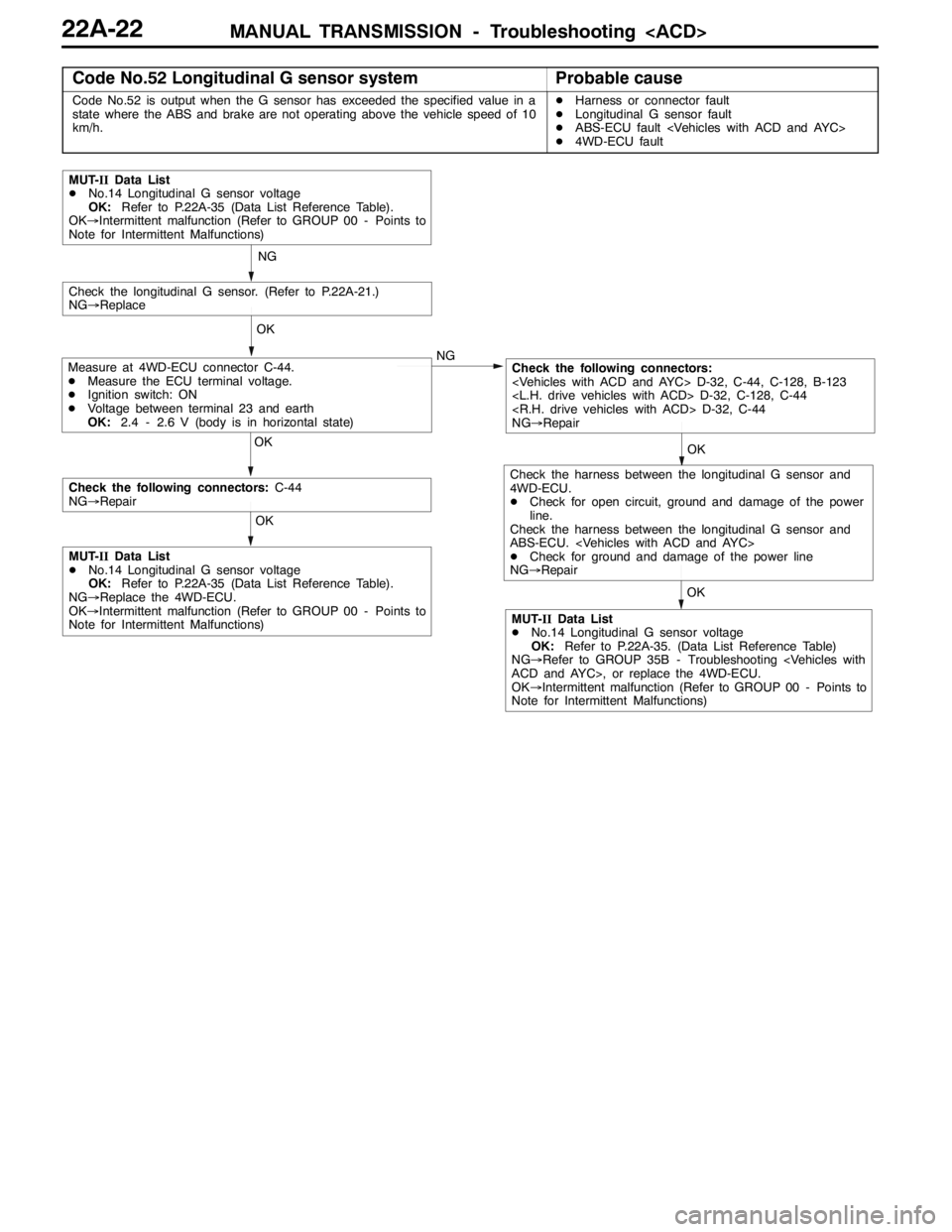
MANUAL TRANSMISSION - Troubleshooting
Code No.52 Longitudinal G sensor systemProbable cause
Code No.52 is output when the G sensor has exceeded the specified value in a
state where the ABS and brake are not operating above the vehicle speed of 10
km/h.DHarness or connector fault
DLongitudinal G sensor fault
DABS-ECU fault
D4WD-ECU fault
OK
NG
MUT-IIData List
DNo.14 Longitudinal G sensor voltage
OK:Refer to P.22A-35 (Data List Reference Table).
OK→Intermittent malfunction (Refer to GROUP 00 - Points to
Note for Intermittent Malfunctions)
OK
Check the following connectors:
NG→Repair NG
Check the longitudinal G sensor. (Refer to P.22A-21.)
NG→Replace
OK
MUT-IIData List
DNo.14 Longitudinal G sensor voltage
OK:Refer to P.22A-35. (Data List Reference Table)
NG→Refer to GROUP 35B - Troubleshooting
OK→Intermittent malfunction (Refer to GROUP 00 - Points to
Note for Intermittent Malfunctions)OK
Check the harness between the longitudinal G sensor and
4WD-ECU.
DCheck for open circuit, ground and damage of the power
line.
Check the harness between the longitudinal G sensor and
ABS-ECU.
DCheck for ground and damage of the power line
NG→Repair
Measure at 4WD-ECU connector C-44.
DMeasure the ECU terminal voltage.
DIgnition switch: ON
DVoltage between terminal 23 and earth
OK:2.4 - 2.6 V (body is in horizontal state)
OK
Check the following connectors:C-44
NG→Repair
MUT-IIData List
DNo.14 Longitudinal G sensor voltage
OK:Refer to P.22A-35 (Data List Reference Table).
NG→Replace the 4WD-ECU.
OK→Intermittent malfunction (Refer to GROUP 00 - Points to
Note for Intermittent Malfunctions)
Page 832 of 1449
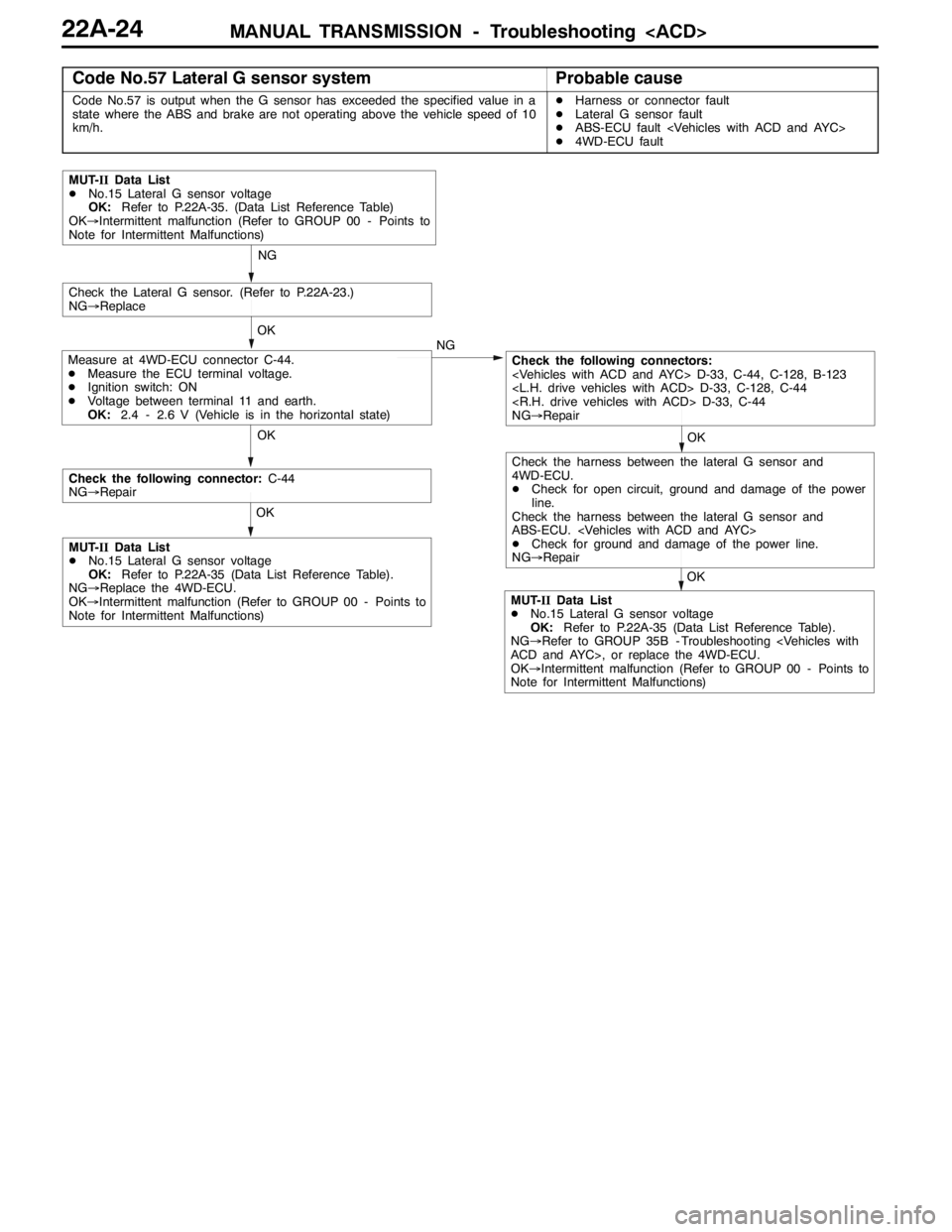
MANUAL TRANSMISSION - Troubleshooting
Code No.57 Lateral G sensor systemProbable cause
Code No.57 is output when the G sensor has exceeded the specified value in a
state where the ABS and brake are not operating above the vehicle speed of 10
km/h.DHarness or connector fault
DLateral G sensor fault
DABS-ECU fault
D4WD-ECU fault
OK
NG
MUT-IIData List
DNo.15 Lateral G sensor voltage
OK:Refer to P.22A-35. (Data List Reference Table)
OK→Intermittent malfunction (Refer to GROUP 00 - Points to
Note for Intermittent Malfunctions)
OK
Check the following connectors:
NG→Repair NG
Check the Lateral G sensor. (Refer to P.22A-23.)
NG→Replace
OK
MUT-IIData List
DNo.15 Lateral G sensor voltage
OK:Refer to P.22A-35 (Data List Reference Table).
NG→Refer to GROUP 35B - Troubleshooting
OK→Intermittent malfunction (Refer to GROUP 00 - Points to
Note for Intermittent Malfunctions)OK
Check the harness between the lateral G sensor and
4WD-ECU.
DCheck for open circuit, ground and damage of the power
line.
Check the harness between the lateral G sensor and
ABS-ECU.
DCheck for ground and damage of the power line.
NG→Repair
Measure at 4WD-ECU connector C-44.
DMeasure the ECU terminal voltage.
DIgnition switch: ON
DVoltage between terminal 11 and earth.
OK:2.4 - 2.6 V (Vehicle is in the horizontal state)
OK
Check the following connector:C-44
NG→Repair
MUT-IIData List
DNo.15 Lateral G sensor voltage
OK:Refer to P.22A-35 (Data List Reference Table).
NG→Replace the 4WD-ECU.
OK→Intermittent malfunction (Refer to GROUP 00 - Points to
Note for Intermittent Malfunctions)
Page 833 of 1449
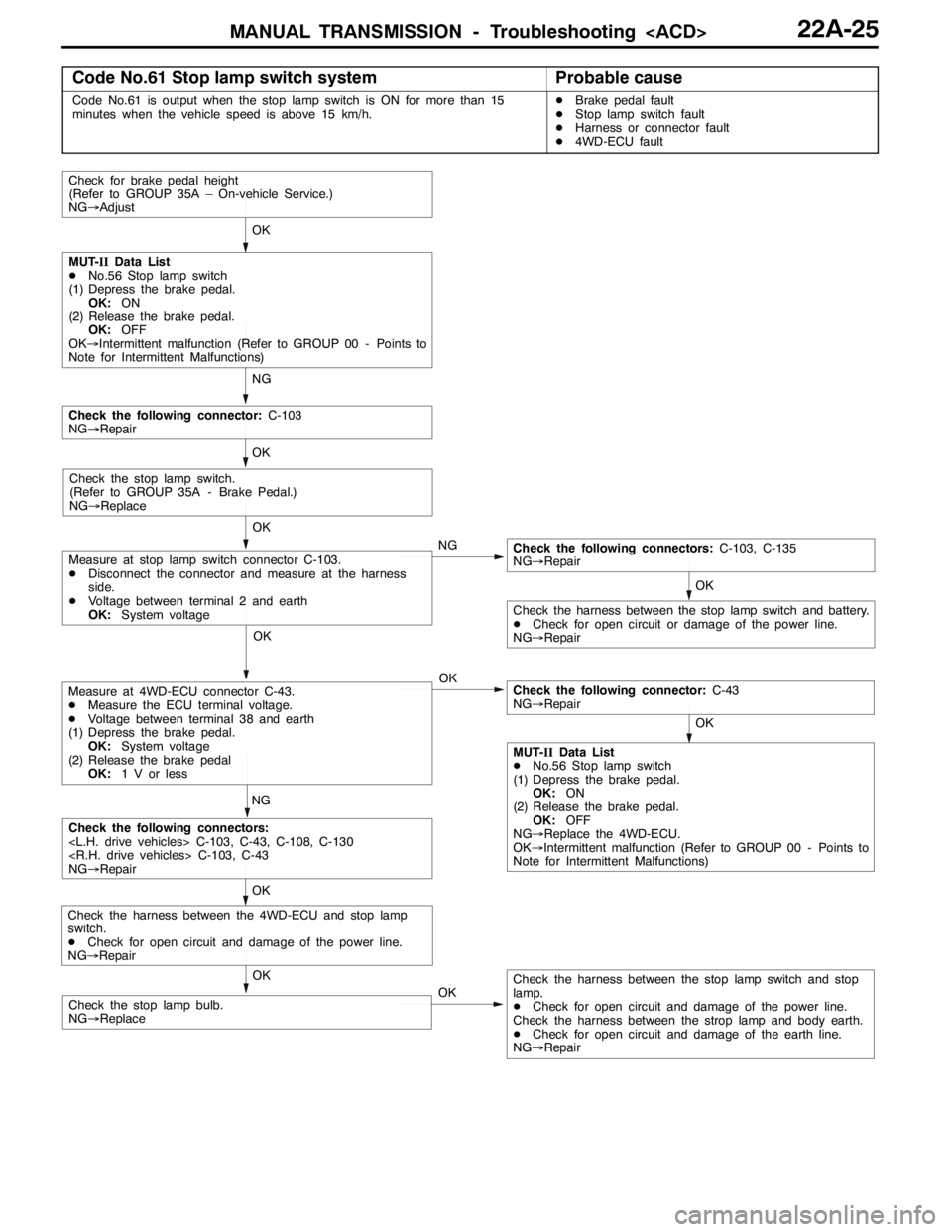
MANUAL TRANSMISSION - Troubleshooting
Code No.61 Stop lamp switch systemProbable cause
Code No.61 is output when the stop lamp switch is ON for more than 15
minutes when the vehicle speed is above 15 km/h.DBrake pedal fault
DStop lamp switch fault
DHarness or connector fault
D4WD-ECU fault
OK
OK
OK
NG
OK
Check for brake pedal height
(Refer to GROUP 35A – On-vehicle Service.)
NG→Adjust
NG
MUT-IIData List
DNo.56 Stop lamp switch
(1) Depress the brake pedal.
OK:ON
(2) Release the brake pedal.
OK:OFF
OK→Intermittent malfunction (Refer to GROUP 00 - Points to
Note for Intermittent Malfunctions)
OK
Check the following connector:C-103
NG→Repair
Check the stop lamp switch.
(Refer to GROUP 35A - Brake Pedal.)
NG→Replace
NG
OK
Check the following connectors:C-103, C-135
NG→Repair
Check the harness between the stop lamp switch and battery.
DCheck for open circuit or damage of the power line.
NG→Repair
OK
Measure at stop lamp switch connector C-103.
DDisconnect the connector and measure at the harness
side.
DVoltage between terminal 2 and earth
OK:System voltage
Measure at 4WD-ECU connector C-43.
DMeasure the ECU terminal voltage.
DVoltage between terminal 38 and earth
(1) Depress the brake pedal.
OK:System voltage
(2) Release the brake pedal
OK:1 V or less
OK
Check the following connectors:
NG→Repair
OKCheck the harness between the stop lamp switch and stop
lamp.
DCheck for open circuit and damage of the power line.
Check the harness between the strop lamp and body earth.
DCheck for open circuit and damage of the earth line.
NG→Repair
Check the harness between the 4WD-ECU and stop lamp
switch.
DCheck for open circuit and damage of the power line.
NG→Repair
Check the following connector:C-43
NG→Repair
MUT-IIData List
DNo.56 Stop lamp switch
(1) Depress the brake pedal.
OK:ON
(2) Release the brake pedal.
OK:OFF
NG→Replace the 4WD-ECU.
OK→Intermittent malfunction (Refer to GROUP 00 - Points to
Note for Intermittent Malfunctions)
OK
Check the stop lamp bulb.
NG→Replace
Page 835 of 1449
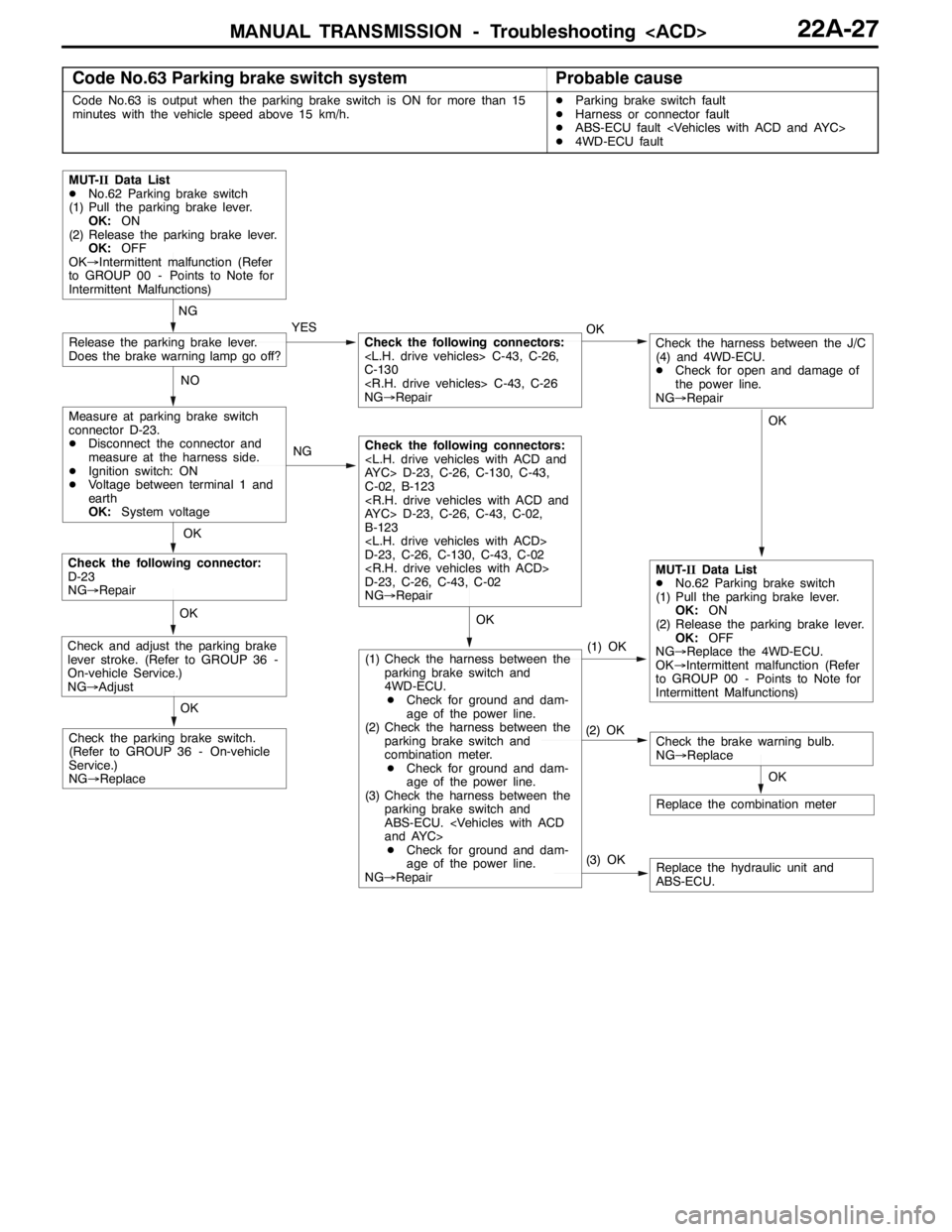
MANUAL TRANSMISSION - Troubleshooting
Code No.63 Parking brake switch systemProbable cause
Code No.63 is output when the parking brake switch is ON for more than 15
minutes with the vehicle speed above 15 km/h.DParking brake switch fault
DHarness or connector fault
DABS-ECU fault
D4WD-ECU fault
OK
NG
YES
NG
(3) OK(1) OKReplace the hydraulic unit and
ABS-ECU.
MUT-IIData List
DNo.62 Parking brake switch
(1) Pull the parking brake lever.
OK:ON
(2) Release the parking brake lever.
OK:OFF
OK→Intermittent malfunction (Refer
to GROUP 00 - Points to Note for
Intermittent Malfunctions)
Measure at parking brake switch
connector D-23.
DDisconnect the connector and
measure at the harness side.
DIgnition switch: ON
DVoltage between terminal 1 and
earth
OK:System voltage
Release the parking brake lever.
Does the brake warning lamp go off?
OK
Check the following connector:
D-23
NG→Repair
OK
Replace the combination meter
OK
Check the brake warning bulb.
NG→ReplaceCheck the parking brake switch.
(Refer to GROUP 36 - On-vehicle
Service.)
NG→Replace
OK
Check and adjust the parking brake
lever stroke. (Refer to GROUP 36 -
On-vehicle Service.)
NG→Adjust
MUT-IIData List
DNo.62 Parking brake switch
(1) Pull the parking brake lever.
OK:ON
(2) Release the parking brake lever.
OK:OFF
NG→Replace the 4WD-ECU.
OK→Intermittent malfunction (Refer
to GROUP 00 - Points to Note for
Intermittent Malfunctions) NOOK
Check the following connectors:
C-130
NG→Repair
Check the following connectors:
C-02, B-123
B-123
D-23, C-26, C-130, C-43, C-02
D-23, C-26, C-43, C-02
NG→Repair
(2) OK
(1) Check the harness between the
parking brake switch and
4WD-ECU.
DCheck for ground and dam-
age of the power line.
(2) Check the harness between the
parking brake switch and
combination meter.
DCheck for ground and dam-
age of the power line.
(3) Check the harness between the
parking brake switch and
ABS-ECU.
DCheck for ground and dam-
age of the power line.
NG→Repair
OK
Check the harness between the J/C
(4) and 4WD-ECU.
DCheck for open and damage of
the power line.
NG→Repair
Page 844 of 1449

MANUAL TRANSMISSION - Troubleshooting
Item
no.Normal conditions Check condition Check item
19Pressure sensor power
supplyIgnition switch: ONApprox.5 V
20Valve power supplyIgnition switch: ONSystem voltage
21Steering wheel sensor
voltage
are displayed alter-
nately.
22Steering wheel sensor
voltage
are displayed alter-
nately.
23Steering wheel sensor
ltSTN
Ignition switch: ONSteering wheel: Neutral1-2Vg
voltage
g
Steering wheel: Turn2.5 - 4.5 V
51Idle switchIgnition switch: ONAccelerator pedal: Full
closedON
Accelerator pedal: PressOFF
52Steering wheel sensor
STN
Ignition switch: ONsteering wheel: NeutralONg
g
Steering wheel: Turn from
the neutral positionOFF
53Steering wheel sensor
played alternaltely.
54Steering wheel sensor
played alternately
55Steering wheel sensor
learning
tral position learning exe-
cutedON
Steering wheel sensor neu-
tral position learning unex-
ecutedOFF
56Stop lamp switchIgnition switch: ONBrake pedal: DepressONppg
Engine: StoppedBrake pedal: ReleaseOFF
57Motor monitorElectric pump motor is currently operatingON
Electric pump motor is currently not operatingOFF
58Oil pressure stateElectric pump motor is currently operatingLOWp
Electric pump motor is currently not operatingHIGH
59Directional valve
Ri ht
AYC clutch right side is currently operatingON
60Directional valve
Lft
AYC clutch left side is currently operatingON
61ABS monitorABS is currently operatingON
ABS is currently not operatingOFF
62Parking brake switchIgnition switch: ONParking brake lever: PullONgg
Engine:StoppedParking brake lever: Re-
leaseOFF
63ACD mode switchIgnition switch: ONACD mode switch: PressONg
Engine:StoppedACD mode switch: ReleaseOFF