Page 1044 of 1449
35A-2
BASIC BRAKE
SYSTEM
CONTENTS
GENERAL INFORMATION 3..................
SERVICE SPECIFICATIONS 5.................
LUBRICANTS 6..............................
SEALANT 6..................................
SPECIAL TOOLS 6...........................
ON-VEHICLE SERVICE 7.....................
Brake Pedal Check and Adjustment 7............
Brake Booster Operating Test 8.................
Check Valve Operation Check 9.................
Proportioning Valve Function Test
9......................Bleeding 10....................................
Brake Fluid Level Sensor Check 11.............
Disc Brake Pad Check and Replacement 11......
Disc Brake Rotor Check 13.....................
Brake Disc Thickness Check 14.................
Brake Disc Run-out Check and Correction 14....
BRAKE PEDAL 16...........................
PROPORTIONING VALVE, MASTER
CYLINDER AND BRAKE BOOSTER 17........
Master Cylinder 19.............................
DISC BRAKE 20.............................
Page 1045 of 1449

BASIC BRAKE SYSTEM -General Information35A-3
GENERAL INFORMATION
The brake system offers high dependability and durability along with improved braking performance and
brake sensitivity.
SERVICE PRECAUTION
Take care not to contact the parts or tools to the caliper because the paint of caliper will be scratched.
SPECIFICATIONS
ItemsSpecifications
Master cylinderTypeTandem type
I.D. mm26.9
Brake boosterTypeVacuum type, tandem
Effective dia. of power cylinder mm205 + 230
Boosting ratio4.5 (Pedal depressing force: 230 N)
Rear wheel hydraulic
controlmethod
Vehicles with ABS Electronic brake-force distribution (EBD)
control methodVehicles without ABS Proportioning valves
Proportioning valves
VehicleswithoutABS
TypeSingle type¢2
Decompression ratio0.25
Front brakes
RS(standard)
TypeFloating caliper, 2 piston, ventilated disc
Disc effective dia.¢thickness mm227¢24
Wheel cylinder I.D. mm42.9 (¢2)
Pad thickness mm10.0
Clearance adjustmentAutomatic
Front brakes
Type4 opposed piston, ventilated disc
Disc effective dia.¢thickness mm263¢32
Wheel cylinder I.D. mm40.0 (¢2), 46.0 (¢2)
Pad thickness mm10.0
Clearance adjustmentAutomatic
Rear brakes
RS(standard)
TypeFloating caliper, 1 piston, ventilated disc
Disc effective dia.¢thickness mm237¢20
Wheel cylinder I.D. mm34.9
Pad thickness mm10.0
Clearance adjustmentAutomatic
Rear brakes
Type2 opposed piston, ventilated disc
Disc effective dia.¢thickness mm252¢22
Wheel cylinder I.D. mm40.0 (¢2)
Pad thickness mm9.0
Clearance adjustmentAutomatic
Brake fluidDOT3 or DOT4
Page 1046 of 1449
BASIC BRAKE SYSTEM -General Information35A-4
CONSTRUCTION DIAGRAM
Brake booster*
Rear disc brake
Parking brake
Front disc brake Master cylinder*Hydraulic unit*
Brake booster*
Rear disc brake
Parking brake
Front disc brake Master cylinder and
proportioning valves*
NOTE
For R.H. drive vehicles, only the position indicated by the * is symmetrical.
Page 1047 of 1449
Page 1048 of 1449
BASIC BRAKE SYSTEM -Lubricants/Sealant/Special Tools35A-6
LUBRICANTS
ItemsSpecified LubricantQuantity
Brake fluidDOT3 or DOT4As required
Piston, wheel cylinder body
Piston boot, piston seal, shimRepair kit grease
Guide pin, lock pin, pin boot
Pad assembly
SEALANT
ItemsSpecified sealantRemarks
Fitting3M ATD Part No. 8661, 8663 or equivalentSemi-drying sealant
SPECIAL TOOLS
ToolNumberNameUse
MB991568Push rod adjusting
socketAdjustment of the brake booster push rod
protrusion amount
AMB990964
A: MB990520Brake tool setPushing-in of the disc brake piston
DDisc brake piston pushing-in
MB990998Front hub remover
and installerProvisional holding of the wheel bearing
Page 1049 of 1449
BASIC BRAKE SYSTEM -On-vehicle Service35A-7
ON-VEHICLE SERVICE
BRAKE PEDAL CHECK AND ADJUSTMENT
BRAKE PEDAL HEIGHT
1. Turn up the carpet, etc. under the brake pedal.
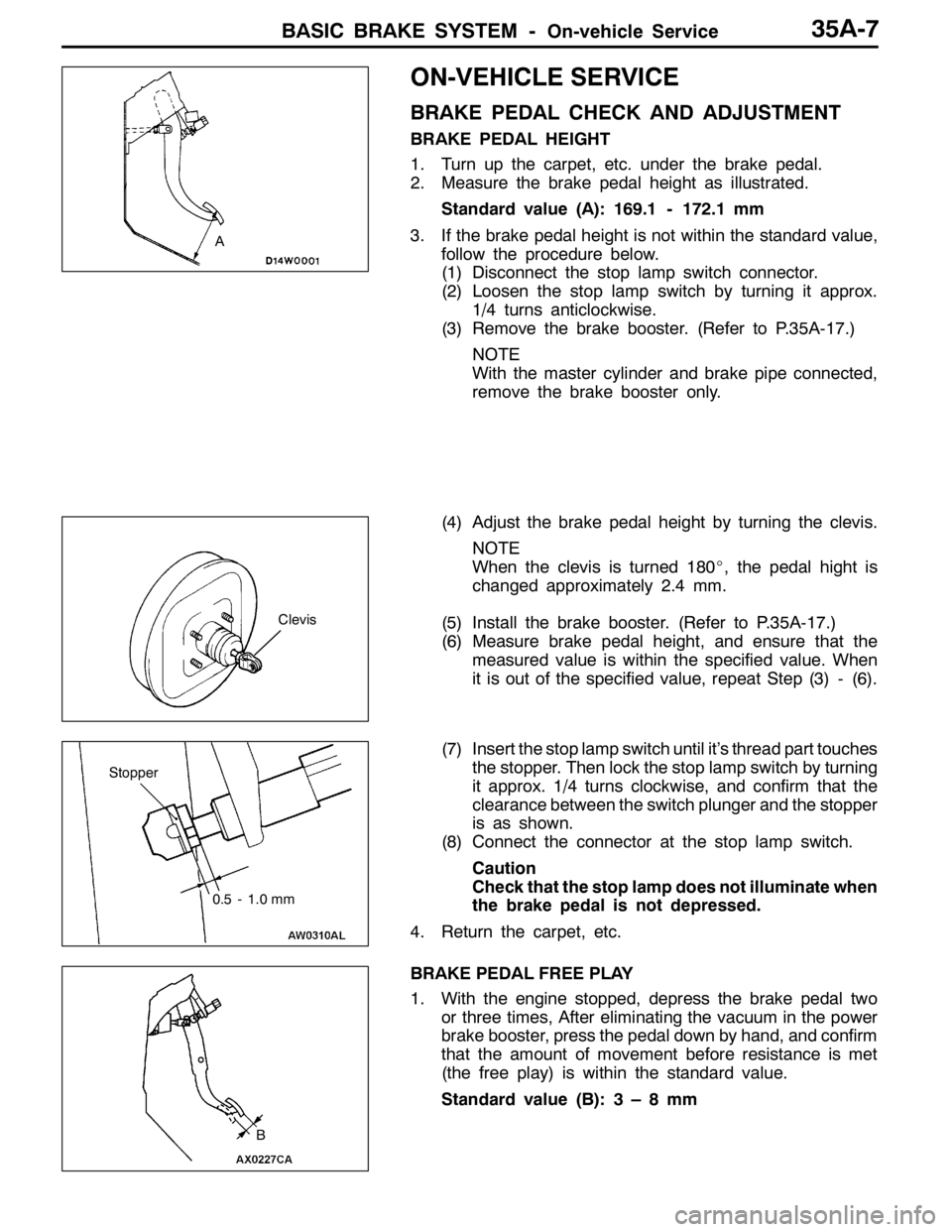
2. Measure the brake pedal height as illustrated.
Standard value (A): 169.1 - 172.1 mm
3. If the brake pedal height is not within the standard value,
follow the procedure below.
(1) Disconnect the stop lamp switch connector.
(2) Loosen the stop lamp switch by turning it approx.
1/4 turns anticlockwise.
(3) Remove the brake booster. (Refer to P.35A-17.)
NOTE
With the master cylinder and brake pipe connected,
remove the brake booster only.
(4) Adjust the brake pedal height by turning the clevis.
NOTE
When the clevis is turned 180_, the pedal hight is
changed approximately 2.4 mm.
(5) Install the brake booster. (Refer to P.35A-17.)
(6) Measure brake pedal height, and ensure that the
measured value is within the specified value. When
it is out of the specified value, repeat Step (3) - (6).
(7) Insert the stop lamp switch until it’s thread part touches
the stopper. Then lock the stop lamp switch by turning
it approx. 1/4 turns clockwise, and confirm that the
clearance between the switch plunger and the stopper
is as shown.
(8) Connect the connector at the stop lamp switch.
Caution
Check that the stop lamp does not illuminate when
the brake pedal is not depressed.
4. Return the carpet, etc.
BRAKE PEDAL FREE PLAY
1. With the engine stopped, depress the brake pedal two
or three times, After eliminating the vacuum in the power
brake booster, press the pedal down by hand, and confirm
that the amount of movement before resistance is met
(the free play) is within the standard value.
Standard value (B):3–8mm
A
Clevis
Stopper
0.5 - 1.0 mm
B
Page 1050 of 1449

BASIC BRAKE SYSTEM -On-vehicle Service35A-8
2. If the brake pedal play is not within the standard value,
check the following, and adjust or replace if necessary:
DExcessive play between the brake pedal and the clevis
pin, or between the clevis pin and the brake booster
operating rod
DBrake pedal height
DInstallation position of the stop lamp switch, etc.
CLEARANCE BETWEEN BRAKE PEDAL AND FLOOR
BOARD
1. Turn up the carpet etc. under the brake pedal.
2. Start the engine, depress the brake pedal with
approximately 500 N of force, and measure the clearance
between the brake pedal and the floorboard.
Standard value (C): 90 mm or more
3. If the clearance is outside the standard value, check for
air trapped in the brake line and thickness of the disc
brake pad and dragging in the parking brake.
Adjust and replace defective parts as required.
4. Return the carpet, etc.
BRAKE BOOSTER OPERATING TEST
For simple checking of the brake booster operation, carry
out the following tests:
1. Run the engine for one or two minutes, and then stop
it.
If the pedal depresses fully the first time but gradually
becomes higher when depressed succeeding times, the
booster is operating properly. If the pedal height remains
unchanged, the booster is defective.
2. With the engine stopped, step on the brake pedal several
times.
Then start the engine while the brake pedal is stepped
on.
If the pedal moves downward slightly, the booster is in
good condition. If there is no change, the booster is
defective.
3. With the engine running, step on the brake pedal and
then stop the engine.
Hold the pedal depressed for 30 seconds. If the pedal
height does not change, the booster is in good condition.
If the pedal rises, the booster is defective.
If the above three tests are okay, the booster performance
can be determined as good.
If one of the above three tests is not okay at least, the check
valve, vacuum hose, or booster will be defective.
C
Good No good
When engine is
stoppedWhen engine is
started
GoodNo good
Page 1051 of 1449
BASIC BRAKE SYSTEM -On-vehicle Service35A-9
CHECK VALVE OPERATION CHECK
1. Remove the vacuum hose. (Refer to P.35A-17.)
Caution
The check valve should not be disassembled from
the vacuum hose as they are united as one part.
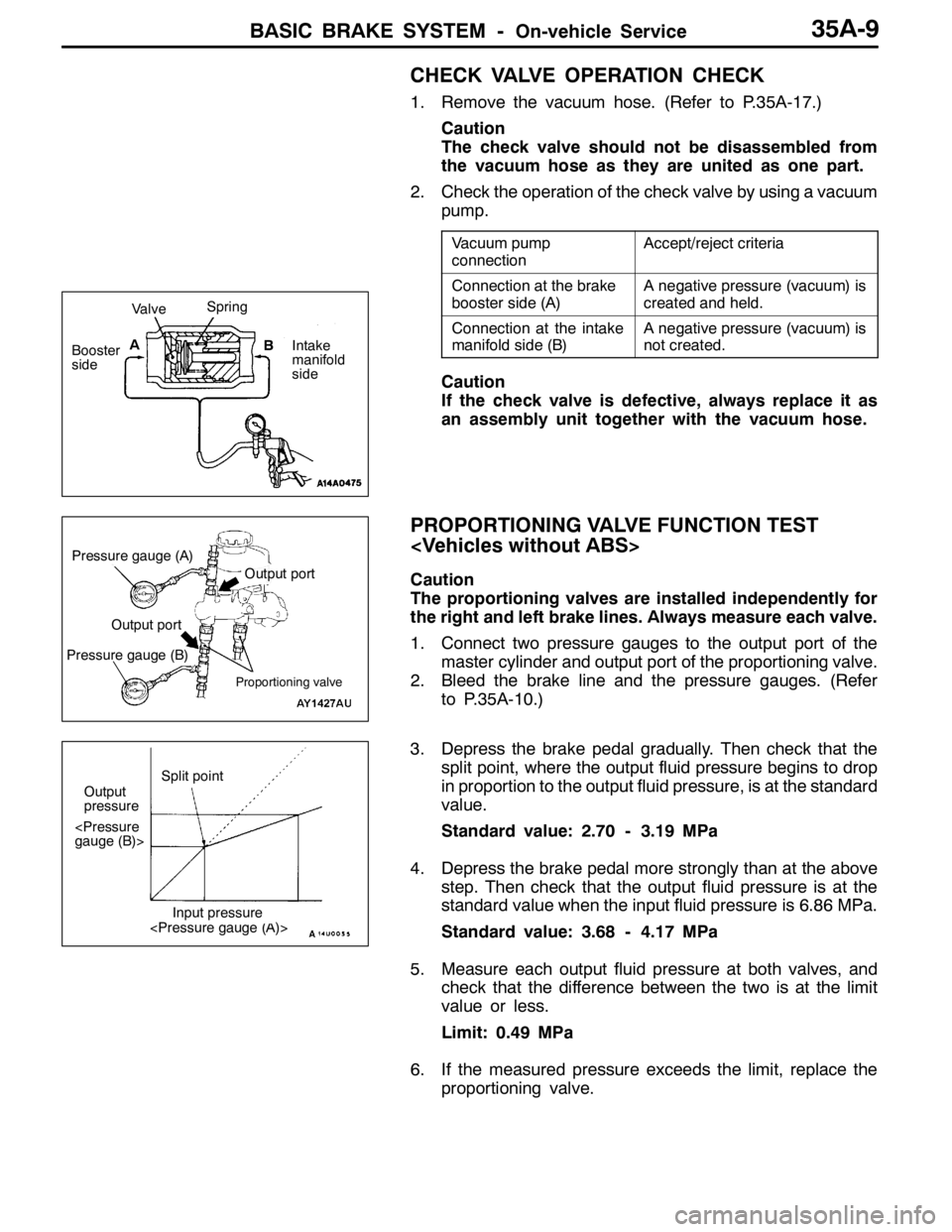
2. Check the operation of the check valve by using a vacuum
pump.
Vacuum pump
connectionAccept/reject criteria
Connection at the brake
booster side (A)A negative pressure (vacuum) is
created and held.
Connection at the intake
manifold side (B)A negative pressure (vacuum) is
not created.
Caution
If the check valve is defective, always replace it as
an assembly unit together with the vacuum hose.
PROPORTIONING VALVE FUNCTION TEST
Caution
The proportioning valves are installed independently for
the right and left brake lines. Always measure each valve.
1. Connect two pressure gauges to the output port of the
master cylinder and output port of the proportioning valve.
2. Bleed the brake line and the pressure gauges. (Refer
to P.35A-10.)
3. Depress the brake pedal gradually. Then check that the
split point, where the output fluid pressure begins to drop
in proportion to the output fluid pressure, is at the standard
value.
Standard value: 2.70 - 3.19 MPa
4. Depress the brake pedal more strongly than at the above
step. Then check that the output fluid pressure is at the
standard value when the input fluid pressure is 6.86 MPa.
Standard value: 3.68 - 4.17 MPa
5. Measure each output fluid pressure at both valves, and
check that the difference between the two is at the limit
value or less.
Limit: 0.49 MPa
6. If the measured pressure exceeds the limit, replace the
proportioning valve.
ValveSpring
Booster
sideA
B
Intake
manifold
side
Pressure gauge (A)
Proportioning valve
Output port
Output port
Pressure gauge (B)
gauge (B)>
Input pressure
Output
pressureSplit point