2007 MITSUBISHI LANCER EVOLUTION battery location
[x] Cancel search: battery locationPage 88 of 1449

HOW TO READ THE WIRING DIAGRAMS -Composition and Contents of Wiring DiagramsA-2
COMPOSITION AND CONTENTS OF WIRING DIAGRAMS
(1) This manual consists of wiring harness diagrams, installation locations of individual parts, circuits
diagrams and index.
(2) In each section, all specifications are listed, including optional specifications. Accordingly, some
specifications may not be applicable for individual vehicles.
SectionBasic contents
Wiring harness
configuration
diagramsConnector locations and harness wiring configurations on actual vehicles are illustrated.
Single part
installation positionLocations are shown for each point of relays, electronic control units, sensors, solenoids,
solenoid valves, diodes, inspection connectors, spare connectors, fusible links, fuses, etc. In the
part’s lists, parts are listed in alphabetical order.
Circuit diagramsCircuits from power supply to earth are shown completely, classified according to system. There
is a main division into power circuits, and circuits classified by system. The circuits classified by
system also include operation and troubleshooting hints.
DJunction block
The entire circuit for the junction block is described, because only the part of the junction
block needed is normally shown in each circuit diagram.
DJoint connectors
The internal circuits for all joint connectors are described, because only the part needed
is shown in each circuit diagram.
DPower supply circuits
Circuits from the battery to fusible link, dedicated fuses, ignition switch, general purpose
fuses, etc.
DCircuits classified by system
For each system, the circuits are shown from fuse to earth, excluding the power supply
sections.
DOperation
The standard operation of each system is briefly described, following the route of current
flow.
DTroubleshooting hints
This is a brief explanation of the inspection points that serve as hints when troubleshooting.
Explanations of the circuits controlled by the electronic control unit are omitted. Refer
to the related publications as required.
IndexAll components used are listed by connector number and component name.
Page 383 of 1449
GENERAL -How to Use This Manual00-5
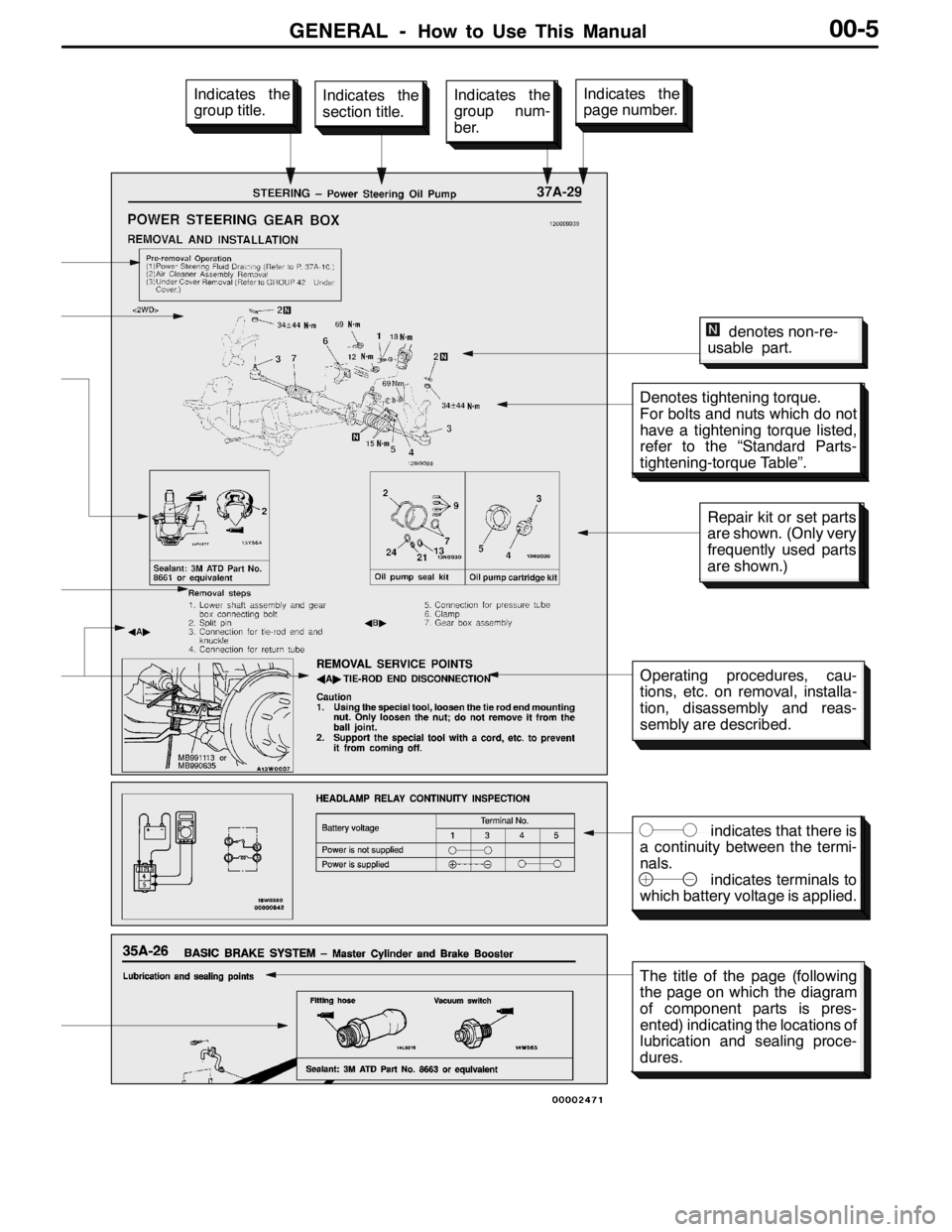
Denotes tightening torque.
For bolts and nuts which do not
have a tightening torque listed,
refer to the “Standard Parts-
tightening-torque Table”.
indicates that there is
a continuity between the termi-
nals.
indicates terminals to
which battery voltage is applied.
Indicates the
section title.Indicates the
group num-
ber.Indicates the
page number.Indicates the
group title.
denotes non-re-
usable part.
Repair kit or set parts
are shown. (Only very
frequently used parts
are shown.)
Operating procedures, cau-
tions, etc. on removal, installa-
tion, disassembly and reas-
sembly are described.
The title of the page (following
the page on which the diagram
of component parts is pres-
ented) indicating the locations of
lubrication and sealing proce-
dures.
Page 396 of 1449

GENERAL -Precautions Before Service00-18
PRECAUTIONS BEFORE SERVICE
SUPPLEMENTAL RESTRAINT SYSTEM (SRS)
1. Items to follow when servicing SRS
(1) Be sure to read GROUP 52B - Supplemental Restraint System (SRS).
For safe operations, please follow the directions and heed all warnings.
(2) Wait at least 60 seconds after disconnecting the battery cable before doing any further work.
The SRS system is designed to retain enough voltage to deploy the air bag even after the battery
has been disconnected. Serious injury may result from unintended air bag deployment if work
is done on the SRS system immediately after the battery cable is disconnected.
(3) Warning labels must be heeded when servicing or handling SRS components. Warning labels
are located in the following locations.
DSun visor
DGlove box
DSRS-ECU
DSteering wheel
DSteering Joint Cover
DAir bag module (driver’s side and front passenger’s side)
DClock spring
DSeat belt with pre-tensioner
(4) Always use the designated special tools and test equipment.
(5) Store components removed from the SRS in a clean and dry place.
The air bag module should be stored on a flat surface and placed so that the pad surface is
facing upward.
Do not place anything on top of it.
(6) Never attempt to disassemble or repair the SRS components (SRS-ECU, air bag module, clock
spring and seat belt with pre-tensioner).
(7) Whenever you finish servicing the SRS, check the SRS warning lamp operation to make sure
that the system functions properly.
(8) Be sure to deploy the air bag before disposing of the air bag module or disposing of a vehicle
equipped with an air bag. (Refer to GROUP 52B - Air Bag Module Disposal Procedures.)
2. Observe the following when carrying out operations on places where SRS components are installed,
including operations not directly related to the SRS air bag.
(1) When removing or installing parts do not allow any impact or shock to the SRS components.
(2) SRS components should not be subjected to heat, so remove the SRS components before drying
or baking the vehicle after painting.
DSRS-ECU, air bag module, clock spring: 93_C or more
DSeat belt with pre-tensioner: 90_C or more
After re-installing them, check the SRS warning lamp operation to make sure that the system
functions properly.
Page 418 of 1449

ENGINE -On-vehicle Service11A-12
12. Install the ignition coils and spark plugs.
13. Use the MUT-IIto erase the self-diagnosis codes or
disconnect the battery cable from the battery ( - ) terminal
for 10 seconds or more and then reconnect the cable.
NOTE
This will erase the diagnosis code resulting from the crank
angle sensor connector being disconnected.
MANIFOLD VACUUM CHECK
1. Set the vehicle to the pre-inspection condition.
2. Turn the ignition switch to the “LOCK” (OFF) position.
3. Set the engine tachometer or connect the MUT-II.
4. Check that the idle speed is within the standard value.
NOTE
When using the MUT-II, select the code No.22.
5. Connect the three-way union joint to the vacuum hose
between the fuel pressure control valve and the air intake
plenum, and connect a vacuum gauge.
6. Check the manifold vacuum at idle.
Limit: 58 kPa
7. Turn the ignition switch to the “LOCK” (OFF) position.
8. Remove the vacuum gauge and install the vacuum hose
in its original location.
9. Remove the engine tachometer or the MUT-II.
LASH ADJUSTER CHECK
If an abnormal noise (knocking) that seems to be coming
from the lash adjuster is heard after starting the engine and
does not stop, carry out the following check.
NOTE
(1) The abnormal noise which is caused by a problem
with the lash adjusters is generated after the engine
is started, and will vary according to the engine speed.
However, this noise is not related to the actual engine
load.
Because of this, if the noise does not occur
immediately after the engine is started, if it does not
change in accordance with the engine speed, or if
it changes in accordance with the engine load, the
source of the noise is not the lash adjusters.
Vacuum gauge
Fuel pressure
control valve
Page 780 of 1449
ENGINE AND EMISSION CONTROL -Emission Control System
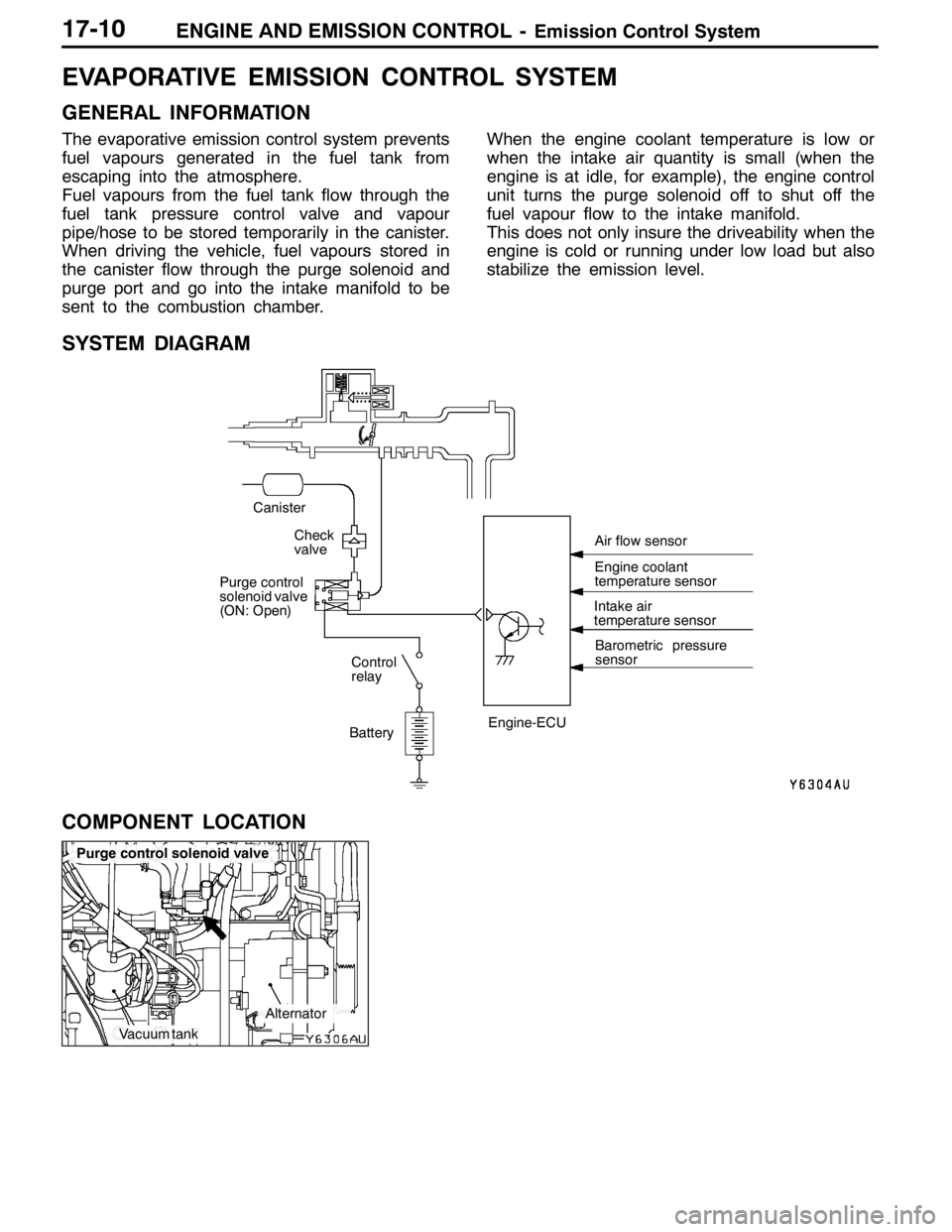
Vacuum tank
Alternator
Purge control solenoid valve
17-10
EVAPORATIVE EMISSION CONTROL SYSTEM
GENERAL INFORMATION
The evaporative emission control system prevents
fuel vapours generated in the fuel tank from
escaping into the atmosphere.
Fuel vapours from the fuel tank flow through the
fuel tank pressure control valve and vapour
pipe/hose to be stored temporarily in the canister.
When driving the vehicle, fuel vapours stored in
the canister flow through the purge solenoid and
purge port and go into the intake manifold to be
sent to the combustion chamber.When the engine coolant temperature is low or
when the intake air quantity is small (when the
engine is at idle, for example), the engine control
unit turns the purge solenoid off to shut off the
fuel vapour flow to the intake manifold.
This does not only insure the driveability when the
engine is cold or running under low load but also
stabilize the emission level.
SYSTEM DIAGRAM
BatteryIntake air
temperature sensor
Barometric pressure
sensor
Check
valve
Canister
Control
relay
Purge control
solenoid valve
(ON: Open)
Engine-ECUEngine coolant
temperature sensor Air flow sensor
COMPONENT LOCATION
Page 1318 of 1449

SRS -AirBagModuleandSeatBeltPre-tensioner
Disposal Procedures52B-74
(3) Route a thick wire through the holes in the seat belt
retractor bracket to secure at the top of the wheel
(convex part). (two locations)
(4) Connect the seat belt pre-tensioner connector to the
the SRS air bag adapter harness with the operation
harness attached.
(5) Pull out the seat belt outside the tyre.
Caution
Place the connector of the SRS air bag adapter
harness so that it is not clamped by the tyres at
deployment.
(6) Place an old tyre (without a wheel) on the tyre, which
the seat belt with pre-tensioner is secured on.
(7) Disconnect the deployment harness as far fromthe
seat belt pre-tensioner as possible and connect the
both terminals of the battery removed from the vehicle.
Then deploy.
Caution
1) Before the deployment, see that no one is near
the seat belt pre-tensioner.
2) Before handling the insulator, wait for a while
for cooling.
3) If the seat belt pre-tensioner fails to operate
although the procedure is respected, do not go
near the seat belt pre-tensioner. Contact your
local distributor.
(8) Discard the operated seat belt pre-tensioner
according to Disposal Procedure.(Refer to P.52B-75.)Seat belt pre-tensioner
Deployment harness
Old tyres without
wheels
Deployment harness
Page 1325 of 1449
CHASSIS ELECTRICAL -Battery54A-5
Caution
1. The battery plugs should be removed during charging.
2. The battery electrolyte level may rise and overflow from the battery during charging.
3. Explosions may occur if the battery is brought close to naked flames during charging.
4. Be careful to avoid tasks that might produce sparks or other danger while the battery is
charging.
5. After charging is complete, replace the battery plugs, pour water over the battery to rinse
away any sulphuric acid, and let the battery stand to dry.
6. Charge the battery in a well-ventilated location.
7. Do not let the battery electrolyte temperature rise above approximately 45_C
(approximately 55_Cduring rapid charging).
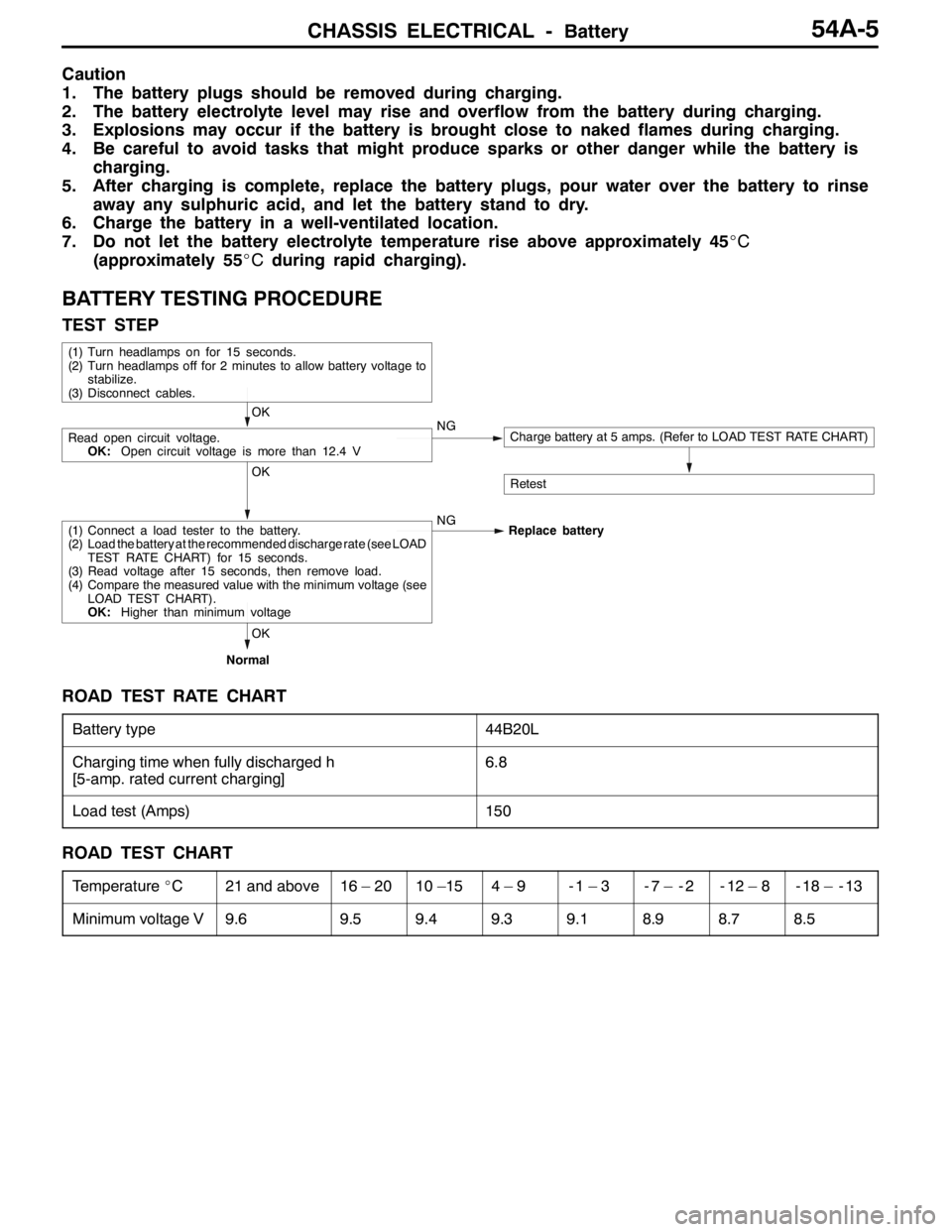
BATTERY TESTING PROCEDURE
TEST STEP
(1) Turn headlamps on for 15 seconds.
(2) Turn headlamps off for 2 minutes to allow battery voltage to
stabilize.
(3) Disconnect cables.
OK
Read open circuit voltage.
OK:Open circuit voltage is more than 12.4 VNGCharge battery at 5 amps. (Refer to LOAD TEST RATE CHART)
RetestOK
(1) Connect a load tester to the battery.
(2) Load the battery at the recommended discharge rate (see LOAD
TEST RATE CHART) for 15 seconds.
(3) Read voltage after 15 seconds, then remove load.
(4) Compare the measured value with the minimum voltage (see
LOAD TEST CHART).
OK:Higher than minimum voltageNG
Replace battery
OK
Normal
ROAD TEST RATE CHART
Battery type44B20L
Charging time when fully discharged h
[5-amp. rated current charging]6.8
Load test (Amps)150
ROAD TEST CHART
Temperature_C21 and above16 – 2010 –154–9-1–3-7 – -2-12 – 8-18 – -13
Minimum voltage V9.69.59.49.39.18.98.78.5