Page 1114 of 1449

PARKING BRAKES -Parking Brake Drum36-8
REMOVAL SERVICE POINT
AA"REAR BRAKE CALIPER ASSEMBLY REMOVAL
Remove the rear brake caliper assembly and support it with
wire or similar.
CAUTION: Brembo disc brake
Take care not to contact the parts or tools to the caliper
because the paint of caliper will be scratched. And if
there is brake fluid on the caliper, wipe out quickly.
INSTALLATION SERVICE POINTS
"AAADJUSTER ASSEMBLY INSTALLATION
Install the adjuster assembly so that the shoe adjusting bolt
of left hand wheel is attached towards the rear of the vehicle,
and the shoe adjusting bolt of right hand wheel is towards
the front of the vehicle.
"BASHOE-TO-ANCHOR SPRING INSTALLATION
Install the shoe-to-anchor springs in the order shown in the
illustration.
NOTE
The figure shows the left wheel; for the right wheel, the position
is symmetrical.
INSPECTION
BRAKE LINING AND BRAKE DRUM CHECK
1. Measure the thickness of the brake lining at several places.
Standard value: 2.8 mm
Limit: 1.0 mm
2. If the thickness of the brake lining has worn down to
the limit value or more, replace the shoe and lining
assemblies on both sides of the vehicle.
3. Measure the inside diameter of the brake disc in two
places or more.
Standard value: 168.0 mm
Limit: 169.0 mm
4. If the inside of the brake disc has worn down to the
limit value or more, or if it is excessively worn on one
side, replace the brake disc.
Shoe adjusting
bolt
Rear side
of the ve-
hicle
A14N0009
12
Paint
Page 1115 of 1449

37A-1
STEERING
CONTENTS
GENERAL INFORMATION 2..................
SERVICE SPECIFICATIONS 4.................
LUBRICANTS 4..............................
SEALANT 4..................................
SPECIAL TOOLS 4...........................
ON-VEHICLE SERVICE 7.....................
Steering Wheel Free Play Check 7..............
Steering Angle Check 7........................
Tie Rod End Ball Joint Turning Torque Check 7..
Stationary Steering Effort Check 8...............
Checking Steering Wheel Return to Centre 8.....
Drive Belt Tension Check 8.....................Power Steering Fluid Level Check 9.............
Power Steering Fluid Replacement 9.............
Power Steering System Bleeding 9..............
Oil Pump Pressure Test 10.....................
Power Steering Oil Pressure Switch Check 11....
Ball Joint Dust Cover Check 11.................
STEERING WHEEL* 12.......................
STEERING SHAFT* 14.......................
POWER STEERING GEAR BOX AND
LINKAGE* 16................................
POWER STEERING OIL PUMP 29............
POWER STEERING OIL HOSES 30...........
WARNINGS REGARDING SERVICING OF SUPPLEMENTAL RESTRAINT SYSTEM (SRS) EQUIPPED VEHICLES
WARNING!
(1) Improper service or maintenance of any component of the SRS, or any SRS-related component, can lead to personal
injury or death to service personnel (from inadvertent firing of the air bag) or to the driver and passenger (from rendering
the SRS inoperative).
(2) Service or maintenance of any SRS component or SRS-related component must be performed only at an authorized
MITSUBISHI dealer.
(3) MITSUBISHI dealer personnel must thoroughly review this manual, and especially its GROUP 52B - Supplemental
Restraint System (SRS) before beginning any service or maintenance of any component of the SRS or any SRS-related
component.
NOTE
The SRS includes the following components: SRS-ECU, SRS warning lamp, air bag module, clock spring and interconnecting
wiring. Other SRS-related components (that may have to be removed/installed in connection with SRS service or maintenance) are
indicated in the table of contents by an asterisk (*).
Page 1116 of 1449

STEERING -General Information37A-2
GENERAL INFORMATION
The system has been equipped with the MOMO
leather 3-spoke-type steering wheel with built-in
SRS airbag.
The steering column is equipped with tilt steering
mechanism.
The power steering is an integral rack and piniontype that combines the steering gear and linkage
into one light-weight and compact assembly.
The steering system uses a vane oil pump with
a fluid flow control system, so that steering effort
varies with engine speed.
ItemLancer EVOLUTION-
Steering wheelTypeMOMO 3-spoke typeg
Outside diameter mm380 ,
365
Maximum number of turns2.1
Steering columnColumn mechanismTilt steering
Power steering typeIntegral type
Oil pumpTypeVariable capacity type (vane pump)pp
Basic discharge amount cm3/rev.9.6
Relief pressure MPa8.3 - 9.0
Reservoir typeSeparate type
Pressure switchEquipped
Steering gear and linkageTypeRack and pinionggg
Stroke ratio (Rack stroke/Steering wheel
Maximum turning radius)68.61
Rack stroke mm146
Steering angleInner wheel32°gg
Outer wheel (for reference)27°
Power steering fluidSpecified lubricantsAutomatic transmission fluid DEXRON IIg
Quantity LApproximately 1.0
Page 1117 of 1449
STEERING -General Information37A-3
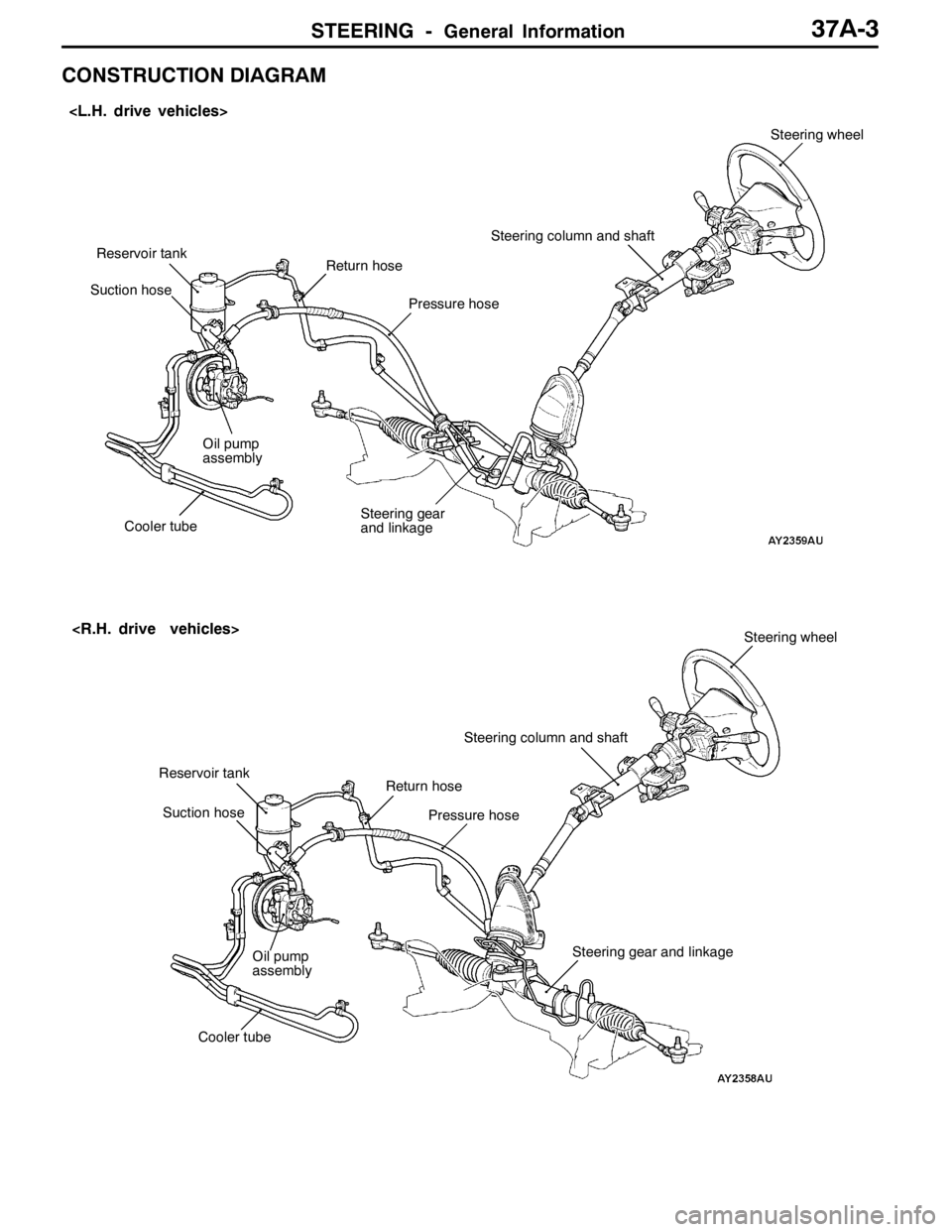
CONSTRUCTION DIAGRAM
Reservoir tank
Reservoir tank
Steering gear and linkage Return hose
Suction hose
Pressure hoseSteering wheel
Steering column and shaft
Oil pump
assembly
Steering gear
and linkage Return hose
Suction hose
Pressure hoseSteering wheel
Steering column and shaft
Oil pump
assembly
Cooler tube
Cooler tube
Page 1118 of 1449

STEERING -Service Specifications/Lubricants/Sealant/Special Tools37A-4
SERVICE SPECIFICATIONS
ItemsStandard valueLimit
Steering wheel free play mmwhen engine running-30 or less
with engine stopped0-10-
Steering angleInner wheel31_45’±1_30’-
Outer wheel 27_15’-
Ball joint turning torque N·m1.0 - 3.0-
Stationary steering effort NSteering effort32 or less-
Fluctuation allowance6.0 or less-
Oil pump relief pressure MPa8.4 - 9.0-
Pressure under no-load conditions MPa0.2 - 0.8-
Steering gear retention hydraulic pressure MPa8.4 - 9.0-
Oil pressure switch operating
pressureMPa
OFF→ON1.8 - 2.4-
pressure MPaON→OFF1.0 - 2.4-
Total pinion torque N·mTotal rotation torque0.8 - 1.8-
Torque variation0.49 or less-
Tie rod joint swing resistance N (Tie rod joint swing torque N·m)8 - 27 (1.5 - 4.9)-
Opening dimension of special tool (MB991561) mm2.9-
Band crimped width mm2.4 - 2.8-
LUBRICANTS
ItemsSpecified lubricantQuantity
Power steering fluidAutomatic transmission fluid DEXRONIIApprox. 1.0 L
Tie rod bellowsSilicone greaseAs required
Pinion and valve assemblyRepair kit greaseAs required
Rack assembly
SEALANT
ItemsSpecified sealantRemarks
Toe boad (steering shaft cover
mounting bolt hole)3M ATD Part No. 8513 or equivalentDrying sealant
Rack support cover end plug3M ATD Part No. 8661, 8663 or equivalentSemi-drying sealant
SPECIAL TOOLS
ToolNumberNameUse
MB990635,
MB991113 or
MB991406Steering linkage
pullerDisconnection of tie rod end
Page 1119 of 1449
STEERING -Special Tools37A-5
Tool UseName Number
MB991006Preload socketMeasurement of the total pinion torque
MB990326Preload socketMeasurement of the ball joint turning torque
MB990993Power steering oil
pressure gauge
adapter (pump
side)Measurement of oil pressure
MB990994Power steering oil
pressure gauge
adapter (hose
side)
MB990662Oil pressure gauge
assemblyMeasurement of oil pressure
MB991204Torque wrench
socketDAdjustment of rack support
DRemoval of rack support cover
MB990784Ornament removerRemoval of steering wheel cover
MB990803Steering wheel
pullerDisconnection of the steering wheel
MB991199Oil seal and
bearing installerDPress fitting of rack housing bearing
DTo press in the oil seal for the rack
Page 1121 of 1449
STEERING -On-vehicle Service37A-7
ON-VEHICLE SERVICE
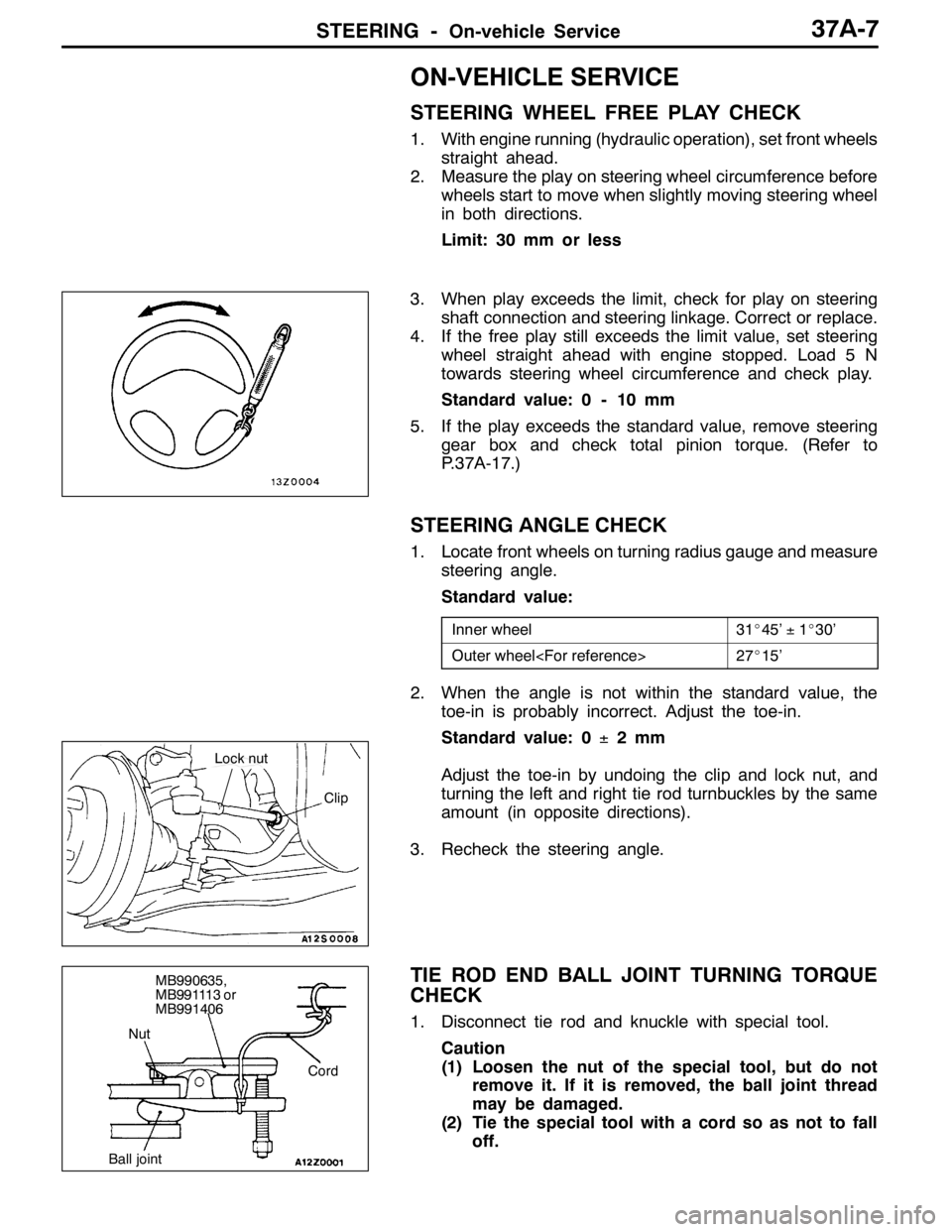
STEERING WHEEL FREE PLAY CHECK
1. With engine running (hydraulic operation), set front wheels
straight ahead.
2. Measure the play on steering wheel circumference before
wheels start to move when slightly moving steering wheel
in both directions.
Limit: 30 mm or less
3. When play exceeds the limit, check for play on steering
shaft connection and steering linkage. Correct or replace.
4. If the free play still exceeds the limit value, set steering
wheel straight ahead with engine stopped. Load 5 N
towards steering wheel circumference and check play.
Standard value: 0 - 10 mm
5. If the play exceeds the standard value, remove steering
gear box and check total pinion torque. (Refer to
P.37A-17.)
STEERING ANGLE CHECK
1. Locate front wheels on turning radius gauge and measure
steering angle.
Standard value:
Inner wheel31_45’±1_30’
Outer wheel27_15’
2. When the angle is not within the standard value, the
toe-in is probably incorrect. Adjust the toe-in.
Standard value: 0±2mm
Adjust the toe-in by undoing the clip and lock nut, and
turning the left and right tie rod turnbuckles by the same
amount (in opposite directions).
3. Recheck the steering angle.
TIE ROD END BALL JOINT TURNING TORQUE
CHECK
1. Disconnect tie rod and knuckle with special tool.
Caution
(1) Loosen the nut of the special tool, but do not
remove it. If it is removed, the ball joint thread
may be damaged.
(2) Tie the special tool with a cord so as not to fall
off.
Clip
Lock nut
Cord
Ball jointNutMB990635,
MB991113 or
MB991406
Page 1122 of 1449
STEERING -On-vehicle Service37A-8
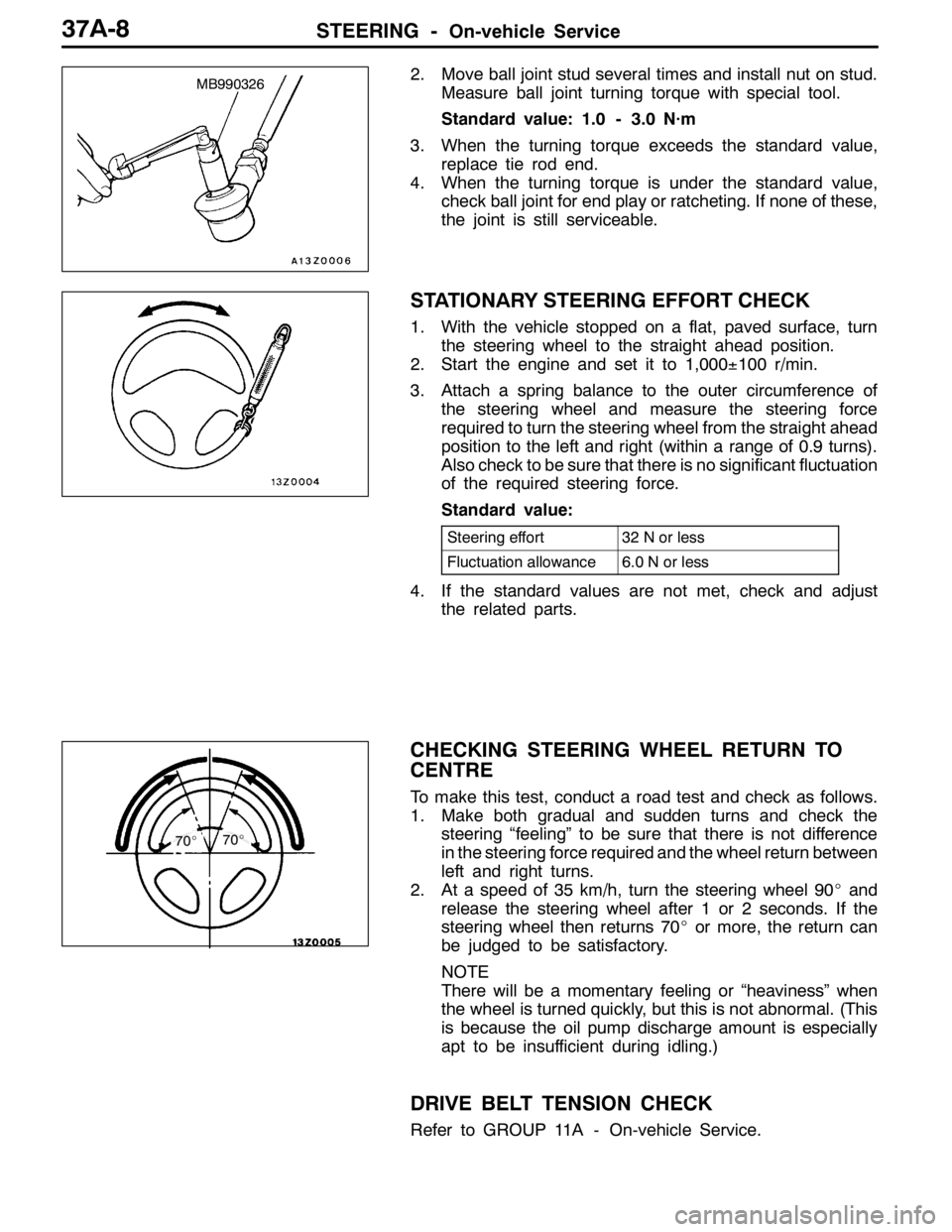
2. Move ball joint stud several times and install nut on stud.
Measure ball joint turning torque with special tool.
Standard value: 1.0 - 3.0 N·m
3. When the turning torque exceeds the standard value,
replace tie rod end.
4. When the turning torque is under the standard value,
check ball joint for end play or ratcheting. If none of these,
the joint is still serviceable.
STATIONARY STEERING EFFORT CHECK
1. With the vehicle stopped on a flat, paved surface, turn
the steering wheel to the straight ahead position.
2. Start the engine and set it to 1,000±100 r/min.
3. Attach a spring balance to the outer circumference of
the steering wheel and measure the steering force
required to turn the steering wheel from the straight ahead
position to the left and right (within a range of 0.9 turns).
Also check to be sure that there is no significant fluctuation
of the required steering force.
Standard value:
Steering effort32 N or less
Fluctuation allowance6.0 N or less
4. If the standard values are not met, check and adjust
the related parts.
CHECKING STEERING WHEEL RETURN TO
CENTRE
To make this test, conduct a road test and check as follows.
1. Make both gradual and sudden turns and check the
steering “feeling” to be sure that there is not difference
in the steering force required and the wheel return between
left and right turns.
2. At a speed of 35 km/h, turn the steering wheel 90_and
release the steering wheel after 1 or 2 seconds. If the
steering wheel then returns 70_or more, the return can
be judged to be satisfactory.
NOTE
There will be a momentary feeling or “heaviness” when
the wheel is turned quickly, but this is not abnormal. (This
is because the oil pump discharge amount is especially
apt to be insufficient during idling.)
DRIVE BELT TENSION CHECK
Refer to GROUP 11A - On-vehicle Service.
MB990326
70_70_