Page 1038 of 1449
FRONT SUSPENSION -Lower Arm Assembly/Stabilizer Bar33A-12
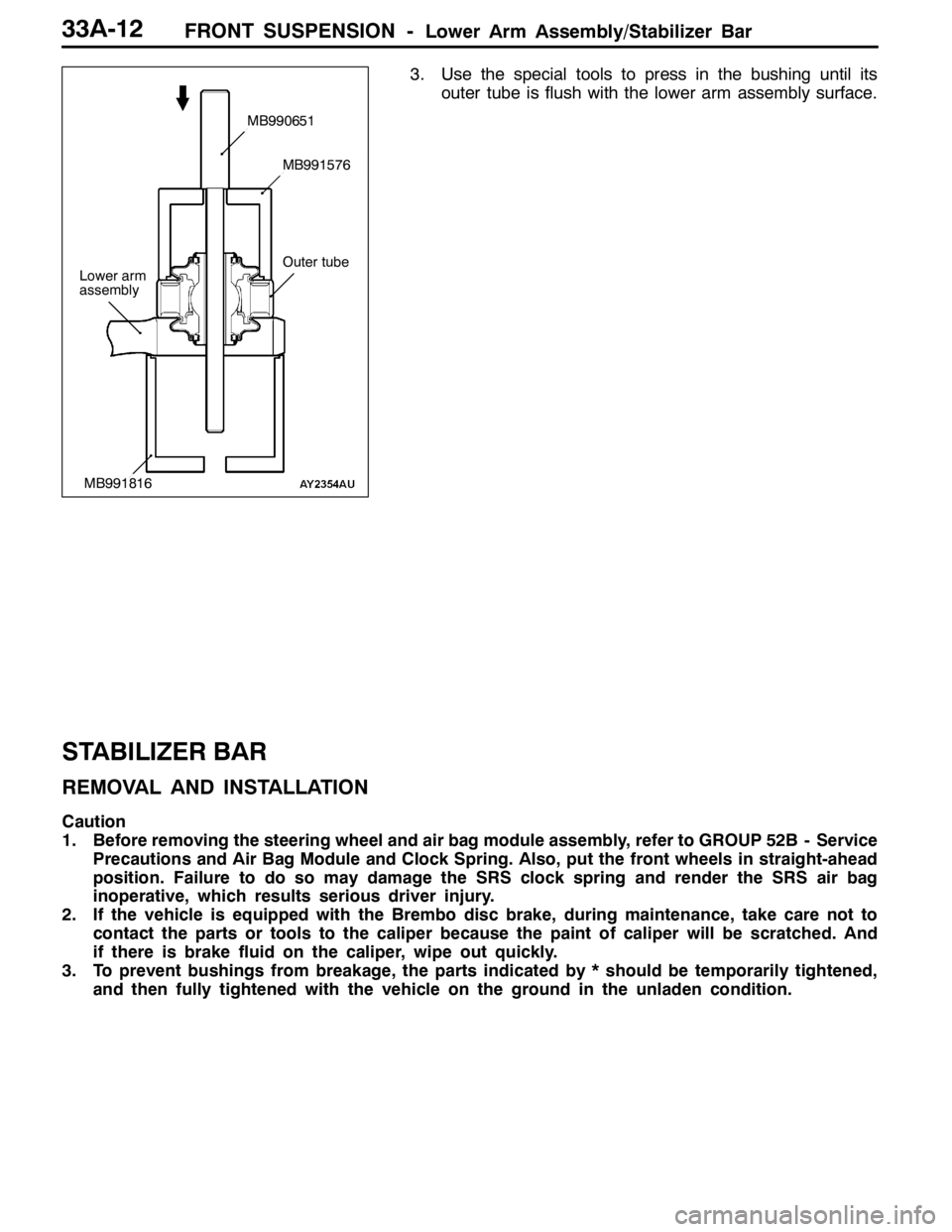
3. Use the special tools to press in the bushing until its
outer tube is flush with the lower arm assembly surface.
STABILIZER BAR
REMOVAL AND INSTALLATION
Caution
1. Before removing the steering wheel and air bag module assembly, refer to GROUP 52B - Service
Precautions and Air Bag Module and Clock Spring. Also, put the front wheels in straight-ahead
position. Failure to do so may damage the SRS clock spring and render the SRS air bag
inoperative, which results serious driver injury.
2. If the vehicle is equipped with the Brembo disc brake, during maintenance, take care not to
contact the parts or tools to the caliper because the paint of caliper will be scratched. And
if there is brake fluid on the caliper, wipe out quickly.
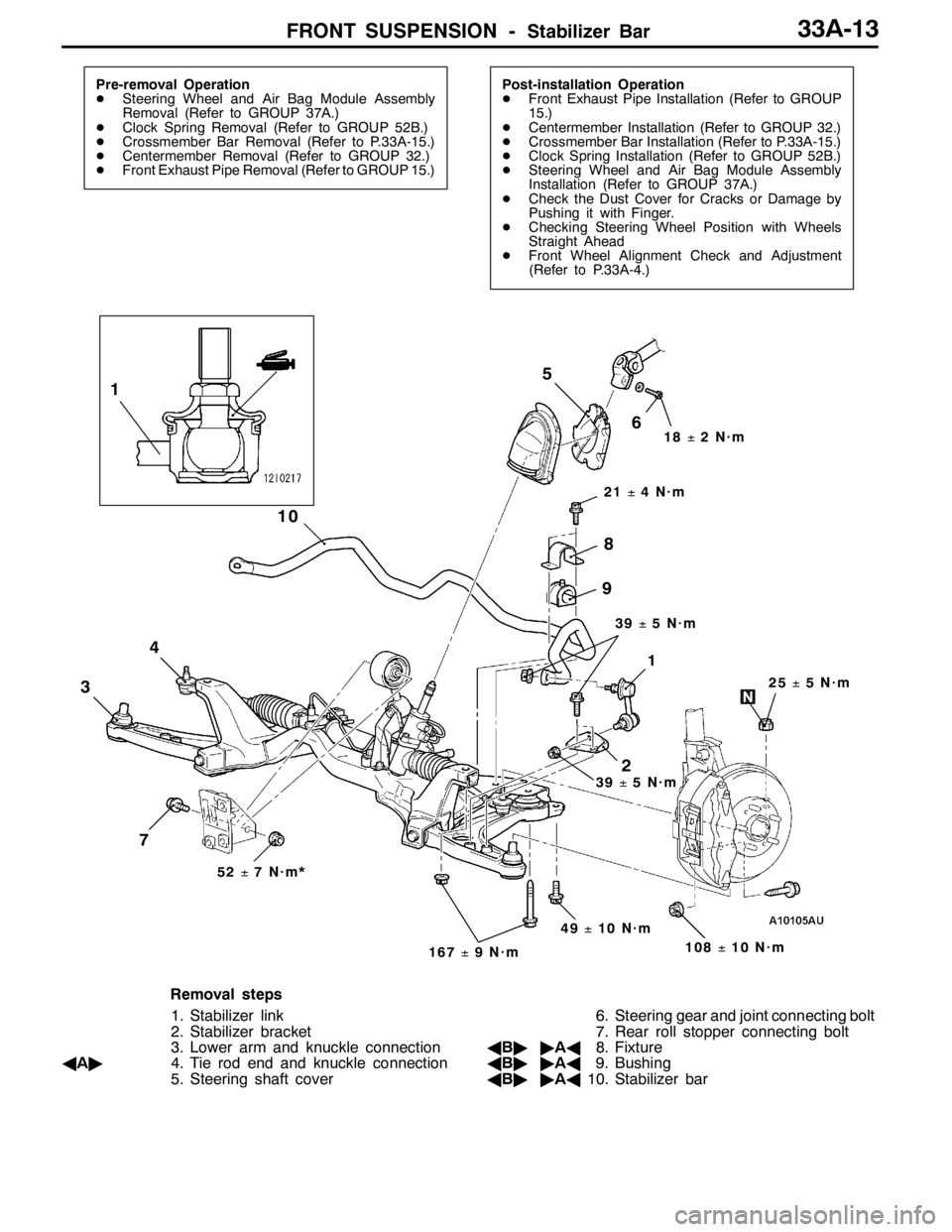
3. To prevent bushings from breakage, the parts indicated by * should be temporarily tightened,
and then fully tightened with the vehicle on the ground in the unladen condition.
Lower arm
assembly
MB990651
MB991576
MB991816
Outer tube
Page 1039 of 1449
FRONT SUSPENSION -Stabilizer Bar33A-13
Pre-removal Operation
DSteering Wheel and Air Bag Module Assembly
Removal (Refer to GROUP 37A.)
DClock Spring Removal (Refer to GROUP 52B.)
DCrossmember Bar Removal (Refer to P.33A-15.)
DCentermember Removal (Refer to GROUP 32.)
DFront Exhaust Pipe Removal (Refer to GROUP 15.)Post-installation Operation
DFront Exhaust Pipe Installation (Refer to GROUP
15.)
DCentermember Installation (Refer to GROUP 32.)
DCrossmember Bar Installation (Refer to P.33A-15.)
DClock Spring Installation (Refer to GROUP 52B.)
DSteering Wheel and Air Bag Module Assembly
Installation (Refer to GROUP 37A.)
DCheck the Dust Cover for Cracks or Damage by
Pushing it with Finger.
DChecking Steering Wheel Position with Wheels
Straight Ahead
DFront Wheel Alignment Check and Adjustment
(Refer to P.33A-4.)
3
4
10
21±4N·m
51
1
2
25±5N·m
18±2N·m
108±10 N·m
52±7N·m*
49±10 N·m
167±9N·m
7
8
9
6
39±5N·m
39±5N·m
Removal steps
1. Stabilizer link
2. Stabilizer bracket
3. Lower arm and knuckle connection
AA"4. Tie rod end and knuckle connection
5. Steering shaft cover6. Steering gear and joint connecting bolt
7. Rear roll stopper connecting bolt
AB""AA8. Fixture
AB""AA9. Bushing
AB""AA10. Stabilizer bar
Page 1041 of 1449
FRONT SUSPENSION -Crossmember Bar33A-15
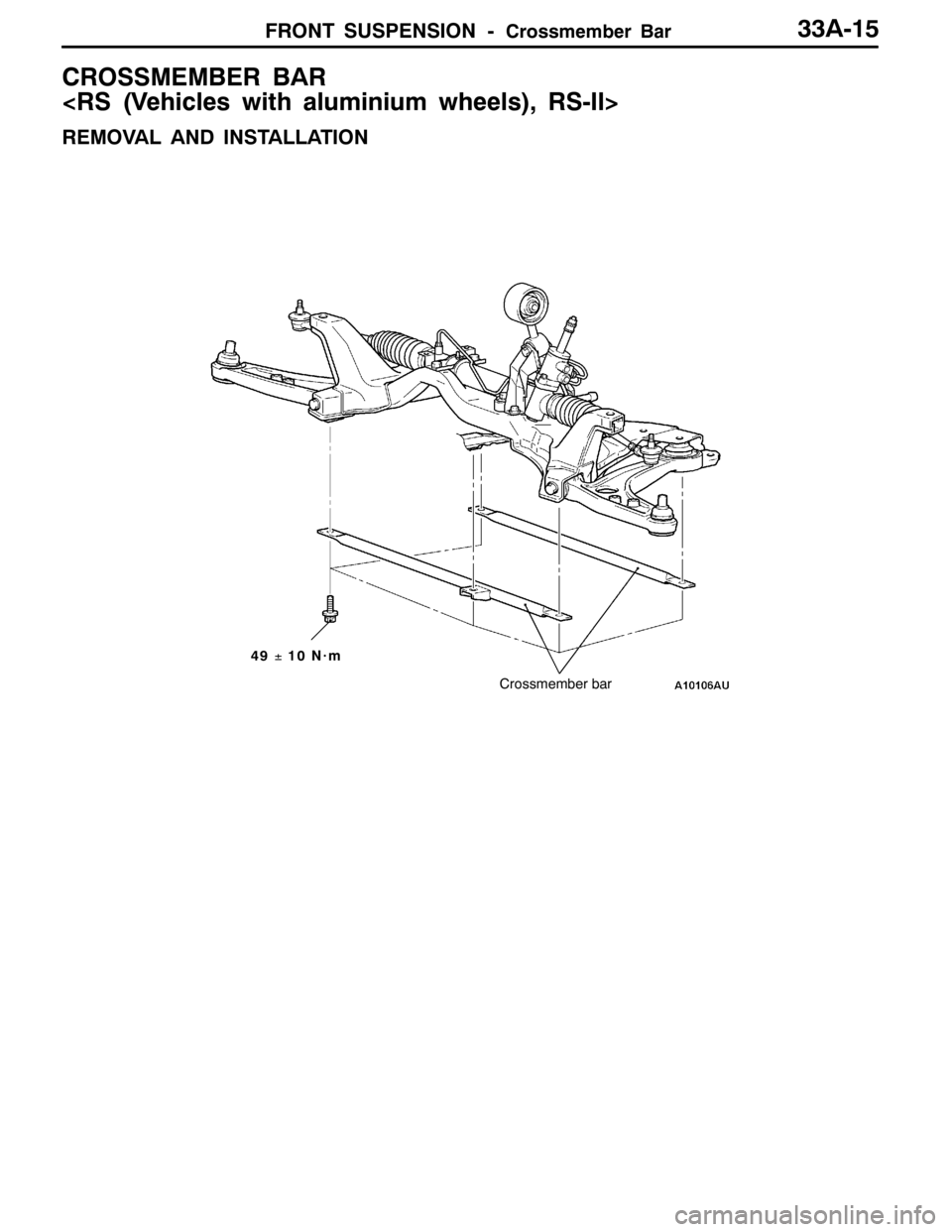
CROSSMEMBER BAR
REMOVAL AND INSTALLATION
49±10 N·m
Crossmember bar
Page 1045 of 1449

BASIC BRAKE SYSTEM -General Information35A-3
GENERAL INFORMATION
The brake system offers high dependability and durability along with improved braking performance and
brake sensitivity.
SERVICE PRECAUTION
Take care not to contact the parts or tools to the caliper because the paint of caliper will be scratched.
SPECIFICATIONS
ItemsSpecifications
Master cylinderTypeTandem type
I.D. mm26.9
Brake boosterTypeVacuum type, tandem
Effective dia. of power cylinder mm205 + 230
Boosting ratio4.5 (Pedal depressing force: 230 N)
Rear wheel hydraulic
controlmethod
Vehicles with ABS Electronic brake-force distribution (EBD)
control methodVehicles without ABS Proportioning valves
Proportioning valves
VehicleswithoutABS
TypeSingle type¢2
Decompression ratio0.25
Front brakes
RS(standard)
TypeFloating caliper, 2 piston, ventilated disc
Disc effective dia.¢thickness mm227¢24
Wheel cylinder I.D. mm42.9 (¢2)
Pad thickness mm10.0
Clearance adjustmentAutomatic
Front brakes
Type4 opposed piston, ventilated disc
Disc effective dia.¢thickness mm263¢32
Wheel cylinder I.D. mm40.0 (¢2), 46.0 (¢2)
Pad thickness mm10.0
Clearance adjustmentAutomatic
Rear brakes
RS(standard)
TypeFloating caliper, 1 piston, ventilated disc
Disc effective dia.¢thickness mm237¢20
Wheel cylinder I.D. mm34.9
Pad thickness mm10.0
Clearance adjustmentAutomatic
Rear brakes
Type2 opposed piston, ventilated disc
Disc effective dia.¢thickness mm252¢22
Wheel cylinder I.D. mm40.0 (¢2)
Pad thickness mm9.0
Clearance adjustmentAutomatic
Brake fluidDOT3 or DOT4
Page 1047 of 1449
Page 1048 of 1449
BASIC BRAKE SYSTEM -Lubricants/Sealant/Special Tools35A-6
LUBRICANTS
ItemsSpecified LubricantQuantity
Brake fluidDOT3 or DOT4As required
Piston, wheel cylinder body
Piston boot, piston seal, shimRepair kit grease
Guide pin, lock pin, pin boot
Pad assembly
SEALANT
ItemsSpecified sealantRemarks
Fitting3M ATD Part No. 8661, 8663 or equivalentSemi-drying sealant
SPECIAL TOOLS
ToolNumberNameUse
MB991568Push rod adjusting
socketAdjustment of the brake booster push rod
protrusion amount
AMB990964
A: MB990520Brake tool setPushing-in of the disc brake piston
DDisc brake piston pushing-in
MB990998Front hub remover
and installerProvisional holding of the wheel bearing
Page 1056 of 1449
BASIC BRAKE SYSTEM -On-vehicle Service35A-14
BRAKE DISC THICKNESS CHECK
Caution: Brembo disc brake
Take care not to contact the parts or tools to the caliper
because the paint of caliper will be scratched. And if
there is brake fluid on the caliper, wipe out quickly.
1. Using a micrometer, measure disc thickness at eight
positions, approximately 45°apart and 10 mm in from
the outer edge of the disc.
Brake disc thickness
Standard value: 24.0 mm , 20.0 mm
Limit: 22.4 mm , 18.4 mm
Brake disc thickness
Standard value:32.0 mm , 22.0 mm
Limit: 29.8 mm , 20.4 mm
Thickness variation (at least 8 positions)
The difference between any thickness measurements
should not be more than 0.015 mm.
2. If the disc is beyond the limits for thickness, remove it
and install a new one. If thickness variation exceeds the
specification, replace the brake disc or grind it with
on-the-car type brake lathe (“MAD, DL-8700PF” or
equivalent).
Caution
(1) After a new brake disc is installed, always grind
the brake disc with on-the-car type brake lathe.If
this step is not carried out, the brake disc run-out
exceeds the specified value, resulting in judder.
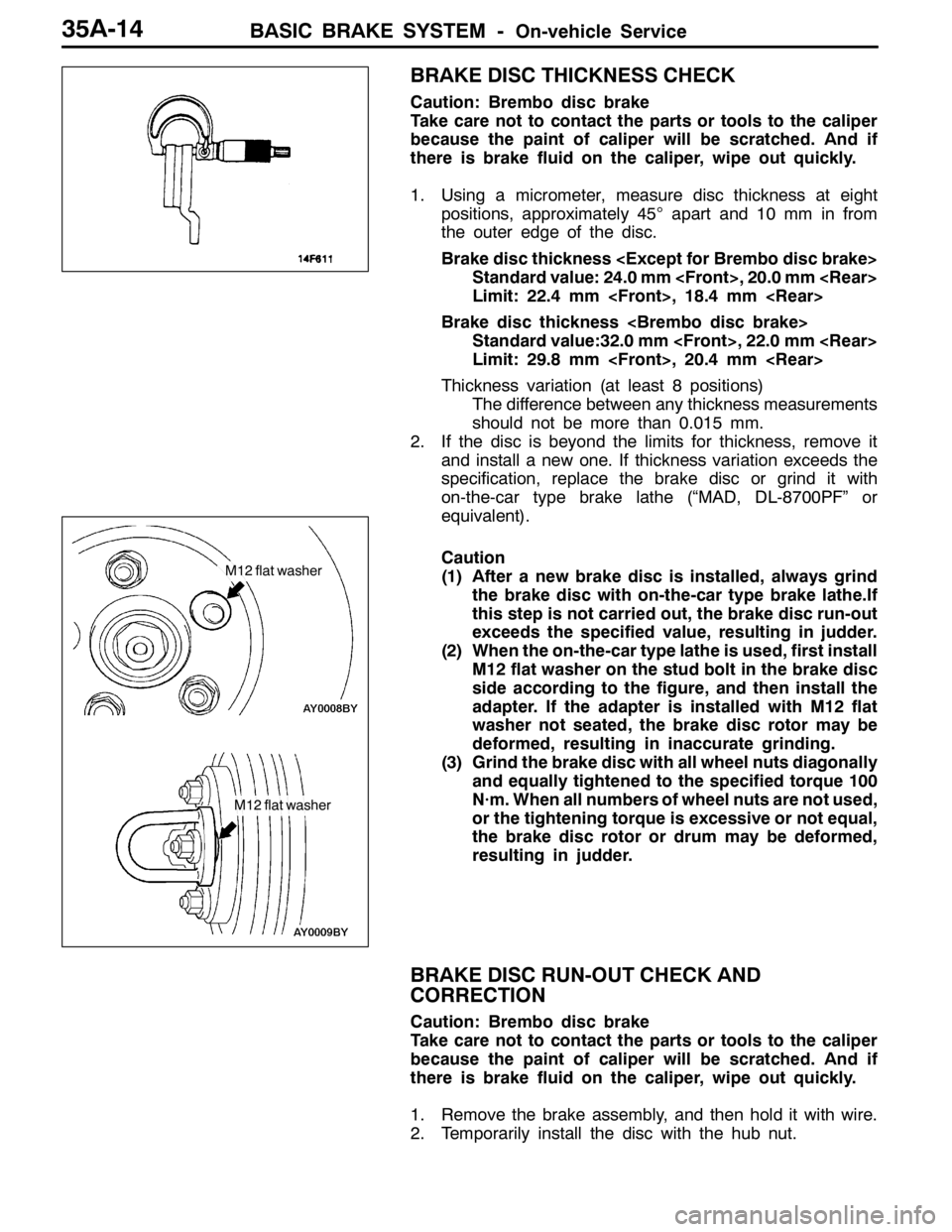
(2) When the on-the-car type lathe is used, first install
M12 flat washer on the stud bolt in the brake disc
side according to the figure, and then install the
adapter. If the adapter is installed with M12 flat
washer not seated, the brake disc rotor may be
deformed, resulting in inaccurate grinding.
(3) Grind the brake disc with all wheel nuts diagonally
and equally tightened to the specified torque 100
N·m. When all numbers of wheel nuts are not used,
or the tightening torque is excessive or not equal,
the brake disc rotor or drum may be deformed,
resulting in judder.
BRAKE DISC RUN-OUT CHECK AND
CORRECTION
Caution: Brembo disc brake
Take care not to contact the parts or tools to the caliper
because the paint of caliper will be scratched. And if
there is brake fluid on the caliper, wipe out quickly.
1. Remove the brake assembly, and then hold it with wire.
2. Temporarily install the disc with the hub nut.
M12 flat washer
M12 flat washer
Page 1057 of 1449
BASIC BRAKE SYSTEM -On-vehicle Service35A-15
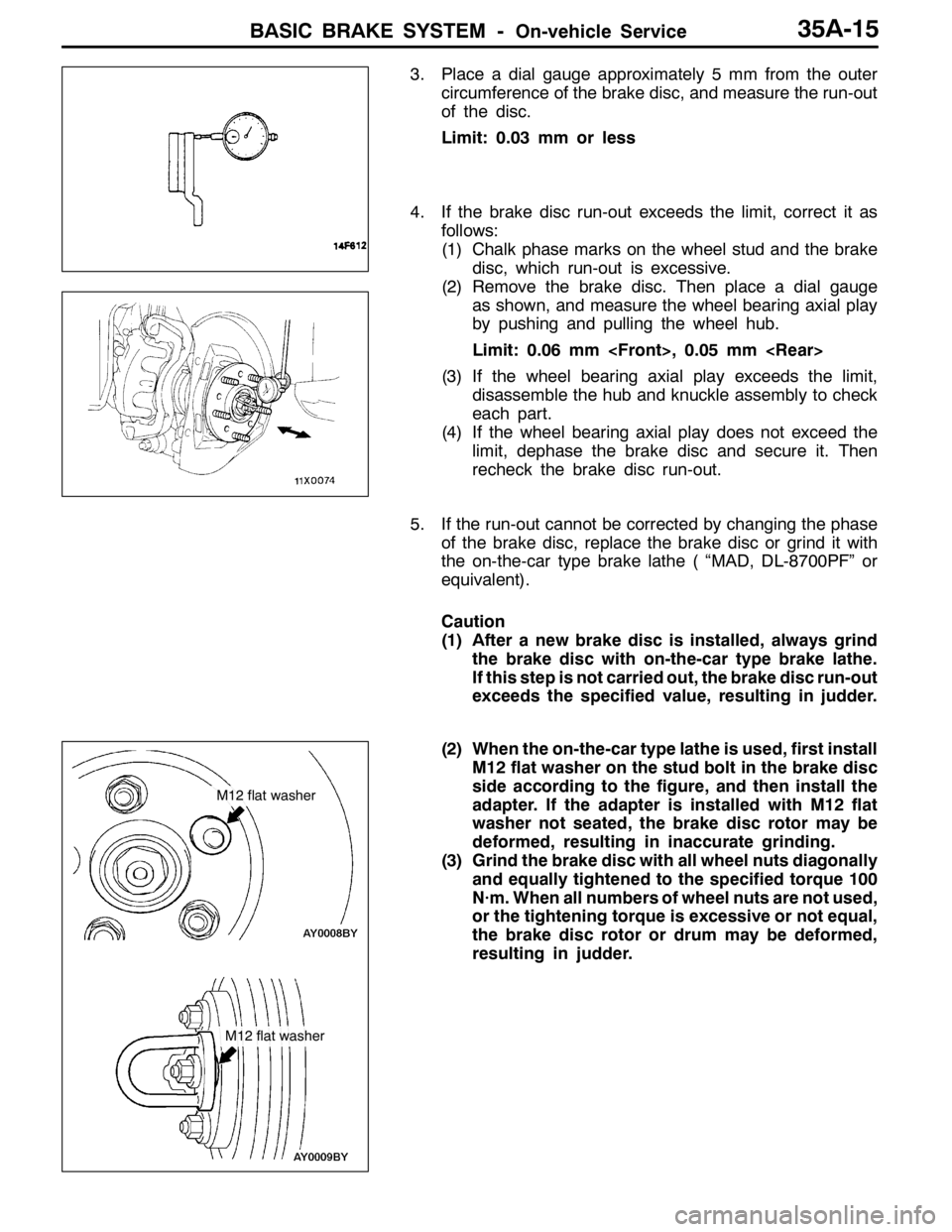
3. Place a dial gauge approximately 5 mm from the outer
circumference of the brake disc, and measure the run-out
of the disc.
Limit: 0.03 mm or less
4. If the brake disc run-out exceeds the limit, correct it as
follows:
(1) Chalk phase marks on the wheel stud and the brake
disc, which run-out is excessive.
(2) Remove the brake disc. Then place a dial gauge
as shown, and measure the wheel bearing axial play
by pushing and pulling the wheel hub.
Limit: 0.06 mm , 0.05 mm
(3) If the wheel bearing axial play exceeds the limit,
disassemble the hub and knuckle assembly to check
each part.
(4) If the wheel bearing axial play does not exceed the
limit, dephase the brake disc and secure it. Then
recheck the brake disc run-out.
5. If the run-out cannot be corrected by changing the phase
of the brake disc, replace the brake disc or grind it with
the on-the-car type brake lathe ( “MAD, DL-8700PF” or
equivalent).
Caution
(1) After a new brake disc is installed, always grind
the brake disc with on-the-car type brake lathe.
If this step is not carried out, the brake disc run-out
exceeds the specified value, resulting in judder.
(2) When the on-the-car type lathe is used, first install
M12 flat washer on the stud bolt in the brake disc
side according to the figure, and then install the
adapter. If the adapter is installed with M12 flat
washer not seated, the brake disc rotor may be
deformed, resulting in inaccurate grinding.
(3) Grind the brake disc with all wheel nuts diagonally
and equally tightened to the specified torque 100
N·m. When all numbers of wheel nuts are not used,
or the tightening torque is excessive or not equal,
the brake disc rotor or drum may be deformed,
resulting in judder.
M12 flat washer
M12 flat washer