2006 SUZUKI SX4 Dif
[x] Cancel search: DifPage 303 of 1556

Downloaded from www.Manualslib.com manuals search engine Engine Mechanical: 1D-21
12) Install oil pressure switch bracket (1).
13) Connect right and left drive shaft joints to differential
gear referring to “Front Drive Shaft Assembly
Removal and Installation in Section 3A”.
14) Install suspension control arm referring to
“Suspension Control Arm / Bushing Removal and
Installation in Section 2B”.
15) Install cylinder upper cover (1).16) Install A/C compressor to its bracket (if equipped)
referring to “Compressor Assembly Removal and
Installation in Section 7B” or “Compressor Assembly
Removal and Installation in Section 7B”.
17) Adjust A/C compressor drive belt referring to
“Compressor Drive Belt Removal and Installation in
Section 7B” or “Compressor Drive Belt Removal and
Installation in Section 7B”.
18) Install air cleaner assembly referring to “Air Cleaner
Assembly Removal and Installation”.
19) Check to ensure that all removed parts are back in
place. Reinstall any necessary parts which have not
been reinstalled.
20) Refill cooling system with coolant referring to
“Cooling System Flush and Refill in Section 1F”.
21) Refill engine with engine oil referring to “Engine Oil
and Filter Change in Section 0B”.
22) Refill transaxle oil referring to “Manual Transaxle Oil
Change in Section 5B” or “A/T Fluid Change in
Section 5A”.
23) Refill transfer oil referring to “Transfer Oil Change in
Section 3C”.
24) Install battery and battery tray with ECM.
25) Connect ECM wire harness.
26) Connect positive and negative cable at battery.
27) Install right and left side engine under covers.
28) Verify that there is no fuel leakage, coolant leakage,
oil leakage and exhaust gas leakage at each
connection.
2. Exhaust manifold
1
2
I5RW0A140011-01
1
I5RW0A140009-01
Page 319 of 1556

Downloaded from www.Manualslib.com manuals search engine Engine Mechanical: 1D-37
6) Tighten camshaft housing bolts evenly and gradually
in numerical order (“1” through “21”) by repeating
tightening sequence two or three times until
specified torque is obtained.
NOTE
Do not rotate camshaft while gauging plastic
is installed.
Tightening torque
Camshaft housing bolt (a): 11 N·m (1.1 kgf-m,
8.0 lb-ft)
7) Remove housing, and using scale (2) on gauging
plastic envelop, measure gauging plastic (1) width at
its widest point.
Camshaft journal clearance
[For engine with VVT system]
[For engine without VVT system]If measured camshaft journal clearance exceeds
limit, measure journal (housing) bore and outside
diameter of camshaft journal. Replace camshaft or
cylinder head assembly whichever the difference
from specification is greater.
Camshaft journal diameter [A]
[For engine with VVT system]
[For engine without VVT system]
Camshaft journal bearing bore [B]
[For engine with VVT system]
[For engine without VVT system] Standard Limit
Intake side
No.1 housing0.020 – 0.072 mm
(0.0008 – 0.0028 in.)0.10 mm
(0.0039 in.)
Others0.045 – 0.087 mm
(0.0018 – 0.0034 in.)0.12 mm
(0.0047 in.)
Standard Limit
0.045 – 0.087 mm
(0.0018 – 0.0034 in.)0.12 mm
(0.0047 in.)
“10”“9”
“2” “1”,(a) “6”“5” “14” “13”
“20”
“17”
“19”
“18”
“21”
“12”
“11”
“4” “3” “8”“7” “16” “15”
I3RH0B140041-01
I2RH0B140083-01
Item Standard
Intake side No.1 housing26.940 – 26.955 mm
(1.0606 – 1.0612 in.)
Exhaust side No.1
housing26.934 – 26.955 mm
(1.0604 – 1.0612 in.)
Others22.934 – 22.955 mm
(0.9029 – 0.9037 in.)
Item Standard
Intake and Exhaust side
No.1 housing26.934 – 26.955 mm
(1.0604 – 1.0612 in.)
Others22.934 – 22.955 mm
(0.9029 – 0.9037 in.)
Item Standard
Intake side No.1 housing30.000 – 30.015 mm
(1.1811 – 1.1816 in.)
Exhaust side No.1
housing27.000 – 27.021 mm
(1.0630 – 1.0638 in.)
Others23.000 – 23.021 mm
(0.9055 – 0.9063 in.)
Item Standard
Intake and Exhaust side
No.1 housing27.000 – 27.021 mm
(1.0630 – 1.0638 in.)
Others23.000 – 23.021 mm
(0.9055 – 0.9063 in.)
Page 323 of 1556

Downloaded from www.Manualslib.com manuals search engine Engine Mechanical: 1D-41
5) Install cylinder head to cylinder block.
Apply engine oil to new cylinder head bolts and
tighten them gradually as follows.
a) Tighten cylinder head bolts (“1” – “10”) to 20 N⋅m
(2.0 kgf-m, 14.5 lb-ft) according to numerical
order as shown by using a 12 corner socket
wrenches.
b) In the same manner as in Step a), tighten them
to 40 N⋅m (4.0 kgf-m, 29.0 lb-ft).
c) Turn all bolts 60° according to numerical order in
figure.
d) Repeat Step c).
e) Tighten cylinder head bolt (M8) (1) to specified
torque.
NOTE
Be sure to tighten M8 bolt (1) after securing
the other bolts.
Tightening torque
Cylinder head bolt for M8 (a): Tighten 25 N⋅m
(2.5 kgf-m, 18.0 lb-ft) by the specified
procedure
Cylinder head bolt for M10 (b): Tighten 20
N⋅m (2.0 kgf-m, 14.5 lb-ft), 40 N⋅m (4.0 kgf-m,
29.0 lb-ft), 60° and 60° by the specified
procedure
NOTE
• If cylinder head bolts (M10) are reused,
check thread diameters of cylinder head
bolt (1) for deformation according to the
follows and replace them with new ones if
thread diameter difference exceeds limit.
• Measure each thread diameter of cylinder
head bolt (1) at “A” on 83.5 mm (2.81 in.)
from seat side of flange bolt and “B” on
115 mm (4.53 in.) from seat side of flange
bolt by using a micrometer (2).
Then calculate difference in diameters (“A”
– “B”). If it exceeds limit, replace with new
one.
Cylinder head bolt diameter measurement
points
“a”: 83.5 mm (2.81 in.)
“b”: 115 mm (4.53 in.)
Cylinder head bolt diameter difference
(deformation)
Limit (“A” – “B”): 0.1 mm (0.004 in.)
6) Install camshafts, tappet and shim referring to
“Camshaft, Tappet and Shim Removal and
Installation”.
7) Install timing chain referring to “Timing Chain and
Chain Tensioner Removal and Installation”.
8) Install timing chain cover referring to “Timing Chain
Cover Removal and Installation”.
9) Install cylinder head cover referring to “Cylinder
Head Cover Removal and Installation”.
10) Install oil pan referring to “Oil Pan and Oil Pump
Strainer Removal and Installation in Section 1E”.
I5RW0C140030-01
“A”
“a”
“b”“B”
1
12
I2RH0B140092-01
Page 333 of 1556

Downloaded from www.Manualslib.com manuals search engine Engine Mechanical: 1D-51
Pistons, Piston Rings, Connecting Rods and
Cylinders Disassembly and Assembly
S6RW0D1406033
Disassembly
1) Using piston ring expander, remove two
compression rings (Top and 2nd) and oil ring from
piston.
2) Remove piston pin from connecting rod as follows.
a) Ease out piston pin circlips (1), as shown.
b) Force piston pin out.
Assembly
1) Decarbonize piston head and ring grooves using a
suitable tool.
2) Install piston pin to piston (1) and connecting rod (2):
a) After applying engine oil to piston pin and piston
pin holes in piston and connecting rod.
b) Installing connecting rod to piston.
NOTE
Be sure to position front mark (4) on piston
and oil hall (5) of connecting rod at specified
position as shown in figure.
c) Insert piston pin to piston and connecting rod.
d) Install piston pin circlips (3).
NOTE
Circlip should be installed with its cut part
facing as shown in figure. Install so that
circlip end gap comes within such range as
indicated by arrow.
3) Install piston rings to piston:
• As indicated in figure, 1st and 2nd rings have “T”
mark (4) respectively. When installing these piston
rings to piston, direct marked side of each ring
toward top of piston.
• 1st ring (1) differs from 2nd ring (2) in thickness,
shape and color of surface contacting cylinder
wall.
Distinguish 1st ring from 2nd ring by referring to
the figure.
• When installing oil ring (3), install spacer first and
then two rails.
4) After installing three rings (1st, 2nd and oil rings),
distribute their end gaps as shown in figure.
I2RH0B140113-01
I2RH0B140114-01
1. Front mark 4. Oil ring upper rail gap
2. 1st ring end gap 5. Oil ring lower rail gap
3. 2nd ring end gap and oil ring spacer gap
I5RW0C140026-01
I6RW0B140011-01
I5RW0C140046-01
Page 334 of 1556

Downloaded from www.Manualslib.com manuals search engine 1D-52 Engine Mechanical:
Cylinders, Pistons and Piston Rings InspectionS6RW0D1406034
Cylinder
Visual inspection
Inspect cylinder walls for scratches, roughness or ridges
which indicate excessive wear. If cylinder bore is very
rough or deeply scratched, or ridged, rebore cylinder and
use over size piston.
Cylinder bore diameter, taper and out-of-round
Using a cylinder gauge (1), measure cylinder bore in
thrust and axial directions at two positions (“a” and “b”)
as shown in figure.
If any of the following conditions is noted, rebore
cylinder.
1) Cylinder bore dia. exceeds limit.
2) Difference of measurements at two positions
exceeds taper limit.
3) Difference between thrust and axial measurements
exceeds out-of-round limit.
Cylinder bore diameter
Standard: 78.000 – 78.014 mm (3.0709 – 3.0714
in.)
Limit: 78.050 mm (3.073 in.)
Cylinder taper and out-of-round
Limit: 0.10 mm (0.004 in.)
NOTE
If any one of four cylinders has to be rebored,
rebore all four to the same next oversize.
This is necessary for the sake of uniformity
and balance.
Piston
Visual inspection
Inspect piston for faults, cracks or other damages.
Damaged or faulty piston should be replaced.
Piston diameter
As indicated in figure, piston diameter should be
measured at a position 19.5 mm (0.77 in.) (“a”) from
piston skirt end in the direction perpendicular to piston
pin.
Piston diameter specification
Standard size (used piston): 77.953 – 77.968 mm
(3.0690 – 3.0696 in.)
Standard size (new piston with coating): 77.963 –
77.990 mm (3.0694 – 3.0704 in.)
Oversize (0.50 mm (0.0196 in.)) (used piston): 78.453
– 78.468 mm (3.0887 – 3.0893 in.)
Oversize (0.50 mm (0.0196 in)) (new piston with
coating): 78.463 – 78.490 mm (3.0891 – 3.0901 in.)
“a”: 50 mm (1.96 in.)
“b”: 100 mm (3.94 in.)
I2RH0B140117-01
I2RH01140157-01
Page 335 of 1556
Downloaded from www.Manualslib.com manuals search engine Engine Mechanical: 1D-53
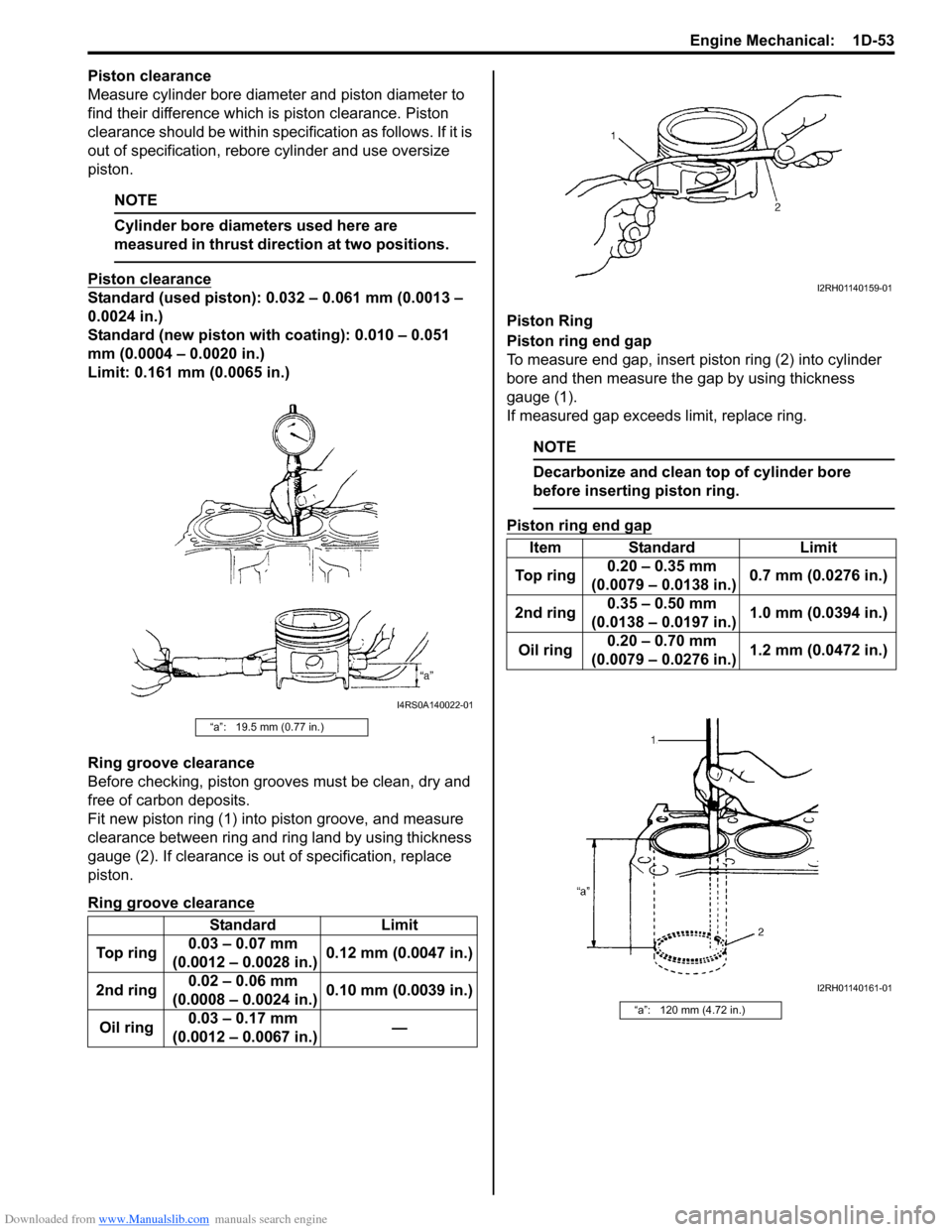
Piston clearance
Measure cylinder bore diameter and piston diameter to
find their difference which is piston clearance. Piston
clearance should be within specification as follows. If it is
out of specification, rebore cylinder and use oversize
piston.
NOTE
Cylinder bore diameters used here are
measured in thrust direction at two positions.
Piston clearance
Standard (used piston): 0.032 – 0.061 mm (0.0013 –
0.0024 in.)
Standard (new piston with coating): 0.010 – 0.051
mm (0.0004 – 0.0020 in.)
Limit: 0.161 mm (0.0065 in.)
Ring groove clearance
Before checking, piston grooves must be clean, dry and
free of carbon deposits.
Fit new piston ring (1) into piston groove, and measure
clearance between ring and ring land by using thickness
gauge (2). If clearance is out of specification, replace
piston.
Ring groove clearance
Piston Ring
Piston ring end gap
To measure end gap, insert piston ring (2) into cylinder
bore and then measure the gap by using thickness
gauge (1).
If measured gap exceeds limit, replace ring.
NOTE
Decarbonize and clean top of cylinder bore
before inserting piston ring.
Piston ring end gap
“a”: 19.5 mm (0.77 in.)
Standard Limit
To p r i n g0.03 – 0.07 mm
(0.0012 – 0.0028 in.)0.12 mm (0.0047 in.)
2nd ring0.02 – 0.06 mm
(0.0008 – 0.0024 in.)0.10 mm (0.0039 in.)
Oil ring0.03 – 0.17 mm
(0.0012 – 0.0067 in.)—
I4RS0A140022-01
Item Standard Limit
To p r i n g0.20 – 0.35 mm
(0.0079 – 0.0138 in.)0.7 mm (0.0276 in.)
2nd ring0.35 – 0.50 mm
(0.0138 – 0.0197 in.)1.0 mm (0.0394 in.)
Oil ring0.20 – 0.70 mm
(0.0079 – 0.0276 in.)1.2 mm (0.0472 in.)
“a”: 120 mm (4.72 in.)
I2RH01140159-01
I2RH01140161-01
Page 337 of 1556

Downloaded from www.Manualslib.com manuals search engine Engine Mechanical: 1D-55
Connecting rod bolt deformation (Plastic
deformation tightening bolt)
Measure each thread diameter of connecting rod bolt (2)
at “A” on 32 mm (1.25 in.) from bolt mounting surface
and “B” on 40 mm (1.57 in.) from bolt mounting surface
by using a micrometer (3).
Calculate difference in diameters (“A” – “B”). If it is
exceeds limit, replace connected rod (1).
Connecting rod bolt measurement points
“a”: 32 mm (1.25 in.)
“b”: 40 mm (1.57 in.)
Connecting rod bolt diameter difference
Limit (“A” – “B”): 0.1 mm (0.004 in.)
Crank Pin and Connecting Rod Bearings
Inspection
S6RW0D1406036
Crank Pin Diameter
Inspect crank pin for uneven wear or damage. Measure
crank pin for out-of-round or taper with a micrometer. If
crank pin is damaged or out-of round or taper is out of
limit, replace crankshaft or regrind crank pin to undersize
and use undersize bearing.
Crank pin diameter
Out-of-round
A – B
Ta p e r
a – b
Crank pin taper and out-of-round
Limit: 0.01 mm (0.0004 in.)
I2RH0B140119-01
Connecting rod bearing
sizeCrank pin diameter
Standard41.982 – 42.000 mm
(1.6528 – 1.6535 in.)
0.25 mm (0.0098 in.)
undersize41.732 – 41.750 mm
(1.6430 – 1.6437 in.)
I2RH0B140120-01
Page 338 of 1556

Downloaded from www.Manualslib.com manuals search engine 1D-56 Engine Mechanical:
Connecting Rod Bearing General Information
Service connecting rod bearings are available in
standard size and 0.25 mm (0.0098 in.) undersize
bearing, and standard size bearing has 5 kinds of
bearings differing in tolerance.
For identification of undersize bearing, it is painted red at
the position as indicated in figure, undersize bearing
thickness is 1.605 – 1.615 mm (0.0632 – 0.0635 in.) at
the center of it.
Connecting Rod Bearing Visual Inspection
Inspect bearing shells for signs of fusion, pitting, burn or
flaking and observe contact pattern. Bearing shells
found in defective condition must be replaced.
Connecting Rod Bearing Clearance
1) Before checking bearing clearance, clean bearing
and crank pin.
2) Install bearing in connecting rod and bearing cap.
3) Place a piece of gauging plastic (1) to full width of
crank pin as contacted by bearing (parallel to
crankshaft), avoiding oil hole.4) Install rod bearing cap (1) to connecting rod.
When installing cap, be sure to point arrow mark (2)
on cap to crankshaft pulley side, as shown in figure.
After applying engine oil to rod bolts, tighten cap nuts
(3) gradually as follows.
a) Tighten all cap nuts to 15 N⋅m (1.5 kgf-m, 11.0 lb-
ft)
b) Retighten them to 45°
c) Repeat Step b) once again.
Tightening torque
Connecting rod bearing cap nut (a): Tighten
15 N⋅m (1.5 kgf-m, 11.0 lb-ft) 45° and 45° by
the specified procedure
5) Remove cap and using a scale (1) on gauging
plastic envelope (2), measure gauging plastic (2)
width at the widest point (clearance).
If clearance exceed its limit, use a new standard size
bearing referring to “Selection of Connecting Rod
Bearings: ”.
After selecting new bearing, recheck clearance.
Connecting rod bearing clearance
Standard: 0.029 – 0.047 mm (0.0011 – 0.0018 in.)
Limit: 0.065 mm (0.0026 in.)
6) If clearance can not be brought to its limit even by
using a new standard size bearing, use next thicker
bearing and recheck clearance or regrind crank pin
to undersize and use 0.25 mm undersize bearing.
1. Red paint
I2RH01140164-01
I2RH0B140121-01
I2RH0B140122-01
I2RH0B140123-01