2006 SUZUKI SX4 Dif
[x] Cancel search: DifPage 61 of 1556

Downloaded from www.Manualslib.com manuals search engine Engine General Information and Diagnosis: 1A-11
Air Intake System DescriptionS6RW0D1101006
The main components of the air intake system are air cleaner (1), air cleaner outlet hose (2), electric throttle body (3)
(for the details, refer to “Description of Electric Throttle Body System”.), and intake manifold (4).
The air (by the amount corresponding to throttle valve (5) opening and engine speed) is filtered by the air cleaner,
distributed by the intake, and finally drawn into each combustion chamber. Electric throttle body is not equipped with
IAC valve for idle speed control. Idle speed control is done by the throttle actuator (6) which opens/closes the throttle
valve. (For the details, refer to “Description of Electric Throttle Body System”.)
Description of Electric Throttle Body System CalibrationS6RW0D1101007
ECM calculates controlled opening of the throttle valve on the basis of the completely closed throttle valve position of
the electric throttle body system. The completely closed position data is saved in memory of ECM. However, the
completely closed position of the throttle valve of the electric throttle body system (signal voltage from throttle position
sensor when throttle is completely closed) differs one from the other depending on individual differences of the throttle
valve and throttle position sensor. As such individual differences must be taken into account for controlling the throttle
valve, it is necessary to register the completely closed throttle valve position data in ECM. When such data is
registered in ECM, it is saved in RAM (memory) of ECM and used as the base data for controlling the throttle valve.
This data is cleared, when any of the works described in “Precautions of Electric Throttle Body System Calibration” is
performed.
Also, after replacement of the throttle body and/or APP sensor assembly, the completely closed position data in
memory of ECM must be cleared once and a new one must be registered, or ECM cannot judge the complete closure
position properly.
For the procedure to register such data, refer to “Electric Throttle Body System Calibration in Section 1C”. (After the
completely closed position data is cleared, ECM, for the first time only, opens and closes the throttle valve for about 5
seconds after the ignition switch is turned ON position, for registration of the completely closed throttle valve position.
If the engine is started during this registration process, such symptom as “longer cranking time” or “slow rise of
revolution speed immediately after start-up” may occur. However, turning OFF the ignition switch once and restarting
will set correct registration.)
Description of Electric Throttle Body SystemS6RW0D1101009
The Electric Throttle Body System consists of electric throttle body assembly, accelerator pedal position (APP) sensor
assembly, ECM and throttle actuator control relay.
Among them, assembly components are as follows.
• Electric throttle body assembly: throttle valve, throttle actuator, 2 throttle position sensors
• APP sensor assembly: Accelerator pedal, 2 accelerator position sensors
42
1
3
5
6
I5RW0A110006-02
Page 62 of 1556
Downloaded from www.Manualslib.com manuals search engine 1A-12 Engine General Information and Diagnosis:
Operation Description
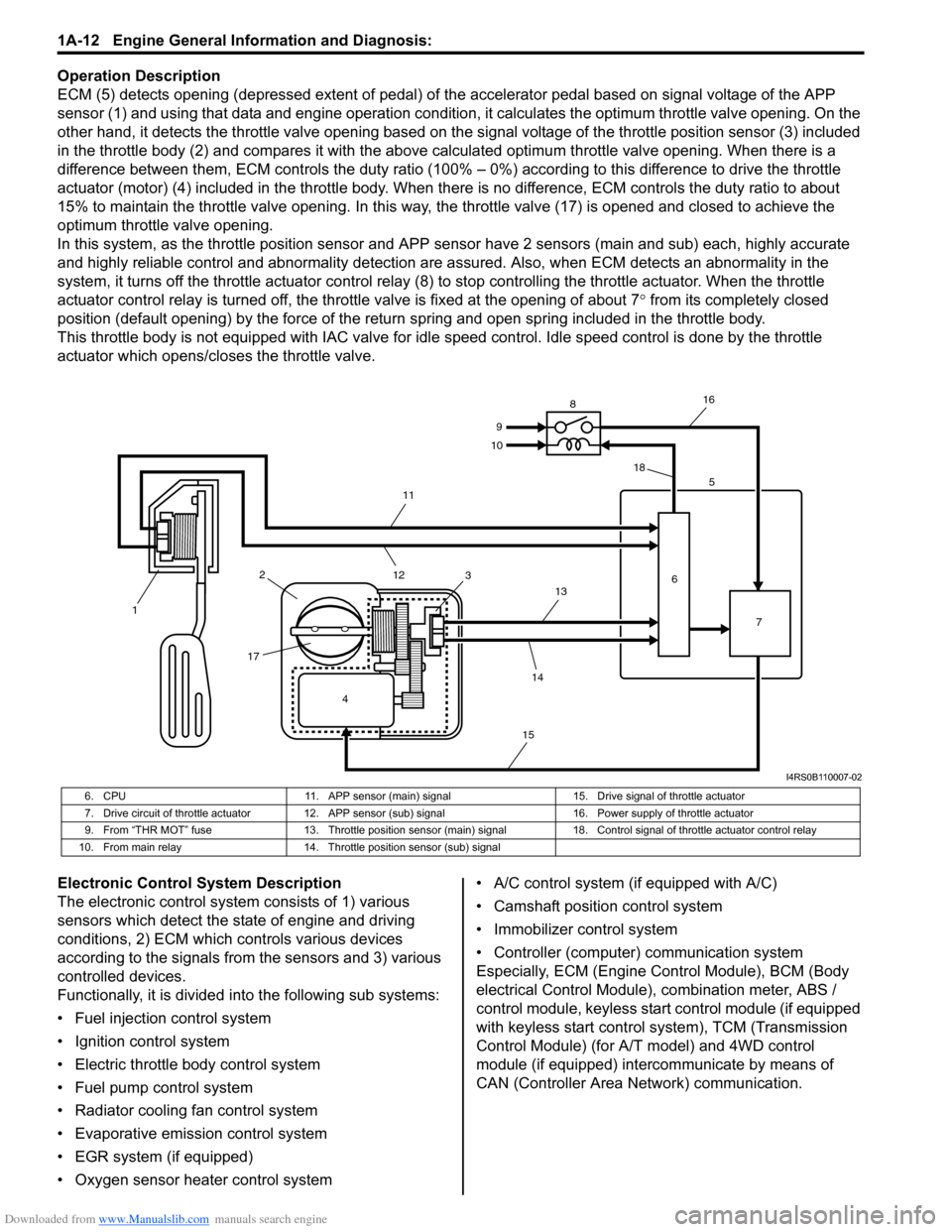
ECM (5) detects opening (depressed extent of pedal) of the accelerator pedal based on signal voltage of the APP
sensor (1) and using that data and engine operation condition, it calculates the optimum throttle valve opening. On the
other hand, it detects the throttle valve opening based on the signal voltage of the throttle position sensor (3) included
in the throttle body (2) and compares it with the above calculated optimum throttle valve opening. When there is a
difference between them, ECM controls the duty ratio (100% – 0%) according to this difference to drive the throttle
actuator (motor) (4) included in the throttle body. When there is no difference, ECM controls the duty ratio to about
15% to maintain the throttle valve opening. In this way, the throttle valve (17) is opened and closed to achieve the
optimum throttle valve opening.
In this system, as the throttle position sensor and APP sensor have 2 sensors (main and sub) each, highly accurate
and highly reliable control and abnormality detection are assured. Also, when ECM detects an abnormality in the
system, it turns off the throttle actuator control relay (8) to stop controlling the throttle actuator. When the throttle
actuator control relay is turned off, the throttle valve is fixed at the opening of about 7° from its completely closed
position (default opening) by the force of the return spring and open spring included in the throttle body.
This throttle body is not equipped with IAC valve for idle speed control. Idle speed control is done by the throttle
actuator which opens/closes the throttle valve.
Electronic Control System Description
The electronic control system consists of 1) various
sensors which detect the state of engine and driving
conditions, 2) ECM which controls various devices
according to the signals from the sensors and 3) various
controlled devices.
Functionally, it is divided into the following sub systems:
• Fuel injection control system
• Ignition control system
• Electric throttle body control system
• Fuel pump control system
• Radiator cooling fan control system
• Evaporative emission control system
• EGR system (if equipped)
• Oxygen sensor heater control system• A/C control system (if equipped with A/C)
• Camshaft position control system
• Immobilizer control system
• Controller (computer) communication system
Especially, ECM (Engine Control Module), BCM (Body
electrical Control Module), combination meter, ABS /
control module, keyless start control module (if equipped
with keyless start control system), TCM (Transmission
Control Module) (for A/T model) and 4WD control
module (if equipped) intercommunicate by means of
CAN (Controller Area Network) communication.
4 12
1735
6
7 8
9
10
11
12
13
14
1516
18
I4RS0B110007-02
6. CPU 11. APP sensor (main) signal 15. Drive signal of throttle actuator
7. Drive circuit of throttle actuator 12. APP sensor (sub) signal 16. Power supply of throttle actuator
9. From “THR MOT” fuse 13. Throttle position sensor (main) signal 18. Control signal of throttle actuator control relay
10. From main relay 14. Throttle position sensor (sub) signal
Page 74 of 1556

Downloaded from www.Manualslib.com manuals search engine 1A-24 Engine General Information and Diagnosis:
Step 1: Customer Complaint Analysis
Record details of the problem (failure, complaint) and how it occurred as described by the customer. For this purpose,
use of such an inspection form will facilitate collecting information to the point required for proper analysis and
diagnosis.
Customer problem inspection form (Example)
NOTE
This form is a standard sample. It should be modified according to conditions characteristic of each
market.
I2RH01110010-02
Page 75 of 1556

Downloaded from www.Manualslib.com manuals search engine Engine General Information and Diagnosis: 1A-25
Step 2: DTC / Freeze Frame Data Check, Record and
Clearance
First, check DTC (including pending DTC), referring to
“DTC Check”. If DTC is indicated, print it and freeze
frame data or write them down and then clear them by
referring to “DTC Clearance”. DTC indicates malfunction
that occurred in the system but does not indicate
whether it exists now or it occurred in the past and the
normal condition has been restored now. To check which
case applies, check the symptom in question according
to Step 5 and recheck DTC according to Step 6 and 7.
Attempt to diagnose a trouble based on DTC in this step
only or failure to clear the DTC in this step will lead to
incorrect diagnosis, trouble diagnosis of a normal circuit
or difficulty in troubleshooting.
Step 3 and 4: Visual Inspection
As a preliminary step, be sure to perform visual check of
the items that support proper function of the engine
referring to “Visual Inspection”.
Step 5: Trouble Symptom Confirmation
Based on information obtained in “Step 1: Customer
Complaint Analysis: ” and “Step 2: DTC / Freeze Frame
Data Check, Record and Clearance: ”, confirm trouble
symptoms. Also, reconfirm DTC according to “DTC
Confirmation Procedure” described in each DTC diag.
flow.
Step 6 and 7: Rechecking and Record of DTC /
Freeze Frame Data
Refer to “DTC Check” for checking procedure.
Step 8: Engine Basic Inspection and Engine
Symptom Diagnosis
Perform basic engine check according to “Engine Basic
Inspection” first. When the end of the flow has been
reached, check the parts of the system suspected as a
possible cause referring to “Engine Symptom Diagnosis”
and based on symptoms appearing on the vehicle
(symptoms obtained through steps of customer
complaint analysis, trouble symptom confirmation and/or
basic engine check) and repair or replace faulty parts, if
any.
Step 9: Troubleshooting for DTC (See each DTC
Diag. Flow)
Based on the DTC indicated in Step 6 or 7 and referring
to the applicable DTC diag. flow, locate the cause of the
trouble, namely in a sensor, switch, wire harness,
connector, actuator, ECM or other part and repair or
replace faulty parts.Step 10: Intermittent Problems Check
Check parts where an intermittent trouble is easy to
occur (e.g., wire harness, connector, etc.), referring to
“Intermittent and Poor Connection Inspection in Section
00” and related circuit of DTC recorded in Step 2.
Step 11: Final Confirmation Test
Confirm that the problem symptom has gone and the
engine is free from any abnormal conditions. If what has
been repaired is related to the DTC, clear the DTC once,
perform DTC confirmation procedure and confirm that no
DTC is indicated.
Malfunction Indicator Lamp (MIL) CheckS6RW0D1104002
1) Turn ON ignition switch (with engine at stop) and
check that MIL (1) lights.
If MIL does not light up (or MIL dims) but engine can
be starting, go to “Malfunction Indicator Lamp Does
Not Come ON with Ignition Switch ON and Engine
Stop (but Engine Can Be Started)” for
troubleshooting.
If MIL does not light with ignition switch ON and
engine does not start though it is cranked up, go to
“ECM Power and Ground Circuit Check”.
2) Start engine and check that MIL turns OFF.
If MIL remains ON and no DTC is stored in ECM, go
to “Malfunction Indicator Lamp Remains ON after
Engine Starts” for troubleshooting.
DTC CheckS6RW0D1104085
NOTE
• There are two types of OBD system
depending on the vehicle specification.
For identification, refer to “Precaution on
On-Board Diagnostic (OBD) System”.
1
I4RS0A110012-01
Page 82 of 1556

Downloaded from www.Manualslib.com manuals search engine 1A-32 Engine General Information and Diagnosis:
DTC TableS6RW0D1104005
NOTE
• There are two types of OBD system depending on the vehicle specification.
For identification, refer to “Precaution on On-Board Diagnostic (OBD) System”.
• For non-Euro-OBD model, some of DTC No. with delta (U) mark in the following table can not be
detected by ECM depending on vehicle specification.
• With the CAN communication generic scan tool, only star (*) marked DTC No. in the following table
can be read.
• 1 driving cycle: MIL lights up when DTC is detected during 1 driving cycle.
• 2 driving cycles: MIL lights up when the same DTC is detected also in the next driving cycle after
DTC is detected and stored temporarily in the first driving cycle.
• *2 driving cycles:
MIL blinks or lights up. Refer to “DTC P0300 / P0301 / P0302 / P0303 / P0304: Random Misfire
Detected / Cylinder 1 / Cylinder 2 / Cylinder 3 / Cylinder 4 Misfire Detected” for details.
DTC No. Detecting itemDetecting condition
(DTC will set when detecting:)MIL
) *P0010Camshaft position actuator circuit
(for engine with VVT system)Oil control valve circuit open or short.1 driving
cycle
) *P0011Camshaft position – timing over-
advanced or system performance
(for engine with VVT system)Actual value of advanced valve timing does not reach
target value, or valve timing is advanced although ECM
command is most retarding.2 driving
cycles
) *P0012Camshaft position – timing over-
retarded
(for engine with VVT system)2 driving
cycles
) *P0031HO2S heater control circuit low
(Sensor-1)Heater current is less than specification while heater ON.2 driving
cycles
) *P0032HO2S heater control circuit high
(Sensor-1)Heater current is more than specification while heater ON.2 driving
cycles
)
U*P0037HO2S heater control circuit low
(Sensor-2)Heater current is less than specification while heater ON.2 driving
cycles
)
U*P0038HO2S heater control circuit high
(Sensor-2)Heater current is more than specification while heater ON.2 driving
cycles
)
U*P0101Mass air flow circuit range/
performanceMAF sensor volume is more than specification or less
than specification.2 driving
cycles
) *P0102 Mass air flow circuit low input Output voltage of MAF sensor is less than specification.1 driving
cycle
) *P0103 Mass air flow circuit high input Output voltage of MAF sensor is more than specification.1 driving
cycle
)
U*P0106Manifold absolute pressure circuit
range/performanceDifference between Max. manifold absolute pressure
value and Min. manifold pressure value is less than
specification or difference between barometric pressure
value and manifold pressure value is less than
specification2 driving
cycles
)
U*P0107Manifold absolute pressure circuit
low inputOutput voltage of MAP sensor is less than specification.
1 driving
cycle
)
U*P0108Manifold absolute pressure circuit
high inputOutput voltage of MAP sensor is more than specification.1 driving
cycle
)
U* P 0 111Intake air temperature sensor circuit
range/performanceVariation of intake air temperature from engine start is
less than specification.2 driving
cycles
) *P0112Intake air temperature sensor circuit
lowCircuit voltage of IAT sensor is less than specification.1 driving
cycle
) *P0113Intake air temperature sensor circuit
highCircuit voltage of IAT sensor is more than specification.1 driving
cycle
)
U*P0116Engine coolant temperature circuit
range/performanceEngine coolant temperature is less than specified
temperature for specified time from engine start.2 driving
cycles
Page 83 of 1556

Downloaded from www.Manualslib.com manuals search engine Engine General Information and Diagnosis: 1A-33
) *P0117Engine coolant temperature circuit
lowCircuit voltage of ECT sensor is less than specification.1 driving
cycle
) *P0118Engine coolant temperature circuit
highCircuit voltage of ECT sensor is more than specification.1 driving
cycle
) *P0122Throttle position sensor (main)
circuit lowOutput voltage of throttle position sensor (main) is lower
than specification.1 driving
cycle
) *P0123Throttle position sensor (main)
circuit highOutput voltage of throttle position sensor (main) is higher
than specification.1 driving
cycle
)
U*P0131O2 sensor (HO2S) circuit low
voltage (Sensor-1)Max. output voltage of HO2S-1 is less than specification.2 driving
cycles
)
U*P0132O2 sensor (HO2S) circuit high
voltage (Sensor-1)Min. output voltage of HO2S-1 is more than specification.2 driving
cycles
)
U*P0133O2 sensor (HO2S) circuit slow
response (Sensor-1)Response time of HO2S-1 output voltage between rich
and lean is longer than specification.2 driving
cycles
) *P0134O2 sensor (HO2S) circuit no activity
detected (Sensor-1)Output voltage of HO2S-1 is more than specification or
less than specification. (or HO2S-1 circuit open or short)2 driving
cycles
)
U*P0137O2 sensor (HO2S) circuit low
voltage (Sensor-2)Output voltage of HO2S-2 is less than specification while
engine is idling after driving with high engine load and
Max. output voltage of HO2S-2 minus Min. output voltage
of HO2S-2 is less than specification.2 driving
cycles
)
U*P0138O2 sensor (HO2S) circuit high
voltage (Sensor-2)Output voltage of HO2S-2 is more than specification while
engine is idling after driving with high engine load and
Max. output voltage of HO2S-2 minus Min. output voltage
of HO2S-2 is less than specification.2 driving
cycles
)
U*P0140O2 sensor (HO2S) circuit no activity
detected (Sensor-2)Output voltage of HO2S-2 is more than specification after
warming up engine.
2 driving
cycles
)
U*P0171System too leanTotal fuel trim is larger than specification for specified time
or longer. (Fuel trim toward rich side is large.)2 driving
cycles
)
U*P0172System too richTotal fuel trim is smaller than specification for specified
time or longer. (Fuel trim toward lean side is large.)2 driving
cycles
) *P0222Throttle position sensor (sub) circuit
lowOutput voltage of throttle position sensor (sub) is lower
than specification.1 driving
cycle
) *P0223Throttle position sensor (sub) circuit
highOutput voltage of throttle position sensor (sub) is higher
than specification.1 driving
cycle
)
U*P0300Random misfire detected
Misfire of such level as to cause damage to three way
catalyst or misfire of such level as to deteriorate emission.*2 driving
cycles )U*P030
1 /
U*P0302 /
U*P0303 /
U*P0304Cylinder 1 misfire detected
Cylinder 2 misfire detected
Cylinder 3 misfire detected
Cylinder 4 misfire detected
) *P0327 Knock sensor circuit low Output voltage of knock sensor is less than specification.1 driving
cycle
) *P0328 Knock sensor circuit high Output voltage of knock sensor is more than specification.1 driving
cycle
) *P0335 Crankshaft position sensor circuitNo signal of CKP sensor for specified time even if starting
motor signal is input.1 driving
cycle
) *P0340 Camshaft position sensor circuit CMP sensor pulse is out of specification.1 driving
cycle
)
U*P0401Exhaust gas recirculation flow
detected as insufficientDifference in intake manifold absolute pressure between
opened EGR valve and closed EGR valve is less than
specification.2 driving
cycles
)
U*P0402Exhaust gas recirculation flow
detected as excessive
Difference in intake manifold absolute pressure between
opened EGR valve and closed EGR valve is more than
specification.2 driving
cycles
)
U*P0403Exhaust gas recirculation control
circuitOutput voltage is different from output command with
more than one pole out of 4 poles.1 driving
cycle DTC No. Detecting itemDetecting condition
(DTC will set when detecting:)MIL
Page 84 of 1556

Downloaded from www.Manualslib.com manuals search engine 1A-34 Engine General Information and Diagnosis:
)
U*P0420Catalyst system efficiency below
thresholdOutput waveforms of HO2S-1 and HO2S-2 are similar.2 driving
cycles
)
U*P0443Evaporative emission system purge
control valve circuitMonitor signal of EVAP canister purge valve is different
from command signal. (circuit open or shorted to ground)2 driving
cycles
) P0462 Fuel level sensor circuit lowCircuit voltage of fuel level sensor is less than
specification.—
) P0463 Fuel level sensor circuit highCircuit voltage of fuel level sensor is more than
specification.—
)
U*P0480Fan 1 control circuitMonitor signal of radiator cooling fan relay is different from
command signal.1 driving
cycle
)
UP0481Fan 2 control circuitMonitor signal of A/C condenser cooling fan relay is
different from command signal.—
) *P0500 Vehicle speed sensor No VSS signal during fuel cut for specified time or longer.2 driving
cycles
) P0532A/C refrigerant pressure sensor
circuit lowOutput voltage of A/C refrigerant pressure sensor is less
than specification.—
) P0533A/C refrigerant pressure sensor
circuit highOutput voltage of A/C refrigerant pressure sensor is more
than specification.—
) *P0601Internal control module memory
check sum errorData write error or check sum error.1 driving
cycle
) P0602 Control module programming error Data programming error.1 driving
cycle
) *P0607 Control module performance Data programming error.1 driving
cycle
)
U*P0616Starter relay circuit lowStarter signal is low voltage even though engine is started
with vehicle at stop.2 driving
cycles
)
U*P0617Starter relay circuit highStarter signal is high voltage for specified time while
engine is running.2 driving
cycles
) *P1510
ECM backup power supply
malfunctionBackup power voltage is out of specification after starting
engine.1 driving
cycle
) *P2101Throttle actuator control motor
circuit range/performanceMonitor signal of throttle actuator output (duty output) is
inconsistent with throttle actuator control command.1 driving
cycle
) *P2102Throttle actuator control motor
circuit lowPower supply voltage of throttle actuator control circuit is
lower than specification even if throttle actuator control
relay turned on.1 driving
cycle
) *P2103Throttle actuator control motor
circuit highPower supply voltage of throttle actuator control circuit is
higher than specification even if throttle actuator control
relay turned off.1 driving
cycle
) *P2111Throttle actuator control system –
stuck openThrottle valve default opening is greater than 8° from
complementary closed position when diagnosing throttle
valve at ignition switch turned OFF.1 driving
cycle
) *P2119Throttle actuator control throttle
body range/performanceDifference between actual throttle valve opening angle
and opening angle calculated by ECM is more than
specification.1 driving
cycle
) *P2122Pedal position sensor (main) circuit
low inputOutput voltage of pedal position sensor (main) is lower
than specification.1 driving
cycle
) *P2123Pedal position sensor (main) circuit
high inputOutput voltage of pedal position sensor (main) is higher
than specification.1 driving
cycle
) *P2127Pedal position sensor (sub) circuit
low inputOutput voltage of pedal position sensor (sub) is lower
than specification.1 driving
cycle
) *P2128Pedal position sensor (sub) circuit
high inputOutput voltage of pedal position sensor (sub) is higher
than specification.1 driving
cycle
) *P2135Throttle position sensor (main / sub)
voltage correlationDifference between the opening angle based on throttle
position sensor (main) and the opening angle based on
throttle position sensor (sub) is more than specification.1 driving
cycle DTC No. Detecting itemDetecting condition
(DTC will set when detecting:)MIL
Page 85 of 1556

Downloaded from www.Manualslib.com manuals search engine Engine General Information and Diagnosis: 1A-35
) *P2138Pedal position sensor (main / sub)
voltage correlationDifference between the opening angle based on
accelerator pedal position sensor (main) and the opening
angle based on accelerator pedal position sensor (sub) is
more than specification.1 driving
cycle
)
U*P2227Barometric pressure circuit range/
performanceDifference of barometric pressure value and intake
manifold pressure value is more than specification at
engine start.2 driving
cycles
) *P2228 Barometric pressure circuit lowBarometric pressure sensor voltage is less than
specification.1 driving
cycle
) *P2229 Barometric pressure circuit highBarometric pressure sensor voltage is more than
specification.1 driving
cycle
) U0073Control Module Communication Bus
OffTransmission error that is inconsistent between
transmission data and transmission monitor (CAN bus
monitor) data is detected more than 30 times
continuously.—
) *U0101Lost Communication With
Transmission Control ModuleReception error of communication data for TCM is
detected for longer than specified time continuously.1 driving
cycle
) *U0121Lost Communication Anti-Lock
Brake System (ABS) Control
ModuleReception error of communication data for ESP® control
module or ABS hydraulic unit / control module assembly
is detected for longer than specified time continuously.1 driving
cycle
)U0140Lost Communication With Body
Control ModuleReception error of communication data for BCM is
detected for longer than specified time continuously.—
P1614 Transponder response error
Refer to “DTC Table in Section 10C”.—
P1615ID code does not registered
(vehicle equipped with keyless start
system only)—
P1616Different registration ID codes
(vehicle equipped with keyless start
system only)—
P1618CAN communication error
(reception error for keyless start
control module) (vehicle equipped
with keyless start system only)—
P1621Immobilizer communication line
error—
P1622 EEPROM error—
P1623 Unregistered transponder—
P1625 Immobilizer antenna error—
P1636Immobilizer information registration
failure—
P1638 Immobilizer information mismatched — DTC No. Detecting item
Detecting condition
(DTC will set when detecting:)MIL