Downloaded from www.Manualslib.com manuals search engine Paint / Coatings: 9L-1
Body, Cab and Accessories
Paint / Coatings
General Description
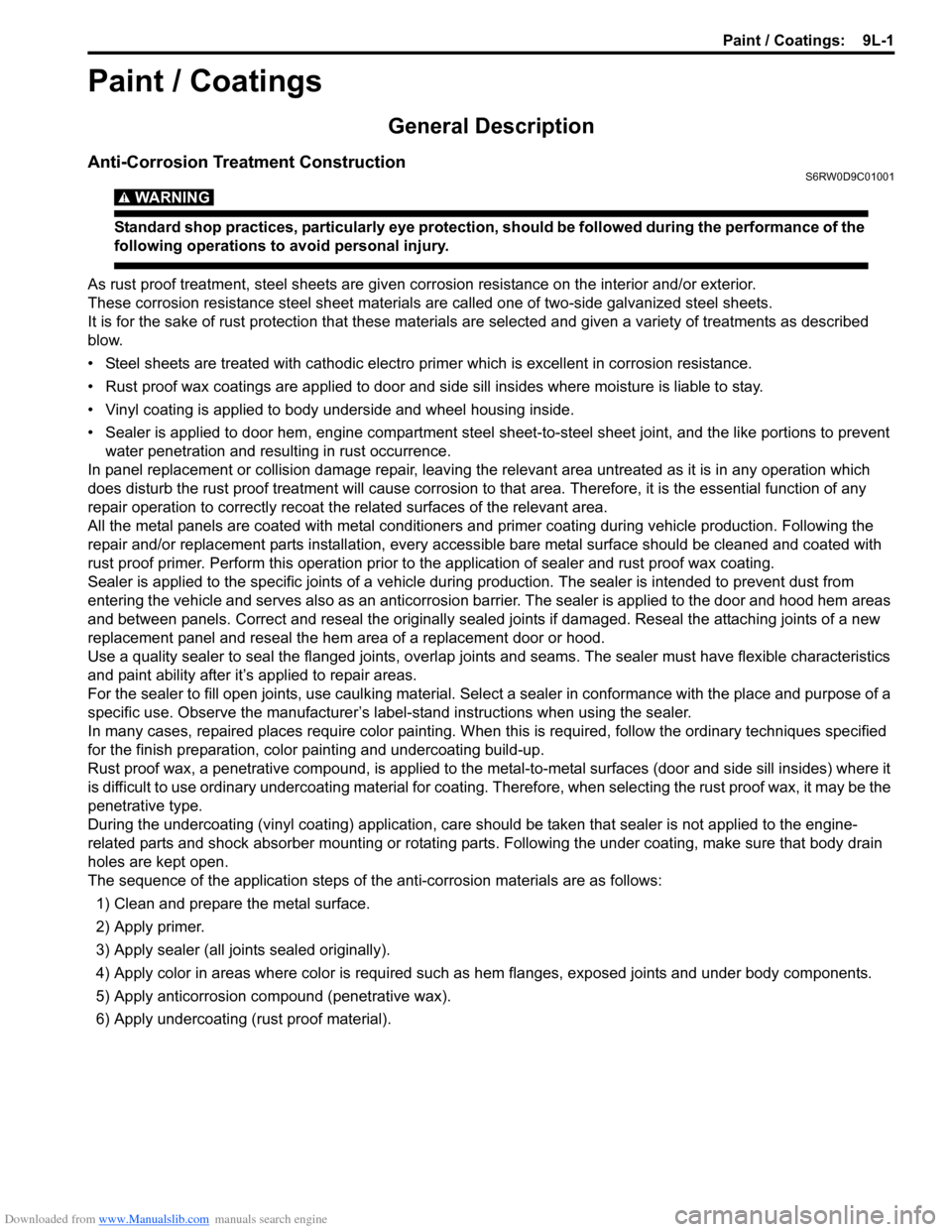
Anti-Corrosion Treatment ConstructionS6RW0D9C01001
WARNING!
Standard shop practices, particularly eye protection, should be followed during the performance of the
following operations to avoid personal injury.
As rust proof treatment, steel sheets are given corrosion resistance on the interior and/or exterior.
These corrosion resistance steel sheet materials are called one of two-side galvanized steel sheets.
It is for the sake of rust protection that these materials are selected and given a variety of treatments as described
blow.
• Steel sheets are treated with cathodic electro primer which is excellent in corrosion resistance.
• Rust proof wax coatings are applied to door and side sill insides where moisture is liable to stay.
• Vinyl coating is applied to body underside and wheel housing inside.
• Sealer is applied to door hem, engine compartment steel sheet-to-steel sheet joint, and the like portions to prevent
water penetration and resulting in rust occurrence.
In panel replacement or collision damage repair, leaving the relevant area untreated as it is in any operation which
does disturb the rust proof treatment will cause corrosion to that area. Therefore, it is the essential function of any
repair operation to correctly recoat the related surfaces of the relevant area.
All the metal panels are coated with metal conditioners and primer coating during vehicle production. Following the
repair and/or replacement parts installation, every accessible bare metal surface should be cleaned and coated with
rust proof primer. Perform this operation prior to the application of sealer and rust proof wax coating.
Sealer is applied to the specific joints of a vehicle during production. The sealer is intended to prevent dust from
entering the vehicle and serves also as an anticorrosion barrier. The sealer is applied to the door and hood hem areas
and between panels. Correct and reseal the originally sealed joints if damaged. Reseal the attaching joints of a new
replacement panel and reseal the hem area of a replacement door or hood.
Use a quality sealer to seal the flanged joints, overlap joints and seams. The sealer must have flexible characteristics
and paint ability after it’s applied to repair areas.
For the sealer to fill open joints, use caulking material. Select a sealer in conformance with the place and purpose of a
specific use. Observe the manufacturer’s label-stand instructions when using the sealer.
In many cases, repaired places require color painting. When this is required, follow the ordinary techniques specified
for the finish preparation, color painting and undercoating build-up.
Rust proof wax, a penetrative compound, is applied to the metal-to-metal surfaces (door and side sill insides) where it
is difficult to use ordinary undercoating material for coating. Therefore, when selecting the rust proof wax, it may be the
penetrative type.
During the undercoating (vinyl coating) application, care should be taken that sealer is not applied to the engine-
related parts and shock absorber mounting or rotating parts. Following the under coating, make sure that body drain
holes are kept open.
The sequence of the application steps of the anti-corrosion materials are as follows:
1) Clean and prepare the metal surface.
2) Apply primer.
3) Apply sealer (all joints sealed originally).
4) Apply color in areas where color is required such as hem flanges, exposed joints and under body components.
5) Apply anticorrosion compound (penetrative wax).
6) Apply undercoating (rust proof material).
Downloaded from www.Manualslib.com manuals search engine Immobilizer Control System: 10C-7
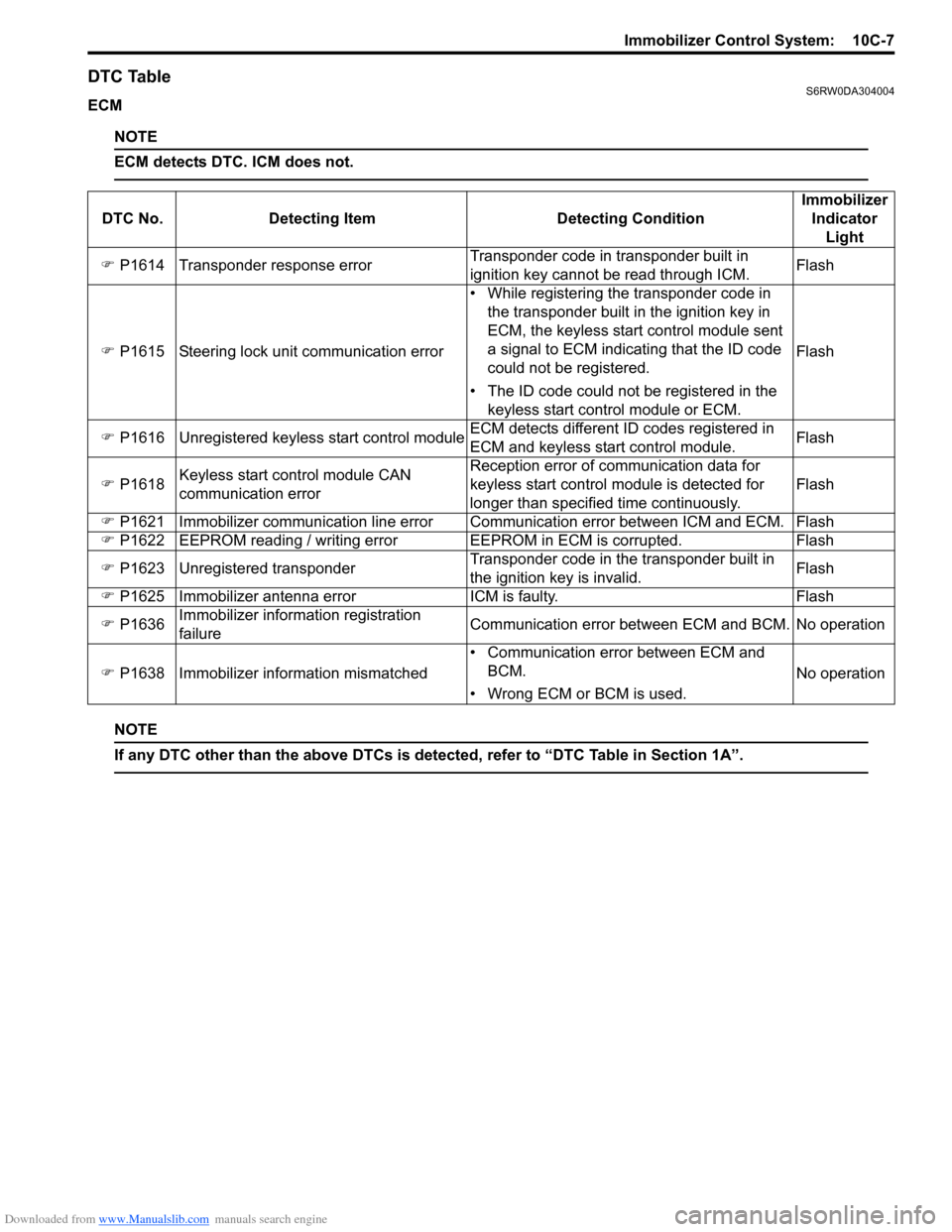
DTC TableS6RW0DA304004
ECM
NOTE
ECM detects DTC. ICM does not.
NOTE
If any DTC other than the above DTCs is detected, refer to “DTC Table in Section 1A”.
DTC No. Detecting Item Detecting ConditionImmobilizer
Indicator
Light
) P1614 Transponder response errorTransponder code in transponder built in
ignition key cannot be read through ICM.Flash
) P1615 Steering lock unit communication error• While registering the transponder code in
the transponder built in the ignition key in
ECM, the keyless start control module sent
a signal to ECM indicating that the ID code
could not be registered.
• The ID code could not be registered in the
keyless start control module or ECM.Flash
) P1616 Unregistered keyless start control moduleECM detects different ID codes registered in
ECM and keyless start control module.Flash
) P1618Keyless start control module CAN
communication errorReception error of communication data for
keyless start control module is detected for
longer than specified time continuously.Flash
) P1621 Immobilizer communication line error Communication error between ICM and ECM. Flash
) P1622 EEPROM reading / writing error EEPROM in ECM is corrupted. Flash
) P1623 Unregistered transponderTransponder code in the transponder built in
the ignition key is invalid.Flash
) P1625 Immobilizer antenna error ICM is faulty. Flash
) P1636Immobilizer information registration
failureCommunication error between ECM and BCM. No operation
) P1638 Immobilizer information mismatched• Communication error between ECM and
BCM.
• Wrong ECM or BCM is used.No operation
Downloaded from www.Manualslib.com manuals search engine 10C-12 Immobilizer Control System:
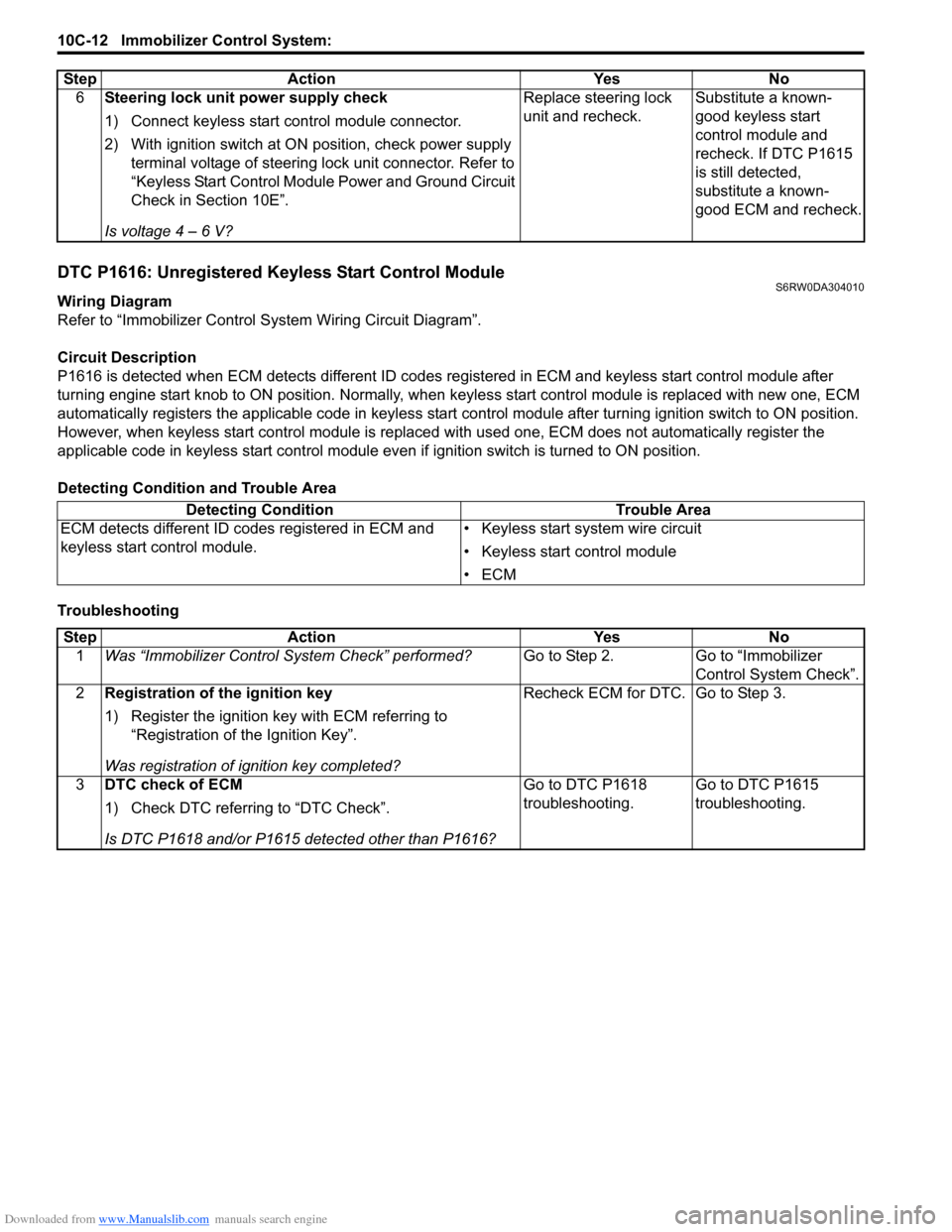
DTC P1616: Unregistered Keyless Start Control ModuleS6RW0DA304010
Wiring Diagram
Refer to “Immobilizer Control System Wiring Circuit Diagram”.
Circuit Description
P1616 is detected when ECM detects different ID codes registered in ECM and keyless start control module after
turning engine start knob to ON position. Normally, when keyless start control module is replaced with new one, ECM
automatically registers the applicable code in keyless start control module after turning ignition switch to ON position.
However, when keyless start control module is replaced with used one, ECM does not automatically register the
applicable code in keyless start control module even if ignition switch is turned to ON position.
Detecting Condition and Trouble Area
Troubleshooting6Steering lock unit power supply check
1) Connect keyless start control module connector.
2) With ignition switch at ON position, check power supply
terminal voltage of steering lock unit connector. Refer to
“Keyless Start Control Module Power and Ground Circuit
Check in Section 10E”.
Is voltage 4 – 6 V?Replace steering lock
unit and recheck.Substitute a known-
good keyless start
control module and
recheck. If DTC P1615
is still detected,
substitute a known-
good ECM and recheck. Step Action Yes No
Detecting Condition Trouble Area
ECM detects different ID codes registered in ECM and
keyless start control module.• Keyless start system wire circuit
• Keyless start control module
•ECM
Step Action Yes No
1Was “Immobilizer Control System Check” performed?Go to Step 2. Go to “Immobilizer
Control System Check”.
2Registration of the ignition key
1) Register the ignition key with ECM referring to
“Registration of the Ignition Key”.
Was registration of ignition key completed?Recheck ECM for DTC. Go to Step 3.
3DTC check of ECM
1) Check DTC referring to “DTC Check”.
Is DTC P1618 and/or P1615 detected other than P1616?Go to DTC P1618
troubleshooting.Go to DTC P1615
troubleshooting.