2006 LAND ROVER FRELANDER 2 warning light
[x] Cancel search: warning lightPage 2808 of 3229
Wipers and washers
88
L
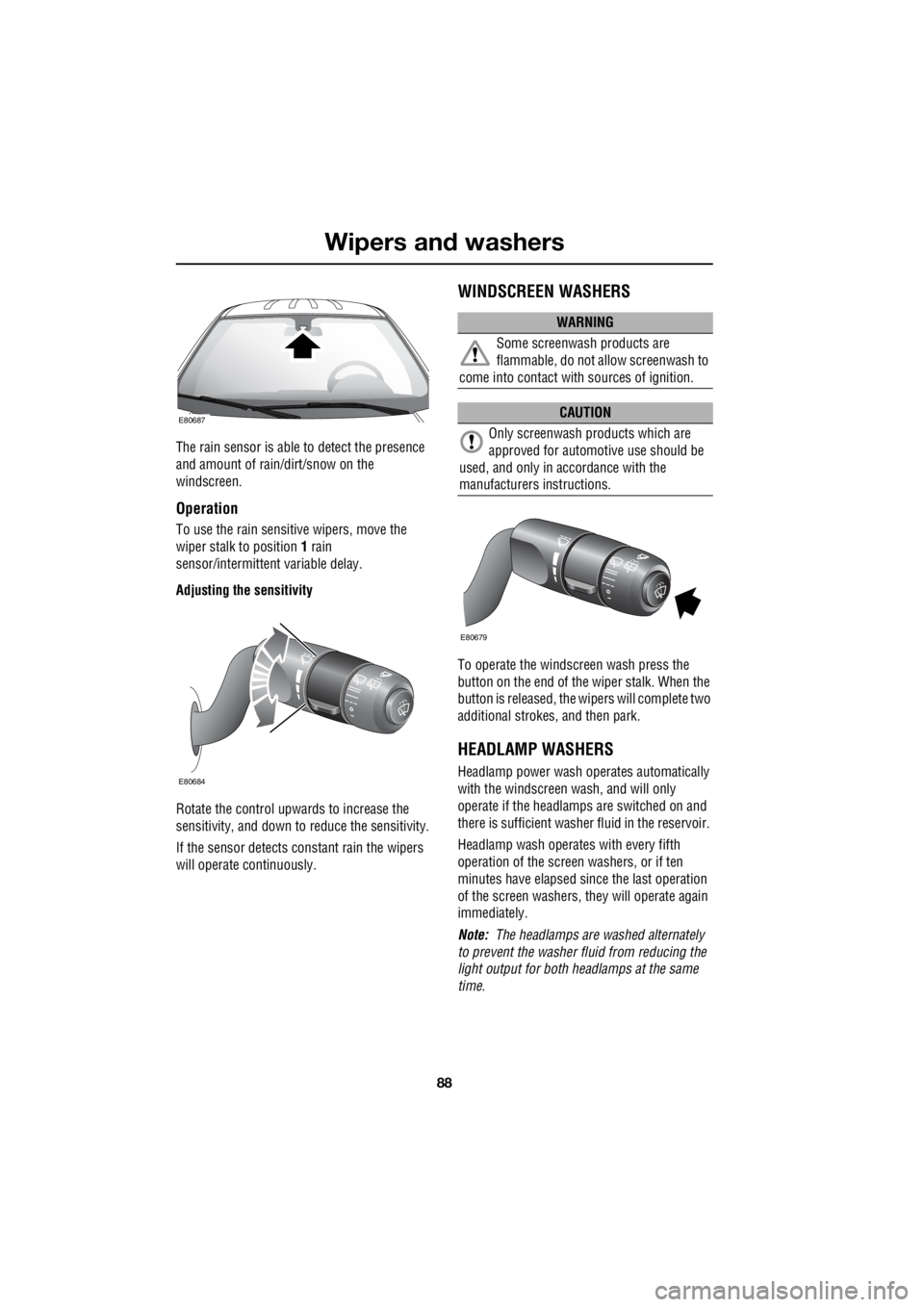
The rain sensor is able to detect the presence
and amount of rain/dirt/snow on the
windscreen.
Operation
To use the rain sensitive wipers, move the
wiper stalk to position 1 rain
sensor/intermittent variable delay.
Adjusting the sensitivity
Rotate the control upwards to increase the
sensitivity, and down to reduce the sensitivity.
If the sensor detects co nstant rain the wipers
will operate continuously.
WINDSCREEN WASHERS
To operate the windscreen wash press the
button on the end of the wiper stalk. When the
button is released, the wi pers will complete two
additional strokes, and then park.
HEADLAMP WASHERS
Headlamp power wash operates automatically
with the windscreen wash, and will only
operate if the headlamps are switched on and
there is sufficient washer fluid in the reservoir.
Headlamp wash operates with every fifth
operation of the screen washers, or if ten
minutes have elapsed si nce the last operation
of the screen washers, they will operate again
immediately.
Note: The headlamps are washed alternately
to prevent the washer fluid from reducing the
light output for both headlamps at the same
time.
E80687
E80684
WARNING
Some screenwash products are
flammable, do not allow screenwash to
come into contact with sources of ignition.
CAUTION
Only screenwash products which are
approved for automotive use should be
used, and only in accordance with the
manufacturers instructions.
E80679
Page 2813 of 3229
93
Windows and mirrors
R
Windows and mirrorsELECTRIC WINDOWS
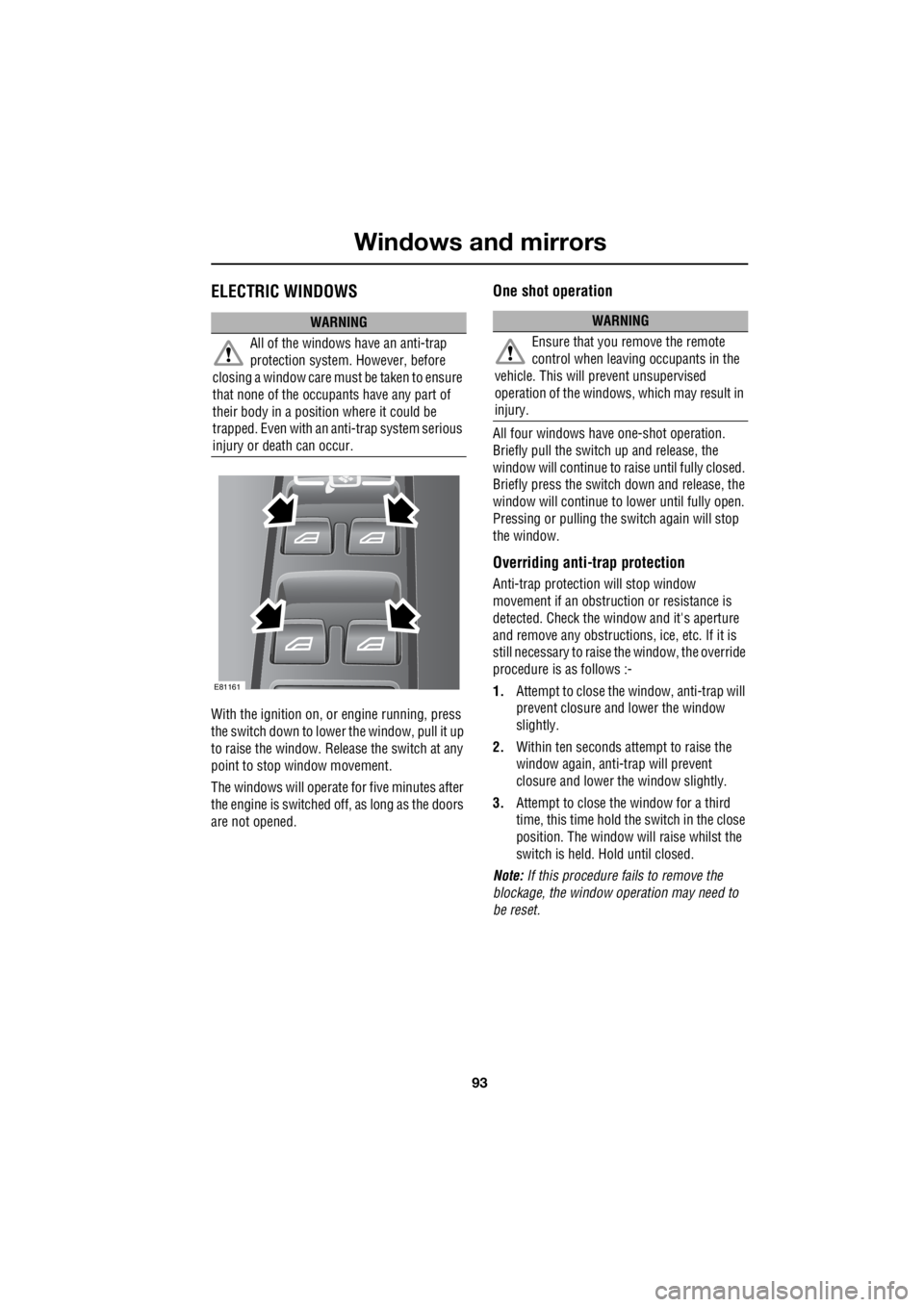
With the ignition on, or engine running, press
the switch down to lower the window, pull it up
to raise the window. Release the switch at any
point to stop window movement.
The windows will operate for five minutes after
the engine is switched off, as long as the doors
are not opened.
One shot operation
All four windows have one-shot operation.
Briefly pull the switch up and release, the
window will continue to raise until fully closed.
Briefly press the switch down and release, the
window will continue to lower until fully open.
Pressing or pulling the switch again will stop
the window.
Overriding anti-trap protection
Anti-trap protection will stop window
movement if an obstruction or resistance is
detected. Check the window and it's aperture
and remove any obstructions , ice, etc. If it is
still necessary to raise the window, the override
procedure is as follows :-
1. Attempt to close the window, anti-trap will
prevent closure and lower the window
slightly.
2. Within ten seconds attempt to raise the
window again, anti-trap will prevent
closure and lower the window slightly.
3. Attempt to close the window for a third
time, this time hold the switch in the close
position. The window will raise whilst the
switch is held. Hold until closed.
Note: If this procedure fails to remove the
blockage, the window operation may need to
be reset.
WARNING
All of the windows have an anti-trap
protection system. However, before
closing a window care must be taken to ensure
that none of the occupa nts have any part of
their body in a position where it could be
trapped. Even with an anti-trap system serious
injury or death can occur.
E81161
WARNING
Ensure that you remove the remote
control when leaving occupants in the
vehicle. This will prevent unsupervised
operation of the windows, which may result in
injury.
Page 2825 of 3229
105
Climate control
R
ELECTRIC SUNROOF
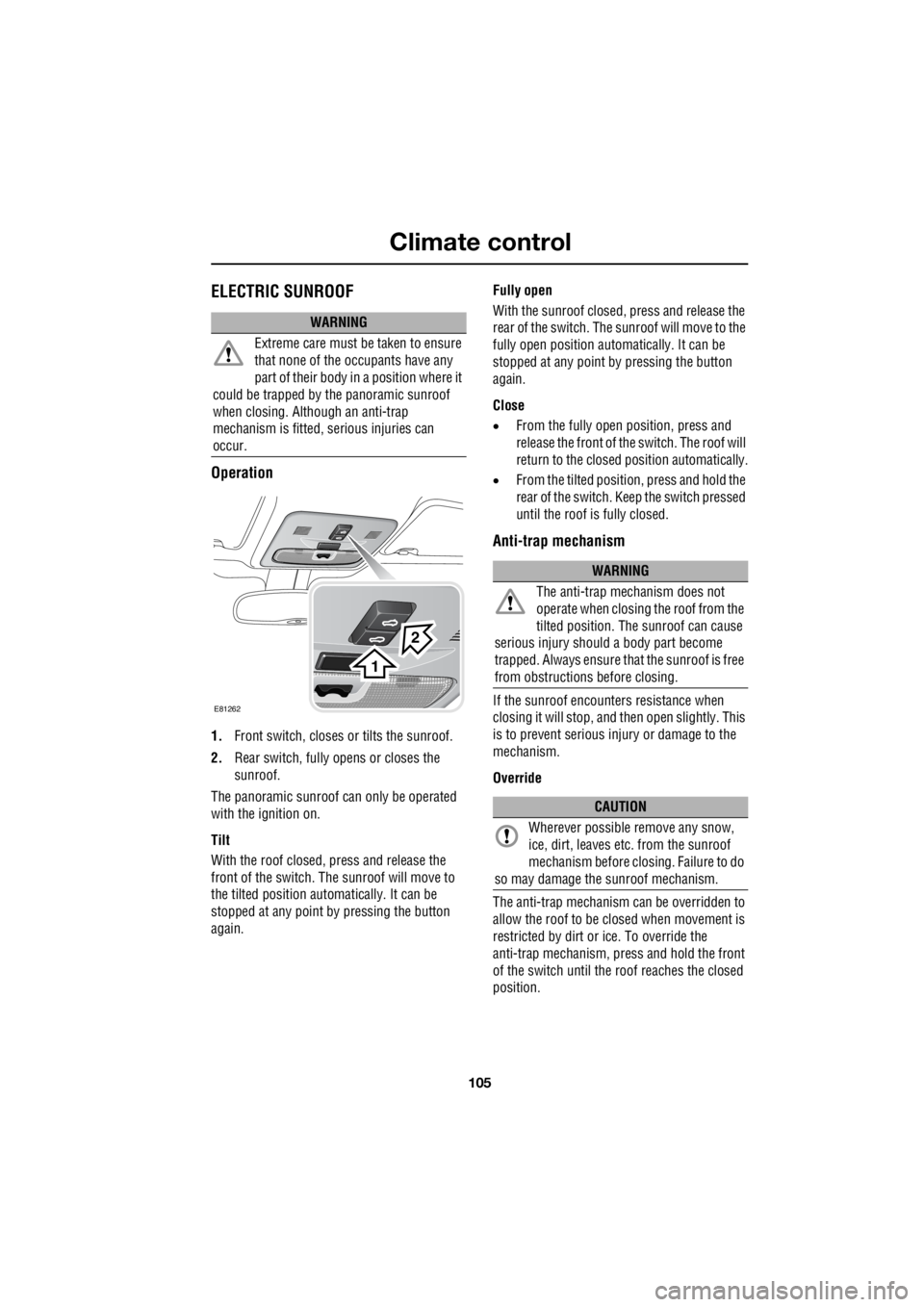
Operation
1. Front switch, closes or tilts the sunroof.
2. Rear switch, fully ope ns or closes the
sunroof.
The panoramic sunroof can only be operated
with the ignition on.
Tilt
With the roof closed, press and release the
front of the switch. The sunroof will move to
the tilted position automatically. It can be
stopped at any point by pressing the button
again. Fully open
With the sunroof closed, press and release the
rear of the switch. The sunroof will move to the
fully open position auto matically. It can be
stopped at any point by pressing the button
again.
Close
• From the fully open position, press and
release the front of the switch. The roof will
return to the closed position automatically.
• From the tilted positi on, press and hold the
rear of the switch. Keep the switch pressed
until the roof is fully closed.
Anti-trap mechanism
If the sunroof encounters resistance when
closing it will stop, a nd then open slightly. This
is to prevent serious injury or damage to the
mechanism.
Override
The anti-trap mechanism can be overridden to
allow the roof to be closed when movement is
restricted by dirt or ice. To override the
anti-trap mechanism, press and hold the front
of the switch until the roof reaches the closed
position.
WARNING
Extreme care must be taken to ensure
that none of the oc cupants have any
part of their body in a position where it
could be trapped by the panoramic sunroof
when closing. Although an anti-trap
mechanism is fitted, serious injuries can
occur.
2
1
E81262
WARNING
The anti-trap mechanism does not
operate when closing the roof from the
tilted position. The sunroof can cause
serious injury should a body part become
trapped. Always ensure th at the sunroof is free
from obstructions before closing.
CAUTION
Wherever possible remove any snow,
ice, dirt, leaves etc. from the sunroof
mechanism before closing. Failure to do
so may damage the sunroof mechanism.
Page 2829 of 3229
109
Convenience features
R
6. Use the rotary control to adjust the
minutes and press to confirm selection.
7. Once the time has been set, OK will be
highlighted. Press the rotary control to
accept the settings.
Set 12/24 hour display
1. With the audio unit switched on, press the
MENU button to access the function menu.
2. Rotate the control to select Clock and
press to confirm selection.
3. Rotate the control to select 12/24 and
press to confirm selection.
4. Use the rotary control to select 12hr or
24hr and press to confirm selection.
CIGAR LIGHTER
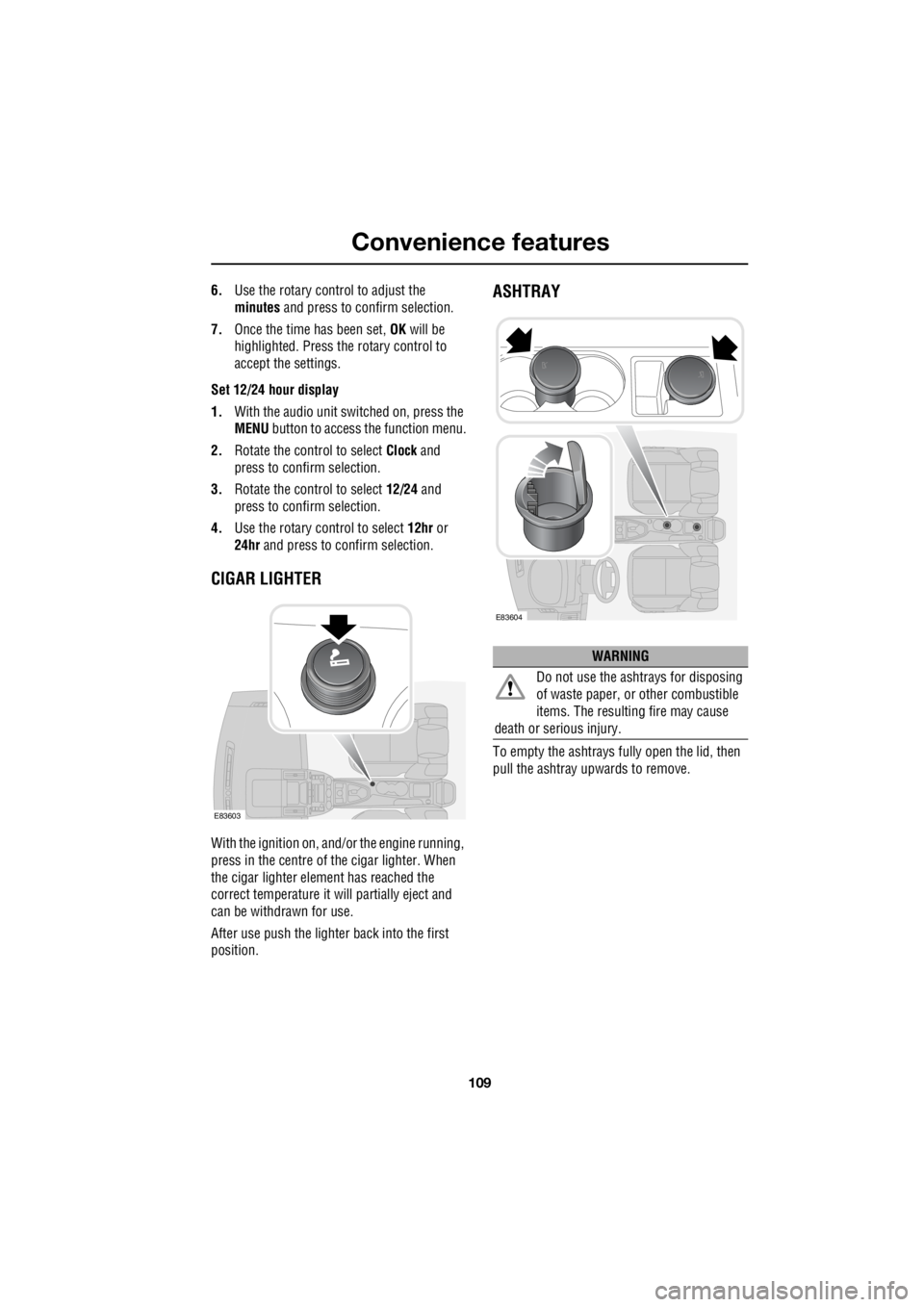
With the ignition on, and/ or the engine running,
press in the centre of the cigar lighter. When
the cigar lighter element has reached the
correct temperature it w ill partially eject and
can be withdrawn for use.
After use push the lighter back into the first
position.
ASHTRAY
To empty the ashtrays fu lly open the lid, then
pull the ashtray upwards to remove.
E83603
WARNING
Do not use the ashtrays for disposing
of waste paper, or other combustible
items. The resulting fire may cause
death or serious injury.
E83604
Page 2837 of 3229

117
Starting the engine
R
Regeneration procedure
If DPF FULL along with the handbook symbol
appears in the message centre, carry out the
following procedure.
Note: At all times during this procedure you
should observe all releva nt speed limits, laws,
and regulations. Always ta ke account of traffic
and weather conditions , and drive with
consideration for other road users.
1. Drive the vehicle until the engine reaches
normal operating temper ature. The engine
should not be left idli ng to achieve working
temperature.
2. Drive the vehicle for a further twenty
minutes, keeping the road speed above 48
km/h (30 mph).
3. If regeneration is su ccessful the warning
light, or message, will extinguish. If they
do not repeat the process.
Note: If the warning indicator or message fails
to extinguish after following the regeneration
process three times, contact your Land Rover
Dealer/Authorised Repairer for assistance.
Warning indicators and messages
If regeneration ca nnot be achieved
automatically by the system, due to short
journeys for example, th e driver will be notified
via a warning indicator, or message.
DPF FULL
If this message appears the driver should carry
out the DPF regeneration procedure as soon as
possible. DPF FULL VISIT DEALER
If this message appears the vehicle should be
taken to your Land Rover Dealer/Authorised
Repairer as soon as possible.
CAUTION
Failure to take the appropriate action
when a warning indicator or message
appears may result in damage to the
engine, DPF system, increased vehicle
emissions, and costly repairs.
Page 2843 of 3229
123
Brakes
R
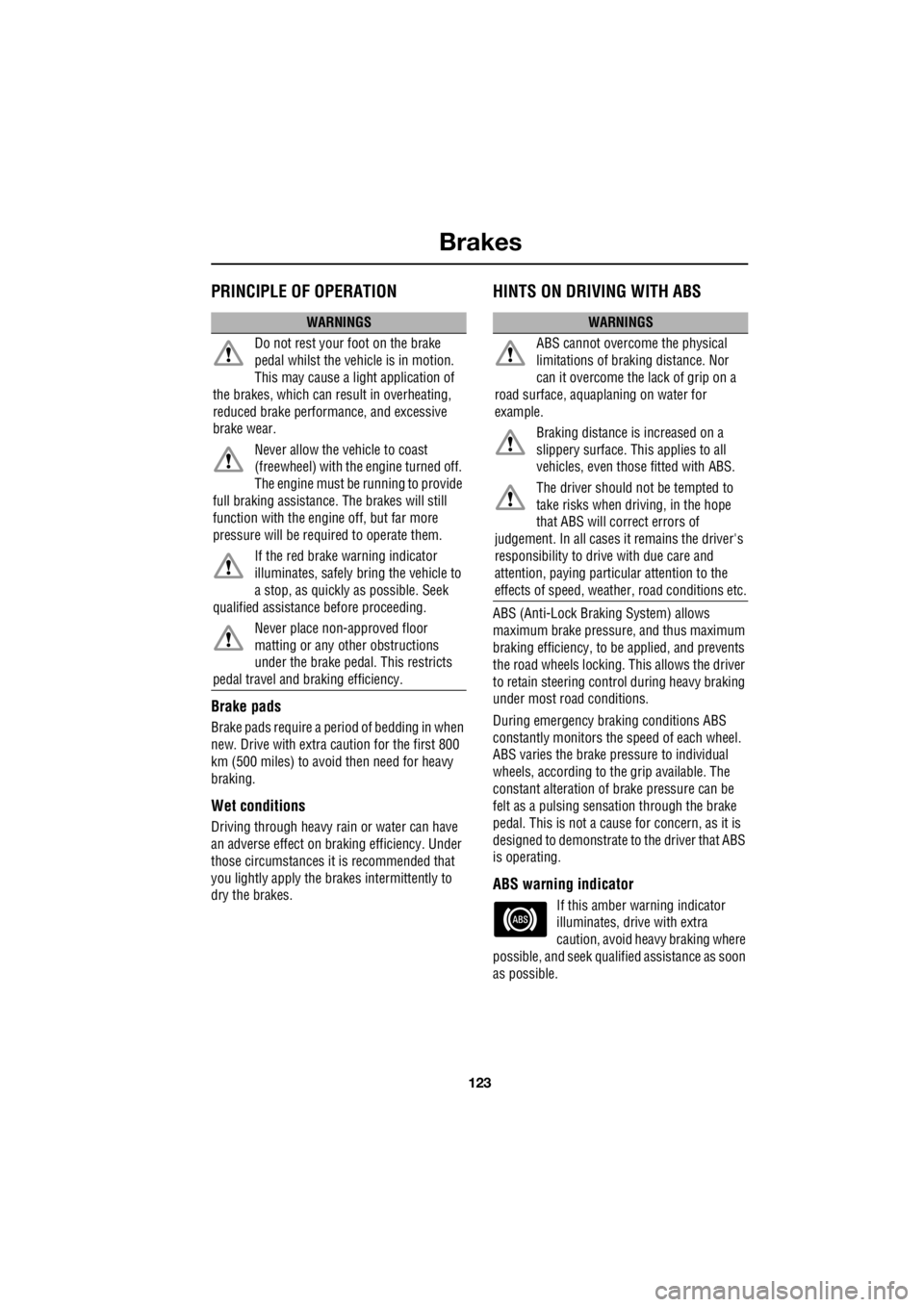
BrakesPRINCIPLE OF OPERATION
Brake pads
Brake pads require a period of bedding in when
new. Drive with extra caution for the first 800
km (500 miles) to avoi d then need for heavy
braking.
Wet conditions
Driving through heavy rain or water can have
an adverse effect on braking efficiency. Under
those circumstances it is recommended that
you lightly apply the brak es intermittently to
dry the brakes.
HINTS ON DRIVING WITH ABS
ABS (Anti-Lock Braki ng System) allows
maximum brake pressure, and thus maximum
braking efficiency, to be applied, and prevents
the road wheels locking. This allows the driver
to retain steering control during heavy braking
under most road conditions.
During emergency brak ing conditions ABS
constantly monitors the speed of each wheel.
ABS varies the brake pressure to individual
wheels, according to the grip available. The
constant alteration of brake pressure can be
felt as a pulsing sensat ion through the brake
pedal. This is not a cause for concern, as it is
designed to demonstrate to the driver that ABS
is operating.
ABS warning indicator
If this amber warning indicator
illuminates, driv e with extra
caution, avoid heavy braking where
possible, and seek qualified assistance as soon
as possible.
WARNINGS
Do not rest your foot on the brake
pedal whilst the vehicle is in motion.
This may cause a light application of
the brakes, which can re sult in overheating,
reduced brake performance, and excessive
brake wear.
Never allow the vehicle to coast
(freewheel) with the engine turned off.
The engine must be running to provide
full braking assistance. The brakes will still
function with the engine off, but far more
pressure will be required to operate them.
If the red brake warning indicator
illuminates, safely bring the vehicle to
a stop, as quickly as possible. Seek
qualified assistance before proceeding.
Never place non-approved floor
matting or any ot her obstructions
under the brake pedal. This restricts
pedal travel and braking efficiency.WARNINGS
ABS cannot overcome the physical
limitations of brak ing distance. Nor
can it overcome the lack of grip on a
road surface, aquaplaning on water for
example.
Braking distance is increased on a
slippery surface. This applies to all
vehicles, even those fitted with ABS.
The driver should not be tempted to
take risks when driving, in the hope
that ABS will correct errors of
judgement. In all cases it remains the driver's
responsibility to driv e with due care and
attention, paying partic ular attention to the
effects of speed, weather, road conditions etc.
Page 2844 of 3229

Brakes
124
L
ABS and off-road driving
ABS will operate when driving off-road,
however it may be unw ise to rely on it's
assistance under some conditions.
Stopping distances will be increased when
travelling over rough, or bumpy terrain.
Soft surfaces
On soft or deep surfaces such as powdery
snow, sand, or gravel, the braking distance
required will be increased. This is because the
natural action of a lock ed wheel (which cannot
happen when ABS is operating) is to form a
wedge of surface material in front of the wheel,
which reduces the stopping distance.
Steep slopes
If the vehicle is stationary on a steep, slippery
slope, it may begin to slide even with the
brakes applied. This is because without wheel
rotation the ABS cannot determine vehicle
movement.
To counteract this, briefl y release the brakes to
allow some wheel rota tion. Then re-apply the
brakes to allow ABS to gain control.
Emergency Brake Assist (EBA)
If the driver rapidly applies the brakes, EBA
automatically boosts the braking force to it's
maximum in order to bring the vehicle to a halt
as quickly as possible. If the driver applies the
brakes slowly, but condi tions mean that ABS
operates on the front wheels, EBA will increase
the braking force in order to apply ABS control
to the rear wheels.
EBA stops operating as soon as the brake pedal
is released.
A fault with the EBA system is
indicated by the red brake warning
indicator illuminating.
Electronic Brake Distribution (EBD)
EBD controls the balanc e of braking forces
supplied to the front and rear wheels, in order
to maintain maximum braking efficiency.
If the vehicle has a light load (only the driver in
the vehicle for example) the EBD will reduce the
braking force applied to the rear wheels. If the
vehicle is heavily laden then EBD will increase
the braking force to the rear wheels.
A fault with the EBD system is
indicated by the red brake warning
indicator illuminating.
PARKING BRAKE
Parking on a slope
Facing uphill
If the vehicle is parked facing uphill, select first
gear (manual gearbox), or Park (automatic
gearbox), and turn the steering wheel so that
the front wheels face away from the kerb.
Facing downhill
If the vehicle is parked facing downhill, select
reverse gear (manual gearbox), or Park
(automatic gearbox), and turn the steering
wheel so that the front wheels face towards the
kerb.
Page 2853 of 3229
133
Terrain response
R
The HDC status will be displayed on the
message centre whether it is engaged or
disengaged by the system, or the driver. Use of
HDC in special programs may prompt
additional driving advice , and warnings to be
displayed on the message centre.
Although Dynamic Stab ility Control is
automatically engaged when a special program
is selected, it can be tu rned off if required See
USING TRACTION CONTROL (page 139).
Automatic gear selection can be overridden by
using the CommandS hift function.
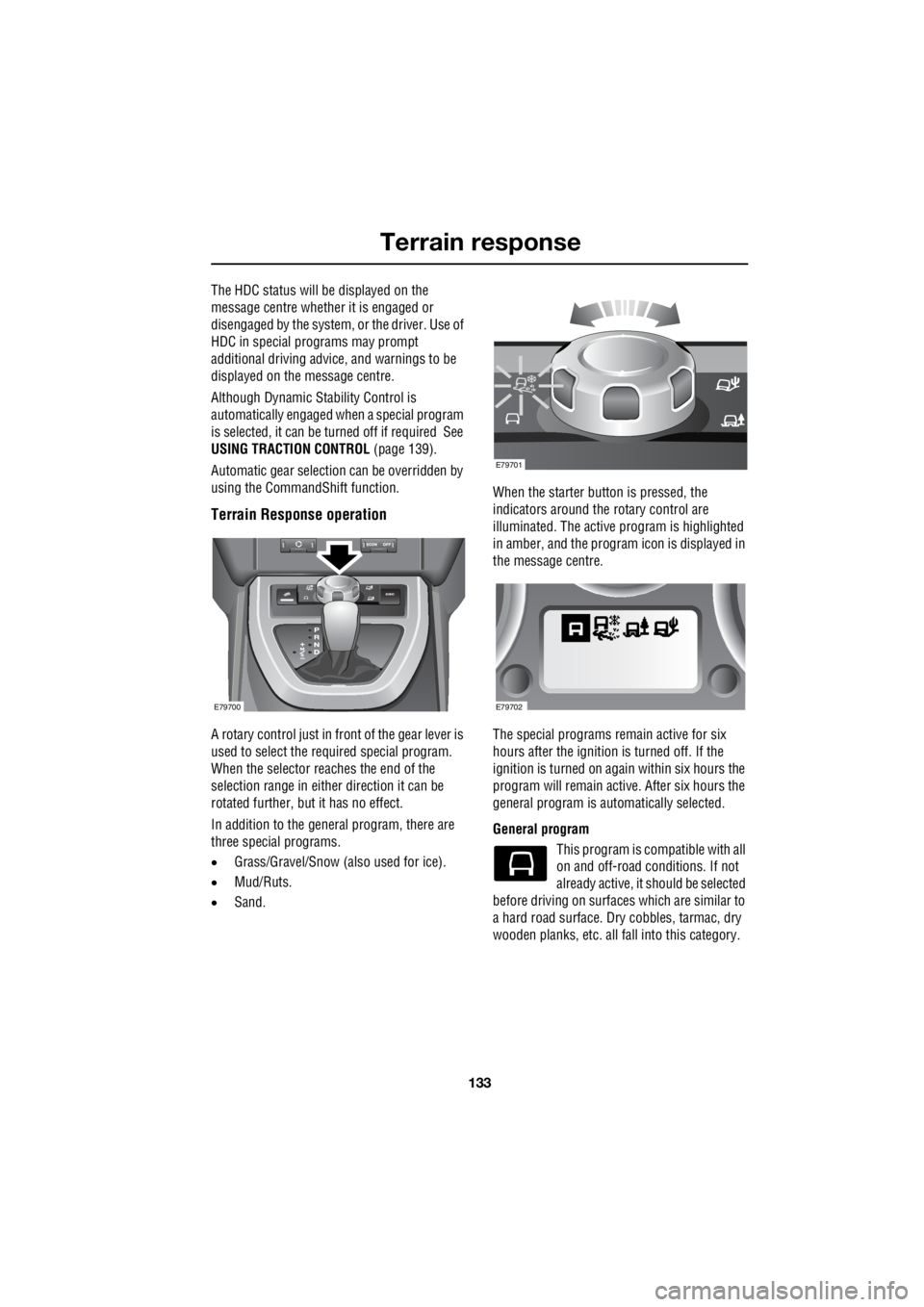
Terrain Response operation
A rotary control just in fr ont of the gear lever is
used to select the required special program.
When the selector reaches the end of the
selection range in either direction it can be
rotated further, but it has no effect.
In addition to the general program, there are
three special programs.
• Grass/Gravel/Snow (also used for ice).
• Mud/Ruts.
• Sand. When the starter button is pressed, the
indicators around the rotary control are
illuminated. The active program is highlighted
in amber, and the program icon is displayed in
the message centre.
The special programs remain active for six
hours after the ignition is turned off. If the
ignition is turned on again within six hours the
program will remain ac tive. After six hours the
general program is automatically selected.
General program This program is co mpatible with all
on and off-road conditions. If not
already active, it should be selected
before driving on surfaces which are similar to
a hard road surface. Dry cobbles, tarmac, dry
wooden planks, etc. all fa ll into this category.
E79700
E79701
E79702