2006 DODGE RAM SRT-10 check engine light
[x] Cancel search: check engine lightPage 217 of 5267

When Monitored:
Ignition on and battery voltage greater than 10 volts.
Set Condition:
Just after key on, the throttle is opened and closed to test the system. If the TP Sensor does not return to
Limp Home Position at the end of this test, this DTC will set. One trip fault and the code will set within 5
seconds. ETC light is flashing.
Possible Causes
THROTTLE PLATE STUCK AT OR BELOW LIMP HOME POSITION
(K448) ETC NEGATIVE CIRCUIT SHORTED TO BATTERY VOLTAGE
(K447) ETC POSITIVE CIRCUIT OPEN
(K448) ETC NEGATIVE CIRCUIT OPEN
(K447) ETC POSITIVE CIRCUIT SHORTED TO GROUND
(K448) ETC NEGATIVE CIRCUIT SHORTED TO GROUND
PCM
Always perform the Pre-Diagnostic Troubleshooting procedure before proceeding. (Refer to 9 - ENGINE -
DIAGNOSIS AND TESTING).
Diagnostic Test
1.ACTIVE DTC
Ignition on, engine not running.
NOTE: The PCM tests the ETC Motor by opening and closing the Throttle Plate before starting the engine.
If during this test the Throttle plate does not return to the closed positionthisDTCsets.
With a scan tool read DTCs.
NOTE: Diagnose any TP Sensor, Battery Voltage, and 5-Volt Supply DTCs before continuing.
Is the DTC active at this time?
Ye s>>
Go To 2
No>>
Refer to the INTERMITTENT CONDITION Diagnostic Procedure.
Perform the POWERTRAIN VERIFICATION TEST. (Refer to 9 - ENGINE - STANDARD PROCEDURE)
2.THROTTLE PLATE STUCK OPEN
Turn the ignition off.
NOTE: The PCM tests the ETC Motor by opening and closing the Throttle Plate before starting the engine.
If during this test the Throttle plate does not open this DTC sets.
Remove the Air Cleaner Assembly from the Throttle Body.
Check for any signs of a foreign material causing the Throttle to remain open.
Using a scan tool actuate the ETC Motor.
Does the Throttle Plate move?
Ye s>>
Go To 3
No>>
Remove the debris if possible or replace the Throttle Body Assembly. Disconnect the Battery when
replacing the Throttle Body Assembly. After installation is complete, use a scan tool and select the ETC
RELEARN function.
Perform the POWERTRAIN VERIFICATION TEST. (Refer to 9 - ENGINE - STANDARD PROCEDURE)
Page 224 of 5267
When Monitored:
With the ignition on and the ETC Motor is not in Limp Home mode.
Set Condition:
When the PCM detects an internal error or a short between the ETC Motor - and ETC Motor + circuits in the
ETC Motor Driver. One trip fault. ETC light is flashing.
Possible Causes
THROTTLE PLATE / BORE INSPECTION
(K447) ETC POSITIVE CIRCUIT SHORTED TO BATTERY VOLTAGE
(K448) ETC NEGATIVE CIRCUIT SHORTED TO BATTERY VOLTAGE
(K447) ETC POSITIVE CIRCUIT SHORTED TO THE (K448) ETC NEGATIVE CIRCUIT
(K447) ETC POSITIVE CIRCUIT OPEN
(K447) ETC POSITIVE CIRCUIT SHORTED TO GROUND
(K448) ETC NEGATIVE CIRCUIT OPEN
(K448) ETC NEGATIVE CIRCUIT SHORTED TO GROUND
ETC MOTOR
PCM
Always perform the Pre-Diagnostic Troubleshooting procedure before proceeding. (Refer to 9 - ENGINE -
DIAGNOSIS AND TESTING).
Diagnostic Test
1.ACTIVE DTC
Ignition on, engine not running.
NOTE: If the P2118 is intermittent, it is possible that the controller is overheating in extreme hot tempera-
tures, and this is considered a normal protection operation. No repair is necessary.
With a scan tool, read DTCs.
Look closely at the temperatures at which this DTC set.
Is the DTC active at this time?
Ye s>>
Go To 2
No>>
Refer to the INTERMITTENT CONDITION Diagnostic Procedure.
Perform the POWERTRAIN VERIFICATION TEST. (Refer to 9 - ENGINE - STANDARD PROCEDURE)
2.THROTTLE PLATE INSPECTION
Turn the ignition off.
Remove the Air Cleaner Assembly from the Throttle Body.
Check for any signs of a foreign material (ice or dirt) on the Throttle Plateor in the bore causing the Throttle Plate
to stick.
Were any signs of foreign material or scoring of the throttle plate or bore found?
Ye s>>
Remove the debris if possible or replace the Throttle Body Assembly. Disconnect the Battery when
replacing the Throttle Body Assembly. After installation is complete, use a scan tool and select the ETC
RELEARN function.
Perform the POWERTRAIN VERIFICATION TEST. (Refer to 9 - ENGINE - STANDARD PROCEDURE)
No>>
Go To 3
Page 264 of 5267
When Monitored:
Ignition on.
Set Condition:
PCM recognizes Vehicle speed input No.2 erratic or high. VSS No.2 is based on the average of the Front
Wheel Speeds. One trip fault and the code will set within 5 seconds. No MIL and No ETC light. Cruise is
disabled.
Possible Causes
(B222) VEHICLE SPEED NO.2 SIGNAL CIRCUIT SHORTED TO VOLTAGE
(B222) VEHICLE SPEED NO.2 SIGNAL CIRCUIT OPEN
(B222) VEHICLE SPEED NO.2 SIGNAL CIRCUIT SHORTED TO GROUND
TIRE CIRCUMFERENCE
PCM
Always perform the Pre-Diagnostic Troubleshooting procedure before proceeding. (Refer to 9 - ENGINE -
DIAGNOSIS AND TESTING).
Diagnostic Test
1.ACTIVE DTC
Ignition on, engine not running.
NOTE: Check for any Bus Communication DTCs. If no Bus or Communication DTCsare set, check for active
DTCs stored in the Anti-Lock Brake Module. Any bus or communication DTCs orVSS DTCs in the Anti-Lock
Brake Module must be properly diagnosed before continuing.
With a scan tool, read DTCs.
Is the DTC active at this time?
Ye s>>
Go To 2
No>>
Refer to the INTERMITTENT CONDITION Diagnostic Procedure.
Perform the POWERTRAIN VERIFICATION TEST. (Refer to 9 - ENGINE - STANDARD PROCEDURE)
2.VISUAL INSPECTION
NOTE: This code can set due to tire circumference differences and from the front or rear wheels being on
a slippery surface while the opposite tires are not.
This code may also set on a hard acceleration on loose gravel or during otheroff road driving conditions.
Check tire pressure of all the tires.
Checktirewearonallthetires.
Ask the customer what the road and driving conditions were like when the fault set.
Were any problems found?
Ye s>>
Repair as necessary. If the code set during a front OR rear wheel spin condition, no repair is necessary.
Perform the POWERTRAIN VERIFICATION TEST. (Refer to 9 - ENGINE - STANDARD PROCEDURE)
No>>
Go To 3
Page 290 of 5267

For a complete wiring diagramRefer to Section 8W.
When Monitored:
Ignition on and engine running with no MAP Sensor DTCs.
Set Condition:
PCM calculated MAP value is greater than actual MAP value plus an offset value. One trip fault. Three good
trips to turn of the mil. ETC light will flash.
Possible Causes
RESTRICTED AIR INLET SYSTEM
RESISTANCE IN THE (F856) 5-VOLT SUPPLY CIRCUIT
(F856) 5-VOLT SUPPLY CIRCUIT SHORTED TO GROUND
RESISTANCE IN THE (K1) MAP SIGNAL CIRCUIT
(K1) MAP SIGNAL CIRCUIT SHORTED TO GROUND
RESISTANCE IN (K900) SENSOR GROUND CIRCUIT
RESISTANCE IN THE (F855) 5-VOLT SUPPLY CIRCUIT
(F855) 5-VOLT SUPPLY CIRCUIT SHORTED TO GROUND
RESISTANCE IN THE TP SENSOR SIGNAL CIRCUIT
TP SENSOR SIGNAL CIRCUIT SHORTED TO GROUND
RESISTANCE IN THE (K922) TP SENSOR RETURN CIRCUIT
MAP SENSOR
TP SENSOR
PCM
Always perform the Pre-Diagnostic Troubleshooting procedure before proceeding. (Refer to 9 - ENGINE -
DIAGNOSIS AND TESTING).
Diagnostic Test
1.ACTIVE DTC
NOTE: The most likely cause of this DTC is a plugged intake air system or Dirty Throttle Body. Check for
TSB’s before continuing.
NOTE: Diagnose any 5-Volt Supply, TP Sensor, Fuel System Lean or Rich, or MAP Sensor DTCs before con-
tinuing.
NOTE: The throttle plate should be free from binding and carbon build up.
NOTE: Question the customer about weather conditions, as ICE build up on the blade can cause this fault
when ambient is around +4 to -10 Celsius range.
Ignition on, engine not running.
With a scan tool, read DTCs.
Is the DTC active at this time?
Ye s>>
Go To 2
No>>
Refer to the INTERMITTENT CONDITION Diagnostic Procedure.
Perform the POWERTRAIN VERIFICATION TEST. (Refer to 9 - ENGINE - STANDARD PROCEDURE)
Page 300 of 5267

When Monitored:
Ignition on and engine running with no MAP Sensor DTCs.
Set Condition:
PCM calculated MAP value is greater than actual MAP value plus an offset value. One trip fault and the code
will set within 5 seconds. Three good trips to turn of the mil. ETC light willflash.
Possible Causes
RESTRICTED AIR INLET SYSTEM
RESISTANCE IN THE (F856) 5-VOLT SUPPLY CIRCUIT
(F856) 5-VOLT SUPPLY CIRCUIT SHORTED TO GROUND
RESISTANCE IN THE (K1) MAP SIGNAL CIRCUIT
(K1) MAP SIGNAL CIRCUIT SHORTED TO GROUND
RESISTANCE IN (K900) SENSOR GROUND CIRCUIT
RESISTANCE IN THE (F855) 5-VOLT SUPPLY CIRCUIT
(F855) 5-VOLT SUPPLY CIRCUIT SHORTED TO GROUND
RESISTANCE IN THE TP SENSOR SIGNAL CIRCUIT
TP SENSOR SIGNAL CIRCUIT SHORTED TO GROUND
RESISTANCE IN THE (K922) TP SENSOR RETURN CIRCUIT
MAP SENSOR
TP SENSOR
PCM
Always perform the Pre-Diagnostic Troubleshooting procedure before proceeding. (Refer to 9 - ENGINE -
DIAGNOSIS AND TESTING).
Diagnostic Test
1.ACTIVE DTC
NOTE: The most likely cause of this DTC is a plugged intake air system or dirty Throttle Body. Check for
any TSB’s before continuing.
NOTE: Diagnose any 5-Volt Supply, TP Sensor, Oxygen Sensor, Fuel related or MAP Sensor DTCs before
continuing.
NOTE: The throttle plate should be free from binding and carbon build up.
NOTE: Question the customer about weather conditions, as ICE build up on the blade can cause this fault
when ambient is around +4 to -10 Celsius range.
Ignition on, engine not running.
With a scan tool, read DTCs.
Is the DTC active at this time?
Ye s>>
Go To 2
No>>
Refer to the INTERMITTENT CONDITION Diagnostic Procedure.
Perform the POWERTRAIN VERIFICATION TEST. (Refer to 9 - ENGINE - STANDARD PROCEDURE)
Page 316 of 5267

For a complete wiring diagramRefer to Section 8W.
When Monitored:
Ignition on. No Break or APPS faults present.
Set Condition:
The PCM recognizes a brake application following the APPS showing a fixed pedal opening. Temporary or
permanent. Internally the PCM will reduce throttle opening below driver demand. One trip fault and the code
will be set within 5 seconds. ETC light will illuminate, the light will onlystay illuminated while DTC is active.
Possible Causes
CUSTOMER PRESSING ACCLERATOR PEDAL, THEN PRESSING BRAKE PEDAL, AND CONTINUES
HOLDING THEM DOWN SIMULTANEOUSLY
STOP LAMP SWITCH
APP SENSOR
Always perform the Pre-Diagnostic Troubleshooting procedure before proceeding. (Refer to 9 - ENGINE -
DIAGNOSIS AND TESTING).
Diagnostic Test
1.DTC INFORMATION
NOTE: If a pedal assembly becomes mechanically stuck the voltage output will stay fixed, if this is also
Followed by a long application of the brakes this code will set.
NOTE: When this code sets the pedal position in the PCM software will ramp toidle. If the Pedal voltage
changes OR the brake pedal is released, the pedal position in the PCM software will ramp up to the pedal
position and the ETC light will go out.
With a scan tool, read DTCs and record the related Freeze Frame data.
Diagnose all other Stop Lamp Switch and APP Sensor codes before continuing.
This code can be set by a driver who uses both feet while driving, one for the Accelerator Pedal and the other for
the Brake Pedal.
NOTE: The most likely cause of this DTC is caused by the customer Brake Torquing the engine by pressing
the Accelerator pedal and the pressing the Brake Pedal.
Ask the driver of the vehicle if these conditions apply to their driving habits.
Are the listed conditions part of the customers driving habits?
Ye s>>
Advise the customer of what caused the DTC. This is normal operation of a ETCequipped vehicle
because of safety issues.
Perform the POWERTRAIN VERIFICATION TEST. (Refer to 9 - ENGINE - STANDARD PROCEDURE)
No>>
Go To 2
2.STOP LAMP SWITCH OPERATION
With a scan tool, read both Stop Lamp Switch statuses while pressing and releasing the Brake Pedal.
Does the scan tool display the Pressed and Released while pressing and releasing the Pedal?
Ye s>>
Go To 3
No>>
Check the Stop Lamp Switch for proper installation and check the related circuits for opens and shorts
using the appropriate wiring diagram. If OK, replace the Stop Lamp Switch assembly.
Perform the POWERTRAIN VERIFICATION TEST. (Refer to 9 - ENGINE - STANDARD PROCEDURE)
Page 355 of 5267

P2610-PCM INTERNAL SHUTDOWN TIMER FAST RATIONALITY
For a complete wiring diagramRefer to Section 8W.
When Monitored:
Ignition on and battery voltage greater than 10 volts.
Set Condition:
Internal PCM failure detected. One Trip Fault. Three good trips to turn offthe MIL.
Possible Causes
PCM FUSED IGNITION SWITCH CIRCUIT
PCM INTERNAL
Always perform the Pre-Diagnostic Troubleshooting procedure before proceeding. (Refer to 9 - ENGINE -
DIAGNOSIS AND TESTING).
Diagnostic Test
1.PCM IGNITION CIRCUITS
Turn the ignition off.
Disconnect the C1 PCM harness connector.
CAUTION: Do not probe the PCM harness connectors. Probing the
PCM harness connectors will damage the PCM terminals resulting
in poor terminal to pin connection. Install Miller Special Tool #8815
to perform diagnosis.
With a 12-volt test light connected to ground and with special tool
#8815 installed, probe the (F202), (F1), and (T751) Fused Ignition
Switch circuits.
Perform the above check with the Ignition key in the off lock position,
Ignition on, engine not running position, and during cranking.
Wiggle the related wire harness while probing the special tool with the
test light to try to interrupt the circuit.
Does the test light illuminate brightly?
Ye s>>
Go To 2
No>>
Repair the open or excessive resistance in the (F202), (F1), and (T751) Fused Ignition Switch (Off, Run,
Start) circuits. Inspect the related fuse, if the fuse is open check the circuits for a short to ground.
Perform the POWERTRAIN VERIFICATION TEST. (Refer to 9 - ENGINE - STANDARD PROCEDURE)
2.PCM
The Powertrain Control Module is reporting internal errors.
NOTE: Before continuing, check the PCM harness connector terminals for corrosion, damage, or terminal
push out. Repair as necessary.
Using the schematics as a guide, inspect the wire harness and connectors. Pay particular attention to all Power and
Ground circuits.
Were there any problems found?
Ye s>>
Repair as necessary.
Perform the POWERTRAIN VERIFICATION TEST. (Refer to 9 - ENGINE - STANDARD PROCEDURE)
No>>
Replace and program the Powertrain Control Module per Service Information.
Perform the POWERTRAIN VERIFICATION TEST. (Refer to 9 - ENGINE - STANDARD PROCEDURE)
Page 395 of 5267
U0101-LOST COMMUNICATION WITH TCM
For a complete wiring diagramRefer to Section 8W.
When Monitored:
Ignition run time is greater than 1 second. Battery voltage between 9 and 16volts. Engine run time greater
than 3 seconds.
Set Condition:
The PCM doesn’t receive a Bus Message from the Transmission Control Modulefor 7 consecutive seconds.
One trip failure. The circuit is continuously monitored.
Possible Causes
PCM FUSED IGNITION SWITCH OUTPUT CIRCUIT CHECK
BUS FAILURE OPEN OR SHORTED CONDITION
PCI BUS UNABLE TO COMMUNICATE WITH THE SCAN TOOL
PCM
Refer to 8 - ELECTRICAL/ELECTRONIC CONTROL MODULES - DIAGNOSIS AND TESTING for diagnostic
procedures and for further possible causes.
Diagnostic Test
1.ACTIVE DTC
Ignition on, engine not running.
With the scan tool, erase DTCs.
Cycle the ignition key on and off several times. Leaving the ignition on forat least 20 seconds.
With the scan tool, read DTCs.
Does the DTC reset?
Ye s>>
Go To 2
No>>
Refer to the INTERMITTENT CONDITIONSymptom (Diagnostic Procedure).
Perform the POWERTRAIN VERIFICATION TEST. (Refer to 9 - ENGINE - STANDARD PROCEDURE)
2.PCM FUSED IGNITION SWITCH OUTPUT CIRCUIT
Turn the ignition off.
Disconnect the C1 PCM harness connector.
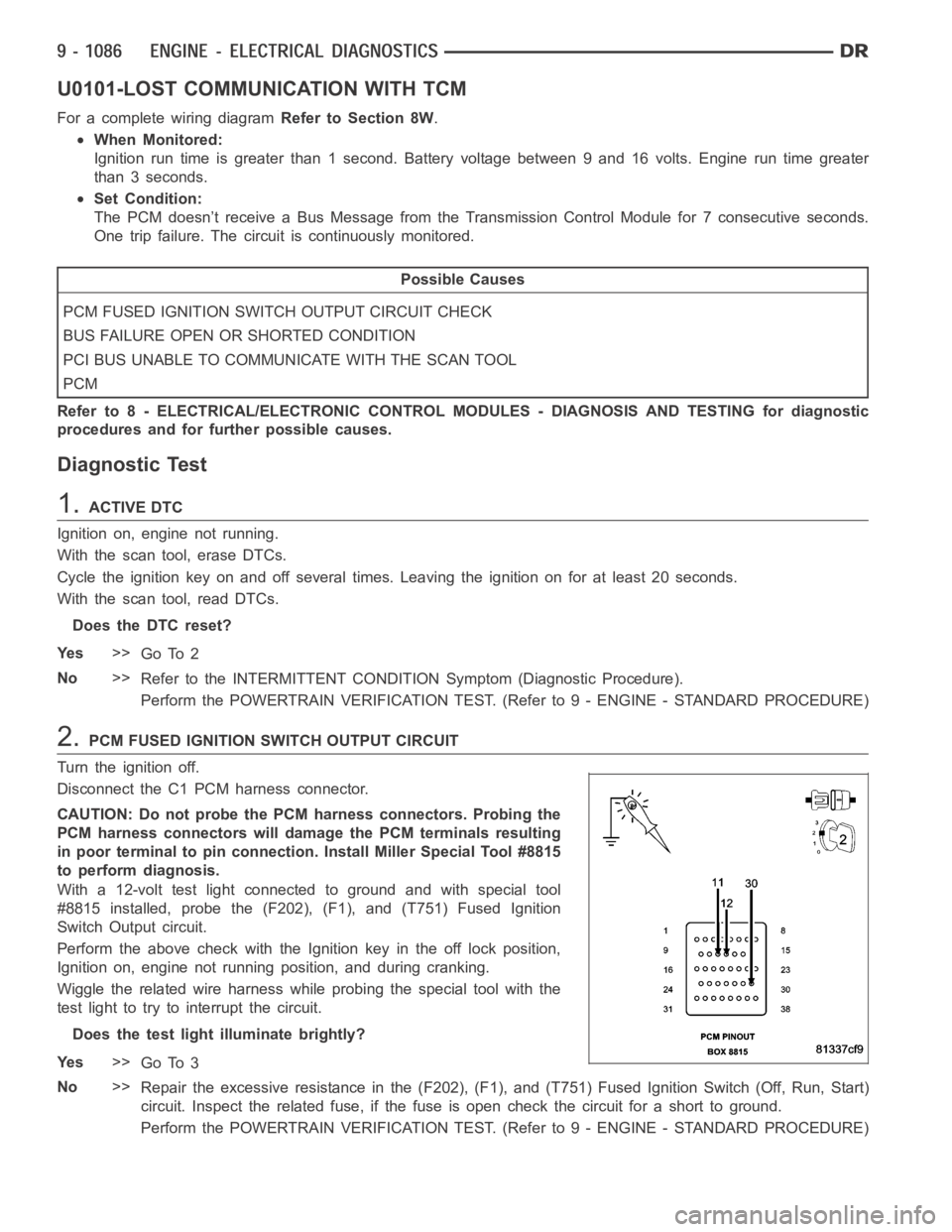
CAUTION: Do not probe the PCM harness connectors. Probing the
PCM harness connectors will damage the PCM terminals resulting
in poor terminal to pin connection. Install Miller Special Tool #8815
to perform diagnosis.
With a 12-volt test light connected to ground and with special tool
#8815 installed, probe the (F202), (F1), and (T751) Fused Ignition
Switch Output circuit.
Perform the above check with the Ignition key in the off lock position,
Ignition on, engine not running position, and during cranking.
Wiggle the related wire harness while probing the special tool with the
test light to try to interrupt the circuit.
Does the test light illuminate brightly?
Ye s>>
Go To 3
No>>
Repair the excessive resistance in the (F202), (F1), and (T751) Fused Ignition Switch (Off, Run, Start)
circuit. Inspect the related fuse, if the fuse is open check the circuit fora short to ground.
Perform the POWERTRAIN VERIFICATION TEST. (Refer to 9 - ENGINE - STANDARD PROCEDURE)