2006 DODGE RAM SRT-10 remote control
[x] Cancel search: remote controlPage 1286 of 5267
6.LEAK AT GAS CAP
Remove the SMOKE supply tip (black hose) from the service port (if equipped) or to the #8404–ADP adapter.
Install gas cap adapter, Miller Tool #8382 (1/4 turn cap) or #6922 (screw cap) and #8399* (secondary seal depres-
sor) and repeat test 5.
Was a leak found at the gas cap adapter?
Ye s>>
Replace the Fuel Filler tube assembly.
Perform the POWERTRAIN VERIFICATION TEST. (Refer to 9 - ENGINE - STANDARD PROCEDURE)
No>>
Replace the gas cap.
Perform the POWERTRAIN VERIFICATION TEST. (Refer to 9 - ENGINE - STANDARD PROCEDURE)
7.LEAK DETECTION PUMP
Apply an external vacuum to the LDP.
Using a scan tool, close the LDP seal to atmosphere.
Inject smoke into the Evap system using the EELD.
Examine the LDP filter port for smoke.
Is smoke visible from the LDP?
Ye s>>
Replace the Leak Detection Pump.
Perform the POWERTRAIN VERIFICATION TEST. (Refer to 9 - ENGINE - STANDARD PROCEDURE)
No>>
Go To 8
8.EVAP PURGE SOLENOID OPERATION
To continue testing you will need Miller Tool #8404 Evaporative Emission Leak Detector (EELD).
Connect the red power lead of the EELD to the battery positive terminal and the black ground lead to the battery
negative ternal.
Disconnect the vacuum hoses at the Evap Purge Solenoid.
Connect the SMOKE supply tip (black hose) to the service port (if equipped)or to the #8404-ADP adapter.
Set the smoke/air control switch to SMOKE.
Press the remote smoke/air start button.
NOTE: Below is an optional method of checking the purge valve for leaks if the EELD is unavailable.
Turn the ignition off.
Disconnect the vacuum hoses at the Evap Purge Solenoid.
Using a hand vacuum pump, apply 10 in Hg to the
CANof the EVAP Purge Solenoid.
With the scan tool, actuate the Evap Purge Solenoid.
NOTE: If the Evap Purge Solenoid does not hold a vacuum, it will need to be repalced..
Is smoke visible from the Evap Purge Solenoid?
Ye s>>
Replace the Evap Purge Solenoid.
Perform the POWERTRAIN VERIFICATION TEST. (Refer to 9 - ENGINE - STANDARD PROCEDURE)
No>>
Te s t C o m p l e t e .
Page 1483 of 5267
POWERTRAIN VERIFICATION TEST
For a complete wiring diagramRefer to Section 8W.
Diagnostic Test
1.SELECTING THE PROPER VERIFICATION TEST
The following verification test are for different repairs. Select the appropriate Verification test for the
repair that has been completed.
Speed Control repair
Go To 2
Charging System repair
Go To 3
NVLD System repair
Go To 4
All other repairs
Go To 5
2.POWERTRAIN VERIFICATION TEST 1
NOTE: 1. If this vehicle is equipped with an Electronic Throttle Control system, and the APP Sensors, PCM,
or Throttle Body Assembly have been replaced, use the scan tool to perform the ETC RELEARN function.
NOTE: 2. After completing the Powertrain Verification Test the Transmission Verification Test must be per-
formed.
NOTE: 3. If the PCM has been replaced and the correct VIN and mileage have notbeen programmed, a DTC
will set in the ABS Module, Airbag Module and the SKIM/SKREEM.
NOTE: 4. If the vehicle is equipped with a Sentry Key Remote Entry, Secret Key data must be updated. Refer
to the Service Information for the PCM, SKIM/SKREEM and the Transponder (ignition key) for programming
information. Using the scan tool, program the Secret Key information intothe PCM using the PCM replaced
function under the WCM menu.
5. Inspect the vehicle to make sure that all engine components are properlyinstalled and connected.
6. Connect the scan tool to the data link connector and erase all codes.
7. Turn the speed control ON (if equipped, cruise light will be on).
8. Depress and release the SET Switch when the vehicle speed is greater than35 MPH. The speed control should
engage and hold the selected speed.
9. Press and hold the RESUME/ACCEL Switch. The vehicle speed should increase by at least 2 MPH.
10. Press and hold the COAST switch. The vehicle speed should decrease.
11. Using caution, press and release the brake pedal. The speed control should disengage.
12. Bring the vehicle speed back up to 35 MPH.
13. Press the RESUME/ACCEL switch. The speed control should resume the previously set speed.
14. Hold down the SET switch. The vehicle should decelerate.
15. Make sure vehicle speed is greater than 35 mph and release the SET Switch. The vehicle should adjust and set
a new vehicle speed.
16. Press and release the CANCEL switch. The speed control should disengage.
17. Bring the vehicle speed back up above 35 mph and engage speed control.
18. Turn the Speed Control Off. (Cruise light will be off). The speed control should disengage.
NOTE: OVERSHOOT/UNDERSHOOT FOLLOWING SPEED CONTROL SET.
19. If the vehicle operator repeatedly presses and releases the SET buttonwith their foot off of the accelerator
(referred to as
lift foot set), the vehicle may accelerate and exceed the desired set speed by up to 5 mph (8km/h).
20. It may also decelerate to less than the desired set speed, before finally achieving the desired set speed.
21. The Speed Control System has an adaptive strategy that compensates forvehicle-to-vehicle variations in speed
control cable lengths.
22. When the speed control is set with the vehicles operators foot off of theaccelerator pedal, the speed control
thinks there is excessive speed control cable slack and adapts accordingly.
Page 1484 of 5267
23. If thelift foot setsare continually used, a speed control overshoot/undershoot condition will develop.
24. To
unlearnthe overshoot/undershoot condition, the vehicle operator has to press and release the set button
while maintaining the desired set speedusing the accelerator pedal (not decelerating or accelerating).
25. Then turn the cruise control switch to the OFF position (or press the CANCEL button if equipped) after waiting
10 seconds.
26. This procedure must be performed approximately 10-15 times to completely unlearn the overshoot/undershoot
condition.
Did the Speed Control pass the above test?
Ye s>>
Repair is complete.
No>>
Check for any related Technical Service Bulletins and/or refer to the appropriate Diagnostic Procedure.
3.POWERTRAIN VERIFICATION TEST 2
1. If this vehicle is equipped with an Electronic Throttle Control system,and the APP Sensors, PCM, or Throttle
Body Assembly has been replaced use a scan tool to perform the ETC RELEARN function.
NOTE: 2. After completing the Powertrain Verification Test the Transmission Verification Test must be per-
formed.
NOTE: 3. If the PCM has been replaced and the correct VIN and mileage have notbeen programmed, a DTC
will set in the ABS Module, Airbag Module and the SKIM/SKREEM.
NOTE: 4. If the vehicle is equipped with a Sentry Key Remote Entry, Secret Key data must be updated. Refer
to the Service Information for the PCM, SKIM/SKREEM and the Transponder (ignition key) for programming
information. Using the scan tool, program the Secret Key information intothe PCM using the PCM replaced
function under the WCM menu.
5. Inspect the vehicle to make sure that all components related to the repair are properly installed and connected.
6. With the scan tool, clear DTCs.
7. Perform generator output test. Refer to the appropriate service information as necessary.
8. Start the engine and set engine speed to 2000 RPM for at least thirty seconds.
9. Cycle the ignition key off and on.
10. With the scan tool, read the DTCs.
Are any DTCs or symptoms remaining?
Ye s>>
Check for any Technical Service Bulletins and/or refer to the appropriateDiagnostic Procedure.
No>>
Repair is complete.
4.POWERTRAIN VERIFICATION TEST 3
1. Install the Miller Tool #8404 Evaporative Emission Leak Detector (EELD) according to the instructions in the pre-
vious DTC table.
2. Set the smoke/air control switch to AIR.
3. Insert the tester’s AIR supply tip (clear hose) into the appropriate calibration orifice on the tester’s control panel
(based on DTC leak size).
4. Press the remote smoke/air start button.
5. Position the red flag on the air flow meter so it is aligned with the indicator ball.
6. When the calibration is complete, release the remote button. The EELD flow meter is now calibrated in liters per
minute to the size of leak indicated by the DTC set in the PCM.
7. Install the service port adapter #8404-14 on the vehicle’s service port.
8. Connect the Air supply hose from the EELD to the vehicle.
9. Press the remote button to activate AIR flow.
NOTE: 10. Larger volume fuel tanks, lower fuel levels or if the vehicle is equipped with a Flow Management
Valve may indicate high flow and will require 4 to 5 minutes to fill.
11. Compare the flow meter indicator ball reading to the red flag.
12. ABOVE the red flag indicates a leak present.
13. BELOW the red flag indicates a sealed system.
Page 1485 of 5267
NOTE: If this vehicle is equipped with an Electronic Throttle Control system, and the APP Sensors, PCM, or
Throttle Body Assembly have been replaced, use the scan tool to perform theETC RELEARN function.
14. If the indicator ball shows a leak present, perform the smoke test indicated in the previous test and identify the
leak and repair. Perform this verification test when the repair is complete.
Didtheindicatorballindicatethealeakispresent?
Ye s>>
Repeat the DTC test to identify the leak and repair.
No>>
Repair is complete.
5.POWERTRAIN VERIFICATION TEST 4
NOTE: 1. After completing the Powertrain Verification Test the Transmission Verification Test must be per-
formed.
NOTE: 2. If the PCM has been replaced and the correct VIN and mileage have notbeen programmed, a DTC
will set in the ABS Module, Airbag Module and the SKIM/SKREEM.
NOTE: 3. If the vehicle is equipped with a Sentry Key Remote Entry, Secret Key data must be updated. Refer
to the Service Information for the PCM, SKIM/SKREEM and the Transponder (ignition key) for programming
information. Using the scan tool, program the Secret Key information intothe PCM using the PCM replaced
function under the WCM menu.
NOTE: 4. If this vehicle is equipped with an Electronic Throttle Control system, and the APP Sensors, PCM,
or Throttle Body Assembly have been replaced, use the scan tool to perform the ETC RELEARN function.
NOTE: 5. When replacing an O2 Sensor, the PCM RAM memory must be cleared, either by disconnecting the
PCM C1 connector or momentarily disconnecting the Battery negative terminal.
6. The NGC learns the characteristics of each O2 heater element and these old values should be cleared when
installing a new O2 sensor. The customermay experience driveability issues if this is not performed.
7. Inspect the vehicle to make sure that all engine components are properlyinstalled and connected. Reassemble
and reconnect components as necessary.
8. Connect the scan tool to the data link connector.
9. Make sure the fuel tank has at least a quarter tank of fuel. Turn off all accessories.
10. If the Catalyst was replaced, with the scan tool go to the MiscellaneousMenu Option
Catalyst Replacedand
press enter.
11. If a Comprehensive Component DTC was repaired, perform steps 12 - 14. Ifa Major OBDII Monitor DTC was
repaired skip those steps and continue verification.
12. After the ignition has been off for at least 10 seconds, restart the vehicle and run 2 minutes.
13. With the scan tool, monitor the appropriate pre-test enabling conditions until all conditions have been met. Once
the conditions have been met, switch screen to the appropriate OBDII monitor, (Audible beeps when the monitor is
running).
14. If the repaired OBDII trouble code has reset or was seen in the monitor while on the road test, the repair is not
complete. Check for any related technical service bulletins or flash updates and return to Engine Electrical Diag-
nostic List.
15. If the conditions cannot be duplicated, erase all DTCs with the Scan tool.
16. If another DTC has set, return to the Engine Electrical Diagnostic Listand follow the path specified for that DTC.
Did the OBDII Monitor run successfully and has the Good Trip Counter changed to one or more?
Ye s>>
Repair is complete.
No>>
Check for any related Technical Service Bulletins and/or refer to the appropriate Diagnostic Procedure.
Page 4352 of 5267
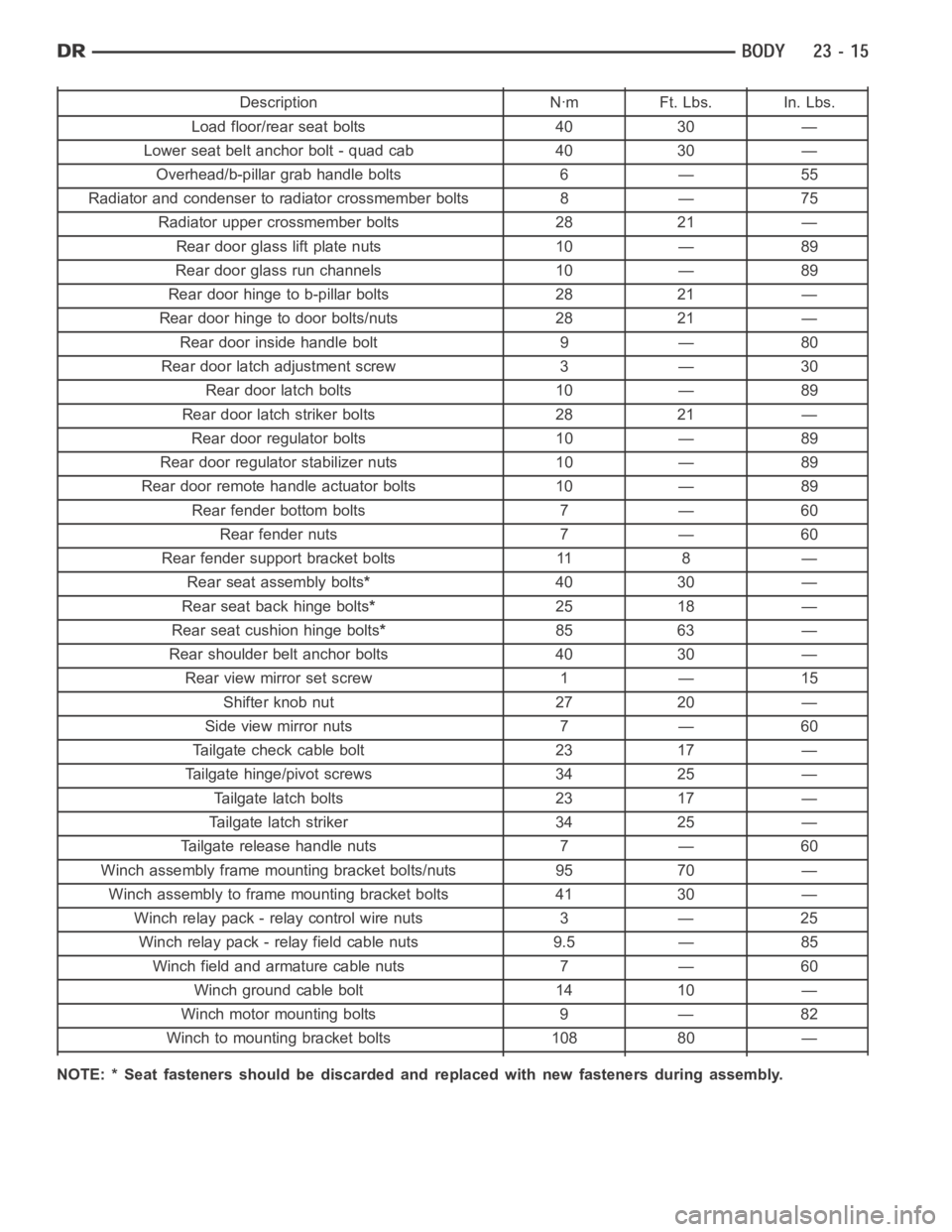
Description Nꞏm Ft. Lbs. In. Lbs.
Load floor/rear seat bolts 40 30 —
Lower seat belt anchor bolt - quad cab 40 30 —
Overhead/b-pillar grab handle bolts 6 — 55
Radiator and condenser to radiator crossmember bolts 8 — 75
Radiator upper crossmember bolts 28 21 —
Rear door glass lift plate nuts 10 — 89
Rear door glass run channels 10 — 89
Rear door hinge to b-pillar bolts 28 21 —
Rear door hinge to door bolts/nuts 28 21 —
Rear door inside handle bolt 9 — 80
Rear door latch adjustment screw 3 — 30
Rear door latch bolts 10 — 89
Rear door latch striker bolts 28 21 —
Rear door regulator bolts 10 — 89
Rear door regulatorstabilizer nuts 10 — 89
Rear door remote handle actuator bolts 10 — 89
Rear fender bottom bolts 7 — 60
Rear fender nuts 7 — 60
Rear fender support bracket bolts 11 8 —
Rear seat assembly bolts*40 30 —
Rear seat back hinge bolts*25 18 —
Rear seat cushion hinge bolts*85 63 —
Rear shoulder belt anchor bolts 40 30 —
Rear view mirror set screw 1 — 15
Shifter knob nut 27 20 —
Side view mirror nuts 7 — 60
Tailgate check cable bolt 23 17 —
Tailgate hinge/pivot screws 34 25 —
Tailgate latch bolts 23 17 —
Tailgate latch striker 34 25 —
Tailgate release handle nuts 7 — 60
Winch assembly frame mounting bracket bolts/nuts 95 70 —
Winch assembly to frame mounting bracket bolts 41 30 —
Winch relay pack - relay control wire nuts 3 — 25
Winch relay pack - relay field cable nuts 9.5 — 85
Winch field and armature cable nuts 7 — 60
Winch ground cable bolt 14 10 —
Winch motor mounting bolts 9 — 82
Winch to mounting bracket bolts 108 80 —
NOTE: * Seat fasteners should be discarded and replaced with new fastenersduring assembly.
Page 4658 of 5267
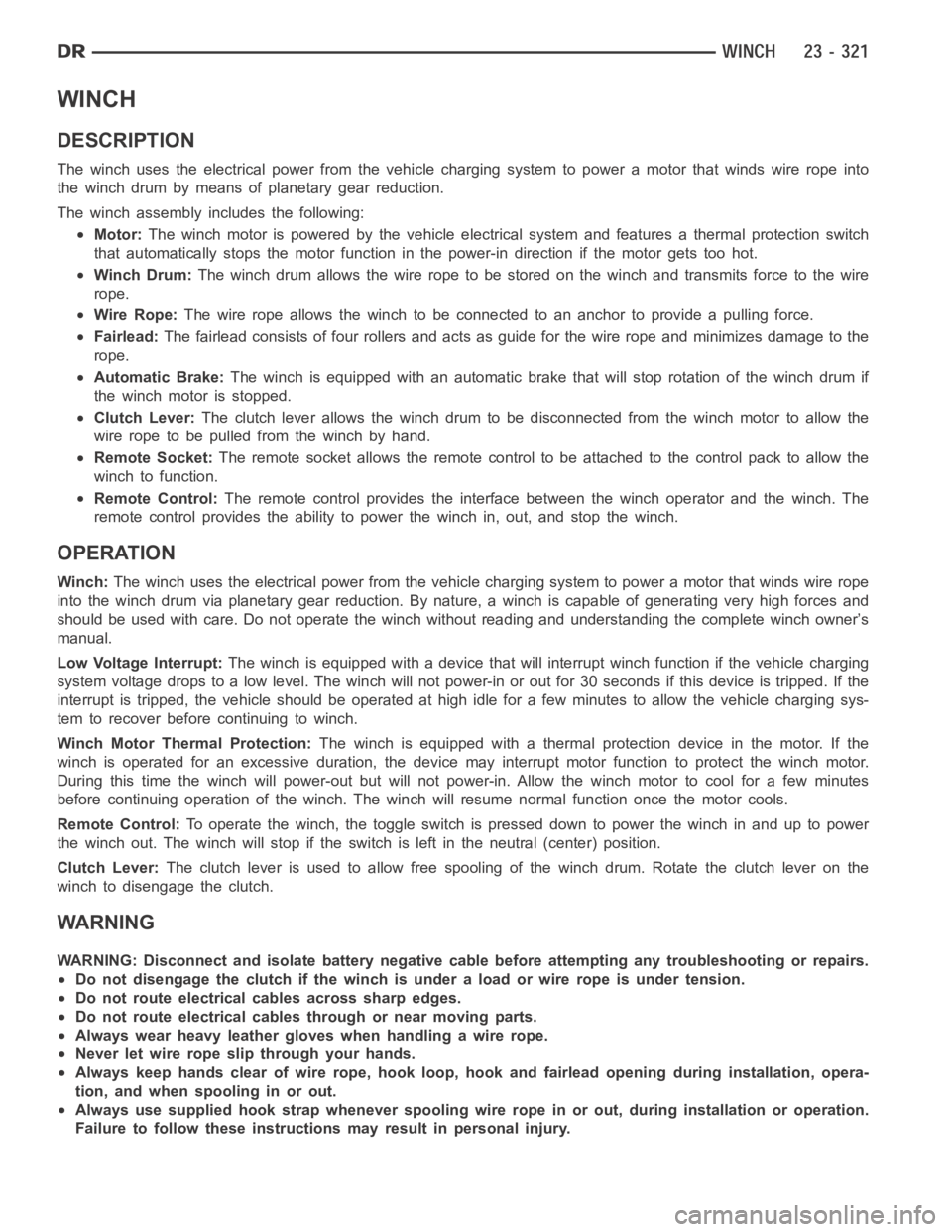
WINCH
DESCRIPTION
The winch uses the electrical power from the vehicle charging system to power a motor that winds wire rope into
the winch drum by means of planetary gear reduction.
The winch assembly includes the following:
Motor:The winch motor is powered by the vehicle electrical system and features a thermal protection switch
that automatically stops the motor function in the power-in direction if the motor gets too hot.
Winch Drum:The winch drum allows the wire rope to be stored on the winch and transmits forcetothewire
rope.
Wire Rope:The wire rope allows the winch to be connected to an anchor to provide a pulling force.
Fairlead:The fairlead consists of four rollers and acts as guide for the wire rope andminimizes damage to the
rope.
Automatic Brake:The winch is equipped with an automatic brake that will stop rotation of thewinch drum if
the winch motor is stopped.
Clutch Lever:The clutch lever allows the winch drum to be disconnected from the winch motor to allow the
wire rope to be pulled from the winch by hand.
Remote Socket:The remote socket allows the remote control to be attached to the control pack to allow the
winchtofunction.
Remote Control:The remote control provides the interface between the winch operator and the winch. The
remote control provides the ability to power the winch in, out, and stop thewinch.
OPERATION
Winch:The winch uses the electrical power from the vehicle charging system to power a motor that winds wire rope
into the winch drum via planetary gear reduction. By nature, a winch is capable of generating very high forces and
should be used with care. Do not operate the winch without reading and understanding the complete winch owner’s
manual.
Low Voltage Interrupt:The winch is equipped with a device that will interrupt winch function if the vehicle charging
system voltage drops to a low level. The winch will not power-in or out for 30seconds if this device is tripped. If the
interrupt is tripped, the vehicle should be operated at high idle for a few minutes to allow the vehicle charging sys-
tem to recover before continuing to winch.
Winch Motor Thermal Protection:The winch is equipped with athermalprotectiondeviceinthemotor.Ifthe
winch is operated for an excessive duration, the device may interrupt motor function to protect the winch motor.
During this time the winch will power-out but will not power-in. Allow the winch motor to cool for a few minutes
before continuing operation of the winch. The winch will resume normal function once the motor cools.
Remote Control:Tooperatethewinch,thetoggleswitchispresseddowntopowerthewinchinand up to power
the winch out. The winch will stop if the switch is left in the neutral (center) position.
Clutch Lever:The clutch lever is used to allow free spooling of the winch drum. Rotate theclutch lever on the
winch to disengage the clutch.
WARNING
WARNING: Disconnect and isolate battery negative cable before attempting any troubleshooting or repairs.
Do not disengage the clutch if the winch is under a load or wire rope is under tension.
Do not route electrical cables across sharp edges.
Do not route electrical cables through or near moving parts.
Always wear heavy leather gloves when handling a wire rope.
Never let wire rope slip through your hands.
Always keep hands clear of wire rope, hook loop, hook and fairlead opening during installation, opera-
tion, and when spooling in or out.
Always use supplied hook strap whenever spooling wire rope in or out, during installation or operation.
Failure to follow these instructions may result in personal injury.
Page 4659 of 5267
CAUTION: Do not leave the remote plugged into the winch when not in use. Leaving the remote plugged in,
may result in a dangerous condition and/or battery drain.
Always make sure the clutch is fully engaged or disengaged.
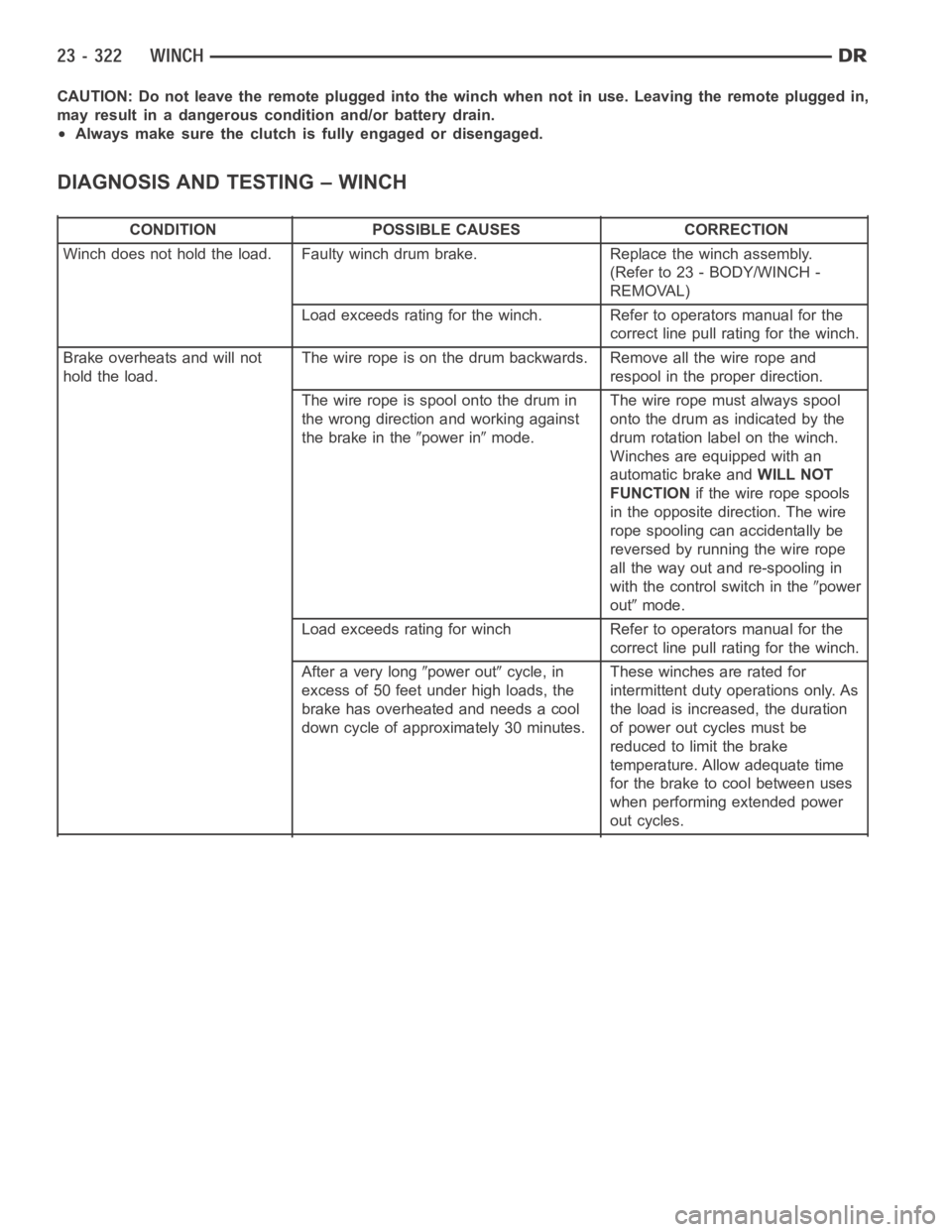
DIAGNOSIS AND TESTING – WINCH
CONDITION POSSIBLE CAUSES CORRECTION
Winch does not hold the load. Faulty winch drum brake. Replace the winch assembly.
(Refer to 23 - BODY/WINCH -
REMOVAL)
Load exceeds rating for the winch. Refer to operators manual for the
correct line pull rating for the winch.
Brake overheats and will not
hold the load.The wire rope is on the drum backwards. Remove all the wire rope and
respool in the proper direction.
Thewireropeisspoolontothedrumin
the wrong direction and working against
the brake in the
power inmode.The wire rope must always spool
onto the drum as indicated by the
drum rotation label on the winch.
Winches are equipped with an
automatic brake andWILL NOT
FUNCTIONif the wire rope spools
intheoppositedirection.Thewire
rope spooling can accidentally be
reversed by running the wire rope
all the way out and re-spooling in
with the control switch in the
power
out
mode.
Load exceeds rating for winch Refer to operators manual for the
correct line pull rating for the winch.
After a very long
power outcycle, in
excess of 50 feet under high loads, the
brake has overheated and needs a cool
down cycle of approximately 30 minutes.These winches are rated for
intermittent duty operations only. As
the load is increased, the duration
of power out cycles must be
reduced to limit the brake
temperature. Allow adequate time
for the brake to cool between uses
when performing extended power
out cycles.
Page 4660 of 5267
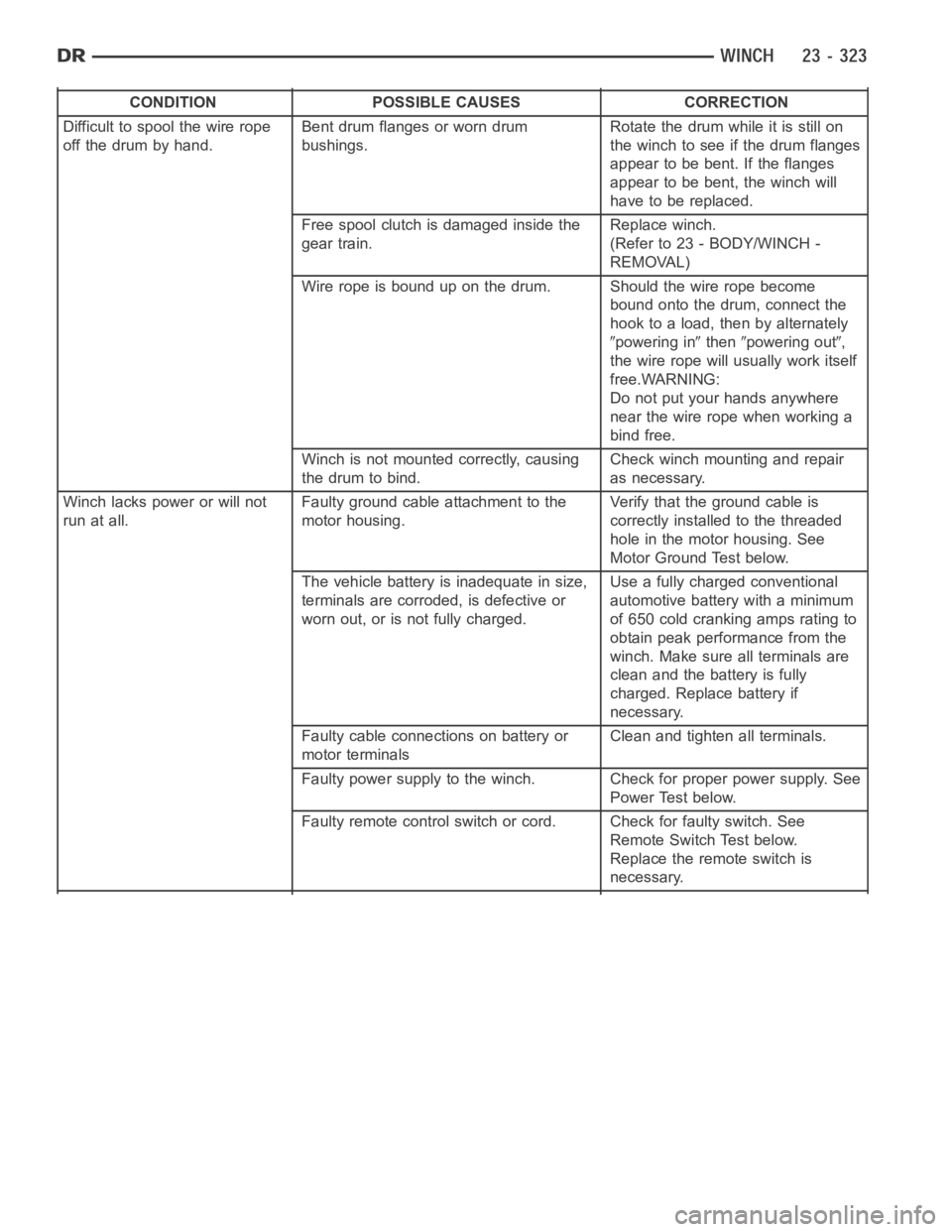
CONDITION POSSIBLE CAUSES CORRECTION
Difficult to spool the wire rope
off the drum by hand.Bent drum flanges or worn drum
bushings.Rotate the drum while it is still on
the winch to see if the drum flanges
appear to be bent. If the flanges
appear to be bent, the winch will
have to be replaced.
Free spool clutch is damaged inside the
gear train.Replace winch.
(Refer to 23 - BODY/WINCH -
REMOVAL)
Wire rope is bound up on the drum. Should the wire rope become
bound onto the drum, connect the
hook to a load, then by alternately
powering inthenpowering out,
the wire rope will usually work itself
free.WARNING:
Do not put your hands anywhere
near the wire rope when working a
bind free.
Winch is not mounted correctly, causing
the drum to bind.Check winch mounting and repair
as necessary.
Winch lacks power or will not
run at all.Faulty ground cable attachment to the
motor housing.Verify that the ground cable is
correctly installed to the threaded
hole in the motor housing. See
Motor Ground Test below.
The vehicle battery is inadequate in size,
terminals are corroded, is defective or
worn out, or is not fully charged.Use a fully charged conventional
automotive battery with a minimum
of650coldcrankingampsratingto
obtain peak performance from the
winch. Make sure all terminals are
clean and the battery is fully
charged. Replace battery if
necessary.
Faulty cable connections on battery or
motor terminalsClean and tighten all terminals.
Faulty power supply to the winch. Check for proper power supply. See
Power Test below.
Faulty remote control switch or cord. Check for faulty switch. See
Remote Switch Test below.
Replace the remote switch is
necessary.