Page 4661 of 5267
CONDITION POSSIBLE CAUSES CORRECTION
When remote control switch is
activated, there is only a
clickingsound, and the winch
does not operate in either
power inorpower out
modes.Low battery charge, corroded terminals,
defective battery.Use a fully charged conventional
automotive battery with a minimum
of650coldcrankingampsratingto
obtain peak performance from the
winch. Make sure all terminals are
clean and the battery is fully
charged. Replace battery if
necessary.
Check for proper power supply. See
Power Test below.
Faulty ground cable attachment to the
motor housing.Check for proper ground. See
Motor Ground Test below.
Faulty motor armature, brushes, or water
in the motor.Replace the motor.
(Refer to 23 - BODY/WINCH/
MOTOR - REMOVAL)
Faulty control relay. Check and replace relays as
necessary. See Relay Pack Test
below
(Refer to 23 - BODY/WINCH/
RELAY - REMOVAL)
Winchrunsslowlyandlacks
power when pulling a load,
won’t pull load, or stalls easily.Thewireropeisspoolontothedrumin
the wrong direction and working against
the brake in the
power inmode.The wire rope must always spool
onto the drum as indicated by the
drum rotation label on the winch.
Winches are equipped with an
automatic brake and WILL NOT
FUNCTION if the wire rope spools
intheoppositedirection.Thewire
rope spooling can accidentally be
reversed by running the wire rope
all the way out and re-spooling in
with the control switch in the
power
out
mode.
When the remote control is
activated, the winch will
operate only in one direction.One or more of the control pack relays is
damagedCheck and replace relays as
necessary. See Relay Pack Test
below
(Refer to 23 - BODY/WINCH/
RELAY - REMOVAL)
The remote control switch is damaged. Check and replace switch as
necessary. See Remote Switch Test
below.
Power-out mode only. Tripped or damaged thermal switch Let motor cool for atleast30
minutes, then try to power-in again.
Check thermal switch. See Thermal
Switch Test below.
Replace the motor if the thermal
switch is faulty.
(Refer to 23 - BODY/WINCH/
MOTOR - REMOVAL)
Page 4662 of 5267
CONDITION POSSIBLE CAUSES CORRECTION
When the remote control is
activated, the winch will not
operate and no “clicking” sound
is heard.Tripped or damaged Low Voltage
Interrupt (LVI)Use a fully charged conventional
automotive battery with a minimum
of650coldcrankingampsratingto
obtain peak performance from the
winch. Make sure all terminals are
clean and the battery is fully
charged. Replace battery if
necessary.
Check LVI. See Low Voltage
Interrupt (LVI) Test below.
Replace the relay pack if the LVI is
faulty.
(Refer to 23 - BODY/WINCH/
RELAY PACK - REMOVAL)
Relay Test
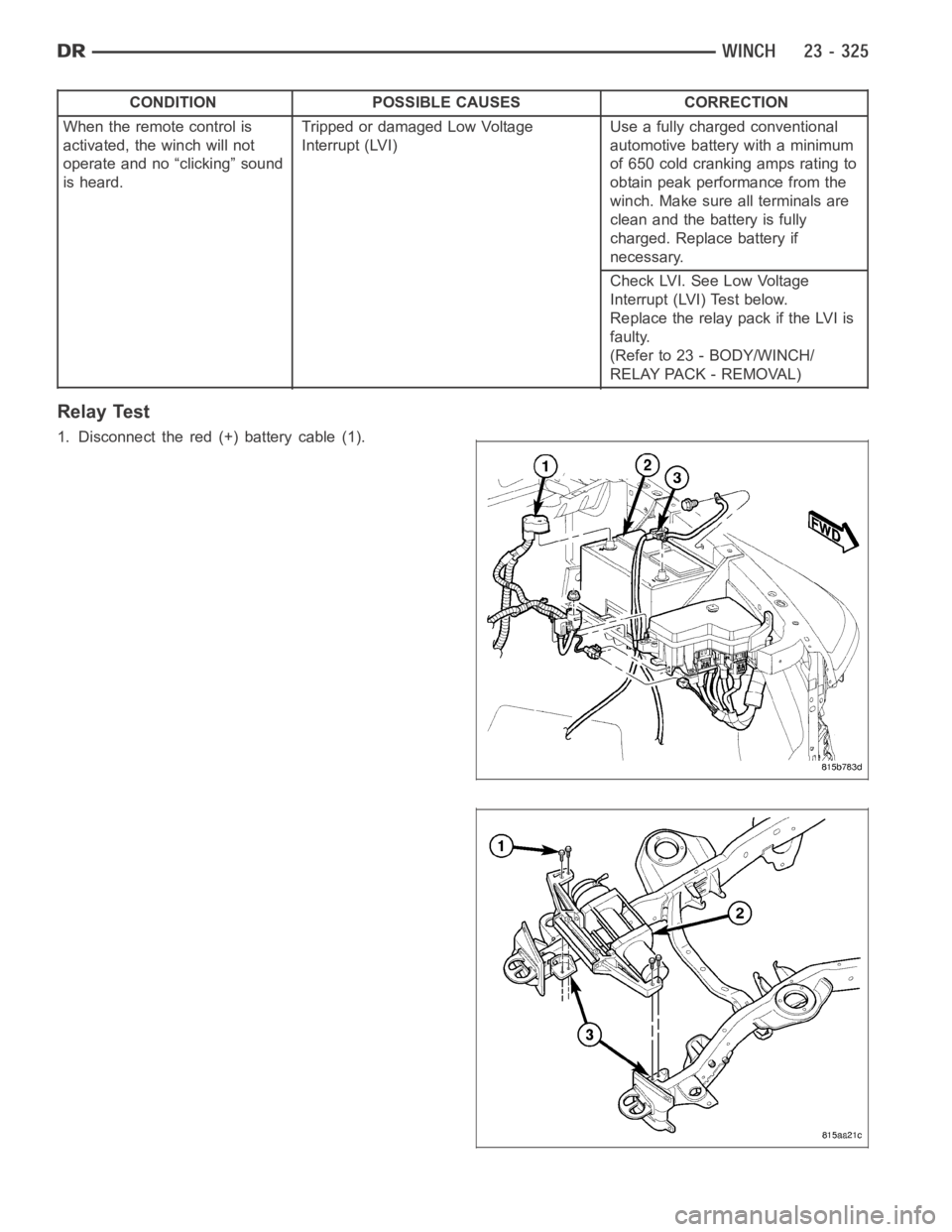
1. Disconnect the red (+) battery cable (1).
Page 4677 of 5267
MOTOR
DESCRIPTION
The winch is driven on one end by a two direction
electric motor powered by the vehicle electrical sys-
tem. The motor is internally protected by a thermal
switch that is activated when the motor gets too hot to
operate efficiently.
Winch motor controls consist of a relay pack mounted
to the motor, and a remote control connected to the
relay pack with a cord. The winch power source
cables are connected to the relay pack which in turn
feeds power to the winch motor through electrical
cable connections. The main function of the relay pack
is to allow the operator to switch the winch on and off
in both directions. The winch relay pack also includes
a Low Voltage Interrupt (LVI) used to prevent winch
operation in the event of battery power dropping below
10 volts.
REMOVAL
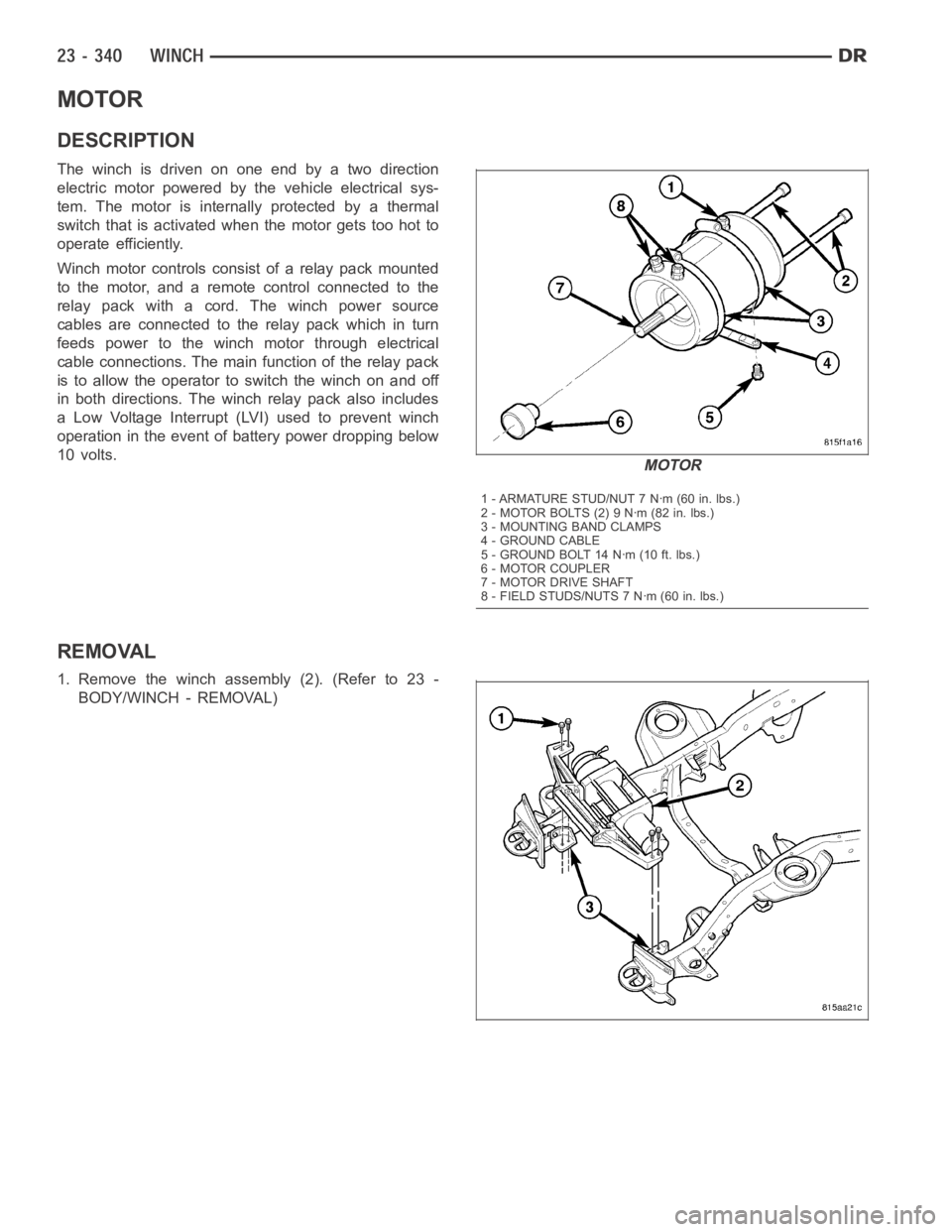
1. Remove the winch assembly (2). (Refer to 23 -
BODY/WINCH - REMOVAL)
MOTOR
1 - ARMATURE STUD/NUT 7 Nꞏm (60 in. lbs.)
2-MOTORBOLTS(2)9Nꞏm(82in.lbs.)
3 - MOUNTING BAND CLAMPS
4 - GROUND CABLE
5 - GROUND BOLT 14 Nꞏm (10 ft. lbs.)
6 - MOTOR COUPLER
7 - MOTOR DRIVE SHAFT
8 - FIELD STUDS/NUTS 7 Nꞏm (60 in. lbs.)
Page 4687 of 5267
RELAY PACK
DESCRIPTION
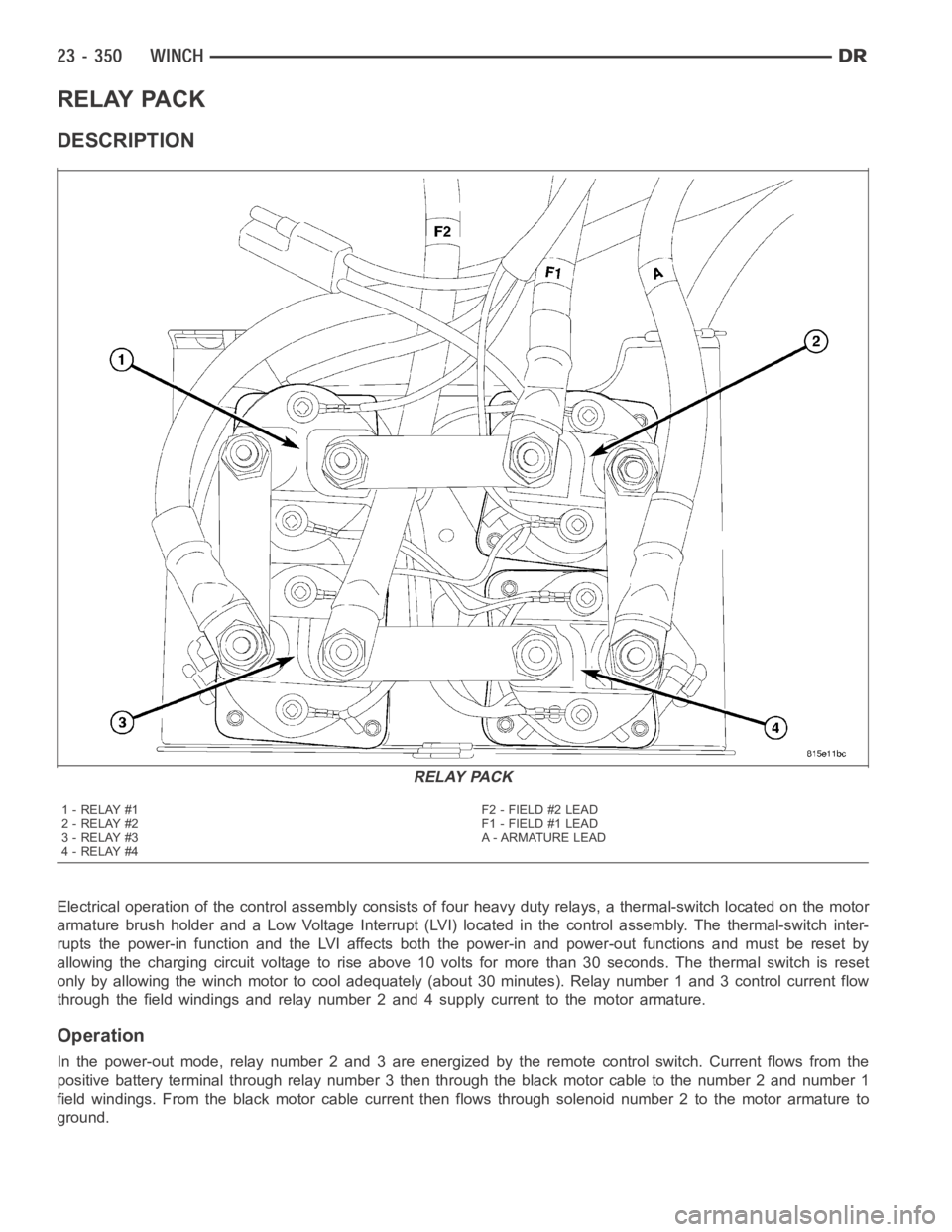
Electrical operation of the control assembly consists of four heavy duty relays, a thermal-switch located on the motor
armature brush holder and a Low Voltage Interrupt (LVI) located in the control assembly. The thermal-switch inter-
rupts the power-in function and the LVI affects both the power-in and power-out functions and must be reset by
allowing the charging circuit voltage to rise above 10 volts for more than 30 seconds. The thermal switch is reset
only by allowing the winch motor to cool adequately (about 30 minutes). Relay number 1 and 3 control current flow
through the field windings and relay number 2 and 4 supply current to the motor armature.
Operation
In the power-out mode, relay number 2 and 3 are energized by the remote control switch. Current flows from the
positive battery terminal through relay number 3 then through the black motor cable to the number 2 and number 1
field windings. From the black motor cable current then flows through solenoid number 2 to the motor armature to
ground.
RELAY PACK
1-RELAY#1
2-RELAY#2
3-RELAY#3
4-RELAY#4F2 - FIELD #2 LEAD
F1 - FIELD #1 LEAD
A - ARMATURE LEAD
Page 4693 of 5267
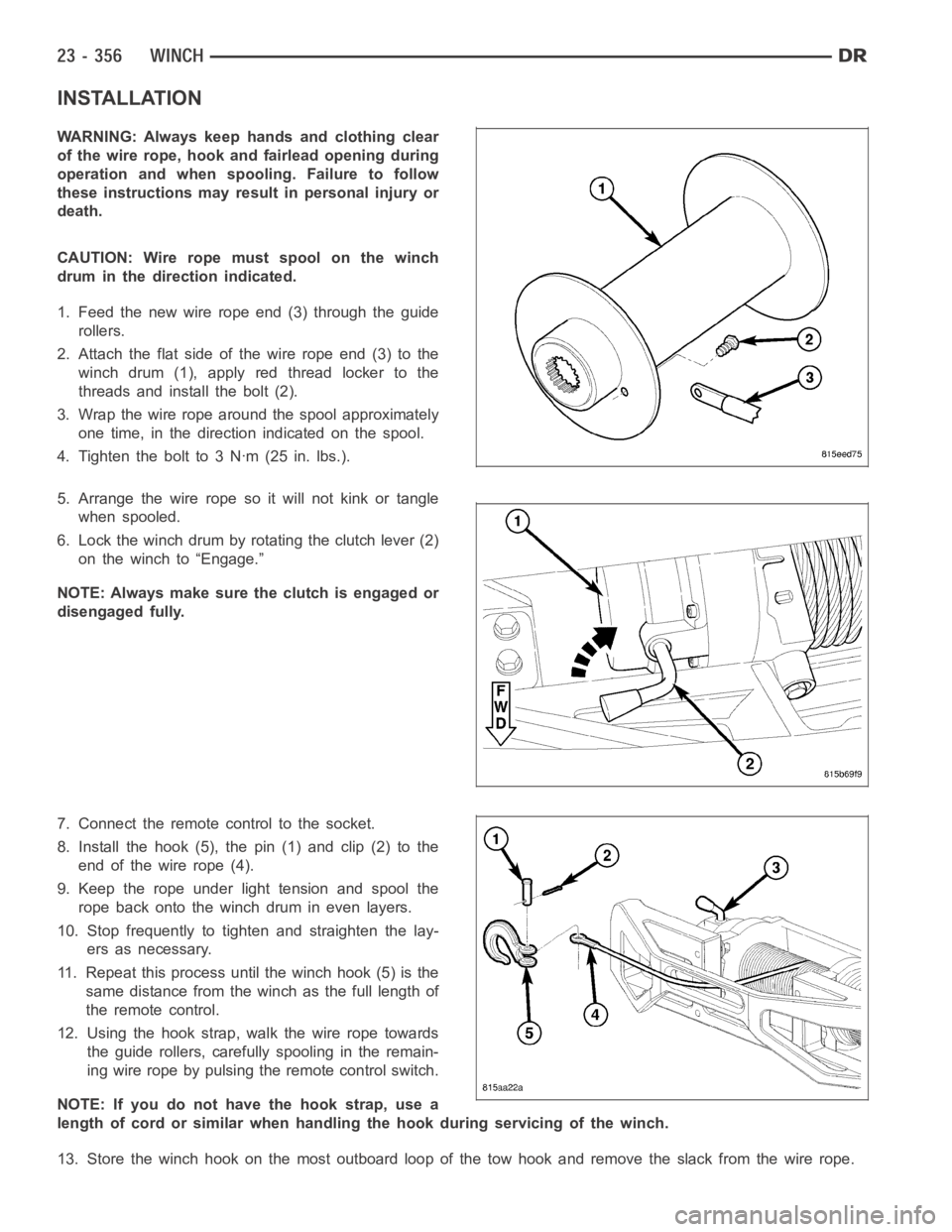
INSTALLATION
WARNING: Always keep hands and clothing clear
of the wire rope, hook and fairlead opening during
operation and when spooling. Failure to follow
these instructions may result in personal injury or
death.
CAUTION: Wire rope must spool on the winch
drum in the direction indicated.
1. Feed the new wire rope end (3) through the guide
rollers.
2. Attach the flat side of the wire rope end (3) to the
winch drum (1), apply red thread locker to the
threads and install the bolt (2).
3. Wrap the wire rope around the spool approximately
one time, in the direction indicated on the spool.
4. Tighten the bolt to 3 Nꞏm (25 in. lbs.).
5. Arrange the wire rope so it will not kink or tangle
when spooled.
6. Lock the winch drum by rotating the clutch lever (2)
on the winch to “Engage.”
NOTE: Always make sure the clutch is engaged or
disengaged fully.
7. Connect the remote control to the socket.
8. Install the hook (5), the pin (1) and clip (2) to the
end of the wire rope (4).
9. Keep the rope under light tension and spool the
rope back onto the winch drum in even layers.
10. Stop frequently to tighten and straighten the lay-
ers as necessary.
11. Repeat this process until the winch hook (5) is the
same distance from the winch as the full length of
theremotecontrol.
12. Using the hook strap, walk the wire rope towards
the guide rollers, carefully spooling in the remain-
ing wire rope by pulsing the remote control switch.
NOTE: If you do not have the hook strap, use a
length of cord or similar when handling the hook during servicing of the winch.
13. Store the winch hook on the most outboard loop of the tow hook and remove the slack from the wire rope.
Page:
< prev 1-8 9-16 17-24