2005 NISSAN NAVARA warning
[x] Cancel search: warningPage 1670 of 3171

GI-48
CONSULT-II CHECKING SYSTEM
Nickel Metal Hydride Battery Replacement
EAS001H4
CONSULT-II contains a nickel metal hydride battery. When replacing the battery obey the following:
WARNING:
Replace the nickel metal hydride battery with Genuine CONSULT-II battery only. Use of another bat-
tery may present a risk of fire or explosion. The battery may present a fire or chemical burn hazard if
mistreated. Do not recharge, disassemble or dispose of in fire.
Keep the battery out of reach of children and discard used battery conforming to the local regulations.
Page 1674 of 3171
GI-52
LIFTING POINT
LIFTING POINT
PFP:00000
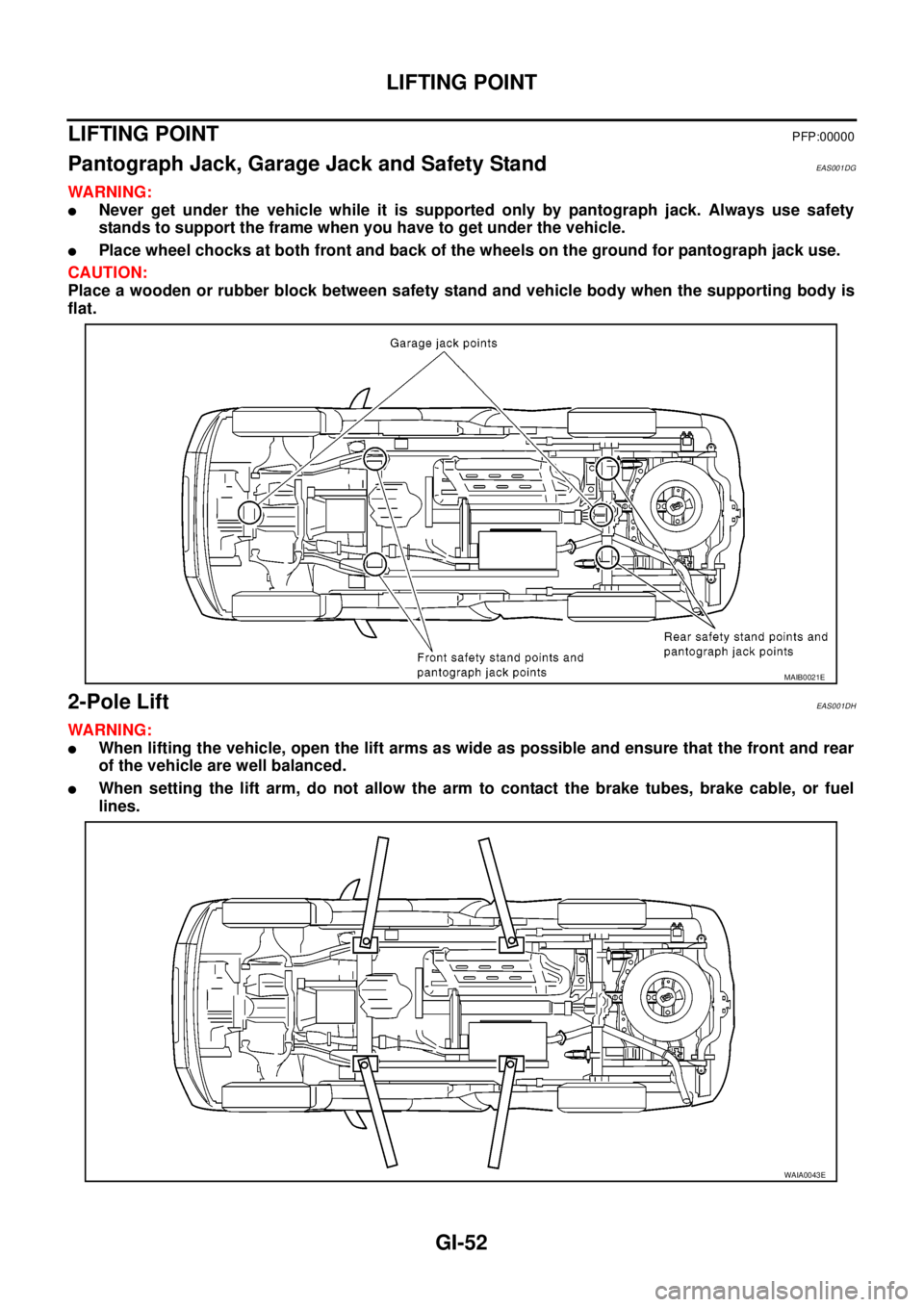
Pantograph Jack, Garage Jack and Safety StandEAS001DG
WARNING:
lNever get under the vehicle while it is supported only by pantograph jack. Always use safety
stands to support the frame when you have to get under the vehicle.
lPlace wheel chocks at both front and back of the wheels on the ground for pantograph jack use.
CAUTION:
Place a wooden or rubber block between safety stand and vehicle body when the supporting body is
flat.
2-Pole LiftEAS001DH
WARNING:
lWhen lifting the vehicle, open the lift arms as wide as possible and ensure that the front and rear
of the vehicle are well balanced.
lWhen setting the lift arm, do not allow the arm to contact the brake tubes, brake cable, or fuel
lines.
MAIB0021E
WAIA0043E
Page 1675 of 3171
TOW TRUCK TOWING
GI-53
C
D
E
F
G
H
I
J
K
L
MB
GI
TOW TRUCK TOWINGPFP:00000
To w Tr u c k To w i n gEAS001DI
WARNING:
lNever get under the vehicle while it is supported only by the jack. Always use safety stands to
support the frame when you have to get under the vehicle.
lPlace wheel chocks at both front and back of the wheels on the ground.
CAUTION:
lAll applicable local laws regarding the towing operation must be obeyed.
lIt is necessary to use proper towing equipment to avoid possible damage during towing opera-
tion. Towing is in accordance with Towing Procedure Manual at dealer.
lAlways attach safety chains before towing.
lWhen towing, make sure that the transmission, steering system and powertrain are in good order.
If any unit is damaged, dollies must be used.
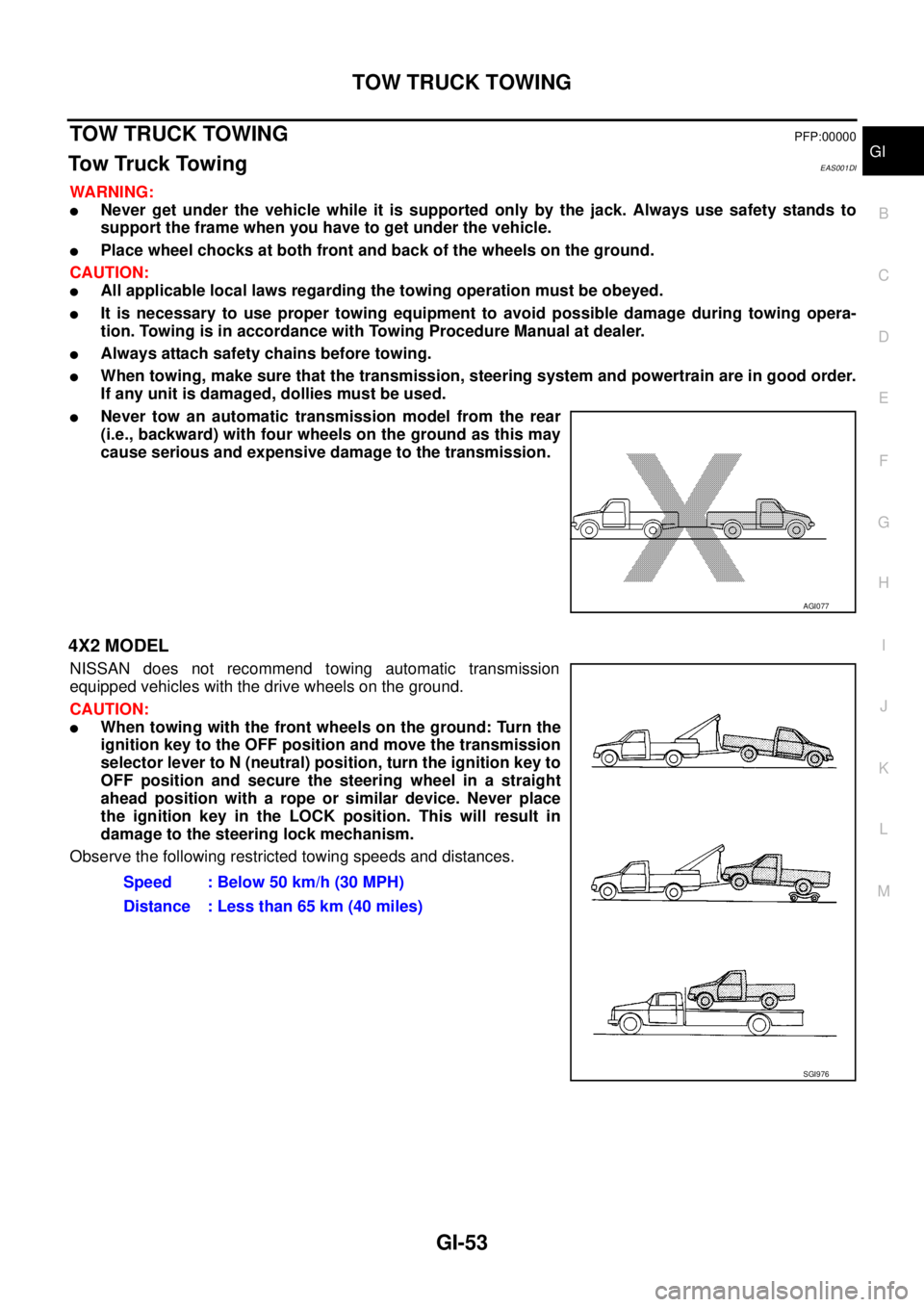
lNever tow an automatic transmission model from the rear
(i.e., backward) with four wheels on the ground as this may
cause serious and expensive damage to the transmission.
4X2 MODEL
NISSAN does not recommend towing automatic transmission
equipped vehicles with the drive wheels on the ground.
CAUTION:
lWhen towing with the front wheels on the ground: Turn the
ignition key to the OFF position and move the transmission
selector lever to N (neutral) position, turn the ignition key to
OFF position and secure the steering wheel in a straight
ahead position with a rope or similar device. Never place
the ignition key in the LOCK position. This will result in
damage to the steering lock mechanism.
Observe the following restricted towing speeds and distances.
AGI077
Speed : Below 50 km/h (30 MPH)
Distance : Less than 65 km (40 miles)
SGI976
Page 1689 of 3171
PRECAUTIONS
GW-3
C
D
E
F
G
H
J
K
L
MA
B
GW
PRECAUTIONSPFP:00001
Precautions for Supplemental Restraint System (SRS) “AIR BAG” and “SEAT
BELT PRE-TENSIONER”
EIS00CED
The Supplemental Restraint System such as “AIR BAG” and “SEAT BELT PRE-TENSIONER”, used along
with a front seat belt, helps to reduce the risk or severity of injury to the driver and front passenger for certain
types of collision. Information necessary to service the system safely is included in the SRS and SB section of
this Service Manual.
WARNING:
lTo avoid rendering the SRS inoperative, which could increase the risk of personal injury or death
in the event of a collision which would result in air bag inflation, all maintenance must be per-
formed by an authorized NISSAN/INFINITI dealer.
lImproper maintenance, including incorrect removal and installation of the SRS, can lead to per-
sonal injury caused by unintentional activation of the system. For removal of Spiral Cable and Air
Bag Module, see the SRS section.
lDo not use electrical test equipment on any circuit related to the SRS unless instructed to in this
Service Manual. SRS wiring harnesses can be identified by yellow and/or orange harnesses or
harness connectors.
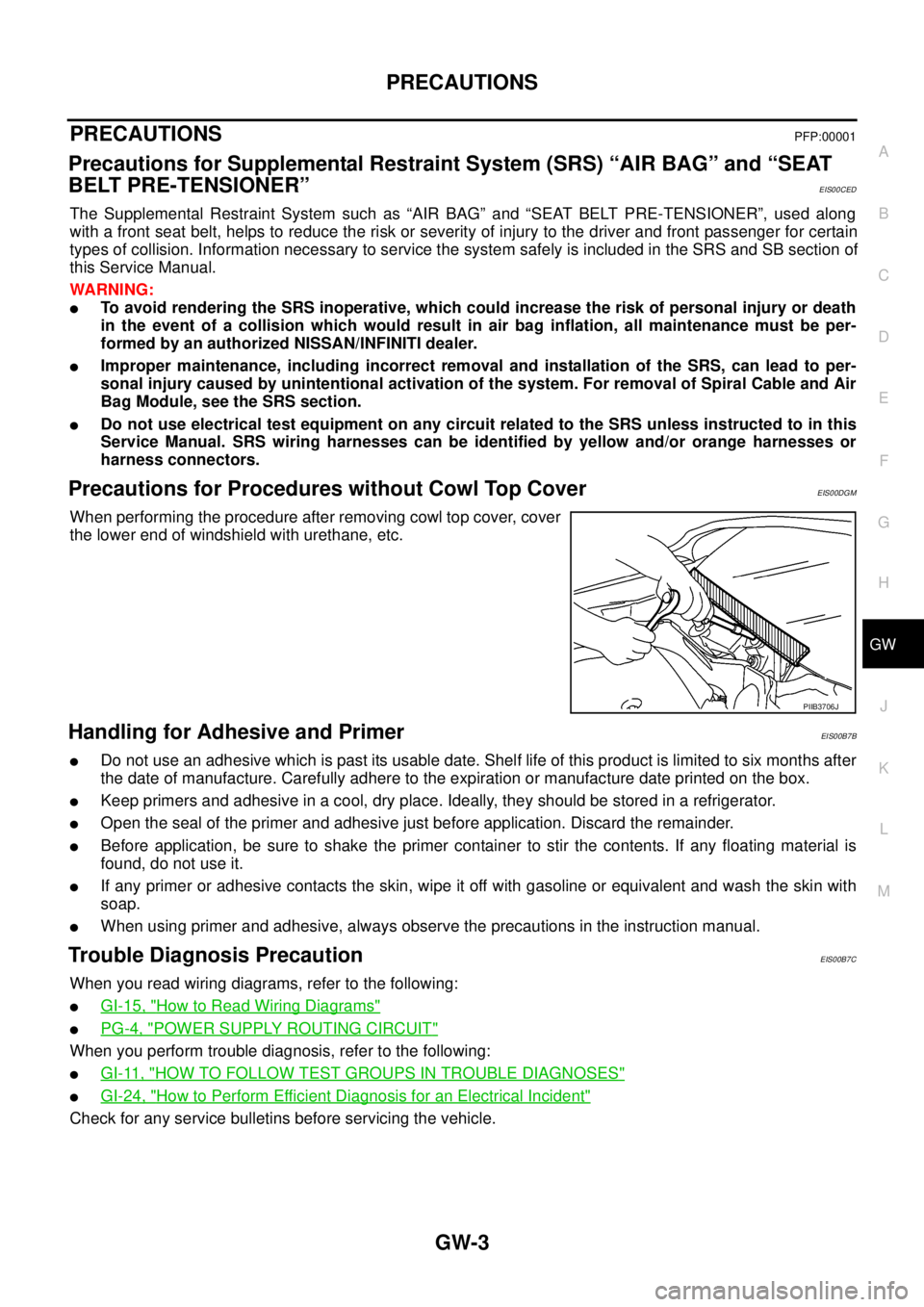
Precautions for Procedures without Cowl Top CoverEIS00DGM
When performing the procedure after removing cowl top cover, cover
the lower end of windshield with urethane, etc.
Handling for Adhesive and PrimerEIS00B7B
lDo not use an adhesive which is past its usable date. Shelf life of this product is limited to six months after
the date of manufacture. Carefully adhere to the expiration or manufacture date printed on the box.
lKeep primers and adhesive in a cool, dry place. Ideally, they should be stored in a refrigerator.
lOpen the seal of the primer and adhesive just before application. Discard the remainder.
lBefore application, be sure to shake the primer container to stir the contents. If any floating material is
found, do not use it.
lIf any primer or adhesive contacts the skin, wipe it off with gasoline or equivalent and wash the skin with
soap.
lWhen using primer and adhesive, always observe the precautions in the instruction manual.
Trouble Diagnosis PrecautionEIS00B7C
When you read wiring diagrams, refer to the following:
lGI-15, "How to Read Wiring Diagrams"
lPG-4, "POWER SUPPLY ROUTING CIRCUIT"
When you perform trouble diagnosis, refer to the following:
lGI-11, "HOW TO FOLLOW TEST GROUPS IN TROUBLE DIAGNOSES"
lGI-24, "How to Perform Efficient Diagnosis for an Electrical Incident"
Check for any service bulletins before servicing the vehicle.
PIIB3706J
Page 1697 of 3171
WINDSHIELD GLASS
GW-11
C
D
E
F
G
H
J
K
L
MA
B
GW
WINDSHIELD GLASSPFP:72712
Removal and InstallationEIS00B7I
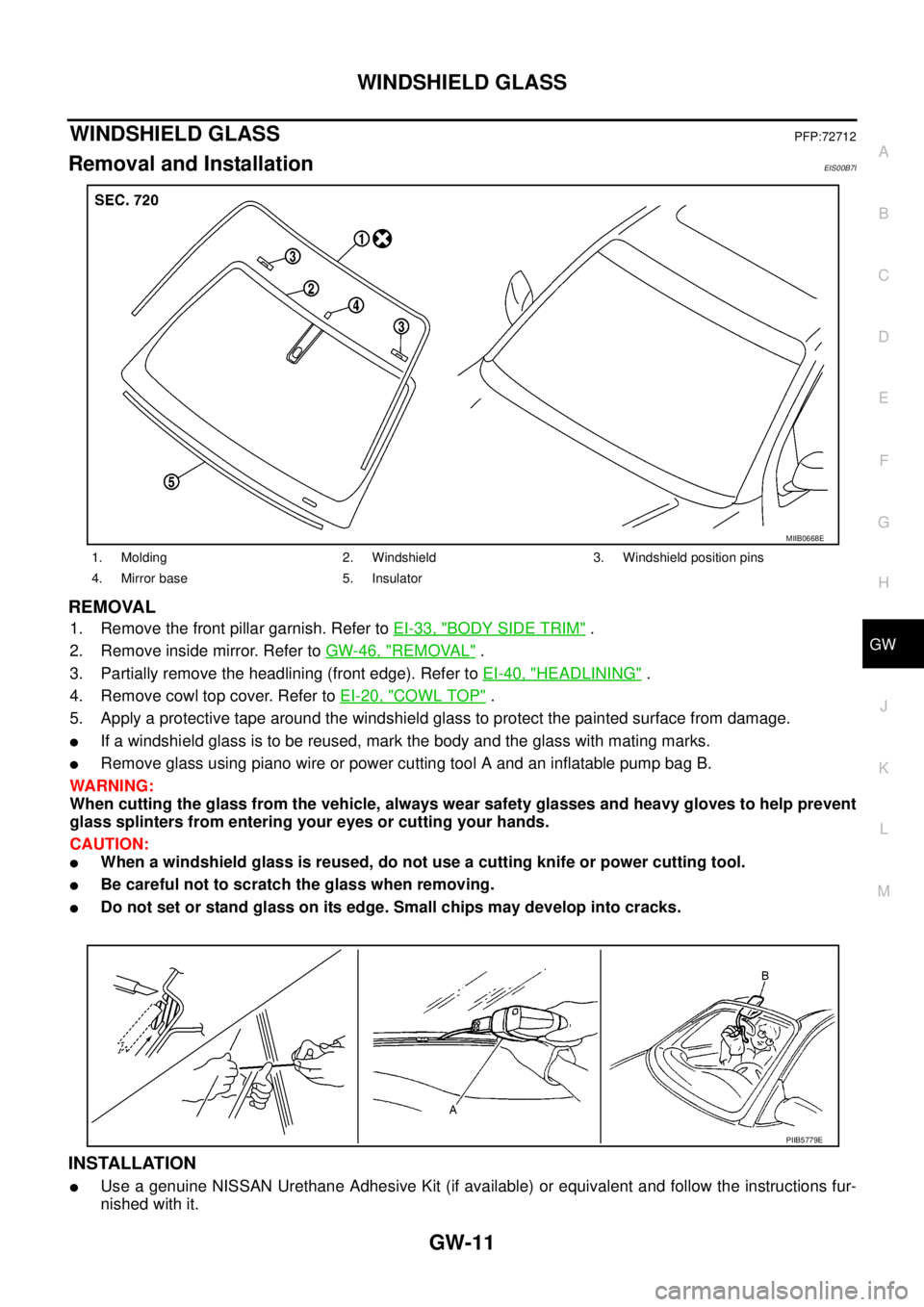
REMOVAL
1. Remove the front pillar garnish. Refer toEI-33, "BODY SIDE TRIM".
2. Remove inside mirror. Refer toGW-46, "
REMOVAL".
3. Partially remove the headlining (front edge). Refer toEI-40, "
HEADLINING".
4. Remove cowl top cover. Refer toEI-20, "
COWL TOP".
5. Apply a protective tape around the windshield glass to protect the painted surface from damage.
lIf a windshield glass is to be reused, mark the body and the glass with mating marks.
lRemove glass using piano wire or power cutting tool A and an inflatable pump bag B.
WARNING:
When cutting the glass from the vehicle, always wear safety glasses and heavy gloves to help prevent
glass splinters from entering your eyes or cutting your hands.
CAUTION:
lWhen a windshield glass is reused, do not use a cutting knife or power cutting tool.
lBe careful not to scratch the glass when removing.
lDo not set or stand glass on its edge. Small chips may develop into cracks.
INSTALLATION
lUse a genuine NISSAN Urethane Adhesive Kit (if available) or equivalent and follow the instructions fur-
nished with it.
1. Molding 2. Windshield 3. Windshield position pins
4. Mirror base 5. Insulator
MIIB0668E
PIIB5779E
Page 1698 of 3171

GW-12
WINDSHIELD GLASS
lWhile the urethane adhesive is curing, open a door window. This will prevent the glass from being forced
out by passenger compartment air pressure when a door is closed.
lThe molding must be installed securely so that it is in position and leaves no gap.
lInform the customer that the vehicle should remain stationary until the urethane adhesive has completely
cured (preferably 24 hours). Curing time varies with temperature and humidity.
lInstall parts removed.
WARNING:
lKeep heat and open flames away as primers and adhesive are flammable.
lThe materials contained in the kit are harmful if swallowed, and may irritate skin and eyes. Avoid
contact with the skin and eyes.
lUse in an open, well ventilated location. Avoid breathing the vapors. They can be harmful if
inhaled. If affected by vapor inhalation, immediately move to an area with fresh air.
lDriving the vehicle before the urethane adhesive has completely cured may affect the perfor-
mance of the windshield in case of an accident.
CAUTION:
lDo not use an adhesive which is past its usable term. Shelf life of this product is limited to six
months after the date of manufacture. Carefully adhere to the expiration or manufacture date
printed on the box.
lKeep primers and adhesive in a cool, dry place. Ideally, they should be stored in a refrigerator.
lDo not leave primers or adhesive cartridge unattended with their caps open or off.
lThe vehicle should not be driven for at least 24 hours or until the urethane adhesive has com-
pletely cured. Curing time varies depending on temperature and humidities. The curing time will
increase under lower temperatures and lower humidities.
Page 1727 of 3171
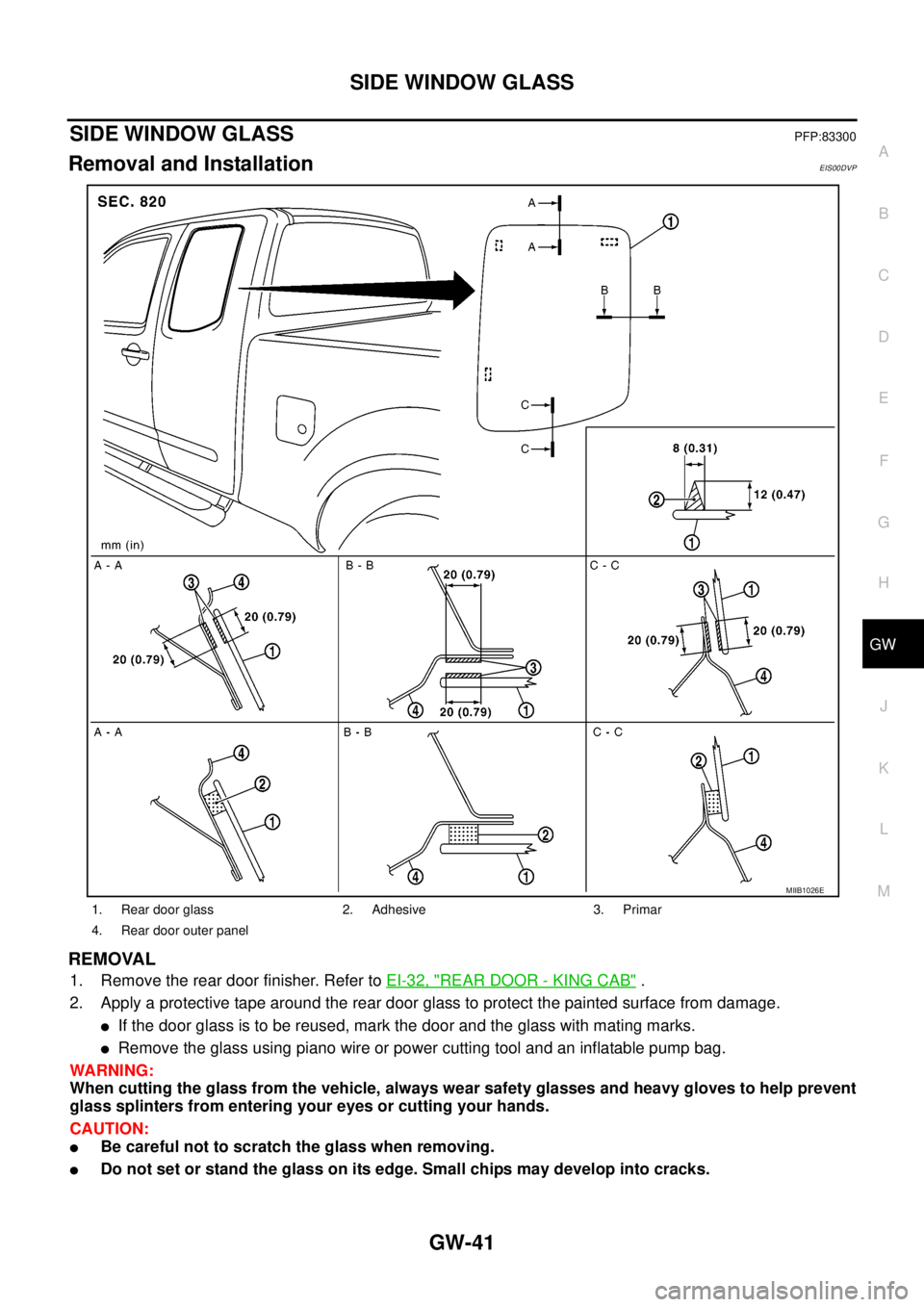
SIDE WINDOW GLASS
GW-41
C
D
E
F
G
H
J
K
L
MA
B
GW
SIDE WINDOW GLASSPFP:83300
Removal and InstallationEIS00DVP
REMOVAL
1. Remove the rear door finisher. Refer toEI-32, "REAR DOOR - KING CAB".
2. Apply a protective tape around the rear door glass to protect the painted surface from damage.
lIf the door glass is to be reused, mark the door and the glass with mating marks.
lRemove the glass using piano wire or power cutting tool and an inflatable pump bag.
WARNING:
When cutting the glass from the vehicle, always wear safety glasses and heavy gloves to help prevent
glass splinters from entering your eyes or cutting your hands.
CAUTION:
lBe careful not to scratch the glass when removing.
lDo not set or stand the glass on its edge. Small chips may develop into cracks.
1. Rear door glass 2. Adhesive 3. Primar
4. Rear door outer panel
MIIB1026E
Page 1728 of 3171

GW-42
SIDE WINDOW GLASS
INSTALLATION
lUse a genuine NISSAN Urethane Adhesive Kit (if available) or equivalent and follow the instructions fur-
nished with it.
lWhile the urethane adhesive is curing, open a door window. This will prevent the glass from being forced
out by passenger compartment air pressure when a door is closed.
lCheck gap along bottom to confirm that glass does not contact sheet metal.
lInform the customer that the vehicle should remain stationary until the urethane adhesive has completely
cured (preferably 24 hours). Curing time varies with temperature and humidity.
lInstall parts removed.
WARNING:
lKeep heat and open flames away as primers and adhesive are flammable.
lThe materials contained in the kit are harmful if swallowed, and may irritate skin and eyes. Avoid
contact with the skin and eyes.
lUse in an open, well ventilated location. Avoid breathing the vapors. They can be harmful if
inhaled. If affected by vapor inhalation, immediately move to an area with fresh air.
lDriving the vehicle before the urethane adhesive has completely cured may affect the perfor-
mance of the glass in case of an accident.
CAUTION:
lDo not use an adhesive which is past its usable term. Shelf life of this product is limited to six
months after the date of manufacture. Carefully adhere to the expiration or manufacture date
printed on the box.
lKeep primers and adhesive in a cool, dry place. Ideally, they should be stored in a refrigerator.
lDo not leave primers or adhesive cartridge unattended with their caps open or off.
lThe vehicle should not be driven for at least 24 hours or until the urethane adhesive has com-
pletely cured. Curing time varies depending on temperature and humidity. The curing time will
increase under lower temperatures and lower humidities.
Repairing Water Leaks for Rear Door Glass
Leaks can be repaired without removing or reinstalling glass.
If water is leaking between urethane adhesive material and body or glass, determine the extent of leakage.
This can be done by applying water to the rear door area while pushing glass outward.
To stop leak, apply primer (if necessary) and then urethane adhesive to the leak point.