Page 1403 of 3171
INTAKE MANIFOLD
EM-21
C
D
E
F
G
H
I
J
K
L
MA
EM
lRefer toGI-10, "Components"for symbol marks except in the above.
Removal and InstallationEBS01EJF
REMOVAL
WARNING:
To avoid the danger of being scalded, do not drain engine coolant when engine is hot.
1. Drain engine coolant. Refer toCO-7, "
Changing Engine Coolant".
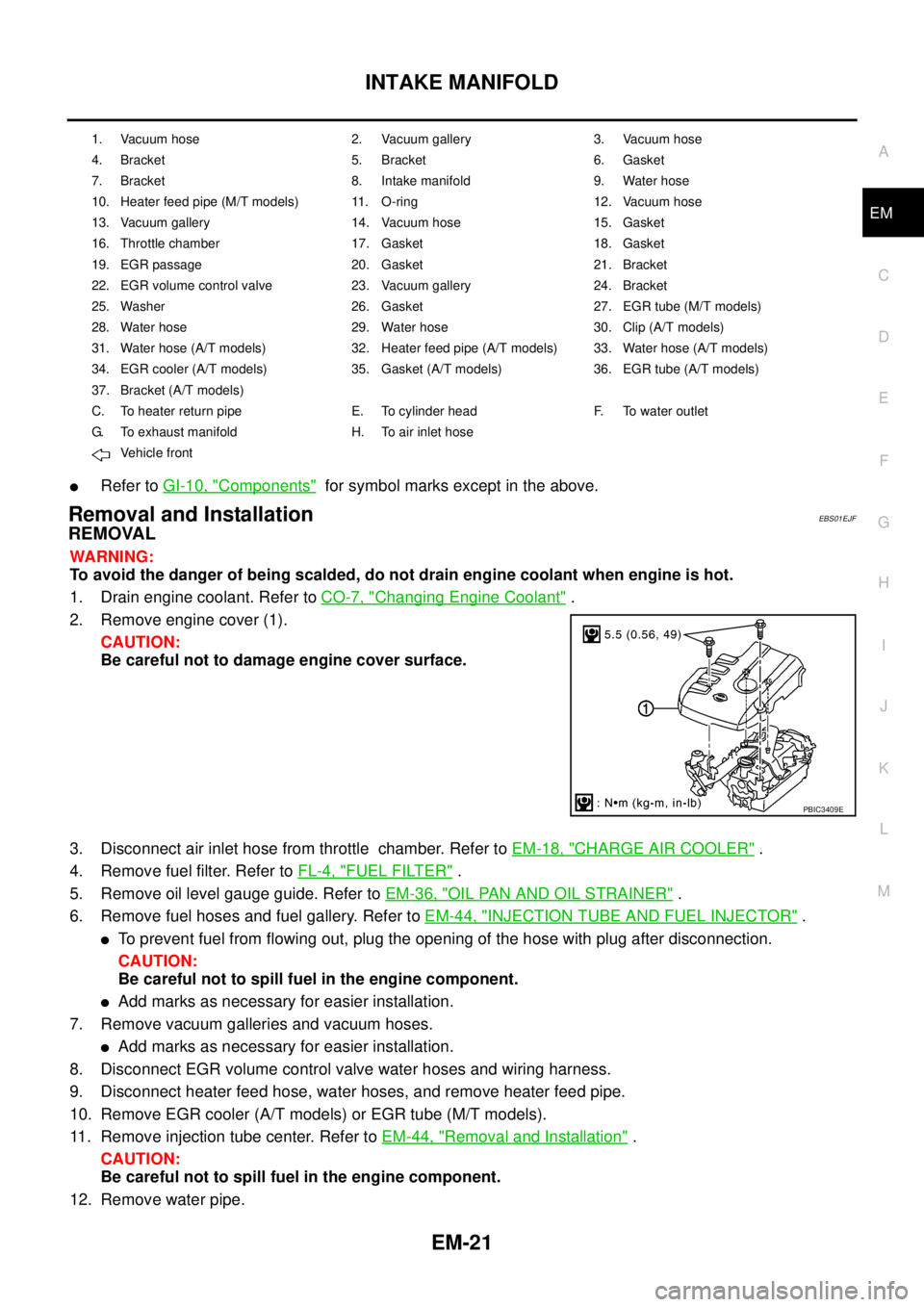
2. Remove engine cover (1).
CAUTION:
Be careful not to damage engine cover surface.
3. Disconnect air inlet hose from throttle chamber. Refer toEM-18, "
CHARGE AIR COOLER".
4. Remove fuel filter. Refer toFL-4, "
FUEL FILTER".
5. Remove oil level gauge guide. Refer toEM-36, "
OIL PAN AND OIL STRAINER".
6. Remove fuel hoses and fuel gallery. Refer toEM-44, "
INJECTION TUBE AND FUEL INJECTOR".
lTo prevent fuel from flowing out, plug the opening of the hose with plug after disconnection.
CAUTION:
Be careful not to spill fuel in the engine component.
lAdd marks as necessary for easier installation.
7. Remove vacuum galleries and vacuum hoses.
lAdd marks as necessary for easier installation.
8. Disconnect EGR volume control valve water hoses and wiring harness.
9. Disconnect heater feed hose, water hoses, and remove heater feed pipe.
10. Remove EGR cooler (A/T models) or EGR tube (M/T models).
11. Remove injection tube center. Refer toEM-44, "
Removal and Installation".
CAUTION:
Be careful not to spill fuel in the engine component.
12. Remove water pipe.
1. Vacuum hose 2. Vacuum gallery 3. Vacuum hose
4. Bracket 5. Bracket 6. Gasket
7. Bracket 8. Intake manifold 9. Water hose
10. Heater feed pipe (M/T models) 11. O-ring 12. Vacuum hose
13. Vacuum gallery 14. Vacuum hose 15. Gasket
16. Throttle chamber 17. Gasket 18. Gasket
19. EGR passage 20. Gasket 21. Bracket
22. EGR volume control valve 23. Vacuum gallery 24. Bracket
25. Washer 26. Gasket 27. EGR tube (M/T models)
28. Water hose 29. Water hose 30. Clip (A/T models)
31. Water hose (A/T models) 32. Heater feed pipe (A/T models) 33. Water hose (A/T models)
34. EGR cooler (A/T models) 35. Gasket (A/T models) 36. EGR tube (A/T models)
37. Bracket (A/T models)
C. To heater return pipe E. To cylinder head F. To water outlet
G. To exhaust manifold H. To air inlet hose
Vehicle front
PBIC3409E
Page 1418 of 3171
EM-36
OIL PAN AND OIL STRAINER
OIL PAN AND OIL STRAINER
P F P : 1111 0
ComponentsEBS01EJK
lRefer toGI-10, "Components"for symbol marks in the figure.
Removal and InstallationEBS01E5Z
REMOVAL
WARNING:
To avoid the danger of being scalded, do not drain engine oil when engine is hot.
1. Remove engine undercover front and engine undercover middle. Refer toEI-17, "
REAR BUMPER".
2. Drain engine oil. Refer toLU-6, "
Changing Engine Oil".
1. Oil level gauge 2. Oil level gauge guide 3. Oil level sensor
4. O-ring 5. O-ring 6. O-ring
7. Oil pan upper 8. Crankshaft position sensor 9. O-ring
10. Rear plate 11. Rear plate cover 12. Oil strainer
13. Oil pan drain plug 14. Drain plug washer 15. Oil pan lower
PBIC3424E
Page 1484 of 3171
EM-102
CYLINDER HEAD
lIf it exceeds the limit, replace valve and/or valve guide.
Valve Guide Replacement
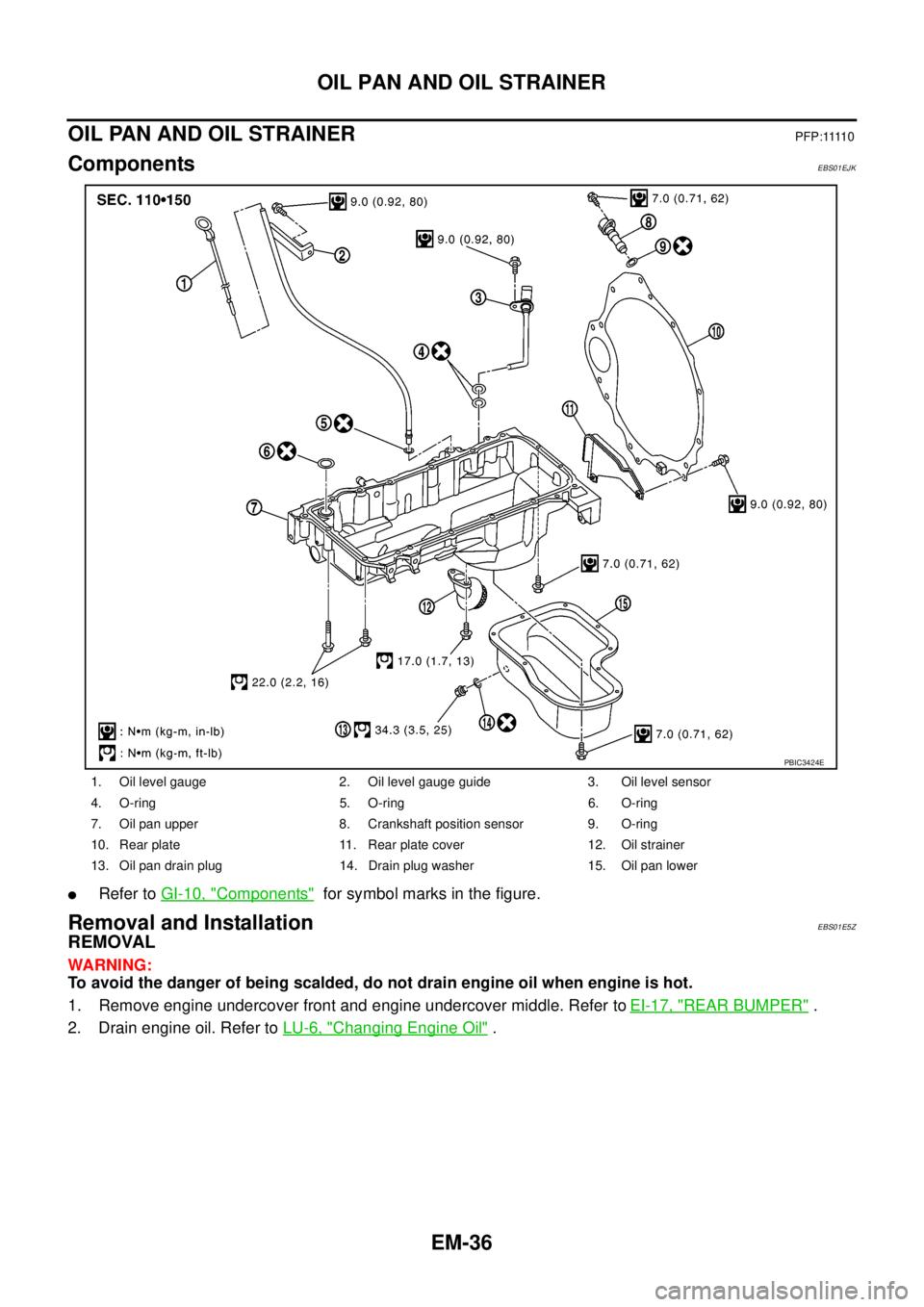
When removing valve guide, replace it with oversized [0.2 mm (0.0008 in)] valve guide.
1. Heat cylinder head to 110 to 130°C(230to266°F) in oil bath.
2. Using the valve guide drift (commercial service tool), tap valve
guides out from the combustion chamber side.
WARNING:
Cylinder head contains heat, when working, wear protective
equipment to avoid getting burned.
3. Ream cylinder head valve guide hole with the valve guide
reamer (commercial service tool).
4. Heat cylinder head to 110 to 130°C(230to266°F) in oil bath.
SEM008A
SEM931C
Valve guide hole diameter (for service parts):
10.175 - 10.196 mm (0.4006 - 0.4014 in)
SEM932C
SEM008A
Page 1485 of 3171
CYLINDER HEAD
EM-103
C
D
E
F
G
H
I
J
K
L
MA
EM
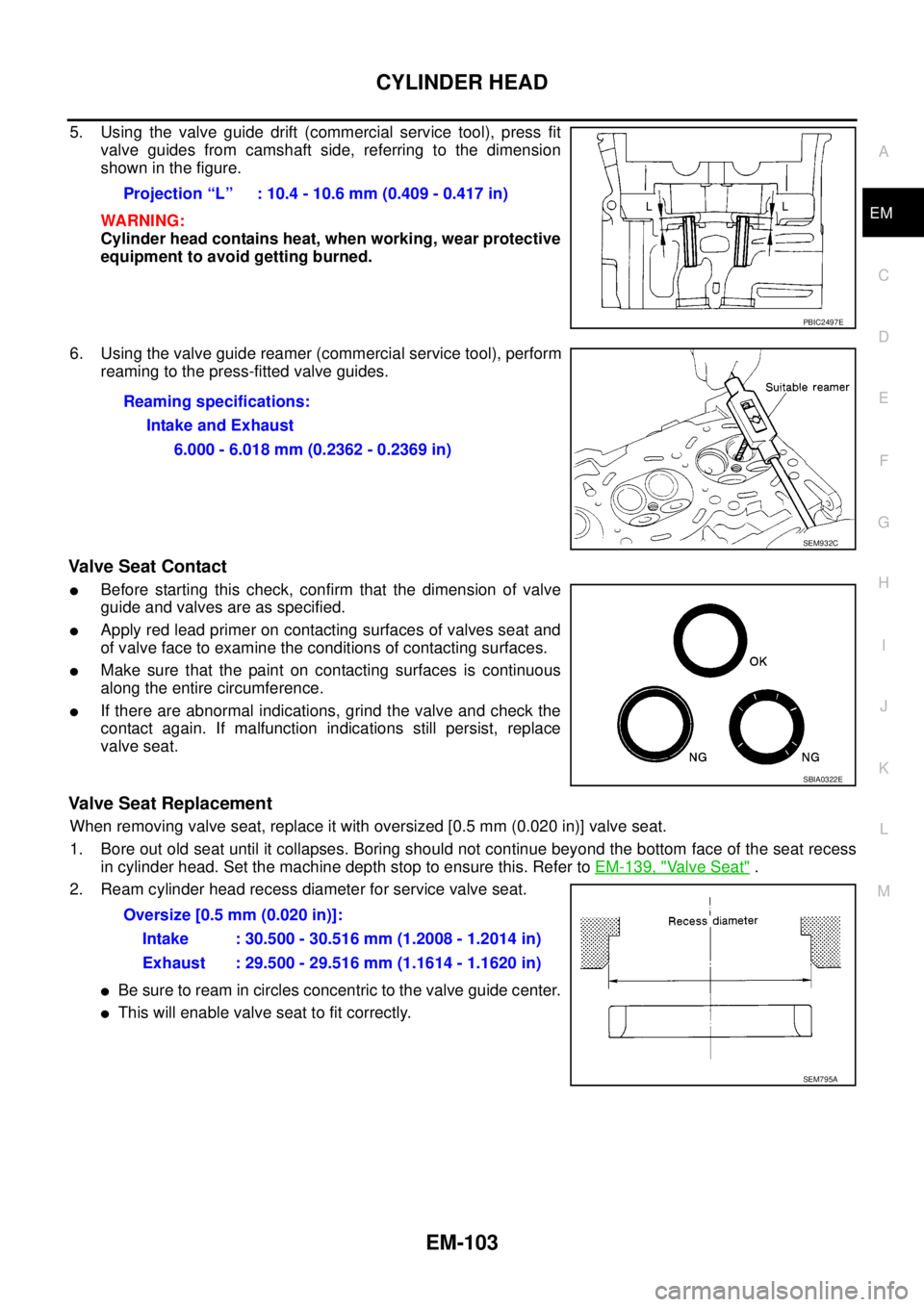
5. Using the valve guide drift (commercial service tool), press fit
valve guides from camshaft side, referring to the dimension
showninthefigure.
WARNING:
Cylinder head contains heat, when working, wear protective
equipment to avoid getting burned.
6. Using the valve guide reamer (commercial service tool), perform
reaming to the press-fitted valve guides.
Valve Seat Contact
lBefore starting this check, confirm that the dimension of valve
guide and valves are as specified.
lApply red lead primer on contacting surfaces of valves seat and
of valve face to examine the conditions of contacting surfaces.
lMake sure that the paint on contacting surfaces is continuous
along the entire circumference.
lIf there are abnormal indications, grind the valve and check the
contact again. If malfunction indications still persist, replace
valve seat.
Valve Seat Replacement
When removing valve seat, replace it with oversized [0.5 mm (0.020 in)] valve seat.
1. Bore out old seat until it collapses. Boring should not continue beyond the bottom face of the seat recess
in cylinder head. Set the machine depth stop to ensure this. Refer toEM-139, "
Valve Seat".
2. Ream cylinder head recess diameter for service valve seat.
lBe sure to ream in circles concentric to the valve guide center.
lThis will enable valve seat to fit correctly.Projection “L” : 10.4 - 10.6 mm (0.409 - 0.417 in)
PBIC2497E
Reaming specifications:
Intake and Exhaust
6.000 - 6.018 mm (0.2362 - 0.2369 in)
SEM932C
SBIA0322E
Oversize [0.5 mm (0.020 in)]:
Intake : 30.500 - 30.516 mm (1.2008 - 1.2014 in)
Exhaust : 29.500 - 29.516 mm (1.1614 - 1.1620 in)
SEM795A
Page 1486 of 3171
EM-104
CYLINDER HEAD
3. Heat cylinder head to approximately 110 to 130°C(230to
266°F) in oil bath.
4. After cooling valve seats sufficiently with dry ice, press fit it to
cylinder head.
WARNING:
Cylinder head contains heat, when working, wear protective
equipment to avoid getting burned.
CAUTION:
Do not touch the cooled valve seats directly by hand.
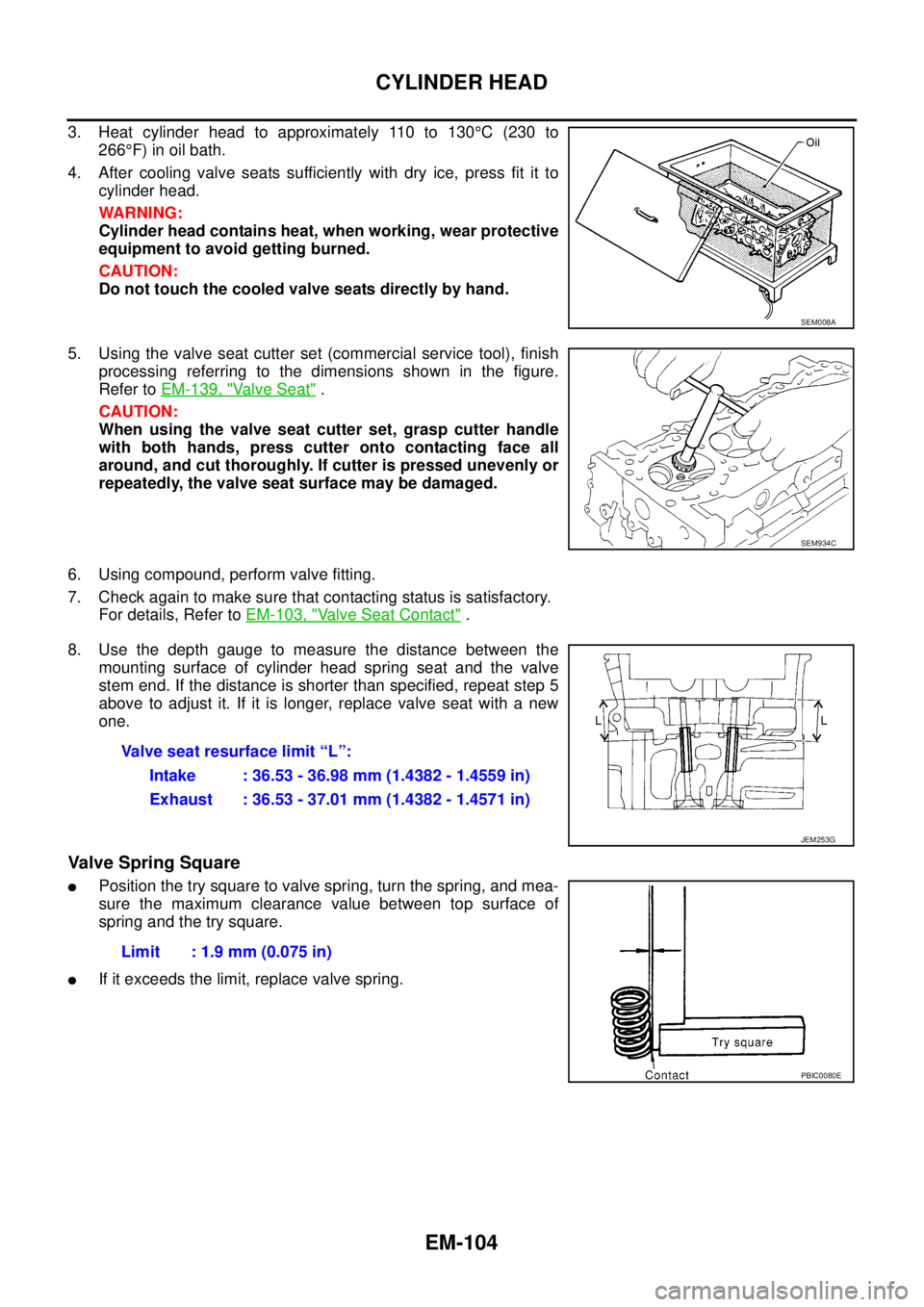
5. Using the valve seat cutter set (commercial service tool), finish
processing referring to the dimensions shown in the figure.
Refer toEM-139, "
Va l v e S e a t".
CAUTION:
When using the valve seat cutter set, grasp cutter handle
with both hands, press cutter onto contacting face all
around, and cut thoroughly. If cutter is pressed unevenly or
repeatedly, the valve seat surface may be damaged.
6. Using compound, perform valve fitting.
7. Check again to make sure that contacting status is satisfactory.
For details, Refer toEM-103, "
Valve Seat Contact".
8. Use the depth gauge to measure the distance between the
mounting surface of cylinder head spring seat and the valve
stem end. If the distance is shorter than specified, repeat step 5
above to adjust it. If it is longer, replace valve seat with a new
one.
Valve Spring Square
lPosition the try square to valve spring, turn the spring, and mea-
sure the maximum clearance value between top surface of
spring and the try square.
lIf it exceeds the limit, replace valve spring.
SEM008A
SEM934C
Valve seat resurface limit “L”:
Intake : 36.53 - 36.98 mm (1.4382 - 1.4559 in)
Exhaust : 36.53 - 37.01 mm (1.4382 - 1.4571 in)
JEM253G
Limit : 1.9 mm (0.075 in)
PBIC0080E
Page 1488 of 3171
EM-106
ENGINE ASSEMBLY
ENGINE ASSEMBLY
PFP:10001
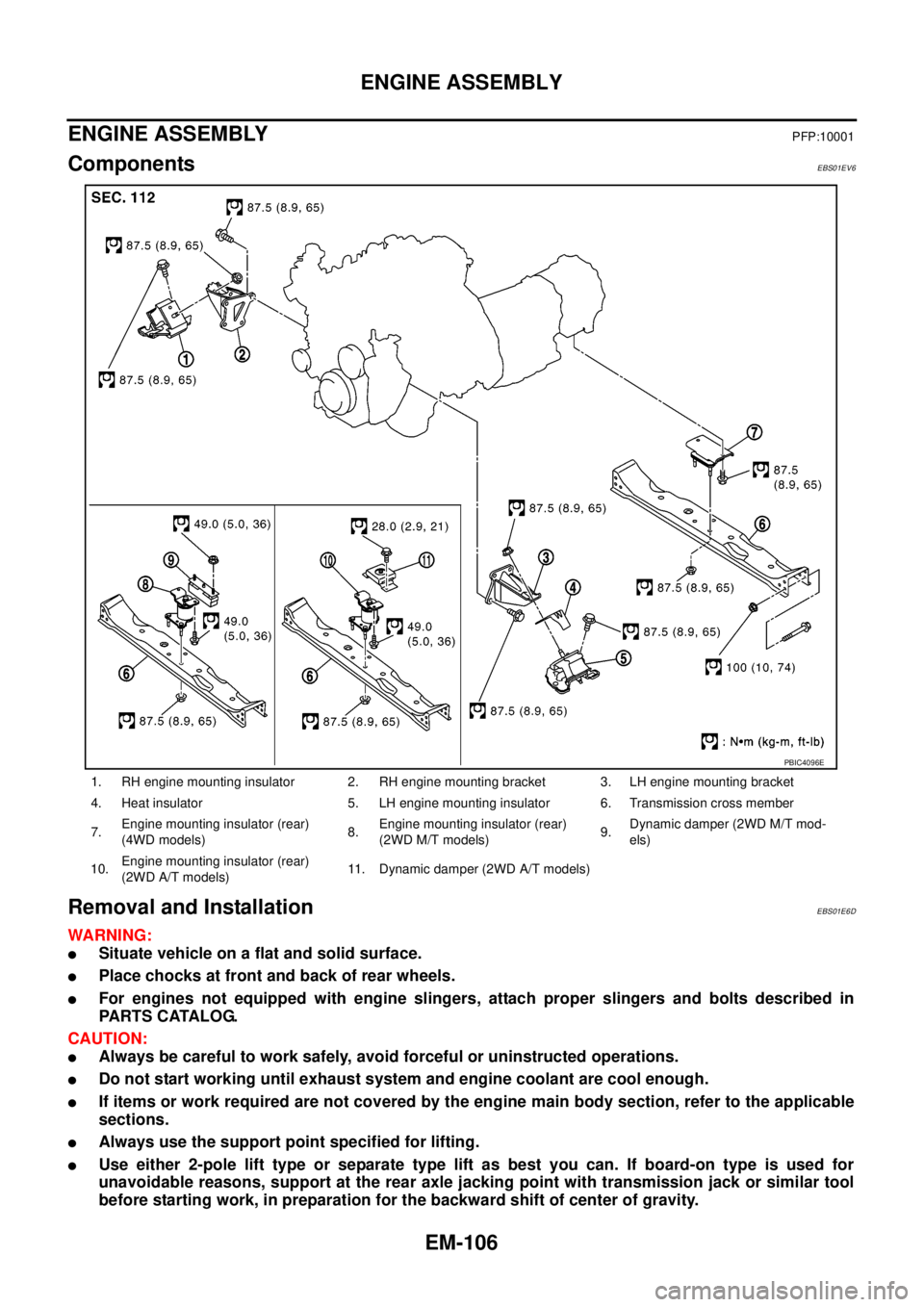
ComponentsEBS01EV6
Removal and InstallationEBS01E6D
WARNING:
lSituate vehicle on a flat and solid surface.
lPlace chocks at front and back of rear wheels.
lFor engines not equipped with engine slingers, attach proper slingers and bolts described in
PARTS CATALOG.
CAUTION:
lAlways be careful to work safely, avoid forceful or uninstructed operations.
lDo not start working until exhaust system and engine coolant are cool enough.
lIf items or work required are not covered by the engine main body section, refer to the applicable
sections.
lAlways use the support point specified for lifting.
lUse either 2-pole lift type or separate type lift as best you can. If board-on type is used for
unavoidable reasons, support at the rear axle jacking point with transmission jack or similar tool
before starting work, in preparation for the backward shift of center of gravity.
1. RH engine mounting insulator 2. RH engine mounting bracket 3. LH engine mounting bracket
4. Heat insulator 5. LH engine mounting insulator 6. Transmission cross member
7.Engine mounting insulator (rear)
(4WD models)8.Engine mounting insulator (rear)
(2WD M/T models)9.Dynamic damper (2WD M/T mod-
els)
10.Engine mounting insulator (rear)
(2WD A/T models)11. Dynamic damper (2WD A/T models)
PBIC4096E
Page 1587 of 3171
FUEL SYSTEM
FL-3
C
D
E
F
G
H
I
J
K
L
MA
FL
FUEL SYSTEMPFP:17503
Checking Fuel LinesEBS01E71
Inspect fuel lines, fuel filler cap and fuel tank for improper attach-
ment, leaks, cracks, damage, loose connections, chafing or deterio-
ration.
If necessary, repair or replace damaged parts.
General PrecautionsEBS01E72
WARNING:
When replacing fuel line parts, be sure to observe the following.
lPut a “CAUTION: INFLAMMABLE” sign in workshop.
lBe sure to work in a well-ventilated area and furnish workshop with a CO2fire extinguisher.
lDo not smoke while servicing fuel system. Keep open flames and spark away from work area.
CAUTION:
lUse diesel fuel required by the regulations for cetane number. Refer toGI-6, "DIESEL ENGINE".
lBefore removing fuel line parts, perform the following procedures:
–Put drained fuel in an explosion-proof container and put the lid on securely. Keep the container in
safe area.
–Disconnect the battery cable from the negative terminal.
lAlways replace O-ring and clamps with new ones.
lDo not kink or twist tubes when they are being installed.
lDo not tighten hose clamps excessively to avoid damaging hoses.
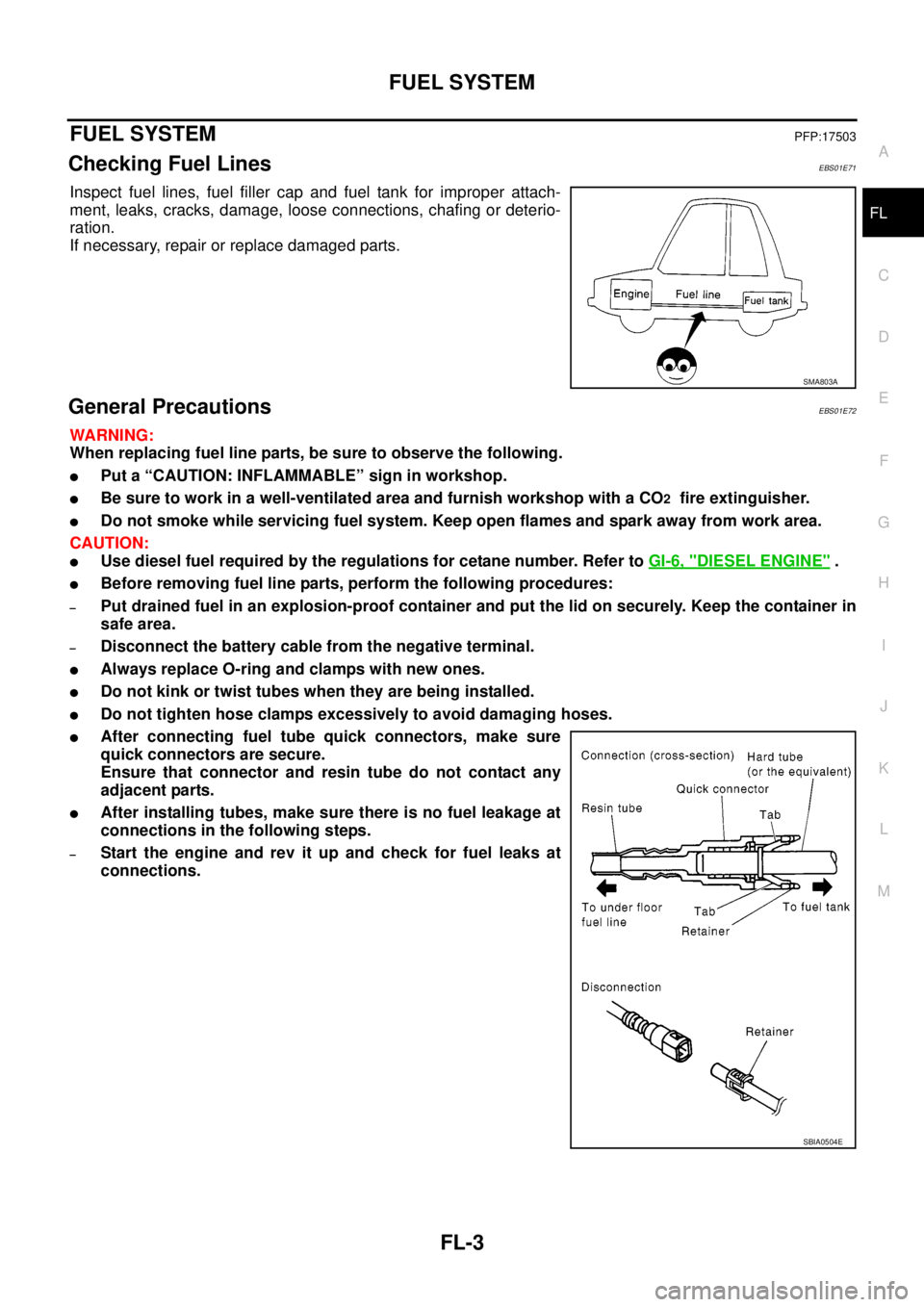
lAfter connecting fuel tube quick connectors, make sure
quick connectors are secure.
Ensure that connector and resin tube do not contact any
adjacent parts.
lAfter installing tubes, make sure there is no fuel leakage at
connections in the following steps.
–Start the engine and rev it up and check for fuel leaks at
connections.
SMA803A
SBIA0504E
Page 1591 of 3171
FUEL COOLER
FL-7
C
D
E
F
G
H
I
J
K
L
MA
FL
FUEL COOLERPFP:17511
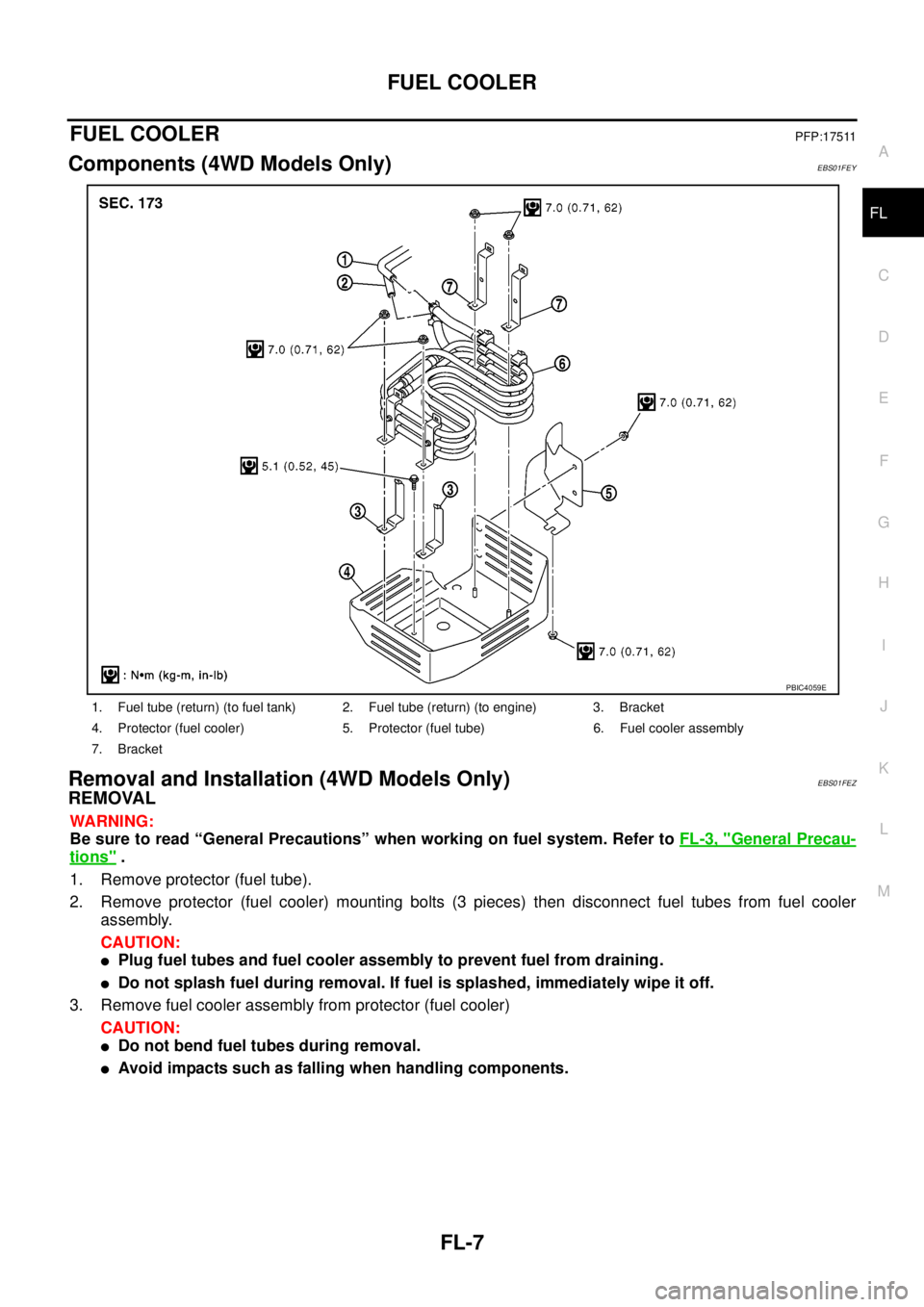
Components (4WD Models Only)EBS01FEY
Removal and Installation (4WD Models Only)EBS01FEZ
REMOVAL
WARNING:
Be sure to read “General Precautions” when working on fuel system. Refer toFL-3, "
General Precau-
tions".
1. Remove protector (fuel tube).
2. Remove protector (fuel cooler) mounting bolts (3 pieces) then disconnect fuel tubes from fuel cooler
assembly.
CAUTION:
lPlug fuel tubes and fuel cooler assembly to prevent fuel from draining.
lDo not splash fuel during removal. If fuel is splashed, immediately wipe it off.
3. Remove fuel cooler assembly from protector (fuel cooler)
CAUTION:
lDo not bend fuel tubes during removal.
lAvoid impacts such as falling when handling components.
1. Fuel tube (return) (to fuel tank) 2. Fuel tube (return) (to engine) 3. Bracket
4. Protector (fuel cooler) 5. Protector (fuel tube) 6. Fuel cooler assembly
7. Bracket
PBIC4059E
![NISSAN NAVARA 2005 Repair Workshop Manual EM-102
CYLINDER HEAD
lIf it exceeds the limit, replace valve and/or valve guide.
Valve Guide Replacement
When removing valve guide, replace it with oversized [0.2 mm (0.0008 in)] valve guide.
1. Heat](/manual-img/5/57362/w960_57362-1483.png "NISSAN NAVARA 2005 Repair Workshop Manual EM-102
CYLINDER HEAD
lIf it exceeds the limit, replace valve and/or valve guide.
Valve Guide Replacement
When removing valve guide, replace it with oversized [0.2 mm (0.0008 in)] valve guide.
1. Heat")