Page 1322 of 1500
TRACTION CONTROL SYSTEM (TCL) DIAGNOSIS
TRACTION CONTROL SYSTEM (TCL)13C-43
(7) The recommended Supply Voltage at terminals 16, 9, 6,
and 8 are:
Set value: 10.0Volts - 14.5Volts
Q: Is the supply voltage within the set value?
YES : Check wheel speed sensor signal at ABS-ECU using
an oscillopscope
NO :
Refer to Power supply systemP.35B-63
Refer to Motor supply systemP.35B-48
Refer to Valve relay systemP.35B-56
Measure wheel speed sensor signals using an
oscilloscope.
NOTE: To check connections of the wheel speed sensors,
remove the rear seat to access the rear wheel speed sen-
sor connectors, and remove inner front guard (splash
shield) to access the front wheel speed sensors.
(1) Wheel speed sensor must remain connected to measure
active sensor.
(2) ABS-ECU must remain connected.
(3) Remove ABS connector protection cap to access terminal
location from the rear of connector for back-probing.
(4) Using probe (MB991222), backprobe the wheel speed
sensor signal circuit terminals (5, 10, 17, 19), and check
individually at the ABS-ECU connector A-02
(5) The wheel to be tested must be free to turn by hand or be
driven by brake dynamometer
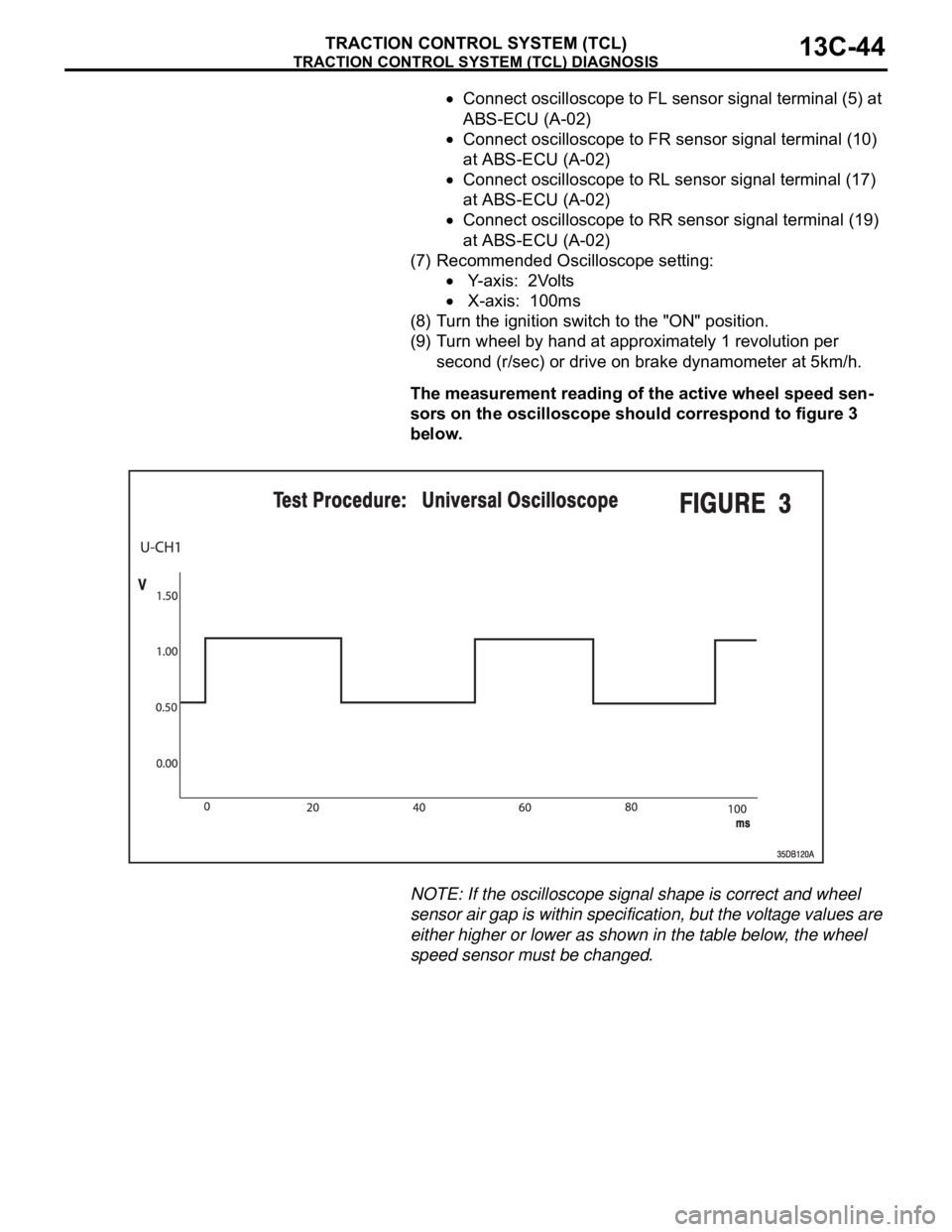
(6) Connect oscilloscope (as per figure 2) shows, to the
appropriate terminal positions and check sensor operation
individually with scope.
Page 1323 of 1500
TRACTION CONTROL SYSTEM (TCL) DIAGNOSIS
TRACTION CONTROL SYSTEM (TCL)13C-44
Connect oscilloscope to FL sensor signal terminal (5) at
ABS-ECU (A-02)
Connect oscilloscope to FR sensor signal terminal (10)
at ABS-ECU (A-02)
Connect oscilloscope to RL sensor signal terminal (17)
at ABS-ECU (A-02)
Connect oscilloscope to RR sensor signal terminal (19)
at ABS-ECU (A-02)
(7) Recommended Oscilloscope setting:
Y-axis: 2Volts
X-axis: 100ms
(8) Turn the ignition switch to the "ON" position.
(9) Turn wheel by hand at approximately 1 revolution per
second (r/sec) or drive on brake dynamometer at 5km/h.
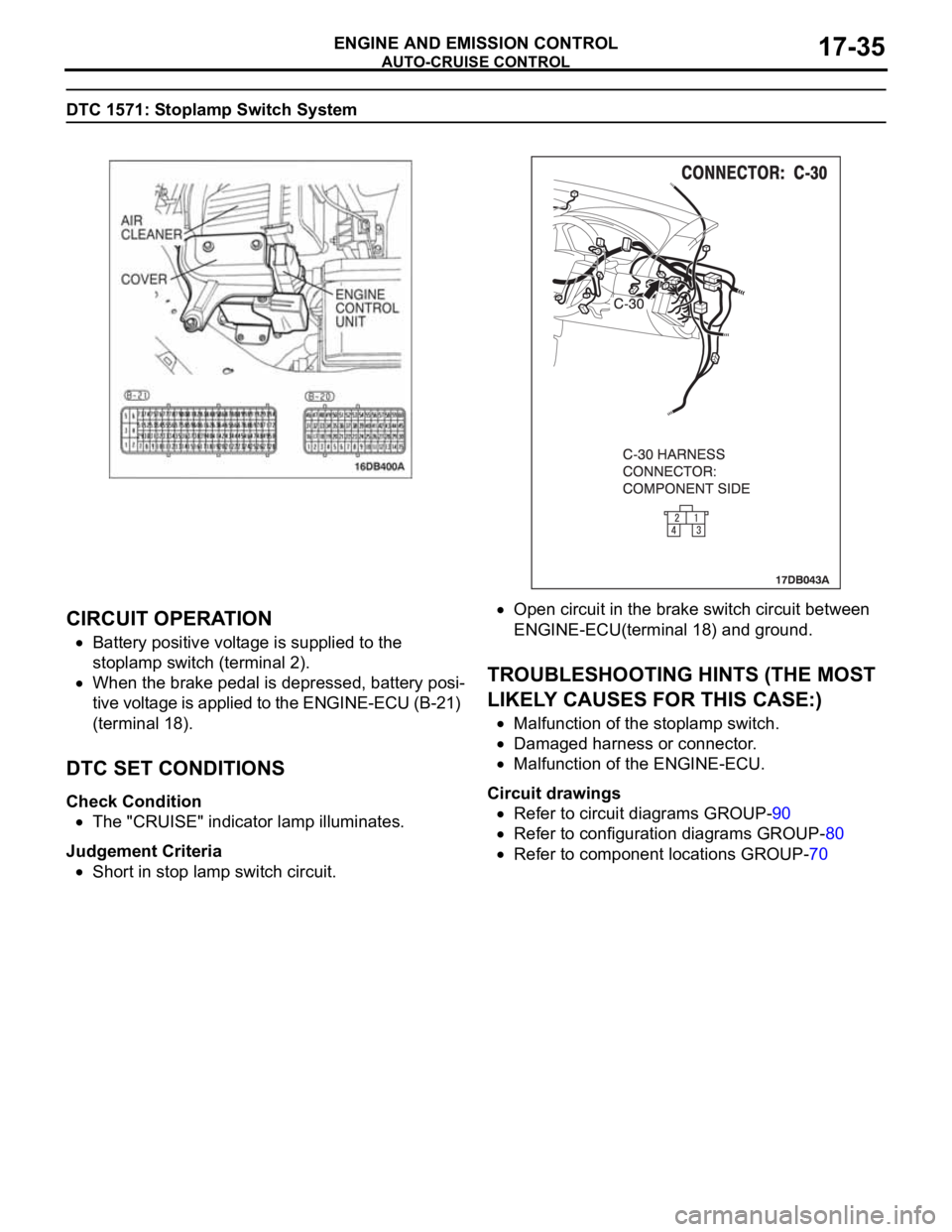
The measurement reading of the active wheel speed sen-
sors on the oscilloscope should correspond to figure 3
below.
NOTE: If the oscilloscope signal shape is correct and wheel
sensor air gap is within specification, but the voltage values are
either higher or lower as shown in the table below, the wheel
speed sensor must be changed.
Page 1366 of 1500
AUTO-CRUISE CONTROL
ENGINE AND EMISSION CONTROL17-35
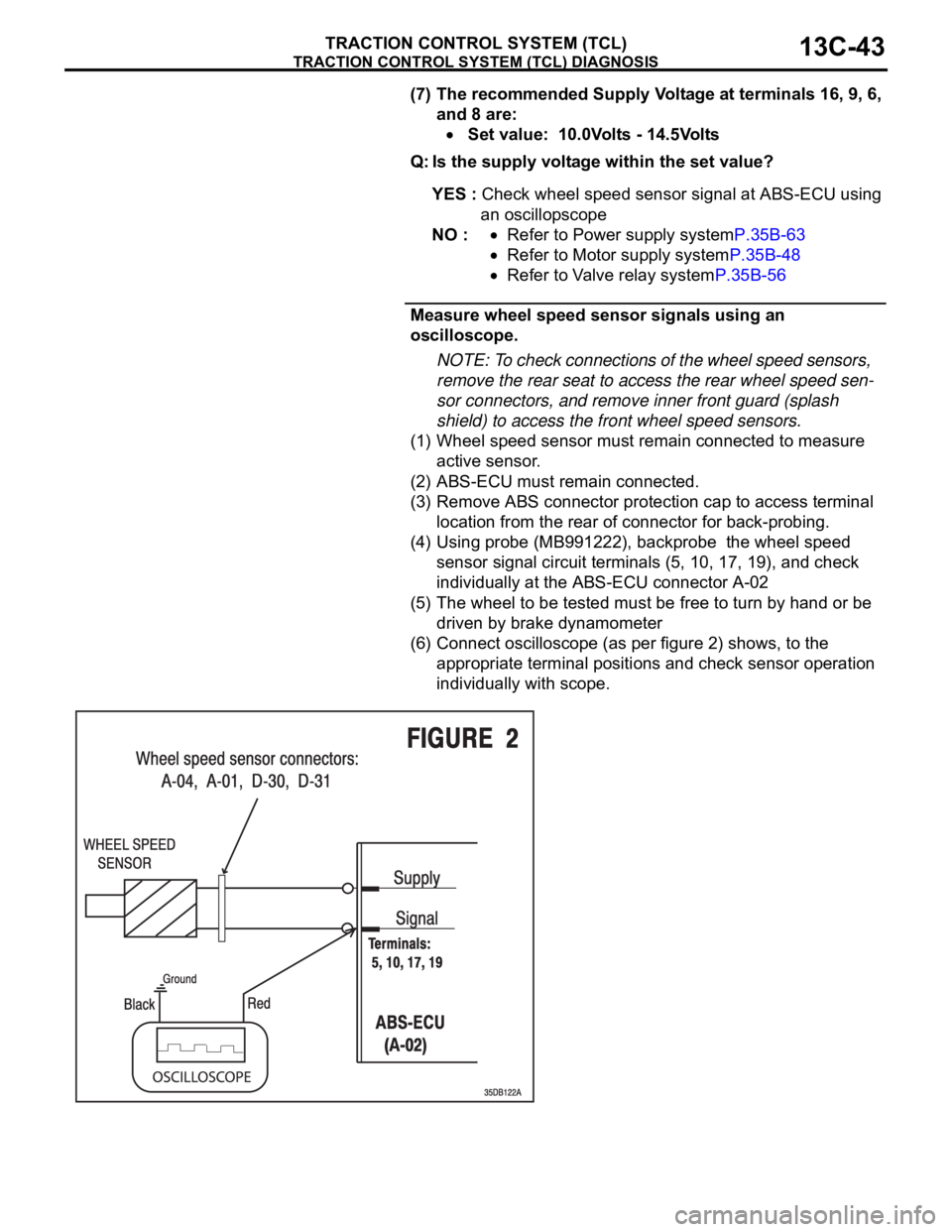
DTC 1571: Stoplamp Switch System
.
CIRCUIT OPERATION
Battery positive voltage is supplied to the
stoplamp switch (terminal 2).
When the brake pedal is depressed, battery posi-
tive voltage is applied to the ENGINE-ECU (B-21)
(terminal 18).
.
DTC SET CONDITIONS
Check Condition
The "CRUISE" indicator lamp illuminates.
Judgement Criteria
Short in stop lamp switch circuit.
Open circuit in the brake switch circuit between
ENGINE-ECU(terminal 18) and ground.
.
TROUBLESHOOTING HINTS (THE MOST
LIKELY CAUSES FOR THIS CASE:)
Malfunction of the stoplamp switch.
Damaged harness or connector.
Malfunction of the ENGINE-ECU.
Circuit drawings
Refer to circuit diagrams GROUP-90
Refer to configuration diagrams GROUP-80
Refer to component locations GROUP-70
Page 1367 of 1500
AUTO-CRUISE CONTROL
ENGINE AND EMISSION CONTROL17-36
DIAGNOSIS
Required Special Tools:
MB991958: Diagnostic ToolDiagnostic Tool (MUT-III Sub
Assembly)
MB991824: V.C.I.
MB991827: MUT-III USB Cable
MB991910: MUT-III Main Harness A
MB991223: Harness Set
MB992044: ENGINE-ECU Check Harness
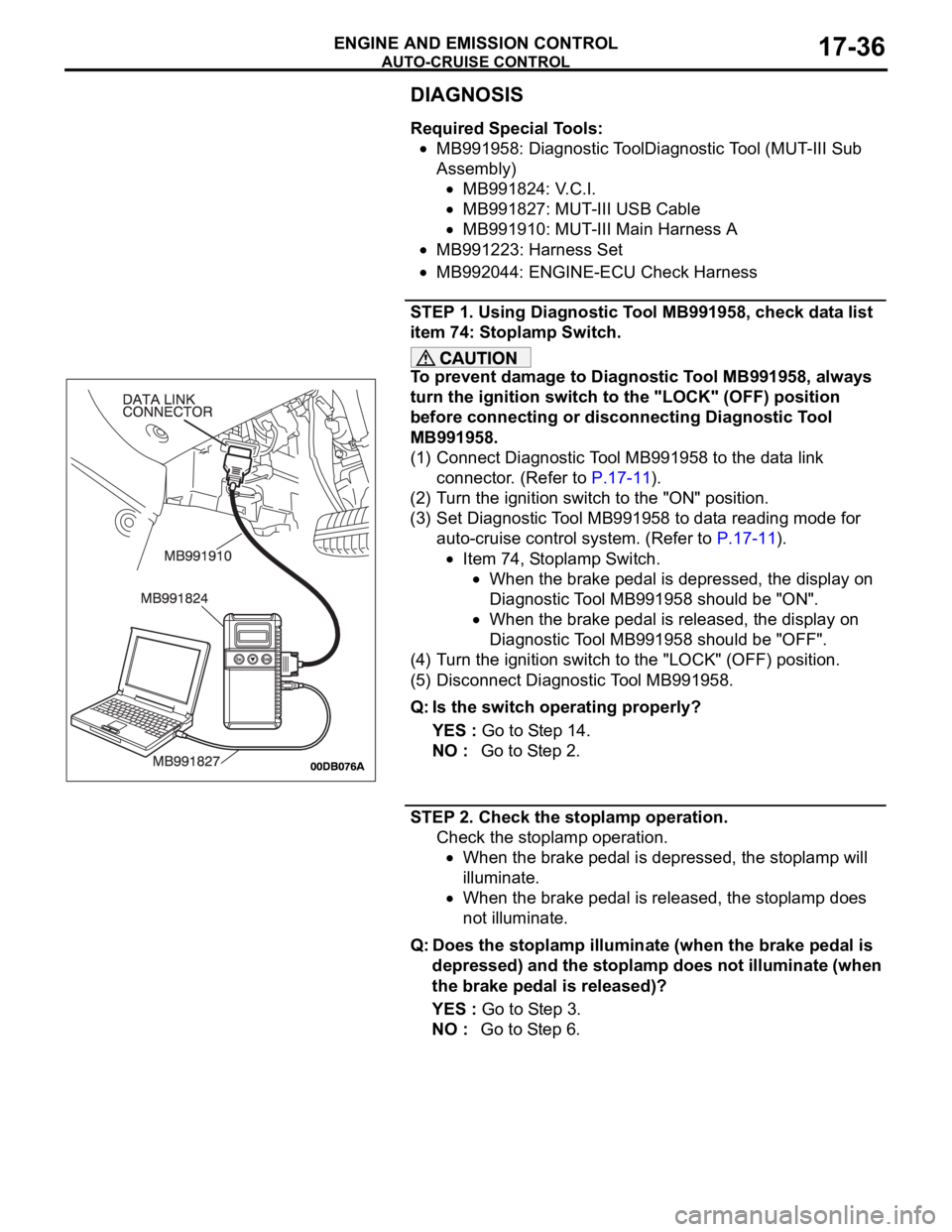
STEP 1. Using Diagnostic Tool MB991958, check data list
item 74: Stoplamp Switch.
To prevent damage to Diagnostic Tool MB991958, always
turn the ignition switch to the "LOCK" (OFF) position
before connecting or disconnecting Diagnostic Tool
MB991958.
(1) Connect Diagnostic Tool MB991958 to the data link
connector. (Refer to P.17-11).
(2) Turn the ignition switch to the "ON" position.
(3) Set Diagnostic Tool MB991958 to data reading mode for
auto-cruise control system. (Refer to P.17-11).
Item 74, Stoplamp Switch.
When the brake pedal is depressed, the display on
Diagnostic Tool MB991958 should be "ON".
When the brake pedal is released, the display on
Diagnostic Tool MB991958 should be "OFF".
(4) Turn the ignition switch to the "LOCK" (OFF) position.
(5) Disconnect Diagnostic Tool MB991958.
Q: Is the switch operating properly?
YES : Go to Step 14.
NO : Go to Step 2.
STEP 2. Check the stoplamp operation.
Check the stoplamp operation.
When the brake pedal is depressed, the stoplamp will
illuminate.
When the brake pedal is released, the stoplamp does
not illuminate.
Q: Does the stoplamp illuminate (when the brake pedal is
depressed) and the stoplamp does not illuminate (when
the brake pedal is released)?
YES : Go to Step 3.
NO : Go to Step 6.
Page 1368 of 1500
AUTO-CRUISE CONTROL
ENGINE AND EMISSION CONTROL17-37
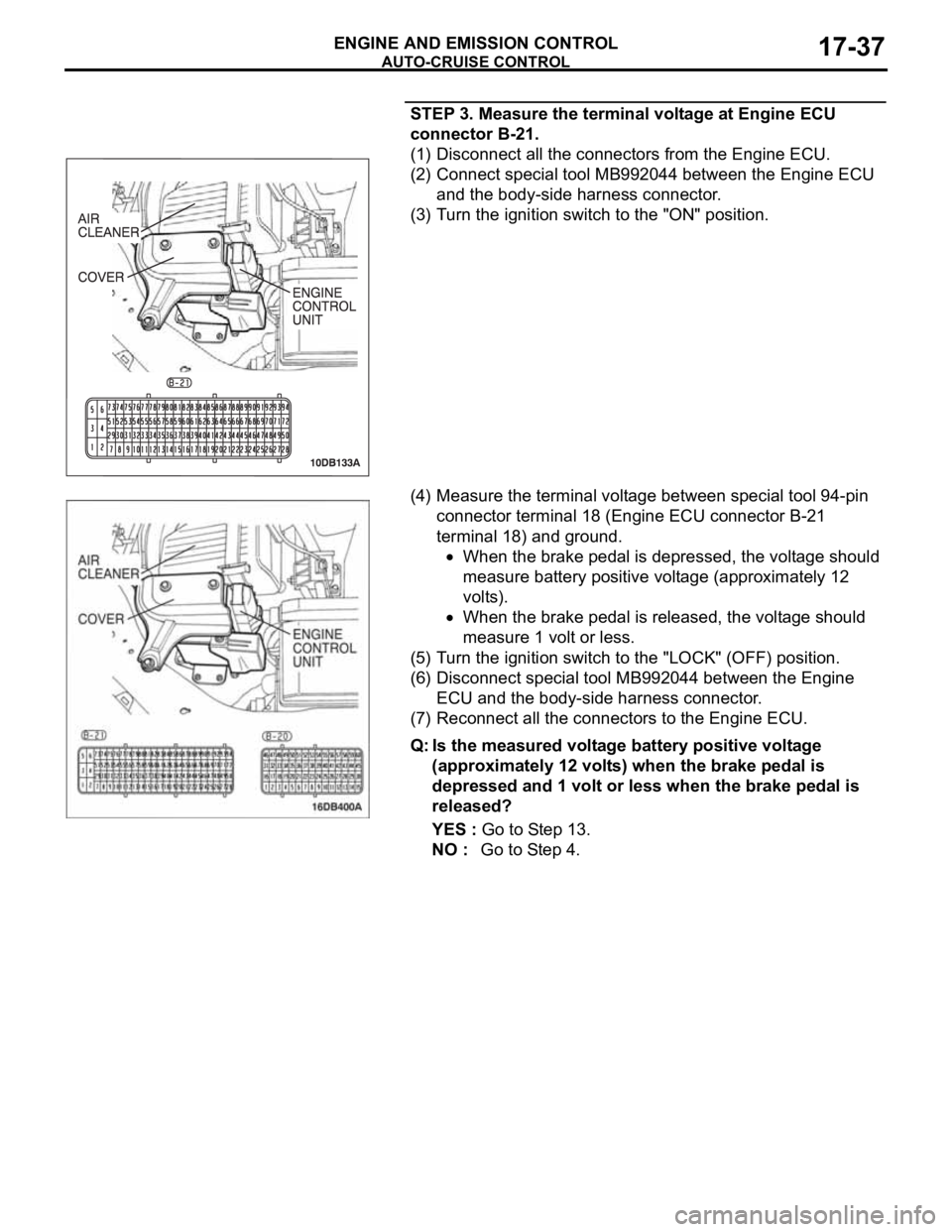
STEP 3. Measure the terminal voltage at Engine ECU
connector B-21.
(1) Disconnect all the connectors from the Engine ECU.
(2) Connect special tool MB992044 between the Engine ECU
and the body-side harness connector.
(3) Turn the ignition switch to the "ON" position.
(4) Measure the terminal voltage between special tool 94-pin
connector terminal 18 (Engine ECU connector B-21
terminal 18) and ground.
When the brake pedal is depressed, the voltage should
measure battery positive voltage (approximately 12
volts).
When the brake pedal is released, the voltage should
measure 1 volt or less.
(5) Turn the ignition switch to the "LOCK" (OFF) position.
(6) Disconnect special tool MB992044 between the Engine
ECU and the body-side harness connector.
(7) Reconnect all the connectors to the Engine ECU.
Q: Is the measured voltage battery positive voltage
(approximately 12 volts) when the brake pedal is
depressed and 1 volt or less when the brake pedal is
released?
YES : Go to Step 13.
NO : Go to Step 4.
Page 1373 of 1500
AUTO-CRUISE CONTROL
ENGINE AND EMISSION CONTROL17-42
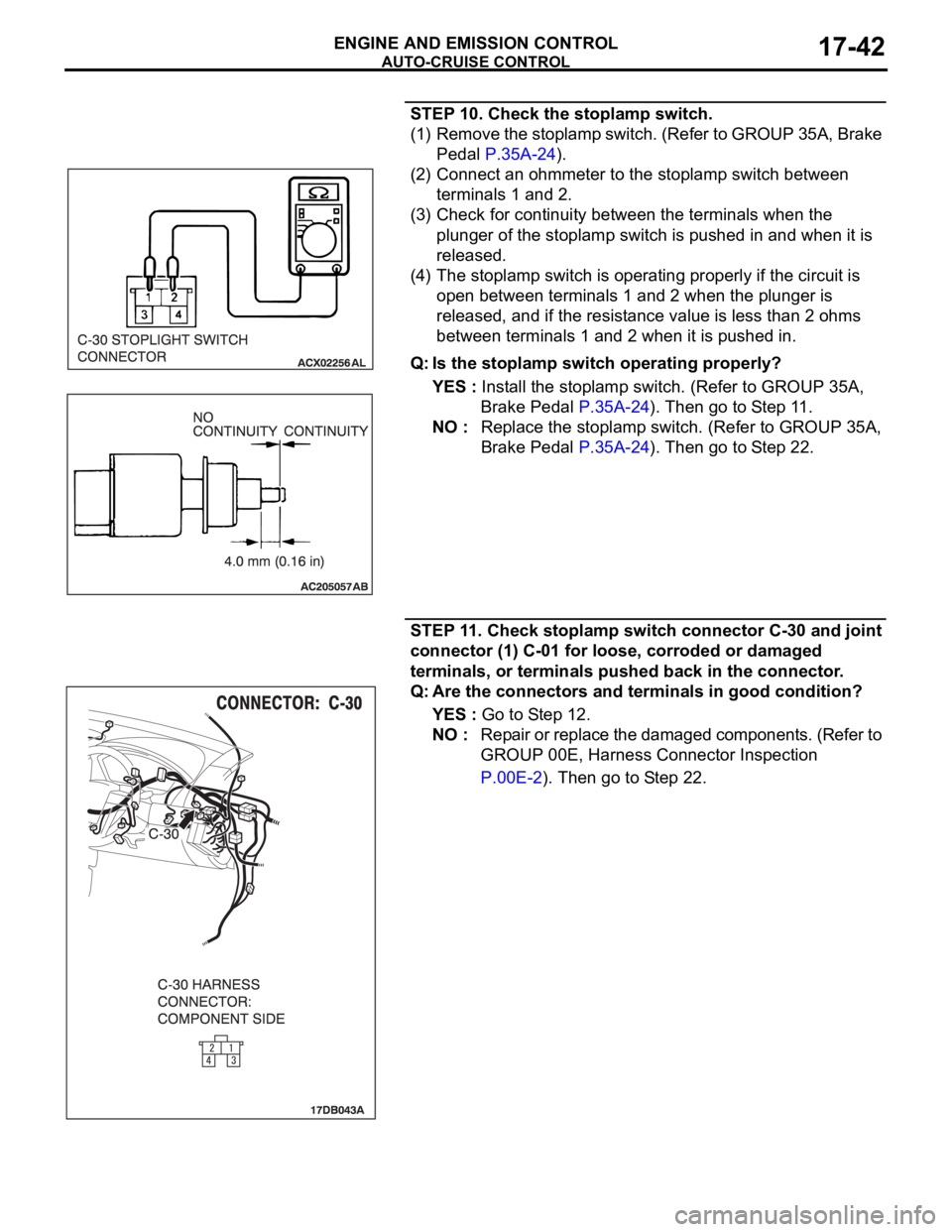
STEP 10. Check the stoplamp switch.
(1) Remove the stoplamp switch. (Refer to GROUP 35A, Brake
Pedal P.35A-24).
(2) Connect an ohmmeter to the stoplamp switch between
terminals 1 and 2.
(3) Check for continuity between the terminals when the
plunger of the stoplamp switch is pushed in and when it is
released.
(4) The stoplamp switch is operating properly if the circuit is
open between terminals 1 and 2 when the plunger is
released, and if the resistance value is less than 2 ohms
between terminals 1 and 2 when it is pushed in.
Q: Is the stoplamp switch operating properly?
YES : Install the stoplamp switch. (Refer to GROUP 35A,
Brake Pedal P.35A-24). Then go to Step 11.
NO : Replace the stoplamp switch. (Refer to GROUP 35A,
Brake Pedal P.35A-24). Then go to Step 22.
STEP 11. Check stoplamp switch connector C-30 and joint
connector (1) C-01 for loose, corroded or damaged
terminals, or terminals pushed back in the connector.
Q: Are the connectors and terminals in good condition?
YES : Go to Step 12.
NO : Repair or replace the damaged components. (Refer to
GROUP 00E, Harness Connector Inspection
P.00E-2). Then go to Step 22.
Page 1375 of 1500
AUTO-CRUISE CONTROL
ENGINE AND EMISSION CONTROL17-44
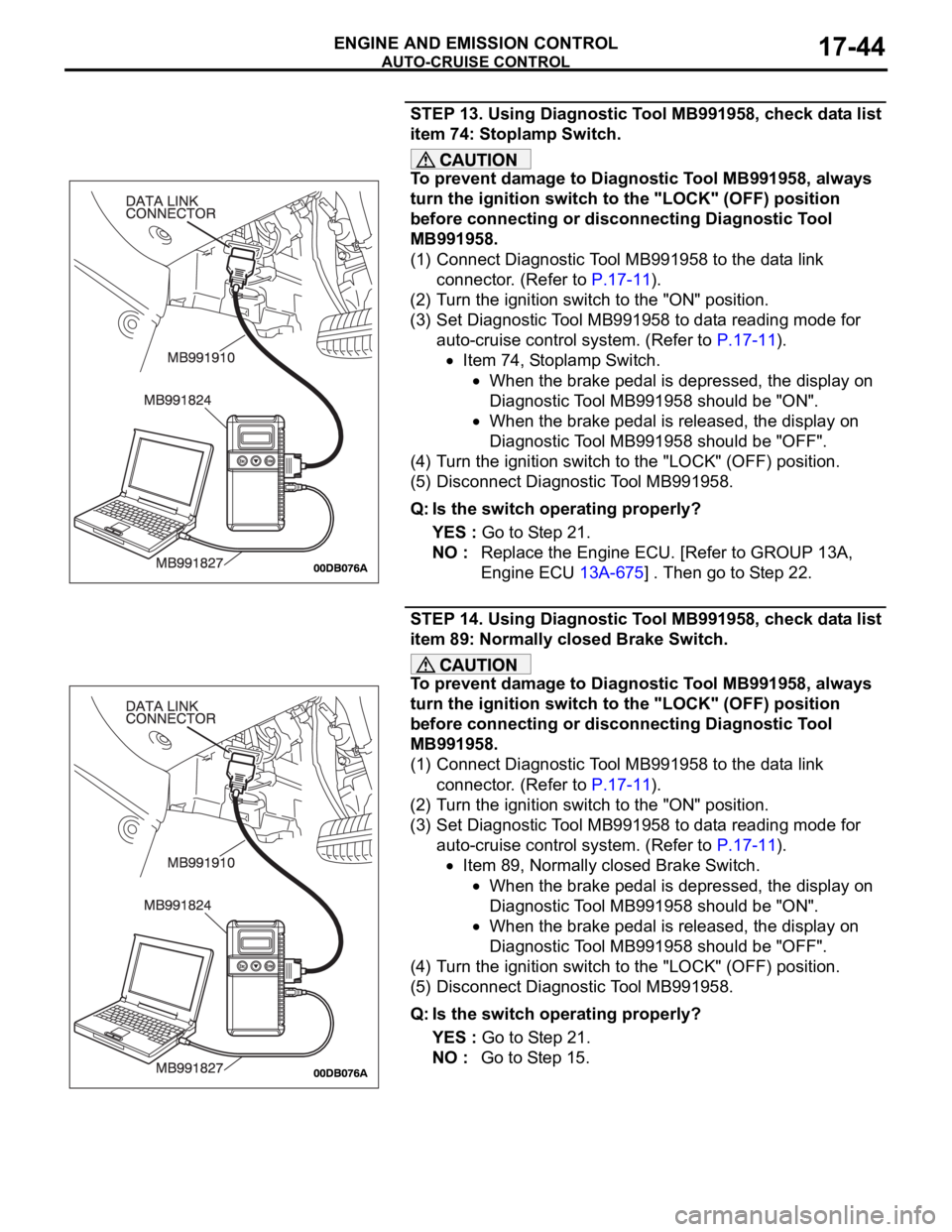
STEP 13. Using Diagnostic Tool MB991958, check data list
item 74: Stoplamp Switch.
To prevent damage to Diagnostic Tool MB991958, always
turn the ignition switch to the "LOCK" (OFF) position
before connecting or disconnecting Diagnostic Tool
MB991958.
(1) Connect Diagnostic Tool MB991958 to the data link
connector. (Refer to P.17-11).
(2) Turn the ignition switch to the "ON" position.
(3) Set Diagnostic Tool MB991958 to data reading mode for
auto-cruise control system. (Refer to P.17-11).
Item 74, Stoplamp Switch.
When the brake pedal is depressed, the display on
Diagnostic Tool MB991958 should be "ON".
When the brake pedal is released, the display on
Diagnostic Tool MB991958 should be "OFF".
(4) Turn the ignition switch to the "LOCK" (OFF) position.
(5) Disconnect Diagnostic Tool MB991958.
Q: Is the switch operating properly?
YES : Go to Step 21.
NO : Replace the Engine ECU. [Refer to GROUP 13A,
Engine ECU 13A-675] . Then go to Step 22.
STEP 14. Using Diagnostic Tool MB991958, check data list
item 89: Normally closed Brake Switch.
To prevent damage to Diagnostic Tool MB991958, always
turn the ignition switch to the "LOCK" (OFF) position
before connecting or disconnecting Diagnostic Tool
MB991958.
(1) Connect Diagnostic Tool MB991958 to the data link
connector. (Refer to P.17-11).
(2) Turn the ignition switch to the "ON" position.
(3) Set Diagnostic Tool MB991958 to data reading mode for
auto-cruise control system. (Refer to P.17-11).
Item 89, Normally closed Brake Switch.
When the brake pedal is depressed, the display on
Diagnostic Tool MB991958 should be "ON".
When the brake pedal is released, the display on
Diagnostic Tool MB991958 should be "OFF".
(4) Turn the ignition switch to the "LOCK" (OFF) position.
(5) Disconnect Diagnostic Tool MB991958.
Q: Is the switch operating properly?
YES : Go to Step 21.
NO : Go to Step 15.
Page 1376 of 1500
AUTO-CRUISE CONTROL
ENGINE AND EMISSION CONTROL17-45
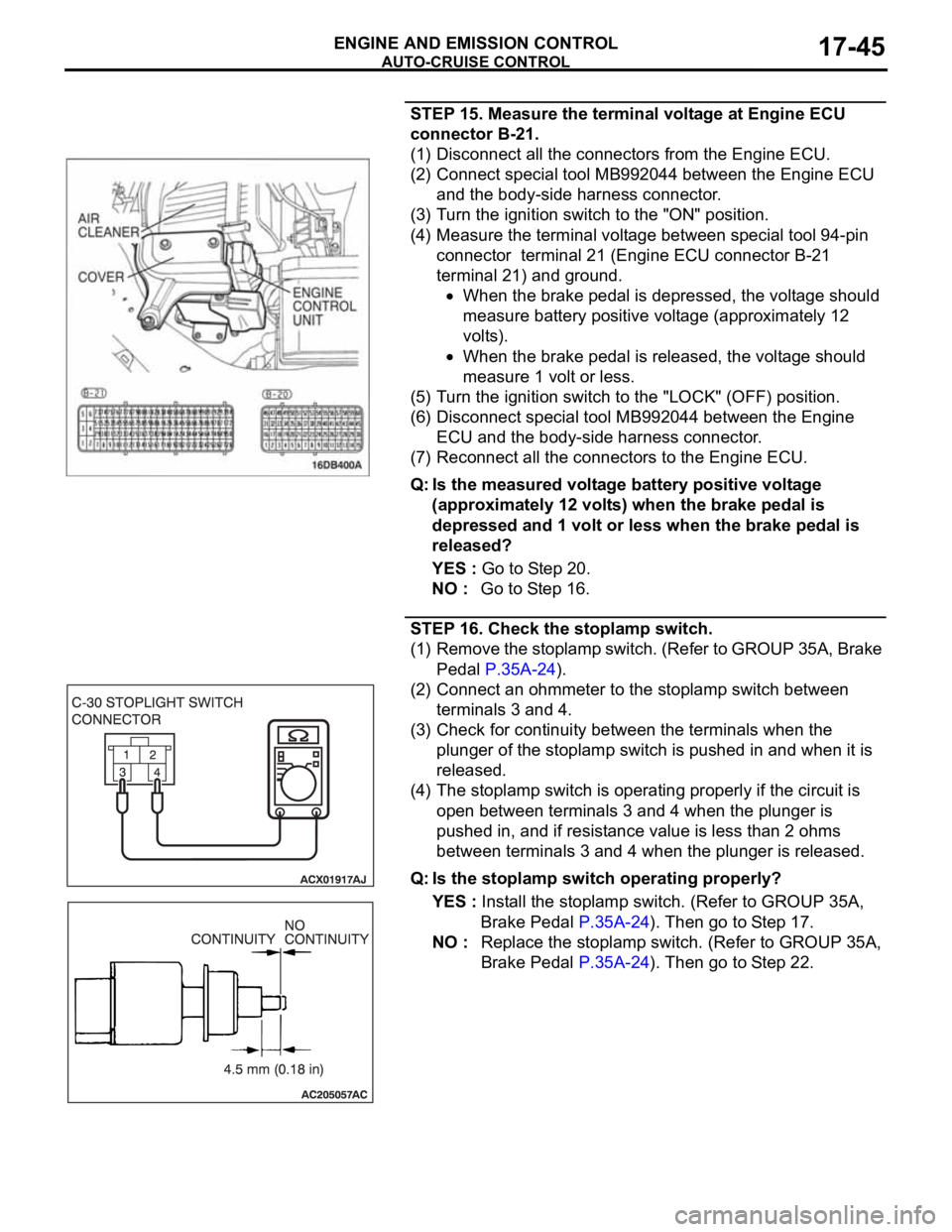
STEP 15. Measure the terminal voltage at Engine ECU
connector B-21.
(1) Disconnect all the connectors from the Engine ECU.
(2) Connect special tool MB992044 between the Engine ECU
and the body-side harness connector.
(3) Turn the ignition switch to the "ON" position.
(4) Measure the terminal voltage between special tool 94-pin
connector terminal 21 (Engine ECU connector B-21
terminal 21) and ground.
When the brake pedal is depressed, the voltage should
measure battery positive voltage (approximately 12
volts).
When the brake pedal is released, the voltage should
measure 1 volt or less.
(5) Turn the ignition switch to the "LOCK" (OFF) position.
(6) Disconnect special tool MB992044 between the Engine
ECU and the body-side harness connector.
(7) Reconnect all the connectors to the Engine ECU.
Q: Is the measured voltage battery positive voltage
(approximately 12 volts) when the brake pedal is
depressed and 1 volt or less when the brake pedal is
released?
YES : Go to Step 20.
NO : Go to Step 16.
STEP 16. Check the stoplamp switch.
(1) Remove the stoplamp switch. (Refer to GROUP 35A, Brake
Pedal P.35A-24).
(2) Connect an ohmmeter to the stoplamp switch between
terminals 3 and 4.
(3) Check for continuity between the terminals when the
plunger of the stoplamp switch is pushed in and when it is
released.
(4) The stoplamp switch is operating properly if the circuit is
open between terminals 3 and 4 when the plunger is
pushed in, and if resistance value is less than 2 ohms
between terminals 3 and 4 when the plunger is released.
Q: Is the stoplamp switch operating properly?
YES : Install the stoplamp switch. (Refer to GROUP 35A,
Brake Pedal P.35A-24). Then go to Step 17.
NO : Replace the stoplamp switch. (Refer to GROUP 35A,
Brake Pedal P.35A-24). Then go to Step 22.