Page 1406 of 1500
AUTO-CRUISE CONTROL
ENGINE AND EMISSION CONTROL17-75
AUTO-CRUISE CONTROL
REMOVAL AND INSTALLATIONM1172001400467
Before removal of the air bag module, refer to GROUP 52B, SRS Service Precautions
P.52B-16 and GROUP 52B, Air Bag Module and Clock Spring P.52B-237.
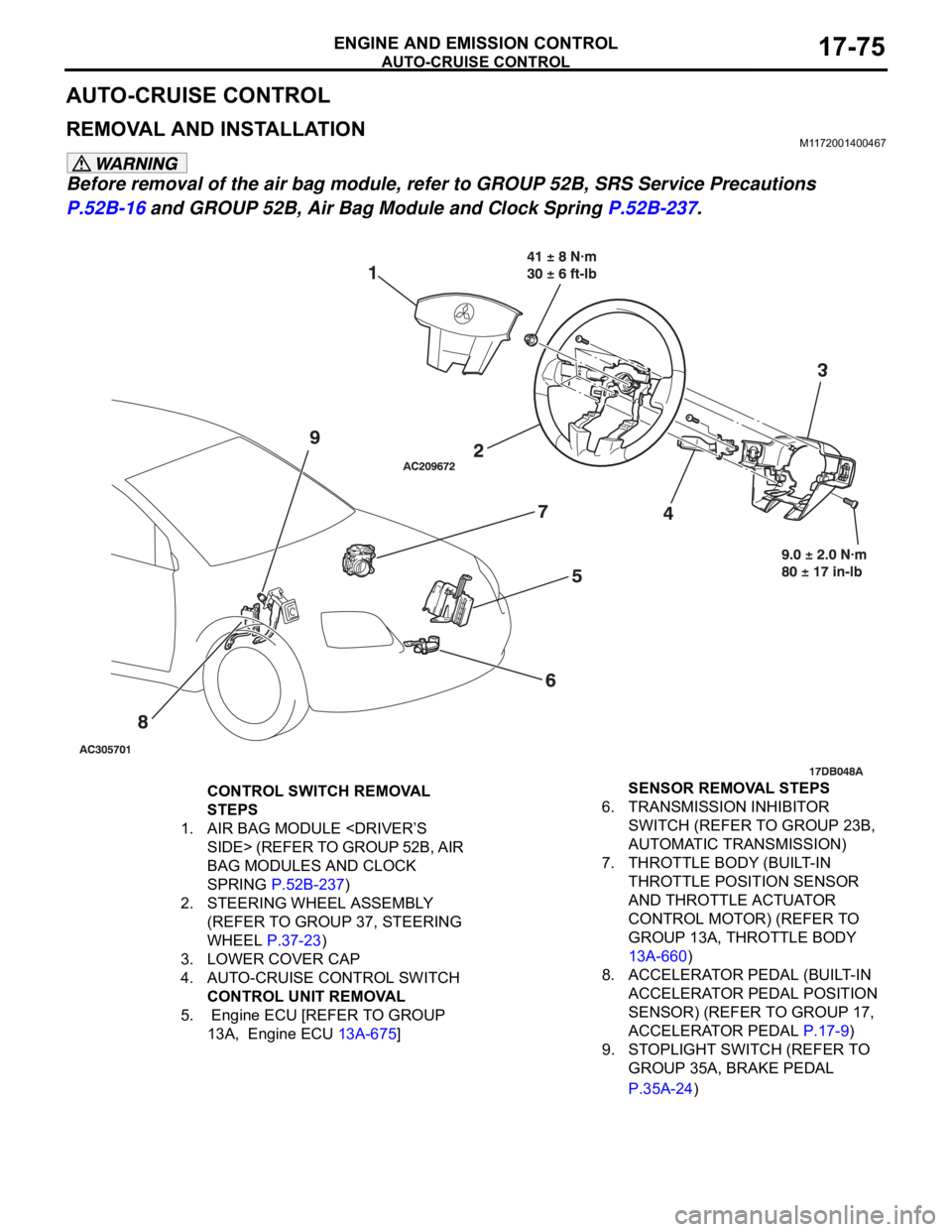
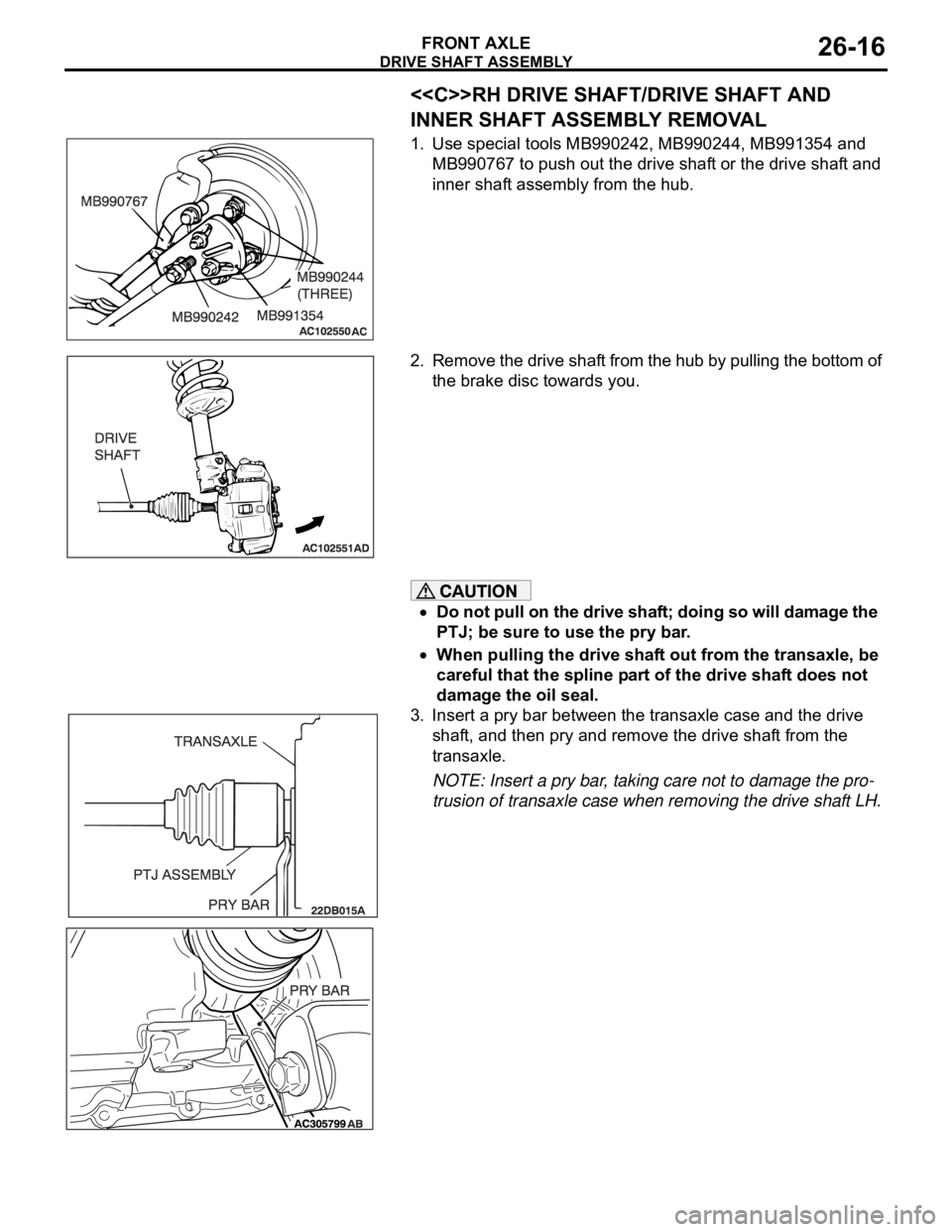
CONTROL SWITCH REMOVAL
STEPS
1. AIR BAG MODULE
SIDE> (REFER TO GROUP 52B, AIR
BAG MODULES AND CLOCK
SPRING P.52B-237)
2. STEERING WHEEL ASSEMBLY
(REFER TO GROUP 37, STEERING
WHEEL P.37-23)
3. LOWER COVER CAP
4. AUTO-CRUISE CONTROL SWITCH
CONTROL UNIT REMOVAL
5. Engine ECU [REFER TO GROUP
13A, Engine ECU 13A-675] SENSOR REMOVAL STEPS
6. TRANSMISSION INHIBITOR
SWITCH (REFER TO GROUP 23B,
AUTOMATIC TRANSMISSION)
7. THROTTLE BODY (BUILT-IN
THROTTLE POSITION SENSOR
AND THROTTLE ACTUATOR
CONTROL MOTOR) (REFER TO
GROUP 13A, THROTTLE BODY
13A-660)
8. ACCELERATOR PEDAL (BUILT-IN
ACCELERATOR PEDAL POSITION
SENSOR) (REFER TO GROUP 17,
ACCELERATOR PEDAL P.17-9)
9. STOPLIGHT SWITCH (REFER TO
GROUP 35A, BRAKE PEDAL
P.35A-24)
Page 1420 of 1500
FRONT AXLE DIAGNOSIS
FRONT AXLE26-3
2. Verify that the condition described by the
customer exists.3. Find the malfunction by following the Symptom
Chart.
4. Verify malfunction is eliminated.
SYMPTOM CHARTM1261005700269
SYMPTOM PROCEDURES
INSPECTION PROCEDURE 1: Noise during Wheel Rotation
DIAGNOSIS
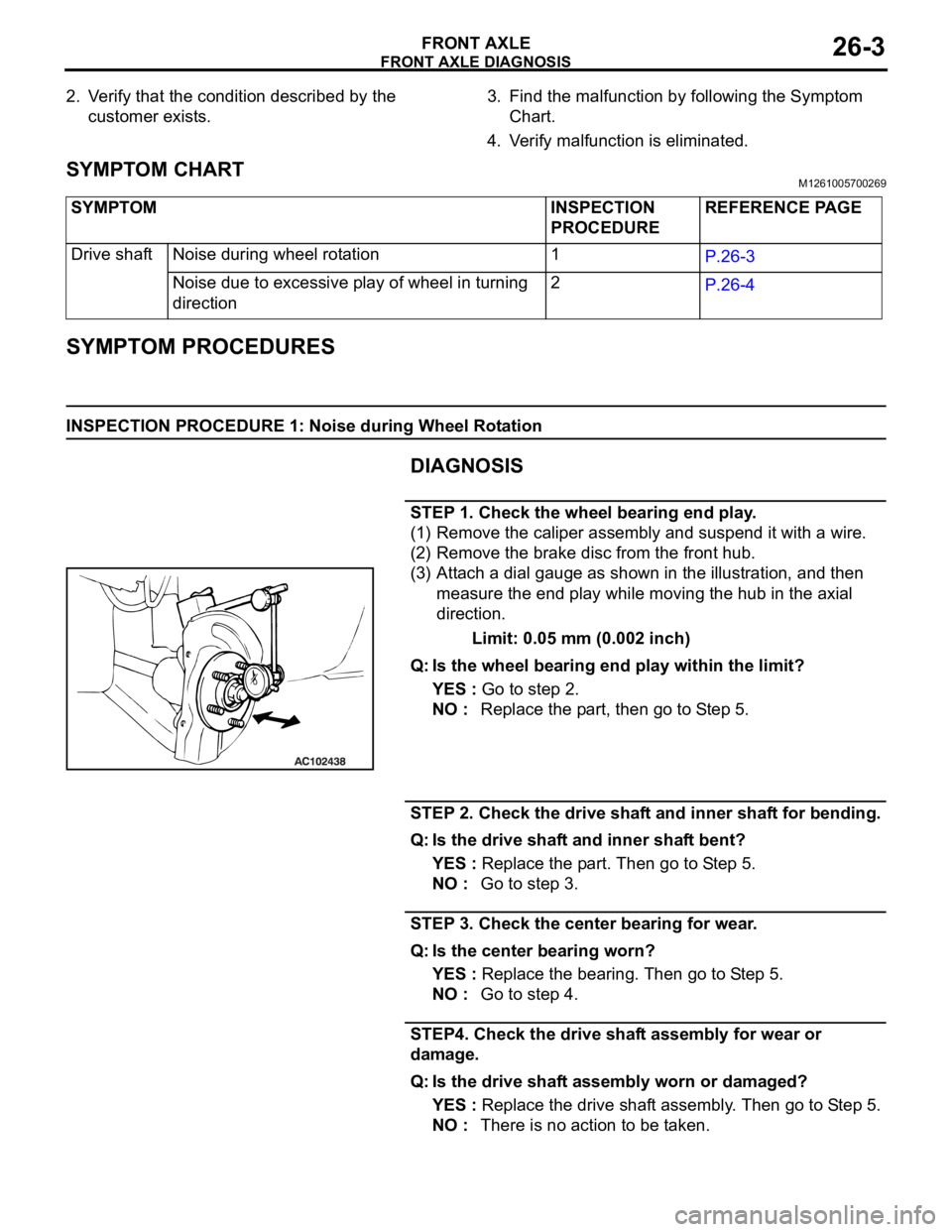
STEP 1. Check the wheel bearing end play.
(1) Remove the caliper assembly and suspend it with a wire.
(2) Remove the brake disc from the front hub.
(3) Attach a dial gauge as shown in the illustration, and then
measure the end play while moving the hub in the axial
direction.
Limit: 0.05 mm (0.002 inch)
Q: Is the wheel bearing end play within the limit?
YES : Go to step 2.
NO : Replace the part, then go to Step 5.
STEP 2. Check the drive shaft and inner shaft for bending.
Q: Is the drive shaft and inner shaft bent?
YES : Replace the part. Then go to Step 5.
NO : Go to step 3.
STEP 3. Check the center bearing for wear.
Q: Is the center bearing worn?
YES : Replace the bearing. Then go to Step 5.
NO : Go to step 4.
STEP4. Check the drive shaft assembly for wear or
damage.
Q: Is the drive shaft assembly worn or damaged?
YES : Replace the drive shaft assembly. Then go to Step 5.
NO : There is no action to be taken. SYMPTOM INSPECTION
PROCEDUREREFERENCE PAGE
Drive shaft Noise during wheel rotation 1
P.26-3
Noise due to excessive play of wheel in turning
direction2
P.26-4
Page 1425 of 1500
ON-VEHICLE SERVICE
FRONT AXLE26-8
ON-VEHICLE SERVICE
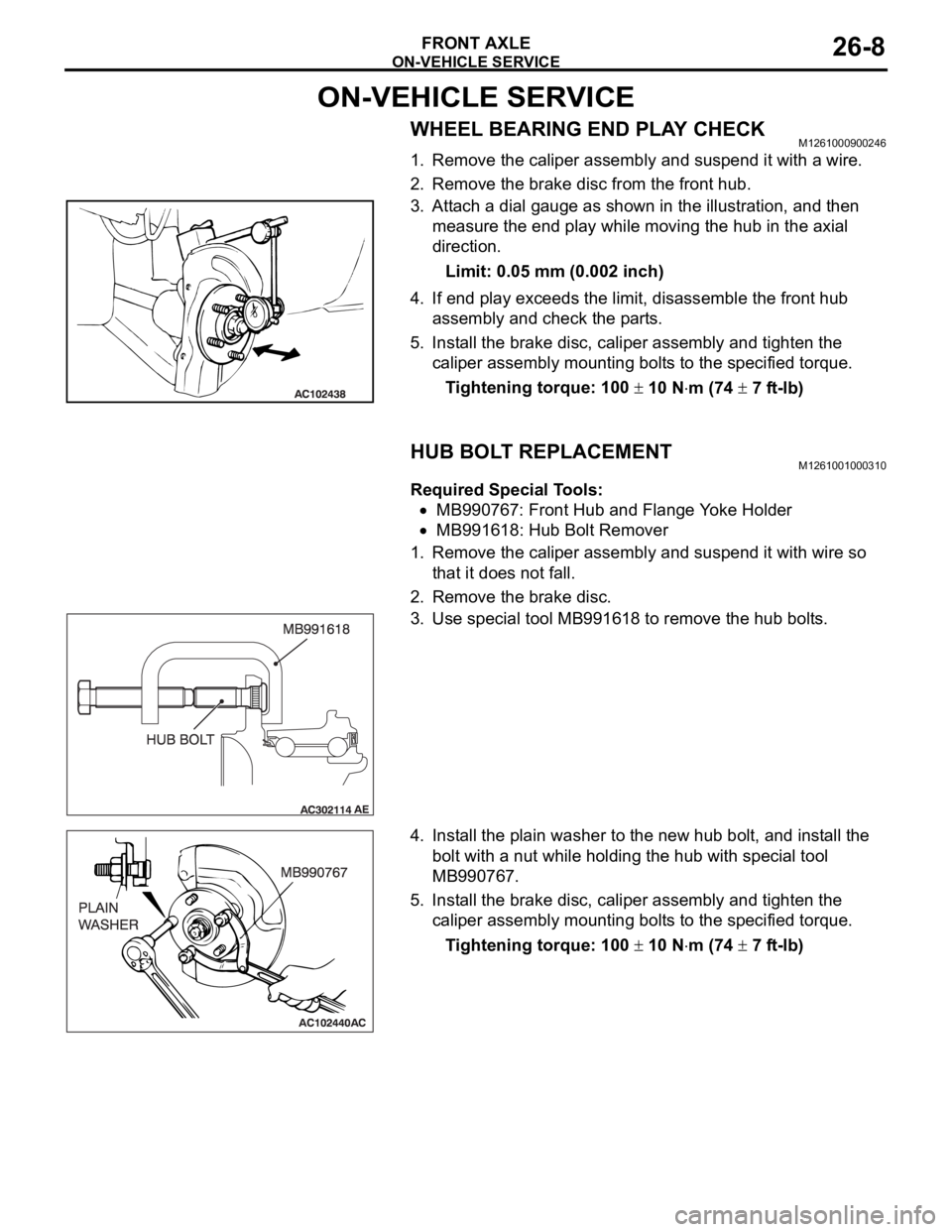
WHEEL BEARING END PLAY CHECKM1261000900246
1. Remove the caliper assembly and suspend it with a wire.
2. Remove the brake disc from the front hub.
3. Attach a dial gauge as shown in the illustration, and then
measure the end play while moving the hub in the axial
direction.
Limit: 0.05 mm (0.002 inch)
4. If end play exceeds the limit, disassemble the front hub
assembly and check the parts.
5. Install the brake disc, caliper assembly and tighten the
caliper assembly mounting bolts to the specified torque.
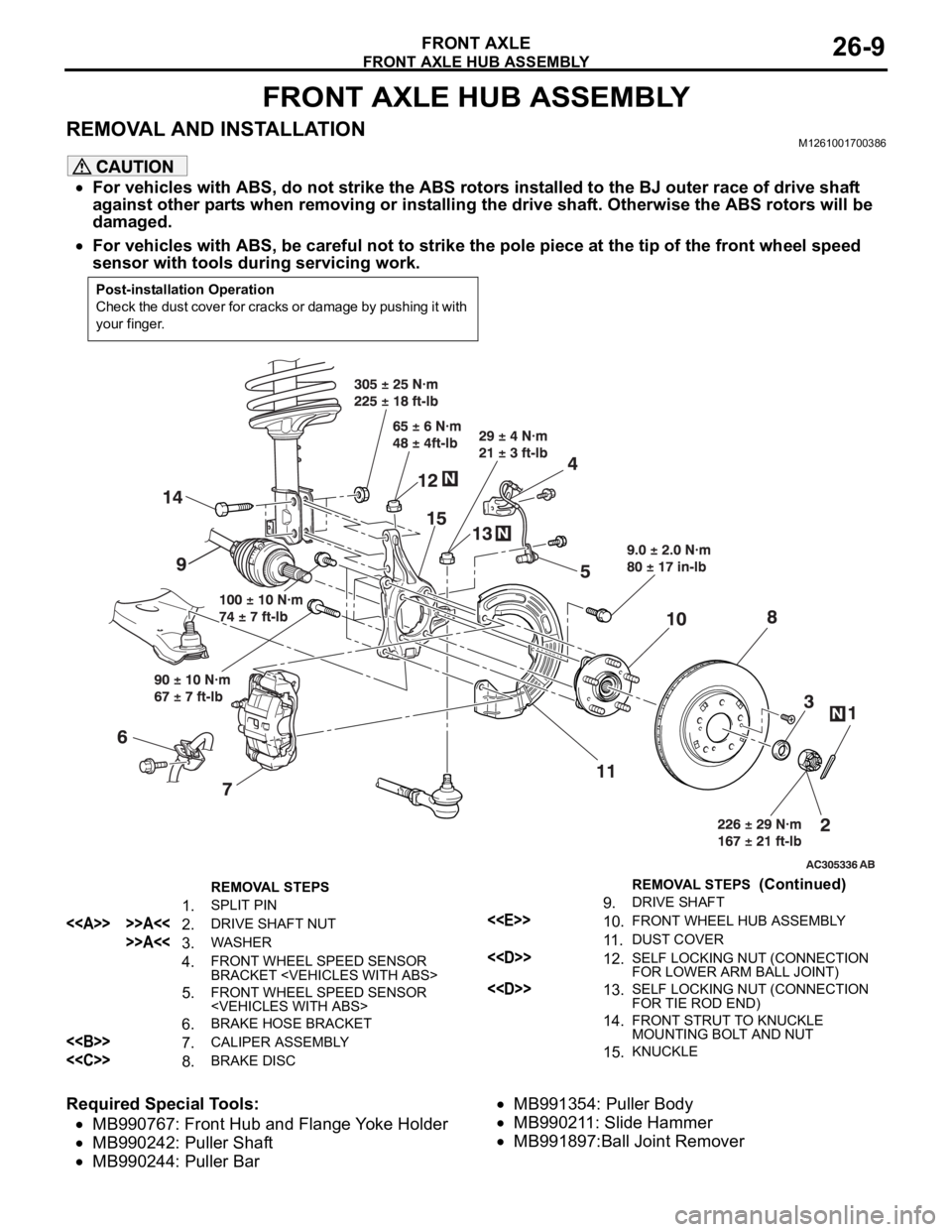
Tightening torque: 100
10 Nm (74 7 ft-lb)
HUB BOLT REPLACEMENTM1261001000310
Required Special Tools:
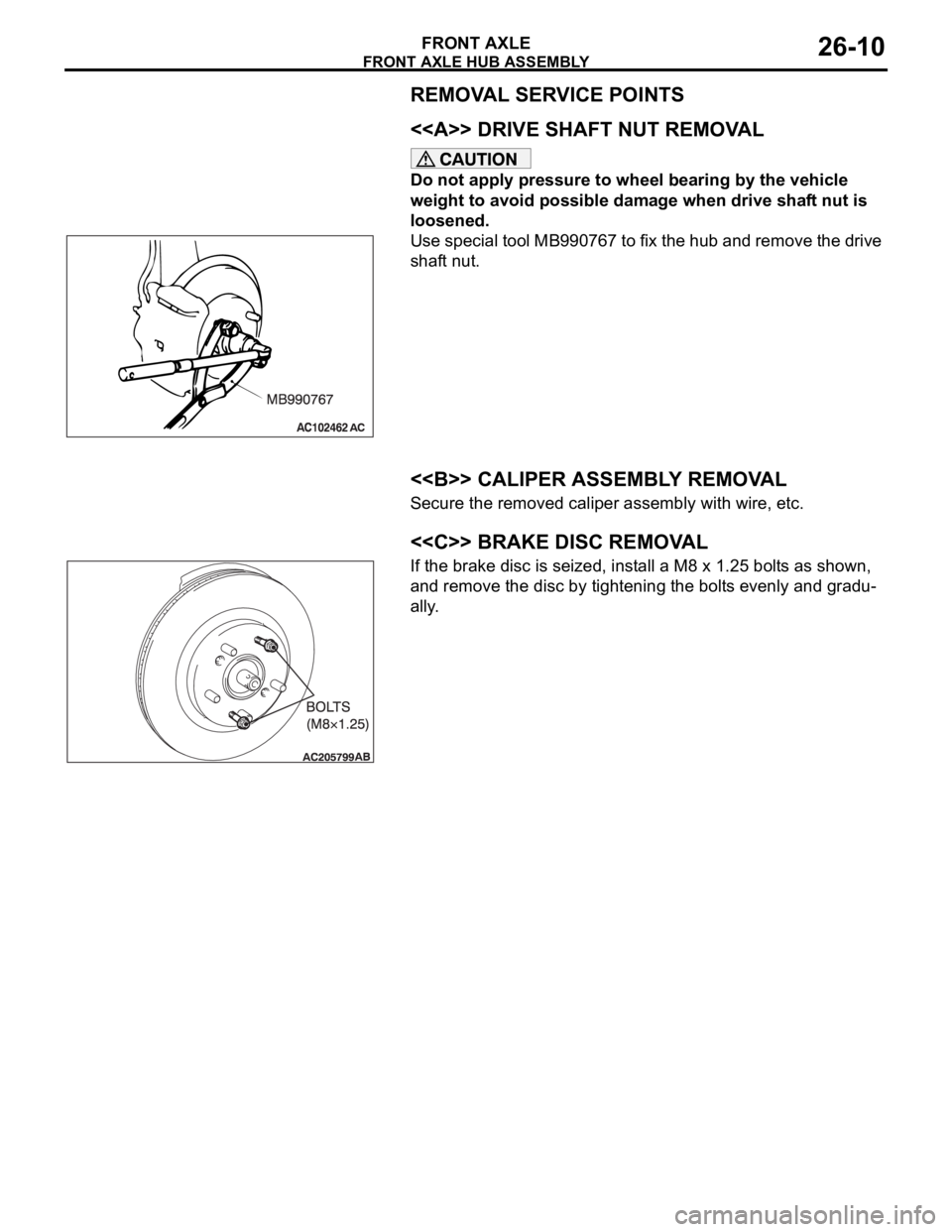
MB990767: Front Hub and Flange Yoke Holder
MB991618: Hub Bolt Remover
1. Remove the caliper assembly and suspend it with wire so
that it does not fall.
2. Remove the brake disc.
3. Use special tool MB991618 to remove the hub bolts.
4. Install the plain washer to the new hub bolt, and install the
bolt with a nut while holding the hub with special tool
MB990767.
5. Install the brake disc, caliper assembly and tighten the
caliper assembly mounting bolts to the specified torque.
Tightening torque: 100
10 Nm (74 7 ft-lb)
Page 1426 of 1500
Page 1427 of 1500
Page 1431 of 1500
Page 1433 of 1500
DRIVE SHAFT ASSEMBLY
FRONT AXLE26-16
<>RH DRIVE SHAFT/DRIVE SHAFT AND
INNER SHAFT ASSEMBLY REMOVAL
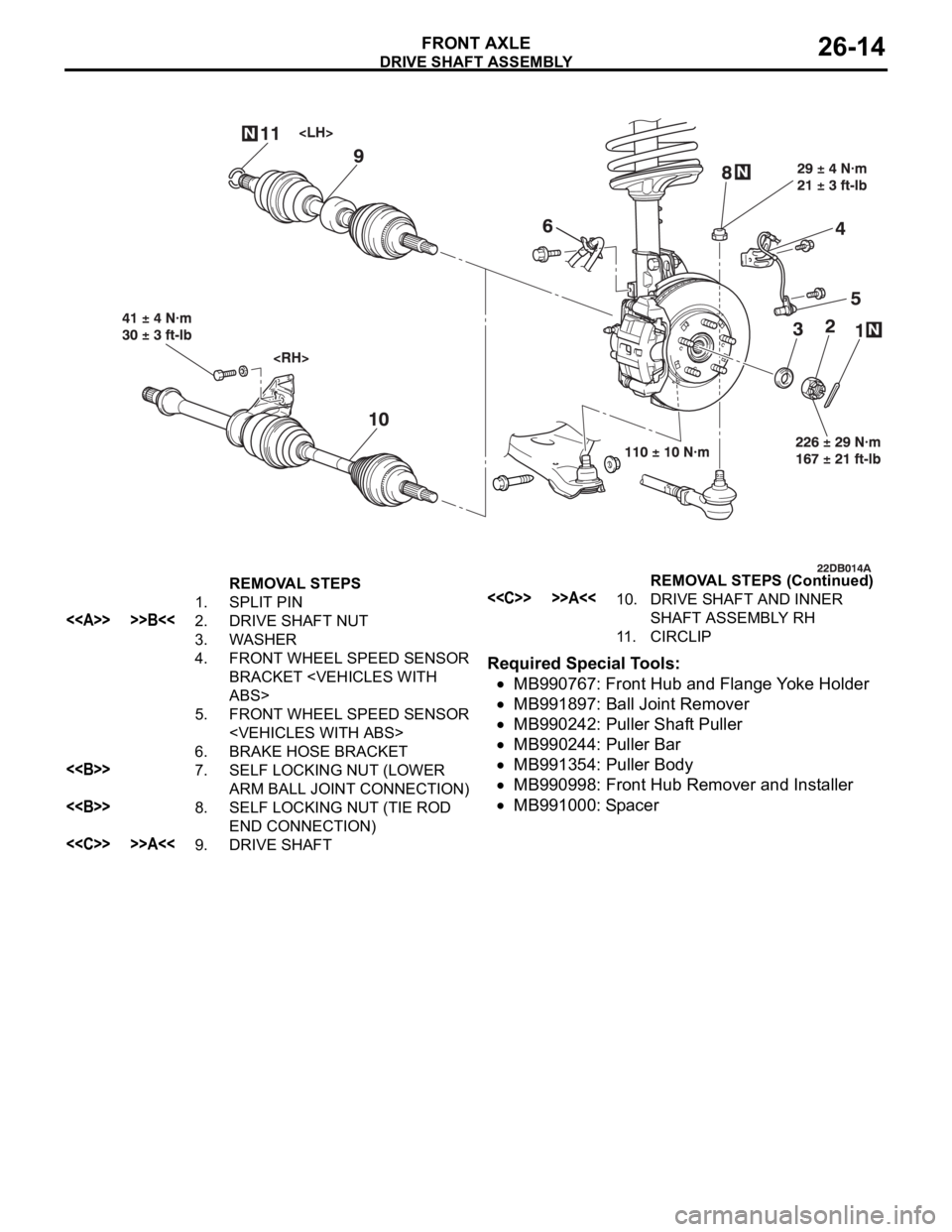
1. Use special tools MB990242, MB990244, MB991354 and
MB990767 to push out the drive shaft or the drive shaft and
inner shaft assembly from the hub.
2. Remove the drive shaft from the hub by pulling the bottom of
the brake disc towards you.
Do not pull on the drive shaft; doing so will damage the
PTJ; be sure to use the pry bar.
When pulling the drive shaft out from the transaxle, be
careful that the spline part of the drive shaft does not
damage the oil seal.
3. Insert a pry bar between the transaxle case and the drive
shaft, and then pry and remove the drive shaft from the
transaxle.
NOTE: Insert a pry bar, taking care not to damage the pro-
trusion of transaxle case when removing the drive shaft LH.
Page 1450 of 1500
REAR AXLE DIAGNOSIS
REAR AXLE27-3
SYMPTOM PROCEDURESM1271004400222
INSPECTION PROCEDURE 1: Abnormal Noise
DIAGNOSIS
STEP 1. Check the rear hub assembly installation bolts for
looseness.
Q: Are the rear hub assembly installation bolts loosened?
YES : Tighten the rear hub assembly installation bolts to the
specified torque 73
7 Nm (54 5 ft-lb). Then go to
St e p 4 .
NO : Go to Step 2.
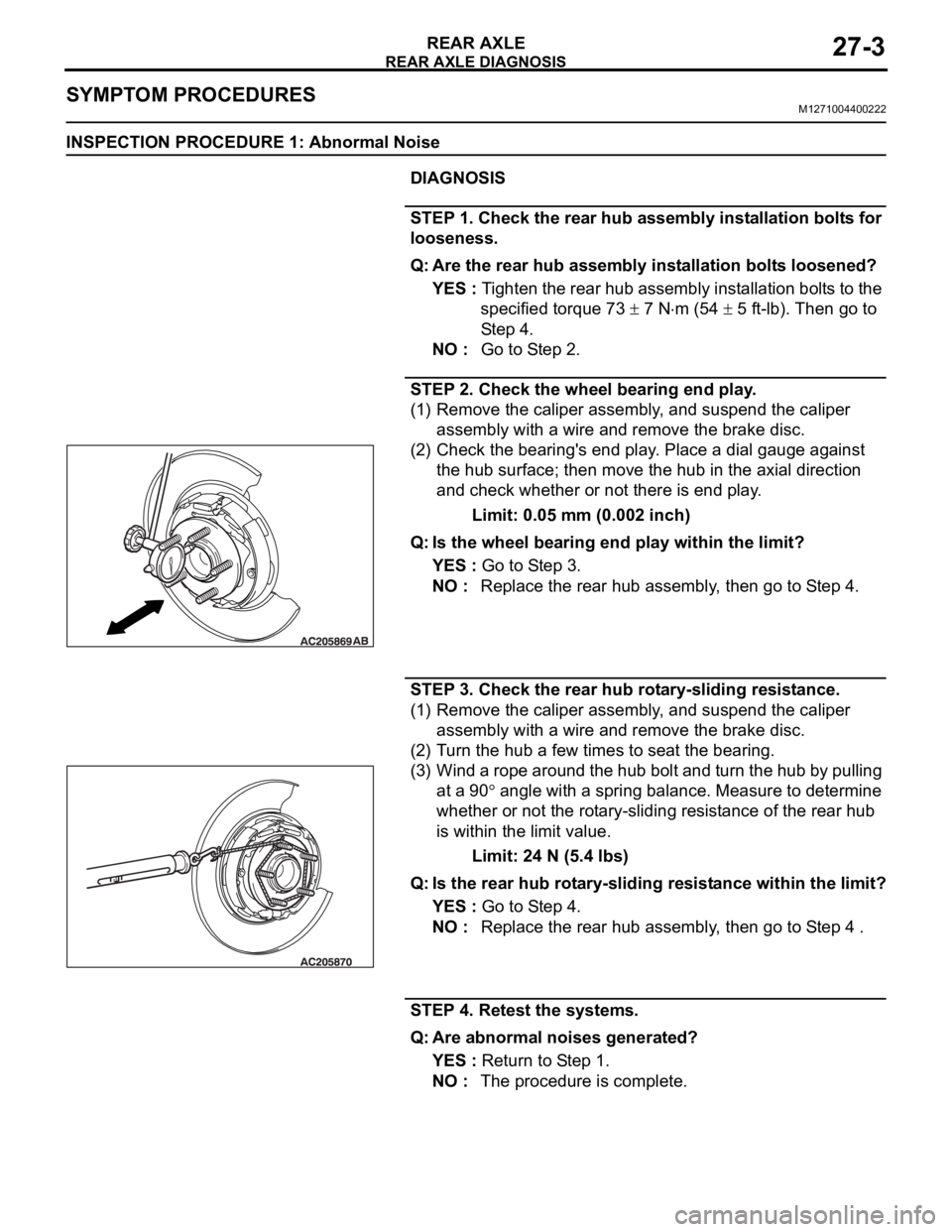
STEP 2. Check the wheel bearing end play.
(1) Remove the caliper assembly, and suspend the caliper
assembly with a wire and remove the brake disc.
(2) Check the bearing's end play. Place a dial gauge against
the hub surface; then move the hub in the axial direction
and check whether or not there is end play.
Limit: 0.05 mm (0.002 inch)
Q: Is the wheel bearing end play within the limit?
YES : Go to Step 3.
NO : Replace the rear hub assembly, then go to Step 4.
STEP 3. Check the rear hub rotary-sliding resistance.
(1) Remove the caliper assembly, and suspend the caliper
assembly with a wire and remove the brake disc.
(2) Turn the hub a few times to seat the bearing.
(3) Wind a rope around the hub bolt and turn the hub by pulling
at a 90
angle with a spring balance. Measure to determine
whether or not the rotary-sliding resistance of the rear hub
is within the limit value.
Limit: 24 N (5.4 lbs)
Q: Is the rear hub rotary-sliding resistance within the limit?
YES : Go to Step 4.
NO : Replace the rear hub assembly, then go to Step 4 .
STEP 4. Retest the systems.
Q: Are abnormal noises generated?
YES : Return to Step 1.
NO : The procedure is complete.