2004 SUBARU FORESTER replace disc
[x] Cancel search: replace discPage 899 of 2870
ME(H4SO)-30
MECHANICAL
Fuel Pressure
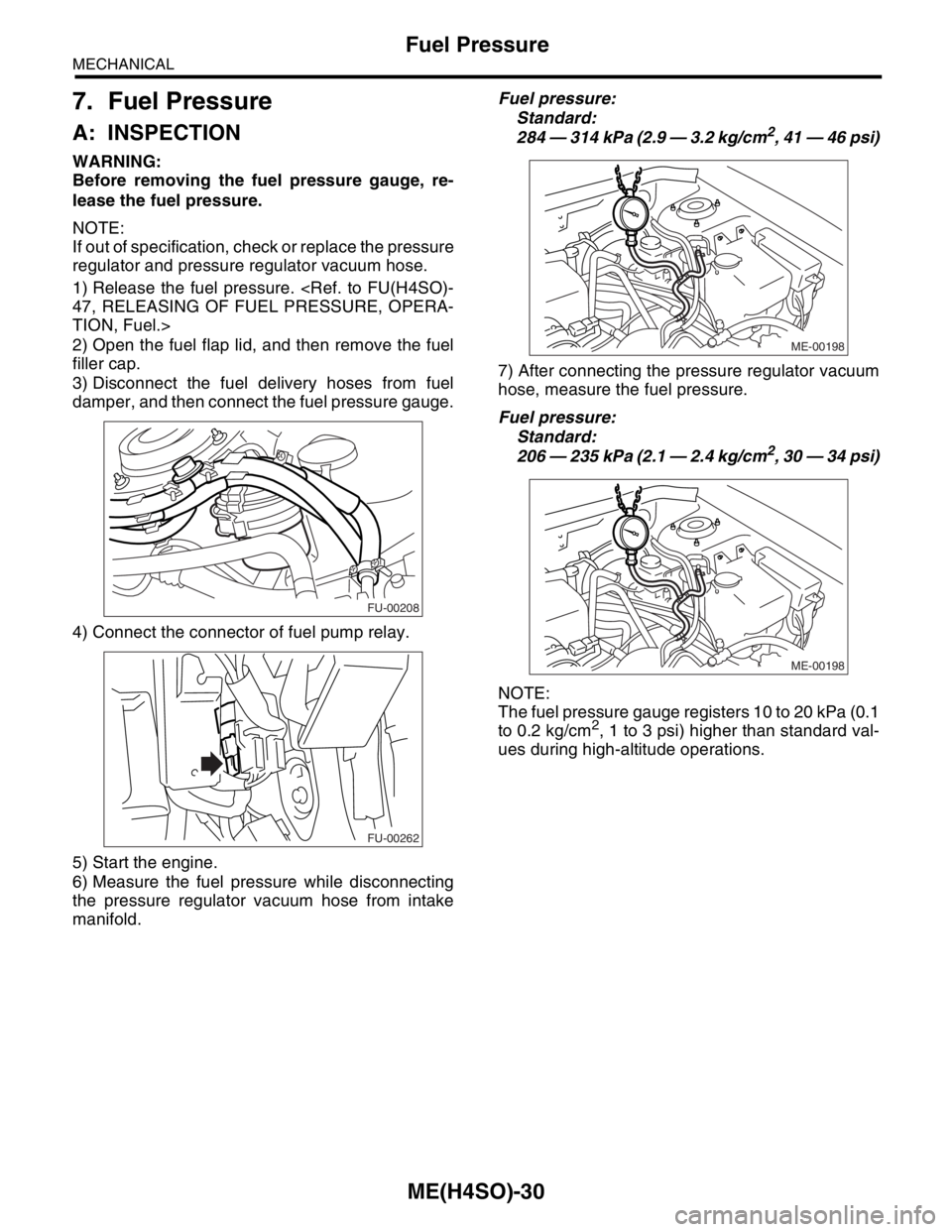
7. Fuel Pressure
A: INSPECTION
WARNING:
Before removing the fuel pressure gauge, re-
lease the fuel pressure.
NOTE:
If out of specification, check or replace the pressure
regulator and pressure regulator vacuum hose.
1) Release the fuel pressure.
TION, Fuel.>
2) Open the fuel flap lid, and then remove the fuel
filler cap.
3) Disconnect the fuel delivery hoses from fuel
damper, and then connect the fuel pressure gauge.
4) Connect the connector of fuel pump relay.
5) Start the engine.
6) Measure the fuel pressure while disconnecting
the pressure regulator vacuum hose from intake
manifold.Fuel pressure:
Standard:
284 — 314 kPa (2.9 — 3.2 kg/cm
2, 41 — 46 psi)
7) After connecting the pressure regulator vacuum
hose, measure the fuel pressure.
Fuel pressure:
Standard:
206 — 235 kPa (2.1 — 2.4 kg/cm
2, 30 — 34 psi)
NOTE:
The fuel pressure gauge registers 10 to 20 kPa (0.1
to 0.2 kg/cm
2, 1 to 3 psi) higher than standard val-
ues during high-altitude operations.
FU-00208
FU-00262
ME-00198
ME-00198
Page 974 of 2870

EX(H4SO)-6
EXHAUST
General Description
B: CAUTION
Wear working clothing, including a cap, protec-
tive goggles, and protective shoes during opera-
tion.
Remove contamination including dirt and corro-
sion before removal, installation or disassembly.
Keep the disassembled parts in order and pro-
tect them from dust or dirt.
Before removal, installation or disassembly, be
sure to clarify the failure. Avoid unnecessary re-
moval, installation, disassembly, and replacement.
Be careful not to burn your hands, because each
part on the vehicle is hot after running.
Be sure to tighten fasteners including bolts and
nuts to the specified torque.
Place shop jacks or rigid racks at the specified
points.
Before disconnecting electrical connectors of
sensors or units, be sure to disconnect the ground
cable from battery.
Page 993 of 2870

CO(H4SO)-10
COOLING
General Description
C: CAUTION
Wear working clothing, including a cap, protec-
tive goggles, and protective shoes during opera-
tion.
Remove contamination including dirt and corro-
sion before removal, installation or disassembly.
Keep the disassembled parts in order and pro-
tect them from dust or dirt.
Before removal, installation or disassembly, be
sure to clarify the failure. Avoid unnecessary re-
moval, installation, disassembly, and replacement.
Be careful not to burn your hands, because each
part in the vehicle is hot after running.
Be sure to tighten fasteners including bolts and
nuts to the specified torque.
Place shop jacks or rigid racks at the specified
points.
Before disconnecting electrical connectors of
sensors or units, be sure to disconnect the ground
cable from battery.
Page 998 of 2870

CO(H4SO)-15
COOLING
Radiator Fan System
6 CHECK HARNESS OF FUSE TERMINAL
AND MAIN FAN RELAY TERMINAL.
1) Turn the ignition switch to OFF.
2) Measure the resistance between 20 A fuse
terminal and main fan relay terminal.
Te r m i n a l
No. 2 — No. 31:Is the resistance less than 1
Ω?Repair the power
supply line.Repair the open
harness.
7 CHECK FUSE.
1) Turn the ignition switch to OFF
2) Remove the fuse No. 18.
3) Check the condition of fuse.Is the fuse blown out? Replace the fuse. Repair the power
supply line.
8 CHECK MAIN FAN RELAY.
1) Turn the ignition switch to OFF.
2) Measure the resistance between main fan
relay terminals.
Te r m i n a l
No. 30 — No. 31:Is the resistance more than 1
MΩ?Go to step 9.Replace the main
fan relay.
9 CHECK MAIN FAN RELAY.
1) Connect the battery to main fan relay termi-
nals No. 32 and No. 34.
2) Measure the resistance between main fan
relay terminals.
Te r m i n a l
No. 30 — No. 31:Is the resistance less than 1
Ω?Go to step 10.Replace the main
fan relay.
10 CHECK HARNESS BETWEEN MAIN FAN
RELAY TERMINAL AND MAIN FAN MOTOR
CONNECTOR.
1) Disconnect the connector from main fan
motor.
2) Measure the resistance between main fan
relay terminal and main fan motor connector.
Connector & terminal
Turbo AT model
(F17) No. 1 — (F27) No. 30:
Except turbo AT model
(F17) No. 2 — (F27) No. 30:Is the resistance less than 1
Ω?Go to step 11.Repair the open
harness between
main fan relay ter-
minal and main fan
motor connector.
11 CHECK HARNESS BETWEEN MAIN FAN
MOTOR CONNECTOR AND FAN MODE RE-
LAY CONNECTOR.
1) Remove the fan mode relay from A/C relay
holder.
2) Measure the resistance between main fan
motor connector and fan mode relay connec-
tor.
Connector & terminal
Turbo AT model
(F17) No. 2 — (F27) No. 9:
Except turbo AT model
(F17) No. 1 — (F27) No. 9:Is the resistance less than 1
Ω?Go to step 12.Repair the open
harness between
main fan motor
connector and fan
mode relay con-
nector.
12 CHECK POOR CONTACT.
Check poor contact in main fan motor connec-
tor.Is there poor contact in main
fan motor connector?Repair poor con-
tact in main fan
motor connector.Go to step 13.
13 CHECK MAIN FAN MOTOR.
Connect the battery positive (+) terminal to ter-
minal No. 2 (except turbo AT model), No. 1
(turbo AT model), and ground (−) terminal to
terminal No. 1 (except turbo AT model), No. 2
(turbo AT model) of main fan motor.Does the main fan rotate? Go to step 14.Replace the main
fan motor with new
one. Step Check Yes No
Page 999 of 2870

CO(H4SO)-16
COOLING
Radiator Fan System
14 CHECK FAN MODE RELAY.
Measure the resistance of fan mode relay.
Te r m i n a l
No. 6 — No. 9:Is the resistance less than 1
Ω?Go to step 15.Replace the fan
mode relay.
15 CHECK RESISTANCE BETWEEN FAN
MODE RELAY TERMINAL AND SUB FAN
MOTOR CONNECTOR.
1) Disconnect the connector from sub fan
motor.
2) Measure the resistance between fan mode
relay terminal and sub fan motor connector.
Connector & terminal
Turbo AT model
(F16) No. 1 — (F27) No. 6:
Except turbo AT model
(F16) No. 2 — (F27) No. 6:Is the resistance less than 1
Ω?Go to step 16.Repair the open
harness between
fan mode relay ter-
minal and sub fan
motor connector.
16 CHECK SUB FAN MOTOR AND GROUND
CIRCUIT.
Measure the resistance between sub fan motor
connector and chassis ground.
Connector & terminal
Turbo AT model
(F16) No. 2 — Chassis ground:
Except turbo AT model
(F16) No. 1 — Chassis ground:Is the resistance less than 5
Ω?Go to step 17.Repair the open
harness between
sub fan motor con-
nector and chassis
ground.
17 CHECK POOR CONTACT.
Check poor contact in sub fan motor connec-
tor.Is there poor contact in sub fan
motor connector?Repair poor con-
tact in sub fan
motor connector.Go to step 18.
18 CHECK SUB FAN MOTOR.
Connect the battery positive (+) terminal to ter-
minal No. 2 (except turbo AT model), No. 1
(turbo AT model), and ground (−) terminal to
terminal No. 1 (except turbo AT model), No. 2
(turbo AT model) of sub fan motor.Does the sub fan rotate? Go to step 19.Replace the sub
fan motor with new
one.
19 CHECK HARNESS BETWEEN MAIN FAN
RELAY AND ECM.
1) Disconnect the connector from ECM.
2) Measure the resistance between fan relay 1
terminal and ECM connector.
Connector & terminal
Turbo model
(B135) No. 25 — (F27) No. 32:
Non-turbo model
(B134) No. 14 — (F27) No. 32:Is the resistance less than 1
Ω?Go to step 20.Repair the open
harness between
fan relay 1 terminal
and ECM.
20 CHECK POOR CONTACT.
Check poor contact in ECM connector.Is there poor contact in ECM
connector?Repair poor con-
tact in ECM con-
nector.Contact with SUB-
ARU dealers.
21 CHECK POWER SUPPLY TO SUB FAN RE-
LAY.
1) Turn the ignition switch to OFF.
2) Remove the sub fan relay from A/C relay
holder.
3) Measure the voltage between sub fan relay
terminal and chassis ground.
Connector & terminal
(F27) No. 28 (+) — Chassis ground (
−):Is the voltage more than 10 V? Go to step 22.Go to step 23. Step Check Yes No
Page 1000 of 2870

CO(H4SO)-17
COOLING
Radiator Fan System
22 CHECK POWER SUPPLY TO SUB FAN RE-
LAY.
1) Turn the ignition switch to ON.
2) Measure the voltage between sub fan relay
terminal and chassis ground.
Connector & terminal
(F27) No. 25 (+) — Chassis ground (
−):Is the voltage more than 10 V? Go to step 26.Go to step 25.
23 CHECK FUSE.
1) Remove the fuse from A/C relay holder.
2) Check the condition of fuse.Is the fuse blown out? Replace the fuse. Go to step 24.
24 CHECK HARNESS BETWEEN FUSE TERMI-
NAL AND SUB FAN RELAY TERMINAL.
1) Turn the ignition switch to OFF.
2) Measure the resistance between fuse ter-
minal and sub fan relay terminal.
Te r m i n a l
No. 4 — No. 28:Is the resistance less than 1
Ω?Repair the power
supply line.Repair the open
harness.
25 CHECK FUSE.
1) Turn the ignition switch to OFF.
2) Remove the fuse No. 17.
3) Check the condition of fuse.Is the fuse blown out? Replace the fuse. Repair the power
supply line.
26 CHECK SUB FAN RELAY.
1) Turn the ignition switch to OFF.
2) Remove the sub fan relay from A/C relay
holder.
3) Measure the resistance of sub fan relay.
Te r m i n a l
No. 28 — No. 29:Is the resistance more than 1
MΩ?Go to step 27.Replace the sub
fan relay.
27 CHECK SUB FAN RELAY.
1) Connect the battery to terminals No. 25 and
No. 27 of sub fan relay.
2) Measure the resistance of sub fan relay.
Te r m i n a l
No. 28 — No. 29:Is the resistance less than 1
Ω?Go to step 28.Replace the sub
fan relay.
28 CHECK HARNESS BETWEEN SUB FAN RE-
LAY TERMINAL AND SUB FAN MOTOR
CONNECTOR.
1) Disconnect the connector from sub fan
motor.
2) Measure the resistance between sub fan
relay terminal and sub fan motor connector.
Connector & terminal
Turbo AT model
(F16) No. 1 — (F27) No. 29:
Except turbo AT model
(F16) No. 2 — (F27) No. 29:Is the resistance less than 1
Ω?Go to step 30.Repair the open
harness between
sub fan relay ter-
minal and sub fan
motor connector.
29 CHECK HARNESS BETWEEN SUB FAN RE-
LAY AND ECM.
1) Disconnect the connector from ECM.
2) Measure the resistance between sub fan
relay terminal and ECM connector.
Connector & terminal
Non-turbo model: (B134) No. 13 — (F27)
No. 27:
Turbo model: (B135) No. 24 — (F27) No.
27:Is the resistance less than 1
Ω?Go to step 30.Repair the open
harness between
sub fan relay ter-
minal and ECM. Step Check Yes No
Page 1009 of 2870
CO(H4SO)-26
COOLING
Thermostat
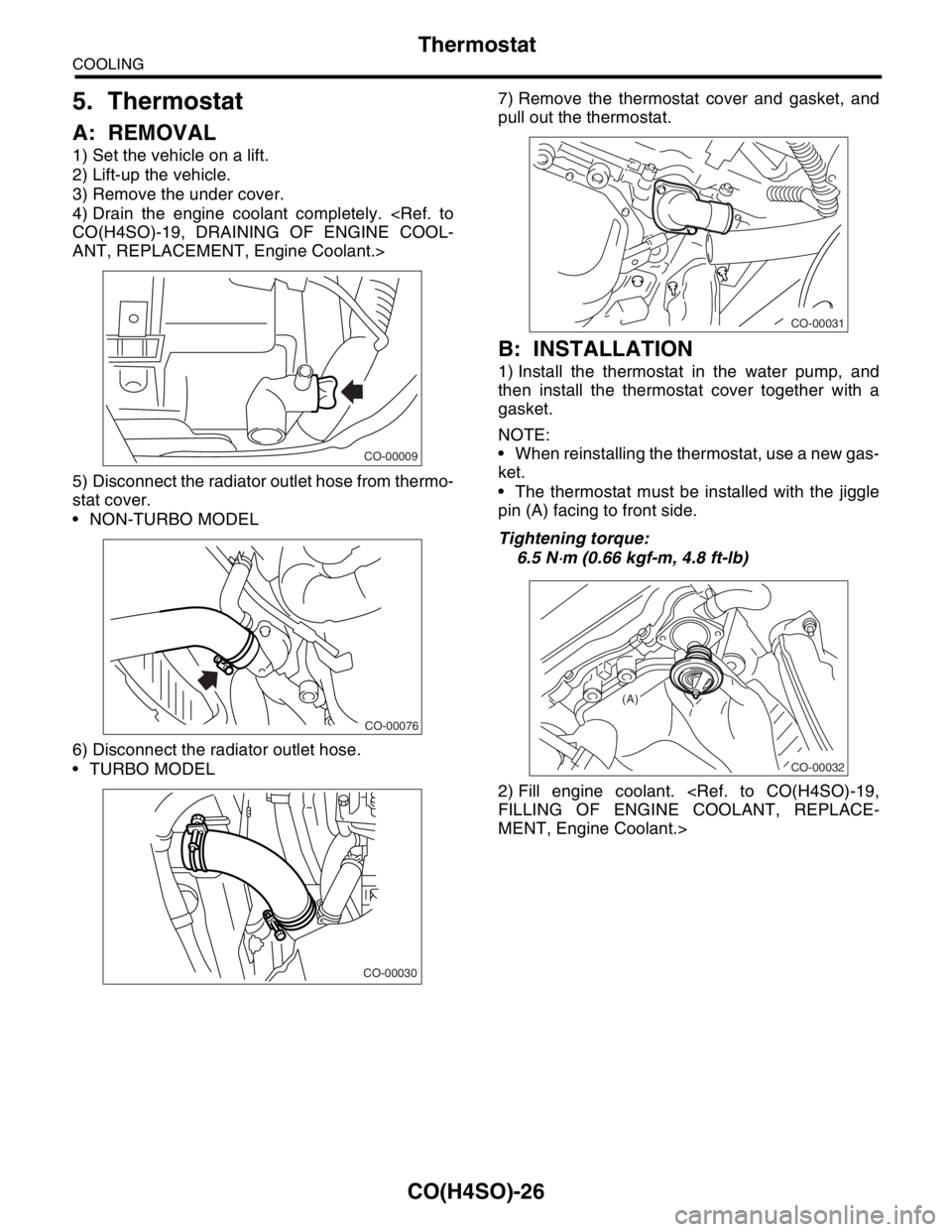
5. Thermostat
A: REMOVAL
1) Set the vehicle on a lift.
2) Lift-up the vehicle.
3) Remove the under cover.
4) Drain the engine coolant completely.
ANT, REPLACEMENT, Engine Coolant.>
5) Disconnect the radiator outlet hose from thermo-
stat cover.
NON-TURBO MODEL
6) Disconnect the radiator outlet hose.
TURBO MODEL7) Remove the thermostat cover and gasket, and
pull out the thermostat.
B: INSTALLATION
1) Install the thermostat in the water pump, and
then install the thermostat cover together with a
gasket.
NOTE:
When reinstalling the thermostat, use a new gas-
ket.
The thermostat must be installed with the jiggle
pin (A) facing to front side.
Tightening torque:
6.5 N
⋅m (0.66 kgf-m, 4.8 ft-lb)
2) Fill engine coolant.
MENT, Engine Coolant.>
CO-00009
CO-00076
CO-00030
CO-00031
CO-00032
(A)
Page 1011 of 2870
CO(H4SO)-28
COOLING
Radiator
6. Radiator
A: REMOVAL
1. NON-TURBO MODEL
WARNING:
The radiator is pressurized. Wait until the en-
gine cools down before working on the radia-
tor.
1) Set the vehicle on a lift.
2) Disconnect the ground cable from battery.
3) Lift-up the vehicle.
4) Remove the under cover.
5) Drain the engine coolant completely.
ANT, REPLACEMENT, Engine Coolant.>
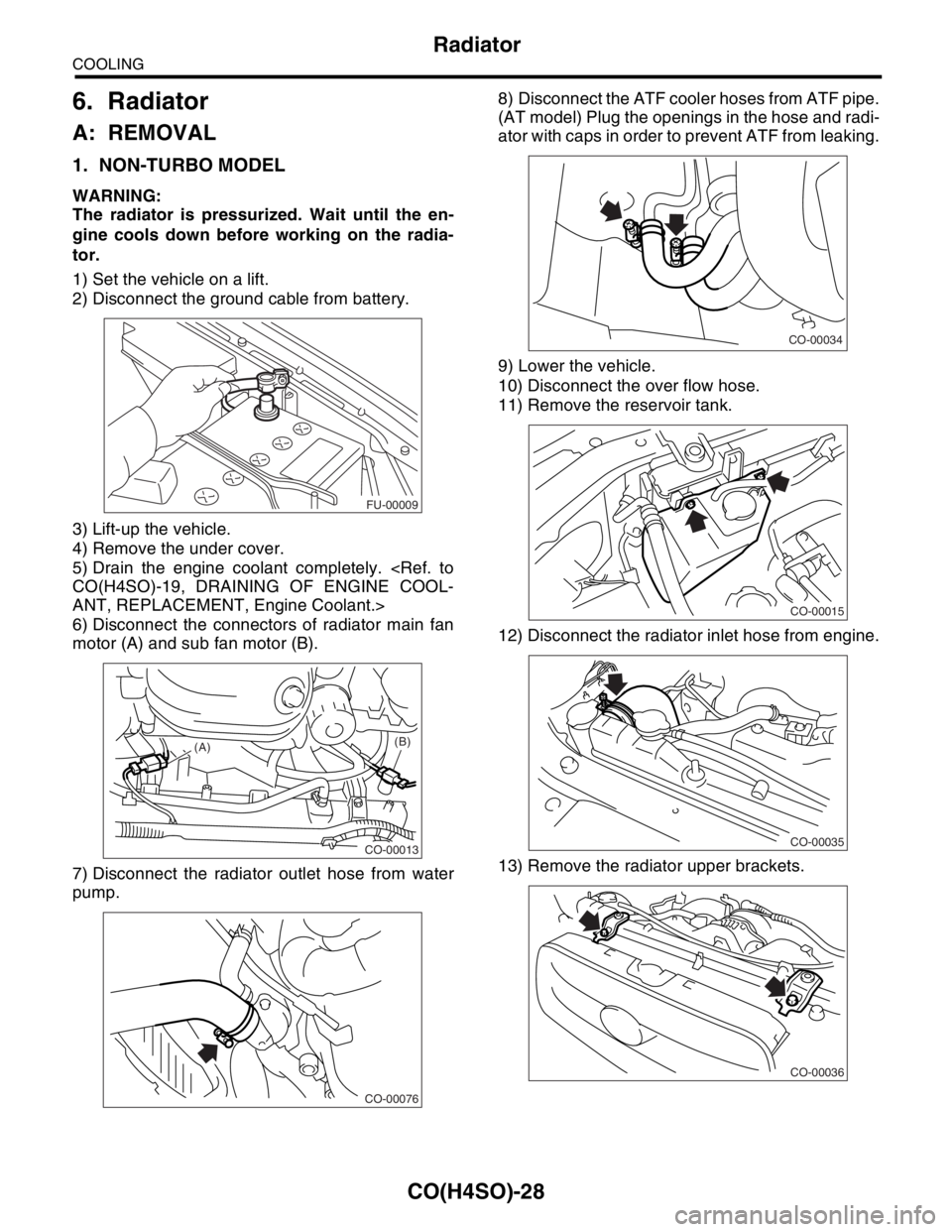
6) Disconnect the connectors of radiator main fan
motor (A) and sub fan motor (B).
7) Disconnect the radiator outlet hose from water
pump.8) Disconnect the ATF cooler hoses from ATF pipe.
(AT model) Plug the openings in the hose and radi-
ator with caps in order to prevent ATF from leaking.
9) Lower the vehicle.
10) Disconnect the over flow hose.
11) Remove the reservoir tank.
12) Disconnect the radiator inlet hose from engine.
13) Remove the radiator upper brackets.
FU-00009
CO-00013
(A)(B)
CO-00076
CO-00034
CO-00015
CO-00035
CO-00036