2003 SKODA FABIA lock
[x] Cancel search: lockPage 105 of 233

Automatic gearbox*
104
Selector lever positions
The selector lever position you have engaged is shown in the information
display of the instrument cluster with the corresponding gear symbol high-
lighted ⇒fig. 88. P - Parklock
The driven wheels are locked mechanically in this position.
The Parklock must only be engaged when the vehicle is stationary
⇒.
If you wish to move the selector lever into or out of this position, you must
press the Shiftlock button in the handle of the selector lever and at the
same time depress the brake pedal.
R - Reverse
Reverse gear must only be engaged when the vehicle is stationary and
the engine idling ⇒.
The brake pedal must be depressed and at the same time the Shiftlock
must be pressed, if you wish to obtain the selector lever positions R, P or
N.
The reversing lights come on when the selector lever is moved into posi-
tion R when the ignition is also on .
N - Neutral
The transmission is in Neutral in this position.
The brake pedal must be depressed and the Shiftlock in the selector lever
grip must be pressed (if the selector lever is in its position for longer than
2 seconds) in order to move the selector lever out of the N position, with
the ignition switched on, on a vehicle travelling at less than 5 km/hour or
on a stationary vehicle.
D - Drive, position for driving forward
With the selector lever in this position the forward gears are shifted up and
down automatically in line with engine load, driving style and vehicle
speed.
You must depress the brake pedal ⇒ if you wish to move the selector
lever into position D from N when the vehicle is travelling at less than
5 km/hour or is stationary.
Fig. 87 Selector lever
Fig. 88 Information
display in the instru-
ment cluster Selector
lever positions
Page 106 of 233

Automatic gearbox*105
Using the systemSafetyDriving TipsGeneral MaintenanceBreakdown assist-
anceTechnical DataFabia Praktik
3 - Position when driving in hilly areas
We recommend selection of this position when the gearbox is often
changing gear under certain driving conditions with the selector lever at D.
The gearbox shifts up and down automatically into first, second and third
gear in line with engine load, driving style and vehicle speed. Fourth gear
remains locked out in this case. This makes it possible to exploit greater
engine braking power when the accelerator is released
⇒.
The Shiftlock on the selector lever grip must be pressed when moving out
of position 3 into position D.
2 - Position when driving in mountainous regions
This position of the selector lever is suitable for long sloping sections.
The gearbox shifts up and down automatically into first and second gear
in line with engine load, driving style and vehicle speed. The third and
fourth gears remain locked out in order to avoid unnecessary gear
changes. Enhanced engine braking power is thus available.
The Shiftlock on the selector lever grip must be pressed when moving out
of position 3 into position 2.
1 - Position for extreme mountainous sections
This position of the selector lever is suitable for very steep sections of
road.
The vehicle will only drive first gear. The second, third and fourth gears
remain locked out. This position offers you the maximum possible engine
braking power.
The Shiftlock on the selector lever grip must be pressed when moving out
of position 2 into position 1.
The cruise control system is locked in position 1.
Note
•Take your foot off the accelerator if you inadvertently shift into N when
driving and wait until the engine speed has dropped to the idling speed
range before shifting into D.
•If you shift gear manually it is possible to select positions 3, 2 and 1 ,
but the automatic gearbox will not shift down until there is no risk of the
engine overrevving.
WARNING
•Never move the selector lever into position R or P when driving
- risk of an accident!
•When the engine is running and the vehicle is stationary, it is
necessary to hold the car with the brake pedal in all the positions
of the selector lever (except P and N) since the power transmission
is never completely interrupted, also not when the engine is idling
- the vehicle "creeps".
•You must on no account unintentionally operate the throttle
(e.g. by hand from the engine compartment) if a drive position is
engaged when the car is stationary. The vehicle would otherwise
immediately start off - also when the handbrake is firmly applied -
risk of an accident!
•You must move the selector lever into position P and firmly
apply the handbrake first before you or any other person opens the
bonnet and starts working on the engine when it is running - risk
of accident!
Page 107 of 233

Automatic gearbox*
106
Selector lever lock
Automatic selector lever lock
With the ignition on, the selector lever is locked when it is in the positions
P and N. You must depress the brake pedal first and press the Shiftlock
button at the same time in order to move the selector lever out of these
positions. The following will be displayed in the information display*:
P LOCKED
or
N LOCKED
Symbol
also lights up in the selector lever cover until the brake pedal
is actuated.
A time delay element ensures that the selector lever is not blocked when
rapidly switching over the position N (e.g. from R to D). This does, for
example, allow one to seesaw out a stuck vehicle. The selector lever lock
will click into place if the lever is in the N position for more than 2 seconds
without the brake pedal being pressed.
The selector lever lock is only active if the vehicle is stationary or moving
at speed of less than 5 km/hour. The lock is switched off automatically into
position N when the car is travelling at a higher speed.
Shiftlock button
The Shiftlock button in the handle of selector lever prevents certain
selector lever positions being engaged inadvertently. The selector lever
lock is cancelled when you press the Shiftlock button.
Kickdown function
The kickdown function provides you with maximum accel-
eration power.
Depressing the accelerator pedal beyond the pressure point casues the
automatic gearbox to shift down into a lower gear (in line with vehicle
speed and engine speed). The gearbox shifts up into the next higher gear
when the engine has reached its maximum revolations.
Dynamic shift programme
The automatic gearbox of your vehicle is controlled electronically. Shifting
up and down through the gears is performed automatically on the basis of
pre-defined driving programmes.
Adopting a moderate style of driving will cause the gearbox to select the
most economical driving programme. Shifting up into a higher gear as
soon as possible and shifting down as late as possible will have a favour-
able effect on your fuel consumption.
Adopting a faster style of driving with rapid movements of the acceler-
ator pedal combined with sharp acceleration and frequent changes in
speed, exploiting the top speed of the car or operating the kickdown func-
tion, will cause the gearbox to switch over to the sporty driving
programme. Shifting up later into a higher gear makes it possible to fully
exploit the power reserves of the engine. The gearbox also then shifts
WARNING
Please note that using the kickdown function can result in the
driven wheels spinning on a smooth or slippery road surface - risk
of skidding!
Page 109 of 233

Communication
108
Communication
Universal telephone connection*
A telephone mount is factory-fitted. The mount is attached to the
centre console. The “Cullmann” adapter and mobile phone are
not factory-fitted.
Initialisation
– Withdraw the ignition key.
– First insert the adapter with the mobile phone into the mount
in the direction of arrow ⇒fig. 89 until the adapter is
touching the stop. Press the adapter slightly in the direction of
arrow until it locks into position. – Plug the adapter cable into the mobile phone socket. The
power socket is located under the front passenger storage
compartment.
– Switch on the ignition.
– Wait for approximately 15 seconds, switch off ignition.
– Insert the mobile phone into the adapter (as specified in manufacturer's instructions).
Removing the mobile phone and adapter
– Press the button and remove the mobile telephone.
An initialisation must be carried out:
•after the first connection of the adapter
•after reconnecting the battery
•after pulling out the adapter cable from the power socket for the mobile
phone
This enables you to make full use of the advantages of a normal carphone
(“handsfree system” using a microphone integrated in the vehicle, optimal
transmission of signals using an external aerial etc.). The battery of the
mobile phone is also constantly charged.
Please contact your Škoda dealer if there are any points which are not
clear.
Please also refer to the additional instructions ⇒page 109, “Mobile
phones and two-way radio systems”.
Fig. 89 Universal tele-
phone connection
ABA1
A2
AA
AC
Page 115 of 233

Seat belts
114
Important safety information regarding
the use of seat belts
The correct use of the seat belts considerably reduces the
risk of injury!
WARNING
•The belt webbing must not be jammed in-between at any point
or twisted, or chafe against any sharp edges.
•No two persons (also not children) should ever use a single
seat belt together.
•The maximum protection which seat belts can offer is only
achieved if you are correctly seated ⇒page 63.
•The belt webbing must not run across solid or fragile objects
(e.g. spectacles, ball-point pens, keys etc.) as this may be a cause
of injuries.
•Bulky, loose clothing (e.g. a winter coat over a jacket) does not
allow you to be correctly seated and impairs proper operation of
the seat belts.
•It is prohibited to use clamps or other objects to adjust seat
belts (e.g. for shortening the belts for smaller persons).
•The lock tongue should only be inserted into the lock which is
the correct one for your seat. Wrong use of the safety belt will
reduce its capacity to protect.
•The backrests of the front seats must not be tilted too far to the
rear otherwise the seatbelts can lose their effectiveness.
•The belt webbing must always be kept clean. Soiled belt
webbing may impair proper operation of the inertia reel
⇒ page 165.
WARNING (continued)
•The slot of the belt tongue must not be blocked by paper or
similar objects otherwise the belt tongue will not lock in place
properly.
•Damaged seat belts which have been subjected to stress in an
accident and were therefore stretched, must be replaced - this is
best done by a Škoda dealer. The anchorage points of the belts
must also be inspected. The anchorage points for the belts should
also be checked.
•In certain export countries it is possible to use seat belts which
differ in terms of their operation from the inertia reel and lap belts
which are described on the pages which follow.
Page 116 of 233

Seat belts115
Using the systemSafetyDriving TipsGeneral MaintenanceBreakdown assist-
anceTechnical DataFabia Praktik
How are seat belts correctly fastened?
Fastening a three-point seat belt
Fasten your seat belt before starting!
– Correctly adjust the front seat and the head restraint before
fastening your seat belt ⇒page 63.
– Slowly pull the belt webbing at the tongue of the lock over your chest and pelvis ⇒.
– Insert the tongue of the lock into the seat belt buckle belonging
to the seat until it is heard to lock in place.
– Pull on the belt to check that it has also reliably engaged in the lock.
Each three-point seat belt is equipped with an inertia reel. This inertia reel
offers you complete freedom of movement if the belt is unreeled slowly. If
the brakes are applied suddenly, the inertia reel will block. It also blocks
the seat belts when the vehicle accelerates, is driving uphill, is in a tilted
position and when cornering.
Expectant mothers must also wear the seat belt ⇒.
Fig. 93 Routing of
webbing over the
shoulders and the lap
belt
Fig. 94 Routing of belt
webbing for an
expectant mother
WARNING
•The shoulder part of the seat belt must never run across your
neck but must run approximately over the middle of the shoulder
and fit snugly against the chest. The lap part of the belt must run
across the hip and must never be routed across the stomach. It
must always fit snugly ⇒fig. 93 . Adjust the belt webbing as
required.
•The lap part of the belt should be positioned as low as possible
at the pelvis of an expectant mother in order to avoid exerting any
pressure on the lower abdomen.
•Always ensure that the webbing of the seat belts is properly
routed. Seat belts which are not correctly adjusted can themselves
cause injuries even in minor accidents.
Page 117 of 233
Seat belts
116
Seat belt height adjuster
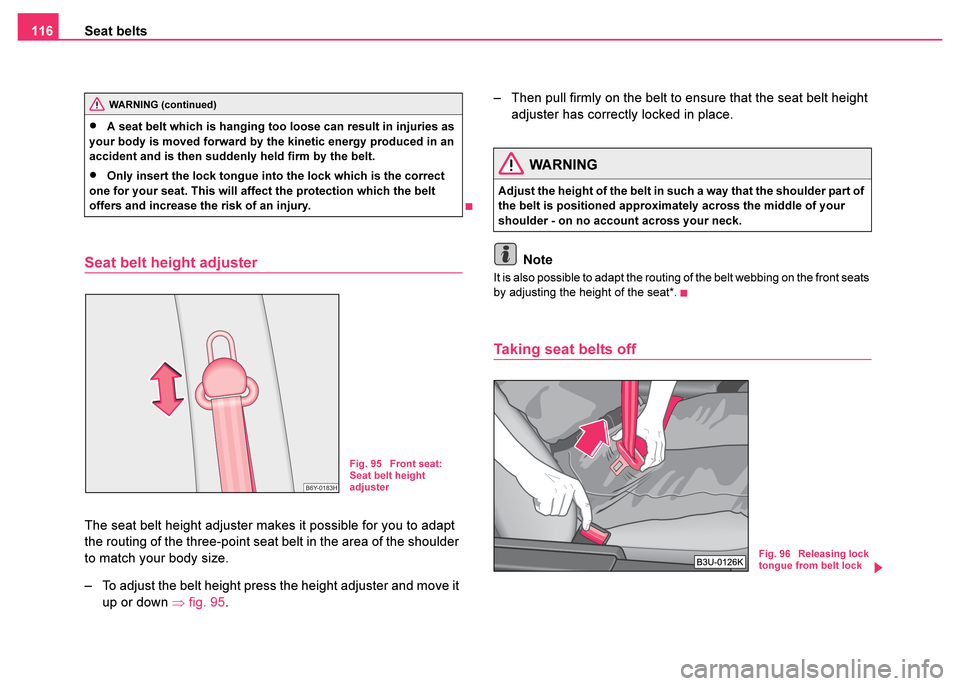
The seat belt height adjuster makes it possible for you to adapt
the routing of the three-point seat belt in the area of the shoulder
to match your body size.
– To adjust the belt height press the height adjuster and move it
up or down ⇒fig. 95 . – Then pull firmly on the belt to ensure that the seat belt height
adjuster has correctly locked in place.
Note
It is also possible to adapt the routing of the belt webbing on the front seats
by adjusting the height of the seat*.
Taking seat belts off
WARNING (continued)
•A seat belt which is hanging too loose can result in injuries as
your body is moved forward by the kinetic energy produced in an
accident and is then suddenly held firm by the belt.
•Only insert the lock tongue into the lock which is the correct
one for your seat. This will affect the protection which the belt
offers and increase the risk of an injury.
Fig. 95 Front seat:
Seat belt height
adjuster
WARNING
Adjust the height of the belt in such a way that the shoulder part of
the belt is positioned approximately across the middle of your
shoulder - on no account across your neck.
Fig. 96 Releasing lock
tongue from belt lock
Page 118 of 233
Seat belts117
Using the systemSafetyDriving TipsGeneral MaintenanceBreakdown assist-
anceTechnical DataFabia Praktik
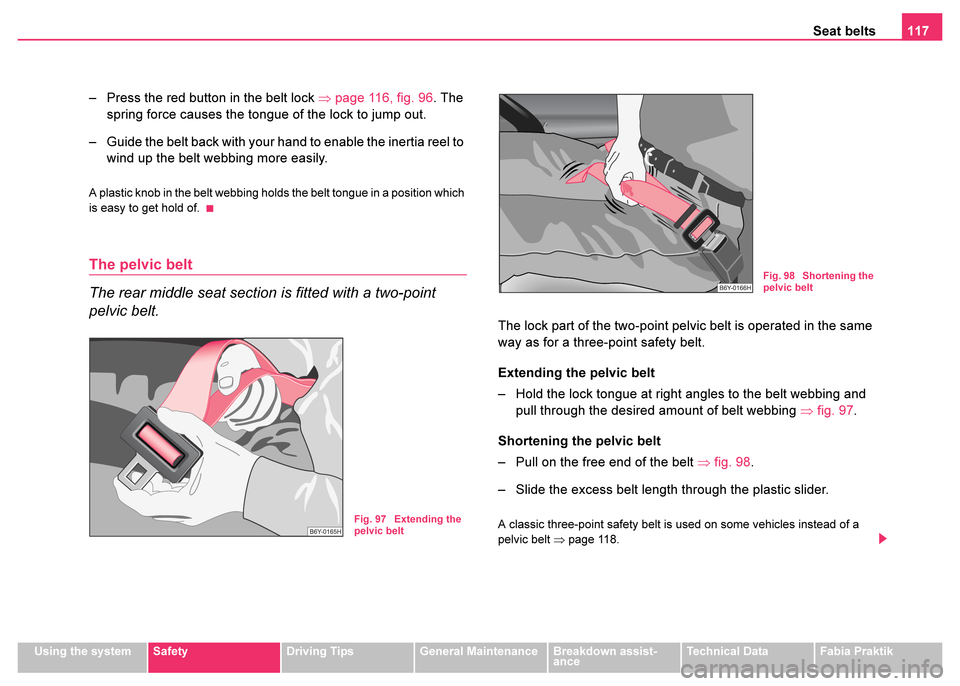
– Press the red button in the belt lock ⇒page 116, fig. 96 . The
spring force causes the tongue of the lock to jump out.
– Guide the belt back with your hand to enable the inertia reel to wind up the belt webbing more easily.
A plastic knob in the belt webbing holds the belt tongue in a position which
is easy to get hold of.
The pelvic belt
The rear middle seat section is fitted with a two-point
pelvic belt.
The lock part of the two-point pelvic belt is oper ated in the same
way as for a three-point safety belt.
Extending the pelvic belt
– Hold the lock tongue at right angles to the belt webbing and pull through the desired amount of belt webbing ⇒fig. 97 .
Shortening the pelvic belt
– Pull on the free end of the belt ⇒fig. 98 .
– Slide the excess belt length through the plastic slider.
A classic three-point safety belt is used on some vehicles instead of a
pelvic belt ⇒page 118.Fig. 97 Extending the
pelvic belt
Fig. 98 Shortening the
pelvic belt