Page 51 of 233

Unlocking and locking
50
The sun screen is also opened automatically when the roof slides open.
You can slide the sun screen into the opened or closed position by hand
when the sliding/tilting roof is closed.
Caution
It may be necessary during winter to remove any ice and snow in the area
of the sliding/tilting roof before opening it in order to prevent damaging the
opening mechanism.
Closing
Sliding closed/closing the sliding/tilting roof
– Turn the switch to position ⇒page 49, fig. 28 .
Safety closing
The sliding/tilting roof is equipped with an overload protection system. The
sliding/tilting roof stops and returns when it cannot be closed because
there is something in the way (e.g. ice). You can close the sliding/tilting
roof completely without overload protection by pressing the switch to the
position ⇒ page 49, fig. 28 at the front for as long as it takes for the
sliding/tilting roof to shut completely ⇒.
Convenience operation
You can also close an open sliding/tilting roof from the outside. – Turn the key in the lock of the driver's door into the closing
position and hold until the sliding/tilting roof is closed ⇒.
The closing process stops when one releases the key.
Emergency operation
You can close the sliding/tilting roof by hand if the system is
defect.
– Carefully remove the plastic covering using a screwdriver.
WARNING
Close the sliding/tilting roof carefully - risk of injury!
AA
AA
WARNING
Close the sliding/tilting roof carefully - risk of injury! The overload
protection system does not function with the convenience closing.
Fig. 29 Detail of the
headliner: Emergency
operation
Page 52 of 233
Unlocking and locking51
Using the systemSafetyDriving TipsGeneral MaintenanceBreakdown assist-
anceTechnical DataFabia Praktik
– Remove the crank from its holder, insert it in the opening down
to the stop and then turn it to close or open the sliding/tilting
roof.
– Put the crank into its holder and place the covering in place again.
– Have the fault rectified by a Škoda Dealer.
Note
If the sliding/tilting roof has been closed through taking emergency meas-
ures press the control dial at the front on the edge of the grip for more than
3 seconds with the switch in the ⇒page 49, fig. 28 position and the
ignition switched on. The sliding/tilting roof will now close properly.
AA
Page 57 of 233

Lights and Visibility
56
Interior lighting
Front interior lighting and storage compartment on
front passenger side
Door contact switching mechanism (on the front and rear*
door)
– Press the switch ⇒fig. 34 to the right into position
.
Switching the interior light on
– Press the switch to the left into position
.
Switching the interior light off
– Press the switch into the middle position O.Reading lights
\b
– Press on one of the switches in order to switch the right or
left reading light on or off.
Lighting of storage compartment on the front passenger
side
– Open the flap of the storage compartment on the front passenger side.
– The light switches on automatically when the parking light is switched on and goes out when the flap is closed.
The interior light is switched on for about 20 seconds when a vehicle with
a central locking system is unlocked, when a door is opened or when the
ignition key is removed. The requirement for this is that the switch is in the
door contact position. The inner light goes out out immediately after the
ignition is switched on.
A time delay switch* causes the inner lighting on vehicles without a central
locking system stays on for a few seconds after the doors have been
closed. The inner light goes out out immediately after the ignition is
switched on.
The interior lighting is switched off after about 30 minutes when a door has
been left open in order to avoid discharging the battery of the vehicle.
Fig. 34 Detail of the
headliner: front interior
lighting
AA
AA
AA
AB
Page 62 of 233

Lights and Visibility61
Using the systemSafetyDriving TipsGeneral MaintenanceBreakdown assist-
anceTechnical DataFabia Praktik
Attaching a wiper blade
– Push the wiper blade over the wiper arm. The securing spring
must click into place audibly.
Windscreen wiper blades in proper condition are essential to obtain good
visibility. Wiper blades should not be allowed to become dirtied by dust,
insect remains and preserving wax.
Juddering or smearing of the wiper blades could be due to wax residues
left on the windscreen by vehicle washing in automatic vehicle wash
systems. It is therefore important to degrease the lips of the winscreen
wiper blades after every pass through an automatic vehicle wash
system .
Replacing the wiper blade on the rear window wiper
Taking off the wiper blade
– Fold the window wiper arm away ⇒fig. 41 .
– Hold the window wiper arm at the top end with one hand.
– Take hold of the wiper blade with the other hand and pull the wiper blade in the direction of arrow .
Attaching a wiper blade
– Interlock the wiper blade into the window wiper arm - see arrow .
The same remarks apply here as for ⇒page 60, “Replacing wiper blades
on the windscreen wipers”.
WARNING
•There is a risk of damage to the windscreen if the windscreen
wiper is used carelessly.
•You should clean the wiper blades regularly with a windscreen
cleaner in order to avoid any smears. Clean a wiper blade with a
sponge or cloth if it is very dirty, for example from insect residues.
•Replace the windscreen wiper blades once or twice a year for
safety reasons. Windscreen wiper blades are available from Škoda
dealers.
Fig. 41 Wiper blade for
the rear window
AA
AB
Page 65 of 233

Seats and Stowage
64
– Release the lever and push the seat further until the lock is heard to engage.
Adjusting height of seat*
– Lift the seat if required by pulling or pumping lever upwards.
– Lower the seat if required by pushing or pumping lever downwards.
Adjusting angle of backrest
– Relieve any pressure on the backrest (do not lean on it) and turn the handwheel to adjust the angle of the backrest.
The driver's seat should be adjusted in such a way that the pedals can be
pressed to the floor with slightly bent legs.
The backrest on the driver's seat should be adjusted in such a way that
the upper point of the steering wheel can be easily reached with slightly
bent arms.
Caution
Vehicles in the Praktik version should not experience contact between the
backrest and the partition wall after adjusting the angle of the backrest
since there is danger of damage to the seat cover through rubbing when
driving.
WARNING
•Only adjust the driver seat when the vehicle is stationary - risk
of injury!
•Take care when adjusting the seat! Adjusting the seat without
care can lead to bruises or injuries.
•The backrests must not be angled too far back when driving
otherwise this will affect proper operation of the seat belts and of
the airbag system - risk of injury!
A1
A2
A2
A3
Page 66 of 233

Seats and Stowage65
Using the systemSafetyDriving TipsGeneral MaintenanceBreakdown assist-
anceTechnical DataFabia Praktik
Head restraintsAdjusting the height of a head restraint
– Grasp the side of the head restraint with both hands and push
it up or down in direction of arrow ⇒fig. 44 . Best protection
is achieved if the top edge of the head restraint is at least at
eye level or higher.
Adjusting the angle of a head restraint*
– The head restraint can be matched to the head of the occu- pant by adjusting the angle in the direction of the arrow
⇒fig. 44 . Adjusting the angle of the head restraint provides
enhanced comfort for the user.
Removing and installing a head restraint
– Pull the head restraint up out of the backrest of the seat as far as the stop (on the rear head restraints fold down the seat
backrest).
– Press the locking button in direction of arrow ⇒fig. 45 and
pull the head restraint out.
– To re-insert the head restraint, push it down into the backrest of the seat far enough until you hear the locking button
engage.
The head restraints on the front seats can be adjusted for tipping angle*
and height. The outer head restraints are not adjustable for height. The
middle head restraints* can be adjusted to two settings ⇒page 66.
The head restraints must be adjusted to match the size of the seat occu-
pant. Correctly adjusted head restraints together with the seat belts offer
effective protection for the occupants.
Fig. 44 Adjusting head
restraint
Fig. 45 Removing a
head restraint
AA
AB
Page 67 of 233
Seats and Stowage
66
Caution
Vehicles in the Praktik version should not experience contact between the
head restraint cover and the partition wall after adjusting the head
restraints since there is danger of damage to the seat cover through
rubbing when driving.
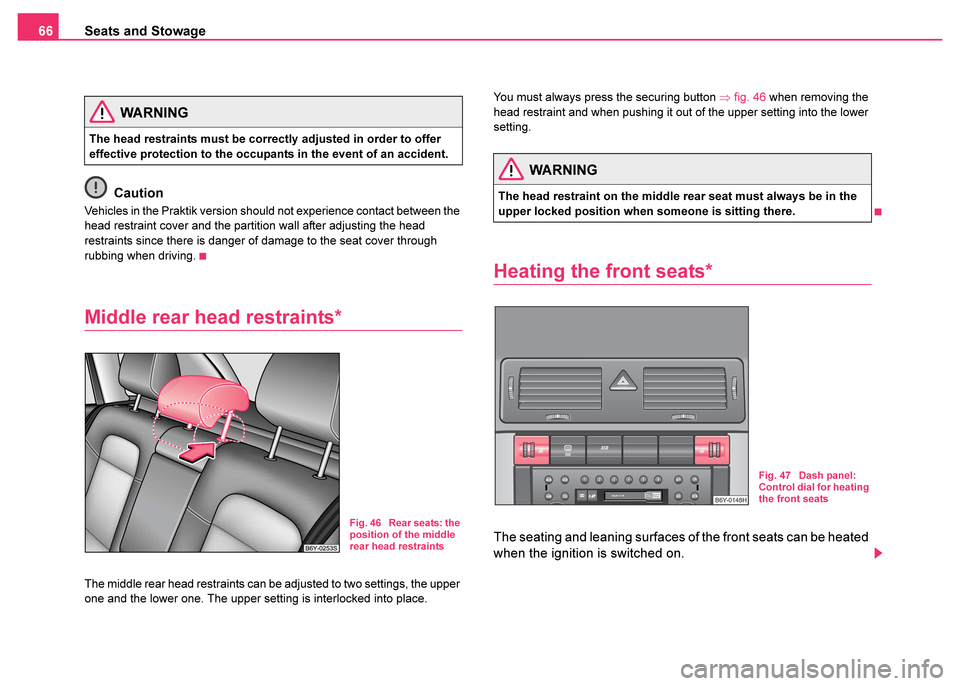
Middle rear head restraints*
The middle rear head restraints can be adjusted to two settings, the upper
one and the lower one. The upper setting is interlocked into place. You must always press the securing button
⇒fig. 46 when removing the
head restraint and when pushing it out of the upper setting into the lower
setting.
Heating the front seats*
The seating and leaning surfaces of the front seats can be heated
when the ignition is switched on.
WARNING
The head restraints must be correctly adjusted in order to offer
effective protection to the occupants in the event of an accident.
Fig. 46 Rear seats: the
position of the middle
rear head restraints
WARNING
The head restraint on the middle rear seat must always be in the
upper locked position when someone is sitting there.
Fig. 47 Dash panel:
Control dial for heating
the front seats
Page 68 of 233
Seats and Stowage67
Using the systemSafetyDriving TipsGeneral MaintenanceBreakdown assist-
anceTechnical DataFabia Praktik
Front seats
– Heating on the driver's ⇒page 66, fig. 47 and front
pasenger's seat can be switched on and regulated by turning
the control dial as required.
– The system is switched off by turning the control dial to the home position “0”.
Caution
•You should not kneel on the seats and avoid applying pressure at
specific points in order to avoid damaging the heating elements of the seat
heaters.
•Do not clean the seats moist ⇒page 164.
Note
The seat heating should only be switched on when the engine is running.
This has a significant effect of saving on the battery capacity.
Rear seats
Folding the rear seats forwards
Fig. 48 Folding the
rear seats forwards
Fig. 49 Unlock the seat
backrests

