2003 SKODA FABIA lock
[x] Cancel search: lockPage 119 of 233
Seat belts
118
Three-point safety belt for the middle rear seat*
It is used in the same way as the normal three-point seat belts on the left
and right (at front and rear). The middle three-point seat belt must be put
on first to allow the pelvic part of the belt to be pulled through between the
belt lock for the right three-point seat belt and the backrest, while avoiding
crossing the belt webbing of the middle and side seat belts.
Belt tensioners
Safety for the driver and front passenger wearing their seat belts is
enhanced by the belt tensioners fitted to the inertia reels of the front three-
point seat belts. The fastened three-point seat belts are automatically tensioned in the
event of a frontal collision of a certain severity. On vehicles fitted with side
airbags, a seat belt which is not fastened is also tensioned.
The belt tensioner is deployed in the event of a frontal collision of major
severity. A powder charge is ignited in the inertia reels during deployment.
The belt webbing is pulled into the inertia reels by a mechanical system
and the belt is tensioned.
Belt tensioners are not activated in the event of minor frontal collisions,
side and rear-end collisions, in the case of a rollover and also not in acci-
dents in which no major forces are produced from the front.
Note
•Smoke is generated when the belt tensioners are deployed. This is not
an indication of a fire in the vehicle.
•It is essential to pay attention to relevant safety regulations if the
vehicle or individual parts of the system are scrapped. Škoda dealers are
familiar with these regulations and will be able to provide you with detailed
information in this respect.
WARNING
•The pelvic belt must always sit firmly across the pelvis; tighten
the belt webbing if necessary.
•An unused pelvic belt should be stowed away together with the
lock for safety reasons.
WARNING
The three-point safety belt for the middle of the rear seat can only
fulfil its function reliably when the backrests of the rear seats are
correctly locked into position ⇒page 29.
WARNING
•The service life of seat belts and belt tensioners is 15 years from
the date of manufacture of the vehicle. It is then necessary to have
the seat belts replaced by a Škoda dealer.
•Any work on the belt tightener system, including removal and
installation of system components because of other repair work,
must only be carried out by Škoda dealer.
•The protective function of the system is only adequate for a
single accident. If the belt tensioners have been deployed, it is then
necessary to replace the entire system.
•The Owner's Manual must also be handed over to the new
owner if the vehicle is sold.
Page 139 of 233
Transporting children safely
138
Attaching a child seat using the “ISOFIX”
system*
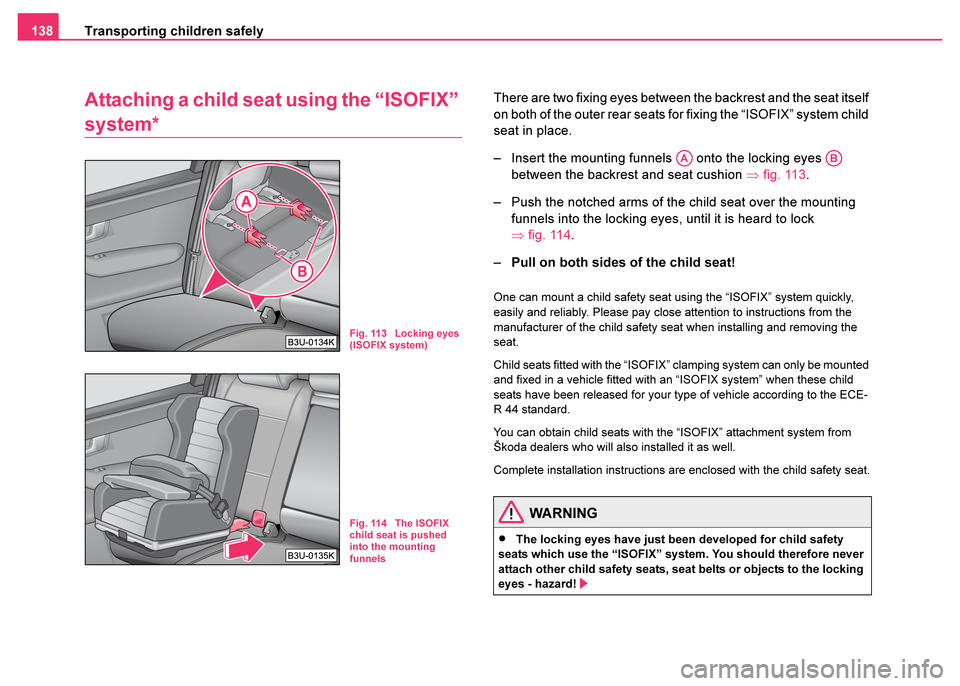
There are two fixing eyes between the backrest and the seat itself
on both of the outer rear seats for fixing the “ISOFIX” system child
seat in place.
– Insert the mounti ng funnels onto t he locking eyes
between the backrest and seat cushion ⇒fig. 113 .
– Push the notched arms of the child seat over the mounting funnels into the locking eyes, until it is heard to lock
⇒fig. 114 .
– Pull on both sides of the child seat!
One can mount a child safety seat using the “ISOFIX” system quickly,
easily and reliably. Please pay close attention to instructions from the
manufacturer of the child safety seat when installing and removing the
seat.
Child seats fitted with the “ISOFIX” clamping system can only be mounted
and fixed in a vehicle fitted with an “ISOFIX system” when these child
seats have been released for your type of vehicle according to the ECE-
R 44 standard.
You can obtain child seats with the “ISOFIX” attachment system from
Škoda dealers who will also installed it as well.
Complete installation instructions are enclosed with the child safety seat.
Fig. 113 Locking eyes
(ISOFIX system)
Fig. 114 The ISOFIX
child seat is pushed
into the mounting
funnelsWARNING
•The locking eyes have just been developed for child safety
seats which use the “ISOFIX” system. You should therefore never
attach other child safety seats, seat belts or objects to the locking
eyes - hazard!
AAAB
Page 142 of 233

Intelligent Technology141
Using the systemSafetyDriving TipsGeneral MaintenanceBreakdown assist-
anceTechnical DataFabia Praktik
Driving Tips
Intelligent Technology
Electronic stability programme (ESP)*
General
General
The ESP aids you maintain control of your vehicle in situations in border-
line driving situations such as when negotiating a curve too fast. The risk
of skidding is reduced and your car thus offers greater driving stability
depending on the conditions of the road surface. This occurs at all speeds.
The following systems are integrated into the electronic stability
programme:
•Electronic Differential Lock (EDL)
•Traction control system (TCS)
•Antilock brake system (ABS)
Operating principle
The ESP switches on automatically when the engine is started and then
conducts a self-test. The ESP control unit processes data from the indi-
vidual systems. It also processes additional measurement data which are
supplied by highly sensitive sensors: the rotational velocity of the vehicle
about its vertical axis, the lateral acceleration of the vehicle, the braking
pressure and the steering angle.
The direction which the driver wishes to take is determined based on the
steering angle and the speed of the vehicle and is constantly compared
with the actual behaviour of the vehicle. If differences exist, such as the
car beginning to skid, the ESP will automatically brake the appropriate
wheel and reduce the engine speed.
The car is stabilised again by the forces which take effect when the wheel
is braked. Intervention into the brake system takes place primarily on the
outer front wheel of a vehicle which tends to oversteer (tendency for the
rear of the vehicle to break away) while occurs this is on the inner rear
wheel of a vehicle which tends to understeer (tendency to shift out of the
curve). This braking control cycle is accompanied by noises.
The ESP operates in combination with the ABS ⇒page 145. If there is a
fault in the ABS system, the ESP also does not operate.
The ESP warning light ⇒page 34 lights up in the instrument cluster when
there is a fault on the ESP.
Fig. 115 ESP switch
Page 144 of 233

Intelligent Technology143
Using the systemSafetyDriving TipsGeneral MaintenanceBreakdown assist-
anceTechnical DataFabia Praktik
The TCS warning light
⇒page 33 lights up in the instrument cluster when
there is a fault on the TCS.
Switching off
You can switch the TCS off and on again as you wish by pressing the
button ⇒page 142, fig. 116 . The TCS warning light ⇒page 33 lights up
in the instrument cluster when the TCS is switched off.
The TCS should normally always be switched on. It may be good practice
in certain exceptional cases, such as when you wish to have wheel slip,
to switch off the TCS.
Examples:
•when driving with snow chains
•when driving in deep snow or on a loose surface
•when it is necessary to rock a car free when it has become stuck
then you should switch on the TCS again.
The EDL ⇒page 143 is a part of the TCS. THE EDL operates independ-
ently of the TCS (also when the TCS has been switched off using the TCS
button).
Note
•All four wheels must be fitted with the same tyres in order to achieve
problem-free operation of the TCS. Differing rolling circumferences of the
tyres can lead to an undesirable reduction in the engine output.
•Changes to vehicle (e.g. on engine, on the brakes, on chassis or other
assignment of tyres and wheels) can influence the function of the TCS
⇒ page 194.
Electronic Differential Lock (EDL)*
The electronic differential lock prevents an individual
wheel from slipping.
Models fitted with TCS can be also equipped with electronic differential
lock (EDL).
General
The EDL makes it much easier, and sometimes at all possible, to start off,
accelerate and climb a steep hill when the conditions of the road surface
are unfavourable.
Operating principle
The EDL is activated automatically, that is without any action on the part
of the driver. It monitors the speeds of the driven wheels with the aid of the
ABS sensors. Should only one drive wheel begin spinning on a slippery
surface there will be an appreciable difference in the speed of the driven
wheels. The EDL function brakes the slipping wheel and the differential
transmits a greater driving force to the other driven wheel. This control
process is also accompanied by noises.
WARNING
You should always adjust your style of driving to the conditions of
the road surface and the traffic situation. The increased safety
offered must not tempt you to take greater risks than otherwise -
risk of an accident!
Page 146 of 233

Intelligent Technology145
Using the systemSafetyDriving TipsGeneral MaintenanceBreakdown assist-
anceTechnical DataFabia Praktik
The brake pedal has to be depressed with a significantly greater force if
the brake booster is not operating because the vehicle has to be towed or
because there is damage to the brake booster, in order to balance out the
missing brake boosting effect.
If you notice that the braking distance has suddenly become longer and
that the brake pedal can be depressed further, it is possible that a brake
circuit of the dual-circuit brake system has failed. Drive, in such cases, to
the nearest Škoda dealer without delay in order to have the problem recti-
fied. Drive at a reduced speed while on your way to the dealer and adapt
your style of driving to the higher brake pedal pressure required.
Low brake fluid level
An insufficient level of brake fluid may result in problems in the brake
system. The level of the brake fluid is monitored electronically
⇒page 35.
Caution
•Never allow the brakes to rub by applying slight pressure if you do not
wish to brake the vehicle. This causes the brakes to overheat and can also
result in a longer braking distance and excessive wear.
•Before negotiating a steep downhill section, please reduce your
speed, shift down into the next lower gear (manual gearbox) or select a
lower driving stage (automatic gearbox). This enables you to make full use
of the braking power of the vehicle and reduces the strain on the brakes.
Any additional braking should be done intermittently, not continuously.
Antilock brake system (ABS)*
ABS prevents the wheels locking when braking.
General
The ABS contributes significantly to enhancing the active safety of your
vehicle. You are able to retain optimal steering ability even during full
braking on a slippery road surface, compared to a vehicle not fitted with
the ABS brake system, because the wheels do not lock up.
You must not expect, however, that the braking distance will be shorter
under all circumstances as a result of the ABS The braking distance for
example on gravel and fresh snow, when you should anyway be driving
slowly and cautiously, will be longer.
Operating principle
As soon as the vehicle speed has increased to about 20 km/hour an auto-
matic test procedure is conducted during which you will be able to hear a
pumping noise for about 1 second.
The brake pressure will be reduced on a wheel which is rotating at a speed
which is too low for the speed of the vehicle and tending to lock. This
control cycle is noticeable from a pulsating movement of the brake
WARNING
•Only apply the brakes for the purpose of drying and cleaning
the brake discs if the traffic conditions permit this. Do not place
any other road users in jeopardy.
•When retrospectively mounting a front spoiler, solid wheel
hubs etc. one must ensure that the air supply to the front wheel
brakes is not reduced otherwise the braking system could run too
hot.
•Allow for the fact that new brake pads do not achieve their full
braking efficiency until after the first 200 kilometres. New brake
pads must be first “run in” before they develop their optimal fric-
tion force. You can, however, compensate for this slightly reduced
braking force by increasing the pressure on the brake pedal. This
guideline also applies to any new brake pads installed at a future
date.
Page 147 of 233

Intelligent Technology
146
pedal which is accompanied by noises. This is consciously intended to
provide the driver with the information that the wheels are tending to lock
(ABS control range). You must always keep the brake pedal depressed to
enable the ABS to optimally control the brake application in this braking
range. Never interrupt the application of the brakes!
Note
•A warning light comes on if a fault occurs in the ABS
system ⇒page 34.
•Changes to vehicle (e.g. on engine, on the brakes, on chassis or other
assignment of tyres and wheels) can influence the function of the ABS
⇒ page 194.
Power steering*
The power steering enables you to steer the vehicle with less physical
force. The steering characteristics can be changed by a Škoda dealer.
You will place great stresses on the power steering system if the steering
is turned to full lock when the vehicle is stationary. Turning the steering to
full lock in such a situation will be accompanied by noises.
It is still possible to fully steer the vehicle if the power steering fails or if the
engine is not running (vehicle being towed in). The only difference is that
greater physical effort is required.
It is possible that the hydraulic pump of the power steering will not run due
to the low vehicle network voltage if the battery has gone flat and the
engine must started with the help off jump leads. This condition will be
indicated by lighting up of the warning light.
The power steering operates again if the battery is charged to a specific
range when engine is running. It also operates again, if the engine can be
started with its own battery.
Caution
Do not leave the steering at full lock for more than 15 seconds when the
engine is running - risk of damaging the power steering!
Note
Have the steering inspected as soon as possible by a Škoda dealer if
there is a leak or fault in the system.
WARNING
•The A BS can also not overcome the physical limits of your
vehicle. Please do not forget this, particularly when driving on icy
or wet road surfaces. If the ABS is operating within the control
range, adapt your speed immediately to the conditions of the road
surface and the traffic situation. The increased safety offered by
the ABS must not tempt you to take greater risks than otherwise -
risk of an accident!
•The normal braking system is still fully functional if there is an
ABS fault. Visit a Skoda dealer as quickly as possible and adjust
your style of driving to take account of the ABS fault in the mean-
time since you will not know how great the damage is.
Page 157 of 233
Towing a trailer
156
Tyre inflation pressure
Select the tyre inflation pressure on your vehicle for that of “fully laden”,
⇒ page 187. The inflation pressure of the tyres fitted to the trailer adjust
in accordance with the manufacturer's recommendation.
Exterior mirrors
You have to have additional exterior mirrors fitted if you are not able to see
the traffic behind the trailer with the standard rear-view mirrors. Both exte-
rior mirrors should be attached to folding arms. Adjust the mirrors so that
they provide you with an adequate field of view to the rear.
Headlights
Before starting off with a hitched trailer, also check the setting of the head-
lights. Alter the setting as necessary with the aid of the headlight beam
adjuster ⇒page 53.
Detachable ball head
On a car which features a factory-fitted towing device, the ball rod is
detachable. It is stowed together with separate fitting instructions in the
spare wheel well in the luggage compartment of the vehicle.
Further information on the towing device ⇒page 157.
Note
•We recommend that you also have your vehicle inspected between
service intervals if you tow a trailer frequently.
•The handbrake on the towing vehicle must be put on when coupling
and decoupling the trailer.
Driving Tips
Particular caution is required when towing a trailer.
– Do not, as far as possible, drive with your vehicle unladen and the trailer laden.
– Do not make full use of the legal maximum speeds. This applies in particular to downhill sections.
– Apply the brakes in good time.
– Keep a check on the coolant temperature gauge if the outside temperature is high.
Distribution of weight
The distribution of the weight is very poor if your vehicle is unladen and
the trailer is laden. Maintain a particularly low speed if you cannot avoid
driving with this combination.
Driving speed
Do not drive faster than 80 km/hour for safety reasons. This also applies
for countries in which higher speeds are allowed.
The fact that the driving stability of the vehicle + trailer combination
reduces with increasing speed means that the legally allowed speed
should not be used when there are unfavourable road, weather or wind
conditions, particularly near accident black spots.
You must always reduce your speed immediately as soon as you detect
even just the slightest swaying of the trailer. On no account attempt to
stop the trailer from “swaying” by accelerating.
Apply the brakes in good time! If the trailer is fitted with a trailer brake,
apply the brakes gently at first then brake firmly. This will avoid brake jolts
resulting from the trailer wheels locking. Shift down gears in good time
Page 158 of 233

Towing a trailer157
Using the systemSafetyDriving TipsGeneral MaintenanceBreakdown assist-
anceTechnical DataFabia Praktik
before negotiating a downhill section to allow the engine to also act as a
brake.
Engine overheating
Please keep a check on the coolant temperature gauge if you have to
negotiate a lengthy downhill stretch in a low gear at a high engine speed
when the outside temperature is very high
⇒page 13. If the needle of the
coolant temperature gauge moves into the right-hand area or even the red
area of the scale, reduce your speed immediately. Stop and switch off the
engine if the warning light
in the instrument cluster begins flashing.
Wait a few minutes and check the level of coolant in the coolant expansion
bottle ⇒page 177.
Please refer to the notes ⇒page 31.
The coolant temperature can be reduced by switching on the heating.
Any increase in the cooling effect of the coolant fan through shifting down
a gear and increasing the engine speed is not possible since the fan
speed is independent of the engine speed. One should also not drop a
gear for this reason when towing a trailer as long as the engine can
manage the slope without any drop in speed.
Detachable towing device*
The detachable ball head of the towing device is stowed in the spare
wheel well in the luggage compartment.
An instruction for correct installation and removal of the ball head of the
towing device is supplied with the ball head
Note
•Do not carry out any modifications or repairs to the ball head or to any
other components on the towing device.
WARNING
Do not use any aids or tools for installing or removing the ball
head. This might result in damage to the locking mechanism to the
extent that the safety of the towing device is no longer assured -
risk of an accident.
Fig. 120 Detachable
ball head