2003 SKODA FABIA lock
[x] Cancel search: lockPage 172 of 233

Inspecting and Replenishing171
Using the systemSafetyDriving TipsGeneral MaintenanceBreakdown assist-
anceTechnical DataFabia Praktik
Inspecting and Replenishing
Engine compartment
Unlocking the bonnet
Unlocking the bonnet
– Pull the unlocking lever below the dash panel on the driver's
side ⇒fig. 123 .
The bonnet jumps out of its lock as a result of the spring force. A handle
appears at the same time in the radiator grille.
Opening and closing the bonnet.
Fig. 123 Bonnet
release lever
Fig. 124 Radiator
grille: handle
Fig. 125 Securing the
bonnet with the bonnet
support
Page 173 of 233

Inspecting and Replenishing
172
Opening the bonnet
– Unlock the bonnet ⇒page 171, fig. 123 .
– Ensure that the arms of the windscreen wipers are correctly in place against the windscreen before opening the bonnet
otherwise damage could occur to the paintwork.
– Pulling on the handle ⇒page 171, fig. 124 will lock the bonnet
fully.
– Grip with the hand under the radiator grille and lift up the bonnet.
– Take the bonnet support out of its holder and set it in the opening designed for it ⇒page 171, fig. 125 .
Closing the bonnet
– Lift the bonnet slightly and unhook the bonnet support. Press the bonnet support into the holder designed to hold it.
– Allow the bonnet to drop from a height of about 30 cm into the lock - bonnet do not press down on it! Caution
•Never open the bonnet using the handle - danger of causing damage.
•Before opening the bonnet, ensure that the arms of the windscreen
wipers are correctly in place against the windscreen. Otherwise, there is
a risk of damage to the paintwork.
Working in the engine compartment
Particular care is required when carrying out any work in
the engine compartment!
There is a risk of injuries, scalding, accidents and fire when working
in the engine compartment, e.g. inspecting and replenishing oil and
other fluids. For this reason, it is essential to comply with the
warning instructions stated below and with the general applicable
rules of safety. The engine compartment of your car is a hazardous
area ⇒ .
WARNING
•Never open the bonnet if you see that steam or coolant is
flowing out of the engine compartment - risk of scalding! Wait long
enough until the steam or coolant has stopped escaping.
•For safety reasons, the bonnet must always be properly closed
when driving. One should therefore check that the lock has in fact
engaged properly after closing the bonnet.
WARNING (continued)
•Stop your vehicle immediately while driving if you notice that
the lock is not properly engaged and close the bonnet properly -
risk of an accident!
WARNING
•Switch off the engine and pull out the ignition key.
•Apply the handbrake firmly.
•If your vehicle is fitted with a manual gearbox, move the gear-
shift lever into Neutral, or if it is fitted with automatic gearbox,
move the selector lever into position P.
Page 193 of 233

Wheels and Tyres
192
Speed restrictions apply to winter tyres as well as to summer tyres
⇒ page 189, ⇒.
You can fit winter tyres of a lower speed category to your vehicle provided
that you also do not drive faster than the permissible maximum speed for
such tyres, even if the possible maximum speed of your vehicle is higher.
Exceeding the speed category of the tyre can lead to damage occurring.
Please pay attention to the notes if you decide to fit winter tyres
⇒ page 187.
You can also fit so-called “all-weather tyres” instead of winter tyres.
Please contact your Škoda dealer If there are any points which are not
clear who will be able to provide you with information regarding the
maximum speed for your tyres.
For the sake of the environment
Fit your summer tyres on again in good time since summer tyres offer you
better grip and handling on roads which are free of snow and ice as well
as ar temperatures below 7 °C - the braking distance is shorter, there is
less tyre noise, tyre wear is reduced and fuel consumption is reduced.
Note
Please observe the various differing legal requirements regarding tyres.
Unidirectional tyres*
The direction of rotation of the tyres is marked by arrows on the wall of
the tyre . This indicates the direction of rotation of the tyre, and it is essen-
tial that the tyres are fitted on to run in this direction. Only then are the
tyres able to provide the optimal properties in terms of grip, low noise,
wear-and-tear and aquaplaning.
Should it be necessary to fit on a spare wheel in exceptional cases with a
tyre not dedicated to the running direction or in opposite running direction,
please adopt a cautious style of driving as the tyre is no longer able to
provide optimal grip and handling in such a situation. This particularly
important on wet roads. You should have the defective tyre replaced as
soon as possible and restore the correct direction of rotation on all tyres
Snow chains
Snow chains can be used on all tyres except type 195/50 R15 and 185/60
R15 and 185/60 R14 with wheel trims 6J x 14 with a depth of 38 mm.
Winter tyres of the type 185/55 R15 should be used for use with snow
chains on vehicles with a 2.0 litre/85 kW engine and 6j x 15 wheel trims.
Snow chains must only be mounted on the front wheels.
When driving on wintry roads, snow chains improve not only traction, but
also the braking performance.
Only use fine-link snow chains . They must not project more than 15 mm
- including the chain lock.
Remove the full wheel trim if you wish to fit snow chains to the wheels.
You must take the chains off as soon as you drive on roads which are free
of snow. They adversely affect the handling of your vehicle, damage the
tyres and are rapidly destroyed.
WARNING
You must on no account drive your car at more than the permis-
sible maximum speed for your winter tyres - risk of an accident
resulting from tyre damage and loss of control over your car.
Page 197 of 233
Breakdown assistance
196
Note
The fire extinguisher is only supplied in certain countries within the scope
of delivery.
Vehicle tool kit
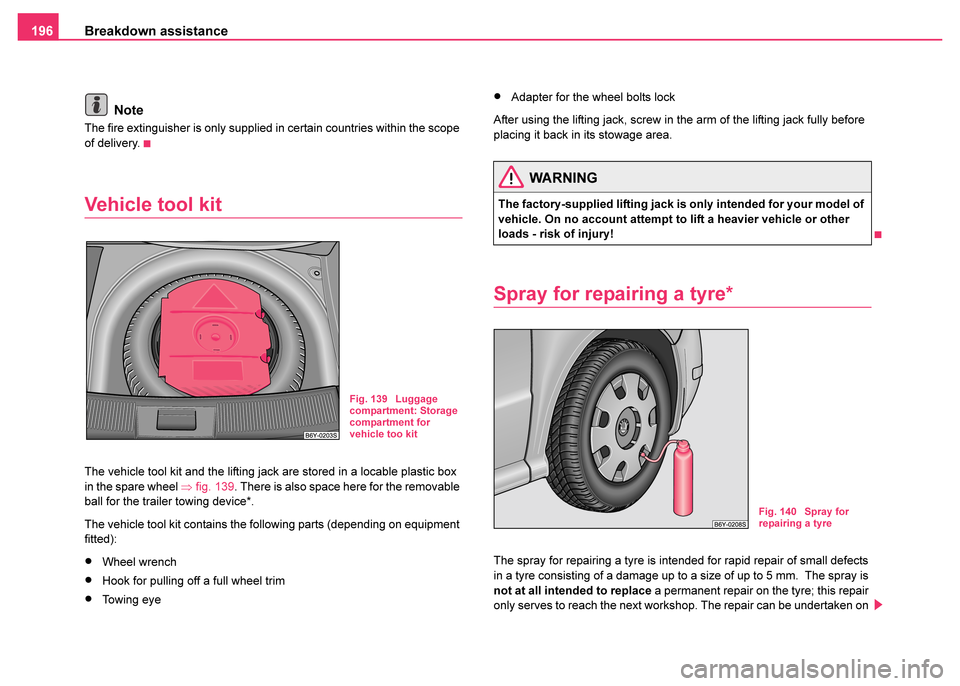
The vehicle tool kit and the lifting jack are stored in a locable plastic box
in the spare wheel ⇒ fig. 139. There is also space here for the removable
ball for the trailer towing device*.
The vehicle tool kit contains the following parts (depending on equipment
fitted):
•Wheel wrench
•Hook for pulling off a full wheel trim
•To w i n g e y e
•Adapter for the wheel bolts lock
After using the lifting jack, screw in the arm of the lifting jack fully before
placing it back in its stowage area.
Spray for repairing a tyre*
The spray for repairing a tyre is intended for rapid repair of small defects
in a tyre consisting of a damage up to a size of up to 5 mm. The spray is
not at all intended to replace a permanent repair on the tyre; this repair
only serves to reach the next workshop. The repair can be undertaken on
Fig. 139 Luggage
compartment: Storage
compartment for
vehicle too kit
WARNING
The factory-supplied lifting jack is only intended for your model of
vehicle. On no account attempt to lift a heavier vehicle or other
loads - risk of injury!
Fig. 140 Spray for
repairing a tyre
Page 199 of 233

Breakdown assistance
198
•The spare wheel provided with a car fitted with unidirectional tyres has
different dimensions. The wheel is provided with a warning sticker.
•After fitting on the wheel, the warning sticker must not be concealed
(e.g. by the wheel trim).
•Do not drive with this spare wheel at more than 80 km/h - risk of acci-
dent. Avoid accelerating at full throttle, sharp braking and fast cornering.
•The inflation pressure for this spare wheel is identical to the inflation
pressure of the standard tyres.
•Use this spare wheel only to reach the nearest service station as it is
not intended for continuous use.
Note
Some vehicles are only fitted with spray to make tyre repairs
⇒ page 196.
Changing a wheel
Preliminary work
The following steps should be carried out before actually
changing the wheel.
– If it is necessary to change a wheel, park the vehicle as far
away as possible from the traffic flow. The place you choose
should be level.
– Have all the occupants get out. While changing a wheel, the
occupants of the vehicle should not stand on the road (it is
better behind a crash barrier). – Apply the
handbrake firmly.
– Engage 1st gear or if your vehicle is fitted with an automatic
gearbox, move the selector lever into position P .
– If a trailer is coupled, uncouple it.
– Take the vehicle tool kit and the spare wheel ⇒ page 196
out of the luggage compartment.
Caution
If you have to change a wheel on a slope first block the opposite wheel
with a stone or similar object in order to secure the vehicle from unexpect-
edly rolling away.
Note
Comply with any legal regulations.
WARNING
•If you find yourself in flowing traffic put on the hazard warning
lights system and place the warning triangle on the side of the road
at the prescribed distance from your vehicle while observing all
national legal provisions. In this way you are protecting not only
yourself but also other road users.
•Never start the engine with the vehicle sitting on the raised jack
- danger of suffering injury!
Page 201 of 233

Breakdown assistance
200
Full wheel trim*
Removing
– Hook the clamp found in the vehicle tool kit into the reinforced
edge of the full wheel trim.
– Push the wheel key through the clamp, support the wheel key on the tyre and pull off the wheel trim ⇒fig. 142 .
Installing
– First press the full wheel trim onto the wheel at the valve opening provided. Then press the full wheel trim into the
wheel in such a way that its entire circumference locks
correctly in place. Caution
Use the pressure of your hand, do not knock on the full wheel trim! Heavy
knocks mainly on the points where the full wheel trim has not been
inserted into the wheel, can result in damage to the guide and centering
elements of the full wheel trim.
Wheel trim caps*
Removing
– Carefully
⇒fig. 143 lever off the wheel trim cap using the
removal hook .
Fig. 142 Removing the
full wheel trim
Fig. 143 Pulling off the
wheel trim cap
Page 203 of 233

Breakdown assistance
202
– Position the lifting jack by selecting the jacking point - lower sill - which is closest to the wheel to be removed ⇒page 201,
fig. 145 .
– Position the lifting jack below the jacking point and move it up until its claw is positioned directly below the vertical web of the
lower sill.
– Align the lifting jack so that its claw grasps the web of the lower sill and the moving base plate of the jack is resting flat
against firm ground.
– Turn the lifting jack up further until the wheel is just clear of the ground.
Ground below the lifting jack which is soft and slippery can cause the
vehicle to slip off the jack. It is therefore always necessary to place the
lifting jack on a solid surface or use a wide and stable base. Use a non-
slip base (e.g. a rubber foot mat) if the surface is smooth, such as
cobbled stones, a tiled floor,etc.
Securing wheels against being stolen*
You need a special adapter for slackening the safety
wheel bolts.
– Pull off the full wheel trim/cap from the wheel hub or cap from the safety wheel bolt.
– Push the adapter with its toothed side into the inner toothing of the safety wheel bolt right down in such a way
that only the outer hexagon is jutting out ⇒fig. 146 .
– Push the wheel wrench fully onto the adapter .
– Slacken the wheel bolt, or tighten it firmly ⇒page 201.
– Reinstall the full wheel trim/wheel cap after removing the adapter or place the cap onto the safety wheel bolt.
WARNING
•Take suitable measures to prevent the base of the lifting jack
from slipping off - risk of injury!
•Not positioning the lifting jack at the specified points can result
in damage to the vehicle. The jack can also slip off if it does not
have sufficient grip - risk of injury!.
•It is important to support the vehicle with suitable supporting
blocks if you wish to work under the lifted vehicle - risk of injury!
AAAB
Fig. 146 Safety wheel
bolt with adapter
AB
AA
AB
Page 205 of 233

Breakdown assistance
204
Starting engine
It is important to connect the jump-start cables in the correct
order.
Connecting positive terminals
– Attach one end to the positive terminal ⇒fig. 147 of the
discharged battery .
– Attach the other end to the positive terminal of the battery supplying the power .
Connecting negative terminal and engine block
– Attach one end to the negative terminal of the battery supplying the power .
– Attach the other end to a solid metal part which is connected firmly to the engine block, or to the engine block
itself. Starting engine
– Start the engine of the vehicle providing current and run the
engine at idling speed.
– Now start the engine of the vehicle with the discharged battery.
– Interrupt the attempt at starting an engine after 10 seconds if it does not start right away and wait for about 30 seconds
before repeating the attempt.
– Disconnect the cables on th e engine in exactly the reverse
order they were connected up.
Fig. 147 Jump-starting
using the battery from
another vehicle: A - flat
vehicle battery, B -
battery providing
current
A1
AA
A2
AB
A3
AB
A4
WARNING
•The non-insulated parts of the terminal clamps must never
make contact with each other. Furthermore, the cable connected to
the positive terminal of the battery must not come into contact with
electrically conducting parts of the vehicle - risk of a short circuit!
•Do not affix the jump starting cables to the negative terminal of
the discharged battery. There is the risk of detonating gas seeping
out the battery being ignited by the strong spark which results
from the engine being started.
•Run the jump-start cables so that they cannot be caught by any
rotating parts in the engine compartment.
•Do not bend over the batteries - risk of caustic burns!
•The vent screws of the battery cells must be tightened firmly.
•Keep any sources of ignition (naked flame, smouldering ciga-
rettes etc.) away from the battery - risk of an explosion!