2003 SKODA FABIA lock
[x] Cancel search: lockPage 206 of 233

Breakdown assistance205
Using the systemSafetyDriving TipsGeneral MaintenanceBreakdown assist-
anceTechnical DataFabia Praktik
Tow-starting and towing vehicle
General
Please pay attention to the following instructions if you are going
to use a tow rope:
Driver of the towing vehicle
– Do not drive off until the tow rope is taught.
– Release the clutch particularly gently when starting off or
depress the accelerator particularly gently if your vehicle is
fitted with an automatic gearbox.
Driver of the towed vehicle
– Switch the ignition on so that the steering wheel is not blocked and you can also operate the turn signal lights, the headlight
flasher, the windscreen wipers and windscreen washer
system.
– Take the vehicle out of gear or move the selector lever into position N if your vehicle is fitted with an automatic gearbox.
– Note that the brake servo unit and power steering only operate if the engine is running. You will require significantly greater
physical force to depress the brake pedal and to steer the
vehicle if the engine is not running.
– Ensure that the tow rope is always kept taught.
Tow rope or tow bar
A tow bar is safest way of towing a vehicle and also minimizes any
shocks. You can use a tow rope only if a suitable tow bar is not available.
The tow rope must be elastic to protect the vehicle. Thus one should only
use plastic fibre rope or a rope made out of a similarly elastic material.
Only attach the tow rope to the towing eyes provided for this purpose
⇒ page 206, “Front towing eye” and ⇒page 207, “Rear towing eye”.
Driving style
Towing another vehicle requires a certain amount of practice. Both drivers
should be familiar with the particular points about towing a vehicle.
Unskilled drivers should not attempt to tow-start or tow in another vehicle.
One should be constantly vigilant not to allow impermissibly high towing
forces or jerky loadings. There is always a risk of excessive stresses and
damage resulting at the points to which you attach the tow rope or tow bar
when you attempt to tow a vehicle which is not standing on a paved road.
Caution
If the gearbox of your vehicle no longer contains any oil because of a
defect, your vehicle must only be towed in with the driven wheels raised
clear of the ground, or on a special vehicle transporter or trailer.
Note
•Please comply with any legal requirements particularly regarding the
switched on signal systems, when towing in or tow-starting another
vehicle.
•The tow rope must not be twisted as it may in certain circumstances
result in the front towing eye being unscrewed out of your vehicle.
Page 207 of 233
Breakdown assistance
206
Front towing eye
The towing eye is stored in the box for the vehicle tool kit.
Remove the protective grille carefully as follows: – Stick a screwdriver through the bore hole of the protective
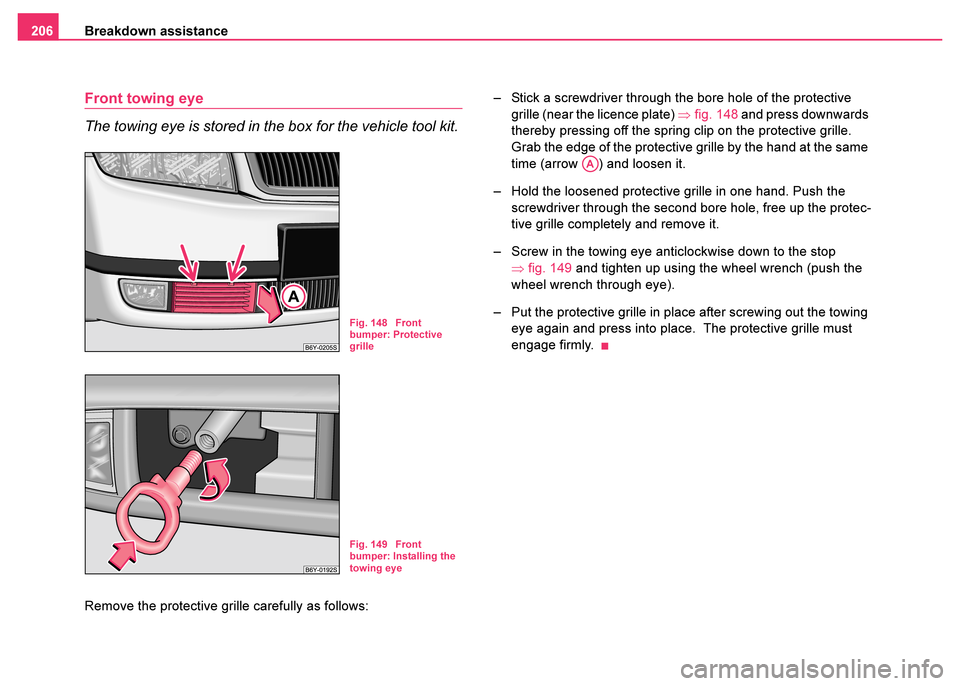
grille (near the licence plate) ⇒fig. 148 and press downwards
thereby pressing off the spring clip on the protective grille.
Grab the edge of the protective grille by the hand at the same
time (arrow ) and loosen it.
– Hold the loosened protective grille in one hand. Push the screwdriver through the second bore hole, free up the protec-
tive grille completely and remove it.
– Screw in the towing eye anticlockwise down to the stop ⇒fig. 149 and tighten up using the wheel wrench (push the
wheel wrench through eye).
– Put the protective grille in place after screwing out the towing eye again and press into place. The protective grille must
engage firmly.
Fig. 148 Front
bumper: Protective
grille
Fig. 149 Front
bumper: Installing the
towing eye
AA
Page 210 of 233

Fuses and light bulbs209
Using the systemSafetyDriving TipsGeneral MaintenanceBreakdown assist-
anceTechnical DataFabia Praktik
Fuses and light bulbs
Electric fuses
Replacing fuses
Defect fuses must be replaced.
Individual electrical circuits are protected by fuses. The fuses are
located on the left side of the dash panel behind the safety cover.
– Switch the ignition off and also the electrical component
affected.
– Set the screwdriver under the safety cover (on the recess in the safety cover), lever it up carefully in the direction of the
arrow and take it out in the direction of the arrow
⇒fig. 151 . – Find out which fuse belongs to the component which is not
operating ⇒page 210, “Fuse assignment in the dash panel”.
– Defect fuses can be detected by their melted metal strips. Replace the defect fuse by a new fuse of the same ampere
number.
– First shift the safety cover into the dash panel in the direction of arrow then press the safety cover in the direction of the
arrow in such a way that the guide lug locks into the
opening of the dash panel.
There is a further box of fuses in the engine compartment on the battery.
We recommend that you have these fuses replaced by a Škoda dealer.
We recommend that you carry the box of replacement fuses with you
which was delivered in your vehicle. Replacement fuses
5) are available
at Škoda dealers.
Colour coding of fuses
Fig. 151 Left side of
the dash panel: fuse
cover
AAAB5)Replacement fuses are, on the other hand, part of the basic equipping of the ve-
hicle in some countries.
ColourMaximum amperage
light brown5
brown7,5
red10
blue15
AB
AA
Page 212 of 233

Fuses and light bulbs211
Using the systemSafetyDriving TipsGeneral MaintenanceBreakdown assist-
anceTechnical DataFabia Praktik
No.Power consumerAmperes
1Instrument cluster, ESP5
2Brake lights10
3Power supply for the diagnostics, air-conditioning
system5
4Interior lighting10
5Door warning light5
6Lights and Visibility5
7Engine electronics, power-assisted steering5
8Not assigned
9Lambda probe10
10S-contact a)5
11Electrically adjustable rear mirror b)5
12Ventilation system, air-conditioning system, Xenon
headlight5
13Reversing light10
14Diesel engine control unit10
15Headlight cleaning system, window wiper10
16Instrument cluster5
17Petrol engine - control unit c)5
18Telephone5
19Automatic gearbox10
20Control unit for lamp failure5
21Heated windscreen washer nozzles5
22Not assigned
23Right main beam10
24Engine electronics10
25Control unit for ABS, TCS
control unit for ESP5
10
26Not assigned
27Not assigned
28Cruise control, switch for the brake and clutch pedal5
29Not assigned
30Main beam on the left and indicator light10
31Central locking system - door lock for the boot lid10
32Rear window wiper10
33Parking light on the right5
34Parking light on the left5
35Injector - petrol engine10
36Licence plate light5
37Rear fog light and indicator light5
38Heating of the external mirror5
39Rear window heater20
40Horn20
41Front window wiper20
42Cigarette lighter, power socket15
43Central control unit, selector lever lock for the auto-
matic gearbox20
44Turn signals15
No.Power consumerAmperes
Page 213 of 233

Fuses and light bulbs
212
The power windows are protected by automatic circuit breakers which
switch on again automatically after a few seconds after the overload has
been eliminated - e.g. frozen windows.
Bulbs
Changing bulbs
The relevant lamp must always be switched off before a light bulb is
replaced.
Do not take hold of the glass bulb with naked fingers (even the smallest
amount of dirt reduces the working life of the light bulb). Use a clean cloth,
serviette or something similar.
Defect light bulbs should only be replaced with light bulbs of the same
type. The designation is located on the light socket or the glass bulb.
Changing certain bulbs is not something which you can do yourself, but
requires to be done by a specialist. Other parts of the vehcle must be
removed in order to change the light bulbs. This applies, in particular, to
bulbs which can only be reached from the engine compartment.
We therefore recommend that you have any bulbs changed by a Škoda
dealer or, in exceptional cases, by calling on other professional assist-
ance.
Please note that the engine compartment is a hazardous area
⇒ page 172.
45Radio, navigation system20
46Electrical power window (at the front on the right)25
47Not assigned
48Diesel engine - control unit, injector30
49Central locking system15
50Low beam on the right15
51Power socket in the luggage compartment15
52Ignition15
53Electrical power window (at the rear on the right)25
54Low beam on the left15
55Not assigned
56Control unit - petrol engine20
57To w i n g d e v i c e25
58Electrical power window (at the front on the left)25
59Not assigned
60Horn for the anti-theft alarm system15
61Fuel pump - petrol engine15
62Electric sliding/tilting roof25
63Seat heaters15
64Headlight cleaning system20
65Fog lights15
66Electrical power window (at the rear on the left)25
67Not assigned
68Fresh air blower25
No.Power consumerAmperesa)For power consumers, e.g. the radio, which can be operated with the ignition
switched off as long as the ignition key is not withdrawn.
b)For vehicles with an electrical power window systemc)It is 15 amps for a vehicle with a 1.2 litre engine.
Page 216 of 233

Fuses and light bulbs215
Using the systemSafetyDriving TipsGeneral MaintenanceBreakdown assist-
anceTechnical DataFabia Praktik
Main beam
– Open the bonnet.
– Remove the protective cover at the rear of the headlight
⇒page 214, fig. 153 .
– Disconnect the plug connector .
– Press together the sprung wire clamp on the lamp holder and swing down.
– Remove the halogen lamp with cable. Insert the new halogen lamp in such a way that the fixing lug on the reflector lies in the
corresponding recess in the lamp lplate.
– Close the sprung wire clamp over the plate. Press together the sprung wire clamp and lock together again.
– Plug into the plug connector . – Get the headlight setting checked by a Skoda dealer after
replacing the light bulb.
Parking light at the front
– Open the bonnet.
– Remove the protective cover at the rear of the headlight ⇒page 214, fig. 153 .
– Pull the lamp holder with light bulb for the parking light out of the headlight ⇒fig. 156 .
– Pull the defect light bulb out of the lamp holder.
– Insert the new light bulb.
Fig. 155 Structure of
the light bulb of the
main beam light
AB
AA
AB
Fig. 156 Structure of
the light bulb of the
parking light
Page 217 of 233
Fuses and light bulbs
216
– Insert the lamp holder with new light bulb into of the headlight.
Low beam
– Open the bonnet.
– Remove the protective cover at the rear of the headlight ⇒page 214, fig. 153 .
– Unplug plug .
– Unlock the sprung wire clamp downwards and swing to the side.
– Remove the light bulb and insert the new light bulb in such a way that the fixing lug on the reflector lies in the corre-
sponding recess in the lamp plate. – Close the sprung wire clamp over the plate and engage it
again.
– Plug in plug .
– Get the headlight setting checked by a Skoda dealer after replacing the light bulb.
Turn signal light (at the front)
– Open the bonnet.
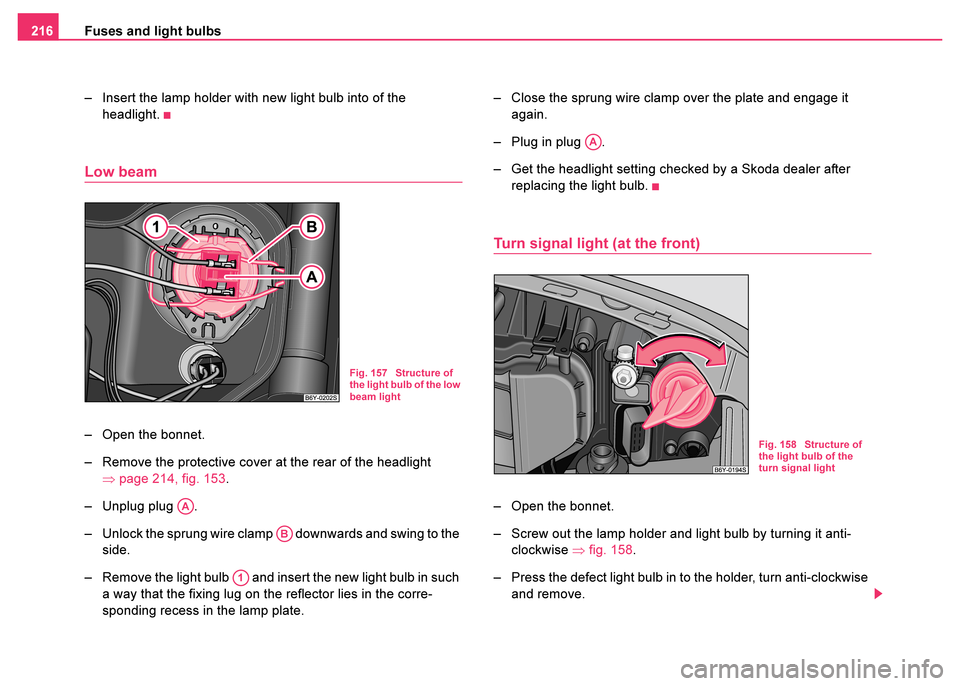
– Screw out the lamp holder and light bulb by turning it anti-clockwise ⇒fig. 158 .
– Press the defect light bulb in to the holder, turn anti-clockwise and remove.
Fig. 157 Structure of
the light bulb of the low
beam light
AA
AB
A1
AA
Fig. 158 Structure of
the light bulb of the
turn signal light
Page 219 of 233

Fuses and light bulbs
218
– Close the sprung wire clamp over the lamp plate. Press together the sprung wire clamp and lock together again.
– Plug into the plug connector .
Note
One should ensure that the outer air temperature sensor* is in the
correct position when mounting the fog light.
Lighting in storage compartment on front passenger
side*
We recommend having the light bulb replaced by a Škoda dealer. – Push in a knife or screwdriver from the side between the light
and the glove compartment ⇒fig. 161 . Lever out the light
carefully.
– Disconnect the plug by pressing the catch from the side.
– Replace the defect light bulb.
– Recreate the plug connection.
– Press the light into the glove compartment from below.
Interior light and the reading light*
– Pull the diffusion disk (see arrow) downwards from the housing ⇒fig. 162 .
AA
AB
A1
Fig. 161 Remove
lighting in storage
compartment on front
passenger side
Fig. 162 Remove inte-
rior light