2003 SKODA FABIA lock
[x] Cancel search: lockPage 159 of 233
Towing a trailer
158
•Contact a Škoda dealer if you encounter any problems using the
device.
•Inspect the ball head to ensure that it is properly locked each time
before setting off.
•Never unlock the ball head with a trailer coupled to it.
•You should take off the ball head if you drive without towing a trailer.
Inspect whether the end cover properly seals off the mounting shaft.
•Remove the ball head beforehand if you wish to clean your vehicle
using a steam jet. Ensure that the end cover properly seals the mounting
shaft.
Page 161 of 233

Care and cleaning
160
Automatic vehicle wash systems
The paintwork of the vehicle is sufficiently resistant that the vehicle can be
washed normally in automatic vehicle wash plants without any problem.
The actual stress to which the paintwork is subjected, however, depends
greatly on the design of the vehicle wash system, the filtering of the water
and the type of washing and care products used. If the paintwork of your
vehicle appears mat after being washed or even has scratches, point this
out to the operator of the vehicle wash plant. Use a different vehicle wash
plant, if necessary.
There are no particular points to note before washing your vehicle in such
a plant other than the usual precautionary measures (closing windows
and sliding/tilting roof, releasing and moving any factory-fitted aerials for
the radio* and navigation system* and telephone system* so that they are
flat against the bodywork, etc.).
It is best to first consult the operator of the vehicle wash plant if you have
any particular attached parts fitted to your vehicle - such as spoiler, roof
rack system or a two-way radio aerial.
It is important to degrease the lips of the windscreen wiper rubbers after
passing through the automatic vehicle wash system.
Caution
Do not screw the swivelling down roof aerial tight before washing the
vehicle in an automatic vehicle wash system - risk of damage!
Washing vehicle by hand
It is important to first soften the dirt with plenty of water and rinse it off as
thoroughly as possible before washing your vehicle by hand.
One should then clean the vehicle using a soft washing sponge,
washing glove or a washing brush and only slight pressure. Work from
the top to the bottom - beginning with the roof. Only place slight pressure
on the vehicle paintwork during cleaning Only use a shampoo for stub-
born dirt.
Wash out the sponge or washing glove thoroughly at short intervals.
Clean wheels, door sills and similar parts last. Use a second sponge for
such areas.
Rinse off the vehicle well after giving it a wash and dry it off using a
chamois leather.
Caution
•Do not wash your vehicle in bright sunlight - risk of paint damage.
•Ensure that the jet of water is not aimed directly at the locks or at the
door and panel joints if you spray your vehicle in winter down with a hose
- risk of freezing.
•Do not use any insect sponges, rough kitchen sponges or similar
cleaning products - risk of damage to the surface of paintwork.
WARNING
When washing your vehicle in the winter: Water and ice in the
brake system can affect the braking efficiency - risk of accident.
WARNING
•The ignition should always be switched off when you wash your
vehicle - risk of accident!
•Protect your hands and arms from sharp-edged metal parts
when you are cleaning the underfloor, the inside of the wheel hous-
ings or the wheel trims - risk of cuts.
Page 163 of 233

Care and cleaning
162
The paint number of the original paintwork of your vehicle is indicated on
the vehicle data sticker ⇒page 223.
Any corrosion which has already have formed must be removed thor-
oughly. Apply a corrosion protection primer and then the paint to the
affected point. You can of course have this work carried out by a Škoda
dealer.
Plastic parts
External plastic parts are cleaned by normal washing. Plastic parts and
synthetic leather can also be treated with special solvent-free plastic
cleaning agents if a damp cloth is not sufficient. Paint care products are
not suitable for plastic parts.
Windows
Only use a plastic ice scraper for removing snow and ice from the
windows and mirrors. You should not move the ice scraper forward and
backward but in one direction on the window which you are cleaning in
order to avoid any damage to the surface of the glass.
You can best remove residues of rubber, oil, grease, wax or silicone by
using a special window cleaner or a special silicone remover.
You should also clean the windows regularly from the inside.
Do not use window leathers which you have used to polish the vehicle
body to dry off the windows. Residues of preservatives in the window
leather can dirty the window and reduce visibility.
Do not affix any stickers over the inside of the rear window to avoid
damage to the heating elements of the rear window heater .We recommend using a preservative from the range of accessories
offered by your Skoda dealer.
The headlight lenses
Please do not use any aggressive cleaning or chemical solvent products
- risk of damage to the plastic lenses
Please use soap and clean warm
water.
Caution
Never wipe the headlights dry and do not use any sharp objects for
cleaning the plastic lenses, this may result in damage to the protective
paintwork and consequently in formation of cracks on the headlight
lenses, e.g through effect of chemical products.
Door and window seals
The rubber seals on the doors, boot lid, bonnet, sliding roof and windows
remain supple and last longer if you treat them from time to time with a
rubber care product (e.g. silicone spray). You also avoid premature wear
of the seals and prevent leakages in this way. It is also easier to open the
doors. Rubber seals which are well cared for also do not stick together in
cold winter weather.
Locks
We recommend that you use Genuine Škoda Spray with regreasing and
anticorrosive effect for de-icing locks.
Page 164 of 233

Care and cleaning163
Using the systemSafetyDriving TipsGeneral MaintenanceBreakdown assist-
anceTechnical DataFabia Praktik
Note
When washing your vehicle, ensure that as little water as possible gets
into the locks.
Wheels
Steel wheels
You should also thoroughly wash the wheels and wheel trims when giving
your vehicle its regular wash. This prevents any brake dust, dirt and road
salt from sticking to the wheel hubs. You can remove stubborn brake abra-
sion adhering to the wheels with an industrial cleaner. Touch up any
damage to the paintwork on the wheels before rust is able to form.
Light alloy wheels
Regular care of light alloy wheels is necessary in order to retain their
decorative appearance over long periods. It is particularly important to
remove any road salt and brake abrasion from light alloy wheels every two
weeks, otherwise the surface will suffer. Wash thoroughly and then treat
the wheels with a protective product for light alloy wheels which does not
contain any acidic components. You should provide the wheel hubs with
a hard wax layer every three months. You must not use any products
which cause abrasion when treating the wheel hubs. Any damage to the
paint layer on the wheel hubs must be touched up immediately.
Note
Severe layers of dirt on the wheels can also result in wheel imbalance.
This may show itself in the form of wheel vibration which is transmitted to
the steering wheel which, in certain circumstances, can cause premature
wear of the steering. It is therefore important to clean dirty wheels.
Underbody protection
The underside of your vehicle is protected for life against chemical and
mechanical influences.
One cannot, however, completely rule out damage to the protective layer
when driving so we recommend that you inspect the protective layer on
the underside of your vehicle and on the chassis at certain intervals - this
is best done at the beginning and end of the winter - and to touch up any
damaged areas.
Škoda dealers have suitable spray products available as well as the
necessary equipment and are familiar with the instructions for its use. It is
therefore best to have such touch-up work or additional corrosion protec-
tion measures carried out by a Škoda dealer.
WARNING
One should remember when cleaning the wheels that moisture, ice
and road salt may adversely affect braking efficiency - risk of an
accident!
WARNING
Never use additional underbody protection or corrosion-protec-
tion agents for the exhaust pipes, catalytic converters or heat
shields. Such substances might ignite when driving - risk of fire!
Page 166 of 233

Care and cleaning165
Using the systemSafetyDriving TipsGeneral MaintenanceBreakdown assist-
anceTechnical DataFabia Praktik
– Remove fresh stains which are oil based (e.g. butter, mayon-
naise, chocolate etc.) with an absorbent cloth or household
cleaning paper or with the cleaner from the care set if the stain
has not yet penetrated into the surface.
– Use a grease dissolver for grease stains which have dried
in .
– Eliminate special stains (e.g. ball-point pens, felt pen, nail
varnish, dispersion paint, shoe cream etc.) with a special stain
remover suitable for leather.
Leather care
– Treat the leather every six months with the leather care product available from Škoda dealers.
– Apply only a small amount of the care product.
– Dry the leather off with a soft cloth
It is best to consult your Škoda dealer if you have any questions regarding
cleaning and care of the leather interior.
Caution
•You must on no account treat the leather with solvents (e.g. gasoline,
turpentine), floor wax, shoe cream or such like.
•Avoid leaving your vehicle for lengthy periods in bright sunlight in order
to avoid bleaching the leather. If you leave your vehicle parked in the open
for lengthy periods, protect the leather from the direct rays of the sun by
covering it over.
•Sharp-edged objects on items of clothing such as zip fasteners, rivets,
sharp-edged belts may leave permanent scratches or signs of rubbing on
the surface.
Note
•Use a care cream with light blocker and impregnation effect regularly
and each time after cleaning the leather. The cream nourishes the leather,
allows it to breathe and keeps it supple and also provides moisture. It also
creates surface protection.
•Clean the leather every 2 to 3 months, remove fresh soiling each time
this occurs.
•Remove fresh stains such as those from ball-point pens, ink, lipstick,
shoe cream etc., as quickly as possible.
•Care also for the leather dye. Refreshen areas which have lost their
colour with a special coloured leather cream as required.
Seat belts
– Keep the seat belts clean!
– Wash seat belts which have become soiled using a mild soapy solution.
– Inspect the seat belts regularly to ensure they are in good condition.
Belt webbing which has become severely soiled may prevent the inertia
reel from reeling up the belt properly.
WARNING
•The seat belts must not be removed for cleaning.
Page 167 of 233
Care and cleaning
166
Engine compartment
Good corrosion protection is very important, particularly in winter when
one often drives over its salt-strewn roads. One should therefore clean the
whole engine compartment and the radiator tank before and after the salt
spreading period and treat with preservative in order to prevent the salt
from being destructive.
Skoda dealers have the cleaning agents and preservatives recommended
by the manufacturer and also the required equipment.
Caution
•Engine cleaning may be only be undertaken when the ignition is off.
•It is recommended to cover the generator before washing the engine
compartment.
For the sake of the environment
The dirty water produced by washing the engine has washed away petrol,
and residues of grease and oil and should therefore be cleaned by an oil
separator. This is why engine washing should only be undertaken in a
garage or at a fueling station (when these are fitted with the required
equipment).
WARNING (continued)
•Never clean the seat belts chemically as dry cleaning may
destroy the fabric. The seat belts must also not be allowed to come
into contact with corrosive liquids (such as acids etc.).
•Seat belts which have damage to the webbing, the connections,
the inertia reel or the lock should be replaced by a Škoda dealer.
•Inertia reel belts must be completely dried before being reeled
up.
WARNING
It is necessary to observe the guidelines given in this chapter
before working on the engine compartment ⇒page 172.
Page 170 of 233
Fuel169
Using the systemSafetyDriving TipsGeneral MaintenanceBreakdown assist-
anceTechnical DataFabia Praktik
Prewarming fuel
The vehicle is fitted with a fuel filter prewarming system. This secures
operation of a vehicle using diesel fuel down to an environmental temper-
ature of -25°C.
Biofuel
We recommend refuelling with diesel fuel at temperatures below -10°C.
Caution
It is not permitted to add the various fuel additives on the market, including
petrol, to diesel fuel in order to improve its flow properties.
RefuellingOpening the fuel filler cap
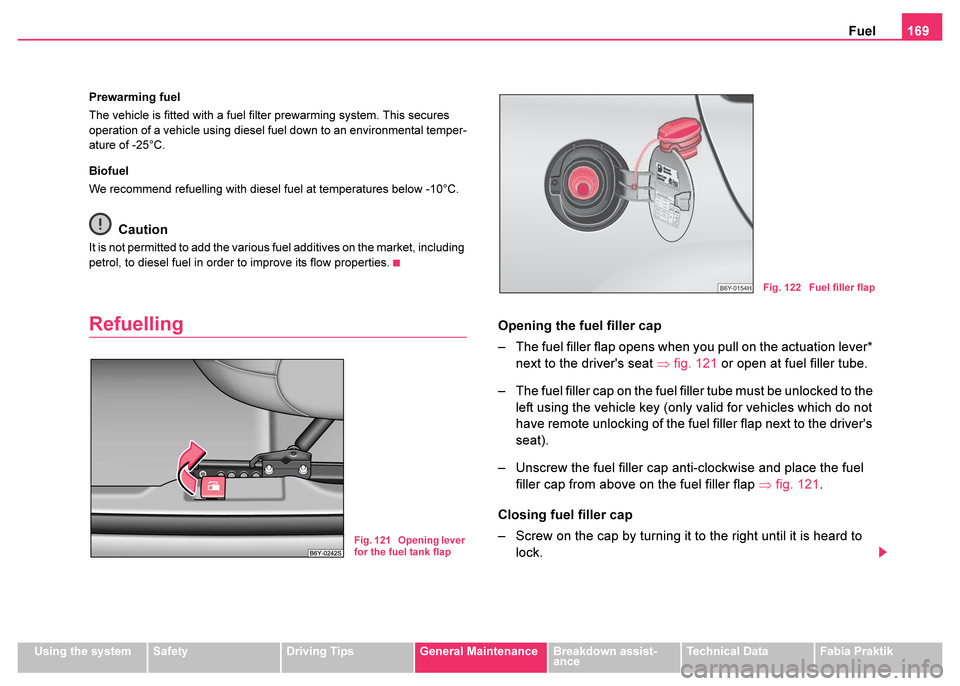
– The fuel filler flap opens when you pull on the actuation lever*
next to the driver's seat ⇒fig. 121 or open at fuel filler tube.
– The fuel filler cap on the fuel filler tube must be unlocked to the left using the vehicle key (only valid for vehicles which do not
have remote unlocking of the fuel filler flap next to the driver's
seat).
– Unscrew the fuel filler cap anti-clockwise and place the fuel filler cap from above on the fuel filler flap ⇒fig. 121 .
Closing fuel filler cap
– Screw on the cap by turning it to the right until it is heard to lock.
Fig. 121 Opening lever
for the fuel tank flap
Fig. 122 Fuel filler flap
Page 171 of 233

Fuel
170
– The fuel filler cap on the fuel filler tube must be locked to the right using the vehicle key and the key then removed (only
valid for vehicles which do not have remote unlocking of the
fuel filler flap next to the driver's seat).
– Press the fuel tank flap closed.
The correct grade of fuel for your vehicle as well as the tyre size and infla-
tion pressures are stated on a sticker affixed to the inside of the fuel filler
flap. Further information on fuel ⇒page 167.
The fuel tank has a capacity of about 45 litres.
Caution
•Remove any fuel which has spilled onto the paintwork of your vehicle
immediately. This particularly applies to biodiesel - risk of paint damage!
•Vehicles fitted with catalytic converter should never be allowed to let
the fuel tank to run completely empty. An irregular supply of fuel to the
engine can result in misfiring and unburnt fuel may get into the exhaust
system, which may result in overheating and damage to the catalytic
converter.
For the sake of the environment
The fuel tank is full just as soon as the pump nozzle switches off for the
first time, provided the nozzle has been operated properly. You should not continue refuelling - otherwise the expansion chamber in the fuel tank will
also be filled with fuel. Fuel might flow out of the tank when it heats up.
WARNING
Pay attention to any legal requirements if you do carry a spare
canister in the vehicle. We do not recommend carrying any fuel
canisters in your vehicle for safety reasons. The canister can be
damaged in the event of an accident and fuel may leak out.