2003 SKODA FABIA lock
[x] Cancel search: lockPage 69 of 233
Seats and Stowage
68
The rear seats and the seat backrest can be folded forwards to
increase the volume of the luggage compartment ⇒page 69.
Both parts of the bank can be folded forward individually on vehi-
cles with a divided rear seat*.
Folding the rear seat forwards
– In order to avoid causing any damage when folding the rear seat forward it is important to adjust the front seats so that no
damage can occur when this is done.
– Pull up the rear seats in the direction of arrow ⇒page 67,
fig. 48 and fold forwards in direction of arrow .
– Pull up the unlocking knob on the seat backrest and fold the seat backrest forwards ⇒page 67, fig. 49 .
– Pull the head restraints out of the seat backrest.
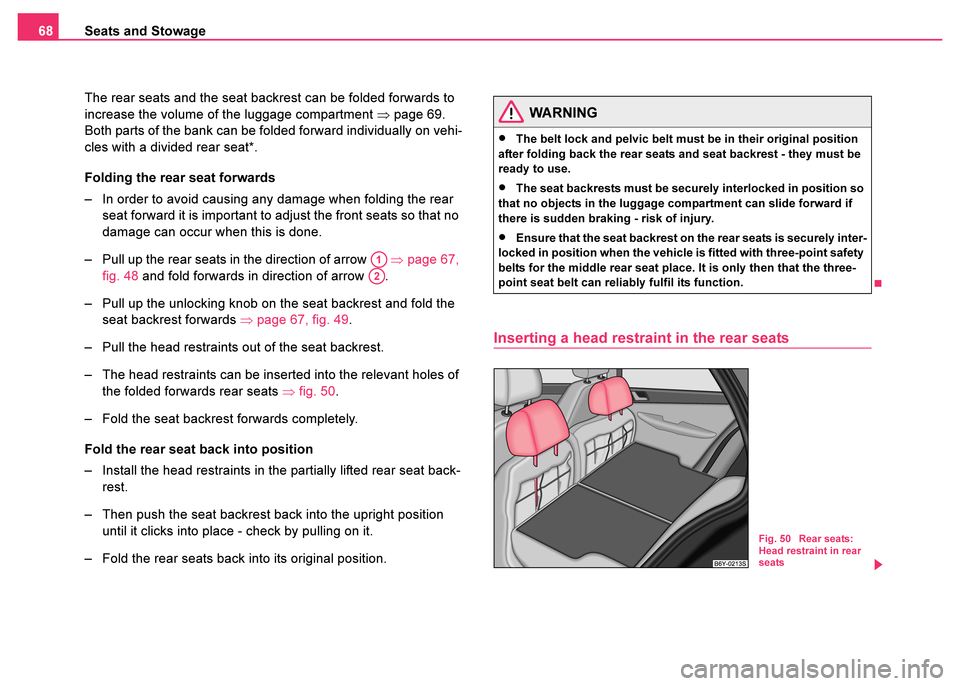
– The head restraints can be inserted into the relevant holes of the folded forwards rear seats ⇒fig. 50 .
– Fold the seat backrest forwards completely.
Fold the rear seat back into position
– Install the head restraints in the partially lifted rear seat back- rest.
– Then push the seat backrest back into the upright position until it clicks into place - check by pulling on it.
– Fold the rear seats back into its original position.
Inserting a head restraint in the rear seats
A1
A2
WARNING
•The belt lock and pelvic belt must be in their original position
after folding back the rear seats and seat backrest - they must be
ready to use.
•The seat backrests must be securely interlocked in position so
that no objects in the luggage compartment can slide forward if
there is sudden braking - risk of injury.
•Ensure that the seat backrest on the rear seats is securely inter-
locked in position when the vehicle is fitted with three-point safety
belts for the middle rear seat place. It is only then that the three-
point seat belt can reliably fulfil its function.
Fig. 50 Rear seats:
Head restraint in rear
seats
Page 75 of 233
Seats and Stowage
74
Unrolling
– Fold the backrests of the rear seats slightly forwards ⇒page 67, which makes it possible to clear the access for
unrolling the net partition.
– Pull the net partition at the bracket out of the housing in direction of the holders ⇒page 73, fig. 57 .
– Insert the cross rod into one of the mounts and push the cross rod forward.
– In the same way, fix the cross rod to the other side of the vehicle, mount .
– Then push the seat backrest back into the upright position until it clicks into place - check by pulling on it ⇒.
Rolling up
– Pull the cross rod back slightly, first on the one side then on the other side and take the cross rod out of the mount
⇒page 73, fig. 58 .
– Hold the cross rod in such a way that the net partition can roll
up slowily and without damage into housing .
If you wish to use the entire luggage compartment, you can remove the
luggage compartment cover ⇒page 72, fig. 56 .
AAAB
AC
AC
AC
AC
AB
WARNING
•Ensure that the seat backrest on the rear seats is securely inter-
locked in position when the vehicle is fitted with three-point safety
belts for the middle rear seat place. It is only then that the three-
point seat belt can reliably fulfil its function.
•First check for yourself that the cross road is inserted into the
mounts in the front position!AC
Page 84 of 233

Seats and Stowage83
Using the systemSafetyDriving TipsGeneral MaintenanceBreakdown assist-
anceTechnical DataFabia Praktik
Cooling of storage compartment on front passenger
side*
The storage compartment is for vehicles fitted with an air-
conditioning system with a closable inlet for cooled air.
– You can switch the cooling system on or off using the control
dial ⇒ fig. 71.
Opening the air inlet when the air conditioning system is on causes fresh
or interior air to flow into the storage compartment.
The cooling of the storage compartment operates only if the air condi-
tioning system is switched on. We recommend that you switch off the
cooling (opening concealed) if it is operating in the heating mode or if you
are not using the cooling system for the storage compartment.
Storage compartments on the driver's side
- storage compartment below steering wheel.
The lockable storage compartment is opened by folding down the
cover in the direction of arrow ⇒fig. 72 .
Storage compartment is for vehicles fitted with an air conditioning
system with a closable inlet for thermally prepared air.
The air supply in the storage compartment is regulated through the pull
out cap . Pulling out the end cover in the direction of travel causes the
air inlet to open while pushing it in causes the air inlet to close.
At open air supply, air flows into the storage with a temperature which is
as high as the one out of the air outlet nozzles, depending on temperature
setting.
The air inlet in the storage compartment is connected to position
through adjustment of the control dial for air distribution. This position
causes the maximum amount of air to flow into the storage compartment
(depending on the rotary regulator position for the fan).
Fig. 71 Storage
compartment: Using
cooling system
Fig. 72 Dash panel:
Storage compartments
on the driver's side
AA
AB
AB
AC
Page 85 of 233
Seats and Stowage
84
You can use the storage compartment, for example, to temper drinks
cans, etc.
If you do not use the air inlet in the storage compartment, the end
cover should always be kept closed.
There is a holder for a pen on the outside of the storage compartment
.
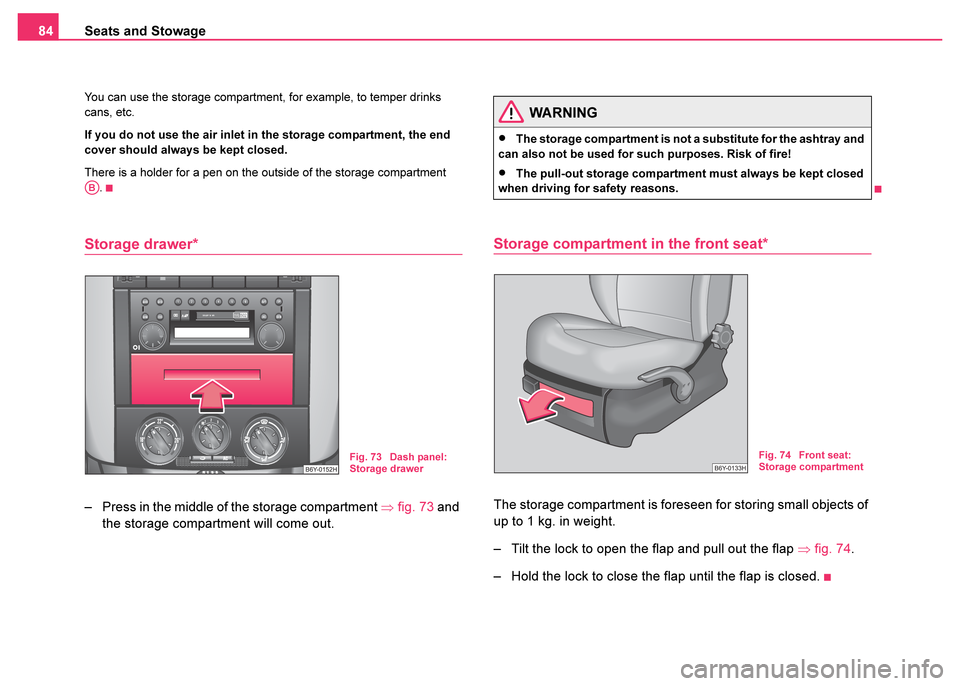
Storage drawer*
– Press in the middle of the storage compartment ⇒fig. 73 and
the storage compartment will come out.
Storage compartment in the front seat*
The storage compartment is foreseen for storing small objects of
up to 1 kg. in weight.
– Tilt the lock to open the flap and pull out the flap ⇒fig. 74 .
– Hold the lock to close the flap until the flap is closed.
AB
Fig. 73 Dash panel:
Storage drawer
WARNING
•The storage compartment is not a substitute for the ashtray and
can also not be used for such purposes. Risk of fire!
•The pull-out storage compartment must always be kept closed
when driving for safety reasons.
Fig. 74 Front seat:
Storage compartment
Page 96 of 233
Starting-off and Driving95
Using the systemSafetyDriving TipsGeneral MaintenanceBreakdown assist-
anceTechnical DataFabia Praktik
Starting-off and Driving
Setting steering wheel position*
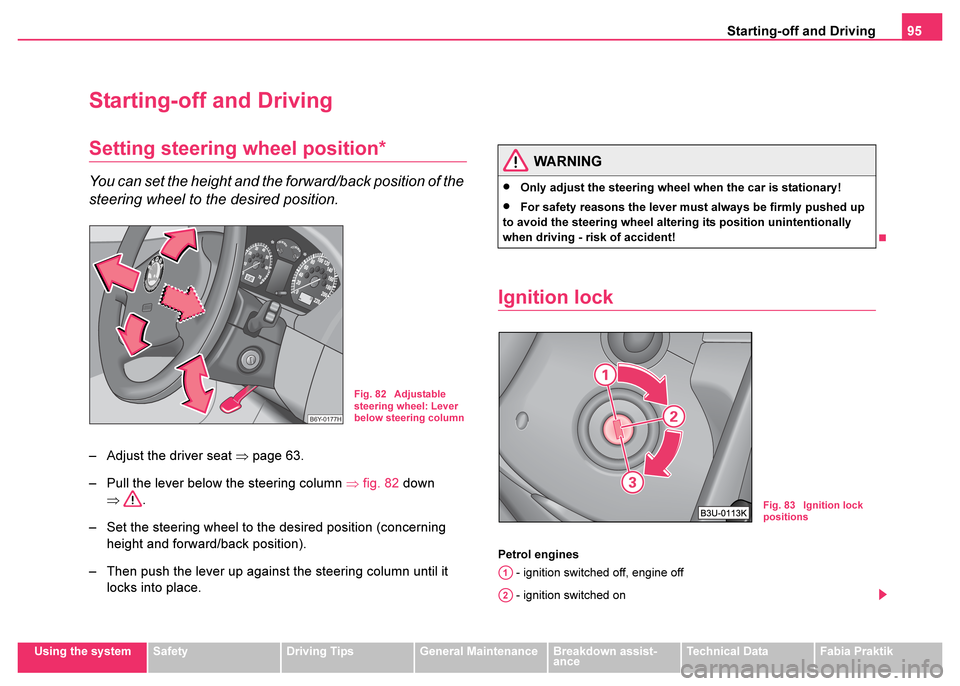
You can set the height and the forward/back position of the
steering wheel to the desired position.
– Adjust the driver seat ⇒page 63.
– Pull the lever below the steering column ⇒fig. 82 down
⇒ .
– Set the steering wheel to the desired position (concerning height and forward/back position).
– Then push the lever up against the steering column until it locks into place.
Ignition lock
Petrol engines
- ignition switched off, engine off
- ignition switched on
Fig. 82 Adjustable
steering wheel: Lever
below steering column
WARNING
•Only adjust the steering wheel when the car is stationary!
•For safety reasons the lever must always be firmly pushed up
to avoid the steering wheel altering its position unintentionally
when driving - risk of accident!
Fig. 83 Ignition lock
positions
A1
A2
Page 97 of 233

Starting-off and Driving
96
- start engine
Diesel engines - fuel supply interrupted, ignition switched off, engine off
- heating glow plugs on, ignition switched on
•You should not switch on any major electrical components during the
heating period otherwise the vehicle battery will be drained unnecessarily.
- start engine
Applies to all models:
Position
To lock the steering , with the ignition key withdrawn, turn the steering
wheel until the steering locking pin is heard to engage. You should always
lock the steering as a general rule if you leave your vehicle. This acts as
a deterrent against possible theft of your vehicle ⇒.
Position
Move the steering wheel back and forward a little if the ignition key cannot,
or cannot easily be turned into this position, in order to release the
steering lock.
Position
The engine is started in this position. At the same time switched on low
beam or main beam or other electrical components with major power
consumption are briefly switched off. The ignition key moves back into
position when one releases the key.
The ignition key must be turned back into position each time before
starting the engine again. The starter repeat lock in the ignition lock
prevents the starter being engaged when the engine is running and thus
getting damaged. Ignition key withdrawal lock (automatic gearbox)
You can only withdraw the ignition key after switching off the ignition if the
selector lever is in position
P.
Starting engine
General
You can only start the engine only using an original ignition
key.
•Place the gearshift lever into neutral (or place the selector lever to the
position P or N in the case of an automatic gearbox) and put on the hand-
brake firmly before starting the engine.
A3
A1
A2
A3
A1
A2
A3
A2
A1
WARNING
•When driving, the ignition key must always be in the position
(ignition switched on) without the engine running. This position is
indicated by the warning lights coming on. If this is not the case, it
could result in unexpected locking of the steering wheel - risk of
accident!
•Only remove the ignition key from the ignition lock when the
vehicle has come to a standstill (put on the handbrake or select the
selector lever position P). The steering lock might otherwise
engage unintentionally - risk of accident!
•Always withdraw the ignition key if you are going to leave the
vehicle, even for a short time. This is particularly important if chil-
dren are left in the vehicle. The children might otherwise start the
engine or operate electrical equipment (e.g. power windows) - risk
of injury!
A2
Page 100 of 233

Starting-off and Driving99
Using the systemSafetyDriving TipsGeneral MaintenanceBreakdown assist-
anceTechnical DataFabia Praktik
Note
One should not lay the hand on the shift lever while driving the vehicle.
The pressure of the hand will be transferred to the gearshift forks in the
gearbox. This can, over a period of time, lead to early wear of the gearshift
forks.
Handbrake
Applying the handbrake
– Pull the handbrake lever up fully.
Releasing the handbrake
– Pull the handbrake lever up slightly and at the same time
press in the locking button ⇒fig. 85 . – Hold the button pressed and push the handbrake lever down
fully ⇒ .
The handbrake warning light lights up when the handbrake is applied,
provided the ignition is on.
A warning signal (buzzer) sounds and the following text appears in the
display* if you have inadvertently driven off with the handbrake applied:
"Handbrake on"
The handbrake warning is activated if you drive at a speed of more than 6
km/h for more than 3 seconds.
Caution
After the car has come to a stop, always first of all apply the handbrake
firmly before then additionally engaging a gear (manual gearbox) or
moving the selector lever into position P (automatic gearbox).
Fig. 85 Centre
console: Handbrake
WARNING
•Please note that the handbrake must be fully released. A hand-
brake which is only partially released can result in the rear brakes
overheating which will have a negative effect on the operation of
the brake system - risk of accident!
•Never leave children unattended in the vehicle. The children
might, for example, release the handbrake or take the vehicle out
of gear. The vehicle might then move off - risk of accident!
Page 104 of 233

Automatic gearbox*103
Using the systemSafetyDriving TipsGeneral MaintenanceBreakdown assist-
anceTechnical DataFabia Praktik
Automatic gearbox*
4-speed automatic gearbox
Information for driving with an automatic gearbox
Shifting up and down through the gears is performed auto-
matically.
Starting-off and Driving
– Depress the brake pedal and hold it depressed.
– Press the Shiftlock button (button in handle of the selector
lever), move the selector lever into the desired position, e.g. D
⇒ page 104, fig. 87 , and then release the Shiftlock button.
– Wait a moment until the gearbox has shifted (a slight engage- ment nudge can be felt).
– Release the brake pedal and depress the accelerator ⇒.
Stopping for a short time
– The selector lever position N does not have to be selected
when stopping just for a short time, such as at a cross roads.
It is sufficient to hold the vehicle stationary using the foot
brake. The engine can, however, be allowed just to idle.
Parking
– Depress the brake pedal and hold it depressed.
– Apply the handbrake firmly. – Press and Shiftlock button in the selector lever, move the
selector lever to P and then release the Shiftlock button.
The engine can only be started when the selector lever is in position P or
N ⇒ page 96.
It is sufficient to engage selector lever position P when parking on a flat
surface. When parking on a slope you should first apply the handbrake
firmly and then move the selector lever into position P. This is to ensure
that there is no excessive pressure acting on the lock mechanism and that
it is easier to subsequently move the selector lever out of position P.
If the selector lever position N is selected by accident while driving it is first
necessary to release pressure on the accelerator pedal and wait for idling
speed of the engine to be reached before engaging a drive position in the
selector lever.
WARNING
•Do not depress the accelerator when changing the position of
the selector lever if the car is stationary and the engine is running
- risk of accident!
•Never move the selector lever into position R or P when driving
- risk of an accident!
•When the engine is running and the vehicle is stationary, it is
necessary to hold the car with the brake pedal in all the positions
of the selector lever (except P and N) since the power transmission
is never completely interrupted, also not when the engine is idling
- the vehicle "creeps".