2003 SKODA FABIA fold seats
[x] Cancel search: fold seatsPage 66 of 233

Seats and Stowage65
Using the systemSafetyDriving TipsGeneral MaintenanceBreakdown assist-
anceTechnical DataFabia Praktik
Head restraintsAdjusting the height of a head restraint
– Grasp the side of the head restraint with both hands and push
it up or down in direction of arrow ⇒fig. 44 . Best protection
is achieved if the top edge of the head restraint is at least at
eye level or higher.
Adjusting the angle of a head restraint*
– The head restraint can be matched to the head of the occu- pant by adjusting the angle in the direction of the arrow
⇒fig. 44 . Adjusting the angle of the head restraint provides
enhanced comfort for the user.
Removing and installing a head restraint
– Pull the head restraint up out of the backrest of the seat as far as the stop (on the rear head restraints fold down the seat
backrest).
– Press the locking button in direction of arrow ⇒fig. 45 and
pull the head restraint out.
– To re-insert the head restraint, push it down into the backrest of the seat far enough until you hear the locking button
engage.
The head restraints on the front seats can be adjusted for tipping angle*
and height. The outer head restraints are not adjustable for height. The
middle head restraints* can be adjusted to two settings ⇒page 66.
The head restraints must be adjusted to match the size of the seat occu-
pant. Correctly adjusted head restraints together with the seat belts offer
effective protection for the occupants.
Fig. 44 Adjusting head
restraint
Fig. 45 Removing a
head restraint
AA
AB
Page 68 of 233

Seats and Stowage67
Using the systemSafetyDriving TipsGeneral MaintenanceBreakdown assist-
anceTechnical DataFabia Praktik
Front seats
– Heating on the driver's ⇒page 66, fig. 47 and front
pasenger's seat can be switched on and regulated by turning
the control dial as required.
– The system is switched off by turning the control dial to the home position “0”.
Caution
•You should not kneel on the seats and avoid applying pressure at
specific points in order to avoid damaging the heating elements of the seat
heaters.
•Do not clean the seats moist ⇒page 164.
Note
The seat heating should only be switched on when the engine is running.
This has a significant effect of saving on the battery capacity.
Rear seats
Folding the rear seats forwards
Fig. 48 Folding the
rear seats forwards
Fig. 49 Unlock the seat
backrests
Page 69 of 233
Seats and Stowage
68
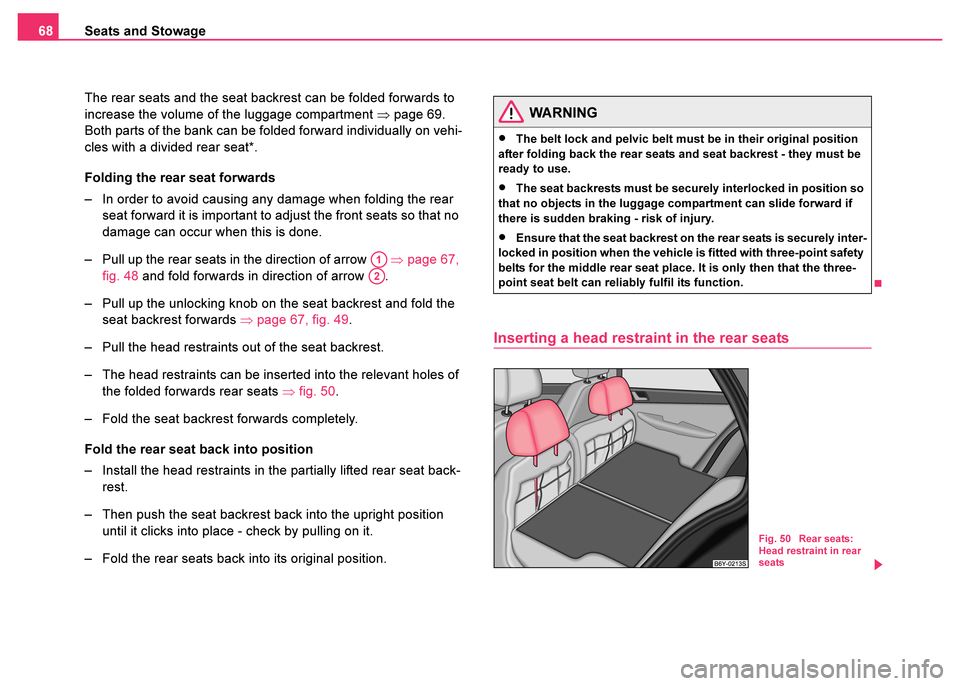
The rear seats and the seat backrest can be folded forwards to
increase the volume of the luggage compartment ⇒page 69.
Both parts of the bank can be folded forward individually on vehi-
cles with a divided rear seat*.
Folding the rear seat forwards
– In order to avoid causing any damage when folding the rear seat forward it is important to adjust the front seats so that no
damage can occur when this is done.
– Pull up the rear seats in the direction of arrow ⇒page 67,
fig. 48 and fold forwards in direction of arrow .
– Pull up the unlocking knob on the seat backrest and fold the seat backrest forwards ⇒page 67, fig. 49 .
– Pull the head restraints out of the seat backrest.
– The head restraints can be inserted into the relevant holes of the folded forwards rear seats ⇒fig. 50 .
– Fold the seat backrest forwards completely.
Fold the rear seat back into position
– Install the head restraints in the partially lifted rear seat back- rest.
– Then push the seat backrest back into the upright position until it clicks into place - check by pulling on it.
– Fold the rear seats back into its original position.
Inserting a head restraint in the rear seats
A1
A2
WARNING
•The belt lock and pelvic belt must be in their original position
after folding back the rear seats and seat backrest - they must be
ready to use.
•The seat backrests must be securely interlocked in position so
that no objects in the luggage compartment can slide forward if
there is sudden braking - risk of injury.
•Ensure that the seat backrest on the rear seats is securely inter-
locked in position when the vehicle is fitted with three-point safety
belts for the middle rear seat place. It is only then that the three-
point seat belt can reliably fulfil its function.
Fig. 50 Rear seats:
Head restraint in rear
seats
Page 70 of 233

Seats and Stowage69
Using the systemSafetyDriving TipsGeneral MaintenanceBreakdown assist-
anceTechnical DataFabia Praktik
– The rear head restraints can be inserted into the relevant
holes of the folded forwards rear seats.
Remove the rear seats
The luggage compar tment can be increased in size by removing
the rear seats
Removing
– Fold the rear seats forwards completely
– Press the wire clamp in the direction of the arrow ⇒fig. 51
and remove the rear seats from its holder.
Installing
– Press the wire clamp in the direction of the arrow and place the seat upholstery in its holder. – Fold the rear seats back into its original position.
Pedals
You should use only footmats which do not obstruct the movement of the
pedals and have an anti-slip protection.
Operation of the pedals must not be hindered!
Luggage compartment
Loading the luggage compartment
Please observe the following in the interest of having good
handling c
haracteristics of your vehicle:
Fig. 51 Remove the
rear seats
WARNING
•Greater pedal distances may be needed when there is a fault in
the brake system.
•Do not place any footmats or other additional floor coverings in
the area of the pedals in order to ensure that all the pedals can be
fully depressed and are able to return unobstructed to their initial
position - risk of accident!
•There must be no objects on the floor which could roll under the
pedals. You would then no longer be able to apply the brakes,
operate the clutch or accelerator - risk of accident!
Page 72 of 233

Seats and Stowage71
Using the systemSafetyDriving TipsGeneral MaintenanceBreakdown assist-
anceTechnical DataFabia Praktik
Folding double hooks*
Folding double hooks for attaching small items of luggage, such as bags
etc., are provided on both sides of the luggage compartment ⇒fig. 53 .
An item of luggage weighing up to 5 kg can be attached to each side of
the double hook.
Fixing of the floor covering of the luggage
compartment (estate car, sedan)
A hook is fixed to the loop in the floor covering of the luggage compart-
ment ⇒fig. 54 .
It is, where necessary, possible to fixed the raised floor cover to a section
of the tailgate using hooks as if one needs to have access to the spare
wheel.
Fig. 53 Luggage
compartment: Folding
luggage double hooks
Fig. 54 Luggage
compartment: Fixing of
the floor covering
Page 75 of 233
Seats and Stowage
74
Unrolling
– Fold the backrests of the rear seats slightly forwards ⇒page 67, which makes it possible to clear the access for
unrolling the net partition.
– Pull the net partition at the bracket out of the housing in direction of the holders ⇒page 73, fig. 57 .
– Insert the cross rod into one of the mounts and push the cross rod forward.
– In the same way, fix the cross rod to the other side of the vehicle, mount .
– Then push the seat backrest back into the upright position until it clicks into place - check by pulling on it ⇒.
Rolling up
– Pull the cross rod back slightly, first on the one side then on the other side and take the cross rod out of the mount
⇒page 73, fig. 58 .
– Hold the cross rod in such a way that the net partition can roll
up slowily and without damage into housing .
If you wish to use the entire luggage compartment, you can remove the
luggage compartment cover ⇒page 72, fig. 56 .
AAAB
AC
AC
AC
AC
AB
WARNING
•Ensure that the seat backrest on the rear seats is securely inter-
locked in position when the vehicle is fitted with three-point safety
belts for the middle rear seat place. It is only then that the three-
point seat belt can reliably fulfil its function.
•First check for yourself that the cross road is inserted into the
mounts in the front position!AC
Page 76 of 233

Seats and Stowage75
Using the systemSafetyDriving TipsGeneral MaintenanceBreakdown assist-
anceTechnical DataFabia Praktik
Use behind the front seats
Unrolling
– Fold the front seats forwards ⇒page 67. – Pull the net partiton net at the plate out of the housing
⇒fig. 59 .
– Insert the cross rod into the mount first on the one side and push the cross rod forward.
– In the same way, fix the cross rod to the other side of the vehicle, mount .
Rolling up
– Pull the cross rod back slightly, first on the one side then on the other side and take the cross rod out of the mount
⇒fig. 60 .
– Hold the cross rod in such a way that the net partition can roll
up slowily and without damage into housing .
– Fold the rear seats back into its original position.
Fig. 59 Unrolling net
partition
Fig. 60 Rolling up net
partition
WARNING
First check for yourself that the cross road is inserted into the
mounts in the front position!
AAAB
AC
AC
AC
AB
AC
Page 77 of 233

Seats and Stowage
76
Removing and installing net partition housing
Removing
– Fold the front seats forwards ⇒page 67.
– Open the right rear door.
– Push the net partition housing ⇒fig. 61 in the direction of
arrow and take it out of the mounts of the rear seat back-
rests in the direction of the arrow .
Installing
– Position the net partition housing into the mounts of the seat backrest.
– Push the net partition housing in the opposite direction of arrow as far as the stop.
– Fold the rear seats back into its original position.
The roof luggage rack system*
Description
Pay attention to the following points if you wish to transport luggage or
other items on the roof of your vehicle:
•A special roof luggage rack system was developed for the vehicle.
That is why you should only use one of the roof luggage rack which has
been released for use by Škoda Auto.
•The base carrier is the basis for a complete roof luggage rack system.
Separate additional holders are required for safety reasons for trans-
porting luggage, bikes, surfboards, skis and boats.
•The basic version of the roof luggage rack system and further compo-
nents are obtainable as accessories from Škoda dealers.
•The base carrier is fixed to the roof of the vehicle using special fixtures
which are located under the roof strip.
Caution
•If you use other roof rack systems or if the roof bars are not properly
fitted, then any damage which may result to your car is not covered by the
warranty agreements. It is therefore essential to pay attention to the fitting
instructions supplied with the roof luggage rack system.
•On models fitted with a power sliding/tilting roof, ensure that the
opened sliding/tilting roof does not strike any items of luggage transported
on the roof.
•Ensure that the opened tailgate does not collide with the roof load.
For the sake of the environment
The increased aerodynamic drag results in a higher fuel consumption.
One should therefore take off the roof bar system after use.
Fig. 61 Rear seats: Net
partition housing
AB
A1
A2
A1